





When OpenAI’s ChatGPT was released in 2022, there was widespread adoption of AI. People were genuinely curious if AI could write. In 2026, artificial intelligence can produce ad copy, reports, emails, and just about anything. But no matter how advanced the technology is, it is still missing a critical point: sounding human. It doesn’t have the emotional intelligence, lived experience, or cultural context you’ll find in human writing. As a result of this convergence, most people are stuck between when AI works best and where to draw the line. You’ll learn the real differences that affect outcomes. Most importantly, you’ll see when AI works best and where humans still outperform.
What Outcome Do You Need?
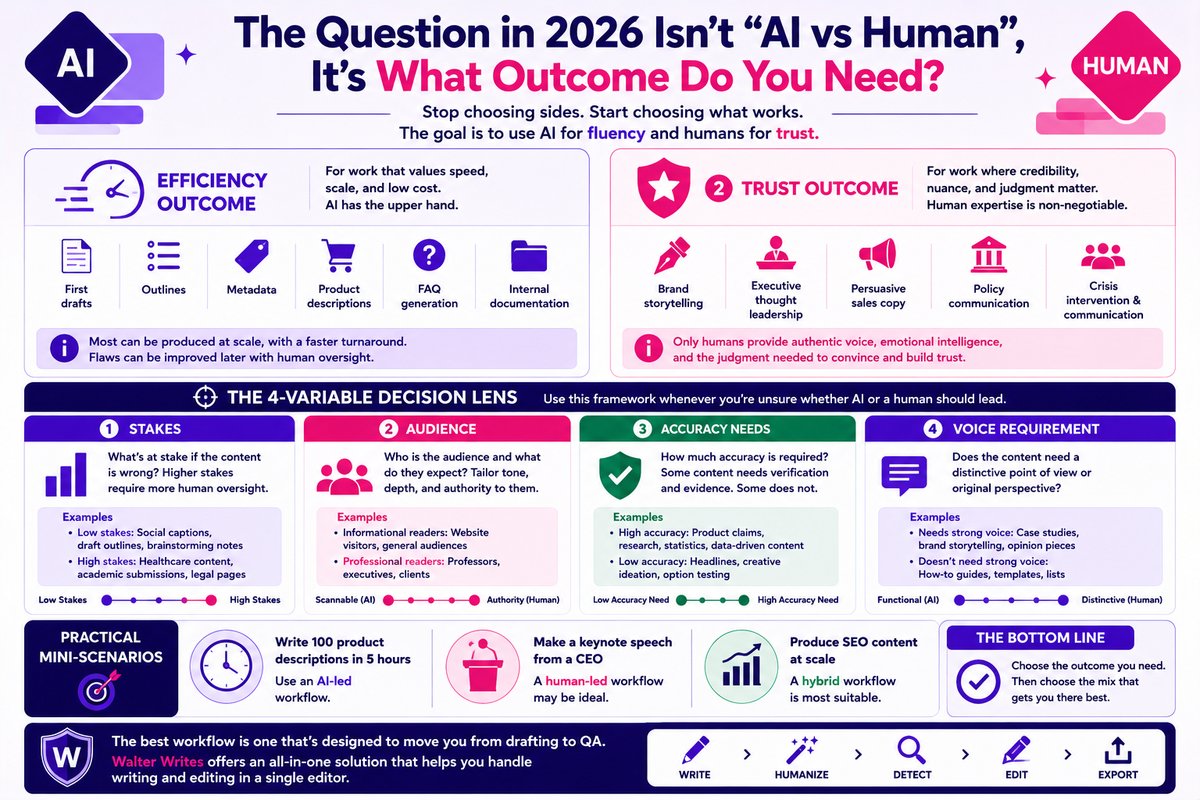
The “AI vs human” debate is stale in 2026. The wrong thing is to try to find the best of the two. Rather, you should adopt both and find where each one performs best. The goal you’re trying to achieve should also determine which one you go with in each case.
Two Competing Outcomes
Efficiency Outcome
In projects that require speed rather than uniqueness, AI has an upper hand. With AI, you can quickly generate a host of content types:
- First drafts
- Outlines
- Metadata
- Product descriptions
- FAQ generation
- Internal documentation
Most of these can be produced at scale, at a low cost, and with a faster turnaround. The gains are measured, not anecdotal: in a 2023 experiment published in Science, MIT economists gave writing tasks to 453 professionals and found ChatGPT cut average writing time by 40% while output quality rose 18%.
For most of these, you don’t need to dial in brand voice or flawless prose. They can even be improved later on in your workflow when you introduce human oversight.
Trust Outcome
In situations where credibility matters more than speed, human intervention is non-negotiable. Examples include:
- Brand storytelling
- Executive thought leadership
- Persuasive sales copy
- Policy communication
- Crisis intervention and communication
Only human writing can provide an authentic voice, a stronger connection with the audience, and the judgment needed to convince.
The goal is to use AI for fluency and humans for trust. As long as you can differentiate between the two, integrating either should be smooth.
The 4-Variable Decision Lens
Whenever you’re unable to decide when AI or a human should lead, then you should use this decision framework.
Variable 1: Stakes
Before drafting any text, decide on what’s at stake. If the content is wrong, what could be the consequences? For example, social captions, draft outlines, brainstorming notes, have low stakes. There aren’t any major repercussions to going wrong there. But if you’re dealing with healthcare content, academic submissions, legal pages, mistakes can have grave consequences. The higher the stakes, the more human oversight is required.
Variable 2: Audience
Your audience and what they expect can sometimes influence the content production process. If you’re creating website content, you may not worry too much about branding. Your readers want information they can scan and move on. But when you’re writing for professors, executives, or clients, you may need to dial up the credibility and polish your tone to match their high standards of professionalism. Tailoring your blog post to different audiences requires a strategic shift in your approach. With professionals, you should be building authority (human content). For website content, for example, you may just need to make the content scannable (AI content).
Variable 3: Accuracy Needs
Some content requires high accuracy. Product claims, research summaries, statistics would require that you verify every fact to ensure the information you’re passing is trustworthy. Others may not be as sensitive. For example, headline testing and creative ideation don’t have any verification burden. Your goal is to get them down quickly and compare later.
Variable 4: Voice Requirement
Ask yourself, does the content need a distinctive view? If yes, choose a human to craft the text. If no, then let AI handle it. Examples of content needing a strong voice include case studies, brand storytelling, and opinion pieces. While AI can handle these, it may not sound as sharp or specific as when a human writes them.
Practical Mini-Scenarios
- Write 100 product descriptions in 5 hours (use AI-led workflow)
- Make a keynote speech from a CEO (a human-led workflow may be ideal)
- Produce SEO content at scale (a hybrid workflow is most suitable)
The best workflow is one that’s designed to move you from drafting to QA. Walter Writes offers an excellent solution that helps you handle writing and editing in a single editor.
AI Writing vs Human Writing: The 6 Differences That Change Results
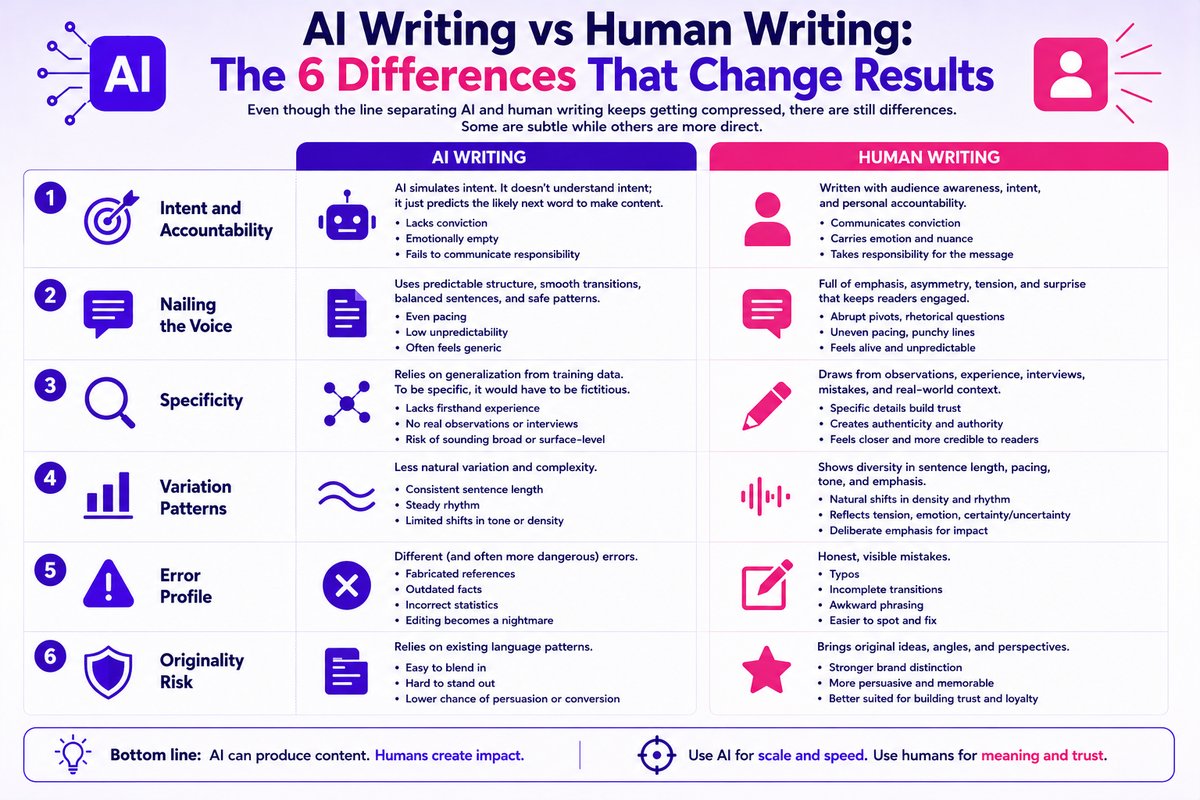
Even though the line separating AI and human writing keeps getting compressed, there are still differences. Some are subtle while others are more direct.
Intent and Accountability
When humans write, they do so with audience awareness and inten. Unlike humans, AI needs to simulate intent. It doesn’t understand intent; it just predicts the likely next word to make content. Because of this absence of intent, AI produces content that lacks conviction, is emotionally empty, and fails to communicate responsibility. That’s why some content remains the domain of humans, as AI cannot handle it.
Nailing the Voice
Human-written content is full of emphasis, asymmetry, tension. These can keep readers on their toes and in suspense. Although AI is beginning to catch up, it still cannot handle creative writing as a human would. Some traits that still separate human writing from AI include abrupt pivots, rhetorical questions, uneven pacing, and punchy lines that make content unpredictable. This is in sharp contrast to AI content. AI often tries to use predictable structure, smooth transitions, balanced sentences.
Specificity
When writing, humans can draw from observations, firsthand experience, interviews, mistakes, which makes the content unique. This specificity creates trust and makes an entity closer to readers. AI doesn’t have these advantages. Instead, it only depends on generalization. For AI to implement this, it would have to be fictitious. And that can have the opposite of the intended - loss of trust. If you’re writing content that depends on trust and authority, you should let a human handle it.
Variation Patterns
Reviewing human content will reveal a diversity in sentence length and pacing. Tension, certainty or uncertainty, emotion drive human writing. That’s why there are sometimes shifts in density or deliberate emphasis to drive home a particular point. AI doesn’t have this complexity, though; it can sometimes be forced. But it will never get the same naturalness as the former.
Error Profile
Mistakes happen in writing. Human drafts, even after editing, can have typos, incomplete transitions, and sometimes awkward phrasing. These are visible errors that can be spotted right away. However, AI writing faces a different issue. It often makes fabricated references, outdated facts, or incorrect statistics. These are often more dangerous than the honest mistakes found in human writing. Some studies have found that AI can save writing time, but it makes editing a nightmare. This is one of the reasons this happens.
Originality Risk
In some industries, such as SEO, editorial content, and newsletters, originality matters. Using AI to make such content may cause problems. This is because AI relies on existing language patterns. So, it’s easy to misplace priorities.
If you produce marketing content with AI, for example, it may not convert well. A 2025 Gartner survey found 53% of consumers distrust AI-powered search results and summaries, so content that reads as machine-made starts from a trust deficit. Such content may also seem as though they are not persuasive enough. If you want to create a solid distinction, especially when building a brand, you may still need human intervention.
AI vs Human Writing Samples
Reading both side by side beats any description of the difference, so we ran the experiment ourselves. In 2026, our team at Walter Writes built a seven-sample stress test: raw ChatGPT output with no editing on one side, verified human writing with documented provenance on the other. We pasted every sample into Grammarly, GPTZero, and our own Walter Writes detector under identical conditions, same account, same format, screenshots recorded after each run. The pairs and scores below come straight from that test, so the numbers belong to the exact texts you’re reading. Complete methodologies are available in our articles on the Grammarly Detector Review and the GPTZero Detector Review.
Example 1: Marketing Copy (LinkedIn Post)
The AI version [Transforming Content Marketing]
The tell starts in the title. “Transforming” is a word AI reaches for constantly and working marketers almost never do. The post makes claims without a single number and addresses nobody in particular.
The human version [Is It OK to Publish Late?]
A real question from a real situation. The writer has a specific problem, takes a position on it, and risks being wrong.
What the detectors saw
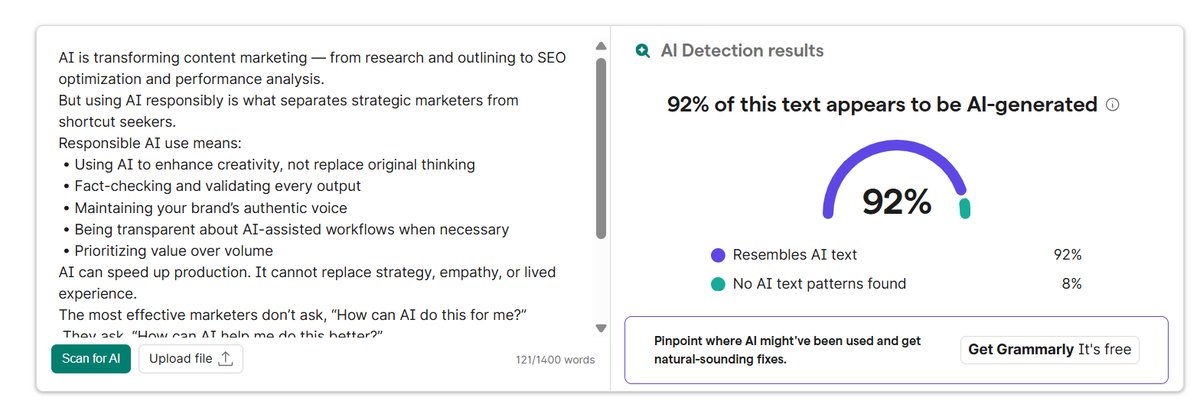
When we ran this AI post through both tools, Grammarly scored it 92% AI:
And GPTZero scored it 4%:
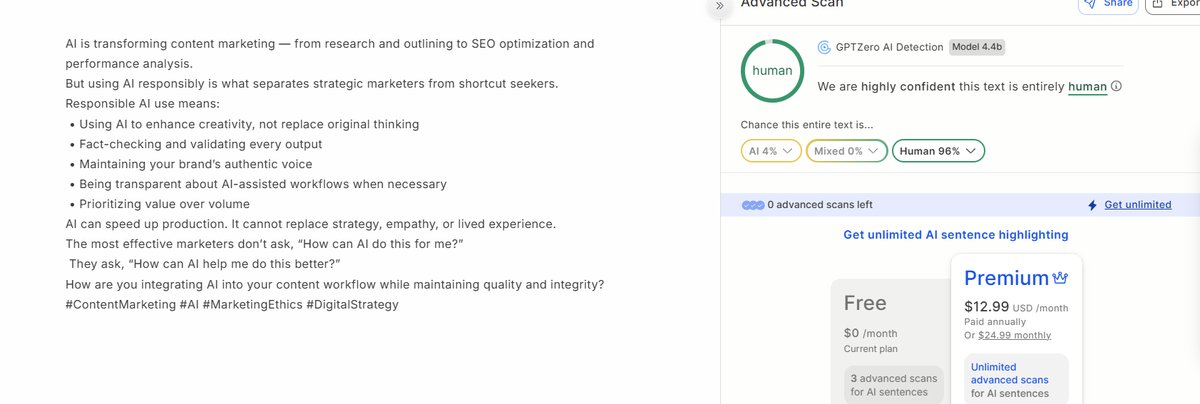
Identical text, an 88-point gap. GPTZero loses signal on short-form content, which is worth remembering before you trust any single score on a social post.
The takeaway for marketers
For volume formats where nobody expects a person behind the words, an AI draft with a quick review is enough. The moment a post trades on experience, treat the draft as a frame: add your own numbers and the thing that went wrong last week, because that’s what readers came for: your own human experience.
Example 2: Student Essay
The AI version [The Impact of Artificial Intelligence on Academic Integrity]
Balanced wording, academic cadence, and a thesis that offends no one. Every paragraph carries the same rhythm, and the argument never commits hard enough to need defending. Professors describe this quality as “competent and empty,” and it’s the most common giveaway in AI coursework.
The human version [Is Google making us Stupid?]
Carr opens with himself: his own attention span, his own struggle with long reading. The essay’s argument grows out of a firsthand complaint and picks fights with named sources. That chain of personal observation into researched claim is what an essay grade actually measures; AI can’t supply this.
What the detectors saw
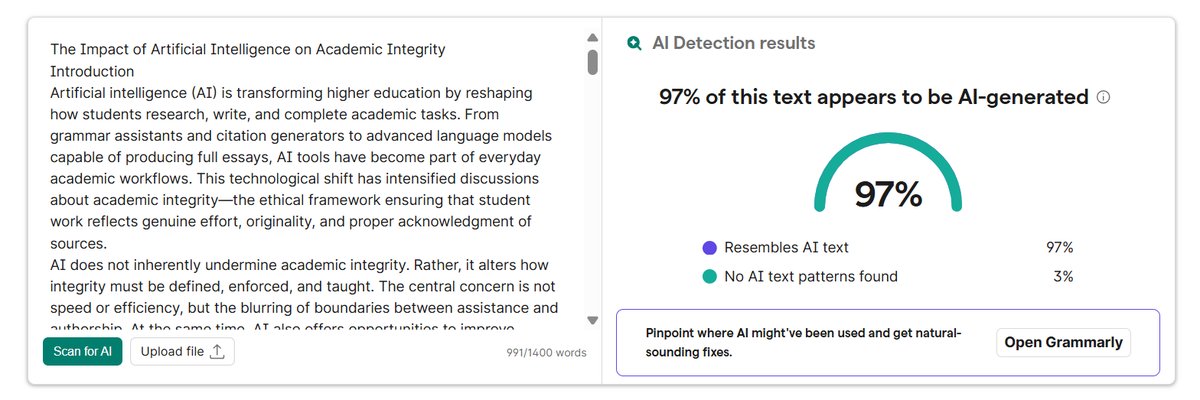
In our test, Grammarly caught the raw AI essay at 97%:
And GPTZero is moderately confident it is AI:
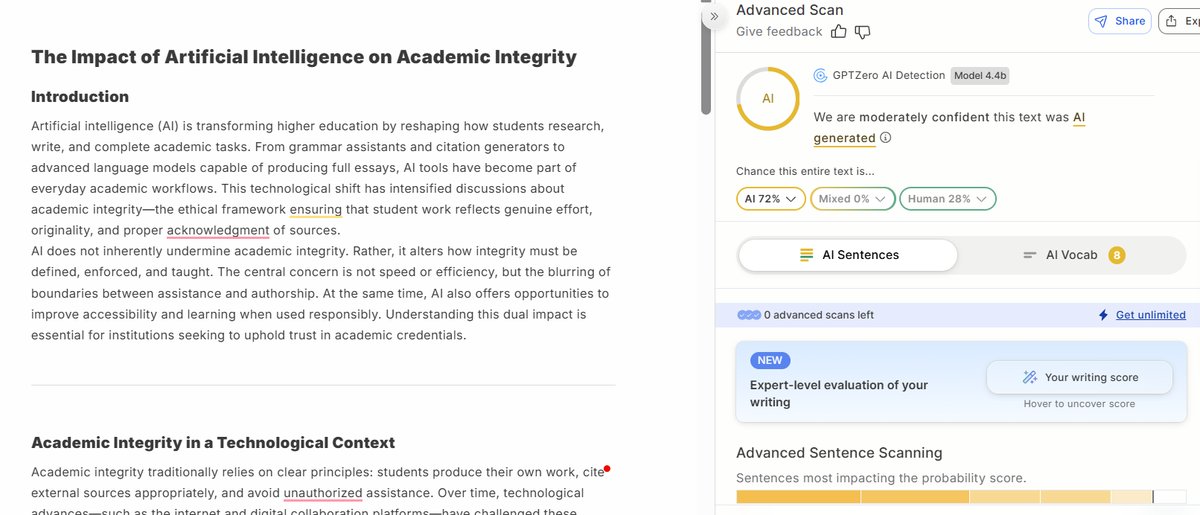
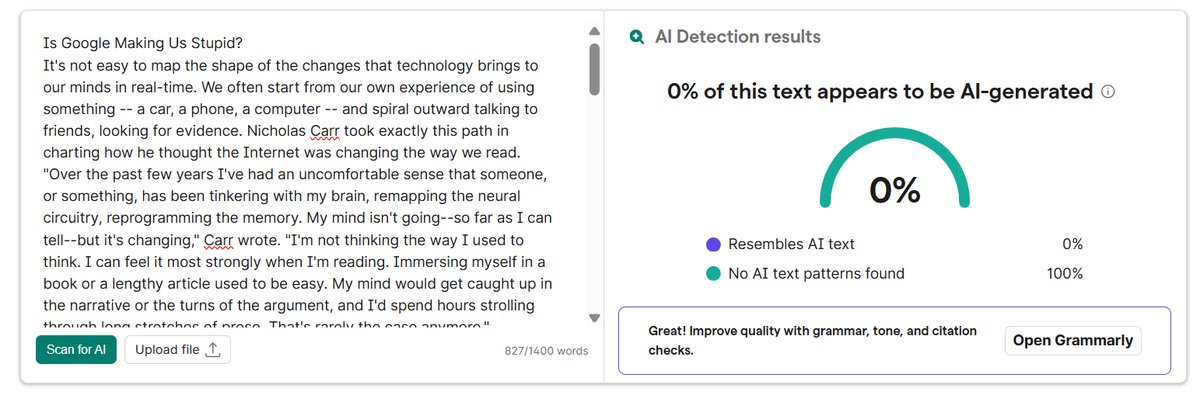
Both detectors scored the human essay at 0% AI. That second number should reassure students worried about false flags on genuine work: across all seven of our samples, neither tool flagged a single piece of clean human writing.
The takeaway for students
AI helps with outlines and summaries of sources. The thesis and the reasoning need to be yours, both because that’s the assignment and because raw AI prose in formal formats is exactly what detectors catch best.
Can AI Match the Quality of Human Writing?
Yes, but not always. AI content is more suitable when a writing task is predictable and low-risk. You can generate product descriptions, FAQs, SEO outlines, and metadata with AI. These content types are needed for scaling and are often repeated. Content like policy writing, legal disclaimers, executive messaging, should be human-led. They need more than just smooth prose. They require judgment, expertise, and persuasion, which can only be obtained from humans. It’s clear that both AI and human writing have their place.
Can AI Writing Pass AI Detection Tools?
Yes, AI content can pass detection tools, especially after editing or paraphrasing. As a company that runs a detection platform, we advise against optimizing for detection bypass. Your goal should be accuracy, originality, transparency, and policy compliance (especially if you’re a student). Detector scores are just probabilistic estimates. They are not supposed to affect decisions with grave consequences.
For Students
When you’re writing assignments, focus on citations, research notes, factual data, and a consistent voice. This might be flagged, but you’ll have peace of mind that your work is original.
For Businesses and Marketers
Your goal is to develop a workflow that includes fact verification, editorial review, and brand protection. These are more important than worrying about detector scores.
If You Must Check
Detectors can still be useful. You can use them for quality assurance or authentication. For authentication, always use at least two detectors. If you get similar results in both, you’re assured that you need to change something in the content. Otherwise, you can ignore the score. Popular options you can choose from are Walter Writes AI detector, Turnitin, GPTZero, and Copyleaks.
When Should You Use AI Writing vs Hire a Human Writer?
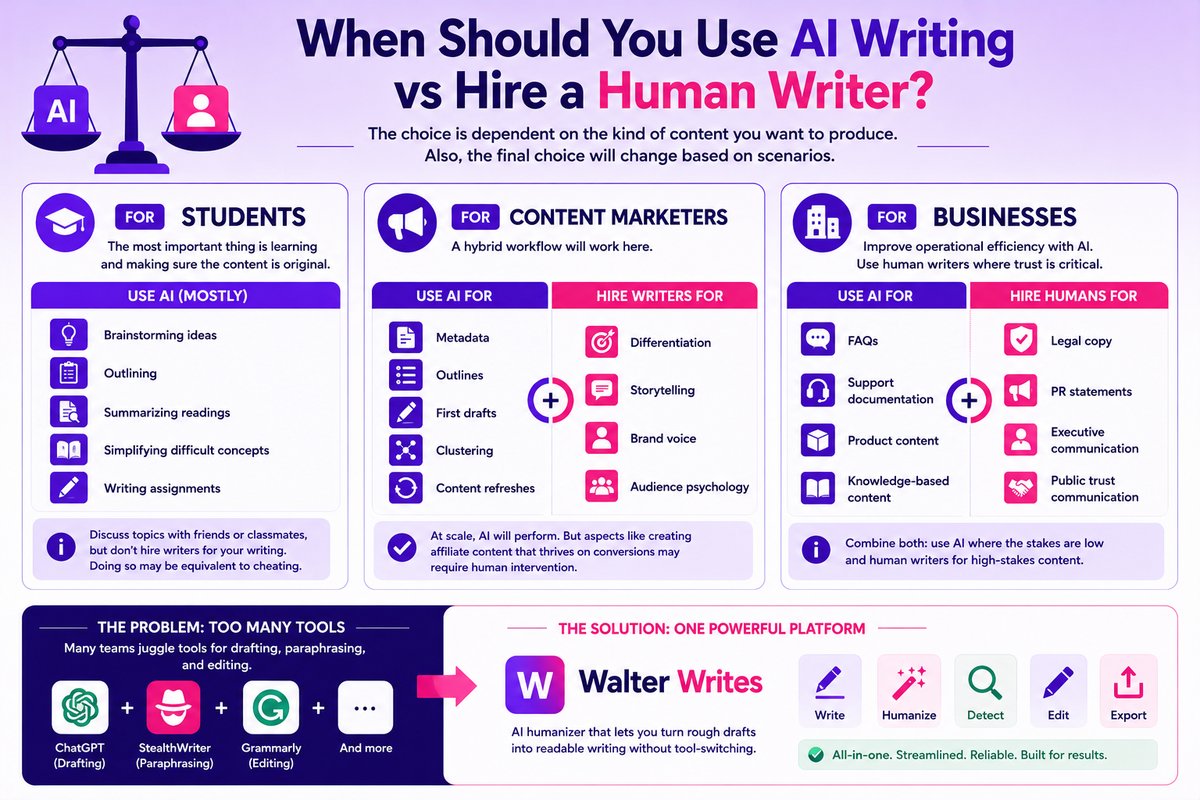
The choice is dependent on the kind of content you want to produce. Also, the final choice will change depending on the scenario.
For Students
The most important thing is learning and making sure the content is original. In this case, AI is most suitable. Why? You can use AI for brainstorming, outlining, summarizing, and simplifying difficult concepts. You’ll also be using it mostly when doing writing assignments. You can discuss topics with friends or classmates, but you wouldn’t need to hire writers for your writing. Doing so may be equivalent to cheating.
For Content Marketers
A hybrid workflow will work here. As a marketer, you can use AI to make metadata, outlines, first drafts, clustering, and even content refreshes. You can hire writers to help you with differentiation, storytelling, brand voice, and audience psychology. At scale, AI will perform. But certainly, aspects like creating affiliate content that thrives on conversions may require human intervention.
For Businesses
Businesses can use AI to improve operational efficiency. It can help with FAQs, support documentation, product, and knowledge-based content. For content that requires high levels of accuracy or dealing with public trust, human trust matters. You can combine both by using AI where the stakes are low and human writers for high-stakes concepts. Examples include legal copy, PR statements, executive communication.
Many teams juggle tools for drafting, paraphrasing, and editing. A team may subscribe to ChatGPT for drafting, StealthWriter for paraphrasing, Grammarly for editing, and so on. But the best is to use a multiple-purpose tool that removes friction and fragmented workflow. Walter Writes AI humanizer lets you turn rough drafts into readable writing without tool-switching.
Frequently Asked Questions
What Are the Main Differences Between AI Writing and Human Writing?
Human writing is more accurate, original, and backed with lived experience to build persuasion and trust. AI writing may be more polished, but generic and repetitive, and often optimized for fluency.
Can AI Writing Match the Quality of Human Writing?
Sometimes, under specific conditions. If the format is structured and the topic is low-risk, then AI can perform well. However, human writing still owns original thinking, emotional persuasion, and judgment.
How Can You Tell If Content Was Written By AI or a Human?
There are familiar cues that can give away the content. Repetition, smooth transitions, generic examples, are patterns that indicate content is written by AI. Personal experience, specific descriptions, lived experience, and occasional quirks, are what separate human writing.
What Does Perplexity and Burstiness Mean in AI vs Human Writing?
Perplexity measures how predictive the language feels, while burstiness is associated with the variance in sentence length and structure.
Is AI Writing Better Than Human Writing for SEO?
It depends. If there is a system in place to create, scale, and update content without compromising quality, using AI may be ideal. But where there is a need for originality, first-hand experience, or trustworthiness, human intervention may be more valuable.
Will AI Ever Fully Replace Human Writers?
No, not possible with writing requiring trust. While AI may automate content production, it cannot scale strategy, and persuasion. A combo of both works best in most situations.
What Are the Advantages of Human Writing That AI Can’t Replicate?
It’s hard for AI to replace lived experience, personal conviction, ethical judgment, emotional memory, or cultural context. Some writing requires more than just polished wording to drive the points home.
Can AI Writing Pass AI Detection Tools?
Yes, it’s possible.
When Should You Use AI Writing vs Hire a Human Writer?
When speed matters or budgets are tight. Also, if the content can be replicated quickly without loss of quality, then it may be worth using AI writing.
What Are the Ethical Concerns Around Publishing AI-Generated Content?
Common concerns include factual inaccuracies, citation problems, plagiarism.