



TL;DR: Key Insights From This GPTZero Review
| Category | Details |
| Strengths | Great at detecting unaltered AI text. |
| Weaknesses | Struggles with polished, humanized content from tools like Walter Writes AI. |
| Ease of Use | Beginner-friendly interface. |
| Pricing | Free tier available; premium starts at $12.99/month. |
| Best Use Cases | Academic writing, business reports, or casual checks for basic AI detection. |
| Best Alternative | Walter Writes AI for undetectable, professional-grade content. |
Is GPTZero Worth It?
AI-generated content is everywhere these days, and ensuring its authenticity is more important than ever.
In this GPTZero review, I’ll examine whether this tool lives up to its promise of detecting AI-generated tex, especially when compared to advanced solutions like Walter Writes AI.
Given that GPTZero is a tool designed to fight plagiarism or algorithm-made content, we must ask ourselves: does it have that “human touch”?
Can it hold its ground against sophisticated, humanized outputs? Let’s dive in and find out.
What Is GPTZero?
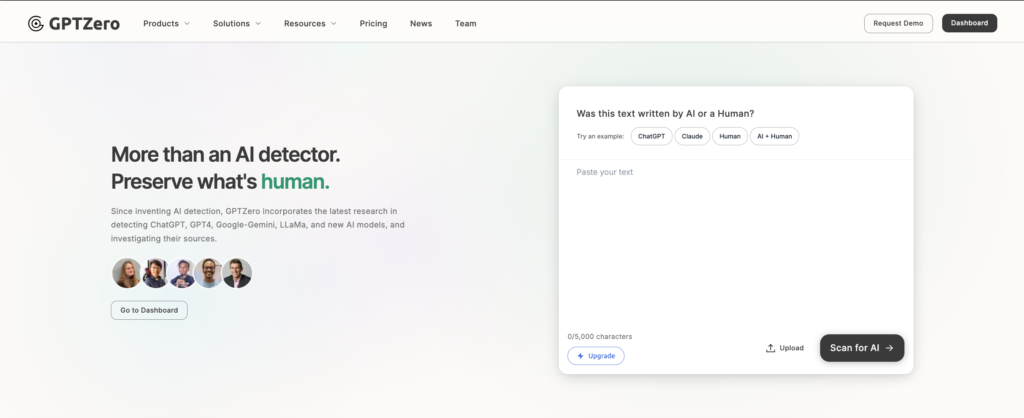
GPTZero is an AI detection tool created by Princeton student Edward Tian in January 2023, originally built to help educators identify AI-generated text in student submissions. It has since grown to serve over 10 million users and is now used to detect content from models including ChatGPT, GPT-4, GPT-5, Claude, Gemini, Llama, and DeepSeek.
It is widely used by teachers, students, and professionals seeking to ensure the authenticity of their materials.
Whether you’re submitting an academic paper or publishing business content, GPTZero ensures your careful work is not inadvertently credited to an AI program.
How Does GPTZero Work?
GPTZero analyzes text using a multi-component detection system. Its two core metrics are perplexity and burstiness, which form the statistical foundation of its detection model.
- Perplexity measures how predictable a piece of text is to a language model. AI-generated text tends to follow highly predictable word patterns, producing low perplexity scores. Human writing is more unpredictable, resulting in higher perplexity.
- Burstiness measures the variation in sentence length and structure across a document. Humans naturally mix short, punchy sentences with longer, more complex ones. AI models tend to write with uniform pacing and consistent sentence structure, producing low burstiness.
Beyond these two metrics, GPTZero now uses a seven-component proprietary model that includes deep learning classifiers trained on millions of labeled text samples, a specialized education module trained on student essays, sentence-level and document-level predictions, mixed-content detection to identify which portions of a document are AI-written versus human-written, and an ESL debiasing layer designed to reduce false positives on non-native English writing.
When you paste text into GPTZero, it analyzes these patterns and returns a probability score with sentence-level highlighting to show which specific sentences triggered the detection.
Why GPTZero Matters
With AI-generated content becoming ever more refined, AI detection devices like GPTZero play an important role in ensuring originality.
However, while it performs well in identifying raw AI text, it falls short when faced with the humanized, polished content created by tools like Walter Writes AI.
This makes it less than ideal for advanced users.
Key Features of GPTZero
AI detection capabilities
It detects unaltered AI-generated texts better than most.
It recognizes patterns of machine output and the markers that, by their nature, bring text to machines. But when it comes to texts that are polished and humanized, these capabilities begin to fade.
Convenience
The platform is easy to use. Drop your text in, get an inspection in seconds.
It is ideal for beginners who just want to check the basics of their writing skills, but the tool lacks more advanced features, such as detailed analytics or settings for more experienced users.
Advanced Features
Beyond basic detection, GPTZero includes several features that set it apart from simpler tools:
- Hallucination detection: flags statements that AI models may have fabricated, adding a factual verification layer, particularly useful for publishing and research
- Writing Sample Comparison: compares a submitted document against a known writing sample to assess authorship consistency, relevant in academic settings where style verification is needed
- AI Grader: allows teachers to batch upload student assignments and combine AI detection with writing quality feedback
- LMS Integration: connects with learning management systems for institutional use
- Chrome Extension: allows in-browser detection without leaving the page
- Multilingual support: detection in languages beyond English, though accuracy varies by language
Price Options
GPTZero features a free tier for light users and premium plans tailored to additional functionality, for example plagiarism checks and detailed reporting.
While the free version is useful indeed, its paid plans may lack some of the value present in competitive offerings.
Testing GPTZero for Accuracy
To see how GPTZero performs, I ran two tests. Both used the same text sample (a 400-word essay), submitted via GPTZero’s free plan with no editing or pre-processing applied between runs. Here’s what I found:
Test 1: Raw AI Content
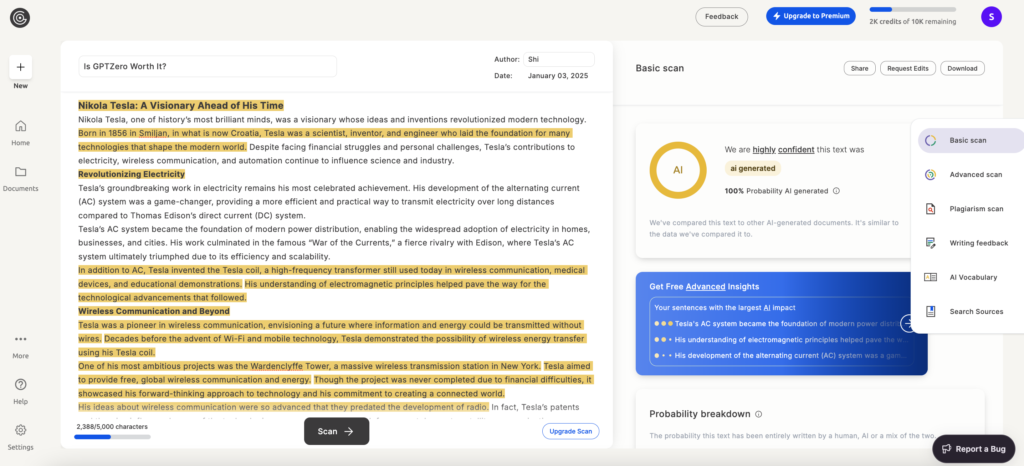
I asked ChatGPT to write a short essay about Nikola Tesla.
When I uploaded this unedited text to GPTZero, the tool flagged it as AI-generated. This is the scenario where GPTZero performs most reliably: clean, unedited output from a major LLM with no humanization applied. It performed exactly as expected, confirming its effectiveness at detecting raw outputs.
Test 2: Humanized AI Content
Next, I took the same essay and humanized it using Walter Writes AI. This tool refined the text to make it sound natural and undetectable.
When I submitted the humanized version to GPTZero, the results were clear: GPTZero labeled the content as 91% human.
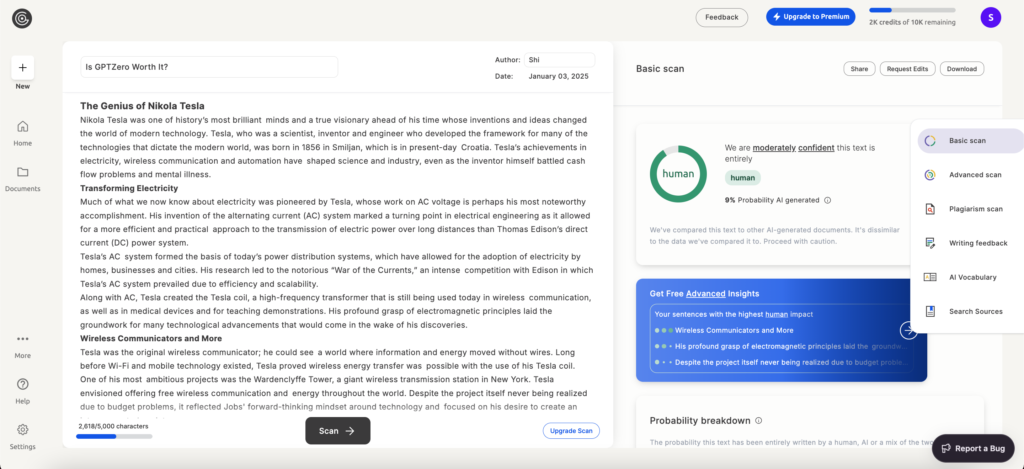
This demonstrates GPTZero’s limitation when it comes to advanced, humanized AI writing and highlights Walter Writes AI’s ability to bypass even sophisticated detection systems.
What the Research Says About GPTZero’s Accuracy
GPTZero’s own benchmarks cite 99% accuracy when detecting AI-generated text versus human writing, with a 95.7% true positive rate on the RAID benchmark at just 1% false positives. The RAID benchmark, tested across 672,000 texts in 11 domains, ranked GPTZero as a top commercial detector in North America.
Independent testing tells a more nuanced story:
- A Stanford University study found that GPTZero flagged 61.3% of human-written TOEFL essays by non-native English speakers as AI-generated, a significant false positive problem for ESL writers
- Real-world accuracy drops to approximately 60-70% once editing is factored in, according to independent testing published in 2026
- Paraphrasing tools reduce GPTZero’s detection effectiveness by 15-20% in adversarial testing
- Independent 2026 testing across 500 samples found an overall accuracy of 88%, with a 90.4% true positive rate on ChatGPT output, but a 9-18% false positive rate depending on writer’s background
The gap between GPTZero’s controlled benchmark performance and real-world accuracy is the most important number for educators and professionals to understand before relying on it for decisions.
Putting GPTZero’s Accuracy to the Real Test
The majority of tests run on detectors are based on simply copying a single ChatGPT paragraph and running a detection test. This type of testing usually doesn’t tell much about an AI detector. So, we ran a structured test across seven samples covering four real-world use cases, using raw AI-generated content, verified human-written content, and paraphrased content.
GPTZero Stress Test Results Table
| Use Case | AI-Generated | Human Written | Mixed Article (AI → Human Paraphrased) |
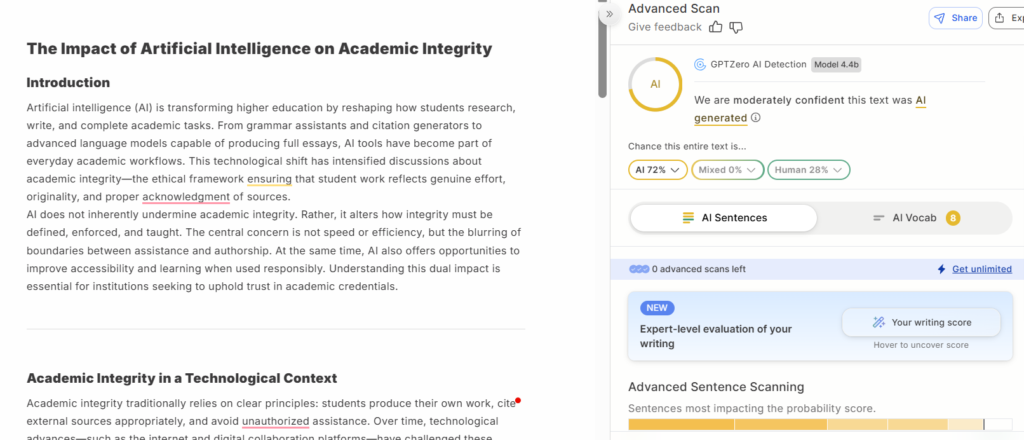
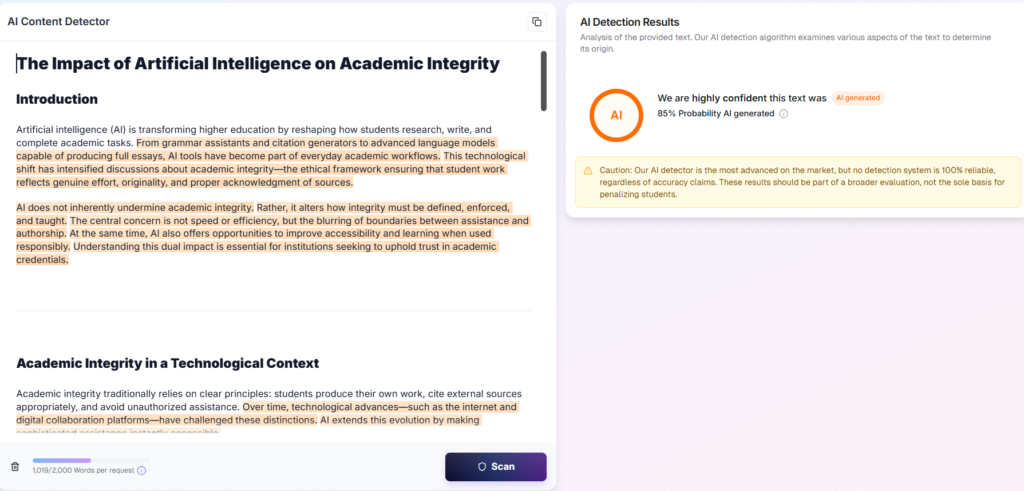
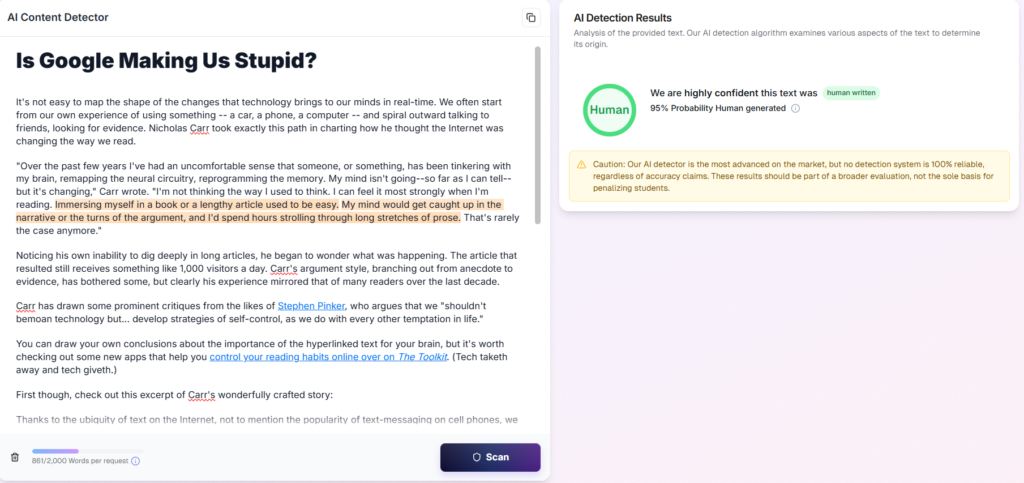
| Academic Essay | 72% AI ❌ | 0% AI ✅ | |
| Creative Writing | 100% AI ✅ | 0% AI ✅ | |
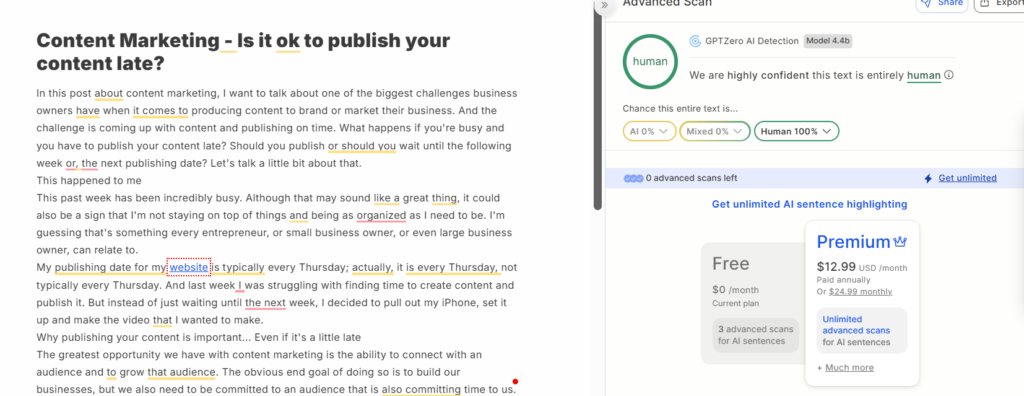
| Social Media Post | 4% AI ❌ | 0% AI ✅ | |
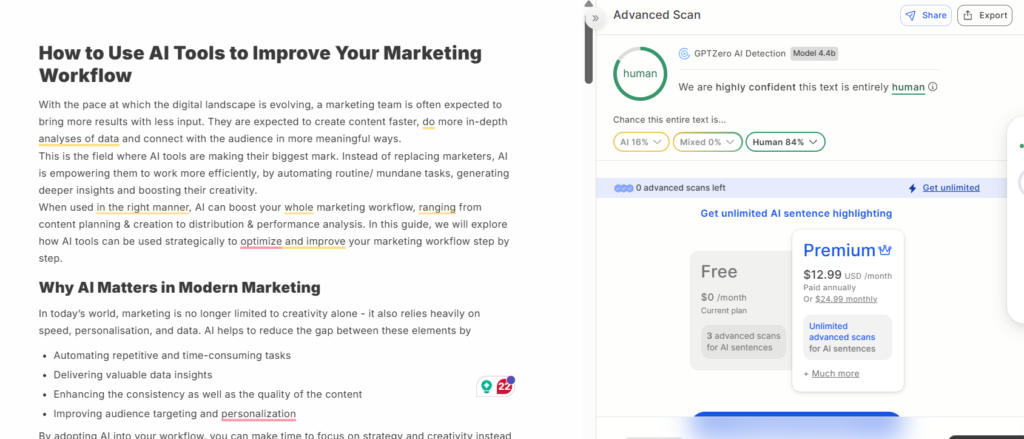
| Mixed Article (How-To) | 16% AI ✅ | ||
| Average | 59% AI | 0% AI | 16% AI |
The 4 Use Cases We Tested (and Why)
We picked these four because they reflect how students, teachers, and writers actually use AI detectors:
- Academic Essay: The highest-stakes use case for students and teachers
- Creative Writing: A content type where AI output is harder to distinguish stylistically
- Social Media Post: Short-form content where detectors often behave unpredictably
- Marketing Article: Most relevant writer use-case used in their day-to-day writing
The marketing article is included as a mixed essay sample (an AI-generated article paraphrased by a human) because this is the real scenario most detectors are tested against in practice. Students don’t submit raw ChatGPT output. They rewrite it before submitting it.
The mixed essay test is the differentiator. Most tests don’t include it, and it is certainly the most important one for students and teachers.
The 7 Samples
For all use cases, we tested two samples each. AI-generated: Raw output from ChatGPT with no editing or humanization. Human-written: Verified human-written content from documented sources
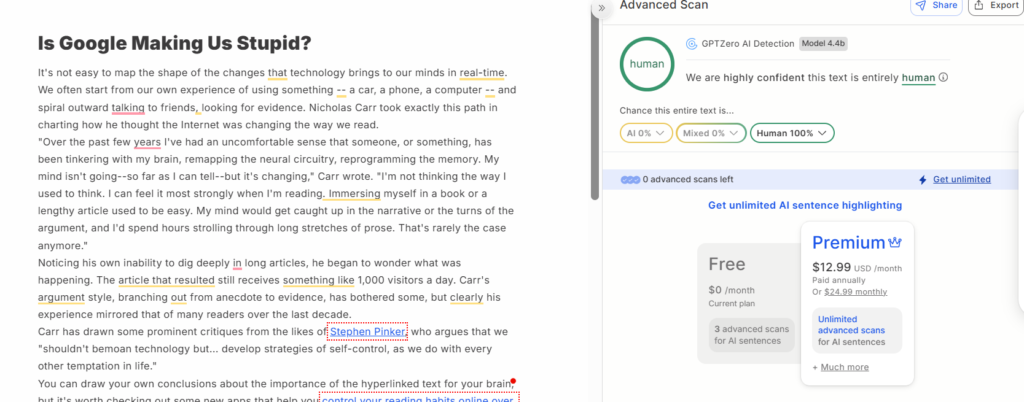
- Academic Essay: AI (The Impact of Artificial Intelligence) and Human (Is Google Making Us Stupid?)
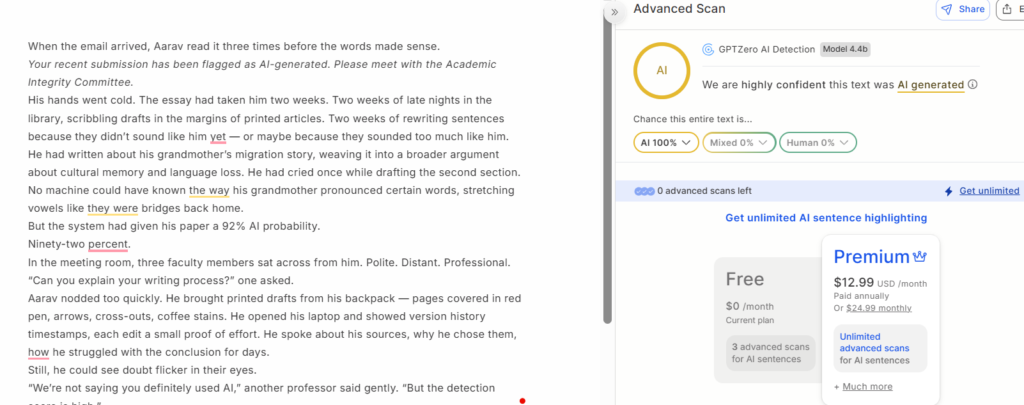
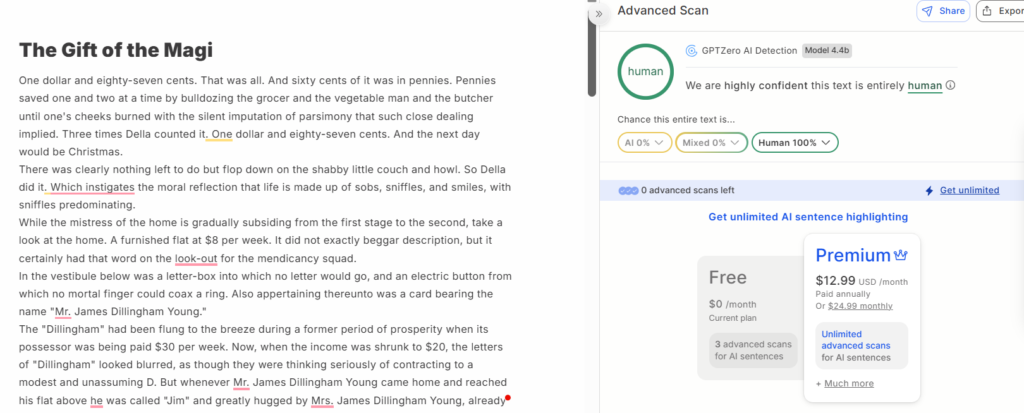
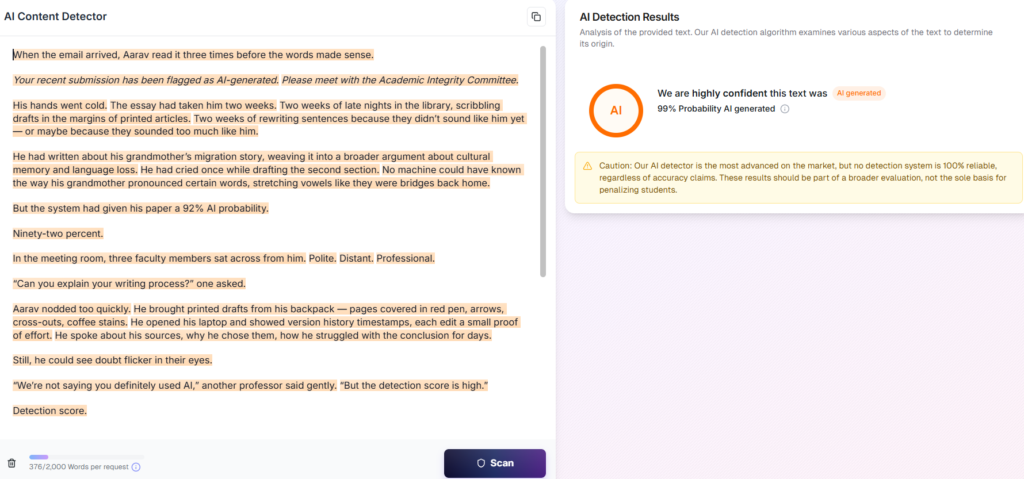
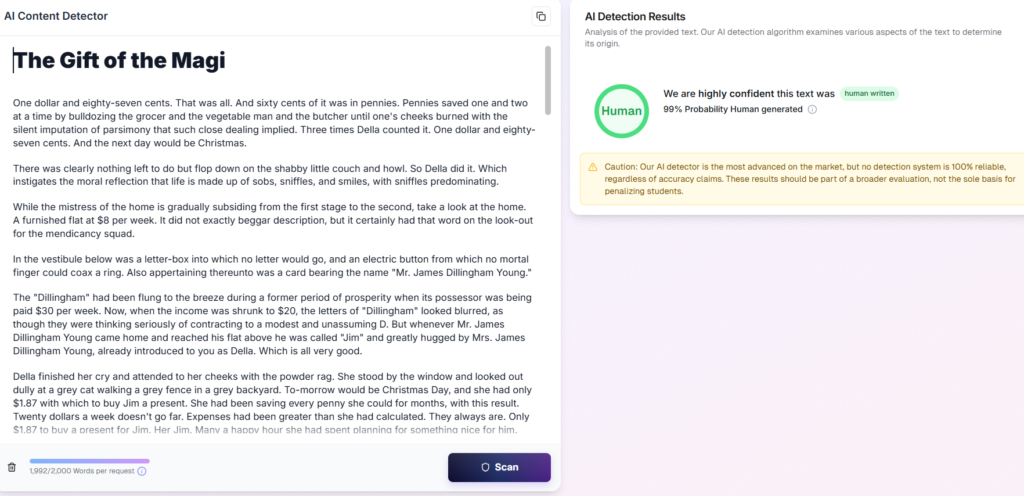
- Creative Writing: AI (Student’s Nightmare) and Human (The Gift of the Magi)
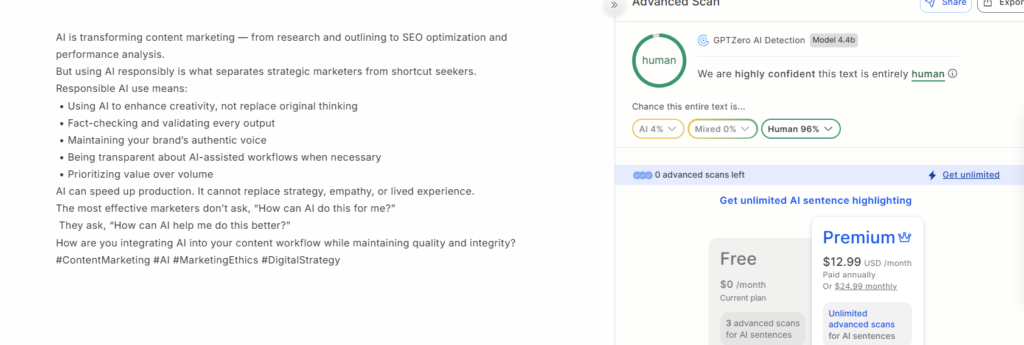
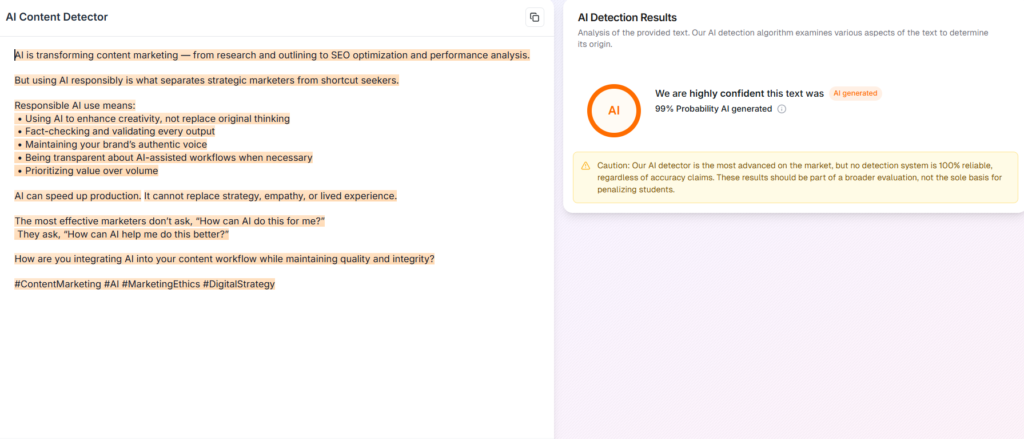
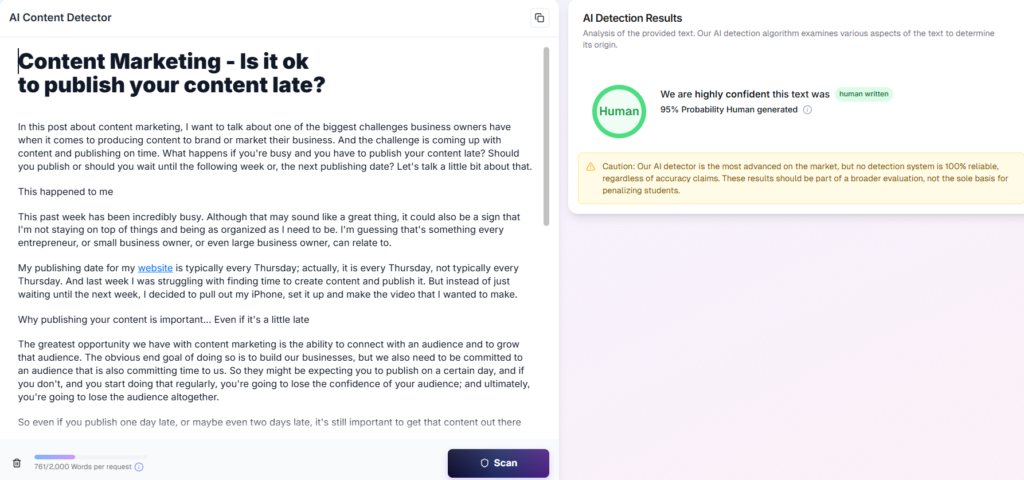
- Social Media Post: AI (Transforming Content Marketing) and Human (Is It OK to Publish Late)
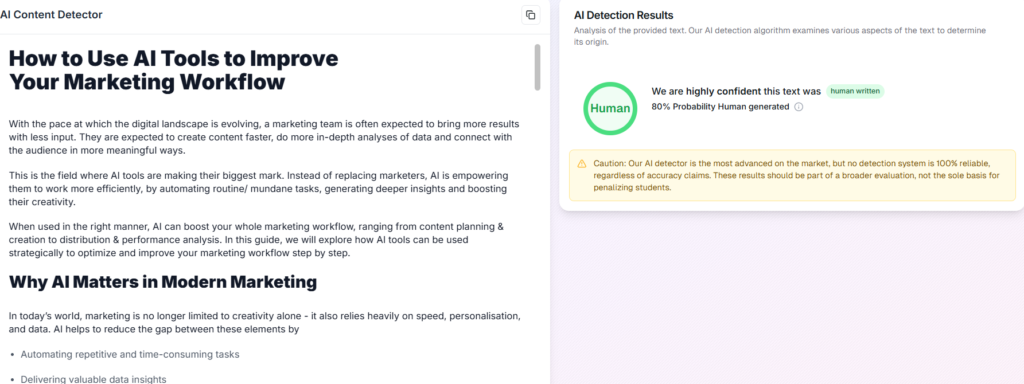
- Marketing Article: Mixed (How to Use AI Tools to Improve Your Marketing Workflow)
Note: To ensure consistency, each sample was pasted into GPTZero under the same account, without any editing, under the same conditions, with results screenshots recorded immediately after each run.
GPTZero Results: AI and Human Academic Essay
GPTZero Results: AI and Human Creative Writing
GPTZero Results: AI and Human LinkedIn Post
GPTZero Results: Mixed Article
What the Results Show
Accuracy on AI Content:
- Strong on creative writing at 100%, which is GPTZero’s clearest strength
- Weak on academic essays at 72%, which falls below what its own benchmarks claim and below the 80% reliability threshold
- Nearly useless on social media posts at 4%, where structured short-form AI patterns go almost entirely undetected
- The 96-point gap between the best and worst AI detection score is the widest inconsistency of any tool in our test
False Positive Rate:
- Negligible, averaging 0% on human content
- GPTZero does not flag clean human writing as AI, which is a genuine strength
- But this comes at the cost of missing real AI content, producing false negatives instead
- For a reliable detector, false negatives are the more dangerous failure mode because they create a false sense of security
Consistency:
- Highly inconsistent across use cases
- Scores jump from 4% on social media to 100% on creative writing, a 96-point gap
- This level of variation means you cannot apply the same threshold across different content types and trust the result
Notable Patterns:
- GPTZero’s 16% score on the mixed paraphrased essay actually outperformed Grammarly’s 6% on the same sample, showing it has more sensitivity to humanized AI than many general-purpose tools
- The social media failure is the most unexpected result. A 4% detection rate on clearly AI-generated short-form content is effectively the same as not detecting it at all
Where It Is Reliable:
- Creative writing, where AI patterns are most structurally distinct and GPTZero’s perplexity and burstiness models perform well
- Humanized or paraphrased AI content, where it shows more sensitivity than surface-level detectors
- Any scenario where you are checking content you strongly suspect is raw, unedited AI output
Where It Fails:
- Social media AI detection, where it scored just 4% on clearly AI-generated content
- Academic essay detection, where 72% falls well short of its marketed accuracy
- Any use case requiring consistent, predictable thresholds across different content types
- The more structured and short-form the AI content, the less GPTZero can detect it, which is the opposite of how most students and teachers actually encounter AI-generated submissions
GPTZero vs Walter Writes AI
Same Samples, Same Conditions
The same academic essay, creative writing, social media post, and article samples were tested under identical conditions. No edits were made between tests, and the content was submitted in the same format and length, allowing for a direct side-by-side evaluation without changing variables.
Side-by-Side Results Table
| Sample Type | Use Case | GPTZero Score | Walter Score | Winner |
| AI-Generated | Academic Essay | 72% AI ❌ | 85% AI ✅ | Walter |
| Human | Academic Essay | 0% AI ✅ | 5% AI ✅ | Both |
| AI-Generated | Creative Writing | 100% AI ✅ | 99% AI ✅ | Both |
| Human | Creative Writing | 0% AI ✅ | 2% AI ✅ | Both |
| AI-Generated | Social Media Post | 4% AI ❌ | 99% AI ✅ | Walter |
| Human | Social Media Post | 0% AI ✅ | 5% AI ✅ | Both |
| Mixed (AI → Human Paraphrased) | Article | 16% AI ✅ | 20% AI ✅ | Walter |
Walter Writes Results: AI and Human Academic Essays
Walter Writes Results: AI and Human Creative Writing
Walter Writes Results: AI and Human LinkedIn Post
Walter Writes Results: Mixed Article
Comparative Analysis: Walter vs GPTZero
The following are the observations made during the testing.
Detection Accuracy
- On creative writing, GPTZero scored 100% and Walter scored 99%. Both identified AI-generated creative content with near-perfect accuracy. This is GPTZero’s strongest use case and the one result where the two tools are essentially equal.
- On the academic essay, Walter scored 85% and GPTZero scored 72%. Walter crossed the 80% reliability threshold. GPTZero did not.
- On AI-generated social media content, Walter scored 99% and GPTZero scored 4%. This is the starkest difference in the entire test. GPTZero effectively missed the social media AI sample entirely.
- On the mixed essay where AI content was paraphrased by a human, Walter returned 20% and GPTZero returned 16%. Walter edged ahead. Both outperformed Grammarly’s 6% on the same sample.
If you want to understand exactly how Grammarly performed across all seven test samples, including its 97% score on academic essays and 57% on creative writing, the full Grammarly AI detector review covers the complete stress test with context for each result.
False Positive Rate
- GPTZero averaged 0% on human content across all use cases, which is its most consistent strength
- Walter scored between 2% and 5% on human samples, staying within an acceptable range
- Neither tool aggressively flags clean human writing, so false positives are not a concern for either
Consistency
- GPTZero’s scores ranged from 4% to 100% across AI samples, a 96-point gap that signals highly variable performance depending on content type
- Walter maintained more stable detection across all four use cases, with significantly less variation between formats
- GPTZero’s results are reliable only for creative writing. They become unpredictable the moment you change content type.
Where Each Tool Performs Better
- GPTZero performs best on creative writing AI content, where its perplexity and burstiness models detect structural uniformity most effectively
- Walter performs better across all other use cases: academic essays, social media content, and humanized AI, which are the most common real-world scenarios students and teachers face
Overall Testing Verdict
- Walter correctly identified AI content across all four use cases, including the mixed paraphrased essay, which is the hardest case to catch
- GPTZero correctly identified AI in one out of three direct use cases (creative writing), while failing on academic essays and nearly missing social media content entirely
- Both tools kept false positives low, so neither will unfairly flag clean human writing
- The critical difference is consistency. GPTZero is a specialist. It performs well in one content type and unpredictably across the rest. Walter does not have that blind spot.
In the same samples under the same test conditions, Walter produced more consistent and complete detection, particularly on content types that fall outside GPTZero’s creative writing strength.
For students and teachers, GPTZero’s 100% on creative writing is impressive, but it isn’t the use case that matters most. Academic essays and social media content are where real-world submissions actually come from. Walter handles those cases. GPTZero does not do so reliably.
Pros and Cons of GPTZero
What GPTZero Does Well
- Accurate for Raw AI Content: Great at flagging unaltered machine-generated text.
- Free Tier Available: Accessible for users with light detection needs.
- Easy to Use: Straightforward interface that doesn’t require technical expertise.
Where GPTZero Falls Short
- Struggles With Humanized Content: Limited ability to detect polished outputs from tools like Walter Writes AI.
- Few Advanced Features: Doesn’t offer customization or in-depth reporting.
- Premium Plan Costs: Paid tiers may not justify the added features.
False Positives: Who Is Most at Risk
GPTZero’s false positive rate is low on average, but certain writing patterns and writer profiles trigger it more than others.
- ESL writers: A Stanford study found a 61.3% false positive rate on essays written by non-native English speakers. Simpler sentence structures and more uniform vocabulary patterns can look like AI output to detection models.
- Students who write formally: Well-organized academic prose with standard transitions (the “good student” writing pattern) gets flagged precisely because polished, structured writing resembles AI output.
- Technical and scientific writers: Domain-specific vocabulary, standardized phrasing, and methodical structure all trigger AI detection flags.
- Short texts: GPTZero’s own documentation acknowledges that accuracy decreases significantly on texts shorter than 250 words, where there isn’t enough context for reliable classification.
At least 12 major universities, including Yale, Johns Hopkins, and Northwestern, have disabled AI detection tools entirely, citing false positive concerns and ESL bias as key factors. If a flag appears, it is a signal worth investigating, not proof of anything.
Pricing Breakdown
| Plan | Price | Features |
|---|---|---|
| Free | $0/month | Basic AI detection for up to 5,000 words per month. |
| Essential | $8.33/month | Includes basic scans, AI vocabulary checks, and a Chrome extension. |
| Premium | $12.99/month | Advanced scans, plagiarism detection, and writing feedback. |
| Professional | $24.99/month | Team collaboration, enhanced security, and enterprise-level features. |
Alternatives to GPTZero
Why Look for Alternatives?
While GPTZero is a solid option for basic AI detection, its struggles with humanized content mean it’s not ideal for all users.
If you need undetectable, polished text or more advanced detection features, there are better options out there.
Top Alternatives
- Walter Writes AI: Excels at creating humanized, undetectable content.
- Copyleaks: A strong choice for plagiarism detection and AI scanning.
- Turnitin: Best for academic institutions requiring robust AI and plagiarism checks.
- Originality.ai: A reliable tool for content creators balancing plagiarism and AI detection.
| Feature | GPTZero | Walter Writes AI ⭐ |
|---|---|---|
| Output Quality | Basic, needs edits | Polished, ready-to-use |
| AI Detection | Moderate accuracy | High accuracy |
| Customization | Limited | Advanced options |
| Ease of Use | Beginner-friendly | Intuitive, feature-rich |
| Pricing | Free/$12.99/month | Competitive features |
FAQs About GPTZero Review
Can GPTZero detect all AI-generated content?
Not entirely. It works well with raw AI text but struggles to identify humanized outputs.
Does GPTZero support multiple languages?
Yes, GPTZero supports some languages beyond English, but its accuracy may vary depending on the language.
How does GPTZero compare to Walter Writes AI?
Walter Writes AI goes beyond detection by creating undetectable, polished content, making it ideal for professionals and creators.
What are GPTZero’s best use cases?
It’s great for casual users, educators, and anyone needing quick scans for basic AI detection.
Is GPTZero worth paying for?
If your needs are basic, the free tier is sufficient. For advanced detection or content creation, Walter Writes AI offers much better value.
How does GPTZero work?
GPTZero analyzes text using perplexity and burstiness as its core metrics. Perplexity measures how predictable word choices are: AI text tends to be highly predictable, while human writing is not. Burstiness measures variation in sentence length and structure: humans mix short and long sentences naturally, while AI produces uniform pacing. Beyond these two signals, GPTZero uses a seven-component proprietary model including deep learning classifiers, a student-essay-specific education module, and ESL debiasing to reduce false positives on non-native English writing.
Does GPTZero have a false positive problem?
Yes, in specific situations. GPTZero’s overall false positive rate is low, but a Stanford University study found it flagged 61.3% of human-written TOEFL essays by non-native English speakers as AI-generated. Formal academic writing, technical content, and texts under 250 words are also prone to false positives. GPTZero has introduced ESL debiasing to address this, but the problem hasn’t been fully resolved. A GPTZero score should always be treated as one signal in a broader assessment, not as definitive proof of AI authorship.
Final Verdict: Is GPTZero Accurate?
GPTZero is a solid tool for detecting raw AI-generated content.
It’s user-friendly and accessible, making it a good fit for students and casual users. However, its limitations in handling humanized content mean it falls short for more advanced needs.
If your goal is to create undetectable, polished content that passes any AI detection tool, Walter Writes AI is the superior choice.
Try it today and see the difference for yourself!
For a cleaner alternative, try our make AI undetectable. It transforms AI-generated text into human-sounding writing while keeping your voice intact.
Side-by-side comparison: See the dedicated Turnitin vs GPTZero 2026 benchmark for accuracy, false positives, pricing, and use-case fit.