

High Probability
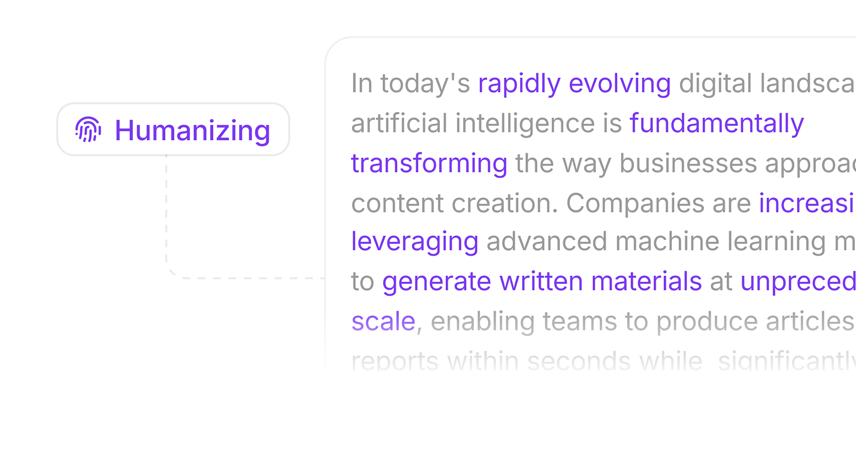
"In today's rapidly evolving digital landscape, organizations must strategically leverage innovative technologies..."
Score any text for AI generation: GPT-4, Claude, Gemini, Llama, and more.
In today’s rapidly evolving digital landscape, organizations must strategically leverage innovative technologies to optimize operational efficiency and unlock unprecedented synergies across cross-functional teams.
"In today's rapidly evolving digital landscape, organizations must strategically leverage innovative technologies..."
"...to optimize operational efficiency and unlock unprecedented synergies across cross-functional teams."
curl https://api.walterwrites.ai/v1/detect
-H "Authorization: Bearer YOUR_API_KEY" \
-H "Content-Type: application/json" \
-d '{
"text": "In today's rapidly evolving digital landscape, organizations must strategically leverage innovative technologies to optimize operational efficiency and unlock unprecedented synergies across cross-functional teams.",
"language": "en""id": "det_4k2p9x1m3",
"status": "completed",
"model": "detector-v3",
"created_at": "2026-04-24T13:45:00Z",
"output": {
"ai_probability": "0.87’’
"words_processed": 12
"usage": { "credits_used": 12 }
From classrooms to content marketplaces to recruiting platforms, detection that fits the workflow your team already runs.
Drop into Canvas, Moodle, Schoology, or your own LMS to score every submission at upload. Per-student dashboards, FERPA-aligned data handling, and an Education tier with discounted volume.
Flag AI-generated submissions at ingestion.
Score cover letters, take-home assignments, and written interview responses.

Monthly plans with included word quotas. No commitments. Volume discounts built in.
Need enterprise pricing?
Dedicated capacity, region pinning, and Zero-Retention mode for high-volume teams.
From classrooms to content marketplaces to recruiting platforms, detection that fits the workflow your team already runs.
AI detector accuracy in 2026 varies dramatically by provider. The best detectors like Walter and Originality achieve 0.9+ AUC (area under curve) on benchmark datasets, while some commercial detectors perform barely better than random guessing. According to the RAID benchmark study (arxiv.org/abs/2405.07940), Walter scores 0.961 AUC on standardized testing data. However, real-world accuracy depends heavily on several factors: text type (academic papers versus casual blog posts versus technical documentation), document length (shorter texts are harder to classify accurately), and language (English-trained models struggle with other languages). Academic writing with formal structure tends to be easier for detectors to analyze than conversational content. When evaluating any AI detector, ask for performance metrics on text similar to yours, not just overall accuracy claims. The gap between top-tier and bottom-tier detectors is substantial, so choosing a well-benchmarked solution matters if detection accuracy is critical for your use case.
Yes, AI detectors show significant bias against non-native English speakers. Research by Liang et al. (2023) published in Patterns found that popular detectors like GPTZero and ZeroGPT misclassified up to 61% of TOEFL essays written by non-native speakers as AI-generated (https://arxiv.org/abs/2304.02819). This happens because these tools mistake the simpler sentence structures and limited vocabulary common in ESL writing for AI patterns. Walter addresses this problem directly by training on diverse ESL writing corpora to reduce false positives for non-native speakers. We also report ESL false-positive rates separately on our public benchmark, giving you transparency other providers don’t offer. If your use case involves international users, students, or global teams, understanding this bias is critical. Walter’s AI Detector API provides more equitable results across different English proficiency levels, making it a better choice for educational institutions and platforms serving diverse populations.
Yes, AI detectors can absolutely be wrong, and they fail in two main ways. False positives occur when human-written text gets flagged as AI-generated, while false negatives happen when AI-generated content slips through undetected. Most detectors show false positive rates between 4-12% when set to a 50% confidence threshold, meaning legitimate human writing gets incorrectly flagged roughly once every 10-25 samples. The accuracy problem gets worse with certain writing styles, non-native English speakers, and highly technical content. Walter’s AI Detector API addresses this by providing calibrated confidence scores rather than binary yes/no answers. This lets you choose your own threshold based on your specific use case. If false positives are costly, you can require higher confidence before flagging content. If catching AI content is critical, you can lower the threshold and accept more false alarms. Detection technology continues improving, but anyone claiming 100% accuracy is overselling. The reality is that AI detection remains probabilistic, not definitive.
AI detection false positives happen when human writing triggers pattern-matching algorithms trained primarily on native English samples. The most common causes include non-native English writing (ESL authors often show reduced lexical diversity that resembles AI output), highly formal or technical writing that follows rigid templates, and text under 100 words where statistical patterns become unreliable. Over-edited human content also loses natural variation, making it appear machine-generated. Academic abstracts are particularly prone to false flags because their standardized structure mimics AI training data. Walter’s AI Humanizer API addresses this through debiasing techniques that preserve your intended meaning while adding natural linguistic variation. Our approach adjusts perplexity and burstiness without compromising clarity, helping human-written content pass detection tools while maintaining professional quality. For technical or ESL content especially, this means fewer unjust flags and more confident publishing.
We provide calibrated probability scores (0-1) instead of binary yes/no verdicts, so your production team can set thresholds that match your risk tolerance. Every API response includes confidence intervals and sentence-level breakdowns that highlight exactly where the model is uncertain. This means human reviewers can focus their attention on ambiguous sections rather than re-reading entire documents. For high-stakes use cases like academic integrity or HR screening, we recommend implementing a two-pass review workflow: flag content above your chosen threshold, then have domain experts examine the flagged sentences using our detailed breakdown. This approach dramatically reduces false positive impact while keeping review time manageable. You control the sensitivity dial, and we give you the granular data to make informed decisions about edge cases.
Yes, the AI Detector API remains effective through continuous retraining. Walter updates the detection models monthly using outputs from the latest LLMs, including GPT-5, Claude 4, and Gemini 2.5 as they’re released. While research like “Can AI-Generated Text be Reliably Detected?” (Sadasivan et al., 2023, arxiv.org/abs/2303.11156) shows that detection-bypass is theoretically unbounded in the long term, practical detection accuracy stays high when detectors keep pace with model evolution. The key is staying current with new release patterns and training data. Walter publishes an accuracy timeline showing performance metrics across different model generations, so you can see exactly how detection holds up as LLMs advance. As long as the detector is regularly retrained on fresh model outputs, rather than relying on static training data, it continues to identify AI-generated content reliably. Think of it like antivirus software: effectiveness depends on regular updates to recognize new threats.