



High Probability
"In today's rapidly evolving digital landscape, organizations must strategically leverage innovative technologies..."
 Every major generator
Upload an image and receive a real, fake, or inpainting verdict with confidence and per-class probabilities.
In today’s rapidly evolving digital landscape, organizations must strategically leverage innovative technologies to optimize operational efficiency and unlock unprecedented synergies across cross-functional teams.
"In today's rapidly evolving digital landscape, organizations must strategically leverage innovative technologies..."
"...to optimize operational efficiency and unlock unprecedented synergies across cross-functional teams."
curl -X POST https://developer-portal.walterwrites.ai/api/image-detector/predict/
-H "X-API-Key: YOUR_API_KEY"
-F "[email protected];type=image/jpeg""prediction": "real",
"confidence": 0.9964,
"probabilities": {
"real": 0.9964,
"fake": 0.0013,
"inpainting": 0.0022
"credits_charged": 6
From social platforms to marketplaces to newsrooms, image and deepfake detection that fits the workflow your team already runs.

Screen uploads, profile photos, and posts for AI-generated and manipulated images at ingestion, with confidence scores your moderation team can act on.

Flag AI-generated or manipulated images in listings, stock submissions, and uploads before they go live.

Verify the authenticity of images before publication and catch synthetic or doctored media.

Monthly plans with included credits. No commitments. Volume discounts built in.
Need enterprise pricing?
Talk to us about higher-volume workloads and enterprise deployment requirements.
Documented answers about the endpoint, response, limits, billing, and production use.
It returns a real, fake, or inpainting prediction, the confidence of that prediction, per-class probabilities, and the exact credits charged.
JPEG, PNG, WebP, GIF, BMP, and TIFF are supported. Uploads may be up to 10 MB.
Image detection is priced by resolution. Each request costs at least 6 credits and is capped at 17 credits for images at or above 4K UHD.
Yes. GET /api/image-detector/health/ reports engine availability and does not require authentication.
Send an API key with the image_detector scope in the X-API-Key header.
From the blog
Guides, comparisons and practical advice from Walter.
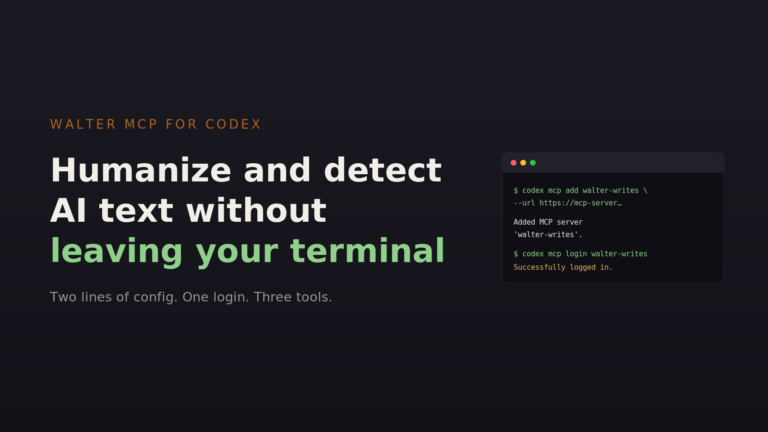
View allConnect Walter to OpenAI Codex over MCP in three commands. Humanize drafts and run AI detection without leaving…
Read moreOne prompt. The whole content workflow. Walter’s MCP connector brings humanization, detection, and batch processing directly into Claude.…
Read moreOne of the most common questions I get as a heavy AI user is the old “ChatGPT vs…
Read more