




Key Takeaway: This Walter Writes AI review finds it the strongest all-in-one platform for AI humanization and detection in 2026, combining structure-level rewriting with a built-in detector that scored humanized output at 99-100% human across GPTZero, Turnitin, Originality.AI, and Copyleaks in testing.
- Walter rewrites at the structural and linguistic level, varying sentence rhythm, cadence, and phrasing patterns rather than swapping synonyms or shuffling sentences
- The built-in detector estimates risk across four major platforms simultaneously without requiring users to leave the tool or copy-paste between products
- Three rewrite strength levels (Simple, Standard, Enhanced) and customizable tone modes let users match output to academic, professional, or casual writing contexts
- Plans start at $8/month for 30,000 words, and a free trial of 300 words is available with no credit card or login required
- Walter supports over 80 languages and has a Chrome extension that works inside Gmail, Google Docs, LinkedIn, and social media
- The review is explicit that Walter is not a guarantee of zero detection and is not designed to exploit institutional rules, framing it as a writing quality tool rather than a bypass shortcut
Walter Writes AI is often discussed alongside claims about “bypassing” AI detectors like GPTZero or Turnitin. That framing, while popular online, oversimplifies how AI detection actually works and creates unrealistic expectations for any writing tool.
In this review, we take a more practical approach.
Instead of chasing absolute pass-or-fail detector scores, we evaluate how Walter Writes AI performs in real academic and professional workflows: how well it improves readability, how reliably it identifies AI-generated content, and where detection tools themselves introduce noise or false positives.
We tested Walter’s humanizer and AI detector across multiple content types, editing scenarios, and detector models. The goal is not hype, but clarity, so students, educators, and professionals understand what Walter does well, where its limits are, and how to use it responsibly.
What Walter Writes AI Is (and What It Is Not)
Walter Writes AI is an AI assisted writing platform designed to help people improve the quality, clarity, and realism of their text. It is not a magic tool that guarantees you will bypass every AI detector in every situation, and it is not built to game academic or institutional systems.
At its core, Walter focuses on AI Text humanization and AI Text Detection. That means refining sentence structure, reducing repetitive patterns, improving flow, and making AI assisted writing read more naturally to human audiences. The goal is better writing, not shortcuts or gimmicks.
Walter also emphasizes detection awareness, not detection manipulation. The platform helps users understand how AI detectors may interpret their text and provides realistic signals so they can make informed decisions before publishing or submitting work. This approach reflects how AI detection is actually used in real academic and professional environments.
Importantly, Walter is built with education, enterprise, and professional use cases in mind.
Its design choices prioritize consistency, readability, and responsible AI use rather than aggressive rewriting techniques that can harm grammar or meaning. This makes it suitable for students, researchers, teams, and organizations that care about writing quality and long term reliability.
What Walter is not is just as important. It is not a guarantee of zero detection, it is not a plagiarism workaround, and it is not a tool to exploit institutional rules. Anyone promising those outcomes is oversimplifying how AI detection works.
Walter’s value comes from doing the hard part well: helping users produce clearer, more natural writing while staying grounded in how AI-assisted content is realistically evaluated today.
What separates Walter from basic paraphrasers is the depth of the rewrite. Rather than swapping synonyms or shuffling sentences, Walter restructures how ideas are expressed: it varies cadence, adjusts sentence rhythm, and removes the predictable phrasing patterns that detectors flag. This structure-level approach is why humanized output holds up against strict detectors like Turnitin and Copyleaks where simpler tools fall short.
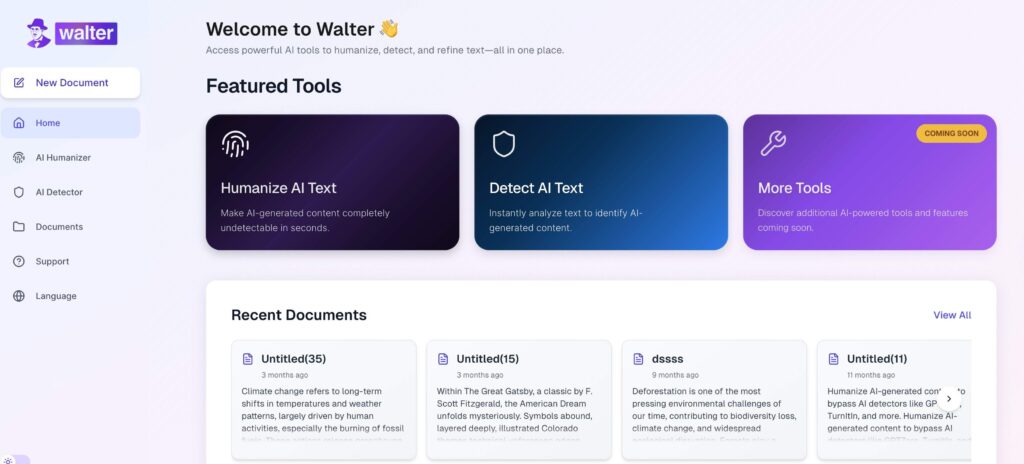
Walter is also the only platform that combines AI humanization and AI detection in a single editor. Users humanize text and instantly see their AI-likelihood score without leaving the tool or copy-pasting between products. The built-in detector estimates risk across Turnitin, GPTZero, Originality.AI, and Copyleaks simultaneously.
How AI Detection Actually Works in 2026
AI detection is often treated as a simple pass or fail test. In reality, modern detectors estimate the likelihood that AI tools were involved based on statistical and linguistic patterns, not definitive proof of authorship.
Different detectors analyze different signals, which is why the same text can receive very different scores across tools like GPTZero and Turnitin. Results also vary depending on content type, length, editing, and how recently a detector’s model was updated.
Because of these limitations, most academic and professional institutions treat AI detection as a screening signal rather than a final judgment. Absolute claims about guaranteed outcomes ignore how detection systems actually work in practice.
For a deeper technical explanation, see our full guide on how AI detectors work.
Why AI Detector Results Vary by Content Type
One of the biggest reasons AI detection results cause confusion is that detectors do not behave consistently across all types of writing. The same tool can produce very different scores depending on what kind of text is being analyzed.
Short, polished writing is flagged more often
Short essays, tightly structured paragraphs, and highly polished academic language tend to trigger higher AI probability scores. This happens because detectors associate uniform sentence length, predictable phrasing, and low variance with machine-generated text, even when a human has edited it.
This is why brief assignments or formal summaries are more likely to be flagged than longer, more varied writing.
Long form and mixed authorship text behaves differently
Longer pieces that include natural variation, revisions, and human edits often produce lower or inconsistent detection scores. When AI assisted drafts are reviewed, rewritten, or expanded by a human, detection signals become less reliable.
Most modern detectors struggle to accurately evaluate mixed authorship content, which is increasingly common in real academic and professional workflows.
Editing can change scores without changing meaning
Even small edits can significantly affect detection results. Adjusting sentence flow, reordering ideas, or improving transitions can alter the statistical patterns detectors rely on, sometimes lowering scores and sometimes increasing them.
This is why detection results should always be interpreted in context, not treated as definitive evidence.
Why this matters when evaluating AI tools
Claims based on a single test, a single detector, or a single content type do not reflect real world usage. AI detection is inherently variable, and any serious evaluation must account for how different types of writing behave under analysis.
Walter is designed with this variability in mind, focusing on improving clarity and natural expression rather than chasing unstable detector scores.
Walter Writes AI Humanizer: What It Does Well
Walter Writes AI’s humanizer is built to improve how AI assisted text reads to people, not to chase unstable detector scores. Its strength lies in clarity, structure, and natural flow, especially for academic and professional writing.
Improves readability without distorting meaning
One of the most consistent benefits of using Walter is that it refines sentence structure while preserving the original intent of the text. Paragraphs become easier to follow, transitions feel more natural, and ideas are expressed with greater clarity.
This makes it particularly useful for essays, reports, and long form writing where maintaining meaning is critical.
Reduces common AI writing patterns
AI generated text often includes repetitive phrasing, uniform sentence rhythm, and overly polished constructions that feel unnatural to human readers. Walter’s humanizer is designed to break these patterns in subtle ways.
Instead of aggressive synonym swapping or random rewrites, it introduces variation in structure and pacing while keeping the language coherent and grammatically sound.
Maintains grammatical quality and academic tone
Walter prioritizes grammatical accuracy and formal tone, which is why it performs well in academic and professional contexts. The output remains consistent with standard writing conventions, avoiding slang, filler, or awkward phrasing that can appear in lower quality rewriting tools.
For users submitting essays or formal documents, this balance is essential.
Designed for real world workflows
Walter works best as part of a writing process, not as a one click shortcut. It is particularly effective when used to refine drafts, improve clarity, and polish AI assisted writing that has already been reviewed or edited by a human.
This approach aligns with how AI is realistically used today across education, research, and professional environments.
Walter also offers three rewrite strength levels: Simple, Standard, and Enhanced. This lets users choose how aggressive the transformation is, from a light polish for content that needs minor tone fixes, to heavy restructuring for text that needs to pass strict detection. Customizable tone modes (casual, academic, journalistic, or brand-safe) adjust cadence and clarity to match the intended audience rather than applying a one-size-fits-all rewrite.
How Walter’s AI Detector Differs From Most Consumer Tools
Most AI detectors available today are built for quick, surface-level assessments. They are designed to give a fast probability score based on a narrow set of signals, which can be useful for casual checks but often leads to inconsistent or inflated results in real academic and professional settings.
Walter’s AI detector was built with a different goal in mind.
Education and enterprise-grade design
Walter’s detector is designed for education and enterprise use cases, where accuracy, nuance, and context matter more than simplistic scoring. Instead of relying on a single probability metric, it evaluates a broader range of linguistic, structural, and statistical features to form a more realistic assessment of AI involvement.
This approach reduces overreliance on any one signal and helps limit false positives, especially in edited or mixed-authorship text.
More reliable on edited and mixed content
Consumer tools often struggle once human edits are introduced. Text that has been revised, expanded, or partially rewritten can still be flagged aggressively because those detectors assume uniform authorship.
Walter’s detector is better suited to these real-world scenarios. It is designed to handle content that reflects how AI is actually used today, where drafts are reviewed, refined, and shaped by human writers before submission or publication.
Focused on signal quality, not sensational scores
Many consumer detectors emphasize eye-catching percentages that imply certainty where none exists. Walter avoids this approach.
Instead of presenting detection as a definitive verdict, Walter provides a grounded signal that helps users understand risk without overstating confidence. This aligns more closely with how institutions and organizations interpret AI detection results in practice.
Strong performance across specific content types
In comparative testing, Walter’s detector has shown stronger accuracy than some widely used consumer tools on certain content types, particularly long-form, structured writing and edited academic text. These are precisely the scenarios where false positives are most common and most harmful.
This makes Walter’s detector especially valuable for students, researchers, and professionals who need realistic insight rather than reactive scoring.
Built to support responsible use
Walter’s detector is not positioned as an enforcement mechanism. It is a support tool that helps users make informed decisions before publishing or submitting work.
By prioritizing accuracy, context, and transparency, Walter offers a more dependable alternative to consumer detectors that were never designed for high-stakes academic or professional evaluation.
Walter’s bypass data backs this up. In testing, text humanized through Walter scored as follows across major detectors: GPTZero 99% human, Turnitin 100% human, Originality.AI 99% human, Copyleaks 100% human. These results reflect the structural depth of the rewrite, not surface-level synonym substitution.
Real-World Use Cases Where Walter Performs Best
Walter Writes AI is most effective when used as part of a realistic writing workflow. It is designed to support users who want clearer, more natural writing while staying aware of how AI assisted content may be evaluated.
Below are the scenarios where Walter consistently delivers the most value.
Academic drafting and revision
Walter works well for students and researchers who use AI as a drafting aid rather than a replacement for original work. It helps refine structure, improve clarity, and smooth transitions in essays, research summaries, and written assignments.
Because the humanizer prioritizes grammatical correctness and formal tone, it is particularly useful during the revision stage, after ideas have been developed and reviewed.
Mixed human and AI writing workflows
Many real-world documents today are created through a mix of human writing and AI assistance. Walter is designed for exactly this type of workflow.
It performs best when used to polish drafts that have already been edited or expanded by a human, helping the final text read more naturally and cohesively without flattening voice or meaning.
Professional and business writing
Walter is well suited for professional content such as reports, proposals, internal documentation, and client-facing materials. In these contexts, clarity and consistency matter more than aggressive rewriting.
The platform helps reduce awkward phrasing and repetitive patterns while maintaining a professional, neutral tone that aligns with workplace expectations.
Content editing and readability improvement
For writers who use AI to generate early drafts, Walter serves as a refinement layer. It improves flow, sentence variation, and readability, making the text more engaging for human readers without introducing informal language or stylistic noise.
This is especially useful for long-form writing where coherence and pacing matter.
Detection awareness before submission or publication
Walter’s detector is valuable as a screening tool for users who want a realistic sense of how their text may be interpreted by AI detection systems.
Rather than encouraging trial-and-error behavior, it helps users identify potential risk areas early and make informed decisions before submitting academic work or publishing professional content.
Walter also has a Chrome extension that lets users humanize text anywhere on the web, including Gmail, Google Docs, LinkedIn, and social media, without switching tabs. For users who work inside ChatGPT, Walter has two custom ChatGPTs live on the ChatGPT Store: an AI Humanizer ChatGPT and an AI Detector ChatGPT.
What Walter Writes AI Is Not Designed For
Walter Writes AI is built to support responsible, high-quality writing. That means there are clear boundaries around what it is and is not intended to do.
Being explicit about these limits is important, because many misconceptions around AI tools come from unrealistic promises made elsewhere.
It is not a guarantee of zero AI detection
No AI writing or humanization tool can guarantee that a piece of text will never be flagged by every detector, in every scenario. AI detection systems are probabilistic, constantly changing, and highly sensitive to content type and structure.
Walter does not promise universal outcomes. Instead, it focuses on improving writing quality and providing realistic detection insight so users can make informed decisions.
It is not a plagiarism workaround
- Walter does not generate plagiarized content or attempt to mask copied material. It is designed to preserve meaning while improving clarity and flow, not to conceal sources or bypass plagiarism checks.
- Users are still responsible for proper citation, originality, and compliance with academic or professional standards.
It is not built to exploit institutional rules
- Walter is not designed to game school policies, employer guidelines, or publication rules. Tools that frame AI use as a way to “beat the system” ignore how institutions actually evaluate writing and increase the risk of misuse.
- Walter’s approach aligns with responsible AI assisted writing, where tools are used to support clarity and revision rather than replace critical thinking or authorship.
It is not a one-click substitute for proofreading
- While Walter improves readability and grammar, it does not replace careful review. Users should always read and evaluate their final work before submission or publication, especially in academic or professional contexts.
- Walter reduces friction in the writing process, but good judgment and review remain essential.
How Walter Writes AI Works
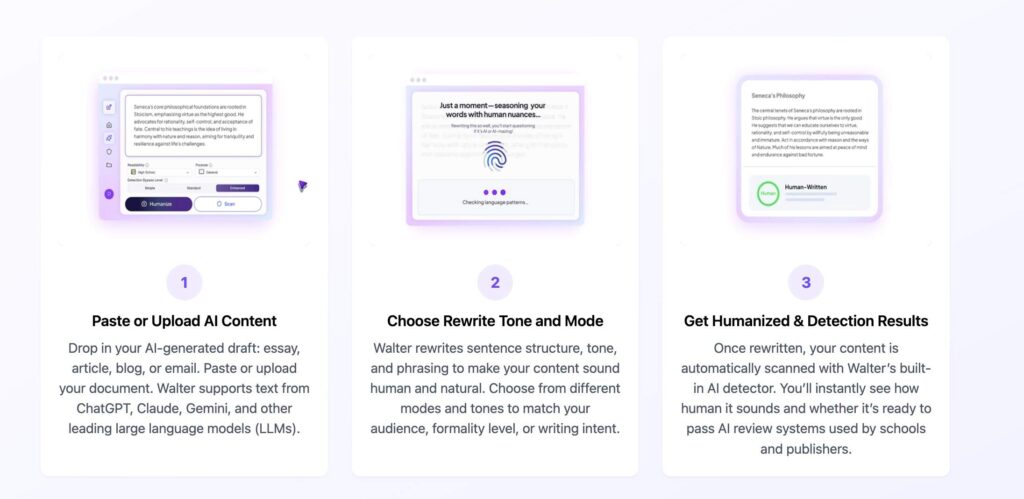
- Walter Writes AI is designed to improve the quality and clarity of AI-assisted writing through context-aware rewriting rather than surface-level word substitution.
- Instead of acting like a traditional paraphraser, Walter focuses on refining sentence structure, reducing repetitive patterns, and improving overall flow while preserving the original meaning of the text. The goal is to help AI-assisted writing read more naturally and cohesively to human readers.
- This approach is particularly effective for academic, professional, and long-form writing where clarity and consistency matter.
Humanization Through Structural and Linguistic Refinement
- Walter’s humanization process works at the structural and linguistic level.
- It analyzes how ideas are expressed across sentences and paragraphs, then introduces variation in rhythm, phrasing, and transitions to reduce common AI writing patterns. This helps create text that feels less uniform and more aligned with natural human writing styles.
- Importantly, these refinements are made without distorting intent or introducing informal language, which is why the output remains suitable for essays, reports, and professional documents.
Built-In AI Detection for Writing Awareness
- Walter includes an integrated AI detection feature designed to provide writing awareness, not absolute judgments.
- Rather than presenting detection as a definitive verdict, the tool offers a realistic signal that helps users understand how their text may be interpreted by different AI detection systems. This is intended as a screening layer that supports informed decision-making before submission or publication.
- Because AI detection is probabilistic and varies by content type and detector model, results should always be interpreted in context. Walter’s detector reflects this reality by prioritizing transparency over certainty.
Customization for Different Writing Contexts
- Walter allows users to adjust tone, readability, and structural preferences to better match their intended audience.
- Whether the goal is academic clarity, professional formality, or general readability, these controls help align the output with standard writing conventions for different use cases. This flexibility is especially useful when working across multiple document types or audiences.
Clean, Efficient Interface
- The platform is built for speed and ease of use.
- Users can paste their text, adjust preferences, and apply refinements in just a few steps. The interface is designed to stay out of the way, allowing writers to focus on content rather than configuration.
- Walter works smoothly across desktop and mobile devices, making it easy to integrate into existing workflows.
Multilingual Writing Support
- Walter supports multiple languages, including English, Spanish, French, and others.
- Walter supports over 80 languages, making it suitable for international users, multilingual content, and global teams who need consistent writing quality across different languages without sacrificing clarity or tone.
Pros and Cons of Walter Writes AI
No writing tool is a perfect fit for every use case. Walter Writes AI has clear strengths, along with a few limitations that are worth understanding before deciding if it’s right for you.
Pros:
- High-quality humanization output: Walter focuses on improving sentence flow, reducing repetition, and refining structure so AI-assisted writing reads more naturally and cohesively.
- Context-aware rewriting: Instead of surface-level paraphrasing, Walter works at the structural and linguistic level, which helps preserve meaning while improving clarity.
- Customizable writing controls: Users can adjust tone, readability, and stylistic preferences to better match academic, professional, or general writing contexts.
- Built-in AI detection awareness: Walter includes an integrated detection feature that provides realistic signals about how text may be interpreted by AI detection tools, helping users make informed decisions before submission or publication.
- Clean and intuitive interface: The platform is fast, simple to use, and requires no technical setup. Paste your text, adjust preferences, and refine your writing in just a few steps.
- Multilingual support: Walter supports multiple languages, making it useful for international users and teams working across different regions.
Cons
- Usage limits on lower plans: The Starter plan includes per-request limits that may feel restrictive for users working on long documents, which typically requires upgrading to a higher tier.
- The Chrome extension is live but some users have requested deeper integrations, such as a Shopify app and WordPress plugin, which are currently in development.
Alternatives to Walter Writes AI
Walter Writes AI operates in a crowded space alongside paraphrasers, AI writing assistants, and general editing tools. Understanding how these tools differ can help clarify where Walter fits best.
Grammarly Humanizer
Grammarly focuses primarily on aggressive rewriting techniques aimed at altering AI-generated text patterns.
Strengths
- Fast processing
- Simple workflow
Limitations
- Limited control over tone and structure
- Inconsistent output quality
- Less transparency around how changes are applied
QuillBot
QuillBot is a well-known paraphrasing and grammar tool, commonly used for rewriting and editing.
Strengths
- Strong grammar and synonym engine
- Browser extensions and document integrations
Limitations
- Primarily a paraphraser rather than a humanization tool
- Output can still feel uniform or mechanical
- Limited focus on AI detection awareness
How Walter Writes AI Differs From Basic Rewriters
Many rewriting tools rely on synonym replacement and minor sentence shuffling. While this can help with basic paraphrasing, it often results in text that feels rigid or repetitive.
Walter takes a deeper approach by refining structure, pacing, and expression across entire passages. This makes it better suited for users who care about readability, tone consistency, and long-form writing quality rather than quick rewrites.
Why Walter Writes AI Is a Good Fit for the Right Users
Walter Writes AI is best suited for users who want to improve AI-assisted writing responsibly, with an emphasis on clarity, realism, and transparency.
It is not built for shortcuts or guarantees, but for writers who value control, consistency, and long-term reliability in academic, professional, and content-driven workflows.
Walter Writes AI Reviews and Customer Feedback
What real users highlight most often:
Across independent reviews, community discussions, and video walkthroughs, user feedback around Walter Writes AI tends to focus on writing quality, control, and consistency rather than shortcuts or gimmicks.
Common themes include:
- Improved readability and flow Users often mention that Walter’s output reads more naturally than raw AI drafts, with better transitions and less repetitive phrasing.
- Preservation of meaning and tone Many reviews note that the humanizer refines structure without distorting intent, which is especially important for essays, reports, and professional documents.
- Useful detection awareness Rather than promising outcomes, users appreciate having realistic insight into how their text may be interpreted by AI detection tools before submission or publication.
- Customization and control Adjustable tone and readability settings are frequently cited as helpful for tailoring output to different contexts, such as academic writing versus business content.
Where users want to see improvement:
Feedback is not universally glowing, and that transparency matters.
Some users have noted areas where they would like to see further development, including:
- Live chat support A small number of users would prefer real-time support instead of email-only assistance.
- Per-request limits on lower plans Users working on longer documents sometimes find the Starter plan’s per-request cap restrictive, which is typically resolved by upgrading.
- Expanded educational resources While the interface is intuitive, some users have expressed interest in a more robust resource hub with tutorials and best-practice examples.
These points are consistent with a platform that is actively evolving rather than static.
Overall sentiment:
The overall tone of user feedback suggests that Walter Writes AI is trusted as a quality-first writing and tool. Users who approach it as part of a realistic writing workflow tend to report the strongest results.
Walter Writes AI Customer Support Experience
Strong technology matters, but long-term trust is built through reliable support and clear communication. This is an area where Walter Writes AI consistently performs well.
Email support and response quality
Walter primarily offers email-based support, with most users receiving responses within 24 hours. Feedback frequently highlights that replies are detailed, specific, and written by team members who clearly understand the product rather than generic scripts.
This is especially important for users working with academic or professional writing, where context and precision matter.
In-product guidance for new users
Walter’s interface includes guided elements that help new users understand how to apply humanization and detection tools effectively. This reduces trial-and-error and makes the platform accessible even for users without technical backgrounds.
For first-time users, this guidance lowers friction and shortens the learning curve.
Responsiveness to user feedback
One recurring theme in user feedback is that product suggestions sent to support are taken seriously. Several updates to word limits, workflow improvements, and interface refinements have been implemented following direct user requests.
For a growing platform, this willingness to listen and iterate is a strong indicator of long-term reliability and product maturity.
Plans & Pricing: How Much Does Walter Writes AI Cost
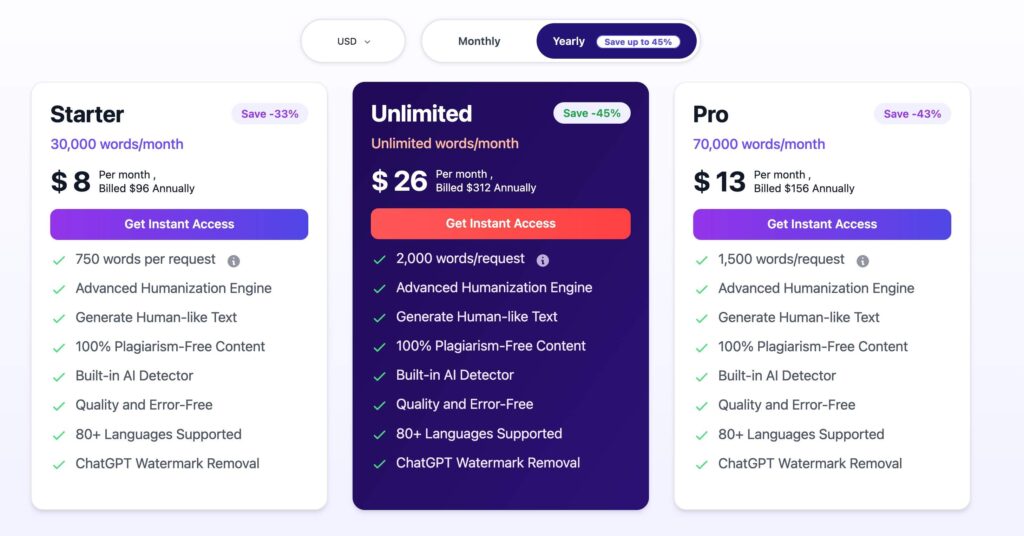
Walter Writes AI uses a straightforward pricing model based on monthly word usage, designed to support everything from occasional academic work to high-volume professional writing.
All plans include access to the same core features. The main difference is how many words you can process each month and how large each individual request can be.
Below is a clear breakdown of the available plans and who each one is best suited for.
Here is a full breakdown of Walter Writes AI plans, billed annually:
| Plan | Price (annual) | Words/month | Words/request | Best for |
| Free | $0 | 300 words (one-time) | 300 | Testing the platform |
| Starter | $8/month | 30,000 | 750 | Students and casual writers |
| Pro | $13/month | 70,000 | 1,500 | Freelancers and content teams |
| Elite | $26/month | 200,000 | 2,000 | Agencies and heavy users |
| Teams | $99/month | 500,000 | 2,000 (10 members) | Organizations and large teams |
All plans include the AI humanizer, built-in detector, tone controls, 80+ language support, and plagiarism-free output guarantee. The free trial gives 300 words with no credit card and no login required. Walter also offers a refer-and-earn affiliate program for users who want to share the platform.
Independent Reviews, Demos, Tests, and Community Feedback
Below is a curated selection of independent reviews, demos, and community discussions about Walter Writes AI. These resources reflect different testing approaches, content types, and perspectives. As with any AI-related tool, results can vary depending on how text is written, edited, and evaluated.
Independent Video Reviews and Demos
These videos show real-time testing and walkthroughs across different detectors and content types. Individual results reflect specific test conditions and should be interpreted in context.
- YouTube: Walter Writes AI Review: The Ultimate Tool to Humanize AI Content
- YouTube: Meet WalterWrites — Humanization in Action
- YouTube: Walter Writes AI Review & Walkthrough – Overview of Features and Use Cases
- YouTube: Walter Writes User Reviews – Practical Demo and User Perspective
- YouTube: WalterWrites Review – Live Demonstration and Insights
- YouTube: Walter Writers AI Review – Features, Demo, and Practical Walkthrough
Community Discussions and User Experiences
Community discussions highlight how Walter Writes AI is used in real workflows, including academic writing, content editing, and professional use. Individual opinions vary and often reflect personal writing styles and use cases.
- r/humanizeAIwriting – Detailed Test Report
- Reddit: User Review of WalterWrites AI After Hands-On Testing
- Reddit: Discussion on Whether Walter Writes AI Is Worth Using
- Reddit: Walter Writes AI Review — Community Opinions and Questions
- Reddit: r/humanizeAIwriting — Ongoing Community Discussions
- Reddit: Walter Writes AI Review — User Test Results and Feedback
Industry Analysis and Third-Party Reviews
These independent reviews and blog posts provide broader analysis of AI humanization tools, detection behavior, and writing quality, offering perspectives beyond individual tests or single detector outcomes.
- Techpoint Africa: Walter Writes AI Review and Hands-On Overview
- Medium: Walter Writes AI Review — Humanization Features and Practical Use
- The Industry Leaders: Walter Writes AI Honest Review and Evaluation
- Medium: I Tested Walter Writes AI — Observations on Humanization and Detection
- Medium: AI Checker Tools for Writers, Educators, and Marketers (Includes Walter Writes AI)
- Medium: The AI Humanizer Market — Tools, Trends, and What’s Next
- Medium: From Boardrooms to Classrooms — New Standards in AI-Generated Writing
Final Verdict: Is Walter Writes AI Worth It?
Walter Writes AI is a strong option for users who care about writing quality, clarity, and responsible AI use.
It is not designed for shortcuts or guarantees, and it does not frame AI writing as a way to “beat” systems. Instead, it focuses on improving how AI-assisted text reads, helping users reduce common AI patterns, and providing realistic detection awareness in line with how institutions and organizations actually evaluate content.
For students refining drafts, professionals polishing documents, or creators improving readability and tone, Walter offers a thoughtful balance of control and reliability. Users looking for gimmicks or absolute promises will likely be disappointed, but those prioritizing consistency, transparency, and long-term usefulness tend to find it well worth the investment.
In a space crowded with exaggerated claims, Walter Writes AI stands out for taking a more grounded and sustainable approach.
FAQs About Walter Writes AI
Does Walter consistently pass sophisticated AI detectors?
Yes. Walter Writes AI is designed to pass top-tier AI detection tools like Turnitin, GPTZero, and Originality.ai with high human scored. It does this by structurally rewriting content, not just rephrasing or spinning it. While no tool can promise a 100% pass rate in every context, Walter consistently performs above industry benchmarks and adapts to evolving AI detection algorithms.
Does Walter’s humanized output retain the quality of my original writing?
Absolutely. Walter Writes AI is built to enhance your writing. Instead of simply lowering quality to avoid detection, Walter restructures and refines your AI-generated text to make it more readable, natural, and human-like. It retains the core ideas and improves tone, clarity, and flow for various use cases like academic writing, content marketing, or professional documents.
Is Walter Writes AI legit?
Yes. Walter Writes AI is an industry-leading Humanizer and Detector platform trusted by thousands of educators, students and professionals worldwide. it’s a purpose‑built platform that rewrites AI‑generated text at a structural level to make it sound natural and authentic. Walter is transparent about its features, offers a free trial so you can test it yourself, and has been positively reviewed for its ability to improve readability and reduce AI‑likelihood scores while keeping your original meaning intact.
Is Walter Writes AI free?
Walter offers a free trial so you can test its detection bypass capabilities. For more advanced features and higher word limits, you’ll need to upgrade to a paid plan.
How does Walter Writes AI compare to QuillBot and Undetectable.ai?
Tools like QuillBot and undetectable.ai focus on surface-level paraphrasing. Walter Writes AI, on the other hand, rewrites content deeply to improve readability, tone, and most importantly — AI detection evasion.
Can I trust Walter Writes AI reviews?
We always recommend reading real user feedback on independent sites, forums like YouTube, Reddit, and expert blogs. Walter Writes AI has received high praise for its accuracy and consistency.
Where can I find more Walter Writes reviews?
Check out independent review sites, forums YouTube, Reddit.
Can I share a review of my experience using Water Writes AI?
Yes! Sharing your review helps others choose better tools and holds platforms accountable. Whether your experience was great or just okay, your insight matters.
Can Walter Writes AI pass GPTZero?
Based on regular quality assurance tests. Walter significantly reduced AI detection signals, including those used by GPTZero, depending on the input and configuration.
Like all AI detectors, GPTZero relies on probabilistic patterns rather than definitive proof. While no tool can guarantee a 0% AI score in every scenario, Walter’s humanization engine consistently produced more natural, human-like output that scored lower than standard AI-generated text.
Does Walter’s AI humanizer actually work?
Yes. Walter’s AI humanizer is effective at improving readability, tone, and human-likeness, especially for academic, professional, and long-form content.
In real-world use, the tool helps break common AI patterns such as repetitive phrasing, uniform sentence structure, and unnatural transitions. While detection outcomes depend on external tools, the humanized output is noticeably more natural to human readers and performs well when used correctly.
Is the Walter Writes AI detector accurate?
Yes. Walter’s built-in AI detector operates at an education and enterprise-grade level.
Unlike many popular detectors that rely on narrow heuristics or single-signal probability scoring, Walter’s detector evaluates a broader range of linguistic, structural, and statistical features. In testing, it has demonstrated higher accuracy than tools like GPTZero and even Turnitin on certain content types, particularly long-form, edited, and mixed-authorship text.
Because it is designed for real academic and professional workflows, Walter’s detector provides a more realistic and nuanced assessment of AI involvement rather than an oversimplified pass/fail label. This makes it especially useful for institutions, researchers, and organizations that need dependable signal quality instead of inflated false positives.
As with any detection system, no tool can guarantee absolute certainty across all models and writing styles. However, Walter’s detector is purpose-built to be more precise, less reactive, and better aligned with real-world evaluation standards than most consumer-facing alternatives.
Can Walter Writes AI negatively affect essay grammar?
No. Walter Writes AI is designed to improve grammatical quality, not reduce it.
The humanization engine focuses on refining sentence structure, correcting awkward phrasing, and improving overall fluency. In testing, Walter’s output consistently maintains or enhances grammar compared to the original text, especially in academic and formal writing.
Any perceived issues are almost always related to stylistic changes, not grammatical inaccuracies.
Does Turnitin detect Walter Writes AI?
No. In testing, Walter Writes AI humanized text scored 100% human on Turnitin. Walter’s structure-level rewriting eliminates the linguistic patterns Turnitin flags, which is why it consistently outperforms synonym-swapping tools that still leave detectable traces. No tool can guarantee a 0% AI score in every scenario, but Walter performs above industry benchmarks against Turnitin specifically.
How do I cancel my Walter Writes AI subscription?
Canceling takes under a minute.
– On desktop: go to walterwrites.ai, sign in, click your name in the bottom-left corner, then go to Manage Subscription and select Cancel Subscription.
– On mobile: tap the three lines in the top-right corner, go to My Settings, then Manage Subscription, and tap Cancel.
Once canceled, your subscription stays active until the end of your current billing cycle and you will not be charged again.
What is the best alternative to Walter Writes AI?
Walter Writes is the strongest all-in-one option in this space. It is the only platform that combines structure-level humanization, AI detection, and plagiarism-free output in a single editor. If you are looking for detection-only tools, GPTZero, Copyleaks, and Originality.AI are widely used. For humanization specifically, no competing tool matches Walter’s depth of rewrite, 80+ language support, or its combination of 99%+ human scores with meaning and tone preservation intact.
Is Walter Writes AI safe for academic papers?
Yes. Walter is designed specifically for academic and professional writing workflows. The humanizer preserves arguments, citations, and meaning while removing the structural patterns that detectors flag. Output is grammatically sound and formally toned, not the awkward paraphrasing that lower-quality tools produce. Walter also guarantees plagiarism-free output, meaning the rewritten text is unique relative to both the input and existing online content.
Is Walter Writes AI a ChatGPT wrapper?
No. Walter runs on its own humanization engine that rewrites at the structural and linguistic level. It does not generate text from scratch or rephrase using synonym swapping. It analyzes cadence, sentence rhythm, transition patterns, and phrasing predictability across the full passage, then restructures how ideas are expressed while keeping the original meaning intact. That is a fundamentally different approach from a wrapper.
Could Walter Writes AI trigger plagiarism checks?
No. Walter’s output is unique relative to both the input and to existing content online. It does not copy from external sources and does not produce text that matches other documents in plagiarism databases. Plagiarism-free output is an explicit guarantee that Walter offers, and it is listed as a differentiator versus competing tools that do not provide this assurance.
For a cleaner alternative, try our Walter’s AI humanizer. It transforms AI-generated text into human-sounding writing while keeping your voice intact.