



Article spinning has been around since the early days of SEO. The concept was easy: Take one piece of content and spin it into dozens of “unique” pieces of content using an article spinner, then fill up the search engines with those unique articles. And it worked, until it did not.
In 2026, AI can detect spin, Google’s quality signals are tighter than ever, and readers want content they can actually understand. This guide covers what article spinning is, why it was used, why it no longer works, and what to do instead.
What Article Spinning Is (and What It Is Not)
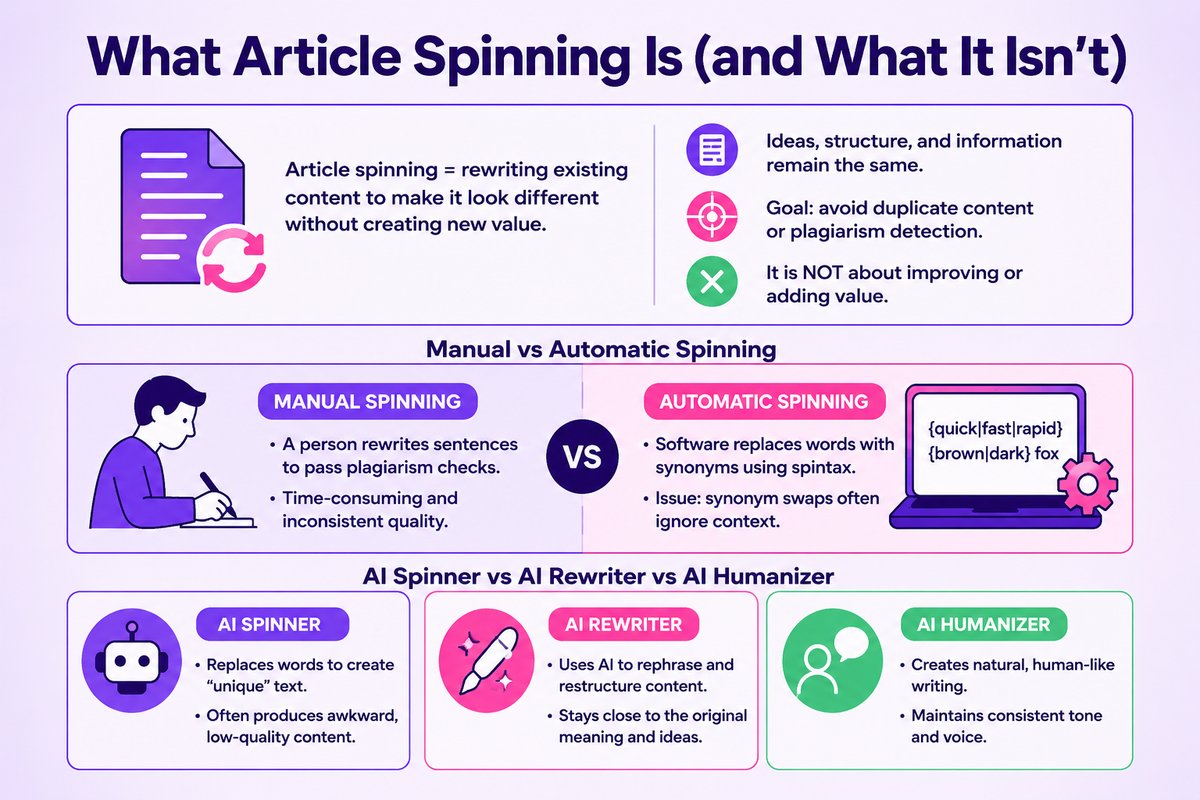
Article spinning is the practice of rewriting existing content to produce text that appears different from the original. The goal is not to create something new or more useful. It is surface-level uniqueness, specifically to avoid duplicate content flags or plagiarism detection.
Spun content is still the same article underneath. The ideas, structure, and information stay the same. Only the words change, and often not for the better.
A 2014 study out of UC San Diego scanned the open web for this. Across more than 400,000 Wikipedia pages and over a million GoArticles submissions, 52% and 7% turned out to be spun. The tell was consistent: once you strip out the words the spinning software swapped, spun versions still scored 90%+ similarity against the original, while unrelated articles scored 27.8%. Spinning doesn’t hide the source. It just rearranges what’s around it.
Manual Spinning vs Automatic Spinning
Manual spinning means a human rewrites an article sentence by sentence to change enough wording to pass a plagiarism check. Automatic spinning uses article spinner software to replace words and phrases with synonyms algorithmically, typically using spintax: {quick|fast|rapid} {brown|dark} fox. The software picks one option from each bracket and assembles a version. Run it again, and you get a different one.
The problem is that synonym substitution does not respect context. “He ran the company” does not mean the same thing as “He sprinted the company.” Article spinner software does not know the difference.
AI Article Spinner vs AI Rewriter vs AI Humanizer (2026 Taxonomy)
In 2026, three tools are often confused:
- Classic article spinner: A spinning tool will replace all instances of each word with other options. Most of the time, this produces poor-sounding copy and is completely incoherent. The only goal of an article spinning tool is to produce unique text.
- AI rewriter: A rewrite tool utilizes a language model to generate alternative ways to phrase a sentence as well as reformat it. Rewrite tools produce much more readable material than spinning tools, but they generally stay very close to their source and do not provide truly rewritten versions.
- AI humanizer: A Humanizing AI tool takes rewriting a step further. The main focus of an AI humanizer is to create content that sounds like it was written by a person and reads naturally, as well as consistently maintains the same tone and voice as the rest of the publication.
Why Article Spinning Existed
In the 2000s and early 2010s, search engines valued volume. The more pages you had, the more chances there were to rank in search results. Likewise, the more links pointing to your website, the greater your credibility. Article spinners allowed webmasters to post the same article across dozens of directories, all linking back to their primary domain. This was a numbers game and worked for a period of time.
The “Cheap Volume” Mindset
Using article spinners was inexpensive. Webmasters who used content farms or affiliate marketing saw the advantage. But there are significant costs associated with using this type of approach, such as clarity, accuracy, distinctiveness in terms of brand voice, and building a relationship with readers based on trust. Bulk spun articles were written solely to be indexed by search engines and have no intention of being read.
Why Article Spinning Fails in 2026
Readability Collapse
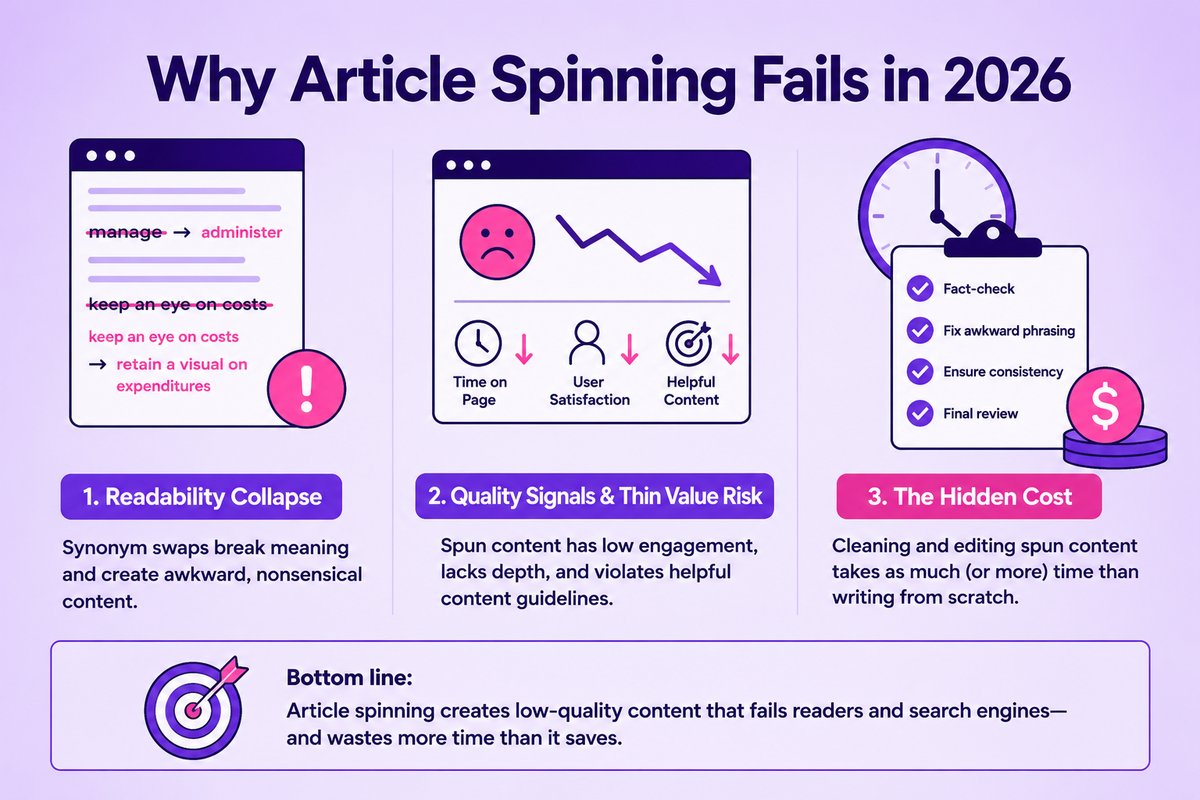
Article Spinners that rely upon synonym substitution for rewriting sentences cause the original statement to break down. For example, replacing “manage” with “administer”, without reviewing whether it would be logical in your particular writing scenario, results in nonsense. Idiomatic expressions such as “keep an eye on costs” converted to “retain a visual on expenditures” immediately appear to be gibberish both to the reader and to search engine algorithms.
Quality Signals and Thin Value Risk
Engagement metrics such as time spent on page and how well users found what they were looking for are now evaluated by search engines. Spun content scores poorly on all of these. It tends to be vague, repetitive in structure, and low on specific information. Google’s helpful content guidance targets pages that exist to manipulate rankings rather than help readers. Spun content fits that description precisely.
The Hidden Cost
While many people think article spinning software is totally free, no one thinks about the time spent cleaning up the spun copy. Every spun article needs fact-checking for distorted facts, incoherent phrasing, and semantic consistency before it can be posted. For almost everyone who uses these tools to create copy, editing a spun article takes just as long, if not longer, than writing a new article from scratch.
Does Article Spinning Work for SEO Today?
The short answer: changing words is not the same as improving content, and search engines are no longer fooled by the difference.
Classic article spinner output can technically produce text that differs from the original at a word level. But uniqueness at the character level is not what search engines reward. They reward relevance, authority, and usefulness. None of these areas is improved upon by spun content.
When It Might Still Appear (and When It Is a Bad Idea)
Article spinning still appears in some very low-risk areas, like generating an internal draft, creating throwaway content for syndication test purposes, or mass placeholder text that will never actually be used as the official version of a page. These types of situations have less inherent risk because the final products do not represent a face of the company, nor are they intended to be seen by the general public.
On the other hand, if you’re creating a piece of content that represents your business, a client’s website, or a monetized blog, then article spinning is just not worth it. The consistency of the spin results can vary greatly. The time spent on editing and cleaning up the content from the spun articles far outweighs the benefits, and there is an actual chance of posting confusing or untruthful information.
Free Article Spinner Tools (and What “Free” Usually Means)
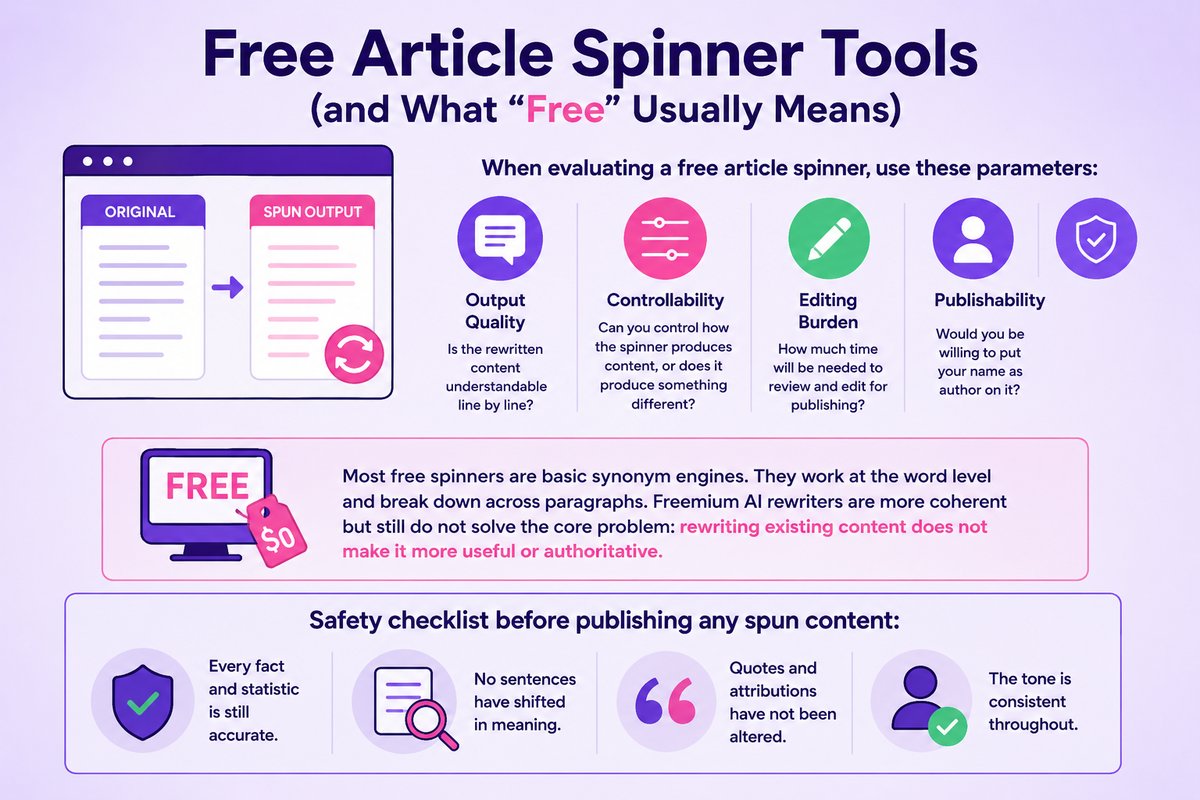
When evaluating a free article spinner, use the following parameters:
- Output quality: Is the rewritten content understandable line by line?
- Controllability: Are you able to control how the spinner produces the content, or does the spinner produce something different from what you wanted?
- Editing burden: After the spinner has produced its results, how much time will be needed to review the product for publishing?
- Publishability: Would you be willing to put your name as author on what was produced?
Most free spinners are basic synonym engines. They work at the word level and break down across paragraphs. Freemium AI rewriters are more coherent but still do not solve the core problem: rewriting existing content does not make it more useful or authoritative.
Safety checklist before publishing any spun content:
- Every fact and statistic is still accurate
- No sentences have shifted in meaning
- Quotes and attributions have not been altered
- The tone is consistent throughout
Can AI Detectors Detect Spun Content?
Yes, AI detectors can often identify spun content.
A 2017 UC Davis study tested this directly. Researchers ran stylometric detection, things like sentence perplexity and vocabulary richness, against more than 150,000 documents, including 13,800 spun with The Best Spinner. The classifier caught spun content with 99.94% accuracy, without ever seeing the spinner’s synonym dictionary.
Structural patterns embedded in spintax-based outputs, like repeating sentence structures and unnatural phrasing, are generally flagged by AI detectors. The detection tools will catch those features, no matter if it was originally written by an AI or not.
Passing a detector isn’t the goal. Passing the test doesn’t necessarily mean you’ve created original content that is factual or publishable. To learn more about how these tools function, take a look at our reviews for Turnitin’s AI detector, as well as our GPTZero review.
Students who use spun content for their schoolwork run a serious risk. See our AI tools for students guide for what is and is not appropriate in academic settings.
What Is the Difference Between an Article Spinner and an AI Humanizer?
An article spinner is built around uniqueness. It changes the text enough to appear different. It does not improve readability, add voice, or make content more coherent.
An AI humanizer is built around publishability. It refines content so it reads naturally, keeps a consistent tone, and varies wording and phrasing the way a person would. The output is created for editing and publishing purposes. The goal is to make it as if the output could be produced by humans rather than simply being different from a source.
A simple test: would you sign your name to the output? Spun content rarely passes that test without significant editing. Well-humanized content is designed to be close to publication-ready from the start.
The Best Alternative to Article Spinning in 2026
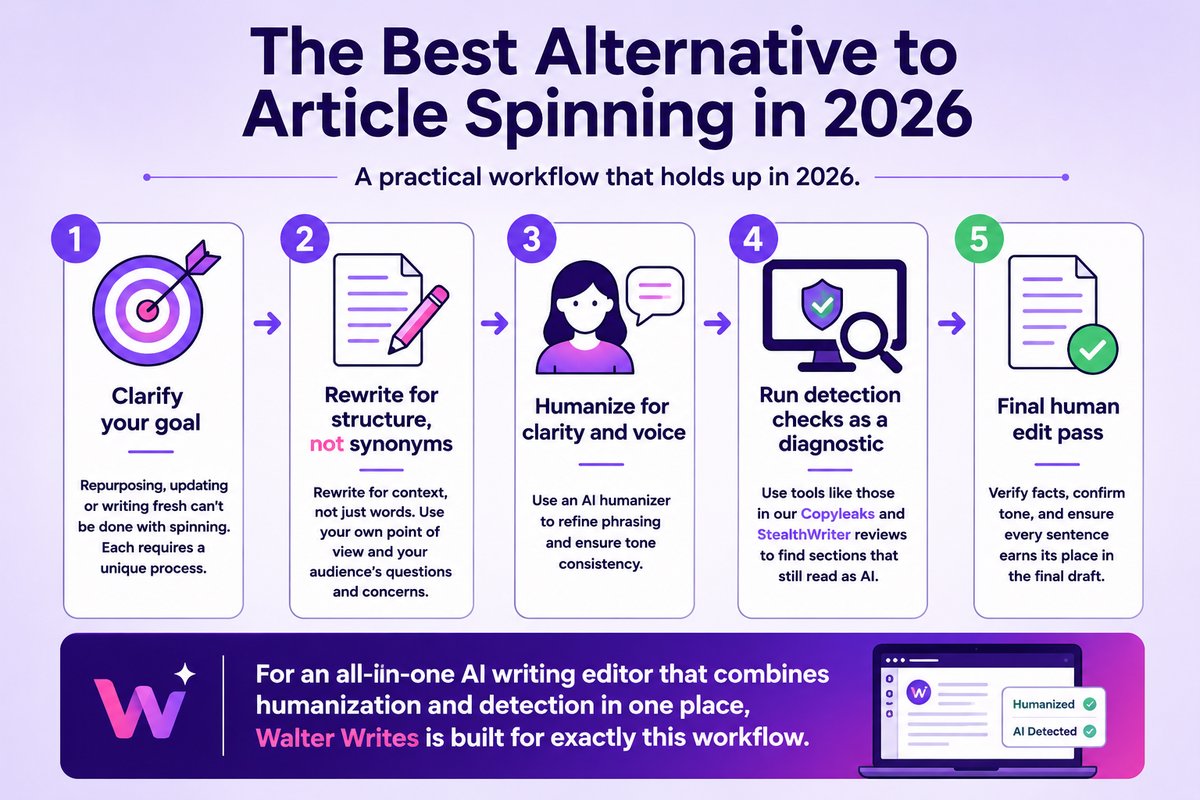
Here is a practical workflow that holds up in 2026:
- Clarify your goal: Repurposing, updating or writing fresh can’t be done with spinning. Each will call for a unique process.
- Rewrite for structure, not synonyms: Content should be rewritten for context. Rewrite based upon your own point of view and the questions and concerns of your target audience.
- Humanize for clarity and voice: Use an AI humanizer to refine phrasing and ensure tone consistency. See our roundup of the best AI humanizer tools for options.
- Run detection checks as a diagnostic: Use tools like those covered in our Copyleaks and StealthWriter reviews to identify sections that still read as AI.
- Final human edit pass: Verify facts, confirm tone, and verify that each sentence has earned its way into the final draft.
For an all-in-one AI writing editor that combines humanization and detection in one place, Walter Writes is built for exactly this workflow.
Conclusion
Article spinning was created for a version of SEO that is considered outdated today. The incentives that made it useful have been eroded by smarter search systems, better detection tools, and readers who expect more.
In 2026, the question is not how to make content look unique. It is about writing articles worth reading. This means you will need to focus on creating quality content with a clear voice, and these things are not possible when using a text spinner.
For those who need to either repurpose or scale their content creation, the most effective approach is a combination of humanizing and an editing review process. That’s why Walter Writes was created as an editor-first platform for both humanizing and reviewing your content in a single workflow, so you can feel confident publishing your work.
FAQs
What Is Article Spinning?
Rewriting existing content using synonym substitution or AI tools to produce text that appears different from the original, typically for SEO or plagiarism evasion.
Is Article Spinning Still Used in 2026?
Yes, but much less than before. Today, most of the people creating articles use either an AI rewriter or an AI humanizer to create rewritten content that has fewer risks and creates a lot better output.
Does Article Spinning Work for SEO?
Not meaningfully. Producing text that differs at the word level does not improve relevance, authority, or usefulness.
Can AI Detectors Detect Spun Content?
Yes, in many cases. Spun content shares structural patterns with low-quality AI-generated text and can be flagged even when no AI was involved.
What Is the Difference Between an Article Spinner and an AI Humanizer?
Article spinners generate variations of the same text. AI humanizers generate completely new, readable content that looks like it was written by a real person. The goal of each tool and the output of each tool are very different from one another.
Is Article Spinning Considered Plagiarism?
In academic settings, yes, generally. In commercial content, it is a grey area, but ethically and practically, it is a poor practice.
Will Spun Content Pass Turnitin or GPTZero?
No. The two tools have dramatically evolved and will detect spun content with new algorithms focused on both structural elements of the content as well as phrasing. See our Turnitin AI detector review for a full breakdown.
Does Google Penalize Spun Content?
Not with manual penalties in most cases, but spun content consistently underperforms on the signals that determine rankings.
What Is the Best Alternative to Article Spinning in 2026?
A structured content development process using real rewriting, AI humanizing, detecting and verifying authenticity with one additional proofread. Tools such as the ones listed in our best AI humanizer tools are a good place to start.
Can an AI Humanizer Replace an Article Spinner?
For any content that is going to be published and needs to be trusted by readers, yes. Article spinners produce variation. Humanizers produce publishing-quality content.