






A research paper outline is a structured plan that maps your thesis, the main claim of each body section, and the sources that support each claim, before you start writing. Most outlines have three parts: an introduction with your thesis, 3 to 5 body sections (claim, evidence, explanation), and a conclusion.
Many students skip outlining altogether and start with the actual write-up. Then they become stuck in the middle, realize that their arguments do not make sense, and must completely reorganize their work.
An outline fixes that by organizing your ideas before you write. This guide shows you which outline format to use, how to build one from your research notes, and how to turn it into a full draft. You can also download all three templates as a Word file.
What Is a Research Paper Outline (and Why Is It Different from an Essay Outline)?
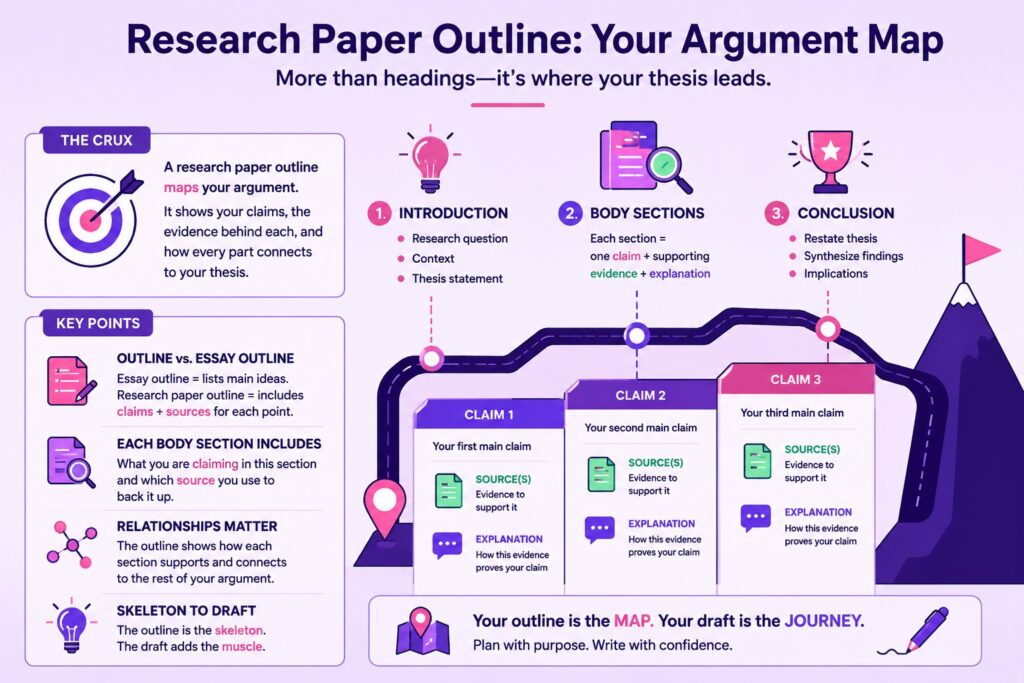
A research paper outline is not just a list of headings. It maps the argument your thesis makes: each point you will argue, the evidence behind each claim, and how the sections connect.
An essay outline generally lists the main idea or points. In contrast, a research paper outline includes both claims and sources to support those claims. Each body section should include two things: what you are claiming in this section, and which source you use to back up that claim.
The basic structure looks like this:
- Introduction: Research question, context, thesis statement
- Body sections: Each one = one claim + supporting evidence + explanation
- Conclusion: Restate thesis, synthesize findings, implications
Think of the outline as the skeleton. The draft is adding muscle to it. If you are new to academic writing, the Walter Writes hub for student writing and research workflows covers related guides worth bookmarking.
The 3 Main Outline Formats (and Exactly When to Use Each)
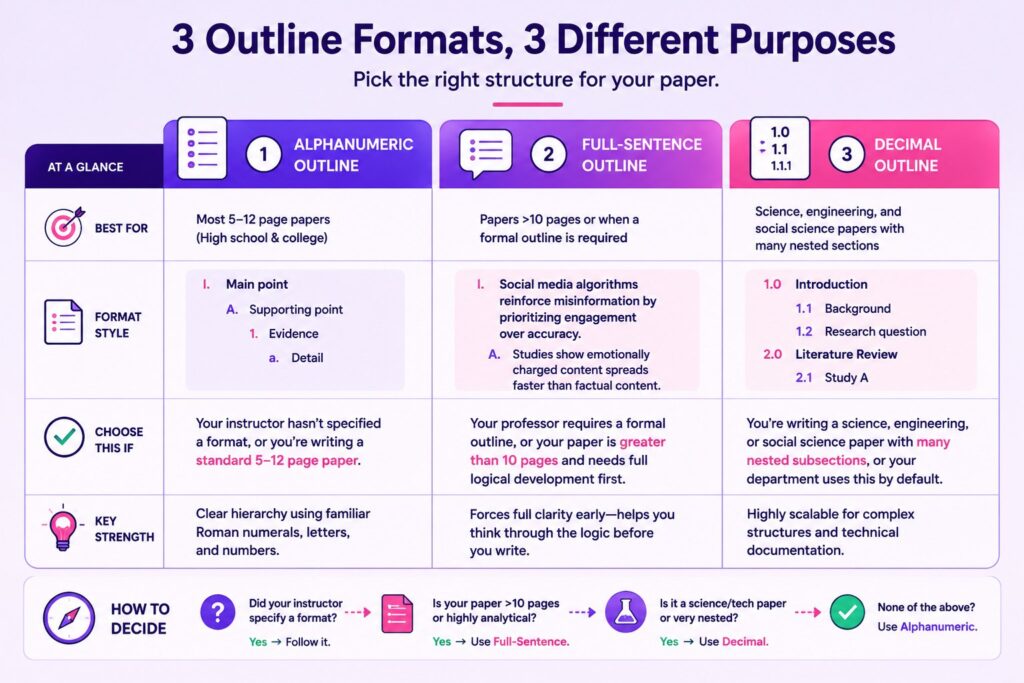
Most resources define these formats, but leave students guessing which one fits their assignment. Here is the decision guide they skipped.
Alphanumeric Outline
The most common format. It uses Roman numerals, capital letters, Arabic numbers, and lowercase letters to show hierarchy. Purdue OWL’s guide to outline types covers the conventions in more detail.
I. Main point
    A. Supporting point
        1. Evidence
            a. Detail
Choose this if: Your instructor hasn’t specified a format, or you’re writing a standard 5 to 12-page paper. This is the default for most high school and college assignments.
Full-Sentence Outline
In a full-sentence outline, every entry is a complete sentence. It takes longer to write, but it forces you to decide exactly what you want to say before you draft.
I. Social media algorithms reinforce misinformation by prioritizing engagement over accuracy.
    A. Studies show emotionally charged content spreads faster than factual content.
Choose this if: your professor requires a formal outline, or your paper is longer than 10 pages and you want the logic worked out before you start.
Decimal Outline
Uses a numbered system (1.0, 1.1, 1.1.1) instead of letters and numerals. Common in scientific and technical writing.
1.0 Introduction
    1.1 Background
    1.2 Research question
2.0 Literature Review
    2.1 Study A
Choose this if: You are writing a science, engineering, or social science paper with many nested subsections, or your department uses this format by default.
Topic Outline vs. Sentence Outline: The Difference That Changes Your Grade
Both can use an alphanumeric hierarchy. The difference is how each entry is written.
A topic outline uses fragments:
II. Effects of sleep deprivation
    A. Cognitive impairment
    B. Emotional dysregulation
A sentence outline uses complete sentences:
II. Sleep deprivation causes measurable cognitive and emotional impairment in young adults.
    A. Sleep-deprived students score significantly lower on memory and attention tasks.
    B. Emotional regulation declines after fewer than six hours of sleep.
When using the sentence version of an outline, you have to make a commitment to the arguments. Topic outlines are quicker, but they are easier to fill with vague claims.
Common mistake: mixing fragments and full sentences in the same outline. Pick one style and use it at every level. If your instructor asks for a “sentence outline,” every entry must be a full sentence.
Step-by-Step: How to Write an Outline for a Research Paper
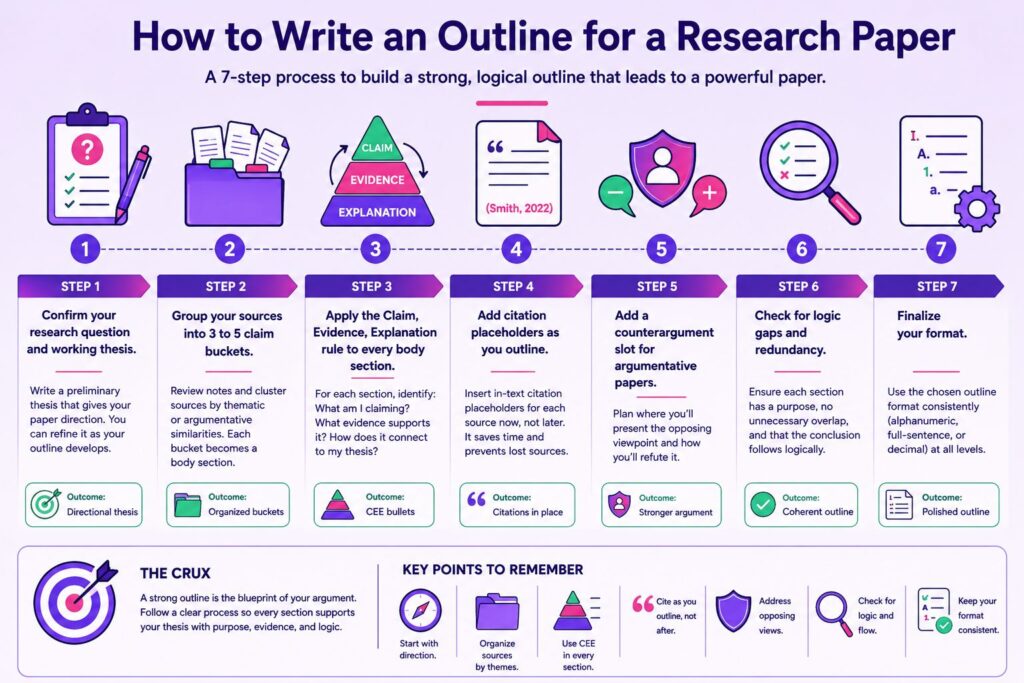
Step 1: Confirm your research question and working thesis.
You don’t need a final draft of a thesis to start outlining. You just need an initial directional thesis, which can be something like this: “Social media algorithms contribute to political polarization by prioritizing engagement over accuracy.” As the thesis begins to develop from the outline, you can continue to refine it.
Step 2: Group your sources into 3 to 5 claim buckets.
Reviewing your notes will help you group your sources based on their thematic or argumentative similarities. Each grouping represents a body section. If you find that your sources naturally fall into four themes, then you will have four body sections.
Step 3: Apply the Claim, Evidence, Explanation rule to every body section.
The CEE model states that each of your main points should contain three elements: Claim, Evidence, and Explanation. That means for each category you can ask yourself: What am I claiming about this subject? What does my data show that supports this claim? How does this support my thesis? Following the CEE model allows you to turn general titles of topics into actual outline bullet points containing some level of detail.
Step 4: Add citation placeholders as you outline.
After each point, add a citation placeholder: (Smith, 2022) for APA or (Smith 45) for MLA. Do this while you outline, not after. Leaving references until the end is one of the most common reasons students lose track of their sources.
Step 5: Add a counterargument slot for argumentative papers.
Decide where your paper will address the opposing view and how you will refute it. Leaving out the counterargument is one of the most common structural gaps in college papers.
Step 6: Check for logic gaps and redundancy.
Review the entire outline. Is there a reason for each section? Are items duplicated throughout any section? Does the conclusion flow logically from the body, or does it introduce new information?
Step 7: Finalize your format.
When you have established that the logic works within your paper, then clean up the formatting. Ensure that you use consistent alphanumeric, sentence, or decimal formatting throughout all levels of the paper.
Turning outline bullets into prose can leave some paragraphs stiff. If a section reads rough, Walter Writes’ AI humanizer can smooth the wording without changing your argument.

Research Paper Outline Template (Copy and Paste)
Prefer a file? Download all three templates (Word, .docx) and fill in your own claims and sources.
Template A: Alphanumeric
I. Introduction
    A. Hook/context
    B. Background information
    C. Thesis statement
II. Body Section 1: [Claim]
    A. Supporting point
        1. Evidence (Author, Year)
        2. Explanation of how it supports the claim
III. Body Section 2: [Claim]
    A. Supporting point
        1. Evidence (Author, Year)
        2. Explanation
IV. Body Section 3: [Claim]
    A. Supporting point
    B. Supporting point
V. Conclusion
    A. Restate thesis
    B. Synthesize key findings
    C. Broader implications
Template B: Full-Sentence
Same structure as Template A. Every entry, including sub-points, is written as a complete sentence.
Template C: Decimal
1.0 Introduction
    1.1 Context and background
    1.2 Research question
    1.3 Thesis statement
2.0 [First Main Claim]
    2.1 Supporting point
        2.1.1 Evidence (Author, Year)
        2.1.2 Analysis
3.0 [Second Main Claim]
4.0 [Third Main Claim]
5.0 Conclusion
    5.1 Restatement of thesis
    5.2 Summary of findings
    5.3 Implications
Research Paper Outline Examples
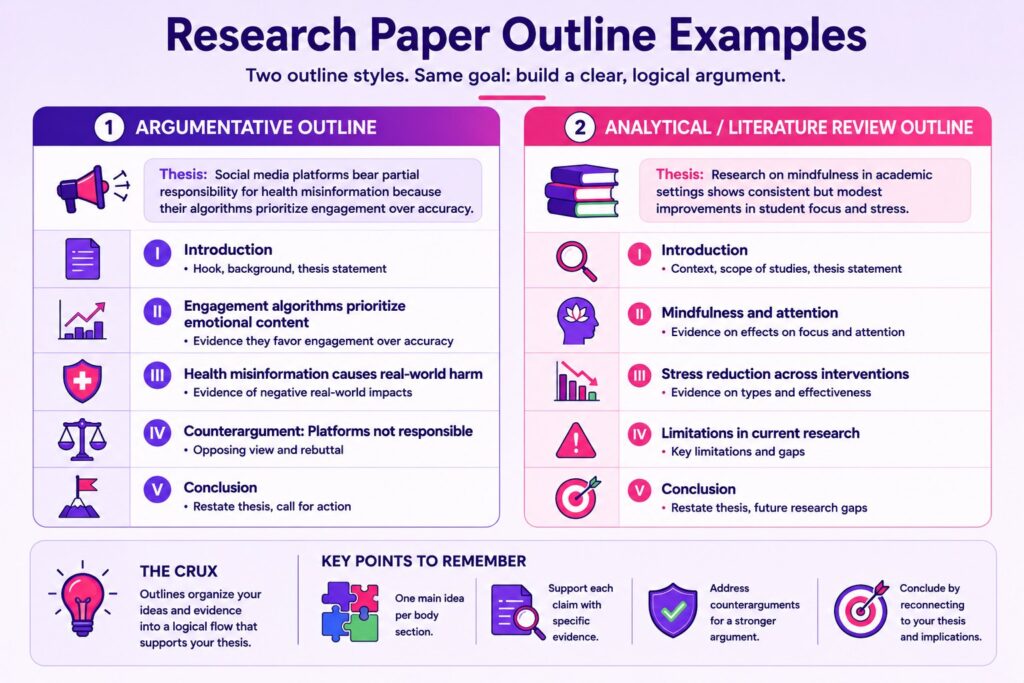
Example 1: Argumentative Research Paper Outline
Thesis: Social media platforms bear partial responsibility for health misinformation because their engagement-first algorithms deprioritize accuracy.
I. Introduction
    A. Hook: COVID-19 vaccine misinformation outraced WHO updates on Facebook
    B. Background: Social media as a primary news source
    C. Thesis statement
II. Engagement algorithms prioritize emotional content over factual accuracy
    A. False news reached people about 6x faster than true news (Vosoughi et al., 2018)
    B. Platform design rewards shares over corrections
III. Health misinformation causes real-world harm
    A. Vaccine hesitancy linked to social media exposure (Loomba et al., 2021)
    B. Patients citing social media over clinical advice
IV. Counterargument: Platforms are not responsible for user content
    A. Section 230 legal framework
    B. Rebuttal: Algorithmic amplification is a platform choice
V. Conclusion
    A. Restate thesis
    B. Call for algorithmic transparency regulation
Example 2: Analytical / Literature Review Outline
Thesis: Research on mindfulness in academic settings shows consistent but modest improvements in student focus and stress.
I. Introduction
    A. Growing interest in mindfulness in education
    B. Scope: studies from 2015 to 2024
    C. Thesis statement
II. Mindfulness and attention
    A. Brief mindfulness training reduces mind-wandering (Mrazek et al., 2013)
    B. Effects stronger in younger students
III. Stress reduction across intervention types
    A. App-based vs. in-person programs
    B. 8-week programs outperform single-session interventions
IV. Limitations in current research
    A. Small sample sizes
    B. Self-reported outcomes introduce bias
V. Conclusion
    A. Restate thesis
    B. Gaps for future research
APA vs. MLA Research Paper Outline: What Changes (and What Does Not)
The logic, hierarchy, and claim structure of your outline do not change based on citation style. What changes is a handful of formatting details.
In an APA outline: Use Author-Year citation placeholders (Smith, 2022). If your paper requests that you include an abstract with your final draft, place this at the beginning of your document and label it as such before the introduction section. Follow APA heading levels if your professor has indicated they want headings to be formatted according to APA guidelines.
In an MLA outline: Use Author-Page placeholders (Smith 45). MLA outlines usually skip the abstract, and MLA does not require a specific heading style, so follow your instructor’s preference. The MLA Style Center covers the paper format itself.
Quick checklist before you submit your outline:
- Were there specific topics or formats specified by your instructor for this assignment?
- Do all of your citations show the same type of placeholder in each reference entry?
- In APA style only, are abstracts included in the outline?
- In addition to having a title for each body section, does each body section contain at least one source to support it?
How Long Should a Research Paper Outline Be?
| Paper Length | Recommended Outline Length |
|---|---|
| 3 to 5 pages | 1 page, 3 to 4 body sections |
| 8 to 12 pages | 1 to 2 pages, 4 to 5 body sections |
| 15+ pages | 2 to 3 pages, 5+ body sections with subsections |
Before researching, create an initial working outline of what you are writing about to help you organize your research as you read. Then, once you have gathered all of your resources, review and revise this original working outline into the final outline you will be using for drafting.
After your first draft, check your work for AI flags before you submit, especially if you used AI tools for research or editing.
How to Turn an Outline into a Full Paper
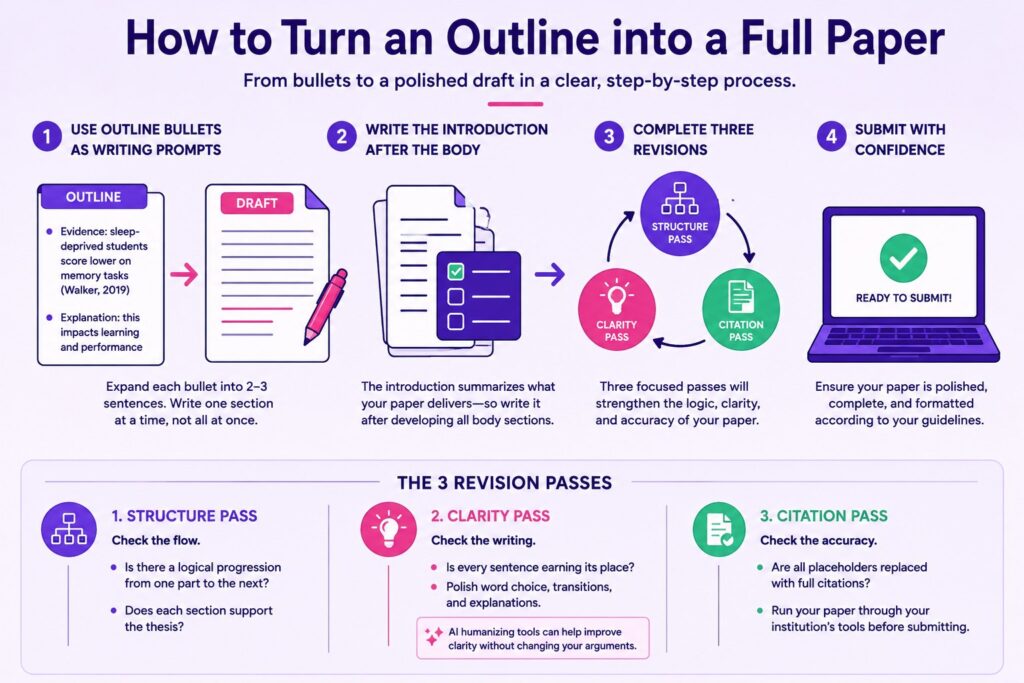
Take each of the outline bullets and use them as writing prompts. If your bullet reads “Evidence: sleep-deprived students score lower on memory tasks (Walker, 2019),” then write two to three sentences to expand upon this evidence. Write one section at a time and not all sections at once.
Write your introduction last. It promises what the paper will deliver, so it is much easier to write once the body exists.
Then complete three revisions prior to submitting:
- Structure pass: Is there a logical progression in the argument from one part of the paper to the next?
- Clarity pass: Is every sentence earning its place? If you feel that your writing could be a little polished but do not want to change your arguments, then using the best AI humanizing tools can help improve the clarity.
- Citation pass: Are all placeholders replaced? When you submit your work, find out how your institution’s tools will read your work.
Most schools run submissions through an AI detector, usually Turnitin. Our Turnitin AI detector review explains how it reads student work.
Research Paper Outline FAQs
What Are the Main Sections of a Research Paper Outline?
Introduction with thesis, three to five sections for body paragraphs, with each body paragraph having a claim, supporting evidence, and, in some cases, a counterargument section for argumentative or persuasive papers. A concluding section with a summary of all aspects of the research.
How Do You Write a Thesis Statement in an Outline?
Add the thesis statement at the very end of your introductory segment, which is supposed to summarize your entire position and can allow someone else to predict what your topic sections will be based on your thesis.
How Do You Format a Research Paper Outline in APA?
The most common hierarchy for this type of formatting is alphanumeric. Create an Abstract Placeholder if necessary. Use Author-Year citation placeholders like (Smith, 2022). If specified by your professor, follow APA’s heading structure.
How Do You Format a Research Paper Outline in MLA?
The same alphanumeric hierarchy applies here. There are no abstracts. Use Author-Page placeholders like (Smith 45). If your professor prefers headings, then adhere to their preference, but MLA does not require you to follow a particular heading system.
Should You Write the Outline Before or After Doing Research?
Both. You should create a lightweight outline prior to researching so that you can use it to help organize your reading. Once you have collected all of your references and gathered enough information from them, you will need to revise your outline based on the real claims and evidence you have uncovered during your research.
What Does a College Research Paper Outline Look Like?
Alphanumeric format, thesis statement in introduction, body sections organized by specific claims rather than vague topics, and evidence placeholders at each supporting point