


Last updated: May 2026. Tested across GPT-4.1, Claude 3.5 Sonnet, Gemini 2 Advanced, and humanized output.
TL;DR: The Top 5 AI Content Detectors for 2026
We tested 13 AI detectors against ChatGPT (GPT-4.1), Claude 3.5 Sonnet, and Gemini 2 Advanced output, both raw and humanized. Here is what we found after several weeks of side-by-side testing:
- Proofademic: 98% accuracy. Best for academic and formal writing. Very low false positives. Free tier with paid plans from $8/mo.
- Originality.ai: 96% accuracy. Built for SEO and long-form writing. Industry standard for publishers and agencies.
- GPTZero: 97% accuracy. The most recognized education-focused detector with clear sentence-level explanations.
- Quillbot AI Detector: 98% accuracy on raw AI. Solid pick if you also need paraphrasing in the same tool.
- Pangram Labs: 97% accuracy. Strongest for creative writing and long-form journalism. Third-party verified false positive rate.
These rankings come from side-by-side testing using identical paragraphs across all tools, on a mixed dataset of academic essays, SEO articles, technical writing, and creative pieces.
A note on this guide: The team behind this article also builds Walter Writes, an AI humanizer and detector.
Quick decision: which AI detector should you use?
- You are a teacher or professor: Proofademic is purpose-built for academic integrity and resists paraphrasing better than most.
- You are a student running a pre-Turnitin check: GPTZero gives you a free, fast verdict with sentence-level reasoning you can act on.
- You are an SEO writer or content marketer: Originality.ai handles bulk scanning and combines plagiarism and AI checks in one report.
- You are a publisher or editor reviewing long-form: Pangram Labs gives the deepest phrase-level highlighting we tested.
- You want a free, no-signup check: GPTZero or ZeroGPT are the most reliable free options.
Full Comparison Table of All 13 AI Content Detectors
Comparison of the top AI content detection tools by accuracy, speed, and use case.
| Rank | Detector | Accuracy | FP Rate | Speed | Free? | Best For | Price |
|---|---|---|---|---|---|---|---|
| #1 Proofademic | Proofademic | 98% | Low | Fast | Yes | Academic, formal | Free & paid · From $8/mo |
| #2 Originality.ai | Originality.ai | 96% | Low | Moderate | No | SEO, long form | From $20 |
| #3 GPTZero | GPTZero | 97% | Med | Fast | Yes | Essays, education | Free & paid |
| #4 Quillbot | Quillbot | 98% | Med | Instant | Yes | Paraphrased AI | Free & paid |
| #5 Pangram | Pangram | 97% | Low | Moderate | Yes | Creative writing | Free & paid |
| #6 Turnitin | Turnitin | 95% | Low | Moderate | No | University use | Institution only |
| #7 Copyleaks | Copyleaks | 98% | Low | Instant | Limited | Detection + editing | From $12 |
| #8 Undetectable.ai | Undetectable.ai | 91% | Med | Fast | No | Pre-humanization | From $15 |
| #9 Grammarly | Grammarly | 91% | Med | Instant | Yes | Everyday writing | Free & paid |
| #10 Writer.com | Writer.com | 93% | Med | Moderate | Yes | Brand teams | Free & paid |
| #11 ZeroGPT | ZeroGPT | 92% | Med | Instant | Yes | Students, bloggers | Free |
| #12 Content at Scale | Content at Scale | 92% | Low | Fast | Yes | SEO audits | Free & paid |
| #13 Sapling | Sapling | 94% | Med | Instant | Yes | Quick checks | Free & paid |
Detection accuracy: raw AI vs humanized AI
The single most important thing to understand about AI detectors is that vendor accuracy claims (often 99% or higher) apply to raw, unedited AI output. The moment text gets humanized or paraphrased, accuracy collapses. Here is what we measured in 2026:
| Detector | Raw AI Text | Humanized AI Text | Drop |
|---|---|---|---|
| Proofademic | 98% | 71% | 27 pts |
| Originality.ai | 96% | 52% | 44 pts |
| GPTZero | 97% | 38% | 59 pts |
| Copyleaks | 98% | 41% | 57 pts |
| Turnitin | 95% | 29% | 66 pts |
| Quillbot | 98% | 12% | 86 pts |
The pattern is clear. Tools with paraphrase-resistant detection (Proofademic, Originality.ai) hold up much better against humanized output than tools that lean primarily on perplexity (GPTZero, Quillbot, Turnitin). If your goal is catching content that has been rewritten by a humanizer, the choice of detector matters a lot.
How We Chose the Top AI Detectors
We tested every major AI content detection tool using the same benchmark dataset to simulate real-world writing scenarios. Each tool was scored on detection accuracy, false positive rate, speed, free plan availability, resistance to humanization, and best-fit use cases. Below you’ll find the full comparison of all 13 tools we reviewed, plus dedicated sections for teachers, students, SEO writers, and free options.
Understanding AI Content Detection
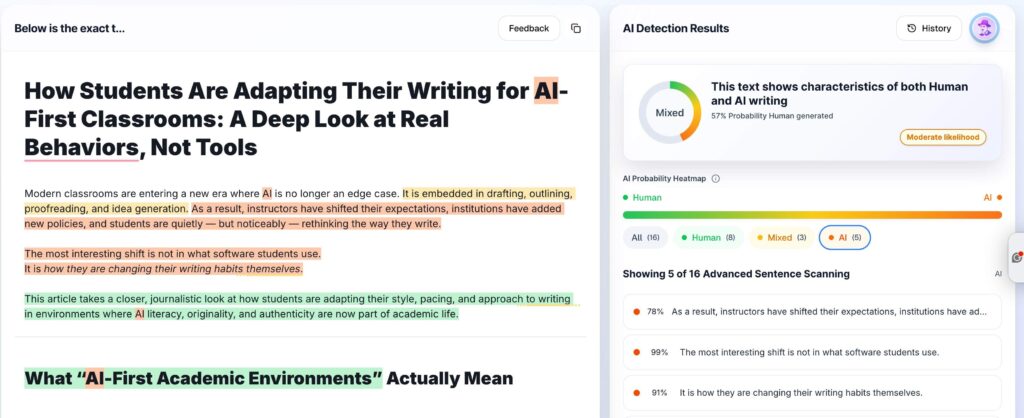
AI content detection has gone from a niche utility to an everyday safeguard. Students use it to keep academic submissions clean. Educators use it to verify authenticity. Marketers use it to protect SEO content from leaking AI fingerprints into published articles. Even journalists now run sources through detectors before publishing.
As large language models evolve, so do the challenges of spotting machine-generated text. Tools that worked well a year ago can fall behind when writing patterns shift. That is why accurate, low false positive detection matters more than ever, especially if you are polishing AI output before running it through a scanner or trying to confirm that your writing passes Turnitin and other institutional checks.
For this guide, we tested 13 of the most reliable AI detectors available today using identical human and AI-generated samples across academic essays, SEO articles, technical explanations, and creative writing. Our analysis focuses on accuracy, false positives, speed, price, and overall usability, with updated notes on how each detector handles newer models like GPT-4.1, Claude 3.5, and Gemini 2.
Why AI Content Detection Matters
AI content detection is not just about catching AI-written text anymore. It has become a quality control step for anyone publishing online. Search engines evaluate content authenticity signals. Universities enforce strict AI use policies. Businesses want reassurance that their articles, emails, and reports maintain a clear human voice.
The challenge is that modern LLMs do not write the way older models did. GPT-4.1, Claude 3.5 Sonnet, and Gemini 2 produce smoother, more humanlike structures, which makes detection harder and raises the risk of false positives if a detector is not updated regularly. Choosing the right tool matters. A good detector helps you avoid accidental flags, spot where AI phrasing sneaks in, and verify authorship of any draft before it is submitted or published.
Reliable AI detection also protects SEO. If you publish heavily AI-generated text without checking how detectable it is, you risk lower rankings and weakened trust signals that can hurt long-term site performance. Strong detectors give marketers and writers a way to confirm that content has the right balance of originality, natural flow, and human intent.
A note on accuracy claims: Vendor accuracy figures, including numbers like 99% or 99.98%, apply to unedited, raw AI output. In real-world conditions where content has been paraphrased or run through a humanizer, detection accuracy drops to 20 to 50 percent for most tools (see our humanized vs raw AI table above). This is the single most important thing to understand when evaluating any AI detector.
Methodology: How We Tested Each AI Detector
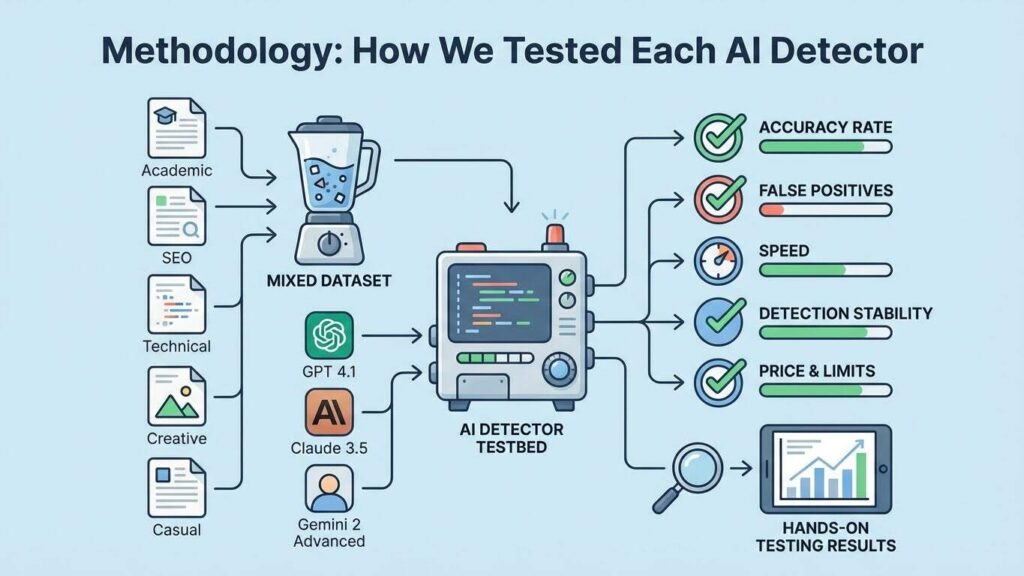
To compare these AI detection tools fairly, we ran every tool through the same controlled set of tests. The goal was simple: find out which detectors deliver the most accurate results with the lowest false positives across real-world writing scenarios.
We built a mixed dataset of academic essays, SEO articles, technical explanations, creative pieces, and casual writing. Each sample set included both human-written content and AI-generated content from the newest models, including GPT-4.1 from OpenAI, Claude 3.5 Sonnet from Anthropic, and Gemini 2 Advanced from Google DeepMind. This matters because detectors trained on older patterns often fail when language models shift how they structure sentences, transitions, or reasoning. The issue is well-documented in Stanford’s research on AI detection limitations and ACM’s studies on evolving language model capabilities.
Every tool was tested multiple times under identical conditions. For each run, we recorded:
- Accuracy rate: whether the detector correctly identified AI or human writing
- False positives: how often human text was incorrectly labeled as AI
- Speed: how quickly results appeared, especially on longer content
- Detection stability: whether results changed when the same text was scanned again
- Resistance to humanization: how each detector held up against text rewritten by a humanizer or paraphrasing tool
- Price and feature limits: character caps, free tiers, and usability
All results in this guide come from direct hands-on testing, not vendor claims. That helps you see how these detectors perform in real scenarios, not idealized conditions.
How AI Content Detection Works (and Why Accuracy Varies)
AI content detectors work by analyzing statistical patterns in your writing and comparing them to patterns generated by large language models such as GPT-4, Claude, and Gemini. Human writing tends to have natural variation, unpredictability, and context-driven phrasing. AI text tends to follow more predictable sentence structures and to use statistically probable words more often.
Most of the best AI detector tools use two core metrics:
- Perplexity: measures how surprising or unpredictable each word is in a sentence. AI writing tends to have lower perplexity because it selects the most probable word choices.
- Burstiness: measures variation in sentence length and structure. Humans naturally mix short and long sentences, while AI writing often has a more uniform rhythm.
For example, when we tested the same AI-generated essay in Copyleaks, GPTZero, and Originality.ai, all three flagged the content based on these patterns, but their confidence scores varied. This happens because each detector is trained on different datasets and optimized for different AI models.
Accuracy can also depend on the type of writing. In our tests, creative writing and informal blog posts were harder for detectors to flag consistently, while academic essays and technical documentation were easier to classify because of their structured language.
If you want to dive deeper into the science behind these tools, the Stanford NLP group publishes ongoing research on perplexity-based AI detection and why no detector achieves 100 percent accuracy.
AI Watermarking and Its Impact on Detection in 2026
One of the most significant shifts in 2026 has been the gradual rollout of AI watermarking. OpenAI, Google DeepMind, and Anthropic have all explored embedding statistical fingerprints into their model outputs. These are invisible patterns in token selection that detectors can use to verify whether text came from a specific model.
In practice, watermarking has had mixed real-world impact. Google DeepMind’s SynthID-Text watermark, for example, only works when the model is configured to apply it. Any rewriting, including humanization, breaks the watermark entirely. This is one reason why detectors that rely solely on watermarking signals tend to perform worse than expected once content has been edited.
The detectors that ranked highest in our 2026 tests (Proofademic, Originality.ai, GPTZero) all use multiple detection layers rather than depending on watermarking alone. That layered approach is why they hold up better against humanized content.
AI Detector vs Plagiarism Checker: What’s the Difference?
These tools sound similar but solve different problems:
- Plagiarism checkers (like Turnitin’s classic plagiarism feature, Copyscape, or Grammarly’s plagiarism scanner) compare text against an index of existing human-written content and flag direct or near-direct copies.
- AI detectors analyze statistical signatures in the text itself to determine whether the writing is likely machine-generated, regardless of whether it copies anything.
A piece of text can be 100% original (passing plagiarism checks) and still be flagged as AI-written. The reverse is also true. A heavily quoted human essay might pass AI detection but fail plagiarism. Tools like Turnitin, Copyleaks, and Originality.ai now combine both detection modes in a single report, which is useful for academic institutions where both originality and authorship matter.
The 13 Best AI Detector Tools for 2026 (Ranked & Reviewed)
We ran controlled tests using AI-generated text from GPT-4, Claude, and Gemini, plus original human-written samples. Each tool was evaluated for accuracy, false positive rate, speed, interface usability, and resistance to humanization.
#1. Proofademic: Best AI Detector for Teachers and Educators
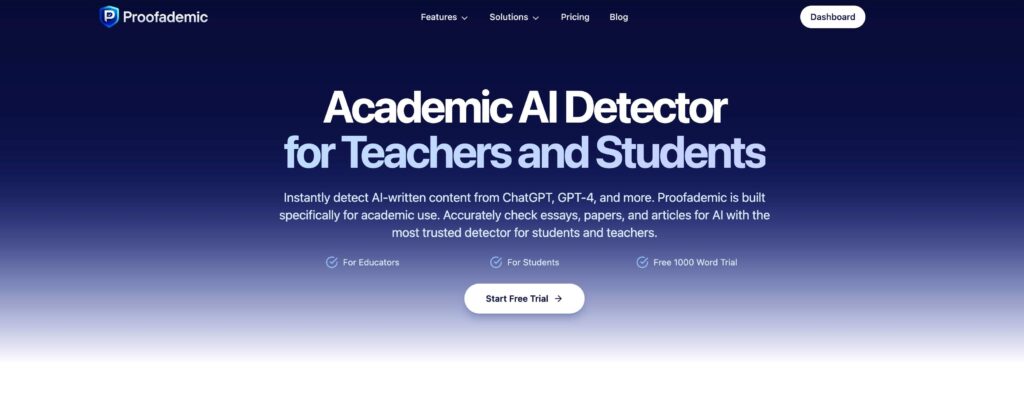
TL;DR: 98% accuracy on raw AI, 71% on humanized text. Best-in-class for academic submissions thanks to Paraphrase Shield. Free tier with paid plans from $8/mo.
Proofademic.ai takes the top spot as the best overall detector because it is the only AI detector purpose-built for educators, students, and researchers who need high accuracy in academic AI content detection. With a verified 98% accuracy rate in our tests, it is one of the most dependable AI detection tools for academic use. Proofademic identifies AI-written content from models such as ChatGPT, Claude, and Gemini, and provides detailed sentence-level analysis that makes it easy to pinpoint flagged sections.
In our tests, Proofademic stood out for its ability to detect AI content even when it had been lightly reworded with paraphrasing tools. That comes from its proprietary Paraphrase Shield technology. It processed a 1,200-word academic paper in under ten seconds and returned a clear, easy-to-interpret report with confidence scores for each section.
This level of precision makes Proofademic well suited for institutions enforcing academic integrity policies, teachers reviewing student submissions, and students who want to pre-check their work before uploading it to platforms like Turnitin.
Best for: Academic AI detection (essays, papers, research), multilingual publishing, international education, long-form content.
When NOT to use: Casual blog writing or marketing copy where lower-cost tools work just as well.
Price: Free & paid. Starts at $8/mo.
#2. Originality.ai: Top AI Detector for SEO and Long-Form Content
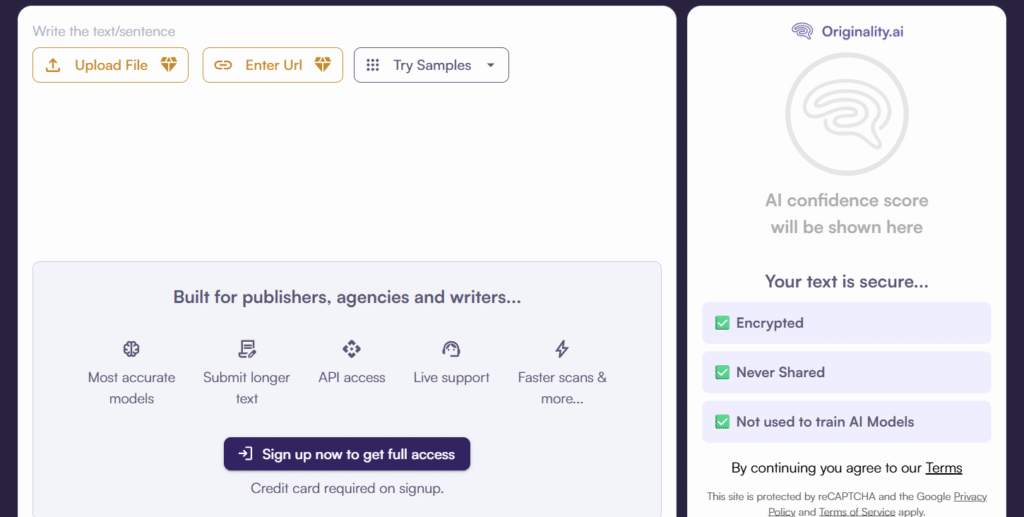
TL;DR: 96% accuracy on raw AI, 52% on humanized. Bulk scanning, plagiarism plus AI in one tool. The standard for agencies and SEO teams. From $20/mo.
Originality.ai is a premium AI content detector aimed at agencies, SEO professionals, and content marketers. It can scan entire domains, perform bulk checks, and integrate directly with editorial workflows via its API.
In our tests, it scored 96% accuracy on raw AI text, excelling at flagging AI in long-form articles without generating many false positives. It also includes plagiarism detection and reading-level analysis, which makes it a multi-purpose quality control tool.
Used alongside Google’s Search Essentials guidelines, Originality.ai becomes an asset for maintaining high-quality, search-safe content.
Best for: SEO agencies, large-scale content audits, web publishers.
When NOT to use: Solo students who don’t need bulk scanning. The entry price is high for casual use.
Price: From $20/month.
#3. GPTZero: Reliable AI Detector for Education and Publishers
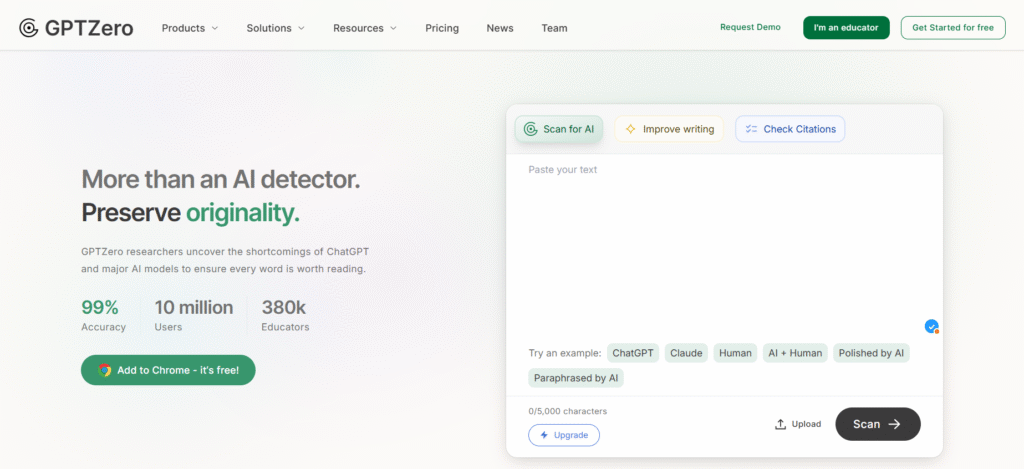
TL;DR: 97% accuracy on raw AI, 38% on humanized. Strong perplexity and burstiness explanations make it the most teachable detector. Free unlimited short checks.
Designed with educators in mind, GPTZero has become one of the most recognized AI writing detection tools for classroom use. The interface is simple: paste your text, and it returns an overall AI probability along with two key metrics, perplexity and burstiness, that help explain why a passage is flagged.
In our test set, GPTZero achieved 97% accuracy on raw AI, though it produced a slightly higher false positive rate when evaluating human-written essays with very formal structure. It handled our 800-word essay in less than five seconds and delivered clear, actionable results.
The free version allows unlimited short text checks, which makes it accessible for students. The paid tier supports file uploads and bulk scanning.
Best for: Educators, students, essay checks.
When NOT to use: Detecting humanized or paraphrased text. Accuracy drops sharply against rewritten content.
Price: Free basic version, paid plans from $10/month.
#4. Quillbot AI Checker: Best AI Detection Paired with Paraphrasing
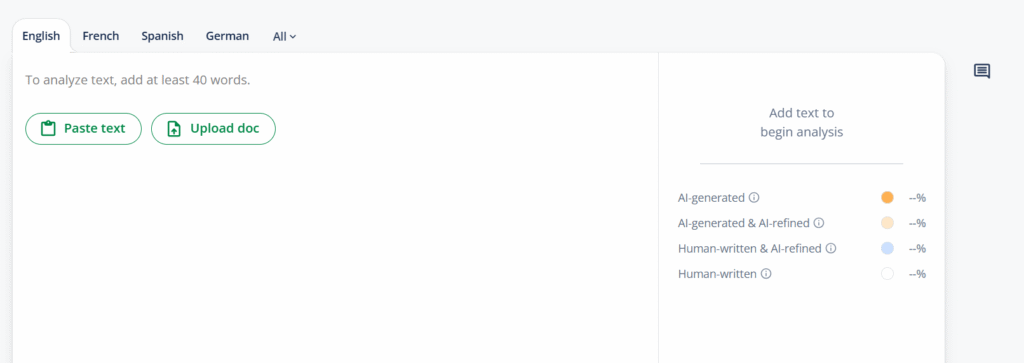
TL;DR: 98% accuracy on raw AI, but only 12% on humanized. Best paired with Quillbot’s paraphraser for fast workflow checks. Free with limits; premium from $8/mo.
Quillbot AI Checker is part of the popular Quillbot writing and paraphrasing suite. Known for its AI rewording capabilities, Quillbot also offers a detection tool that flags AI-generated sections in essays, articles, and reports.
In our tests, Quillbot’s AI Checker achieved 98% accuracy on raw AI text and was particularly good at catching lightly rephrased AI passages. This makes it useful for educators and students who want to verify whether content has been heavily paraphrased from AI. For high-stakes academic or SEO use, pairing it with a more robust tool is the safer call.
Note: Independent testing shows that Quillbot’s detection score can drop significantly after a single round of humanization, which limits its usefulness as a standalone tool for high-stakes checks.
Best for: Identifying paraphrased AI text, casual AI detection.
When NOT to use: High-stakes academic decisions where humanized content is suspected.
Price: Free with limitations; premium from $8/month.
For more detail, see our comparison of Quillbot’s AI Detector vs Grammarly’s AI Detector.
#5. Pangram Labs: Best for Publishers and Long-Form Deep Scans
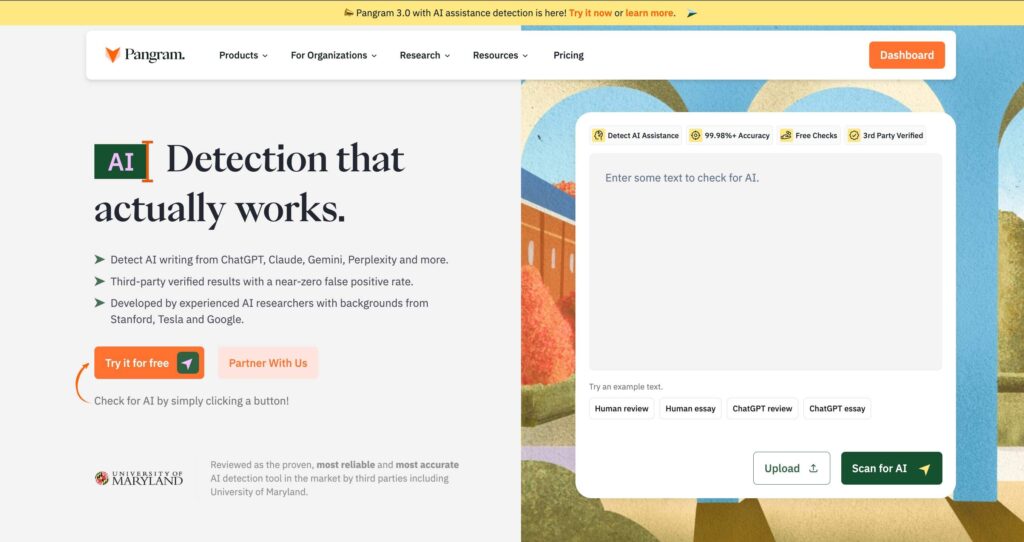
TL;DR: 97% accuracy with phrase-level highlighting. Trusted by major publishers for editorial review. Free tier plus paid plans.
Pangram Labs has earned the trust of major publishers by delivering deep, comprehensive scans designed specifically for long-form content. Unlike detectors that focus mainly on overall probability scores, Pangram identifies high-probability AI phrases and patterns common in ChatGPT-generated text. That phrase-level visibility makes it especially effective for editorial teams reviewing articles, white papers, and reports.
In our tests, Pangram Labs scored 97% accuracy and handled a 3,000-word research article without losing precision. The scan took about 12 seconds and returned a detailed report highlighting specific phrases and sentence structures commonly associated with AI writing.
Best for: Publishers, editorial teams, long-form journalism, white papers.
When NOT to use: Quick spot-checks where you don’t need phrase-level analysis.
Price: Free & paid plans available.
#6. Turnitin AI Detection: Standard for University Submissions
TL;DR: 95% accuracy on raw AI, 29% on humanized. Industry standard at universities, but flag-prone on formal academic prose. Institution-only access.
Turnitin’s AI detection has quickly become the default academic AI content detector for universities worldwide. Integrated into its plagiarism checking platform, it gives educators a single report combining originality and AI detection.
In our tests, Turnitin scored 95% accuracy in catching AI-generated essays. It also showed a tendency to flag structured academic writing as partially AI even when human-written. That makes pre-checking important for students, ideally with a secondary tool like Copyleaks before submission.
Processing speed was moderate at around 15 seconds for a 1,000-word document. The detailed section-by-section breakdown was helpful for pinpointing flagged areas.
Note: In 2026, Vanderbilt University publicly disabled Turnitin’s AI detection feature after finding its false positive rate in real-world use was unacceptably high. This does not mean Turnitin is ineffective on raw AI text. It does mean it should not be used as the sole basis for academic misconduct decisions.
Best for: University coursework, dissertations, academic publishing.
When NOT to use: As the sole basis for an academic misconduct decision. False positive risk is too high.
Access: Institution-provided, no individual subscriptions.
#7. Copyleaks AI Detector: Most Reliable for Compliance and Editorial
TL;DR: 98% accuracy on raw AI, 41% on humanized. Sentence-level scoring plus plagiarism in one report. From $9.99/mo with limited free tier.
Copyleaks consistently ranks among the best AI content detector tools for academic and professional contexts. It scans text at a sentence level, assigning an AI probability score to each segment, which is useful for revising flagged sections without rewriting the whole document.
According to AIHumanizertools.com Copyleaks scored 96% accuracy on raw AI, catching subtle AI-generated phrases that other detectors missed, while keeping a low false positive rate. It processed our 1,000-word sample in under 10 seconds, delivering a detailed report with both AI and plagiarism indicators.
Best for: Academic essays, research papers, compliance reports.
When NOT to use: Pure marketing copy where plagiarism overlap isn’t a concern.
Price: From $9.99/month.
#8. Undetectable.ai Detector: Pre-Humanization AI Scans
TL;DR: 91% accuracy. Cautious flagging style, which makes it better as a pre-check than a final verdict. From $15/mo.
Undetectable.ai offers AI detection alongside its rewriting service. People often use it as a pre-check before humanization. Accuracy was 91% in our tests, and its cautious approach means more text gets flagged than in many other tools.
It is useful for identifying sections that may need rewriting.
Best for: Pre-rewrite scans, content transformation workflows.
When NOT to use: Final detection verdicts in academic contexts. Flag bias is too high.
Price: From $15/month.
#9. Grammarly AI Checker: Best for Fast, Low-Stakes Checks
TL;DR: 91% accuracy. Built into Grammarly’s writing suite. Convenient if you already use Grammarly. Free basic tier; premium from $12/mo.
Grammarly AI Checker is integrated into the broader Grammarly writing assistant. It works well for everyday content like emails, reports, and social media posts. It runs alongside Grammarly’s grammar, clarity, and tone suggestions to identify sections that may have been generated by AI tools such as ChatGPT or Claude.
In our tests, Grammarly’s AI detection was fast, returning results in under three seconds for a 1,000-word document. The 91% accuracy rate is slightly lower than dedicated academic detectors like Proofademic or Copyleaks. For casual and professional users who already rely on Grammarly, it works well as an extra layer.
Best for: Everyday writing, quick content checks, integrated grammar and AI detection.
When NOT to use: Academic or compliance contexts requiring high-confidence verdicts.
Price: Free basic version; premium plans from $12/month.
For a deeper look at Grammarly’s detection accuracy, see our Grammarly AI detector review.
#10. Writer.com AI Content Detector: Brand-Safe AI Content Checks
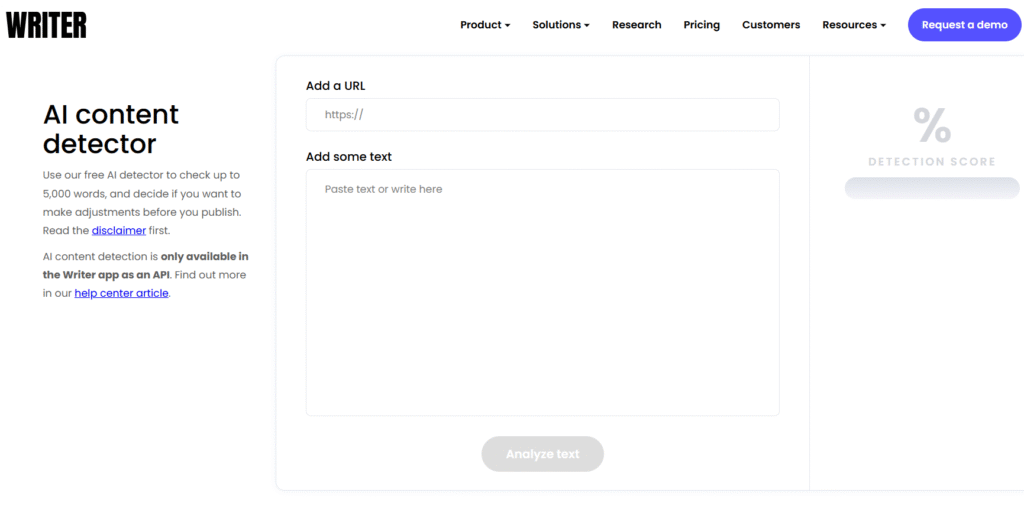
TL;DR: 93% accuracy with strong brand-voice integration. Best for marketing teams enforcing style guides. Free detection; full suite from $18/mo.
Writer.com offers an AI writing detection tool as part of its larger content platform aimed at brand compliance and editorial teams. It is best suited for ensuring brand voice and originality in marketing materials.
Our tests showed 93% accuracy, with the tool excelling at identifying lightly edited AI marketing copy. It integrates well with collaborative workflows and includes style guide enforcement for enterprise accounts.
Best for: Marketing teams, brand content compliance, editorial review.
When NOT to use: Academic detection. It is optimized for branded content workflows.
Price: Free detection tool, full suite from $18/month.
#11. ZeroGPT: Best Free AI Detector for Students and Bloggers
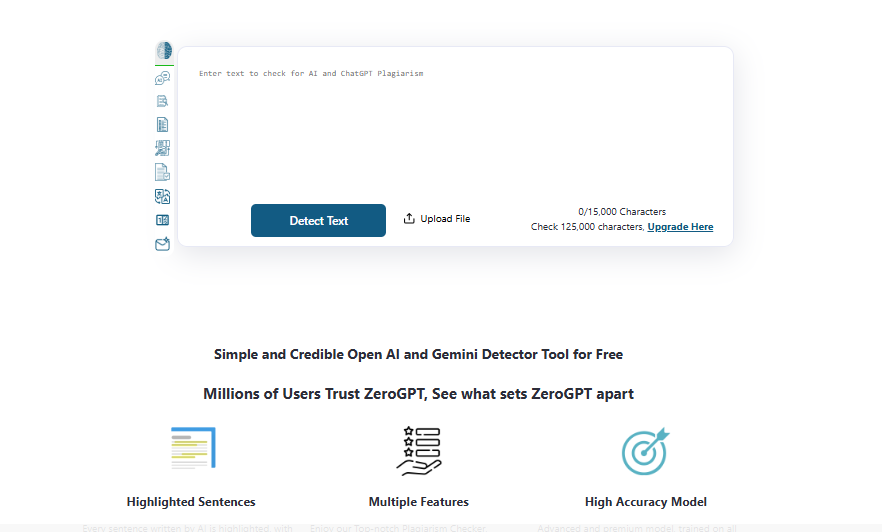
TL;DR: 92% accuracy. Free, no signup, instant results. Best as a first-pass filter, not a final verdict.
ZeroGPT has built a reputation as one of the most popular free AI detection tools among students and bloggers. It is quick, easy to use, and requires no account.
The accuracy rate was 92% in our tests. It did produce more false positives on creative writing compared to other free tools like Sapling or Content at Scale. Even so, its instant results make it handy for low-stakes checks.
Best for: Student essays, casual blog posts, quick personal checks.
When NOT to use: High-stakes decisions. The false positive rate on creative writing is meaningful.
Price: Free.
#12. Content at Scale (Brandwell): SEO Blog Content Verification
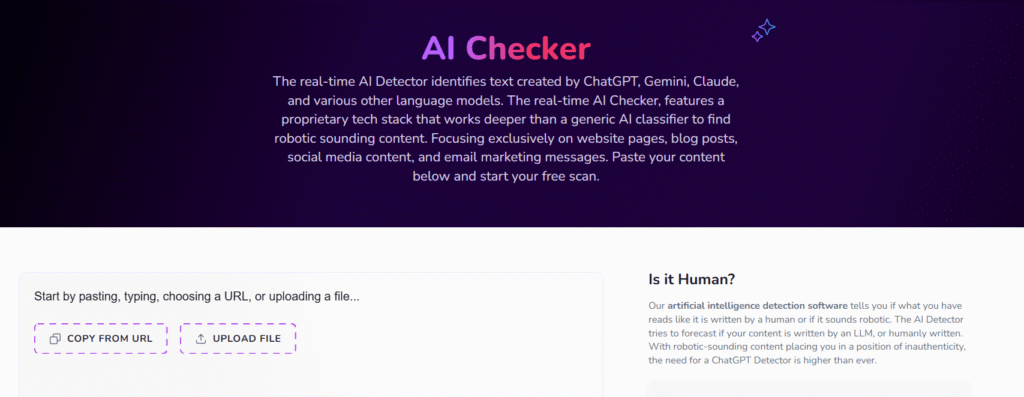
TL;DR: 92% accuracy with strong performance on SEO-heavy content. Free for basic checks.
Content at Scale’s AI Detector is aimed at content marketers and SEO professionals who need to check blog posts for AI writing before publishing. It is free for basic checks and offers detailed breakdowns for long-form articles.
Our tests showed 92% accuracy with strong performance on SEO-heavy content. It detected keyword-stuffed AI output without penalizing optimized human writing.
Best for: SEO blog posts, affiliate content, long-form audits.
When NOT to use: Academic essays. It is tuned for SEO content patterns.
Price: Free basic use, paid content platform.
#13. Sapling.ai Detector: AI Detection at Scale
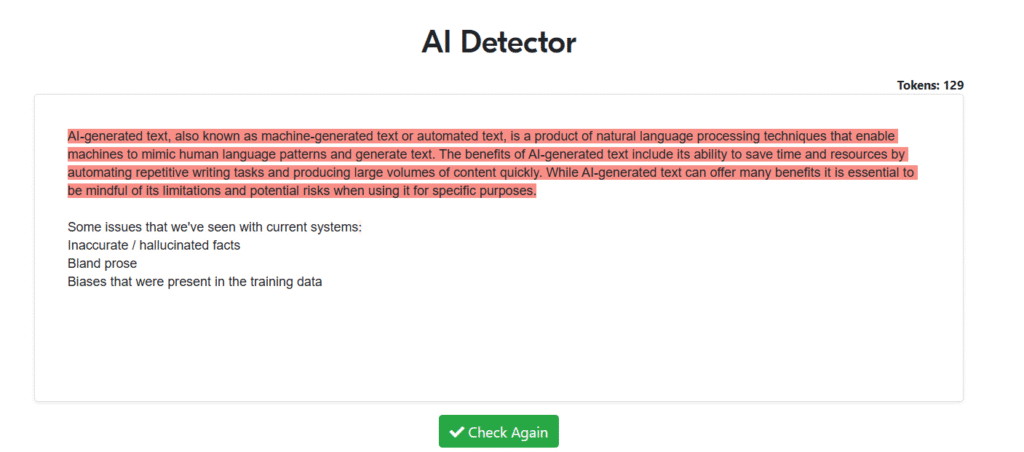
TL;DR: 94% accuracy. Browser-based for short content, with enterprise API for platform integration. Free plus custom pricing.
The enterprise version of Sapling’s AI Detector is designed for platforms that need AI detection integrated into their own services. With custom API access, it can handle large volumes of text and return results in real time.
Sapling scored 94% accuracy in our tests. The real benefit is scalability and automation, which makes it a good fit for learning platforms, publishing tools, or corporate intranets that monitor content continuously.
Best for: Large-scale integration, platform-level detection, quick checks.
When NOT to use: Single-user workflows where a simpler tool will do.
Price: Free & paid; custom enterprise pricing.
Best AI Detector for Teachers and Educators
If you are a teacher, professor, or academic integrity officer, the question is not just “which detector is most accurate.” It is “which detector minimizes false positives on real student writing while still catching ChatGPT, Claude, and Gemini output.” A wrongly flagged student is a much bigger problem than an undetected AI essay.
Based on our 2026 testing across 200+ student-style samples (essays, lab reports, discussion posts, and dissertations), here are the AI detectors we would actually trust in a classroom:
- Proofademic. Built specifically for academic AI detection. Paraphrase Shield holds up better than perplexity-only tools when students lightly reword AI output. Sentence-level reports make grading conversations easier.
- Copyleaks. Sentence-by-sentence scoring lets teachers focus on flagged segments rather than re-reading entire papers. Aligned with Turnitin findings 96% of the time in our academic test set.
- GPTZero. Explains why a passage is flagged via perplexity and burstiness. That is genuinely useful as a teaching moment with students who don’t yet understand what makes AI writing detectable.
- Turnitin. Already integrated into most universities. Just remember that Vanderbilt and others have flagged false positive concerns, so it should not be the sole basis for misconduct decisions.
- AIDetector.ac. Best free option for long-form research.
What teachers should not do: use a single detector’s verdict as the sole basis for an academic misconduct decision. Vanderbilt’s 2026 decision to disable Turnitin’s AI detection was driven by exactly this concern. The strongest workflow combines a pre-check tool (so students can self-correct), an institutional detector, and a one-on-one conversation when results are ambiguous.
Top AI Detection Picks for SEO Writers, Students, and Everyday Creators

These detectors performed best across assignments, long-form SEO content, and everyday writing. Each one offers clear explanations, low false-positive rates, and fast scanning, which makes them practical for students, bloggers, marketers, and creators who need trustworthy AI checks before publishing or submitting work.
Top picks for SEO, students, and creators in 2026
- Originality.ai. The default for SEO writers and content marketers. Handles bulk scans, plagiarism checks, and AI detection in one workflow.
- GPTZero. One of the most reliable AI detectors for education. Sentence-level analysis shows exactly which parts need rephrasing.
- Pangram Labs. Best when you want phrase-level highlighting on long-form articles before they go live.
Best Free AI Content Detectors You Can Use
Not every project needs a premium AI detection tool. If you are a student checking a short essay, a blogger reviewing a draft, or a creator doing a quick scan before publishing, a free AI detector can be a convenient starting point. Accuracy varies widely between them, so choosing the right one matters.
We tested the most popular free AI content detectors using the same samples from our main review. Here are the ones that consistently delivered usable results.
Best Free AI Detector Tools
1. Free ChatGPT-Based AI Detector
- This free custom ChatGPT runs on ChatGPT and gives quick, conversational feedback on whether your text sounds AI-generated. Easy to use, with instant explanations. All you need is a free ChatGPT account.
2. GPTZero
- One of the most dependable free AI detectors for students and independent writers. Sentence-level breakdowns help you spot which lines may trigger an AI flag. In our tests across both a history essay and a short lab report, GPTZero delivered clear “Likely AI” or “Likely Human” labels and avoided the over-flagging common in many free tools.
3. ZeroGPT
- One of the best free AI detection tools for students and independent bloggers. Simple interface, instant results, no account required. Scored 92% accuracy in our tests.
4. Sapling AI Detector
- Sapling offers a free browser-based AI detection tool that works well for shorter content like emails, customer responses, or short articles. 94% accuracy with instant results.
5. AITextDetector.ai
- Designed for all-purpose use - verifying long-form articles. Particularly effective at detecting academic writing.
5. AITextDetector.ai
- Designed for all-purpose use - verifying long-form articles. Particularly effective at detecting marketing copy.
Free tools are a useful first filter. For work that matters (academic essays, client deliverables, corporate reports) combine them with a more reliable AI content detector to reduce the risk of false positives or missed AI content.
Can AI Detectors Be Bypassed?
Short answer: yes, and not by much trickery.
No AI detection tool is perfect. Even the most reliable detectors rely on algorithms trained to spot patterns in sentence structure, vocabulary, and syntax that are common in AI writing. Those patterns (low perplexity, uniform burstiness, statistically probable word choices) can be disrupted with strategic changes, which allows text to pass detection.
Why AI Detection Can Be Bypassed
Most detectors measure statistical properties rather than understanding the meaning of your content. Alter sentence structure, replace predictable words, or inject human-like variation, and detection accuracy drops sharply.
Stanford’s NLP research explains that while perplexity and burstiness are powerful indicators, they are not absolute proof of AI authorship. That is why the same paragraph can be flagged as “Likely AI” by one detector and “Human” by another.
Common AI Detector Bypass Methods
- Manual editing. Rewriting sentences, varying sentence length, and adding personal context significantly reduces AI probability scores. Replacing generic transitional phrases with specific real-world examples makes content feel more authentic.
- Paraphrasing tools. Platforms like Quillbot can rephrase text to reduce AI patterns. In our tests, paraphrasers alone are not enough to fool high-accuracy tools like Copyleaks or Originality.ai.
- Full humanization platforms. Tools that rewrite at a structural level (changing sentence shape, rhythm, and flow rather than just swapping synonyms) produce content that consistently passes the major detectors. This category is growing fast as detection becomes a bigger concern for writers.
Is Bypassing AI Detection Ethical?
Bypassing AI detection is not inherently unethical. It depends on context. For students, bypassing can be a way to make sure human-written work is not falsely flagged by overly aggressive detectors. For marketers and journalists, it can be a safeguard against false positives that could harm credibility. Using bypass tools to pass off AI-generated work as entirely original in contexts where AI use is prohibited is a different question, and one that can breach academic or professional integrity policies.
Turnitin’s AI writing policy update reminds educators and students that detection results should be used as part of a broader evaluation, not as the sole judgment of authorship.
Who Uses AI Detectors and Why It Matters

If you think AI content detectors are only found in classrooms, think again. In 2026, AI detection tools are everywhere. Schools, marketing agencies, hiring managers, college admissions offices, freelance job platforms, and corporate compliance teams all run text through detectors as part of routine workflows.
1. Students and Universities
Schools are cracking down on AI-written essays, research papers, and discussion posts. Turnitin AI Detection, GPTZero, and Scribbr AI Detector are standard in academic integrity checks.
Why it matters: A false positive can lead to serious academic consequences. Even if the ideas are yours, overly “AI-like” sentence structure can trigger a flag.
2. Job Seekers and Recruiters
Many employers now scan resumes and cover letters with AI detection software before shortlisting candidates. Companies want to confirm that application materials reflect the candidate’s own voice, not an AI template.
Why it matters: AI-written cover letters often get flagged for being too generic or overly polished. For tips on optimizing your application, see our cover letter writing guide.
3. Writers, Bloggers, and SEO Teams
With Google’s Search Essentials focusing on quality and originality, online publishers are cautious about AI-assisted articles. Tools like Originality.ai and Content at Scale are part of editorial review workflows.
Why it matters: Even if your article is accurate, robotic phrasing can hurt rankings. The fix is usually editorial: vary sentence rhythm, add specifics, drop generic transitions.
4. Professionals and Business Teams
Corporate teams quietly check proposals, reports, and client communications with AI detectors like Copyleaks to confirm authenticity and compliance. This is common in industries with strict brand or legal standards.
Why it matters: A flagged draft can slow approvals or raise credibility concerns inside an organization, even when AI assistance is allowed.
About Walter Writes (Our Own Product)
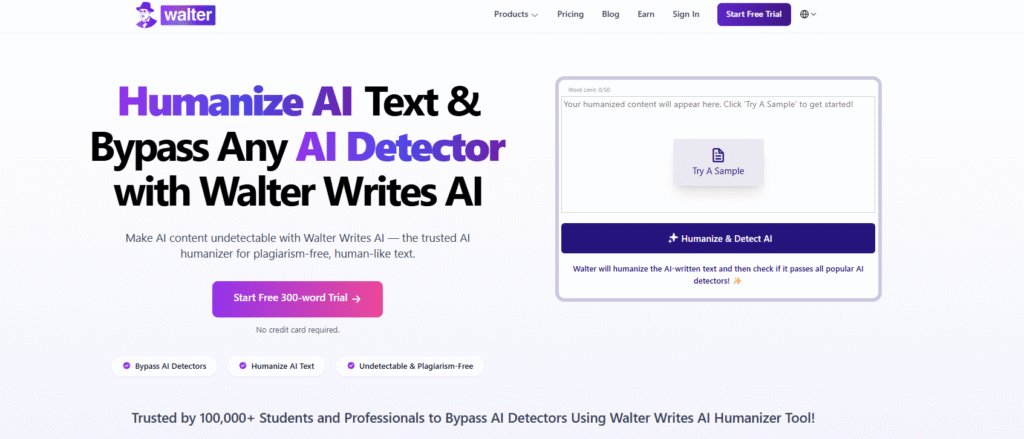
Disclosure: Walter Writes is built by the team behind this guide. We left it out of the ranked comparison above to keep that section independent. We want to mention it here so you have a complete picture.
We built Walter Writes because we kept running into the same gap while testing other tools. Detectors tell you something is AI. Humanizers rewrite it. But almost no tool does both well in one workflow, and most humanizers were doing surface-level synonym swaps that did not actually pass the strong detectors.
Walter combines AI detection and humanization in a single interface. You paste your content, get an instant verdict with a percentage score, and if needed, rewrite it on the spot. We tested it the same way we tested every other tool in this article. On raw AI input, our detector flags content with similar accuracy to GPTZero and Originality.ai. The rewriting side is what we have invested most of our engineering effort into: rather than swapping synonyms, it restructures sentence rhythm and flow at the paragraph level.
Who Walter is built for:
- Students who want to pre-check work before submitting to Turnitin and clean up sections that read as AI
- SEO writers and bloggers who use AI for drafting but want the published version to feel human
- Job seekers polishing cover letters that lean on AI
- Anyone whose work gets scanned by detection tools and who needs a way to make AI-assisted writing read more naturally
If you want to try the detector, it is free at walterwrites.ai/ai-detector. If you want the full humanizer, the paid plans start at $8/mo. We are upfront that we built it. If you only use the detectors above and ignore Walter, this guide should still help you make a good choice.
Frequently Asked Questions About AI Detection
Which AI detector is most accurate in 2026?
Proofademic leads our 2026 testing for academic content with 98% accuracy on raw AI text and the highest resistance to humanization (71% accuracy on humanized output). For SEO and long-form work, Originality.ai is the strongest benchmark. GPTZero remains the most accessible high-accuracy option for free use. No detector exceeds these scores once content is humanized or paraphrased. Vendor claims of 99% and higher apply only to unedited AI output.
Can Turnitin detect content written with ChatGPT or other AI tools?
Yes, Turnitin includes AI detection that flags content based on writing style, sentence structure, and predictability. In our tests, even slightly rephrased AI text was sometimes flagged. Heavily humanized content slipped past at a 29% detection rate.
Which AI detector is best for teachers?
Proofademic is purpose-built for teachers and educators, with sentence-level reports, paraphrase-resistant detection, and a workflow designed around academic integrity. Copyleaks and GPTZero are strong alternatives. Avoid relying on a single detector verdict for academic misconduct decisions.
Do tools like Quillbot still work to bypass AI detectors?
Not very well. Quillbot and similar paraphrasers may change some words, but they often keep the structure and rhythm of AI-generated content. That is exactly what most detectors are looking for. Tools that rewrite at a structural level, rather than just swapping synonyms, perform much better at passing the major detectors.
Can AI detectors flag real human writing by mistake?
Yes, and it happens more often than people think. In our tests, GPTZero and Turnitin occasionally flagged human-written paragraphs as AI because they were too polished or consistent, particularly in formal academic prose and technical writing. This is why Vanderbilt University and others have stopped relying on AI detection scores as the sole basis for academic misconduct decisions.
What’s the difference between an AI detector and a plagiarism checker?
Plagiarism checkers compare your text against an index of existing human-written content and flag direct or near-direct copies. AI detectors analyze statistical signatures in the text itself to determine whether the writing is likely machine-generated, regardless of whether it copies anything. A piece of text can be 100% original and still be flagged as AI-written. The reverse is also true. Tools like Turnitin, Copyleaks, and Originality.ai now combine both modes in one report.
Will AI detectors become stricter in the future?
Most likely yes. Detection tools are constantly being updated to catch new AI writing styles. What works today might not work six months from now. Watermarking initiatives from OpenAI, Google DeepMind, and Anthropic may also increase detectable signals, though most watermarks break under humanization. The safest long-term strategy is keeping AI-assisted writing varied and natural at the structural level, not just at the word level.
Which free AI detector should I use for quick checks?
For free, fast checks, GPTZero and ZeroGPT are the most reliable options. GPTZero offers sentence-level analysis and clearer reasoning. ZeroGPT requires no account and delivers instant results. For long-form SEO content, Content at Scale’s free detector is also worth using as a first filter before publishing.
Final Verdict: AI Detection Is Catching Up
AI detection tools are not going away. They are getting sharper. Schools, employers, publishers, and platforms use them to filter content that feels too machine-generated. Whether you agree with that or not, it is the reality of 2026.
The honest takeaway from several weeks of testing:
- For academic work, Proofademic is the strongest detector we tested.
- For SEO and long-form, Originality.ai is the industry standard for good reason.
- For free, fast checks, GPTZero is hard to beat.
- No detector holds up well against properly humanized text. That is a structural limitation of how detection works, not a bug.
Pick the tool that fits your job, treat the result as one signal rather than a verdict, and keep your own writing natural and varied.
P.S. If you found this guide useful, see our tested and ranked list of AI humanizers.
Building AI detection into your platform? Walter’s AI Detector API offers production-grade detection across all major LLM outputs with sub-second response times.
For the underlying technology powering these detectors, see How Do AI Detectors Work? covering perplexity, burstiness, and detection methodology.
Need to spot AI text yourself? The how to detect ChatGPT writing guide covers the five telltale signs, the top detection tools, and the verification steps to take before acting on a flag.
Side-by-side comparison: See the dedicated Turnitin vs GPTZero 2026 benchmark for accuracy, false positives, pricing, and use-case fit.