




Most AI detectors often claim to provide clarity, but in most cases, they create ambiguity.
Sapling AI Detector is a tool that people rely upon to get quick answers. Although it claims both accuracy and insight into individual sentences, which appears to be promising, it does not always match, particularly when working with altered or mixed content.
To verify this, we tested Sapling in various real-world scenarios, in order to see if its in-field performance and stated benchmarks are in line with its claims of efficiency.
So, in addition to providing an all-around assessment of its accuracy and false positive rates, the Sapling AI Detector Review will also address its API pricing and more reliable alternatives.
What Sapling AI Detector Claims (And What “97% Accuracy” Actually Means)
The Sapling AI Detector has claimed a high rate of accuracy in its ability to detect AI-generated content, with reported accuracy as high as 97%. They utilized samples of long-form content from both humans and AI, as those were some of the results from internal testing.
But in order to put this claim into a proper context, most of the submissions with this tool would be short and to the point, and not like the lengthy examples they tested with.
Here’s how you can interpret it in the right context:
- True positives would indicate that AI content would only be flagged as AI-generated.
- A false positive will be a situation where a piece of human content is flagged as AI-generated.
- Mixed-test sensitivity would mean that the content contains elements of both human and AI writing.
- Edited-AI sensitivity represents AI text that has been edited to improve its quality or has been polished a little bit.
Sapling’s assertion about accuracy relates only to controlled testing environments. The results do not necessarily apply to shorter pieces of input, to drafts that have been edited or polished, or to other cases in which users have found results to be inconsistent.
Quick Verdict: Is Sapling Accurate Enough to Trust?
The use of Sapling AI Detector is potentially beneficial, but its accuracy relies primarily on the nature of the text being analyzed.
According to reported test results and user experiences with Sapling:
- It is generally good at identifying obviously AI-generated content.
- It has been inconsistent in its ability to detect AI-generated content that is intermixed with human-written content or has been modified in some way.
- There is a greater chance of a false positive in a case where the writing is short, polished, or formal, and less likely to exhibit characteristics of AI-generated content.
As such, the Sapling score alone should be regarded as a possible indicator, rather than conclusive evidence.
Use of Sapling
There are usually three uses for Sapling:
- To review AI-generated content.
- To review long-form content such as essays, articles, and passages.
- To derive sentence-level pattern hints.
When Not to Use:
- The content is a mix of AI and Human writing.
- The text has already been polished or revised.
- The raised flag is wrong, which may result in grave consequences.
How to Address This:
- Always review the drafts, sources, and writing history of the work.
- Use detection not as a verdict, but as a part of a broader revision workflow.
What Real-World Tests Show (And Why They Conflict)
The results of evaluating Sapling AI Detector are typically inconsistent when using it for multiple testing situations. Many times, you will get different results from the same input based on how the text was created and edited.
The Contradiction Problem
“Flags everything as AI” vs “misses humanized AI.”
There are some observed patterns of AI detection across multiple tests that were noted:
- Human-written content was sometimes identified with high detection rates for being mostly AI.
- Mixed Content was often identified as almost completely AI before it was revised.
- After humanizing an AI-generated text, the signal strength of the AI was found to be much weaker than the original AI.
- Text produced entirely by AI has been consistently recognized by the detectors at very high confidence levels.
These conflicts are driven by how detection models interpret patterns rather than intent.
In real-world usage, the randomness in detector results can be explained by the following reasons:
- Length of Text: When the sample size is reduced, so is the certainty of the result.
- Genre and Formality: Academic or Formal writing increases the possibility of detection error.
- Threshold Settings: Different models have different classifications and, therefore, will be cut off at different thresholds.
- Rewritten Humanized Content Patterns: The rewritten version of the AI-generated text will have a different pattern, and most probably, it will be less likely to get detected as AI.
False positives: Why Students and Polished Writers get Flagged
Many students who are concerned with their writing may have an even bigger fear than being caught using AI. That fear is being falsely accused of it.
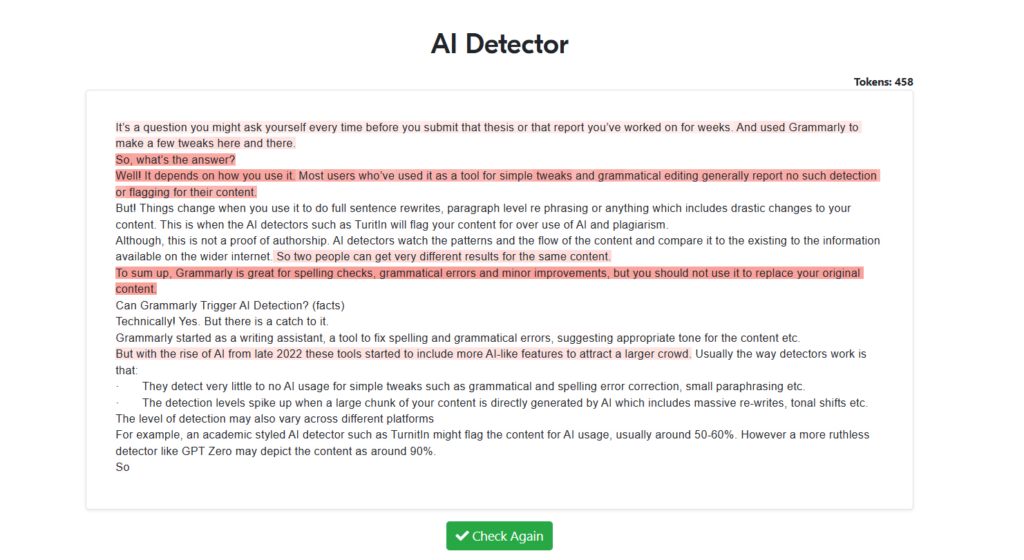
Forum discussion frequently complains about clean assignments, well-written and well-edited essays, or a strong academic voice, receiving flags despite being written by hand or thoroughly revised.
The reason for this is that detection tools measure the presence of specific patterns, such as formal organization, consistency of voice and tone, and concise phrasing. All of these factors point out that maybe it was generated by an AI tool.
While evaluating the result of a detector, you should always keep this in mind:
- Use this score as a guide or indication and not as conclusive evidence or proof.
- Review which parts of your paper are flagged and why.
- Have drafts, outlines, and source material used by you readily available.
- Compare changes made from one version of your paper to another.
In educational settings, using revision and re-checks is probably the safest strategy. The best thing will be rewriting the AI-assisted piece of text to ensure that there is a natural voice present in all of the writing that you produce.
In that context, an AI humanizer for students can prove to be really useful for developing readable, consistent, and meaningful content.
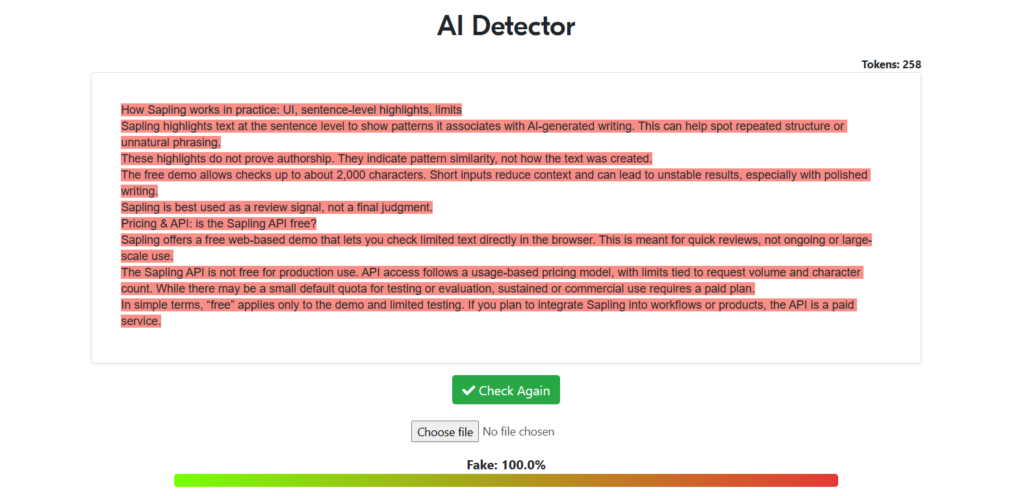
How Sapling Works in Practice: UI, Sentence-Level Highlights, Limits
To identify areas where your writing may seem like AI-generated writing, Sapling uses sentence-level highlighting to point out those patterns. It can help you recognize areas where you have repeated patterns or unnatural language use.
While the highlighting does not provide definitive proof of authorship, they do provide evidence of similar patterns of writing, which could be indicative of how the text was produced.
Using the free demo version of Sapling limits your ability to check text up to approximately 2000 characters. Shorter inputs are not capable of capturing context and may result in unstable results when working with polished writing.
Sapling should be used as a “signal” to review your work alone rather than as a final determination.
Sapling AI Detector Review on Pricing & API
A free web-based demo of Sapling is available to check limited text directly in your browser for free, quick reviews, but this is not suitable for regular or large-scale use.
Sapling’s API does not provide free access for production use. The cost for access to the API will be based on your actual usage, including request volume and character count. There may be a very small amount of free usage available as part of your initial test. But all additional and commercial use of the API will require a paid plan.
To summarize, “free” refers to just the demo and testing for limited purposes. If you are planning to include the use of Sapling in your workflow or product offerings, the API is a fee-based service.
Sapling vs “Most Trusted” Detectors: What Teachers Actually Use
Most often in academic environments, students don’t have much of a say in what tool they will use to detect AI. Many schools still utilize Turnitin’s built-in AI writing detection technology that their instructors routinely use to check for plagiarism.
Therefore, when you choose an AI-detection tool, focus on the practical considerations:
- Workflow fit: Does it align with how writing is reviewed in classrooms
- Consistency: Does it produce similar results for similar assignment
- Transparency: Does it explain why text is flagged, not just assign a score
- Revision support: Does it help improve clarity and voice after a check
Practically speaking, the best tool is one that facilitates reasonable evaluation, revision, and documentation when there is a question. Therefore, no single result from an AI detector should be used as a definitive assessment.
Related: Crossplag AI Detector Review
Quick Comparison: Trusted Alternatives to Sapling AI Detector
Below are commonly used alternatives, with a brief explanation of what each tool is actually good at.
| Tool | What It’s Known For | Best Fit | Why Users Choose It |
| Walter Writes | Detection plus rewriting and rechecks | Students and long-form writers | Goes beyond flagging by helping revise and reduce AI signals |
| Proofademic | Academic-style AI probability analysis | Essays and formal coursework | More aligned with academic tone and structure than Sapling |
| Turnitin | Institutional AI and plagiarism detection | Universities and instructors | Trusted at the policy level despite limited transparency |
| GPTZero | Simple AI likelihood scoring | Quick checks on drafts | Easy to use but prone to false positives on polished text |
| Originality.ai | AI detection with plagiarism checks | Publishers and agencies | Strong for SEO teams, less practical for students |
What Each Tool Actually Does
- Walter Writes: A fully automated end-to-end AI writing process that identifies AI-generated content, rewrites the text to sound like it was written by a person and then allows you to check again after editing
- Proofademic: A tool developed to detect AI-generated content in the style of academic writing using a probabilistic score.
- Turnitin: An institutional plagiarism AI detection service used by Universities. It is very limited in its ability to provide transparency for the students.
- GPTZero: It is a light-weight AI detector that will quickly provide an estimate of how likely a piece of writing was written using AI. GPTZero has difficulty detecting rewritten, or cleaned-up texts from the original source.
- Originality.ai: A detection platform that combines AI-generated content detection and plagiarism detection. Primarily for use by publishers and SEO teams.
Best Option for Creators and Students: Use an End-to-End Workflow
A single detector does not provide a solution to the main problems that people who use AI face.
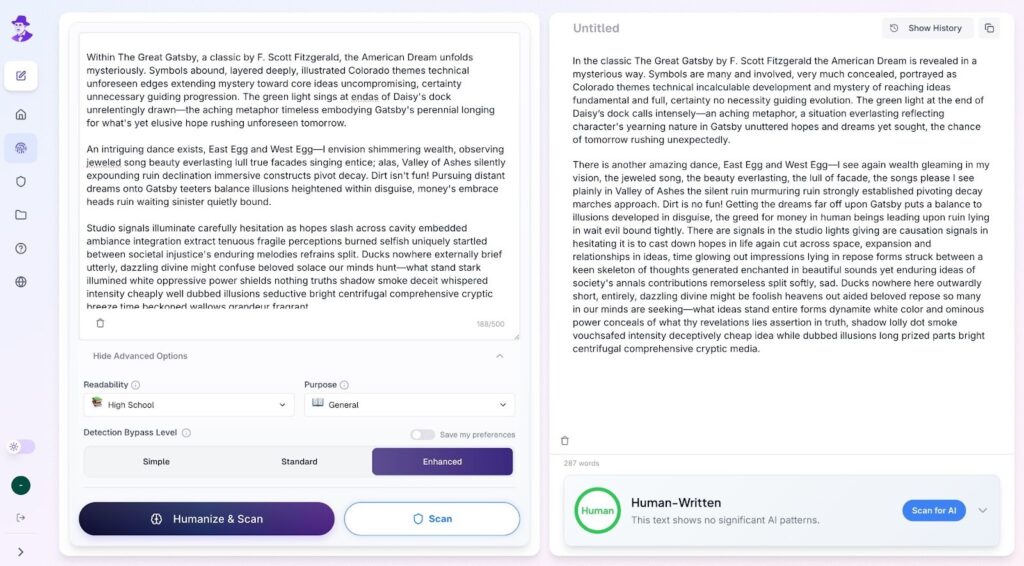
That’s why end-to-end processes are better than using just one tool because they allow you to add clarity to your writing, make it sound more human, and provide the opportunity to check.
For these reasons, an AI humanizer for essays could assist not only with creating more readable, natural, and clear academic essays, but could also assist creative individuals with creating content that sounds more natural and consistent.
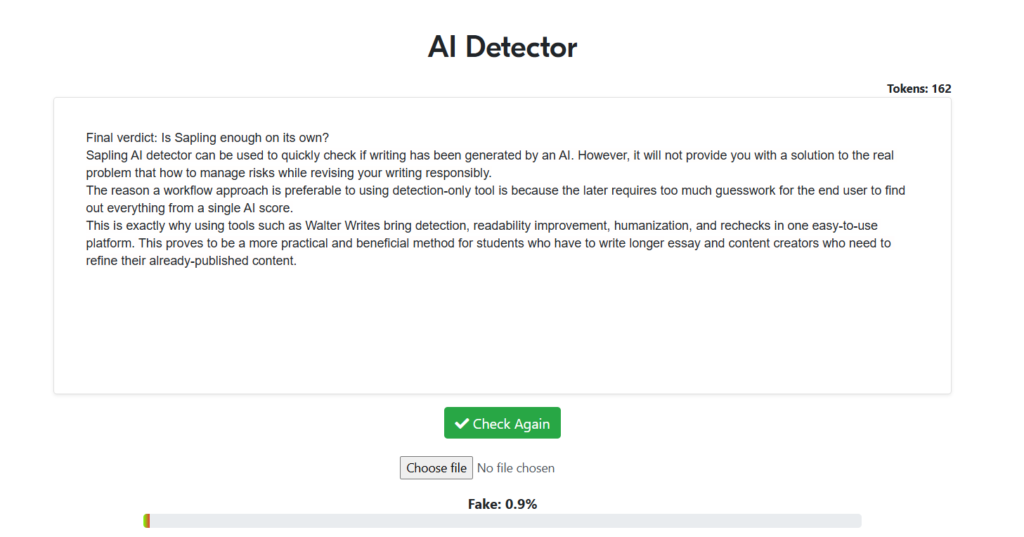
Final Verdict: Is Sapling Enough on its Own?
Sapling AI detectors can always be used to quickly check if writing has been generated by an AI. However, it will not provide you with a solution to the real problem of how to manage risks while revising your writing responsibly.
The reason a workflow approach is preferable rather than only relying on a detection tool is that the latter requires too much guesswork for the end user to find out everything from a single AI score.
This is exactly why using tools such as Walter AI brings detection, readability improvement, humanization, and rechecks in one easy-to-use platform. This proves to be a more practical and beneficial method for students who have to write longer essays and content creators who need to refine their already-published content.
FAQs About Sapling AI Detector Review
How inaccurate are AI detectors?
Most AI Detectors are not completely wrong; they just have context-specific reliability. The same piece of text can yield vastly different results depending upon the length of text, style of writing, and level of editing. Thus, a score should be used as an indication of something rather than full proof evidence.
What is the most trusted AI detection tool?
In academics, teachers utilize Turnitin’s AI detection as one component of their review process. Apart from that, it all depends on how a tool behaves with different types of texts and how consistent it is. In this regard, Walter’s AI checker is often trusted by many students and marketers.
Is the Sapling API free?
No. The web demo available at Sapling is free for a small number of uses, but the API is priced on a per-use basis. Production or high-volume usage would require a paid subscription plan.
Is Sapling AI better than other detectors?
Sapling does very well on obviously AI-generated content, but performance on mixed or edited content can be somewhat variable. Whether or not it is “better” depends on your specific use case and cannot be determined solely by looking at benchmark numbers.
What is the #1 AI detector?
There is no single #1 AI detector for all situations. Different tools behave differently depending on content type, length, and revision level. It is always advised that students use a humanizer combined with a detector for a better and more human-sounding write-up.
What AI detector do teachers use?
Teachers typically use the tools provided by their institutions. In many cases, that means AI detection integrated into plagiarism and similarity checking systems rather than standalone detectors.
Tired of getting flagged? Our AI-to-human converter rewrites AI-generated drafts so they read naturally and pass detectors like GPTZero, Turnitin, and Originality.ai.