




AI images are getting so realistic that they are increasingly difficult to distinguish from human images. So, the conversation is not just about visual quality but also authorship and originality. Who owns the image’s copyright? How do they compare to human art? Would there still be a need for human-made images? And where do we draw the line? These are questions that teachers, students, creatives, and those with careers in the art industry are asking. If you find yourself constantly wondering about these questions, keep reading. We’ll explore these questions and break down the debate over the superiority of human and AI art.
The Fastest Way to Understand the Debate (a 60-Second Framework)
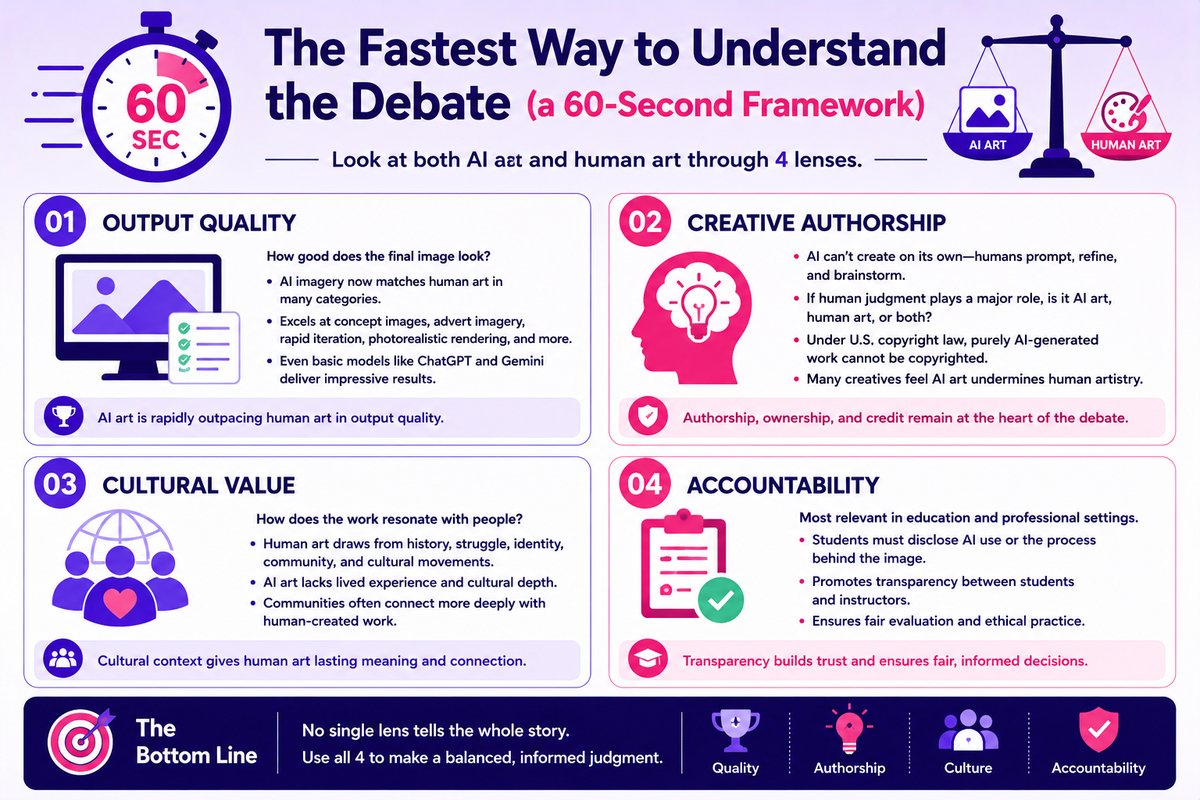
When comparing art designs from humans and AI, people look at it from a different perspective. While one person is looking at the visual quality, another is concerned about ethics. Yet another person only cares about the market value of the image and then concludes. But the best way to approach the debate is to look at both through 4 lenses.
Output Quality
Looking from the quality aspect, you should be concerned about how good the final image looks. AI imagery is now so developed that it is at par with human art in many categories. AI can now produce concept images, advert imagery, rapid visual iteration, photorealistic rendering, and more. You can get this result from even basic LLM models like ChatGPT and Gemini. Gradually, AI art is outpacing human art quality-wise.
Creative Authorship
A high-quality image generated by AI might still lack originality. AI cannot make the image itself. There has to be a human at the other end who prompts, refines, and brainstorms new ideas. If human judgment plays a significant role in the process, can we call it AI or human art? We can say both play a significant role in the final visual outcome. But assuming we consider it human art, who owns it? Under U.S. copyright law, purely AI-generated work cannot be copyrighted. This is why many creatives still believe they’ve been cheated. In Thaler v. Perlmutter, the D.C. Circuit ruled that only a human being can be an author, though work made with AI assistance can still be protected when a human shapes it. This is why many creatives still believe they’ve been cheated.
Cultural Value
Another aspect of evaluating AI and human work is its significance for people. How it affects a people’s story, identity, history, and community determines how it’s perceived. Unlike AI, human work can draw from historical context, artistic struggle, community connection, cultural movements, etc. This makes it easier for a certain group to connect to it than an AI image. Such people would prefer human work and might consider AI too artificial.
Accountability
This is more applicable in the education space. Art students can decide to create art themselves or use AI. However, there is a need to disclose the use of AI or the process for generating the image. This can affect classroom decision-making and transparency between students and tutors.
Key Differences That Matter
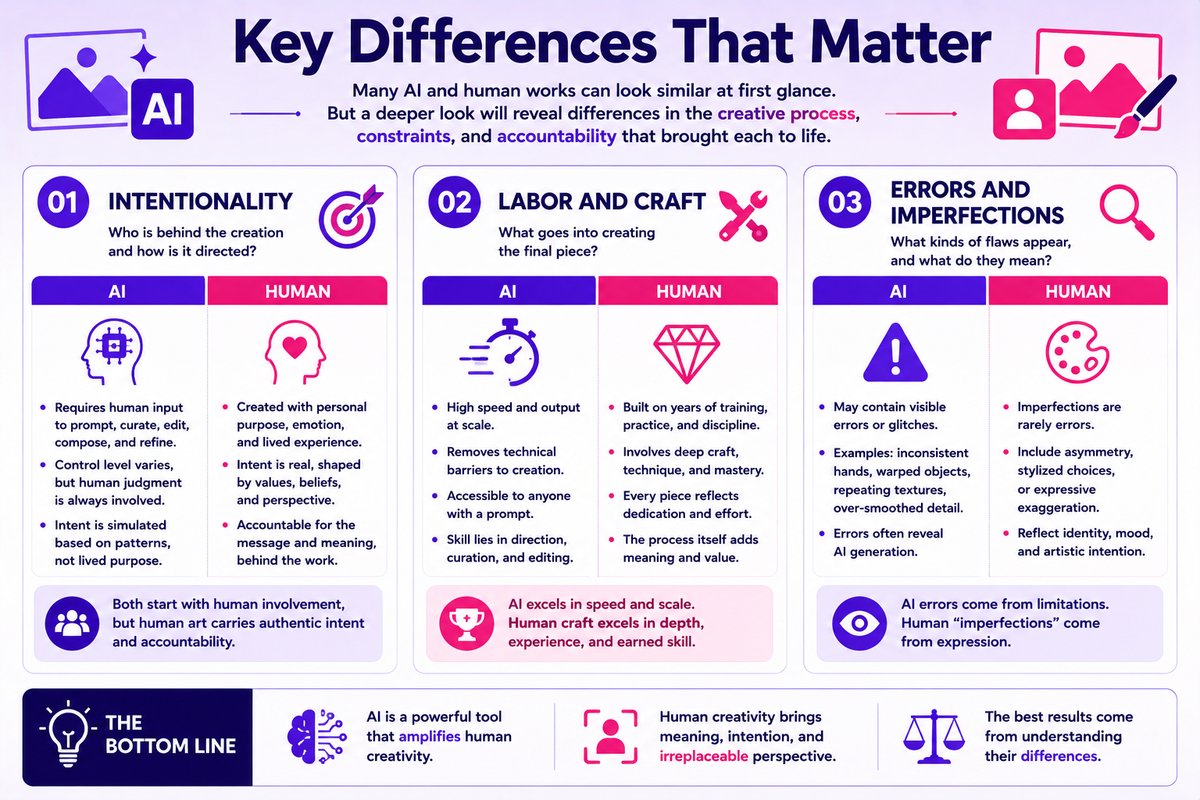
Many AI and human works can look similar at first glance. But a deeper look will reveal differences in the creative process, constraints, and accountability that brought each to life.
Intentionality
When you are looking at an artistic creation, the first thing that should come to mind is who made it? Most AI-generated images always involve human output. Someone has to prompt, curate, edit, compose, and refine it. While the level of control might vary, there is still a need for human judgment, especially in the final image.
Labor and Craft
AI outputs may look polished, but human craft still has more value to some people. This is because they consider the effort, skill, technique, and mastery developed over a long period. However, it’s undeniable that AI has removed that technical barrier to producing impressive-looking imagery. The production speed is higher. And accessibility is now democratized to the point where anyone with a prompt can be an art director.
Errors and Imperfections
Though there might be imperfections, human art rarely contains errors. These imperfections range from distorted anatomy to unusual proportions to asymmetry to stylistic exaggeration. They may be influenced by visual identity, mood, or expression. AI, on the other hand, is often accompanied by errors. Examples include inconsistent hands, warped objects, repeating textures, and over-smoothed detail. This makes it easy for people to detect AI and trust human work even more. As AI models advance, the errors may become smaller and less detectable.
Can People Reliably Tell the Difference?
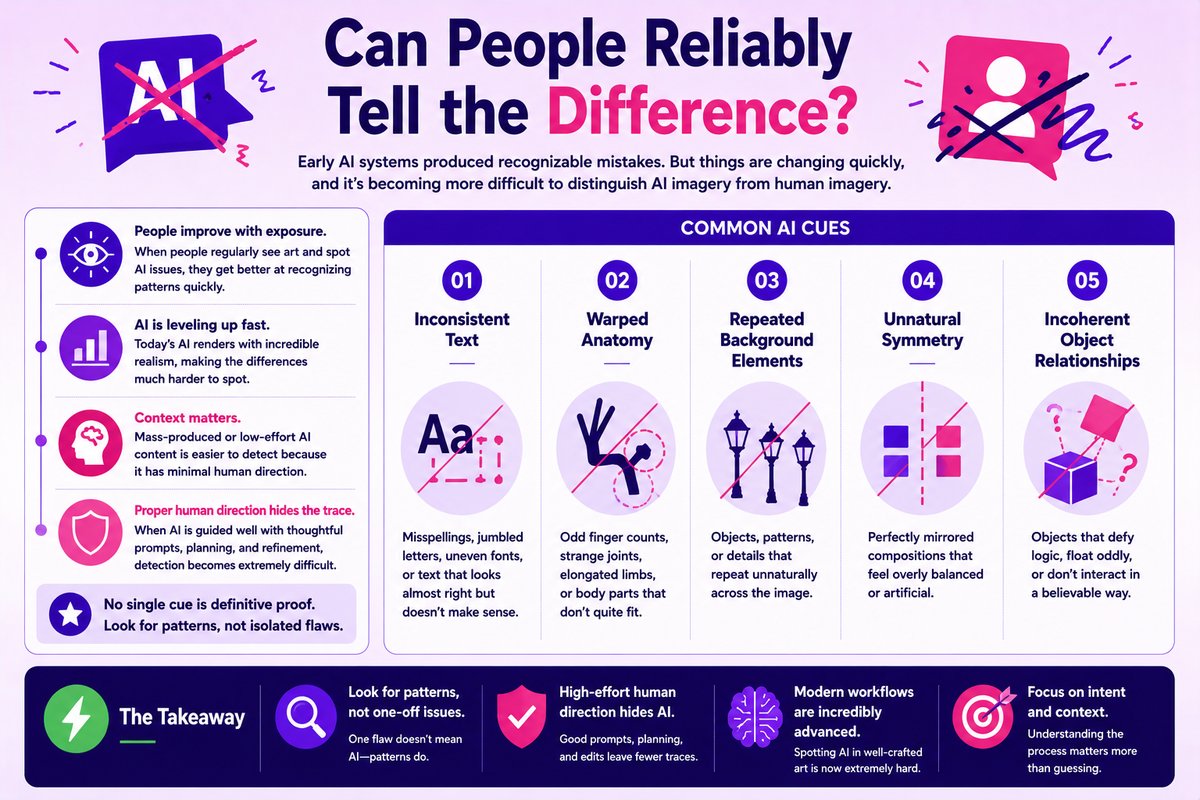
Early AI systems produced recognizable mistakes. But things are changing quickly, and it’s becoming more difficult to distinguish AI imagery from human imagery. The common AI cues include repeated background elements, incoherent object relationships, unnatural symmetry, inconsistent text, etc. When people regularly come across art that spot these issues, it becomes the norm. People become better at recognizing the pattern immediately. With the current level of AI, their rendering is almost perfect, making spotting more difficult.
Common AI Cues
- Inconsistent text
- Warped anatomy
- Repeated background elements
- Unnatural symmetric
- Incoherent object relationships
These are not definitive proof that their presence reveals AI involvement. Detection may not work when AI is prompted properly with solid human direction. That is why mass-produced content and low-effort AI generations are still the best for detection. This is because they have minimal human interaction. Modern AI generation workflows now make spotting AI almost impossible.
What Research Says About Value and Creativity When AI Is in the Room
Research suggests that people are not moved by visuals alone. In one 2023 study, participants rated 30 paintings that were all AI-generated. Researchers randomly labeled each one human-created or AI-created, and the human label alone raised scores for liking, beauty, profundity, and worth. Observers place more value on images they believe came from hard work and experience, even when the pixels are identical.
A Columbia Business School led by Sheena Iyengar found the same pattern across six experiments. The 2,965 participants rated identical artworks higher on skill and value when told a human made them. Even pieces labeled as human and AI collaborations scored below purely human work.
- Effort
- Intention
- Originality
- Developed skill
- Authenticity
This tends to increase the emotional depth and labor value of such pieces. This doesn’t mean that traditional art is automatically better. But people are attaching the years of experience to each image. And that matters for artists who are still trying to keep their audience and win them over from AI. For this perception to shift, AI image creation will have to be transparent. Being transparent about the references, prompts, edits, iterations, etc., used to make the image will create more credibility than trying to hide AI involvement.
What It Means for Creativity in 2026
AI is disrupting the space. But that has not removed the need for creative skill. Your skill is still valuable. In fact, you should adopt AI to move away from manual labor and get things done faster. Everyone can generate images quickly. However, those without skill will spend more time editing than publishing. Experience and specialization will still be needed for scaling.
As an artist, you already have an advantage. You’ll understand training data faster, pick up ideas quickly, and get better iterations than a novice. However, you need an AI workflow to help you. Pick up the tools, learn them, and you’ll still be in demand.
For students, understand that creativity is evolving. It’s not disappearing. Those who adapt best and quickly will be the ones who survive the AI takeover.
A Practical “AI Art vs Human Art” Comparison Checklist for Students
If you’re an artist or student, you need to understand how critiques work in the AI era. Most evaluations now border on process, transparency, and the artist’s creative reasoning. So, if you can include evidence of how the work evolves, it’ll make your portfolio more credible.
Whenever you use AI in your work, document the process. Even if you just use sketches or a thumbnail, put it down. This way, you don’t imply AI did everything, and neither would you be guilty of ascribing everything to yourself.
As a student, you should also be thinking like your instructor. Start thinking about what they might evaluate. It could be your depth of creative reasoning, experimentation, process development, revision, and so on. This way, you can prepare ahead.
| Situation | Good Practice | What to Avoid |
|---|---|---|
| Prompting | Save prompt iterations and explain goals | Pretending prompts were the entire creative process |
| Editing | Show paint-overs, compositing, or revisions | Claiming untouched outputs are fully handmade |
| References | Credit references and inspirations | Hiding obvious style imitation |
| Portfolio Process | Include sketches, thumbnails, or workflow notes | Uploading only polished final images |
| Critiques | Explain why you selected certain outputs | Saying “the AI made it” without reflection |
Transform From Design to Writing
If you’re an artist, you may need to explain your process, intent, references, and AI usage. More and more people now request that before judging the final image. So, writing has become part of the creative process, whether you like it or not.
Practical Creator Pain Points
Students now write artist statements when they use AI in the creative process. This is due to the fear around AI disclosure in schools. Artists may also have to do the same when submitting applications. It’s not that the use of AI is being pushed back. It’s just that people are more intentional about authorship, accountability, and transparency.
Walter Writes AI humanizer is a one workspace tool that can help you express your thinking and decisions throughout the creative process. You can even make drafts, refine them, and improve readability without losing your voice.
Frequently Asked Questions
What Is the Main Difference Between AI Art and Human Art?
AI art is generated through trained models, using prompts. Humans design art through intentional practice and experience. They are visually similar but often differ in authorship.
Can AI Art Replace Human Artists?
The creation of art with AI often speeds up production and makes commercial processes faster. However, human artists still dominate in many areas. Some creative areas still need storytelling, cultural context, personal identity, and relationship building. It is difficult to fill these roles with AI. Roles may shift as AI advances, but it is unlikely to be a total replacement.
Is AI-Generated Art Considered Real Art?
It depends on the art being used and who is using it. Some institutions are beginning to adopt AI-assisted work, but that’s where it stops. It’ll not be considered real art until when it is eliminated the many obvious errors in the final image are eliminated.
Can People Reliably Tell the Difference Between AI and Human-Made Art?
Low-effort AI outputs will always be prone to detection. Only images that have gone through extensive modification can escape discovery. Having said that, there is a lot of advanced AI imagery that is very similar to human imagery. So, they are hard to spot. They may only be discovered when their authorship is revealed. There is also a growing list of AI detectors that can detect AI-assisted images.
Does AI Art Have Emotional Depth or Intentionality?
Viewers can feel emotional responses to AI-generated images. However, the AI system doesn’t have emotion or human experience.
How Does AI Generate Images, and What Does That Mean for Human Creativity?
AI systems use large datasets to learn visual patterns for image generation. This increasingly threatens manual rendering except in the area of directing, curating, and editing.
Is Creating or Selling AI Art Ethical?
Ethical expectations vary across classrooms, industry, and communities. The debate often centers around training data, artists’ consent, disclosure, and imitation. Some see it as moral when there is transparency. Others view it as unethical in all its forms. They argue that it devalues human labor and exploits artists’ work without adequate compensation.
Who Owns the Copyright to AI-Generated Artwork?
Various countries and jurisdictions have different laws. Some regions consider that AI-generated work does not have legally bound copyright ownership.
What Are the Creative Limitations of AI Art?
AI doesn’t have symbolic consistency, human perspective, or sustained narrative intent. Output can become visually repetitive over time.
How Do Professional Artists and the Art World View AI-Generated Work?
Many artists view AI with skepticism and resistance. Others have accepted and adopted it for experimentation. There are yet others who take the hybrid approach, using AI as one tool within a broader workflow rather than a replacement for craft.