

Does SafeAssign detect ChatGPT? Yes, partially. SafeAssign is Blackboard’s built-in plagiarism checker, and as of 2024 it includes an AI detection signal alongside its traditional plagiarism similarity check. The detection is less aggressive than Turnitin AI Detection but still flags raw ChatGPT output reliably. Light editing reduces detection significantly. Behavioral data (submission timing, edit history) from Blackboard often matters as much as the SafeAssign score itself.
This guide covers exactly how SafeAssign detects ChatGPT and AI writing in 2026, what the AI flag looks like, how it compares to Turnitin AI Detection, false-positive rates, and how to use AI assistance without getting flagged on Blackboard.
TL;DR:
- SafeAssign cannot detect AI writing. It was built exclusively for plagiarism detection, meaning it matches your text against a database of existing sources rather than analyzing writing patterns
- AI-generated text is produced from scratch and doesn’t exist anywhere in SafeAssign’s database, so there is nothing for it to match against and flag
- Plagiarism detection and AI detection are fundamentally different technologies. SafeAssign uses database matching while AI detectors analyze perplexity and burstiness, the predictability of word choices and variation in sentence length, neither of which SafeAssign can measure
- Blackboard’s parent company Anthology ran a beta test for AI detection features in 2023 and decided not to integrate them into the platform, acknowledging the limitations of relying on AI detection
- For educators who need actual AI detection, Turnitin, GPTZero, and Copyleaks are the tools most commonly used alongside SafeAssign in 2026
- Walter Writes AI produces natural, human-like writing that reads well and holds up to scrutiny, and includes a built-in AI detection feature so students can check their work before submitting
AI writing tools have taken off in recent years, making it easier than ever for students to generate essays with just a few clicks. While this can save time, it also raises a big question: Can SafeAssign detect AI-generated writing?
If you’ve ever submitted an assignment through Blackboard, you know SafeAssign is used to check for plagiarism. But does it actually catch AI-generated content, or is it only looking for copied text?
In this article, we’ll break down how SafeAssign works, what it can and can’t detect, and why tools like Walter Writes AI help students produce high-quality, natural-sounding content that’s undetectable.
The short answer: SafeAssign does not detect AI-generated text. It was built to catch plagiarism, which is a different problem entirely. SafeAssign checks whether your words match words that already exist somewhere in its database. AI writes original text from scratch, so there is nothing for SafeAssign to match against.
What is SafeAssign?

SafeAssign is a plagiarism checker used by schools and universities to ensure students are submitting original work. It’s built into Blackboard, one of the most common learning management systems (LMS) in education.
When you submit a paper, SafeAssign scans it against a massive database of academic papers, books, and online content to check for similarities. If it finds a match, it flags it.
SafeAssign’s database is made up of three main sources: institutional archives containing all papers previously submitted at your school, the Global Reference Database with over 15 million papers voluntarily submitted by students across Blackboard institutions worldwide, and the ProQuest ABI/Inform Journal Database covering more than 5 million documents dating back to the 1970s. The depth of that database is what makes SafeAssign effective at catching plagiarism. But it also illustrates why it struggles with AI: none of those sources contain AI-generated text for it to match against.
One thing worth knowing: SafeAssign is free for students and instructors at any institution that uses Blackboard. There is no separate cost or license needed.
How Does SafeAssign Check for Plagiarism?
- Comparing your paper to its database which includes previously submitted student papers and academic sources.
- Detecting exact matches or word-for-word copying.
- Identifying paraphrased content where words are changed but the meaning stays the same.
In the end, it generates an Originality Report showing the percentage of your paper that matches existing sources.
But here’s the thing - SafeAssign wasn’t designed to detect AI-generated content. It mainly looks for plagiarism, which is different from AI writing.
What SafeAssign’s Originality Score Means
When your report comes back, SafeAssign gives you a similarity percentage. Here is what that number generally indicates:
- Below 15%: Likely includes common phrases or properly cited quotations. Usually not a concern.
- 15 to 40%: May reflect extensive paraphrasing, heavy quoting, or potential plagiarism. Instructors will review the flagged sections.
- Above 40%: High probability of significant copying. Instructors are likely to flag this for academic integrity review.
These are guidelines, not hard rules. Instructors read the report in context. A 35% score on a paper with many properly cited quotes is very different from a 35% score on a paper with no citations at all.
Does SafeAssign Detect AI Writing?
AI-generated Text vs. Traditional Plagiarism
When we talk about plagiarism, we usually mean copying someone else’s work - whether it’s a direct copy-paste job or a paraphrased version of an existing source.
AI-generated content, however, is completely new. It’s not copied from anywhere - it’s just written by a machine instead of a person.
That means SafeAssign may struggle to detect AI-generated writing because there’s no pre-existing source for it to match against.
This is the core reason SafeAssign misses AI writing: plagiarism detection and AI detection are fundamentally different technologies. Plagiarism detectors use database matching. They compare your text against known sources and flag overlaps. AI detectors work differently. They analyze linguistic patterns, specifically how predictable the word choices are (called perplexity) and how much sentence length varies (called burstiness). AI writing tends to be smooth, consistent, and predictable in ways human writing is not. SafeAssign has no such pattern-recognition capability.
How SafeAssign Analyzes AI-generated Content
Even though SafeAssign wasn’t designed to detect AI writing, it can sometimes flag AI-generated text if:
- It pulls phrases from academic sources that are already in its database.
- The writing sounds unnatural or has repetitive sentence structures.
- It mimics common patterns that are often found in AI-generated text.
Limitations of SafeAssign in AI Detection
At the end of the day, SafeAssign wasn’t built to catch AI-generated writing. Its main focus is plagiarism detection, not AI identification.
This means:
- SafeAssign cannot directly detect text written by ChatGPT or any other AI tool unless that text happens to match something already in its database.
- If an AI tool generates completely original text, SafeAssign won’t flag it at all.
That’s why students who use AI-generated content, especially if they refine and edit it, often pass SafeAssign without issues.
It’s also worth knowing that SafeAssign is only one part of what Blackboard offers for academic integrity. Institutions also use Lockdown Browser, which prevents students from navigating to other websites during timed assessments, and Randomization features that give each student a unique version of a test. These tools address different concerns than plagiarism or AI use, but they show that Blackboard takes a layered approach to academic honesty.
What Detection Methods Does SafeAssign Use?

How SafeAssign Checks for Copied Content
SafeAssign follows a simple process when reviewing papers:
- Identifies exact or paraphrased matches.
- It scans your work and compares it to academic papers, online sources, and previous submissions.
- Generates a report showing similarities.
However, it doesn’t have an AI detection model - it only checks for plagiarism.
Can SafeAssign Detect AI-generated Text?
If AI-generated text copies from publicly available sources, SafeAssign might flag it. But if the AI content is fully original, it won’t match anything in the database, so it likely won’t be detected.
Why AI Detection is Tricky
Even though AI-generated text sometimes follows predictable patterns, modern AI tools like Walter Writes AI are getting better at sounding human. That makes them even harder to detect.
Can SafeAssign Accurately Identify AI-written essays?
Why Does Some AI-generated Content Get Flagged and Some Don’t
AI-written essays might get flagged if:
- They contain phrases pulled from existing academic sources.
- They repeat common AI-generated phrases that SafeAssign recognizes.
- They lack citations where they should have them.
However, if an AI-generated essay is well-written, properly edited, and refined, SafeAssign usually won’t catch it.
The Problem of False Positives & False Negatives
Because SafeAssign wasn’t built for AI detection, it sometimes:
- Flags human-written text as potentially problematic if it contains repetitive phrasing, even when no copying occurred.
- Misses AI-generated essays entirely if they sound natural and don’t match anything in its database.
That’s why SafeAssign is far from perfect when it comes to detecting AI writing.
What Should Educators Use Instead?
SafeAssign is a solid plagiarism tool, but it was not designed for AI detection and Blackboard has acknowledged as much. In one of its own assignment creation guides, Blackboard stated that “research indicates a variety of issues with a reliance on AI detection.” In 2023, Anthology (Blackboard’s parent company) ran a beta test for AI detection features and ultimately decided not to integrate them into the platform.
For educators who want to check whether a student used AI, the tools most commonly recommended in 2026 are Turnitin (which added an AI detection module in 2023), GPTZero (built specifically for classrooms, free tier available, trusted by over 2.5 million educators), Copyleaks (strong multilingual support and LMS integration), and Winston AI (detailed reporting with low false positive rates).
Walter Writes AI also includes a built-in AI detection feature designed to give students and educators a clear read on whether content is likely to be flagged. It’s worth noting that no AI detector is perfectly accurate. Even the best tools produce false positives, meaning they occasionally flag human-written text as AI-generated, particularly formal academic writing or essays by non-native English speakers. Detection scores should be treated as one signal among several, not as proof of anything on their own.
Walter Writes AI - A Smarter Writing Solution
How Walter Writes AI Ensures Human-like Content
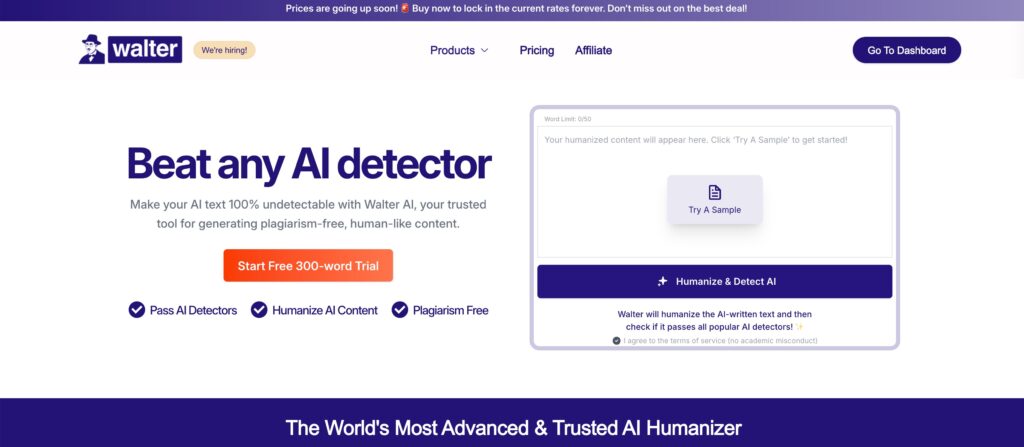
Unlike generic AI tools, Walter Writes AI is built to create natural, undetectable content.
- It mimics human writing styles so it doesn’t get flagged.
- Uses varied sentence structures to avoid repetitive phrasing.
- Creates well-organized, readable content that sounds natural.
Why Students & Professionals Choose Walter Writes AI
Walter Writes AI helps users:
- Write high-quality essays without plagiarism concerns.
- Improve sentence flow, clarity, and readability.
- Produce content that’s natural and engaging.
The Right Way to Use AI for Writing
AI should be a tool to help with brainstorming, organizing thoughts, and improving writing, not a way to completely replace human effort.
Walter Writes AI is designed to support your writing, making it stronger and more polished, while ensuring originality.
Frequently Asked Questions
1. Does SafeAssign detect AI-generated essays?
Not really. SafeAssign is mainly looking for plagiarism, not AI-written content.
2. Can SafeAssign check for ChatGPT content?
Only if the AI-generated text includes phrases copied from existing sources. Otherwise, it won’t be detected.
3. Does SafeAssign use AI for plagiarism detection?
Nope. It relies on database comparisons, not AI-driven detection.
4. Can Walter Writes AI help me with original writing?
Yes! Walter Writes AI produces high-quality, human-like content that won’t get flagged.
5. Is using AI for academic writing considered cheating?
It depends on how you use it. If you use AI for brainstorming, editing, and structuring your ideas, it’s fine. But submitting a fully AI-generated paper without changes could violate academic integrity policies.
6. What does a SafeAssign score of 30% mean?
It means 30% of your text matched something in SafeAssign’s database. That doesn’t automatically mean plagiarism. Properly cited quotes, common academic phrases, and standard terminology all contribute to the similarity score. Your instructor will look at the flagged sections in context before drawing any conclusions.
7. What AI detector should instructors use alongside SafeAssign?
The most widely used options in 2026 are Turnitin’s AI writing indicator, GPTZero, and Copyleaks. For schools that want a tool accessible to both instructors and students, Walter Writes AI includes a built-in AI detection feature that gives clear, straightforward results without requiring an institutional contract.
The Future of AI Detection in SafeAssign
Right now, SafeAssign is not fully capable of detecting AI-generated content.
As AI tools continue to evolve, detection methods might improve - but for now, SafeAssign mainly focuses on plagiarism, not AI writing.
Want to write high-quality, undetectable essays? Try Walter Writes AI today!
Safe, ethical, and built to sound human - Walter Writes AI is the smartest way to ensure originality while using AI assistance.
Check out Walter Writes AI now!
SafeAssign is one piece of the picture. For the broader story on how Turnitin detects ChatGPT and AI writing across submissions, see our 2026 deep dive on perplexity, burstiness, and accuracy data.
FAQ: SafeAssign AI detection (2026)
Does SafeAssign detect ChatGPT?
Yes. SafeAssign added an AI detection signal in 2024 alongside its existing plagiarism similarity check. The AI flag appears in the Blackboard instructor report. Raw ChatGPT output is flagged reliably; light editing and paraphrasing reduce detection.
How is SafeAssign’s AI detection different from Turnitin’s?
SafeAssign is bundled with Blackboard and includes AI flagging as part of its plagiarism similarity report. Turnitin AI Detection is a separate, more aggressive feature with its own AI Writing percentage scoring. Turnitin is generally more sensitive; SafeAssign is more conservative with its AI flag. See How Does Turnitin Detect ChatGPT?
Can SafeAssign detect paraphrased ChatGPT?
Often partial detection. Light paraphrasing (QuillBot, synonym swapping) reduces but rarely eliminates the AI signal. See Does QuillBot Pass Turnitin? for testing data that applies broadly to similar detectors.
What happens if SafeAssign flags my paper as AI?
The instructor sees the flag in the Blackboard grading interface alongside the similarity report. Typical sequence: instructor reviews flagged sections, compares with behavioral data (timing, edit history), discusses with student informally, and either resolves it or escalates to academic integrity.
Does SafeAssign store my paper?
By default yes, SafeAssign adds submissions to the Blackboard institution-wide database to power future plagiarism comparisons. Some universities allow students to opt out of this storage.
How can I make sure my AI-assisted essay passes SafeAssign?
The reliable approach is using ChatGPT for brainstorming only, writing the actual essay yourself, and running a final pass through an AI humanizer if needed. Submit with progressive draft history so behavioral signals support your work. See How Students Can Pass AI Detectors in 2026.