



As more students adopt AI in their workflow, institutions are taking steps to combat academic fraud. As a student, you don’t just worry about being flagged for AI. You also need to ensure you’re not penalized wrongly. If you use an anti AI detector tool in your work, you need to focus on keeping your essay natural so that citations are intact after rewriting. Many tools promise 100% undetectable output. But your concern should be on preserving the original meaning and maintaining a proper argument trail. This is because many of these tools don’t often deliver what they promise. So it’s important to know the right one to choose. This article will help you choose the best anti AI detection tools to reduce academic risks. You’ll also know which one you should avoid.
Quick Picks: Top AI Detection Removers for Students
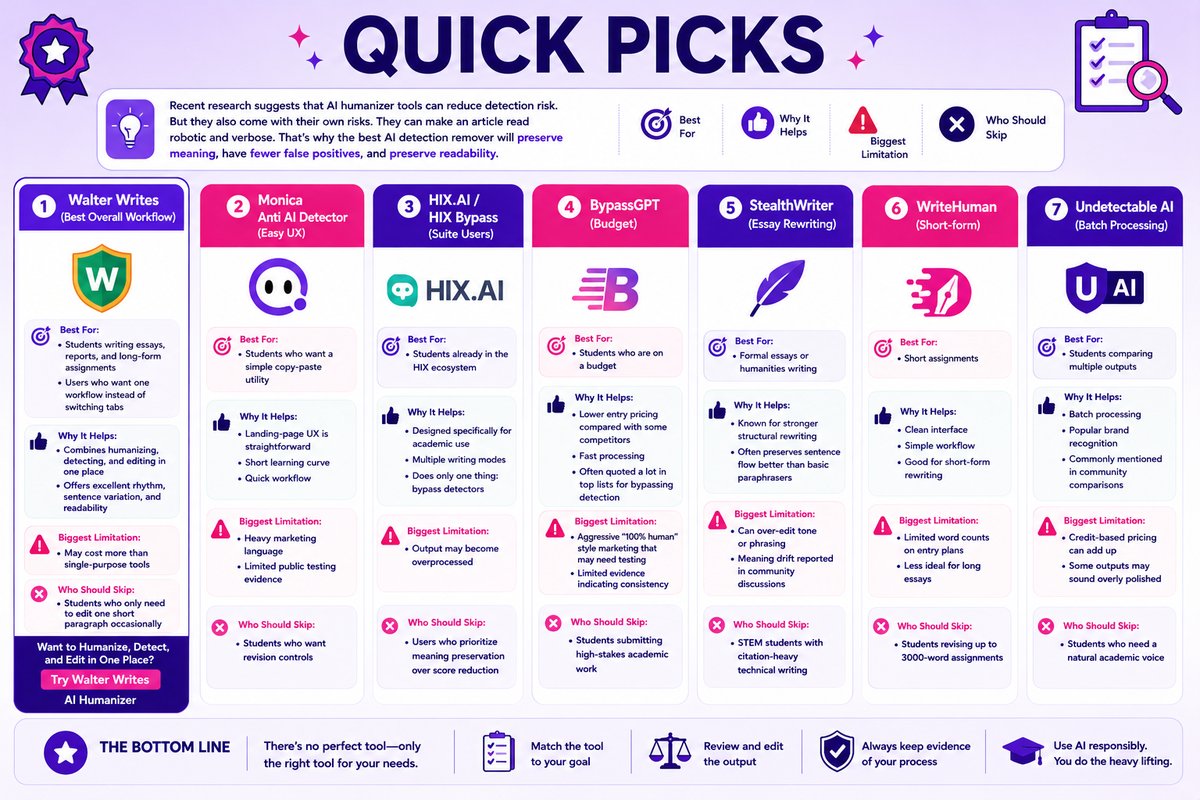
Recent research suggests that AI humanizer tools can reduce detection risk. But they also come with their own risks. They can make an article read robotic and verbose. That’s why the best AI detection remover will preserve meaning, have fewer false positives, and preserve readability.
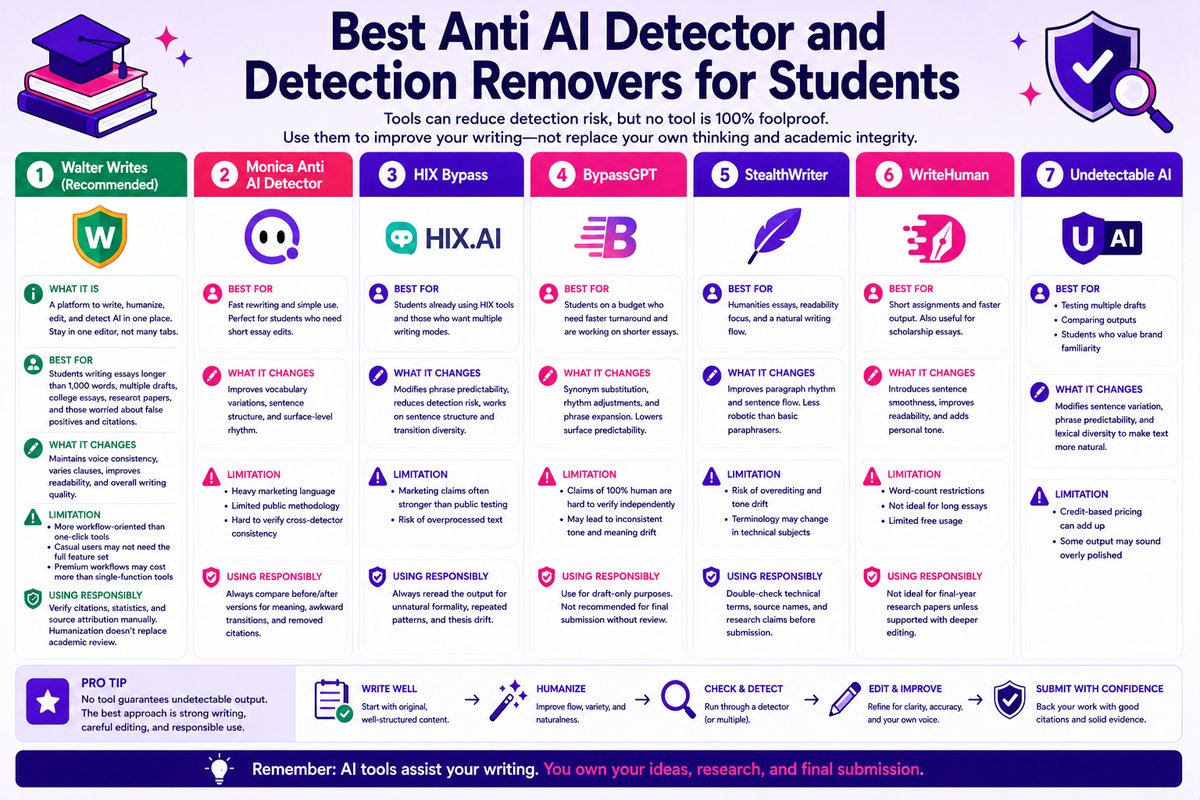
Walter Writes (Best Overall Workflow)
Best for:
- Students writing essays, reports, and long-form assignments
- Users who want one workflow instead of switching tabs
Why It Helps:
- Combines humanizing, detecting, and editing in one place
- Offers excellent rhythm, sentence variation, and readability
Biggest Limitation
- May cost more than single-purpose tools
Who Should Skip
- Students who only need to edit one short paragraph occasionally
Want to Humanize, Detect, and Edit in One Place? Try Walter Writes AI Humanizer
Monica Anti AI Detector (Easy UX)
Best for:
- Students who want a simple copy-paste utility
Why It Helps:
- Landing-page UX is straightforward
- Short learning curve
- Quick workflow
Biggest Limitation
- Heavy marketing language
- Limited public testing evidence
Who Should Skip:
- Students who want revision controls
HIX.AI/HIX Bypass (Suite Users)
Best for:
- Students already in the HIX ecosystem
Why It Helps:
- Designed specifically for academic use
- Multiple writing modes
- Does only one thing: bypass detectors
Biggest Limitation:
- Output may become overprocessed
Who Should Skip:
- Users who prioritize meaning preservation over score reduction
BypassGPT (Budget)
Best for:
- Students who are on a budget
While It Helps:
- Lower entry pricing compared with some competitors
- Fast processing
- Often quoted a lot in top lists for bypassing detection
Biggest Limitation
- Aggressive “100% human” style marketing that may need testing
- Limited evidence indicating consistency
Who Should Skip:
- Students submitting high-stakes academic work
StealthWriter (Essay Rewriting)
Best for:
- Formal essays or humanities writing
Why It Helps:
- Known for stronger structural rewriting
- Often preserves sentence flow better than basic paraphrasers
Biggest Limitation:
- Can over-edit tone or phrasing
- Meaning drift reported in community discussions
Who Should Skip:
- STEM students with citation-heavy technical writing
WriteHuman (Short-form)
Best for:
- Short assignments
Why It Helps:
- Clean interface
- Simple workflow
- Good for short-form rewriting
Biggest Limitation:
- Limited word counts on entry plans
- Less ideal for long essays
Who Should Skip:
- Students revising up to 3000-word assignments
Undetectable AI (Batch Processing)
Best for:
- Students comparing multiple outputs
Why It Helps:
- Batch processing
- Popular brand recognition
- Commonly mentioned in community comparisons
Biggest Limitation
- Credit-based pricing can add up
- Some outputs may sound overly polished
Who Should Skip:
- Students who need a natural academic voice
How AI Detectors Work
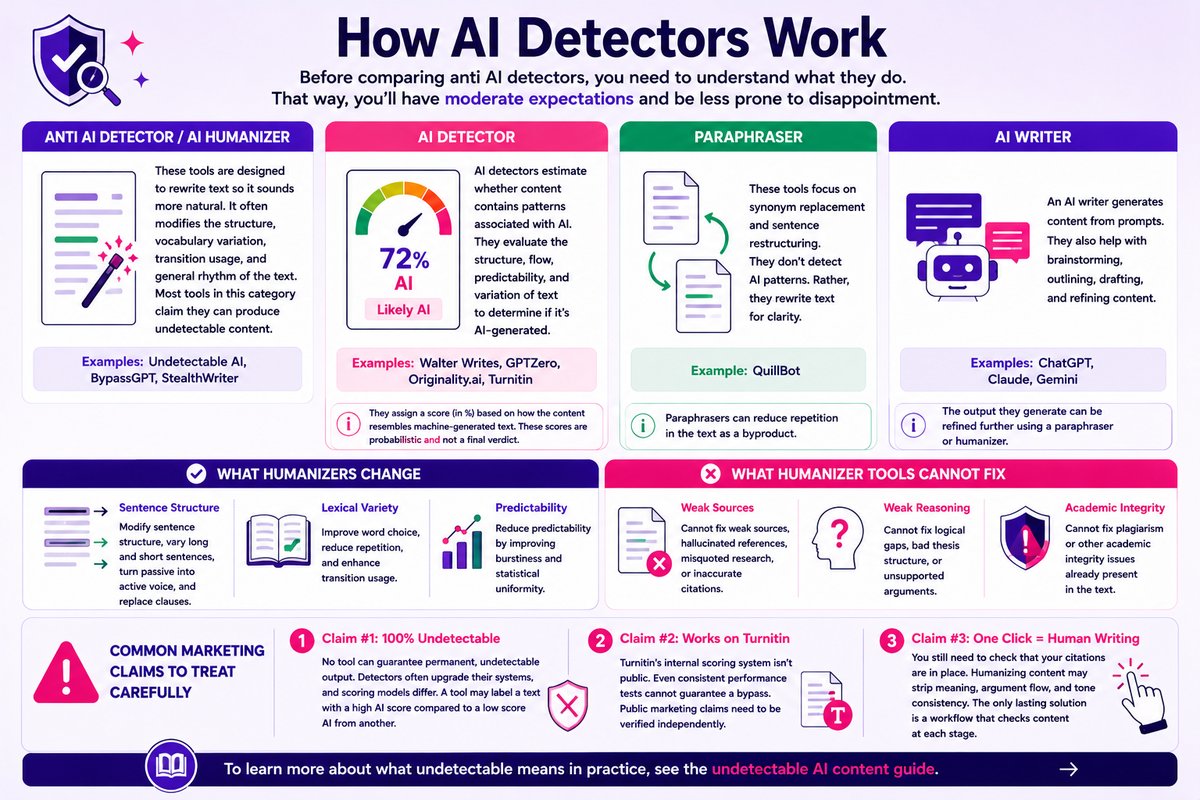
Before comparing anti AI detectors, you need to understand what they do. That way, you’ll have moderate expectations and be less prone to disappointment.
Anti AI Detector vs AI Detector vs Paraphraser vs AI Writer
Anti AI Detector/AI Humanizer
These tools are designed to rewrite text so it sounds more natural. It often modifies the structure, vocabulary variation, transition usage, and general rhythm of the text. Most tools in this category claim they can produce undetectable content. Examples include Undetectable AI, BypassGPT, and StealthWriter. Some of these tools aren’t truly detection removers. They are just glorified rewriters.
AI Detector
AI detectors estimate whether content contains patterns associated with AI. They evaluate the structure, flow, predictability, and variation of text to determine if it’s AI-generated. They assign a score (in %) based on how the content resembles machine-generated text. These scores are generated through probability and shouldn’t be taken as a final verdict. Examples include Walter Writes, GPTZero, Originality.ai, and Turnitin.
Paraphraser
These tools focus on synonym replacement and sentence restructuring. They don’t detect AI patterns. Rather, they rewrite text for clarity. A popular example is QuillBot. Paraphrasers can reduce repetition in the text as a byproduct.
AI Writer
An AI writer generates content from prompts. They also help with brainstorming, outlining, drafting, and refining content. The output they generate can be refined further using a paraphraser or humanizer. Examples include ChatGPT, Claude, and Gemini.
What These Tools Change vs What They Can’t Change
What Humanizers Change
- They modify sentence structure. They vary from long and short sentences, turn passive into active voice, and replace clauses in text.
- They also work on lexical variety, such as word choice, phrase repetition, and transition usage.
- Another thing they work on is predictability. They act on burstiness and statistical uniformity.
What Humanizers Tools Cannot Fix
- An AI humanizer cannot fix weak sources. They ignore hallucinated references, misquoted research, etc., in the content. That’s why you need to review humanized content before submitting.
- They also cannot identify weak reasoning. So, if there are logical gaps, a bad thesis structure, or unsupported arguments in your essay, they’ll leave it as is.
- Another area where humanizers are weak is in identifying academic integrity issues. Plagiarism, for example, can remain largely unchanged if it’s already in the text before humanization.
Common Marketing Claims to Treat Carefully
Claim #1: 100% Undetectable
No tool can guarantee permanent, undetectable output. This is because detectors often upgrade their systems, which might make them more potent. Moreover, scoring models differ. A tool may label a text with a high AI score compared to a low score AI from another.
Claim #2: One Click = Human Writing
In reality, you still need to check that your citations are still in place. Many a time, humanizing content may strip it of meaning, argument flow, and tone consistency. The only lasting solution is to follow a workflow that checks content at each stage. To learn more about what undetectable means in practice, see the undetectable AI content guide.
How AI Detectors Tend to Judge Writing
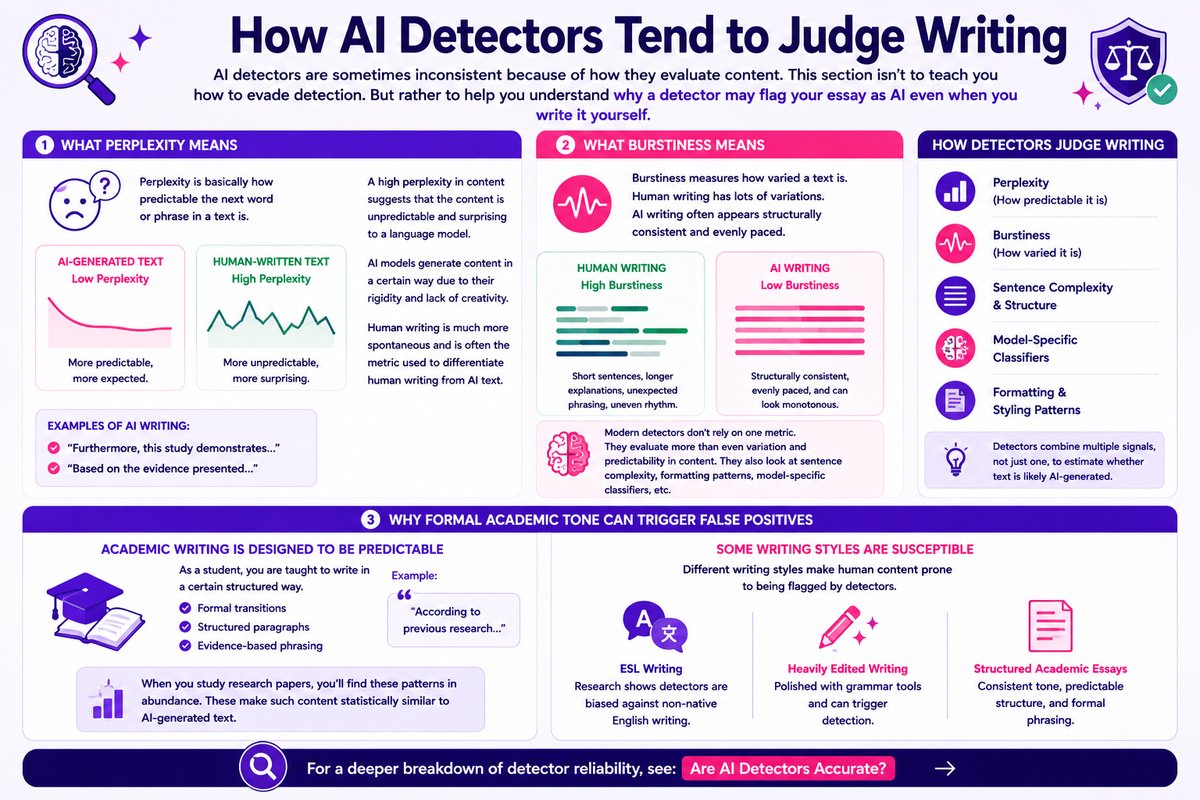
AI detectors are sometimes inconsistent because of how they evaluate content.
What Perplexity Means
Perplexity is basically how predictable the next word or phrase in a text is. AI-generated content often has low perplexity while human-written content has high perplexity. A high perplexity in content suggests that the content is unpredictable and surprising to a language model. Due to their rigidity and lack of creativity, AI models generate content in a certain way. But human writing is much more spontaneous. It is often the metric used to differentiate human writing from AI text.
Examples of AI writing:
- “Furthermore, this study demonstrates…”
- “Based on the evidence presented…”
What Burstiness Means
Burstiness measures how varied a text is. Human writing often has a lot of variations. Short sentences, longer explanations, unexpected phrasing, uneven rhythm. AI writing, however, often appears structurally consistent and evenly paced, so much so that it looks monotonous. Detectors often analyze burstiness alongside perplexity to detect AI content.
Modern detectors don’t rely on one metric. They evaluate more than even variation and predictability in content. They also look at sentence complexity, formatting patterns, and model-specific classifiers.
Why Formal Academic Tone Can Trigger False Positives
Academic Writing is Designed to Be Predictable
As a student, you are taught to write in a certain structured way. Formal transitions, structured paragraphs, evidence-based phrasing. Example,, “According to previous research…” When you study research papers, you’ll find these patterns in abundance. These make such content statistically similar to AI-generated text.
Some Writing Styles Are Susceptible
Different writing styles make human content prone to being flagged by detectors. This includes: ESL writing (research shows detectors are biased against non-native English writing, heavily edited writing (which are polished with grammar tools and can trigger detection, and structured academic essays (due to their consistent tone). For a deeper breakdown of detector reliability, see: Are AI Detectors Accurate?
Student-Centric AI Detection Risk
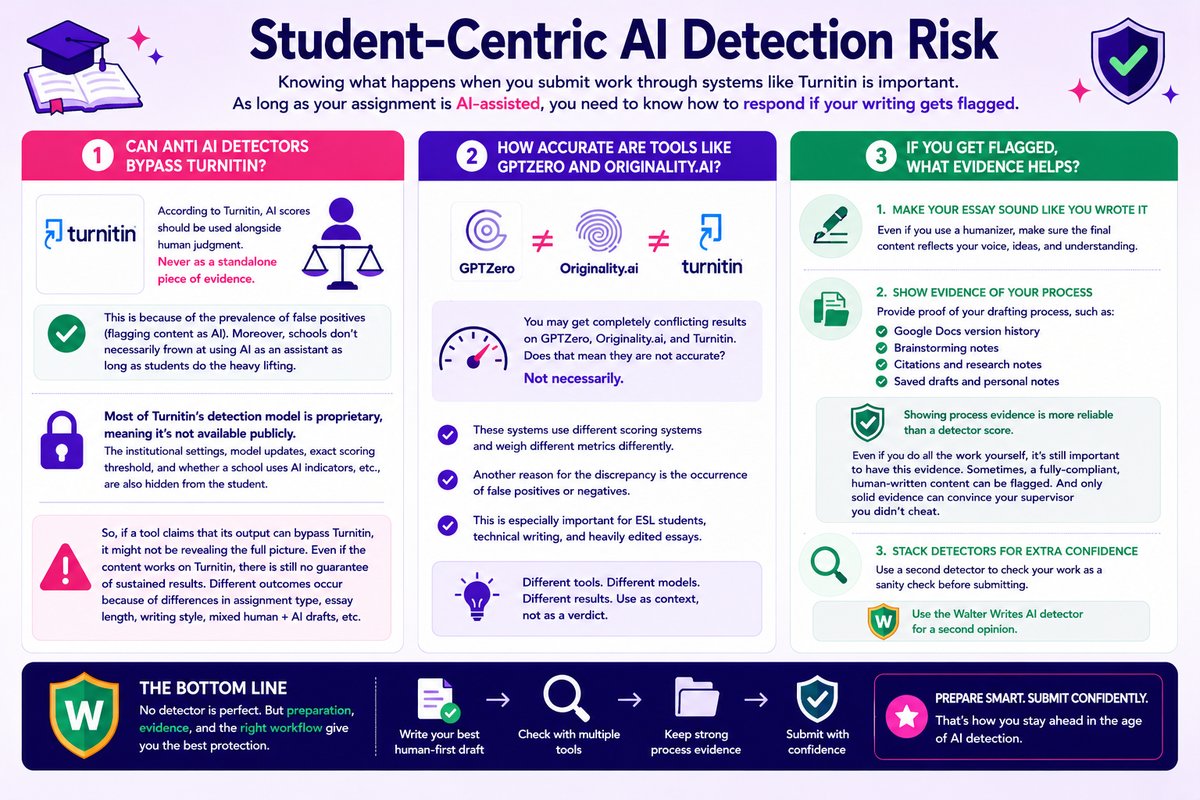
Knowing what happens when you submit work through systems like Turnitin is important. As long as your assignment is AI-assisted, you need to know how to respond if your writing gets flagged.
Can Anti AI Detectors Bypass Turnitin?
According to Turnitin, AI scores should be used alongside human judgment. Never as a standalone piece of evidence. This is because of the prevalence of false positives (flagging content as AI). Moreover, schools don’t necessarily frown at using AI as an assistant as long as students do the heavy lifting.
Most of Turnitin’s detection model is proprietary, meaning it’s not available publicly. The institutional settings, model updates, exact scoring threshold, and whether a school uses AI indicators are also hidden from the student. So, if a tool claims that its output can bypass Turnitin, it might not be revealing the full picture. Even if the content works on Turnitin, there is still no guarantee of sustained results. Different outcomes occur because of differences in assignment type, essay length, writing style, and mixed human + AI drafts.
How Accurate Are Tools Like GPTZero and Originality.ai?
You may get completely conflicting results on GPTZero, Originality.ai, and Turnitin. Does that mean they are not accurate? Not necessarily. These systems use different scoring systems and weigh different metrics differently. Another reason for the discrepancy is the occurrence of false positives or negatives. This is especially important for ESL students, technical writing, and heavily edited essays.
If You Get Flagged, What Evidence Helps?
Now that you understand the complexities of this system, how can you prepare for when you get flagged? First, you can make your essay sound like you wrote it, even if you use a humanizer.
Second, you should be able to show evidence of the drafting process. This includes Google Docs version history, brainstorming notes, citations, saved drafts, and personal notes. Showing process evidence is more reliable than a detector score. Even if you do all the work yourself, it’s still important to have this evidence. Sometimes, fully compliant, human-written content can be flagged. And only solid evidence can convince your supervisor you didn’t cheat.
If you want extra confidence, you can stack detectors. That is, use a second detector to check your work as a sanity check before submitting. Use the Walter Writes AI detector for a second opinion.
The Rubric We Use to Rank Tools
To select the best anti AI detectors for students, we considered a few criteria. This is to ensure we promote the right tools for students.
Meaning Preservation
The most important feature in any AI detection remover is the ability to sustain meaning after humanization. Your arguments and evidence should be preserved. It’s easy to lose marks because a tool changed meaning, which makes an entire paragraph worthless.
Logic Consistency
After humanizing the content, check to ensure an important part of the work hasn’t been changed. Is your thesis still the same? Are your claims weaker or stronger accidentally?
Citation Integrity
Many AI humanizers often focus on style, rather than integrity. As a result, your important citations may be cut off. So, you need to review this area too. Are your statistics/quotations intact? Is the source name removed? Are your citations attached to the right claims? These are some of the questions you need to ask and answer before proceeding.
Readability
Natural Flow
Natural flow helps to keep your work sound human. When it is humanized, it may start to feel like AI-generated content. Read through and see if the essay still sounds like you wrote it. Also, check if transitions are natural.
Voice Consistency
Sometimes, replacing synonyms in content doesn’t work. And since that is what many humanizers do as part of their rewrite, you need to be careful if you want to preserve your voice. When you review the content, make sure the vocabulary is not forced. It also shouldn’t sound too formal or robotic. For example, the tool may replace “use” with “utilize”, which fits poorly most times.
Iteration Control
Another consideration is whether the tool allows for multiple revisions. Even if you’re using the free plan, it should still allow for editing. Some tools, like WriteHuman or Undetectable AI, may use word caps. In such a case, you already know the total number of words you can generate in a month. That way, you can monitor and manage what you have. Another thing is being able to rewrite, edit, and recheck in one workspace. That is where tools like Walter Writes excel with their all-in-one workflow system.
Best Anti AI Detector and Detection Removers for Students
Walter Writes (Recommended)
What It Is
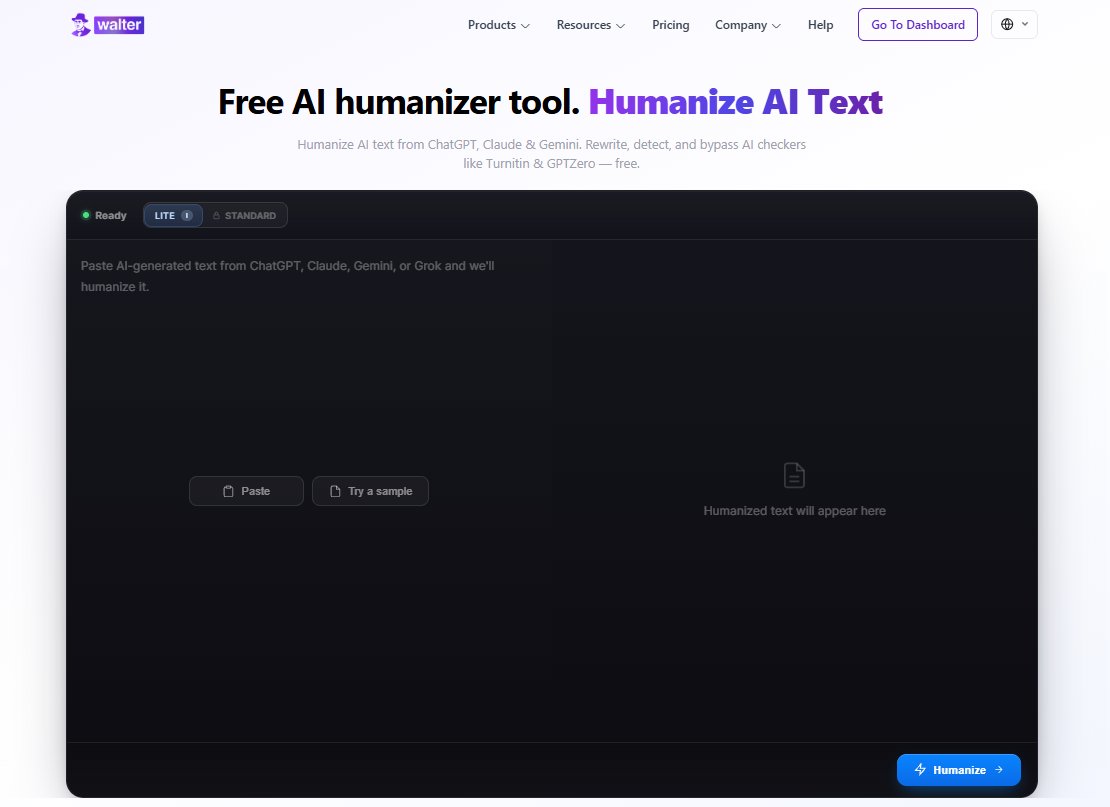
Walter Writes is not a bypass tool. Rather, it’s a platform that allows writing, humanizing, editing, and AI detection in one place. It allows you to stay in one editor instead of hopping between tools.
Best For
It’s the most reliable option for students who write essays longer than 1,000 words. These kinds of essays require revising multiple drafts. Being able to do that in one place makes the work easier. You can use it to write college essays, scholarship writing, and research papers. It’s also suitable for students who worry about false positives and need citation-sensitive editing.
What It Changes
Walter Writes is not just a tool to make AI text undetectable or for synonym replacement. It can help you maintain voice consistency, vary clauses, and generally improve readability.
Limitation
- More workflow-oriented than one-click tools
- Casual users may not need the full feature set
- Premium workflows may cost more than single-function tools
Using Responsibly
If you use the Walter Writes AI humanizer to complete your essay, you still need to verify citations, statistics, and source attribution manually. Humanization doesn’t replace academic review. It’ll help you catch last-minute errors that may creep into your work after humanizing.
Monica Anti AI Detector
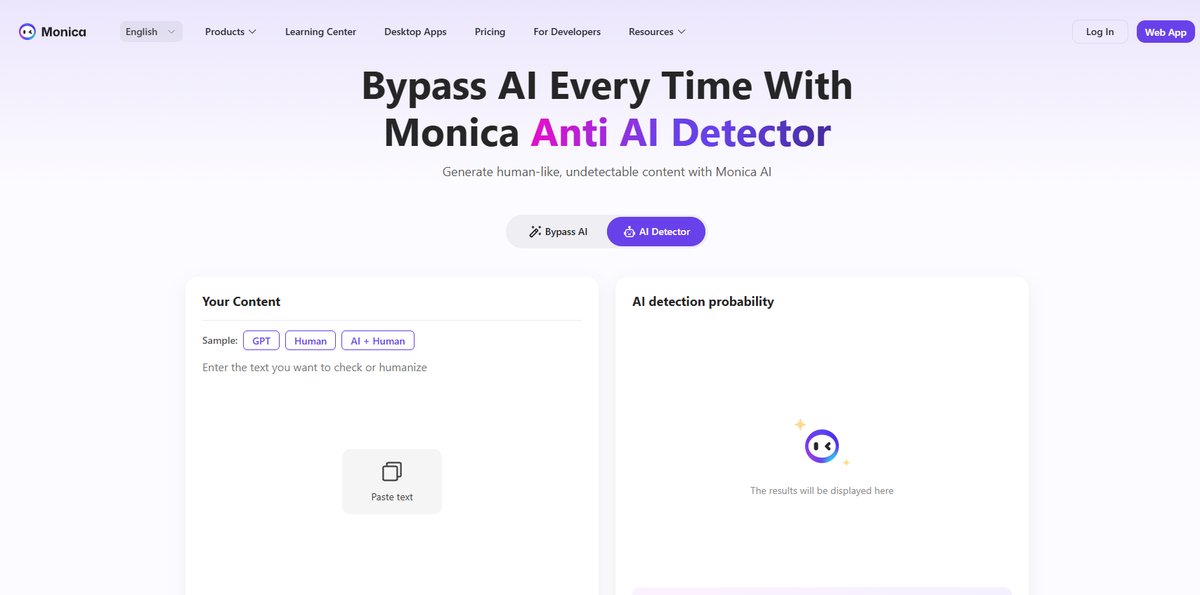
This AI detector is part of the broader Monica ecosystem. It’s positioned to offer students a copy-paste, rewrite, and humanization solution. The interface is simple, making it easy for first-time users.
Best For
If you want a solution for fast rewriting, then this is a good option. It doesn’t have a complex dashboard that’ll take time to master when you just want a simple writer. Most importantly, it’s suitable for students who only need short essay edits.
What It Changes
The tool can improve vocabulary variations, sentence structure, and surface-level rhythm. This makes it one of the most intuitive systems for beginners.
Limitation
- Heavy marketing language
- Limited public methodology
- Hard to verify cross-detector consistency
Using Responsibly
Always compare before/after versions for changes in meaning, awkward transitions, and removed citations. These seemingly simple things can have a huge effect on your essay. So, pay attention to them before submitting.
HIX Bypass
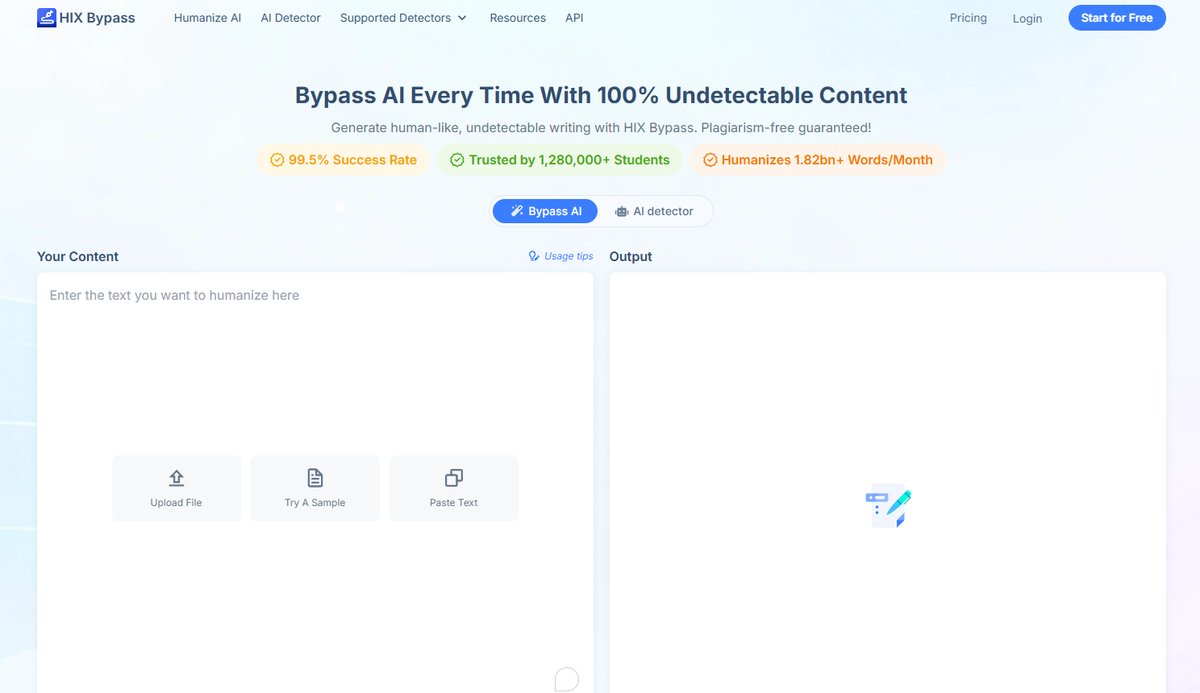
As the name implies, it’s designed for students who want to bypass Turnitin, GPTZero, and Originality.ai. It is commonly used by writers seeking the best, most undetectable AI writer. However, it must be tested to see how it fits into your current workflow. It also offers strong AI writing support, especially for students who may not be familiar with the HIX.AI platform or their tools.
Best For
It’s suitable for students who already use HIX tools. The AI writer is part of the HIX.AI suite of software writing tools. It is also positioned for students who want multiple writing modes to support their writing process.
What It Changes
When used, it’ll help modify phrase predictability, reducing susceptibility to detection. It also works on sentence structure and transition diversity to make the content sound more human.
Limitations
- Marketing claims are often stronger than public testing evidence
- Risk of overprocessed text
Using Responsibly
Always reread the output for any unnatural formality, repeated sentence patterns, and thesis drift.
BypassGPT
BypassGPT is a dedicated detector-removal tool that promises to convert AI-generated content into human-written output and detector-safe text. It’s not as advanced as Walter Writes or Monica AI. So, it’s better used for simple draft generation. It is more affordable and therefore suitable for students who are on a tight budget.
Best For
Students who want lower-cost entry, need faster turnaround, and are testing shorter essays. It is ideal for students on a budget.
What It Changes
Common changes include synonym substitution, rhythm adjustments, and phrase expansion. It can also help lower surface predictability for smaller assignments.
Limitation
- Claims of 100% human are hard to verify independently
- May lead to inconsistent tone and meaning drift
Using Responsibly
It should not be used for final submission without review. It’s best used as a draft-only solution.
StealthWriter
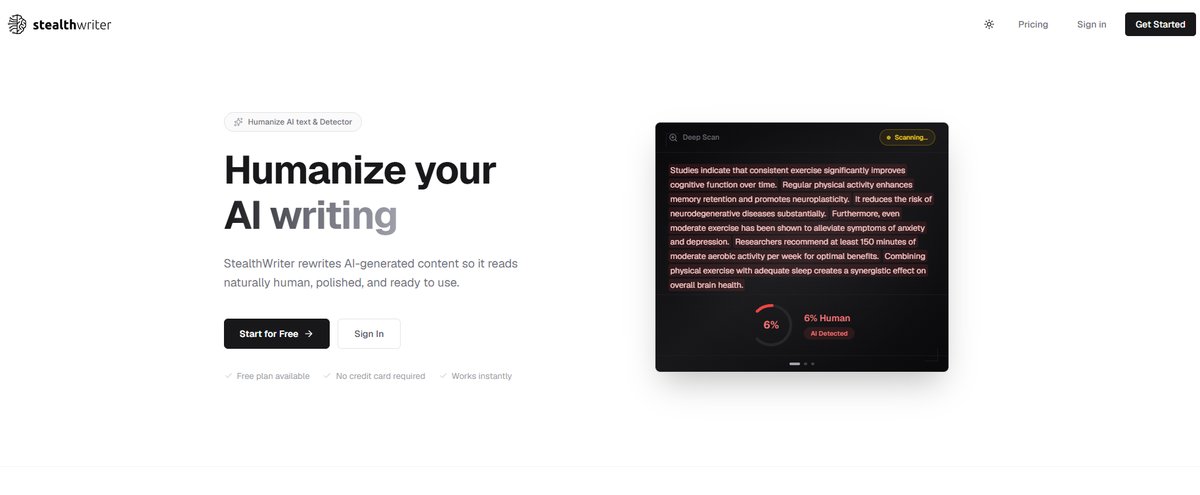
StealthWriter claims to be an AI humanizer that can turn ChatGPT or Gemini-produced content into text that reads as if it is human-written. The tool is designed for users who use AI to generate their content but who want to bypass AI detection systems. This includes students writing essays, marketers generating blog content, and professionals needing natural-sounding writing.
Best For
This is suitable for students who want to write humanities essays, care about readability, and prefer a more natural writing flow.
What It Changes
It often changes paragraph rhythm and the flow of sentences. It’s less robotic than basic paraphrasers and can add variation in the academic tone.
Limitation
- Risk of overediting and tone drift
- Terminology may change in technical subjects
Using Responsibly
Double-check technical terms, source names, and research claims before submission. May warrant rewriting some parts.
WriteHuman
WriteHuman is built around simple rewriting. Like Monica, it also has a clean interface and simple workflow. This makes it easier for students who want a quick writing platform.
Best For
Students who are working on short assignments and who need a faster output. It can also be used to revise scholarship essays, but it’s most ideal for short-form editing.
What It Changes
It can introduce sentence smoothness, readability, and help with personal tone.
Limitation
- Word-count restrictions
- Not ideal for long essays
- Limited free usage
Using Responsibly
Not ideal for final-year research papers unless supported with deeper editing.
Undetectable AI
This is one of the most recognized anti-detection brands. It’s suitable for students looking to compare multiple outputs. It’s commonly praised for batch processing. However, its polished output may sound unnatural in academic settings.
Best For
- Testing multiple drafts
- Comparing multiple outputs
- Students who value brand familiarity
What It Changes
It can modify sentence variation, phrase predictability, and lexical diversity to make text more natural.
Limitation
- Credit-based pricing can add up
- Some output may sound overly polished
Pricing Comparison
Most students compare AI humanizer tools by monthly price. But the real cost comes from how many times you need to rewrite an essay. If you have to rewrite five times with a $9 tool, then it costs more (in time, credits, and stress) than a $15 that gets you close on the first pass.
| Tool | Starting Price | Credit Limits | Constraints | Free Tier |
|---|---|---|---|---|
| Walter Writes | $8/month | 30,000 words/month, 750 words/request | Longer essays may require splitting the draft into sections | No |
| HIX Bypass | $9.99-$14.99/month | 5,000 words/month, 3,000 words/input | Higher plans unlock larger request limits. | No |
| BypassGPT | $8/month | 5,000 words/month, 500 words/request | Lower entry pricing, but multiple rewrites may consume credits faster. | Yes |
| StealthWriter | $20/month | 7,500,000 words/month, 5,000 words/input | Higher price point for students on tight budgets. | Yes |
| WriteHuman | $12/month | 48,000 words/month, 600 words/request | Smaller quotas may be limiting for multiple assignments. | No |
| Undetectable AI | $5-$9.99/month | 10,000 words/month, tiered by word usage | Credit-heavy workflows can add up over a semester. | No |
How to Use an AI Humanizer Safely for Essays
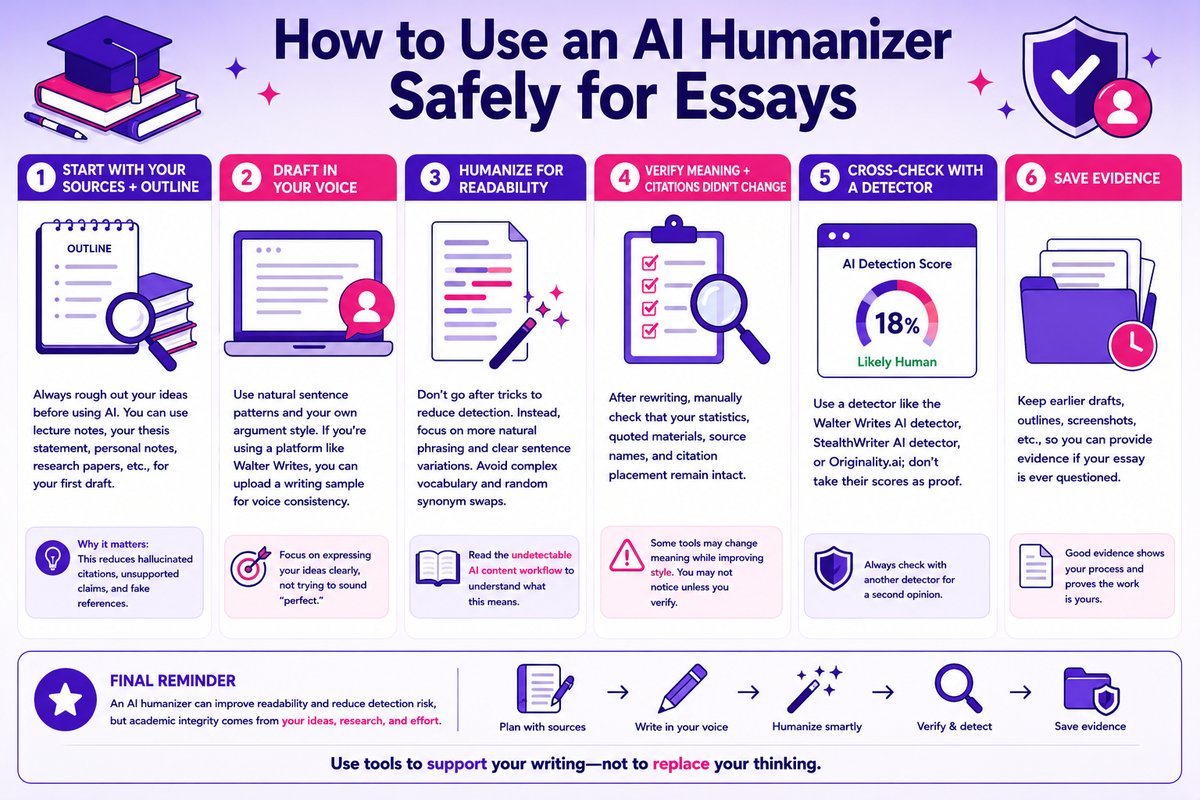
Step 1: Start With Your Sources + Outline
Always rough out your ideas before using AI. You can use lecture notes, your thesis statement, personal notes, research papers, etc., for your first draft. This will reduce hallucinated citations, unsupported claims, and fake references. For tool picks focused on essay quality, see our guide to the best AI humanizers for students.
Step 2: Draft in Your Voice
Use natural sentence patterns and your own argument style. If you’re using a platform like Walter Writes, you can upload a writing sample for voice consistency.
Step 3: Humanize for Readability
Don’t go after tricks to reduce detection. Instead, focus on more natural phrasing and clear sentence variations. Avoid complex vocabulary and random synonym swaps. Read the undetectable AI content workflow to understand what this means.
Step 4: Verify Meaning + Citations Didn’t Change
After rewriting, manually check that your statistics, quoted materials, source names, and citation placement remain intact. Some tools may change meaning while improving style. You may not notice unless you verify.
Step 5: Cross-Check With a Detector
Use a detector like the Walter Writes AI detector, StealthWriter AI detector, or Originality.ai; don’t take their scores as proof. Always check with another detector for a second opinion.
Step 6: Save Evidence
Keep earlier drafts, outlines, and screenshots so you can provide evidence if your essay is ever questioned.
Frequently Asked Questions
What Is an Anti AI Detector and How Does It Work?
An anti AI detector, also known as an AI humanizer, is a tool that changes patterns in written content associated with machine-generated content. They change vocabulary, predictability, and transitions. Examples include Walter Writes and StealthWriter.
Can Anti AI Detector Bypass Turnitin?
Even the best undetectable AI writers cannot guarantee that they can bypass Turnitin. Scoring models differ, as do institutional settings. These things determine the result.
Are AI Detection Removers Legal to Use for School Assignments?
It’s the school policy that’ll determine the legality. Always check your course syllabus, instructor rules, and school AI policy. While it may be legal in one school, it may not be in another.
What’s the Difference Between an AI Detector and Anti AI Detector?
An AI detector estimates whether writing resembles AI output, while an anti AI detector tries to rewrite content to look more human-like.
Do Anti AI Detectors Affect the Quality or Meaning of the Original Text?
Yes, it can sometimes affect the quality. Issues that may arise from trying to humanize AI text are altered claims, logic drift, citation modification, and even awkward phrasing. It’s recommended to review each output before submitting.
Can AI Detectors Give False Positives on Human-Written Essays?
Yes, many anti AI detector tools are guilty of this. Not all AI detectors are accurate. If the writing has a formal academic tone, repetitive structure, or ESL writing patterns, then it may be prone to false positives.
How Accurate Are Tools Like GPTZero and Originality.ai?
Accuracy varies by editing level, essay type, and model updates. You may get different results from both GPTZero and Originality.ai; that’s why it’s important to use more than one tool when evaluating content.
Will Using an AI Humanizer Tool Get You Caught?
Using an AI humanizer tool doesn’t get you caught directly. But it can introduce factual errors and broken citations, making your work suspicious and subject to review.
What Should Students Look for When Choosing an Anti AI Detector Tool?
Students should prioritize preserving meaning, maintaining voice consistency, allowing for flexible revision, and ensuring citation safety.
Does Humanized AI Text Still Pass Plagiarism Checkers?
AI detection and plagiarism checkers do different things. However, a single tool (e.g., Turnitin) may offer both features. When you rewrite content to bypass GPTZero, it doesn’t solve the need for citation and proper attribution.