





You’ve spent weeks perfecting your college essay. Every word feels right. But now you’re staring at the submit button, wondering if some AI detector is going to flag your work because you used ChatChatGPT to fix a comma splice. So you ask yourself, “Do colleges use AI detectors?”
If you’re a graduating high school student or incoming college student working on your college essays, you’ve likely worried about this question.
This guide breaks down what colleges actually do with AI detectors, which tools they use, and how to write with confidence without gaming the system.
Do Colleges Use AI Detectors? YES. But Read On.
Many people assume that colleges use AI detectors to “catch” applicants who have used AI to assist with writing their college essays. This is far from the truth. Most colleges have no official policy related to AI detectors. In fact, most colleges have very little to say about the use of AI in the college application process.
What Admissions Policies Actually Say
Most colleges have no formal AI detection policies. You won’t find a page on their admissions website stating along the lines of “we scan every essay with Proofademic and reject anything above 60%.”
What you will find is vague language about authenticity and personal voice. Admissions teams care about holistic review. They are reviewing your application for your story, not scanning every submission through an AI detector.
Why Policy Matters More Than Detection Tools
Just because a college has access to an AI detector doesn’t mean they are using it as a decision-making tool. Tools alone cannot (and should not) determine an applicant’s fate.
Human readers still control the process. If an essay seems suspicious, it will be sent for a second review.
Do Colleges Use AI Detectors? Yes, But Humans Will Review.
College admissions are human-led and cautious. An AI detector is simply a tool used to flag potentially suspicious content. The focus is on authentic representation, not AI scores.
Colleges use AI detectors to maintain academic integrity standards and to verify authenticity during the admissions and scholarship processes. While detection tools are a supplementary component, human judgment is the main factor.
For more on how colleges also use AI detectors in admissions and scholarships, we’ve covered that in detail.
What AI Detection Tools Exist (and How Colleges Might Use Them)
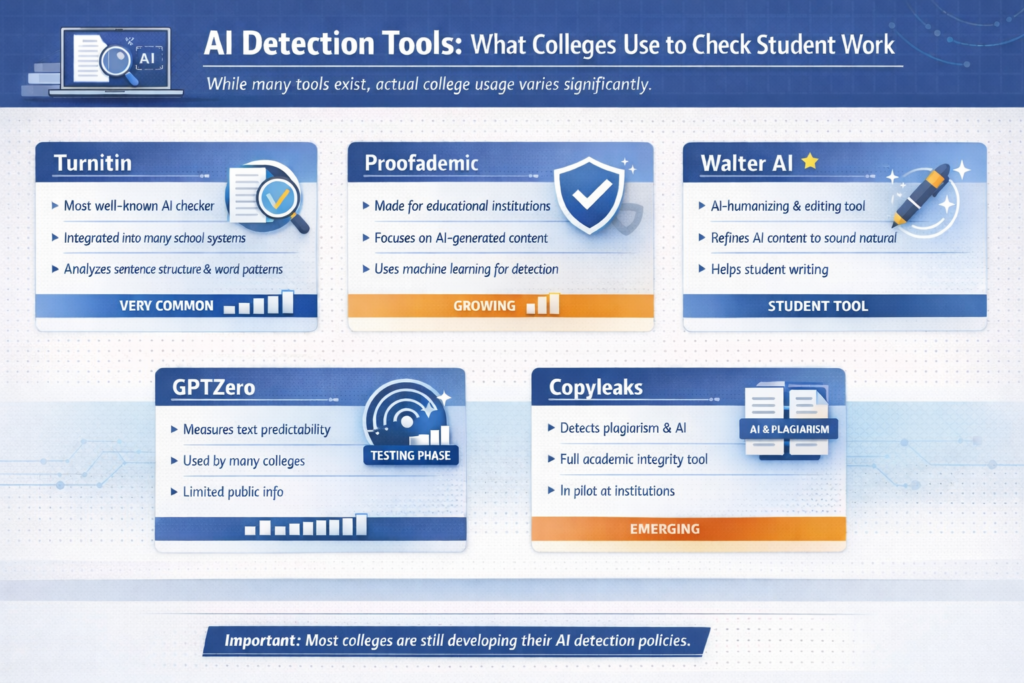
While there are many tools available for detecting AI-generated content, the actual use of these tools by colleges is much less widespread than you might think.
There are numerous tools that colleges use to detect AI-generated content. Some of the most commonly mentioned include:
Turnitin
Turnitin’s AI Checker is probably the most well-known. This tool uses a combination of algorithms and machine learning to identify and flag potentially AI-generated content. As an extension of Turnitin’s existing plagiarism-detection services, it is already integrated into the systems of many schools. It works by analyzing sentence structure and word choice for patterns.
Proofademic
Proofademic is another popular tool. This tool is designed specifically for educational institutions and is primarily focused on identifying AI-generated content within student submissions. Like Turnitin’s AI checker, Proofademic uses advanced machine-learning techniques to identify patterns in sentence structure and word choice. Instead of focusing on plagiarism detection, Proofademic is designed to detect AI-generated content specifically within student submissions.
Walter AI
Walter AI is an AI-humanizing tool that can be used to refine AI-assisted drafts so that they sound more natural, more authentic, and more representative of the student who wrote the draft.
Unlike the other two tools listed, Walter Writes is not a standalone AI detector. Instead, it functions as an AI-humanizing tool that refines AI-assisted drafts to produce a natural-sounding, authentic voice that is consistent with the writer.
ChatGPTZero
ChatGPTZero-style classifiers are yet another type of AI detector. These tools use a variety of metrics, like predictability and uniformity, to determine whether content was generated by an AI program. While many colleges have tested ChatGPTZero-style tools internally, there is very little information available about the actual tools that colleges are currently using.
Copyleaks
Copyleaks is another comprehensive tool that detects both plagiarism and AI-generated content. This tool has emerged as a comprehensive solution for both plagiarism detection and AI content detection. Many institutions are currently testing or implementing Copyleaks in addition to their current academic integrity tools.
Experimental or internal tools
Finally, colleges may develop their own internal tools, either independently or through a partnership with a third-party vendor. Such tools are typically not made publicly available.
If you want a breakdown of what AI detector tools are out there and how they compare, check out our full guide to the best AI detectors in 2026.
How These Tools Are Actually Used
Colleges do not use AI detectors to automatically reject applicants whose essays generate a high AI score. Instead, AI detectors are used to flag potential issues with an applicant’s essay.
What is more likely to happen is that colleges will use AI detectors to identify potential issues with essays. If a piece of writing produces a high AI score, it will not necessarily lead to an immediate rejection. Rather, it will typically trigger a manual review by a human reader, who will evaluate the essay based on several factors, including content, coherence, and overall writing quality.
If an essay receives a high AI score, it will be sent for a manual review by a member of the admissions team, who will then evaluate the essay based on a variety of factors, including content, coherence, and overall writing quality.
In addition to detecting AI-generated content, colleges may also use AI detectors to evaluate the writing style of an applicant. For example, if an applicant’s personal statement reads like a TED Talk, but their supplemental essays appear to have been written by a middle schooler, that is a red flag. While this may not be due to AI, it indicates a lack of consistency in writing style.
Limitations of AI Detectors
AI detectors function by making pattern-based guesses, rather than providing definitive proof that AI was used. Because AI detectors rely on comparisons to known AI outputs, they are susceptible to producing false positives.
Key limitations include:
- Non-native English speakers who write clearly and concisely are particularly vulnerable to being flagged
- Same with experimental or internal tools who usually stick to a uniform style of writing.
- There have been instances in which even published authors have been incorrectly identified as having used AI in their writing
- AI detectors are also prone to flagging classical works as AI. One funny example is that AI detectors flagged the Bible as AI-written
Want to understand the technical side of how these tools actually work? We break it down in our guide on how AI detectors work.
AI Detection Risks & Common Student Misconceptions
Students are understandably concerned about the risks associated with using AI detectors. Let us address some of the common misconceptions.
Myth vs. Reality
“AI Score = Rejection.” → False. A high AI score is merely a flag for a human reviewer. It is not an automatic rejection.
“Turnitin Bans AI Essays.” → False. Turnitin flags possible AI-generated content. The college determines what action should be taken.
Bias & Fairness Issues
Unfortunately, AI detectors have some bias and fairness issues.
Some of the reasons that colleges are not using AI detectors more frequently include concerns about fairness, biases in AI algorithms, and the likelihood of false positives.
There is evidence that AI detectors are disproportionately more likely to flag content written by individuals with polished writing styles or those who are native English speakers.
For example, while many colleges encourage students to edit their essays for clarity and grammar, AI detectors may flag content written in polished prose as suspicious, simply because it appears too consistent in terms of style.
Additionally, neurodivergent writers are also more likely to receive false positive ratings because neurodiverse students often develop consistent writing patterns as part of their daily communication style.
While AI detectors are certainly capable of identifying patterns indicative of AI-generated content, their limitations render them less than ideal for making objective decisions about academic integrity.
This is a well-documented issue, and it is one of the reasons that colleges are so hesitant to rely on AI detectors.
Students who want to understand these limitations in depth, including whether any AI detector is truly 100% accurate, will find a detailed breakdown of the error rates and what they mean in practice.
What Happens If an Essay Is Flagged?
“If colleges do use AI detectors, what happens if my essay gets flagged?”
The manner in which a college responds to a flagged essay will vary depending on the institution. In the vast majority of cases, receiving a flagged essay is not grounds for an automatic rejection.
In nearly all cases, a college will conduct a manual review of the essay. A human reviewer will then evaluate the essay to determine if it appears to represent the applicant’s authentic voice and experience.
Rarely, a college may request additional writing or clarification regarding an applicant’s essay.
Although the AI detector itself does not make the ultimate decision regarding your eligibility, it serves as a warning sign to the admissions committee, indicating that you may have employed some form of AI to assist with the composition of the essay.
Ultimately, the use of AI detectors is intended to aid in maintaining academic integrity, rather than serving as the primary mechanism for evaluating applications.
Human judgment and interpretation remain essential components of the admissions process, regardless of the technology available.
Practical Advice on College Essays and AI Use
Don’t write to avoid getting caught. Write to be human because a human is going to read your essay.
Instead, focus on developing a strong personal voice and writing in a style that reflects your personality.
If you’re worried about sounding “too AI,” the problem isn’t the detector. It’s that your essay might lack personal voice. And that’s fixable. Here’s a guide to undetectable AI content.
If you are concerned about the risk of your essay being flagged by an AI detector, consider testing your essay prior to submission using an AI detector tool. At Walter Writes, we offer such a tool as part of our services.
To view your essay’s detection risk, try using our AI detector tool. When you write confidently, you’ll never worry again.
Is It Ethical to Use AI for College Applications?
This is the question that actually matters. Not “will I get caught,” but “should I be doing this?”
Generally Acceptable Uses
In general, most colleges are OK with the idea of students using AI for:
- Brainstorming. Stuck on how to structure your essay? AI can help generate ideas or suggest angles you haven’t considered.
- Outlining. If you have a good sense of what you want to say but struggle with organizing the various elements of your essay, AI can assist with creating an outline.
- Editing for clarity and grammar. If you’ve written a coherent essay but could benefit from having someone review your work, using AI to catch typos or rephrase awkward sentences is no different than using Grammarly or asking a teacher for feedback.
Risky or Unethical Uses
There’s only one where you cross the line:
Submitting fully AI-written essays as personal work. If you didn’t write it, don’t claim you did. This isn’t about detection. It’s about honesty.
Ask yourself, “Did the idea come from me or did I let ChatChatGPT do the thinking?”
A related form of misrepresentation worth knowing is self-plagiarism: resubmitting your own prior written work as new for a different assignment, without disclosure.
How Colleges Frame Integrity
Because colleges value authenticity, honesty, and a genuine expression of an applicant’s unique perspective, AI detectors serve as a useful tool for identifying potential problems with an applicant’s essay.
Ultimately, it is the responsibility of the applicant to demonstrate authenticity and original thought in all aspects of the college application process.
Colleges care about authentic voice and honest representation. They want to know who you are, not how well you can prompt ChatChatGPT.
If you used AI to refine your ideas or clean up your writing, you’ll be fine.
How to Use AI Safely and Effectively for Admissions Essays
Alright. Let’s talk strategy. You can use AI without compromising your integrity or triggering false positives.
Focus on Personal Story First
Your lived experience beats polished but generic writing every time. Start with your story. Write it in your own words. Don’t outsource the thinking.
AI can help you refine it later. But the foundation has to be yours.
Use AI as a Writing Assistant, Not a Replacement
Think of AI like a tutor, not a ghostwriter. Use it for refinement, clarity, and tone. Not for generating your entire essay from scratch.
If you’re using AI to rewrite every sentence until it sounds “better,” you’re probably stripping out your voice in the process.
How Walter Writes Helps with College Work
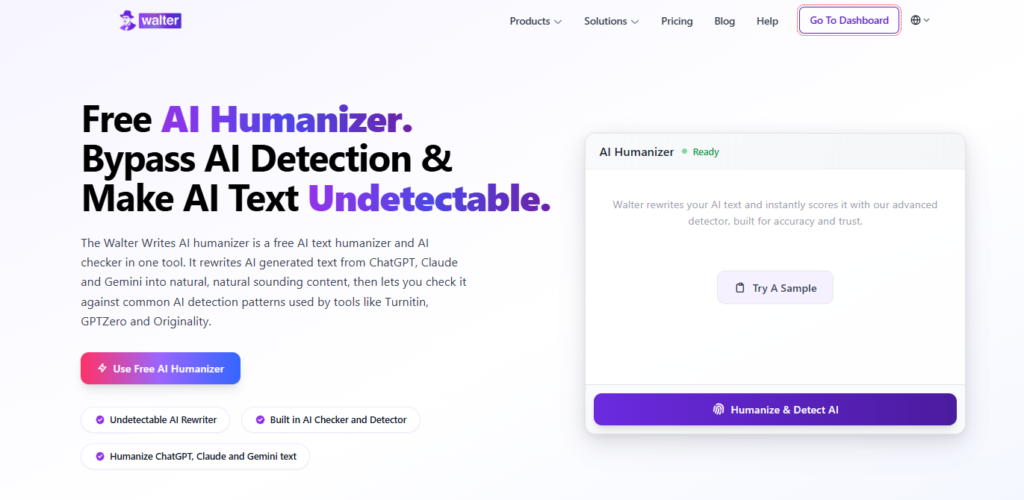
This is where Walter Writes comes in. We’re not here to help you cheat the system. We’re here to help you write like yourself.
Walter Writes humanizes AI-assisted drafts. If you’ve used AI to clean up your writing, we make sure it still sounds like you. Not like ChatChatGPT with a coat of paint.
We also help students check detection risk before submission. If you’re worried about whether your essay will get flagged, you can test it with our AI detector tool before you hit submit.
Want to understand what an AI humanizer actually does? We break it down in our guide on what is an AI humanizer. And if you’re curious about the mechanics of how AI humanizers bypass AI detectors, we’ve got a full guide on how AI humanizers bypass AI detectors.
Not sure if Walter Writes is right for you? Check out our Walter Writes review.
FAQ
Do colleges use AI detectors for application essays?
Sometimes experimentally, but rarely as the sole decision-maker. Most colleges prioritize human review over automated scores.
Can AI-generated essays be detected?
Tools can flag patterns, but results are not definitive. False positives are common, especially for non-native speakers and clean writers.
Is it ethical to use AI for college applications?
Yes, when used for assistance, not substitution. Brainstorming, outlining, and editing are generally acceptable. Full AI-written essays are not.
How does Walter Writes AI help with admissions essays?
Walter Writes helps refine drafts to sound natural, authentic, and student-written. It’s designed for high-stakes writing where your voice matters.
Can universities detect the use of AI?
Detection is imperfect and always reviewed by humans. Even if an essay is flagged, it doesn’t mean automatic rejection.
Do colleges use AI detectors to catch me?
No. Detectors are merely guides. Accuracy and honesty matter more than detection scores. If the content is true and represents your work, Colleges will rarely care.
Do colleges have software to detect AI?
Some do, but usage is inconsistent and cautious. Turnitin AI checker is common, but most schools don’t rely on it exclusively.
Which AI detectors do college professors use?
Proofrademic, Walter AI, Turnitin AI checker, ChatGPTZero, Copyleaks, and internal systems. Usage varies widely by institution.
Want the deeper guide? Can colleges detect ChatChatGPT? walks through the five methods universities stack (detection software, LMS behavioral data, plagiarism AI flags, manual review, document version history), how accurate each detector actually is, and what happens when a student gets flagged.
For the instructor side of the question, see How Do Professors Detect AI Writing in 2026? covering the detection stack faculty actually use.