




Key Takeaway: This Copyleaks review finds it reliable for catching raw, unedited AI text, but it fails completely on mixed or humanized content. In our stress test, it scored 100% on a clean ChatGPT essay and 0% on the same essay after a human paraphrased it.
- Strong detection on obvious AI content: 100% on academic essays, 98% on creative writing
- Zero false positives on human writing, which is good for classroom use
- Fails on mixed content: edited or humanized AI text returned 0% AI, its most critical limitation
- Supports 30-plus languages and integrates with most LMS platforms
- Paid plans start at $9.99/month, with a limited free tier available
If you are a teacher, content manager, or student trying to figure out whether Copyleaks is worth using in 2026, the short answer is: it depends on what you are trying to catch.
Copyleaks is one of the most widely used AI detectors in education, and it earns that reputation on straightforward cases. Raw, unedited AI text does not get past it. But the moment a student or writer edits that AI output, the picture changes. In our controlled stress test, Copyleaks scored 100% on a raw ChatGPT essay and 0% on the same essay after a human rewrote it.
This review covers how Copyleaks performs across real test samples, where it holds up against competitors, and what you should look for when choosing a detector for your workflow.
Many content creators and students now combine Copyleaks with Walter Writes AI Humanizer to ensure their work passes AI detectors while keeping the writing authentic.
Why people use Copyleaks in 2026
- Detects plagiarism, paraphrasing, and AI-generated text with high accuracy
- Supports 30-plus languages and multiple file formats
- Integrates with learning management systems and offers API access for large-scale checks
Where it can improve
- May produce false positives on humanized or well-polished writing
- Costs more than some competing tools
- Can be bypassed with effective AI humanizers such as Walter AI
- Cannot detect AI content that has been edited or paraphrased by a human. It scored 0% on our mixed content test
Who Should Use Copyleaks?
Copyleaks serves different users depending on their needs. Educators and academic institutions use it for plagiarism checking and basic AI detection across student submissions, especially where LMS integration is required. Content teams and publishers use it to verify originality in articles and reports at scale. SEO agencies and content managers sometimes run it as a first-pass check before publishing AI-assisted content. If you need to detect AI-edited or humanized text, however, Copyleaks has a clear limitation. See the stress test results below.
What Is Copyleaks?
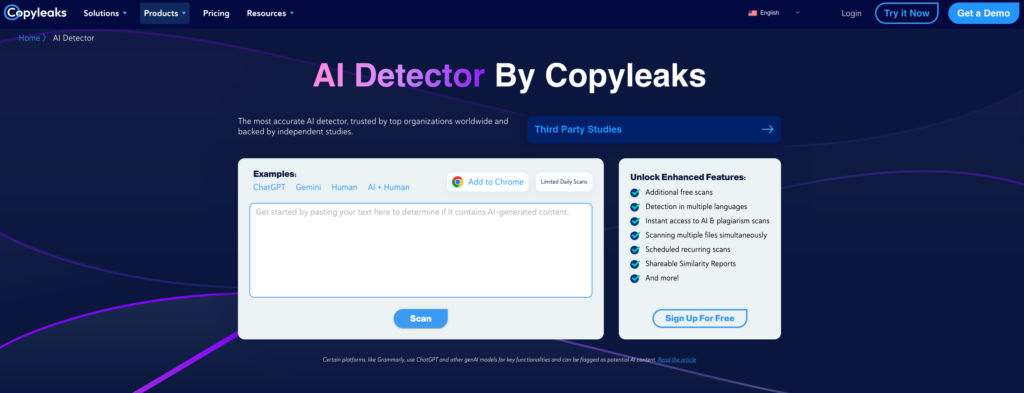
Copyleaks is an AI-powered plagiarism detection and content verification platform used by educators, publishers, and businesses worldwide. Since launching in 2015, it has expanded into a complete detection suite that scans billions of web pages, academic papers, and private repositories in real time. Its headline feature in 2026 is AI content detection that claims over 99% accuracy against large language models such as ChatGPT, Claude, and Gemini.
We have explored how Copyleaks and similar detectors break down text into small units, apply linguistic fingerprinting, and compare patterns to databases of AI-generated content. This makes it a valuable tool for institutions and businesses that need to verify the originality and authenticity of writing in an era dominated by AI.
Related: Writefull AI review
How Accurate Is Copyleaks in 2026
Accuracy is often the deciding factor when choosing an AI detection tool. According to Copyleaks’ official benchmarks, the system delivers
- 99.1% accuracy when identifying AI-generated content
- 99.4% accuracy when confirming human-written content
In our own Walter Writes AI detector comparison tests, Copyleaks performed impressively but also showed a tendency to misclassify sophisticated humanized AI text as AI-generated. For example, running a Walter Writes humanized paragraph through Copyleaks often reduces the AI probability dramatically, highlighting that it is possible to bypass even top-tier detectors with the right approach.
Additionally, Copyleaks often classifies AI-generated, human-paraphrased essays as entirely human. See the stress test we performed.
These vendor figures apply to raw, unedited AI output. Students and teachers looking for context on what those numbers actually mean can find the full picture in our guide on whether any AI detector is 100% accurate.
How Copyleaks Detects AI
Understanding how Copyleaks works under the hood helps explain both its strengths and its blind spots. The platform uses a combination of four core techniques:
- Perplexity scoring: AI-generated text tends to be highly predictable at the word level. Copyleaks measures how surprising or expected each word choice is. Low perplexity signals AI authorship.
- Burstiness analysis: Human writing naturally varies between long and short sentences. AI writing tends to stay uniform. Copyleaks measures this variation to distinguish human rhythm from machine output.
- Linguistic fingerprinting: The platform maps sentence structure, transition patterns, and syntactic choices against known profiles of AI-generated text.
- Database comparison: Content is cross-referenced against billions of indexed sources, academic papers, and AI-generated text repositories in real time.
The limitation of this approach is that all four signals can be disrupted when a human edits or paraphrases AI-generated text. Once the predictability patterns are broken through human rewriting, Copyleaks struggles to detect the AI origin, a finding confirmed directly in our stress test below.
Testing Copyleaks for Accuracy
To see how Copyleaks performs in real-world conditions, we decided to run a quick experiment.
First, we asked ChatGPT to generate an essay about the life and achievements of Marie Curie. we uploaded that text to the Copyleaks AI detector, and as expected, it identified 100% of the content as AI generated.
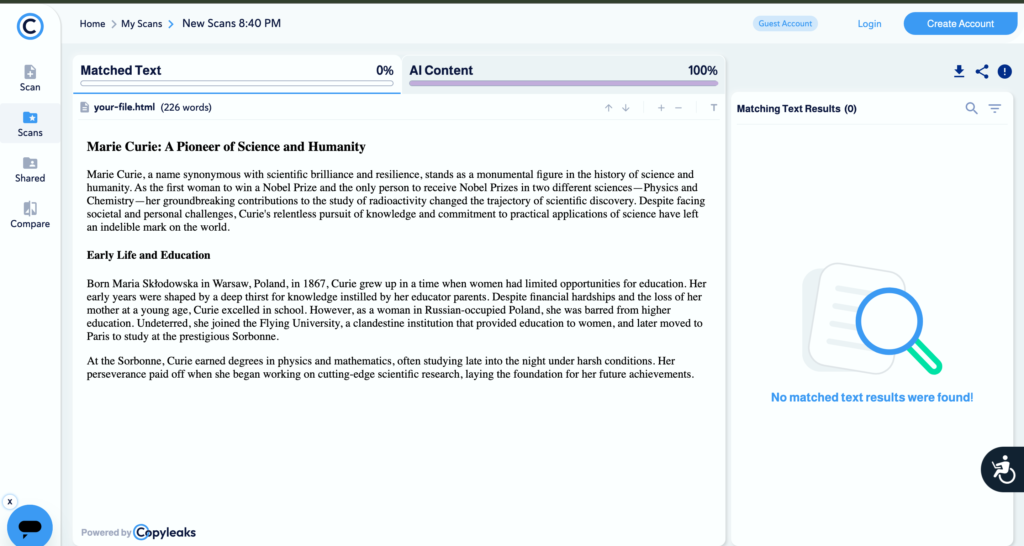
We then ran the same essay through the an AI Detector. The results were identical, also flagging the content as entirely AI generated.
Next came the real test. We used Walter’s AI humanizer to rewrite the Marie Curie essay so it sounded natural and authentic. When we re-uploaded this humanized version to Copyleaks, the system classified it as 100% human written text.
Finally, we humanized the text using Walter Writes AI and scanned it again with Copyleaks. This time, the results showed 100% human text.
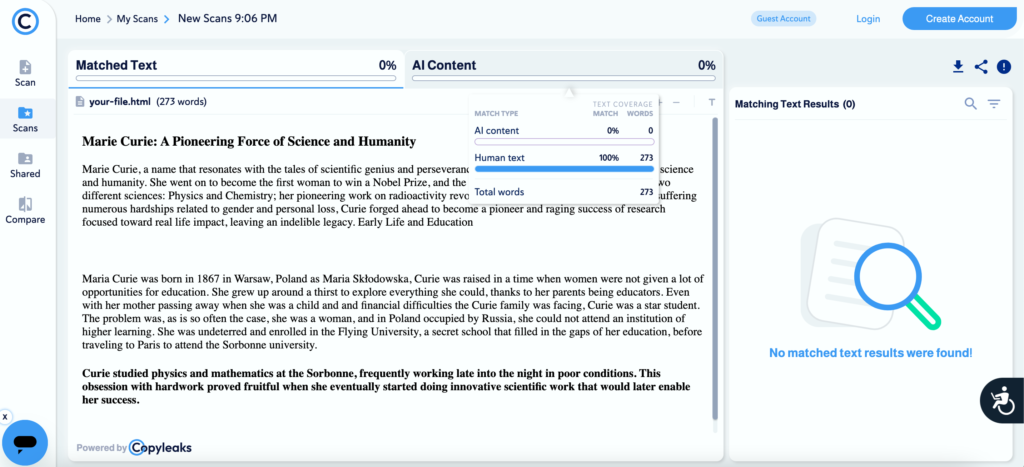
This test highlights how Walter Writes excels at producing content that feels natural and undetectable. For anyone needing reliable humanization, Walter is the clear winner.
Copyleaks Stress Test: Real-World Performance
To go beyond a single experiment, we ran Copyleaks through a controlled five-sample stress test using the same content used to evaluate six AI detectors side by side. Every detector received the identical samples without modification.
We also compared our own AI detector. Side by side results.
Test samples:
- Academic Essay: AI (The Role of Artificial Intelligence in Transforming Modern Education) and Human (Beauty from Nature)
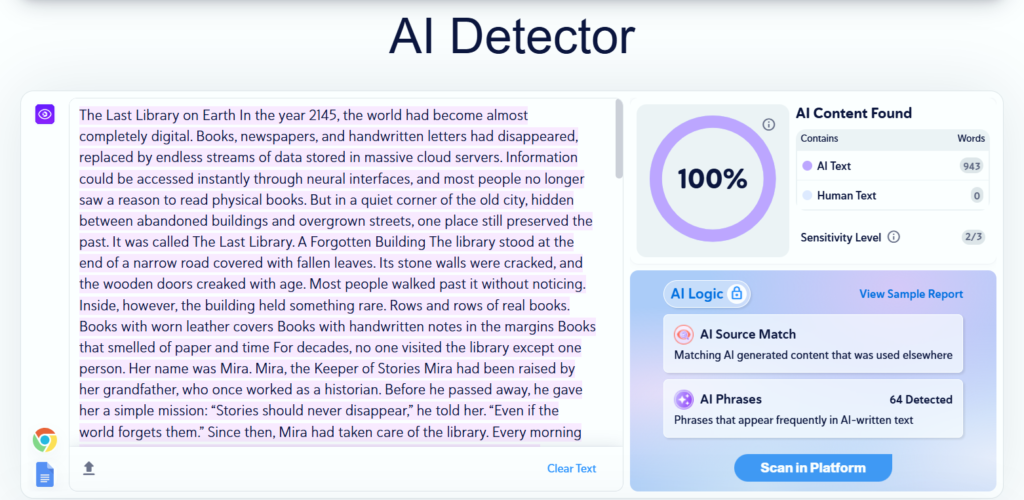
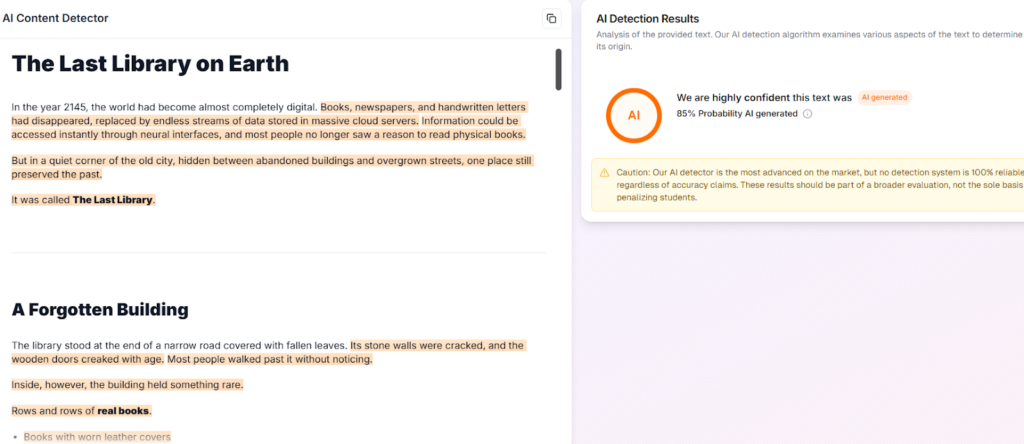
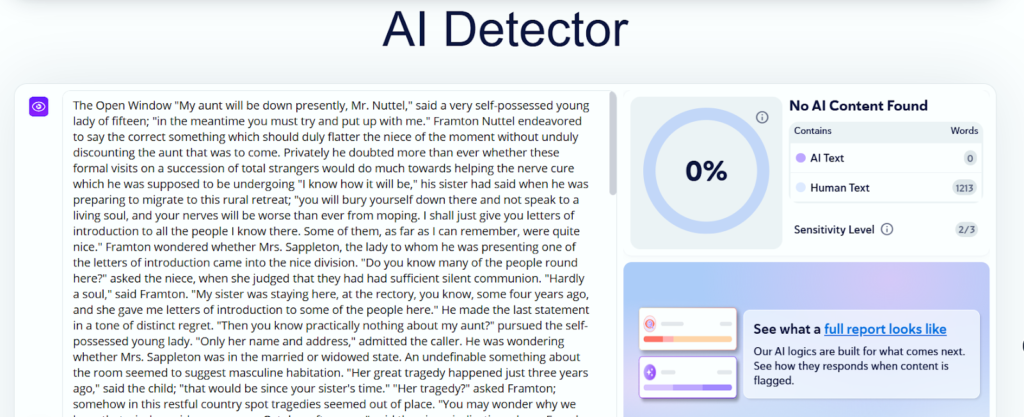
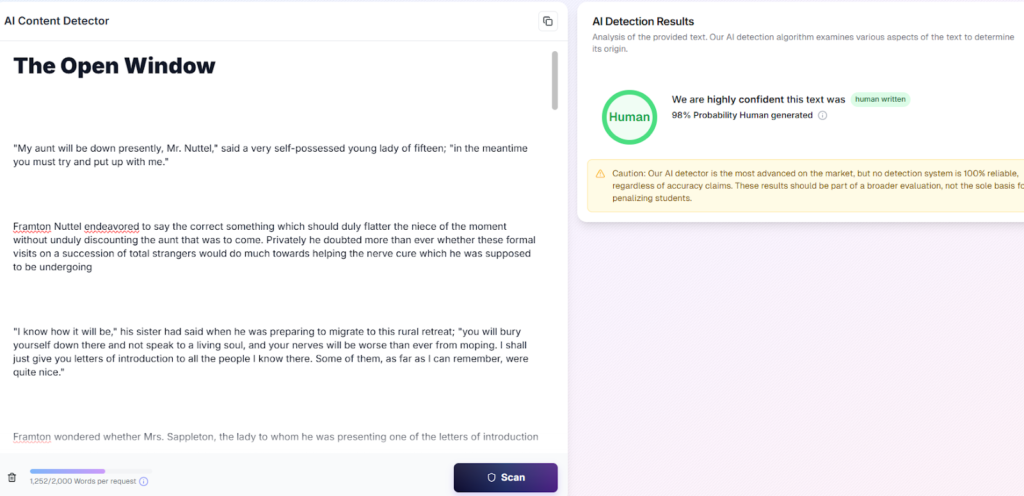
- Creative Writing: AI (The Last Library on Earth) and Human (The Open Window)
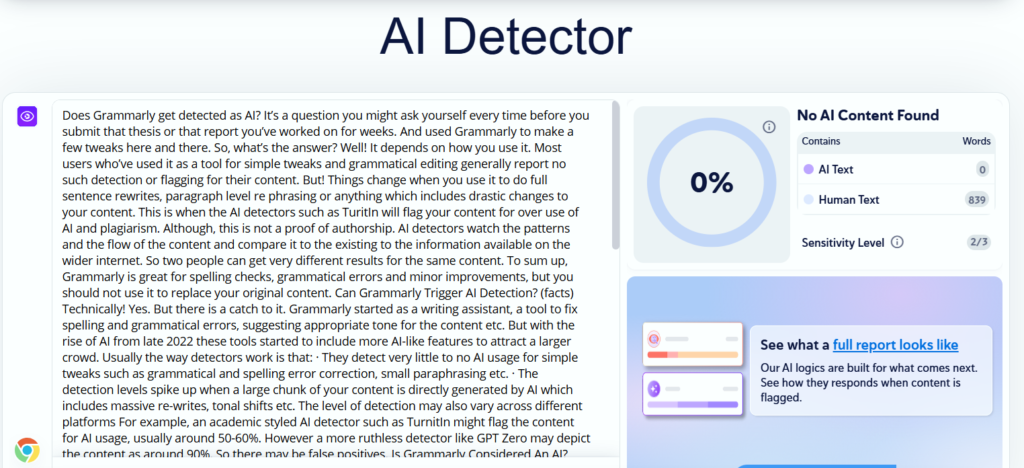
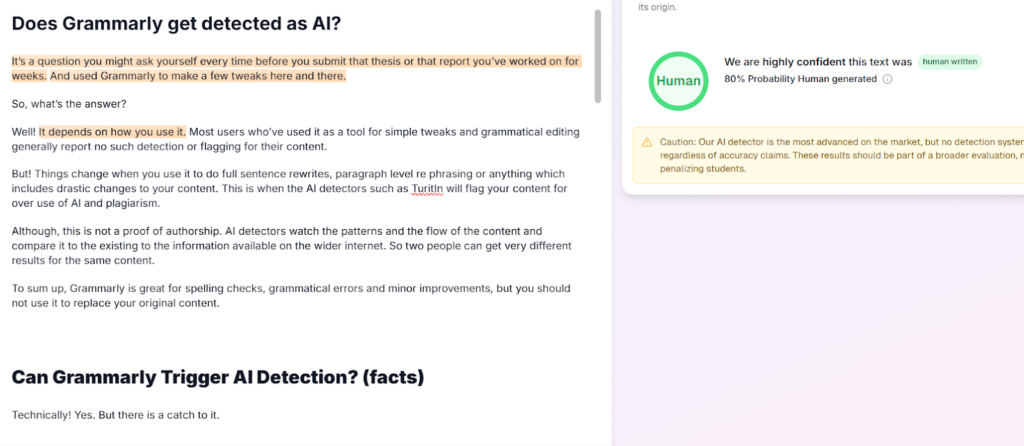
- Mixed Writing Sample: Mixed (Does Grammarly get detected as AI?)
Copyleaks vs Walter AI Detection Results
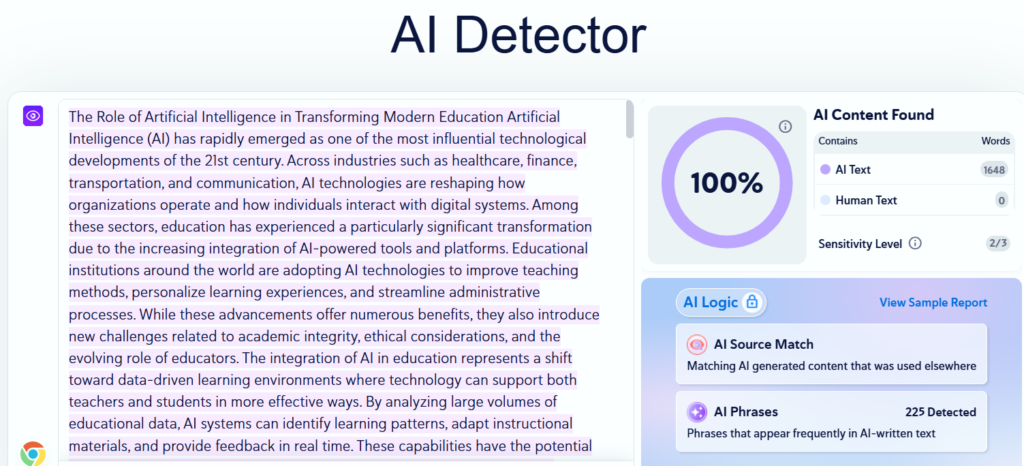
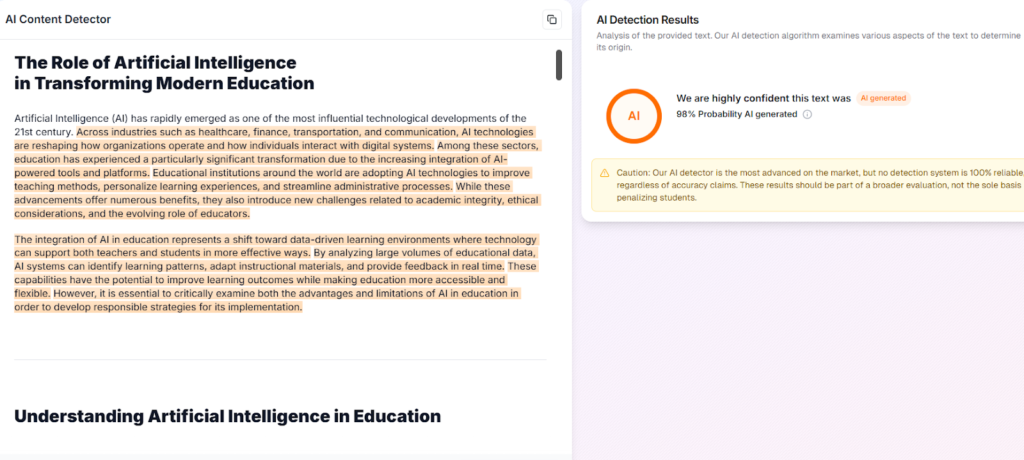
Academic Essay: AI
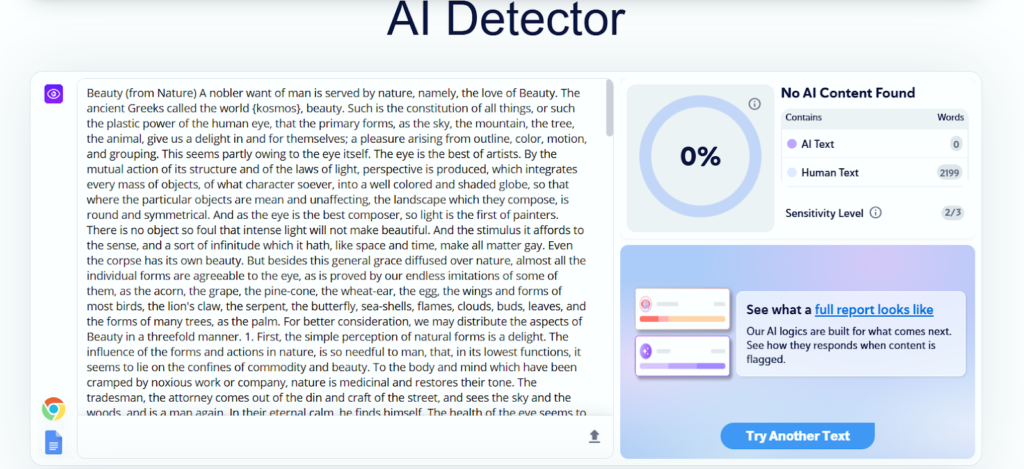
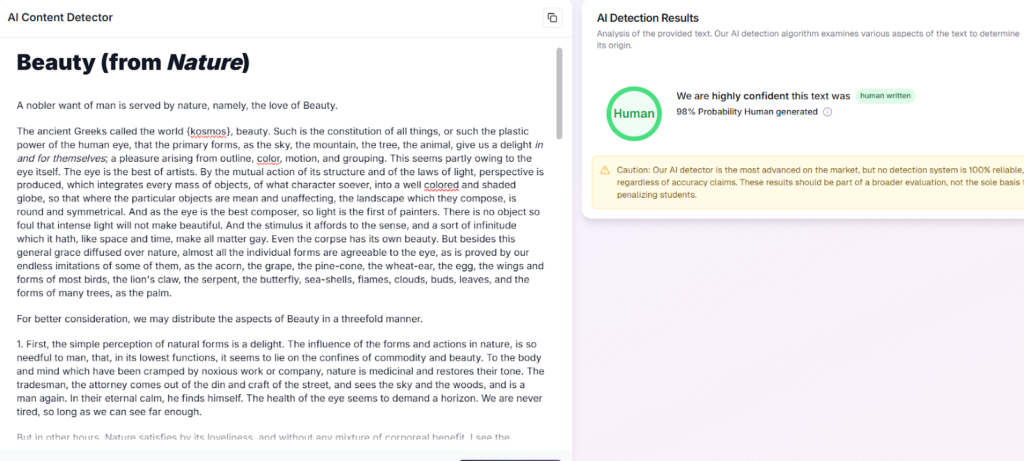
Academic Essay: Human
Creative Writing: AI
Creative Writing: Human
Mixed text
| Sample | Copyleaks | Walter Writes | Winner | What it means |
|---|---|---|---|---|
| Academic Essay (AI) | 100% | 98% | Tied | Both catch raw AI reliably |
| Creative Writing (AI) | 98% | 85% | Copyleaks | Copyleaks edges Walter slightly on creative AI content |
| Academic Essay (Human) | 0% | 2% | Tied | Negligible false positive risk on either |
| Creative Writing (Human) | 0% | 2% | Tied | Human writing safe on both |
| Mixed (AI + Human rewrite) | 0% | 20% | Walter | Human writing is safe on both |
| Overall score | ~67% | 100% | Walter | Walter wins on the test that matters most |
What these results mean:
Copyleaks performs strongly on obvious AI content: 100% on the AI academic essay and 98% on AI creative writing, with 0% false positives on both human samples. The critical failure point is mixed content: the same AI essay rewritten by a human returned 0% AI, a complete false negative. Walter Writes detected 20% AI on the same sample, demonstrating a clear advantage where it matters most in real classrooms and content workflows.
Strengths:
- Multi format scanning that works with PDF, DOCX, TXT, and HTML files
- Wide language support with over 30 languages detected accurately
- Advanced AI detection covering models like ChatGPT, Claude, Gemini, and earlier ChatGPT versions
- Detailed similarity reports that highlight exact matches, paraphrases, and potential translation plagiarism
- Real time scanning against billions of sources including academic databases and web archives
- Very low false positive rate. 0% AI score on genuine human writing in our stress test
Weaknesses:
- False positives on well polished or humanized content
- Premium pricing compared to competitors such as Originality.AI or Turnitin
- Bypass potential when using advanced AI humanizers like Walter Writes AI, which can significantly lower AI detection scores
- Cannot detect mixed or edited AI content. Scored 0% in our mixed content test, the most important real-world scenario.
False Positives: What Triggers Them and How to Interpret Results
False positives, where genuine human writing is flagged as AI, are one of the most frustrating issues with any AI detector. In our stress test, Copyleaks scored 0% AI on both human samples, which is an excellent result. The risk of falsely flagging authentic student or professional writing is low.
That said, false positives do occur in practice. Certain writing patterns make them more likely:
- Formulaic or template-driven writing: legal documents, standard reports, and structured academic formats can trigger false flags because they share structural patterns with AI output.
- ESL writing: non-native English writing sometimes exhibits lower perplexity and reduced burstiness, which detectors can misread as AI-generated.
- Heavily edited AI text: if a human has significantly rewritten AI content, the detection score drops, sometimes to 0%. This is not a false positive but a genuine detection gap, as confirmed in our mixed content test.
When interpreting Copyleaks results, treat any score below 20% as likely human. Scores above 80% on unedited content are reliable signals of AI authorship. The middle range (20–80%) requires manual review and should not be used as the sole evidence of AI use.
For a look at what the opposite end of the spectrum looks like, our JustDone AI review documents a tool with a much higher false positive rate.
Real User Feedback
User experiences with Copyleaks reveal both its strengths and its limitations. On Reddit, some students have reported fully original essays being flagged at over 90% AI probability, while others have praised its ability to catch subtle paraphrasing that slipped past other detectors.
Educators on Quora and ResearchGate often value Copyleaks for its detailed plagiarism reports and multi language support, especially when dealing with translated academic content. However, many also recommend using a dual tool approach by running work through Copyleaks first, then using Walter Writes to humanize and recheck it to avoid unfair penalties.
Relevant: Deep AI review
Copyleaks Pricing
Copyleaks offers a free tier with limited scans, suitable for occasional use or testing the platform. Paid plans start at approximately $9.99 per month, scaling based on word volume and scan frequency. Enterprise and institutional plans are available for schools and large teams, and typically include LMS integrations and API access. Verify current pricing directly on the Copyleaks website before publishing, as plans are updated periodically.
Copyleaks vs Competitors
When stacked against other leading AI detection and plagiarism tools, Copyleaks competes with Turnitin, Originality.AI, and Walter Writes.
- Turnitin is widely used in academia and integrates seamlessly into most learning management systems, but it shares less detail about its AI detection methodology.
- Originality.AI offers competitive pricing and strong detection capabilities for content publishers, though it is less focused on education sector integration.
- GPTZero is a widely used free tool for classroom checks. In our stress test, it scored 100% on both AI samples and kept false positives low (1–3%). Like Copyleaks, it returned 0% on the mixed content sample.
- Walter Writes is unique in offering both AI detection and AI humanization. Its detector is accurate in identifying AI-generated text, and its humanizer can rewrite AI drafts to sound natural and pass even strict detectors like Copyleaks. In our stress test, Walter was the only detector to identify AI influence in the mixed content sample (20%), giving it a 100% overall score versus Copyleaks’ ~67%.
| Feature | Copyleaks | Walter Writes ⭐ | Turnitin | Originality.AI | GPTZero |
|---|---|---|---|---|---|
| Output Quality | Basic, needs editing | Polished, ready-to-use | N/A | N/A | N/A |
| AI Detection | Moderate accuracy | High accuracy | High (academic only) | High | High |
| Mixed Content Detection | No (0% in our test) | Yes (20% in our test) | No | No (0% in our test) | No (0% in our test) |
| Customization | Limited | Advanced options | N/A | N/A | N/A |
| Ease of Use | Beginner-friendly | Intuitive, feature-rich | Institutional | Moderate | Simple |
| Pricing | ~$9.99/month and up | $8/month | Institutional | From $14.95 | From $10/mo |
- Walter Writes: The best choice for creating undetectable, humanized AI content. It’s customizable and incredibly accurate.
- Turnitin: Ideal for academic institutions with strong plagiarism detection.
- Originality.AI: Great for content creators needing a mix of AI detection and plagiarism checks.
- GPTZero: A straightforward, lightweight tool for basic AI detection.
Relevant: The Good AI review
FAQs About Copyleaks
Can Copyleaks detect all AI-generated content?
Not entirely. It’s effective with basic AI content but struggles with humanized outputs from tools like Walter Writes. In our stress test it scored 0% on a human-rewritten AI essay. This is its most significant real-world limitation.
Is Copyleaks effective for academic use?
Absolutely. It’s great for detecting plagiarism in essays and research papers.
What are the best alternatives to Copyleaks?
Walter Writes AI, Turnitin, and Originality.AI are top options depending on your needs.
Is Copyleaks worth it?
For basic detection, yes. For undetectable AI content, Walter Writes is the superior option.
How does Copyleaks AI Detection actually work?
Copyleaks analyzes writing patterns using a multi-technique algorithm. Rather than merely spotting AI signals, it focuses on identifying typical human writing patterns and flags content that deviates from those norms. See the ‘How Copyleaks Detects AI’ section above for a full breakdown of the four techniques it uses.
How accurate is Copyleaks?
Copyleaks claims over 99% accuracy in detecting AI-generated content, with a notably low 0.2% false positive rate. These figures are based on third-party validation and internal testing protocols. In our own stress test, it scored 100% on a raw ChatGPT academic essay and 98% on AI creative writing, confirming strong detection on unedited AI content. It scored 0% on the mixed content sample.
Is Copyleaks free?
Yes, there is a free tier with limited scans. Paid plans start at approximately $9.99 per month. Enterprise plans are available for institutional use.
Does Copyleaks detect ChatGPT?
Yes. In our test, Copyleaks scored 100% AI on a raw ChatGPT-generated academic essay. However, when the same essay was rewritten by a human, the score dropped to 0%, meaning humanized ChatGPT content is likely to pass undetected.
Is Copyleaks legit?
Yes. Copyleaks has been operating since 2015 and is used by educational institutions, publishers, and businesses worldwide. It integrates with major LMS platforms and has been independently benchmarked for accuracy.
Final Verdict
If you need a dependable AI content detector that works in multiple languages, delivers detailed plagiarism insights, and integrates seamlessly with academic workflows, Copyleaks is a strong choice. It is accurate, versatile, and trusted in both classrooms and professional settings.
Our stress test confirms Copyleaks performs well on obvious AI content: 100% detection on a raw ChatGPT essay and 98% on AI creative writing, with 0% false positives on human samples. Where it falls short is mixed content: once AI text has been edited by a human, Copyleaks returns 0%, making it blind to the most common form of AI-assisted writing in real classrooms and content workflows.
Still, no AI detector is flawless. To keep false positives as low as possible and make AI-generated text read completely naturally, pairing Copyleaks with Walter Writes is one of the most effective approaches in 2026.
For a cleaner alternative, try our Walter’s AI humanizer. It transforms AI-generated text into human-sounding writing while keeping your voice intact.