



If you are using “The Good AI” to assist in your essay, then you most likely want a fast, safe way to create it.
Perhaps you want to write faster but also comply with the institutional rules and guidelines and avoid any problems regarding unreliable citations, originality, or policy violations.
This The Good AI review will discuss how practical it is for real students, including price, essay quality, and limitations. We will also see when it works well & when it doesn’t, and which are safer alternatives for those important submissions.
What Is The Good AI (And Who It’s Actually For)?
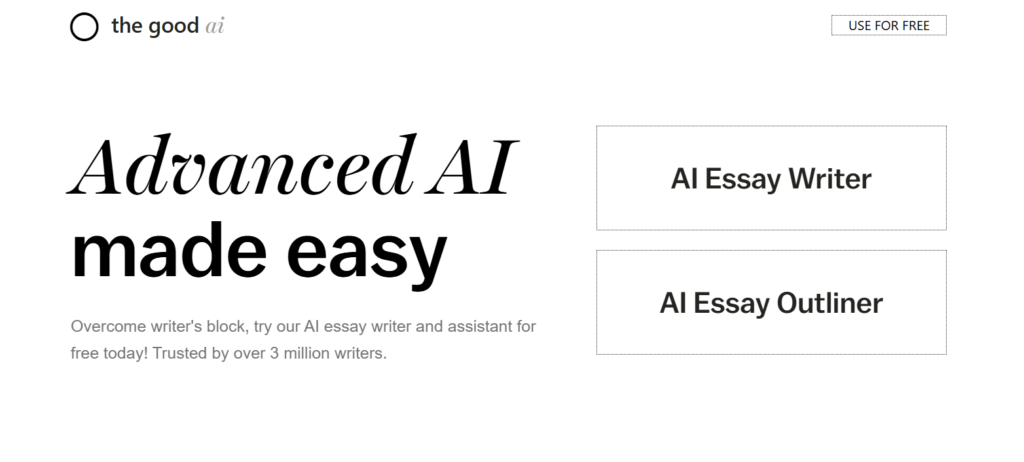
The Good AI enables you to quickly develop ideas for essays that are normally difficult to begin. It may be a helpful writing resource when you do not know how to organize your thoughts in order to create an essay.
It is easy to operate, but its usage will limit your ability to create content freely since you have to follow the guided writing process.
It is mainly intended for the outline development, creation of initial drafts, and brainstorming for essay ideas, and it is not advised to use this resource for a thesis or research-based projects.
As with all writing tools, you should only utilize The Good AI Essay Tool as a resource to help you write your essay and not a final product ready for submission.
How The Good AI Works for Essay Writing (Core Workflow)
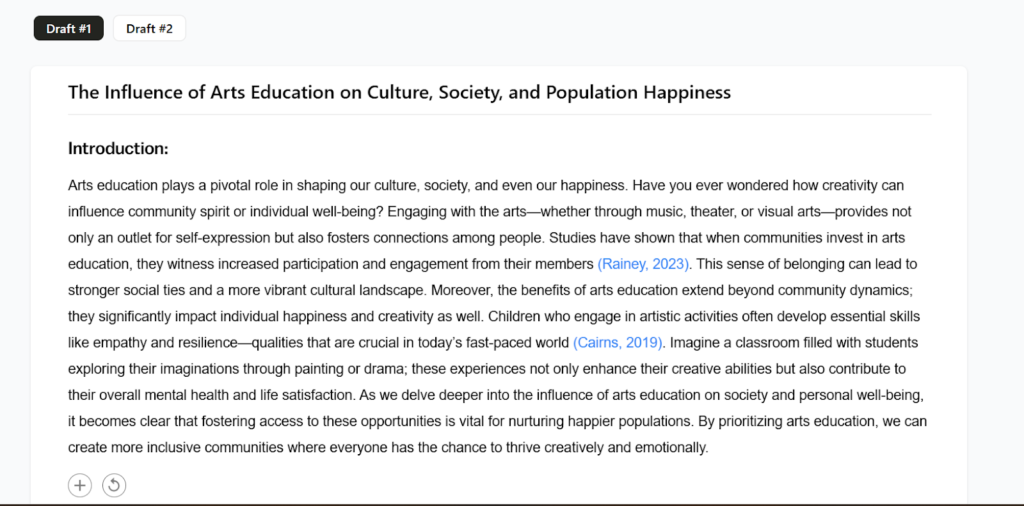
This is a quick walkthrough of a general procedure that The Good AI follows when helping you write an essay.
- Insert topic: To begin, enter your essay topic or research question.
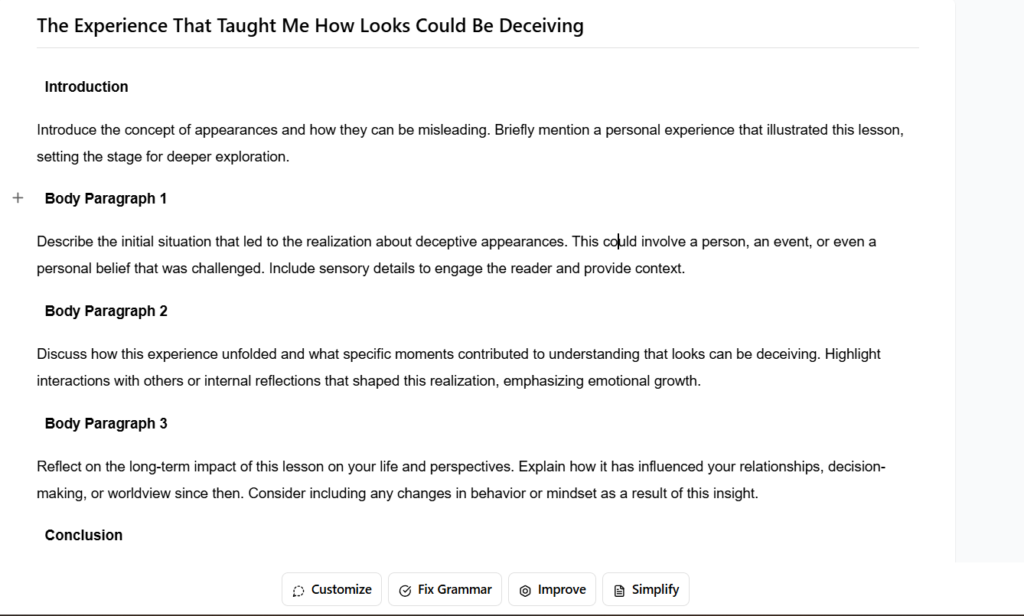
- Outline generation: The AI will create a structure/ outline that will guide the essay.
- Draft generation: Based upon the outline, your first draft is created.
- Autocomplete: This step helps you expand the existing phrase or paragraphs by autofilling them using AI.
- Editing tools: Very basic types of changes, like grammar and spell check, will be made.
You can also make a few minor editing requests, as well as provide prompts. It is through manual editing that you can add depth to an argument, manually reorganize the structure of sections, or utilize citations and formatting.
The workflow will provide you with good speed and direction as you work on your essay, but you will have to perform manual revisions and fact-checking prior to submitting it.
Features Breakdown (What Matters vs What’s Just Nice)
Not every AI feature is useful for you when it comes to academic work. The following highlights what is actually useful.
- Essay writer and outliner: Good for a start, but information often stays surface level; it only generates a quick, basic draft.
- Autocomplete and expansion: Gives you the ability to draft complete sentences and even paragraphs quickly. But it can also lead to vague rationale and repetitive phrasing.
- Editing and grammar support: It is an aid in creating a cleaner read of your writing by making very minor adjustments, such as correcting the grammar, punctuation, and spelling errors, but manual review of these corrections is necessary.
- Sources and citations support: The generated references must always be verified. Always check the original sources of these references.
Academic Must-Haves Checklist
- A set of good citations with reliable sources that can be verified later.
- Greater control over the structure of the content and its revision.
- Set of clean export options for the final draft.
- Good amount of originality and detection checks before submission.
These are the must-haves you need for important academic projects.
The Good AI Pricing (And What You Actually Get on Each Plan)
The Good AI pricing is marketed as an affordable option for students with a low-cost plan and a free option.
Let’s take a look at its advertised options.
Free plan: This is only good to understand the workflow or test the tool, as the features and word output are limited.
Paid plan: It provides more consistent essay generation as it gives access to autocomplete and expansion, and has higher word limits. This is generally more productive for drafting than creating a finished version of the document.
These features can always change as part of the plan, so it is better to be safe and check before making an upgrade.
5-Minute Verification Checklist
- The maximum word limit per essay
- Final draft export options
- Source handling and citation
- Availability of plagiarism checks
- Inclusion of AI detection and humanization tools
Always use these checks to avoid any last-minute hassles.
Is ‘The Good AI’ Worth It for Essays?
This would solely depend on the nature of the academic project you wish to use it for and the level of control you need over the final outcome.
Decision Rubric
- Drafting quality: The quality of drafts is average (3/5)
- Control over edits: It is very low (2/5)
- Citation credibility: Would always need to be verified. (2/5)
- Confidence and originality: highly suspicious without checks (2/5)
- Risk of compliance: It is rather moderate (3/5)
- Is it worth it: Only good for beginners (3/5)
When The Good AI Is Not Worth It
- Content that is research-heavy
- Rigid compliances for originality
- Important academic projects
- High-stakes submissions
When The Good AI Is Worth It
- Fast drafting with simple outlines
- Low-stakes short assignments
- When manual revision is planned
Now the readers can make quick decisions as this sets expectations more realistically.
Can AI Be 100% Trusted? (What Goes Wrong, and How to Protect Yourself)
No. While AI can be used for content generation and writing, it should not replace the user’s academic judgment.
Always make enough changes to your work so that it does not contain any copied content. Verify every claim and factual aspect by a definite, reliable source, and also check every reference provided in your essay by yourself. Before submitting your work, ensure your final version is reviewed against the assignment rubric.
Keep in mind, AI performs best as a tool, but not as the brain.
Can AI Write a Paper for Me? (What’s Allowed vs What’s Risky)
AI writing tools give you a good beginning, but don’t allow them to replace your own academic output. Use it just for creating early drafts, generating ideas, or simply to prepare a structure.
AI-generated content without review is a risky choice. Most institutions have a clear and defined set of rules regarding the level of acceptable AI use and its disclosure.
So even when AI is allowed, the students have to disclose its use before the final submission.
Due to many policy violations, submitting a paper as-is without review carries a greater risk of discrepancies. To avoid this, make sure that the generated AI content is fact-checked, verified, and rewritten in your own language.
Downsides + Biggest Risks of Using AI for Writing (And Mitigation Steps)
The blatant use of AI will always come at a cost. It can save you time, but carries far greater risks, as stated below.
- Fabricated info: Your AI-generated content might be made-up.
- Reasoning is missing: The evidence for your argument is likely weak and without substance.
- Generic voice: It is possible that your personal writing voice does not come through in your essay and looks like a flat, uninteresting piece of paper.
- Error in citation: The cited references may turn out to be incorrect, incomplete, or simply not relevant.
- Policy violations: The submission of unreviewed AI content might be a violation of academic rules and regulations
- Originality uncertainty: The issues regarding detection and plagiarism will always remain.
How To Avoid These Risks
- Always start with an outline rather than the full draft.
- Manually verify each and every citation and claim.
- Rewrite the sections in your own style and words.
- Use authentic and real evidence to strengthen your arguments.
- Before the submission, run a few detection and originality checks.
Remember, AI study tools are meant to support your thinking, not replace it.
Writing Support Tools Students Can Use After Drafting
Since “The Good AI” mainly focuses on generating outlines and early drafts, the tools below support later stages of the writing process, helping students with revision control, clarity improvement, originality confidence, and safer submission readiness.
| Tool | Essay Support | Humanization & Detection Support | Best For |
| Walter Writes | Essay rewriting, structure, clarity | Strong (humanization + detection) | Final-ready academic submissions |
| Grammarly | Grammar, clarity, tone fixes | None | Language polishing |
| QuillBot | Paraphrasing, sentence rewording | Limited (rewriting only) | Rephrasing drafts |
| Wordtune | Sentence-level rewriting | Limited (rewriting only) | Improving expression |
| ProWritingAid | Style, structure, readability | None | Deep writing analysis |
If The Good AI does not fully meet your needs, the appropriate support tool will depend on what problem you are trying to solve or which stage of the writing process you are currently on.
“I Need a Draft Fast”
If your main concern is speed. You may want to start generating rough drafts and basic outlines to begin your work.
“I Need Better Writing Control”
Or you may prefer control over your writing to speed. You may want to refine the structure, improve clarity, and adjust the tone manually.
“I Need Confidence Before Submitting”
For some, the main concern is confidence. They want to know their essay meets the expectations of originality and is compliant with the institutional regulations.
For these students, who are looking for a more hands-on approach to their writing workflow, an AI humanizer for essays such as Walter Writes would provide a useful function of rewriting an AI-generated draft, creating a natural voice, and preventing the AI from being detected.
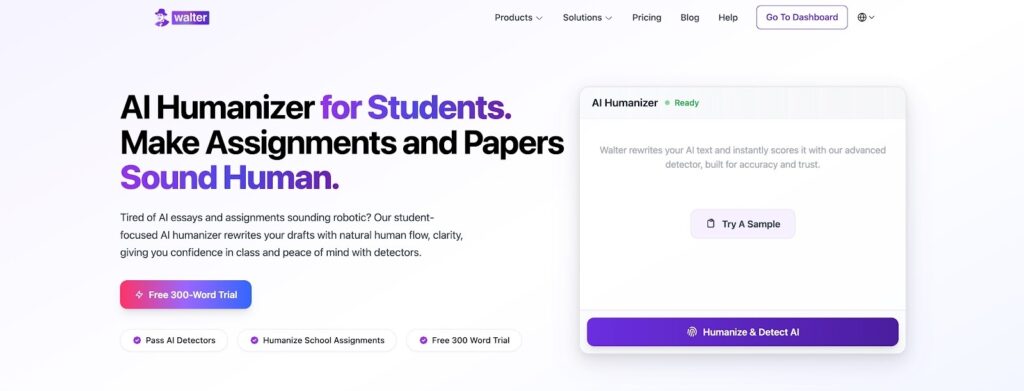
This would reduce uncertainty and give more confidence to students before those big submissions, as their work would now align with academic expectations.
The Safer Alternative: A Practical Essay Writing Tech Stack
Best For: Students who want safer, original, and more human-sounding essays before submission.
- The Good AI ($5/month) - Prepare first drafts and outlines
- Walter Writes ($8/month) - Humanization + built-in AI detection
- Grammarly (Free) - Final grammar & quality check
Cost Per Month:$13
Limitation: The free version of Grammarly does not include pro suggestions.
Final Checklist: Should You Use The Good AI for Your Next Essay?
If most of the following are true for you, go ahead:
- The assignment submission is of low importance.
- Compliance risk is limited.
- There is almost no need for research.
- You just need a start.
- You have time for manual revision and rewriting.
- You’re going to verify citations by yourself.
- You’re not using AI for the final submission.
- Sourcing and originality are being handled separately.
Best Next Step
Use The Good AI for quick drafts and outlines, and for more important work, a holistic workflow like Walter Writes will help reduce compliance risk, improve readability, and confidence before submission.
Final Verdict
While the Good AI is certainly useful as a starting point and may also provide some benefit in terms of speed, in higher-stakes and more complex projects, students require more than just a structure draft generator. They need a safer alternative to rework AI-assisted content and reduce risk before submission.
In these cases, an AI humanizer for students like Walter Writes can be a more viable option. It allows you to rewrite drafts to increase readability, humanize, and allows detection checks in one place, providing students with the confidence they need before submission.
FAQs About “The Good AI Review”
Is The Good AI worth it?
It is good for outlines and fast drafts for low-stakes assignments. Not good for more rigid, strict, and research-heavy projects without manual review.
Can AI be 100% trusted?
There is no way for any AI-based program to be 100% accurate or reliable in its performance. In order to prevent errors, be sure to double-check all references created by an AI prior to including them within your final version.
Can AI write a paper for me?
No. It can only generate unrefined content. You are expected to rewrite and review your work before submission.
Is there a downside to using AI for writing?
Yes. The style and tone of your work might be too generic, with weak reasoning and full of academic compliance discrepancies.
What are the biggest risks of using AI for writing?
Misinterpreted facts, unreliable citations, originality concerns, and many academic violations, if the content is not revised or checked.
Looking for a better alternative? Try our our AI humanizer tool free for 300 words - turn AI text into natural, undetectable writing in seconds.