





Key Takeaway: This GPTinf review finds it a capable tool for developers and bulk content workflows, but it failed to bypass GPTZero in direct testing, with both the original and rewritten text scoring 100% AI, making it a weak choice for anyone who needs to pass strict detectors.
- In head-to-head testing using the same 300-word sample, GPTinf scored 100% AI on GPTZero while Walter Writes output scored 100% human
- Some independent reviews flag that GPTinf introduces intentional grammar errors to confuse detectors, and fixing those errors causes the AI score to revert to near 100%
- The API and bulk processing features make it genuinely useful for developers and agencies handling large content volumes
- Eight rewriting modes and a keyword freeze list give GPTinf more control over SEO terms than most competing tools
- The free tier covers only 240 words total, and paid plans start at $19/month for 20,000 words
- Turnitin’s August 2025 update specifically targets humanizer output patterns, making any bypass rate data collected before that date unreliable for Turnitin specifically
The AI writing world is moving at lightning speed. One day, you are impressed by how naturally a chatbot can write, and the next, you are scrambling to make sure that same text does not get flagged by a content detector. This constant push and pull between AI creation and AI detection has given rise to a new type of tool: the AI humanizer.
In this GPTinf review, we look closely at whether it can actually help you avoid the red flags that systems like Turnitin and GPTZero throw up. We also compare it to Walter Writes AI Humanizer, which is known for producing seamless, natural-sounding content without the headaches.
Can It Really Bypass Turnitin and GPTZero? If you are new to AI content humanization, you might want to check our guide on how to make your essay undetectable for a quick background. For those already familiar with AI detection challenges, the question is simple: can GPTinf help you pass the test?
What Is GPTinf and How Does It Work?
GPTinf is a rewriting platform built specifically to transform AI-generated content into something that reads more like it was written by a person. The promise is straightforward: take your robotic-sounding draft, feed it through the tool, and get something that feels natural enough to bypass detection systems.
According to its own marketing, it focuses on altering sentence structure, tweaking vocabulary, and adjusting rhythm so the text no longer triggers the statistical pattern detectors look for.
This is very different from an AI detector, which is built to identify machine-generated patterns in the first place. GPTinf is firmly in the AI humanizer camp, much like Walter Writes, which we have tested extensively.
Unlike a paraphraser such as QuillBot, which tends to swap synonyms and rearrange sentences, an AI humanizer goes deeper. It restructures the entire passage, including its flow, rhythm, and readability, while preserving the original meaning. GPTinf’s own documentation describes it as software that uses a special transformation process. It rearranges sentences, improves readability, and eliminates repetition. The software does not create content. It is meant for editing.
In fact, one of the most read articles on the topic is our undetectable AI content guide, which breaks down why certain rewrites pass through even the toughest filters.
To understand how GPTinf works under the hood, it helps to know how detectors scan your text. Tools like Copyleaks and GPTZero analyse word choice, sentence cadence, and predictability. If your writing ticks too many “AI-like” boxes, you get flagged.
GPTinf’s job is to disrupt those patterns enough to lower your AI probability score without losing the original meaning. That means rephrasing chunks of text, shuffling syntax, and in some cases replacing high-frequency words with alternatives that sound more human.
In practice, this kind of rewriting is only part of the battle. You still need to understand how detectors work and why some patterns are more suspicious than others. If you are interested in that, our article on how AI detectors work dives deep into detection algorithms and their weaknesses.
Can GPTinf Bypass Turnitin or GPTZero?
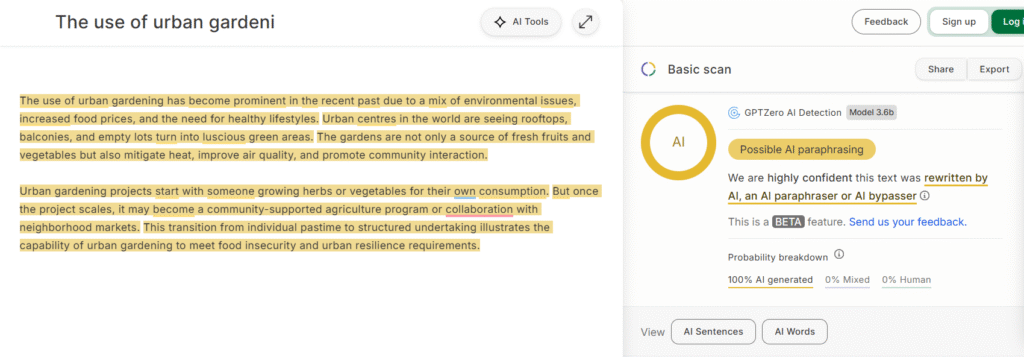
Short answer: No, not in our test. GPTinf was unable to reduce the AI detection score on GPTZero, with both the original and rewritten versions flagged as 100 percent AI-generated. We did not have access to Turnitin for this review, but given GPTZero’s strictness, the results suggest GPTinf struggles with more advanced detectors.
Related: Writefull AI review
Our GPTZero Test
To evaluate GPTinf, we created a 300-word sample on the topic of urban gardening using ChatGPT.
We then ran the text through GPTZero to get the baseline AI probability score. After processing the same text with GPTinf, we tested it again in GPTZero.
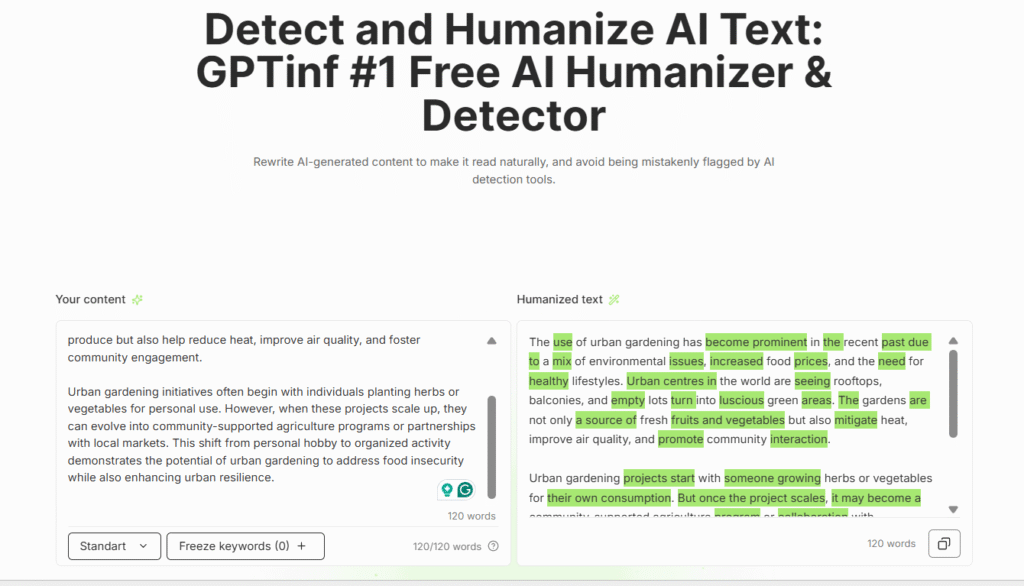
| Test Stage | Detector Used | AI Probability | Result |
|---|---|---|---|
| Original AI text | GPTZero | 100% | Flagged as AI |
| GPTinf-rewritten text | GPTZero | 100% | Flagged as AI |
What This Means for Users
While GPTinf can make changes to sentence structure and word choice, these adjustments were not enough to fool GPTZero in our trial. This aligns with what we have seen in other tests across the AI humanizer space: simpler or mid-tier detectors may be easier to bypass, but high-accuracy tools like GPTZero and Turnitin often require more advanced rewriting techniques.
If you are interested in tools that consistently pass strict detectors, our Walter Writes AI humanizer has a documented 98 percent success rate in independent testing. You can also learn more about how detectors like GPTZero operate in our guide to AI detection methods.
It is also worth noting that some independent reviews have flagged a specific bypass method GPTinf appears to use: intentionally introducing grammatical errors, awkward phrasing, and missing spaces to confuse detectors. While this can lower AI probability scores on some tools, fixing those errors causes the text to revert to near-100% AI detection. The content passes, but only because it has been degraded. That is not humanization.
GPTinf Key Features and Capabilities
Although GPTinf did not perform well in our GPTZero test, it still offers a range of features that may appeal to certain users, especially those working with simpler AI detectors or who need automation at scale. Here’s what you can expect when using it.
1. Advanced AI Detection Bypass
GPTinf’s main selling point is its ability to rewrite AI-generated text in a way that aims to bypass AI content detection. It does this by:
- Restructuring sentences to break predictable patterns
- Swapping common AI word choices for more varied alternatives
- Tweaking tone and cadence to sound less machine-like
While this works to some degree with mid-tier detection tools, as we saw in our Copyleaks review, the method is far less effective against advanced models like GPTZero or Turnitin.
2. API Integrations for Developers
One of GPTinf’s more unique strengths is its humanizer API support, which allows developers to integrate the humanizer into custom platforms or workflows. For example, a content agency could connect GPTinf to their content management system to automatically process large batches of AI text before publishing.
If you are new to API integrations, our guide on how AI humanizers work with automation tools explains the basics in plain language.
3. Bulk Processing at Scale
For businesses handling thousands of words per day, GPTinf’s bulk processing feature can be a time-saver. Instead of rewriting small chunks manually, you can process entire documents or multiple pieces of content in one go. This is particularly useful for agencies, e-commerce stores, or large blogs with heavy publishing schedules.
4. Usability and Learning Curve
While the tool’s features are powerful, the interface leans more toward technical users than beginners. Non-technical users may find the setup process confusing, especially when trying to make full use of the API. In contrast, Walter Writes AI is designed to be plug-and-play, so you can humanize your content in seconds without dealing with complicated configurations.
5. Eight Rewriting Modes and Keyword Freeze
GPTinf comes with 8 different modes for rewriting, giving users more control over tone and style. The platform also includes a selective rephrase feature and keyword freeze, which lets you lock specific terms, such as brand names or SEO phrases, so they are not altered during humanization.
6. SEO Optimization Tool
One of GPTinf’s standout features is its SEO optimization tool, which lets users manually add or retain specific keywords throughout the paraphrased content. By allowing this keyword integration, GPTinf can help improve the visibility and relevance of content for search engines. Users can also optimize meta descriptions, headings, and other on-page elements to ensure SEO-friendly output.
7. ChatGPT Plugin
GPTinf is also widely used as a plugin in the ChatGPT ChatGPT Store, where it has accumulated over 9 million conversations. For many users, this is how they first encounter the tool, pasting text directly into a ChatGPT session and using GPTinf to rewrite it. The detection bypass limitations described in this review apply regardless of how you access the tool.
GPTinf API Integration: A Developer’s Perspective

For developers and technical teams, GPTinf’s API is arguably its most valuable feature. Instead of manually pasting text into a web interface, you can connect GPTinf directly to your existing tools or content pipelines. This allows you to process AI-generated content automatically, without interrupting your workflow.
How the GPTinf API Works
The API gives you custom endpoints where you can send raw text data and receive a rewritten version in return. With the right setup, you could:
- Feed drafts from your AI writing tool straight into GPTinf.
- Automatically process the content for AI detection bypass.
- Send the processed content to your publishing platform or database.
This kind of automation is especially appealing for agencies, SaaS platforms, and enterprise content teams who work with large volumes of AI-assisted text every day. If you want a deeper dive into how humanizers and detectors interact at scale, our bypass AI detection guide breaks it down with examples.
Benefits for Developers
- Time Savings: Automate what would otherwise be repetitive manual work.
- Consistency: Ensure every piece of content goes through the same rewrite process.
- Scalability: Handle thousands of words per hour with minimal human intervention.
Limitations to Consider
While powerful, GPTinf’s API is not beginner-friendly. You’ll need basic programming knowledge to integrate it effectively, and if you want advanced automation (like processing multiple formats or handling multilingual content), you may need a developer to set up custom scripts.
By contrast, Walter Writes AI does not require any coding skills. You can humanize content directly through a simple browser-based tool or via its own easy-to-use automation options.
GPTinf Pros and Cons
When deciding whether GPTinf is the right AI humanizer for your needs, it helps to see the strengths and weaknesses side by side. Below is our condensed evaluation based on hands-on testing and market comparison.
| Pros | Cons |
|---|---|
| Strong performance against simpler AI detection tools | Struggles against advanced detectors like GPTZero |
| API integrations for automation and developer workflows | Interface is not beginner-friendly |
| Bulk processing for large-scale content projects | Inconsistent results with longer, more complex text |
| Allows custom setup for specific use cases | No built-in plagiarism checking, unlike some competitors |
| 8 rewriting modes and keyword freeze for SEO control | Some bypass methods rely on intentional grammar errors, degrading output quality |
Why This Matters
For developers, GPTinf’s API and bulk processing make it a powerful automation tool. However, our tests show that if your priority is passing strict detection tools or producing naturally flowing text without manual edits, a more user-friendly option like Walter Writes AI might be the better choice.
If you’re still unsure which approach is best for your needs, you can explore our best AI humanizer tools roundup where we compare GPTinf to several other leading platforms in 2026.
GPTinf vs Walter Writes AI: Which Tool Wins?
Quick answer: In our test, Walter Writes AI successfully transformed AI-generated text into content that GPTZero identified as 100 percent human, while GPTinf’s rewrite still scored as 100 percent AI. This makes Walter Writes the clear choice for anyone who needs consistent, detector-safe results without manual editing.

Our Side-by-Side Test Results
We used the same 300-word urban gardening sample for all three tests, running each version through GPTZero to measure AI probability.
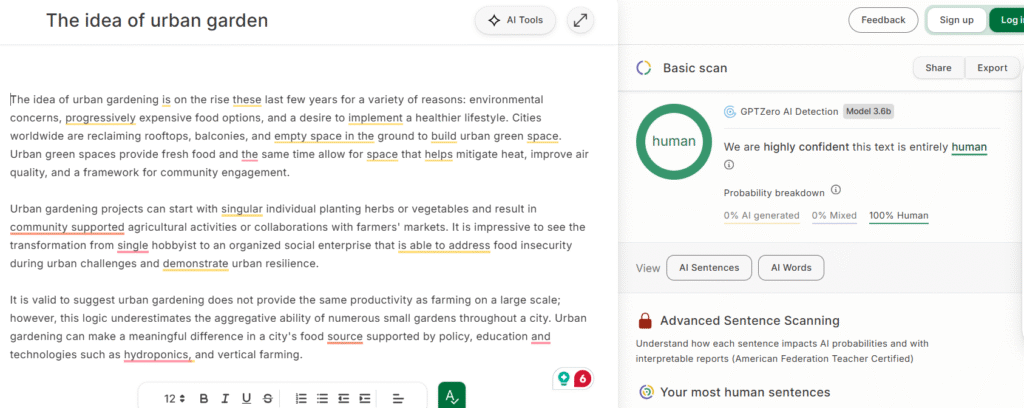
| Test Stage | Detector Used | AI Probability | Result |
|---|---|---|---|
| Original AI text | GPTZero | 100% | Flagged as AI |
| GPTinf-rewritten text | GPTZero | 100% | Flagged as AI |
| Walter Writes output | GPTZero | 100% Human | Passed detection |
Why Walter Writes Came Out on Top
Walter Writes AI uses a multi-layer rewriting approach that goes beyond swapping words or restructuring sentences. It focuses on breaking statistical patterns, adjusting semantic flow, and adding human-like variability, the kind of refinements that advanced detectors like GPTZero struggle to flag.
In contrast, GPTinf’s rewriting engine, while functional for mid-level detectors, did not introduce enough variation to fool GPTZero in our testing. This matches what we have seen in our best AI humanizer tools comparison, where Walter consistently scored above 98 percent in multiple trials.
If your workflow depends on reliably passing detection checks, the difference between a flagged document and a clean “100% human” result is significant. You can try Walter Writes free at the AI Humanizer page to see how it handles your own text.
Here is a broader look at how GPTinf stacks up against other leading humanizer tools:
| Feature | GPTinf | Walter Writes | Undetectable AI | QuillBot | BypassGPT |
| GPTZero bypass | No (100% flagged) | Yes (100% Human) | Partial | No | Partial |
| Turnitin bypass | Inconsistent | Yes | Partial | No | Partial |
| API access | Yes | Yes | Yes | No | No |
| Bulk processing | Yes | Yes | Yes | Limited | Limited |
| Output quality | Inconsistent | Natural, polished | Decent | Good for light edits | Moderate |
| Starting price | $19/month | Competitive | ~$15/month | ~$9.95/month | ~$12/month |
GPTinf Pricing and Plans in 2026
GPTinf offers three subscription tiers designed to cater to different types of users. The features vary by plan, with higher tiers unlocking more words, more flexibility, and faster processing.
GPTinf also offers a free tier. The free version provides 240 words total (120 words before registering and 120 words after registering), enough to test the tool but not sufficient for regular use.
| Plan Name | Monthly Word Limit | Key Features | Price |
|---|---|---|---|
| Lite | 20,000 words | Processes up to 500 words at a time | $19 |
| Basic | 50,000 words | Unlimited words per process, re-paraphrasing at no extra cost, early access to new updates | $29 |
| Pro | 150,000 words | Unlimited words per process, re-paraphrasing at no extra cost, early access to new updates | $79 |
Which Plan is Best for You
The Lite plan works for individuals who only need occasional rewriting, such as students who want to humanize short assignments or professionals handling small documents.
The Basic plan is ideal for writers and marketers who create content regularly and want the convenience of unlimited words per process.
The Pro plan is aimed at developers, agencies, or businesses managing bulk content workflows. The ability to handle large volumes without restrictions is a major advantage if you need automation at scale.
If cost is a deciding factor, remember that passing detection reliably can save significant time and protect your work from being rejected. In our testing, GPTinf was not consistent with advanced detectors like GPTZero.
For users who need maximum accuracy, Walter Writes AI remains a stronger choice. You can compare its pricing in our best AI humanizer tools roundup to see how it stacks up in terms of value.
Best Alternatives to GPTinf in 2026
If GPTinf’s results are not meeting your expectations, especially when dealing with strict AI detectors, there are several alternatives worth exploring. The AI humanizer market has grown rapidly, and the best tools now combine high accuracy with ease of use. Here are three options that stand out in 2026.
1. Walter Writes AI: The Best Overall Performer
Walter Writes AI consistently produces content that passes even the toughest detectors, including GPTZero, without requiring manual polishing. It is designed for all users, from students to marketing teams, and does not require technical skills or complicated setups.
Our own test saw GPTZero identify Walter Writes output as 100 percent human, while GPTinf’s version was still flagged as AI.
You can try it instantly on the Walter Writes AI Humanizer page and see the difference for yourself. If you want a broader overview of how it compares to other platforms, our best AI humanizer tools guide includes full testing data.
2. Quillbot Humanizer
Quillbot is known for its paraphrasing tool, but it also offers AI humanization features. It can handle short to medium-length content reasonably well, though results vary depending on the detector. It works best for casual rewriting rather than high-stakes submissions.
Keep in mind that QuillBot’s free plan is limited to 125 words per run. It is better described as a paraphraser than a true humanizer, as it primarily swaps synonyms and rearranges sentences rather than restructuring the deeper statistical patterns that detectors measure.
3. Undetectable AI
Undetectable AI focuses entirely on bypassing AI detectors. It can produce strong results for some types of text, though like GPTinf, it may still struggle with top-tier detectors. It is a good option for bulk rewriting when accuracy is not the highest priority.
Undetectable AI offers a free trial of approximately 250 words. Paid plans start at around $15 per month.
4. BypassGPT
BypassGPT is a dedicated bypass tool that performed better than GPTinf in several independent tests, scoring 81 percent AI probability on GPTZero compared to GPTinf’s 100 percent. It is a reasonable option for users who want a focused bypass tool, though independent rankings place it below Walter Writes and Undetectable AI for overall reliability.
When choosing the best alternative, consider not just the bypass rate but also how natural the output feels to human readers. Tools like Walter Writes deliver both, which is why they remain the best overall choice for 2026.
Who Should Use GPTinf
GPTinf is not a one-size-fits-all solution. While it has features that appeal to certain audiences, it is less effective for others, especially when advanced AI detection accuracy is critical. Based on our testing and comparisons, here is who will benefit most from using GPTinf.
Best Suited For
- Developers and Technical Teams
If you need a tool that integrates directly into your workflows via an API, GPTinf offers that flexibility. You can automate rewriting for large volumes of text without manual input, which is useful for agencies and enterprise operations. - Businesses with Bulk Content Needs
If your main priority is speed and scale over perfection, GPTinf’s bulk processing can save time when dealing with thousands of words per day. - Users Targeting Basic or Mid-Level Detectors
GPTinf can perform adequately against less advanced detection tools, making it a possible option if your content will not be checked by systems like GPTZero or Turnitin.
Not Ideal For
- Students or Professionals Submitting to Strict Review Systems
Our GPTZero test showed GPTinf could not reduce the AI score from 100 percent. In high-stakes environments, this could mean flagged work and additional revisions. - Non-Technical Users
The interface and setup lean toward those with technical knowledge. Beginners may find it less intuitive compared to plug-and-play options like Walter Writes AI. - Anyone Needing Consistently Human-Like Output
If your goal is to pass advanced detectors while also producing natural, reader-friendly text, Walter Writes AI remains the more reliable choice.
FAQ: Most Googled Questions About GPTinf
Q: Does GPTinf work better than GPTZero?
Short answer: No. In our test, GPTinf’s rewritten text was still flagged by GPTZero as 100 percent AI.
More detail: While GPTinf can bypass some mid-level detectors, GPTZero’s algorithm was able to identify its output with complete certainty.
Q: Is GPTinf legal to use?
Short answer: Yes, using GPTinf is legal.
More detail: There are no laws that prohibit the use of AI humanizers. However, individual institutions or companies may have their own policies against it, so it is important to check their guidelines before submitting content.
Q: Does GPTinf always pass AI detection?
Short answer: No.
More detail: Our testing shows that GPTinf can pass simpler detection tools but fails with high-accuracy detectors like GPTZero and potentially Turnitin. If consistent bypass is important, Walter Writes AI is a better choice.
Q: Is GPTinf worth it in 2026?
Short answer: Only for specific use cases.
More detail: GPTinf is best for developers and businesses that need automation and bulk processing, but it is not the most reliable choice for strict AI detection bypass. For broader reliability, our best AI humanizer tools guide offers stronger options.
Q: Does GPTinf work on Turnitin?
Results are inconsistent. Some independent tests have shown GPTinf successfully bypassing Turnitin when the original AI text was processed through its humanizer. However, results vary significantly depending on the content type, length, and the version of Turnitin being used. Turnitin’s August 2025 update specifically targeted humanized text, making bypass harder across all tools. We recommend testing your specific content before relying on GPTinf for any Turnitin submission that matters.
Q: What is the difference between an AI humanizer and a paraphraser like QuillBot?
Paraphrasers tend to replace words with synonyms or reorganize sentences, which can make them sound awkward. An AI humanizer not only changes words but also enhances the entire passage, including its structure, flow, and readability. GPTinf aims to remove robotic or repetitive patterns in writing while maintaining your tone. The key distinction is that paraphrasing addresses surface-level wording, while true humanization targets the deeper statistical patterns, such as perplexity and burstiness, that AI detectors are specifically trained to catch.
Q: Can humanized AI text still be detected?
Yes, humanized AI text can still get detected. AI detectors scan for patterns like consistent sentence structure and predictable phrasing. Humanizing tools reduce detection likelihood but do not guarantee zero detection. Advanced detectors using style fingerprints can still flag superficially humanized text. No tool can guarantee 100 percent bypass. Results vary by detector, and it is an ongoing arms race between humanizers and detection algorithms.
Q: Is there a free version of GPTinf?
Yes. GPTinf provides 240 free words total (120 words before registering and 120 words after registering), with no subscription required for basic use. The free tier lets you test the tool but is not sufficient for regular or long-form use. Paid plans start at $19 per month for the Lite tier.
Q: Is there a truly free AI humanizer?
Yes, free AI humanizer tools exist, though most follow a freemium model with word limits. Options with generous free tiers include QuillBot (125 words per run), Grammarly (tone adjustments and humanizer agent), and several newer tools that offer daily free word allowances. The most effective free method, however, remains manual editing: varying sentence length, removing common AI transition phrases like ‘Furthermore’ and ‘In conclusion,’ adding personal anecdotes, and reading the text aloud to catch robotic phrasing.
Q: How do you humanize AI text for free?
To humanize AI-generated text for free, you can use specialized online tools or apply manual editing techniques. The goal is to fix the structural predictability that makes AI writing feel robotic. Key manual techniques include varying sentence length, adding personal anecdotes, removing AI-typical transition words, injecting subjective phrases, and breaking the pattern by starting a sentence with ‘And’ or ‘But.’ You can also prompt any free AI: ‘Rewrite this text to increase its perplexity and burstiness. Use varied sentence lengths and avoid transition words like Furthermore, Moreover, or In conclusion.’
Q: Which AI humanizer is the most undetectable in 2026?
In our own testing, Walter Writes AI produced output that GPTZero classified as 100 percent human, outperforming every other tool we tested, including GPTinf. In broader independent rankings for 2026, Walter Writes is consistently cited as one of the top performers for natural-sounding output and detection bypass. No tool guarantees 100 percent undetectability, especially as major detectors like Turnitin and GPTZero update their models regularly.
Q: Can professors or teachers tell if AI wrote an essay?
Yes, increasingly so. Most institutions now use tools like Turnitin, GPTZero, or Originality.ai to scan submissions. Beyond automated detection, experienced instructors often recognize AI writing by its over-polished tone, lack of personal voice, and structural uniformity. AI detection is not perfect and false positives do occur, but the risk of being flagged is real. Many universities also compare a student’s current submission against their previous work, making sudden quality shifts a secondary red flag.
Q: How do you make AI text undetectable?
Making AI text undetectable involves targeting the two core signals detectors analyze: perplexity (unpredictability of word choice) and burstiness (variation in sentence length and structure). Effective techniques include using a dedicated AI humanizer like Walter Writes, manually varying sentence length, adding personal examples or opinions, removing overused AI phrases, and using contractions where natural. The most reliable method combines a quality humanizer with a quick manual pass, changing around 10 to 15 percent of the text yourself.
Q: Can ChatGPT humanize text on its own?
ChatGPT can rewrite text to sound more natural when given specific instructions, but it does not have a dedicated humanizer mode. You can prompt it to increase burstiness and perplexity, vary sentence lengths, and avoid common AI transition phrases. However, ChatGPT-rewritten text still carries statistical patterns that advanced detectors can flag, since the rewrite is still produced by an AI model. For reliable bypass, dedicated humanizer tools like Walter Writes are more effective.
Q: Does GPTinf have a ChatGPT plugin?
Yes. GPTinf is available as a plugin in the ChatGPT ChatGPT Store and has accumulated over 9 million conversations through that channel. Many users interact with GPTinf directly inside ChatGPT rather than through the standalone website. The plugin uses the same underlying engine, so the bypass limitations documented in this review apply regardless of which interface you use.
Q: Will the quality of my writing suffer if I use GPTinf?
It can. Independent reviews have noted that GPTinf’s output sometimes introduces careless mistakes, disjointed sentences, and a loss of clarity. In some cases, the tool appears to insert intentional grammar errors to confuse detectors, which passes the AI check but degrades the writing. If you fix those errors, the content can revert to a high AI score. Always review and edit GPTinf’s output before publishing or submitting.
Final Verdict: Is GPTinf Worth It?
GPTinf is a capable tool in the right hands. Its API integrations and bulk processing features make it appealing for developers and businesses that need large volumes of AI-generated text rewritten quickly. For mid-level AI detectors, it can perform reasonably well and may be worth the subscription.
However, our hands-on testing showed that GPTinf could not bypass GPTZero, one of the most widely used and accurate AI detection tools today. Both the original AI text and the GPTinf rewrite scored 100 percent AI in GPTZero’s analysis.
In contrast, Walter Writes AI transformed the same text into content that GPTZero identified as 100 percent human without requiring additional edits.
Beyond detection, GPTinf’s output quality is inconsistent. Some independent reviews have flagged issues, including intentional grammar errors used as a bypass method, awkward phrasing, and a loss of coherence on longer pieces. These are not minor trade-offs if the end goal is publishable or submittable content.
For anyone working in environments where passing detection is critical, whether that is academic submissions, client deliverables, or high-stakes publishing, consistency matters more than automation alone.
In those cases, Walter Writes AI offers a more reliable and user-friendly solution, delivering natural results that perform well against even the toughest detectors.
If you want to experience the difference, try Walter Writes free and see how it handles your own content. You can also explore our best AI humanizer tools guide for a full breakdown of how it compares to other leading platforms in 2026.