


Originality.ai Review: Is It Worth It?
How many times have you wondered if your content could potentially be flagged as being created using AI? In this Originality AI review, I will provide all that you need to know about this tool.
Due to the increase in new tools designed to detect AI-created content along with plagiarism, it’s a concern that’s more relevant than ever.
But here’s the question: Does Originality AI meet the expectations?
This review provides a breakdown of the features of Originality AI, along with real-world testing results for different content types, and areas where it has room for improvement compared to other tools. We also ran a structural stress test comparing multiple content types in order to help you understand exactly when to use Originality AI and when to avoid using it altogether.
TL;DR: Key Takeaways from This Review
| Category | Details |
| AI Detection Accuracy | High accuracy for basic AI-generated content, but less effective for humanized outputs. |
| Plagiarism Detection | Comprehensive plagiarism checks across multiple sources. |
| False Positive Risk | Less risk of getting false positives on real human writing |
| Multi-Language Support | Supports up to 15 languages, with the best performance in English |
| Ease of Use | User-friendly interface, though some features require a learning curve |
| Pricing | Credit-based: 1 credit per 100 words. Pro plan starts at $14.95/month for 2,000 credits |
| Best Fit | Detecting AI and plagiarism in academic, professional, and marketing content. |
| Stress Test Verdict | A reliable choice for detecting 100% of AI-generated content. No false positives when used against human-generated writing. Identified 33% of paraphrased mixed content. Decisive results are typical of this tool, like 100% or 0%. If you need another perspective, use a similar reliable detection model, such as Walter Writes |
| Best Alternative | Walter Writes AI: reliable detection and humanization in one workflow |
What Is Originality AI?
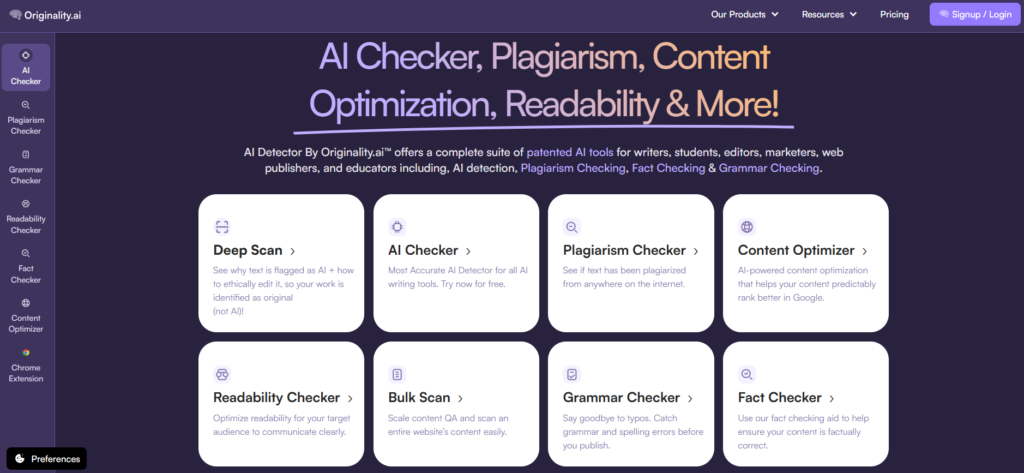
Originality AI is a two-way tool. One way to assist in identifying AI-generated writing, as well as to identify plagiarized work. Whether you’re a student submitting an essay or a marketer publishing online, this tool can be used to assist with maintaining credibility.
This is an easy all-in-one answer, but just like many other tools, there are some limitations.
What It Claims to Do
The tool scans for AI-generated text patterns and checks for plagiarism across a wide range of sources. Additionally to these two primary services, the product has a readability score service, a fact-checking service, and team workflow tools, which include API access that allows agencies to run large bulk scans of their content. While they are available in higher plans, they have not been really advertised.
It operates on a credit-based system where one credit covers 100 words scanned.
Who It Is Designed For
Originality AI was built primarily for web publishers, editors, and content agencies that need to screen large volumes of content quickly. It is not designed with students or freelance writers in mind, and that distinction matters when evaluating its results.
A screening tool geared toward bulk screening will provide clear-cut results. When we ran our stress test on this tool, the scores were either 100% or 0% with almost no middle ground. While the clarity from an agency perspective can be beneficial, the binary results may seem too black and white to the end user, who expects some degree of nuance.
Why Originality AI Matters (and Where It’s Commonly Used)
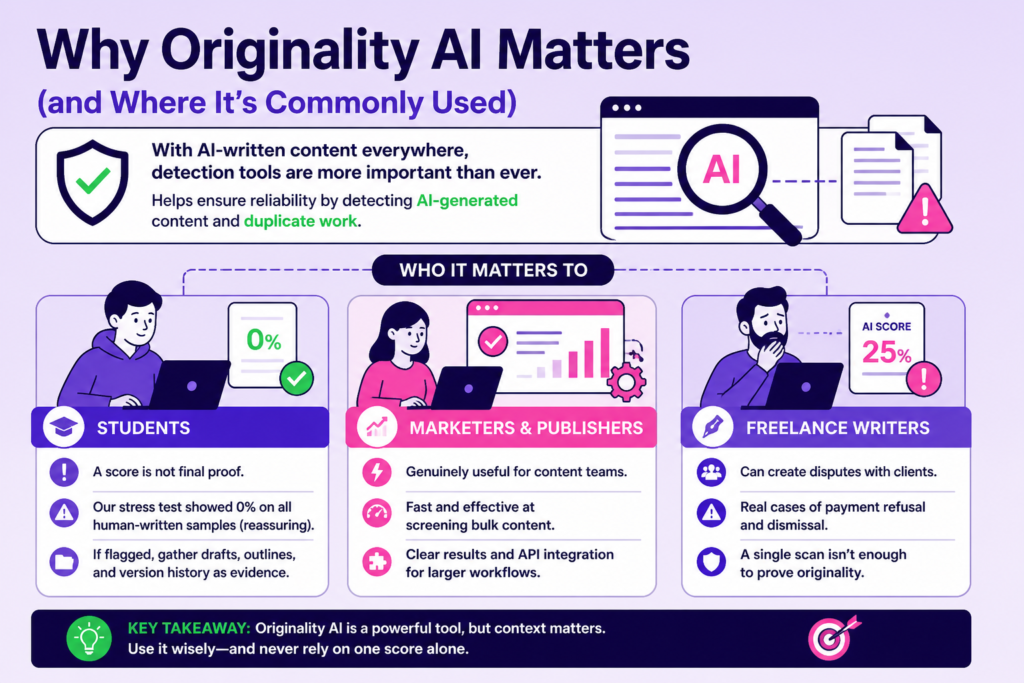
With AI-written content popping up everywhere, the need for detection tools has never been greater. The reliability of this tool is also positioned as a means to provide an effective method to detect AI-generated content and duplicate work.
But who it matters to depends upon what position they are currently in.
Students
A score is not final proof. Our stress test showed 0% on all human-written samples, which is reassuring. But there may come a time when one or some of your work gets flagged. At this point, gather up your drafts, outlines, and version history prior to submitting your response.
For more information, see our guide regarding how professors can identify AI-generated content, and to avoid potential plagiarism concerns with respect to your research paper, view our tips on avoiding research paper plagiarism.
Marketers and Publishers
For content teams, Originality AI is genuinely useful. It is fast and effective at screening bulk content and provides clear results through its API to integrate into larger workflows.
Freelance Writers
This is where things get complicated. There are many posts on Reddit about real cases where it has led to clients refusing payment and dismissal. If a client demands a 0% AI result, a single Originality scan is not enough to settle that dispute.
Originality AI Key Functions
AI Detection
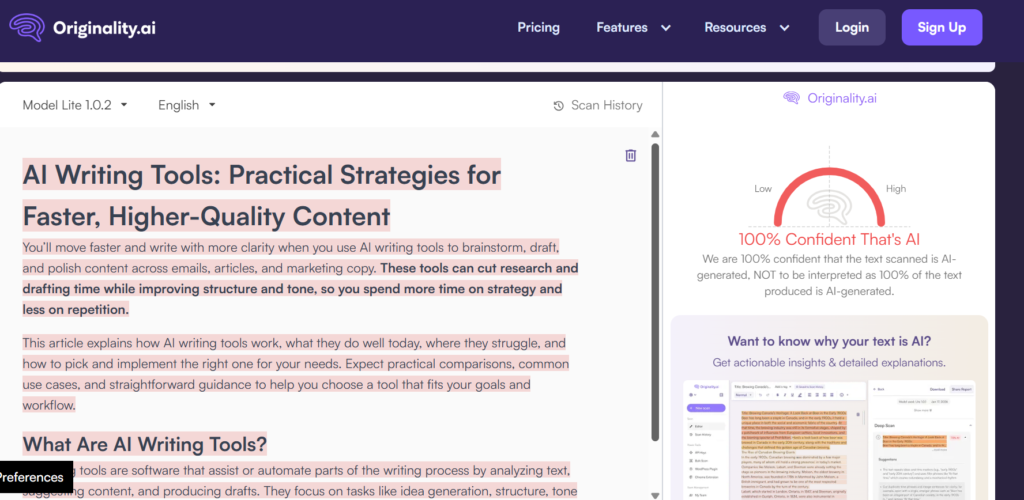
The tool scans for AI-generated text patterns. The detection tool performs well with identifying the base-level outputs of AI systems such as ChatGPT-3 and ChatGPT-4.
Our stress testing confirmed this. In all three tests performed with original AI-generated content, Originality scored 100%. Where the detection tool becomes less accurate is when detecting paraphrased or humanized content.
When the content has been further humanized through additional editing processes or “polished” using other tools, the detection tool may lose a significant amount of effectiveness.
Plagiarism Detection
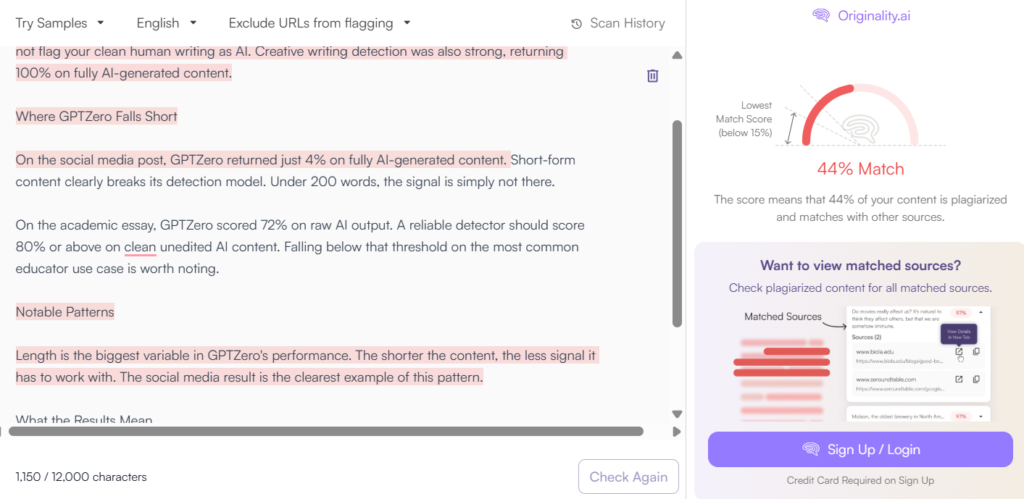
The plagiarism detection system is one of its main features. It scans all types of material, such as academic articles and web pages, as well as providing a solid backup source for students, teachers, and business professionals trying to produce new work.
Readability, Fact Checking, and Team Workflows
Beyond detection, Originality AI includes a readability scorer, a fact-checking feature that flags unverified claims, and team management tools that let agencies run shared workflows under one account. Teams will have API integration capabilities in the upper tiers of membership in order to incorporate scanning into their overall content pipeline.
Although these features may not cause someone to originally subscribe to this tool, they do offer additional utility and value for publishers who wish to implement a single layer of quality control across all content produced.
Ease of Use
This platform is both intuitive and user-friendly. It makes it very simple to upload documents or files, to run scans, to receive detailed reports, and to do so at the touch of a mouse. If you are a bit more tech-oriented and you need specific scan settings or scan configurations, then your options may be limited.
Stress Test (2026): How Originality AI Performs in Real-World Writing Scenarios
Most detector tests work like this: paste a raw ChatChatGPT paragraph, run it, and report the number. This provides limited information regarding how an actual tool works. That’s why we tested Originality.ai’s performance against raw AI-generated content, verified human-written content, and paraphrased content in 4 different, real-world use cases.
Originality AI Detector Results Table:
| Use Case | AI-Generated | Human written | Mixed Article (AI Article → Human Paraphrased) |
|---|---|---|---|
| Academic Essay | 100% AI ✅ | 0% AI ✅ | |
| Creative Writing | 100% AI ✅ | 0% AI ✅ | |
| Social Media Post | 100% AI ✅ | 0% AI ✅ | |
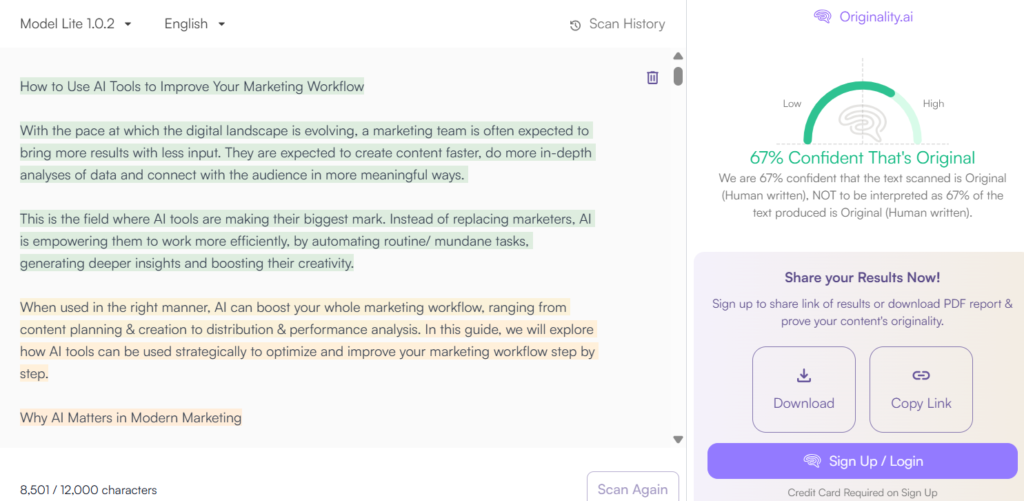
| Mixed Article (How-To) | 33% AI ✅ | ||
| Average | 100% AI | 0% AI | 33% AI |
Test Setup- 4 use cases
We tested Originality AI across four use cases. No edits were made between tests. Content was submitted in the same format and length each time.
The four use cases:
- Academic Essay: The highest-stakes scenario for students and educators
- Creative Writing: A content type where AI output is harder to distinguish stylistically
- Social Media Post: Short-form content where detectors often behave unpredictably
- Marketing Article (AI content paraphrased by a human): The most important real-world test, because people rarely use raw ChatChatGPT output
Test Samples Used for this Originality AI Detector Review
Below are all the 7 samples used during the testing.
Link to these samples:
- Academic Essay: AI (The Impact of Artificial Intelligence) and Human (Is Google Making Us Stupid?)
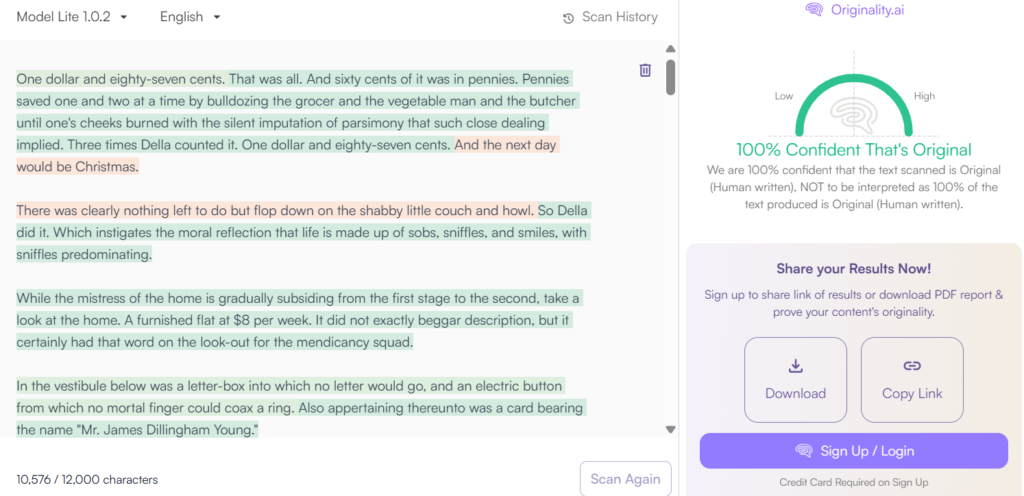
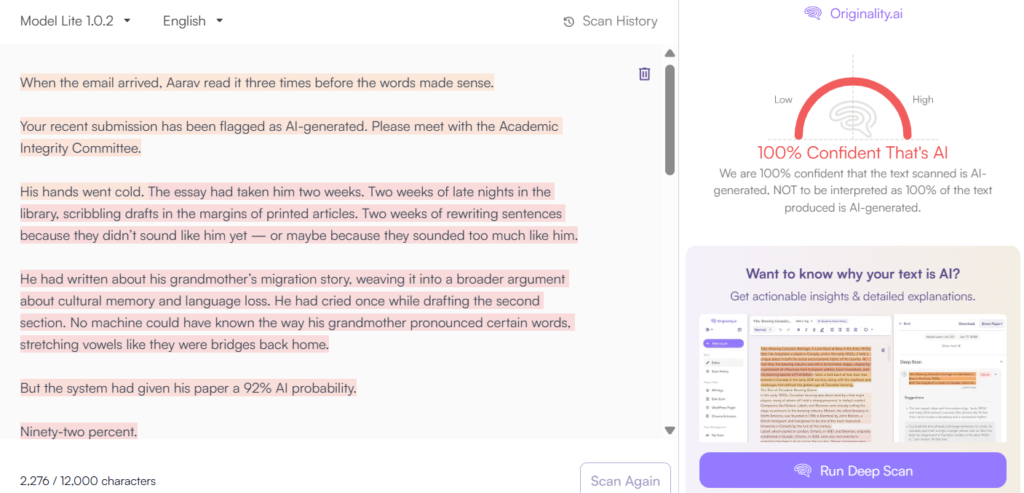
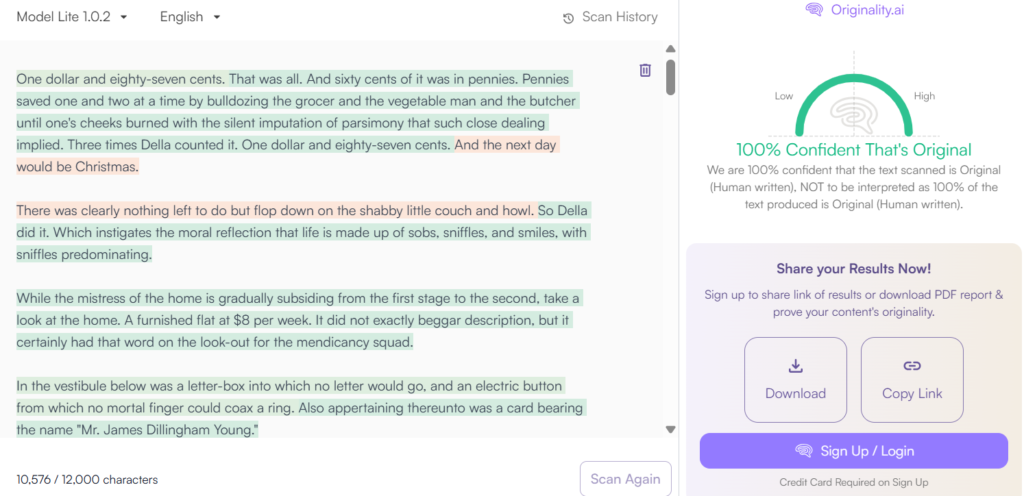
- Creative Writing: AI (Student’s Nightmare) and Human (The Gift of the Magi)
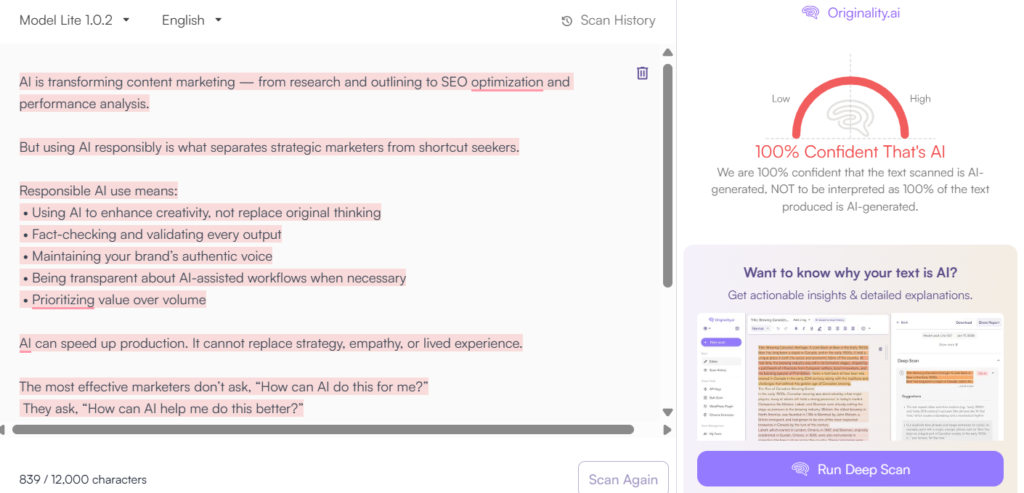
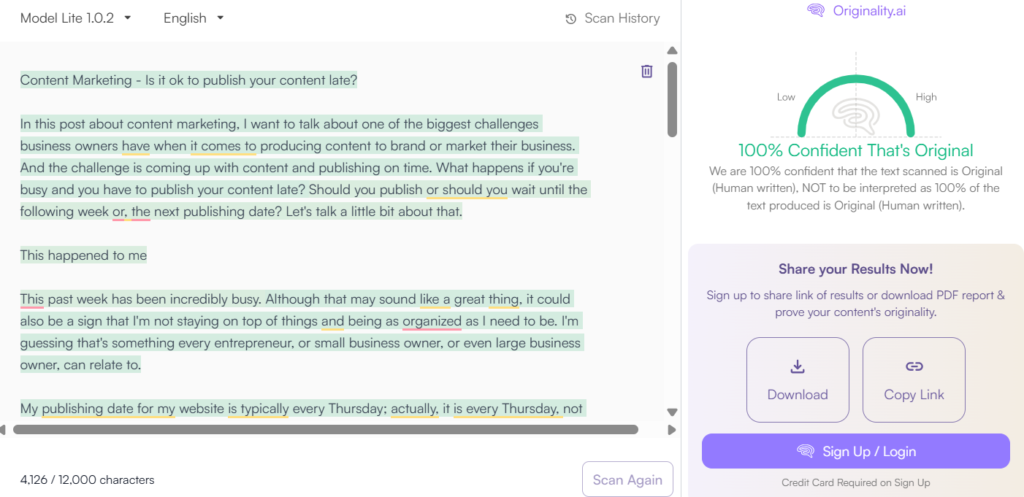
- Social Media Post: AI (Transforming Content Marketing) and Human (Is It OK to Publish Late)
- Marketing Article: Mixed (How to Use AI Tools to Improve Your Marketing Workflow)
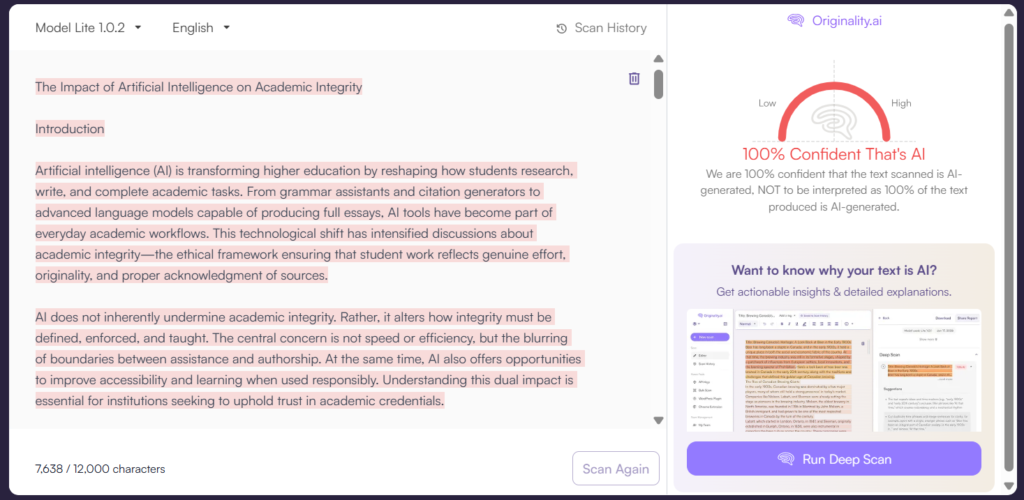
Originality Results: AI and Human Academic Essay
Originality Results: AI and Human Creative Writing
Originality Results: AI and Human Social Media Post
Originality Results: Mixed Article
What the Results Show
Where Originality AI Is Reliable
Across all three standard use cases, Originality AI returned a perfect score. Raw AI content was flagged at 100% every single time. On the other hand, human-written content generated zero false positives with this detector. The consistency that Originality AI provides is very rare when it comes to most free or low-cost detectors.
Where Results Get More Nuanced
On the mixed article, where a human paraphrased AI-generated content, Originality returned 33%. That is a meaningful signal. While many detectors fail to identify such content, Originality detects a 33% rate of paraphrased content that had been edited by humans, clearly indicating that there is some level of genuine sensitivity to identifying AI in writing patterns even after they have been edited.
Notable Patterns
Originality AI tends to return decisive scores and tends to generate extreme output, such as 100% or 0%. It does so by clustering results at both ends of the scale, resulting in little room for moderate interpretations of “the gray areas” of low quality, lightly rewritten, or collaborative content.
What the Results Mean
For students screening raw AI content, this is about as strong a result as you will see from any detector. For users dealing with mixed or humanized content, the 33% score on the paraphrased article is encouraging but does not provide conclusive evidence. A second scan using another reliable tool like Walter Writes AI detector will give you a complete picture before you make any content-related decision.
Pros and Cons of Originality AI
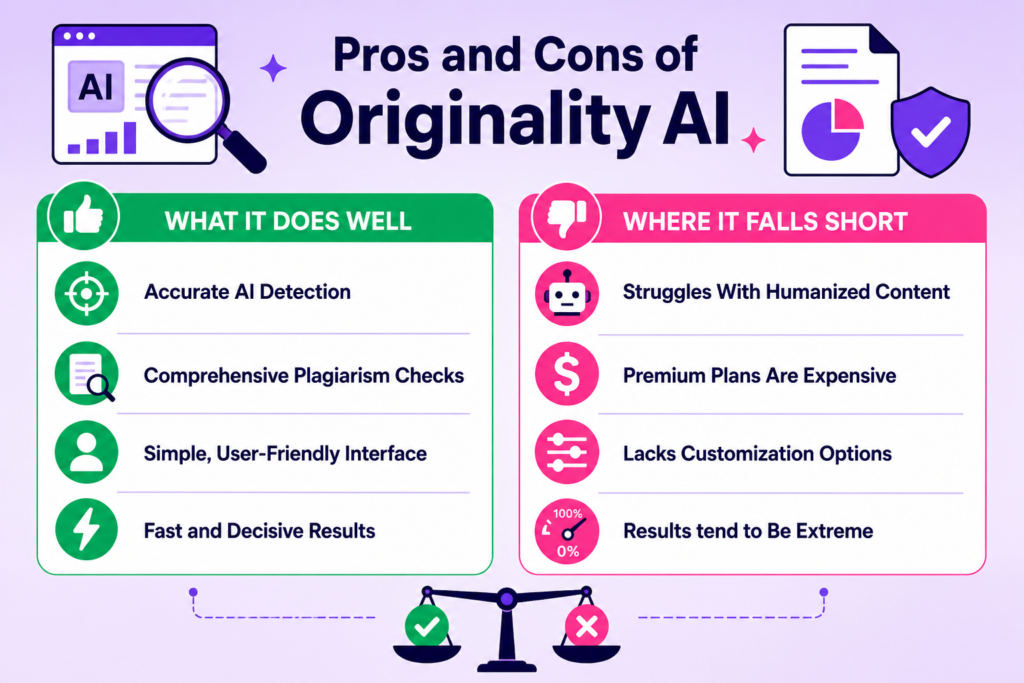
What It Does Well
- Accurate AI Detection for Basic Content: It’s reliable with raw AI output. The system has a 100 percent detection rate using raw AI output, as demonstrated through our stress testing process, which was run on all types of content.
- Comprehensive Plagiarism Checks: Provides both a high level of comprehensiveness and trustworthiness needed by students and professionals when checking for plagiarism.
- Simple, User-Friendly Interface: An intuitive user interface is provided so that first-time users can easily use the software.
- Fast and Decisive Results: All scores are clearly understandable and provide no ambiguity if an obviously AI-generated piece of content exists.
Where It Falls Short
- Struggles With Humanized Content: It can’t effectively detect text refined by humanizer tools. Independent benchmarks put paraphraser detection at approximately 60%. Most publishers will not find this level of reliability acceptable.
- Premium Plans Are Expensive: Some premium features have a high cost associated with them. In addition, since they operate on a credit-based pricing model, you will run out of credits before being able to scan all your content. The number of scans allowed on free models ranges from 3 to 4.
- Lacks Customization Options: There are no options available to users to customize their scans based on their individual scanning requirements.
- Results tend to Be Extreme: Results come in scores that are either 100% or 0%. This tends to create an extreme decision-making environment as it creates little middle ground, mainly when you have lightly edited or collaborative content.
Relevant Guides: Sapling AI review and PaperTyper Review
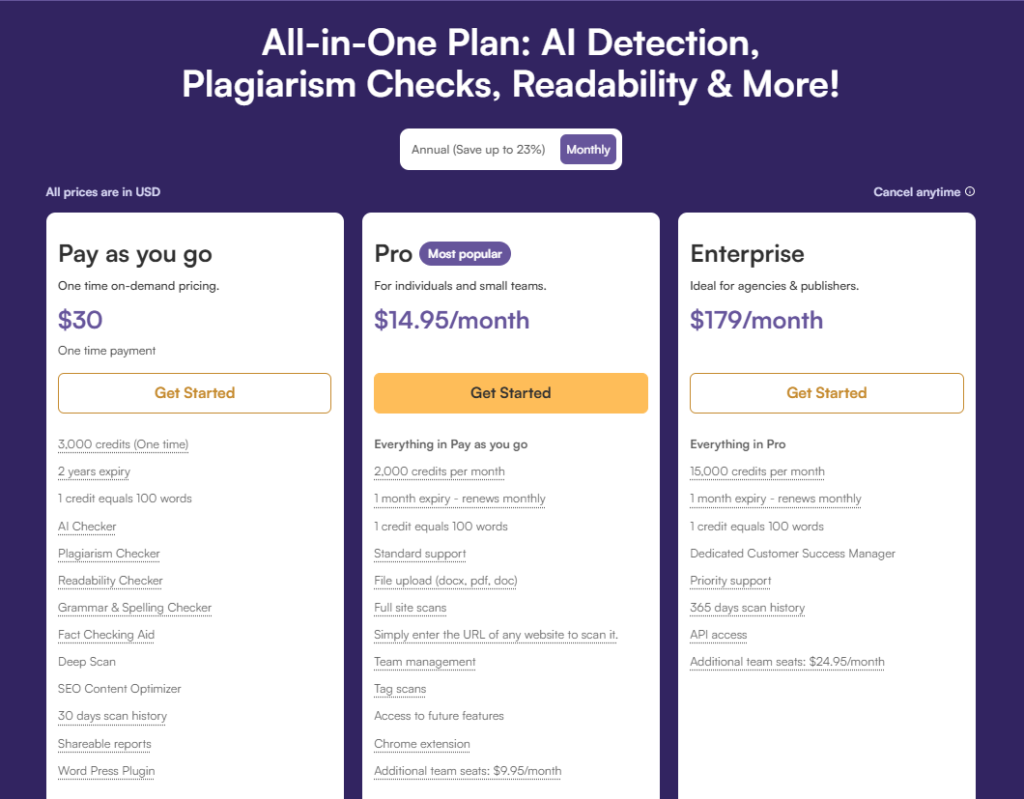
Originality AI Pricing Breakdown
| Plan | Monthly Price | Credits | Best For |
| Pay As You Go | $30 one-time | 3,000 credits (2-year expiry) | Occasional users, first-time buyers |
| Pro | $14.95/month | 2,000 credits/month | Individuals and small teams |
| Enterprise | $179/month | 15,000 credits/month | Agencies and publishers |
What Credits Actually Mean
The amount of data one credit can scan is 100 words. If your account has 2,000 credits, as it does on the pro-plan, then you are able to scan around 200,000 words in that same month. Although this may seem as if it would be plenty, there are generally about 15 credits needed to run an average 1500-word piece. So running 10-15 pieces per week will exhaust it, and you can reach your limit of credits very quickly.
The Pay As You Go option is the lowest commitment entry point at $30 for 3,000 credits, with no monthly lock-in. Credits do not roll over on subscription plans at the end of each billing period.
Which Plan Fits You
- Students or occasional users: Pay As You Go gives you flexibility without a subscription
- Freelancers and solo marketers: Pro at $14.95/month covers light to medium volume
- Agencies and publishers: Enterprise at $179/month includes API access, priority support, and 365-day scan history
There is no permanent free tier. New users can start with Pay As You Go before committing to a monthly plan.
Cost vs. Value
Although Originality AI offers great deals on its basic features, those features are inferior to those of its most advanced competitor, Walter Writes AI, which offers premium features at competitive rates, including advanced humanization and detection-proof capabilities.
Originality AI vs Turnitin vs Grammarly (and What “Better” Actually Means)
Originality AI vs Turnitin
These two tools are often compared, but they serve different purposes. Turnitin is built for academic institutions and focuses heavily on plagiarism detection, with AI detection added more recently. Originality AI is built for web publishers and content teams, with AI detection as its primary function.
Turnitin is more conservative in its AI scoring, which reduces false positive risk in academic settings. Originality AI returns more definitive scores than Turnitin. The more definite nature of scores from Originality AI is better suited for bulk publisher screening but may be perceived as overly harsh in an academic setting.
Turnitin is generally viewed as having more institutional trust by schools and universities. For content agencies and publishers, Originality AI is the more practical and cost-effective choice. For related context, see our guide on how Turnitin can detect Perplexity AI.
Originality AI vs Grammarly
These are not the same category of tool. Grammarly is primarily a writing assistant with a basic AI detection feature added. Originality AI is a dedicated AI and plagiarism detector. If AI detection is your main need, Grammarly is not a direct competitor.
Originality AI provides better detection reliability than Grammarly on structured or formal content.
Better Alternatives to Originality AI
| Tool | Best For | Strengths | Cost | Free Trial |
| Walter Writes | Students, freelancers, and marketers | Detection + humanization in one workflow | From $8/month | Yes, 3 days |
| ChatGPTZero | Educators and students | Sentence-level analysis, LMS integrations | Free tier available | Yes |
| Turnitin | Academic institutions | Institutional trust, plagiarism depth | Custom pricing | No |
| Proofademic | Academic writing | Sentence heatmaps, paraphrase detection, and formal writing calibration | From $8/month | Yes |
| Copyleaks | Multilingual teams | 100+ language support, plagiarism, and AI detection | From $13.99/month | Yes |
Why Walter Writes Is the Practical Alternative
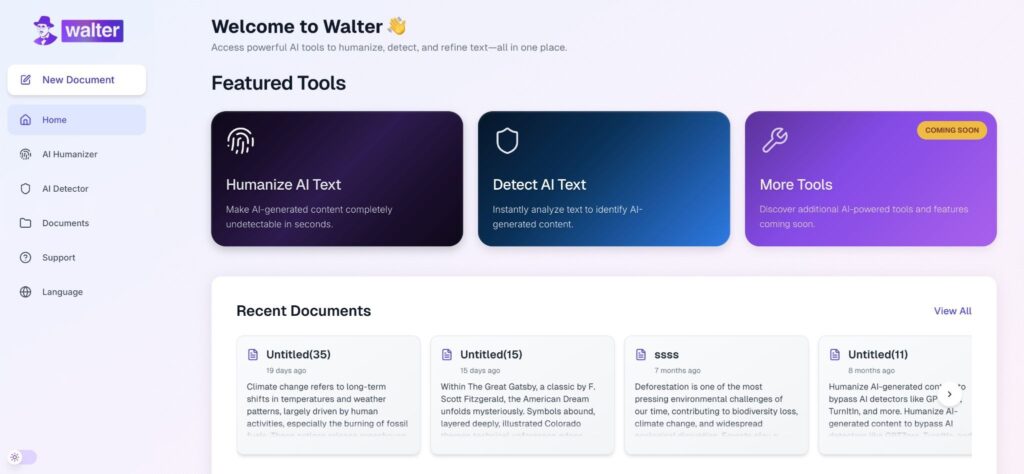
Walter Writes combines AI detection and humanization in one platform. Instead of scanning content and then switching to a separate tool to rewrite it, you do both in the same place.
An end-to-end workflow such as this will be much easier for writers and marketing professionals who need to create content that appears to read naturally while passing an AI detection test. Explore the best AI humanizer tools or go straight to the AI humanizer to see how it works.
FAQs About Originality AI
Is Originality AI Or Turnitin Better?
Depends on the use case. Turnitin is the standard for academic institutions. Originality AI is better for publishers and content agencies screening bulk content for AI.
Can Originality AI Detect ChatChatGPT?
Yes. Our stress test confirmed 100% detection on raw ChatChatGPT output across all four content types tested.
Is Originality AI More Accurate Than Grammarly?
For AI detection, yes. Grammarly is a writing assistant with a basic detection feature. Originality AI is purpose-built for detection and is significantly more reliable.
Is Originality AI Free To Use?
No permanent free tier. You can start with Pay As You Go at $30 for 3,000 credits, or subscribe to the Pro plan at $14.95/month.
How Accurate Is Originality AI?
Originality AI says it has a 99% accuracy rating on ChatGPT-4, an 83% rating for ChatChatGPT, and independent tests have shown a 76% average accuracy rate. In our own testing, we were able to get a 100% score for raw AI and a 33% when AI had been rewritten.
What Is Originality AI Used For?
AI content detection, plagiarism checking, readability scoring, and fact checking. Most commonly used by publishers, agencies, and content teams.
Does Originality AI Have A Lot Of False Positives?
Our test showed 0% false positives on human-written content. Independent reports suggest formal or highly structured writing can occasionally be flagged. It is not a widespread issue but worth knowing if your writing style is very formal.
Is Originality AI Worth It For Freelance Writers?
It depends on your clients. If they require 0% AI scores, it is useful for self-checking. But a single score should never be treated as a final verdict. See our guide on the best AI checkers for teachers for context on how professionals use these tools.
What Are The Best Alternatives To Originality AI?
Walter Writes for detection and humanization together, Turnitin for institutional settings, and Proofademic for formal academic writing. See the comparison table above.
How Does Originality AI Pricing Work?
Credit-based. Each Credit = 100 Words. Pro plan gives 2,000 credits per month at $14.95. Pay As You Go gives 3,000 credits for a one-time $30 payment with no monthly commitment.
Final Verdict: Is Originality AI Right for You?
Originality AI is a nice choice for basic AI detection and anti-plagiarism checks.
Good Fit
Originality AI works well if you are a publisher or agency screening raw AI content at volume. In our stress testing, we have found that it is possibly a good one available at this price point, being both highly decisive and consistent. It has earned its place within workflows that include mass content verification.
Risky Fit
If you are a student under academic scrutiny, a freelance writer with strict clients, or anyone operating under a 0% AI policy, a single Originality score is not enough to protect you. This tool was designed for use in bulk content verification, not in providing high-stakes individual conclusions. Use it as just one piece of evidence and do not rely solely on it when making decisions regarding what constitutes acceptable work.
There have been documented cases on Reddit of actual freelance writers having paid projects refused due to disputed Originality scores, which also resulted in losing potential clients. Be aware of the limitations of the tool before using it in high-risk situations such as these.
If You Need Publish-Ready Content That Passes Detection, Do This Instead
A more robust process is to develop your writing as opposed to simply reviewing your writing. Identify areas where your writing can be improved with respect to clarity and voice. Then review the work again. If you are not sure how humanization works in practice, see our guide on what an AI humanizer is before getting started. Walter Writes handles both AI detection and humanization steps in one place.