




Key Takeaway: JustDone AI is a convenient all-in-one tool for quick detection and humanization, but its detector flagged every human-written sample as AI in testing, making it unreliable for academic submissions where false positives carry real consequences.
- JustDone correctly identified AI content but flagged all human samples as AI, averaging 87.6% on human-written text
- Walter Writes scored human samples between 0-6% AI on the same test content
- The humanizer struggles with long-form academic writing, producing tone shifts and meaning drift
- The $2 trial auto-renews to $39.99/month if not cancelled. Credits also expire
- Real user reviews flag false positives on original writing and billing transparency issues
- Best for quick content checks and simple rewriting. Not suitable for graded essays or dissertations
Most students don’t just want an accurate AI humanizer and detector. They want an all-in-one solution that helps them avoid poor rewrites, false AI flags, and risky submissions. Can JustDone AI help students avoid academic penalties and be confident in their work? Where is it reliable, and where can it fail for students? If you’re unsure whether JustDone is right for you, this review will clear your confusion. We’ll evaluate JustDone using a student-first reliability model. We’ll look at the detector reliability, the humanizer quality, and the usefulness of the plagiarism checker.
The 60-Second Verdict (Make Your Decision Fast)
JustDone is reliable as an all-in-one tool, but not consistently reliable for sensitive academic work. It is best for students who want a quick system to detect, humanize, and check their work for plagiarism. It is not as reliable for graded essays, dissertations, or coursework where the need for accuracy and integrity is high. If you want a safer, more reliable, and more controlled workflow without tool hopping, try Walter Writes for students.
JustDone AI Detector Review
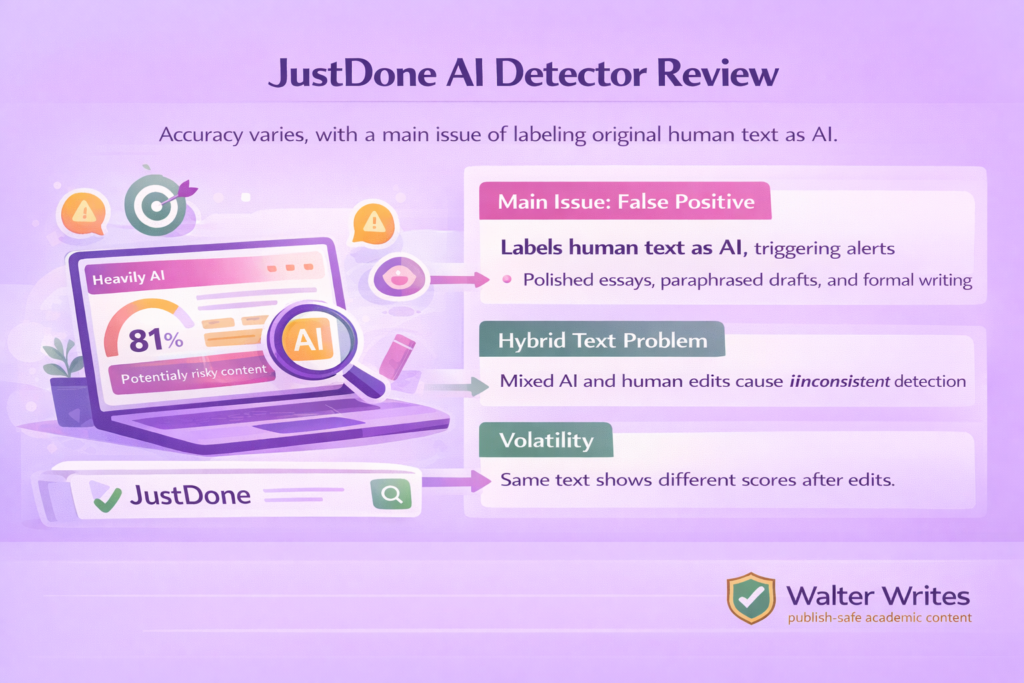
JustDone AI is best used for quick, directional checks. The detector classifies content as either AI-generated or human-written. It highlights risky sections (likely to be AI-generated) in yellow/orange. The tool claims 94.1% accuracy, while independent tests have shown varying results. The target is students and content creators who want to ensure originality in their work. Although it works well at detecting ChatGPT-generated content, it’s not effective for detecting academic integrity.
You may not be able to catch errors that may put your work in jeopardy. While AI detection should not be a definitive proof for AI usage or not, it should at least give you the signals that’ll inform you if your work is safe for submission. Also, the best AI detector will have as few false positives as true positives across different tests.
How It Works
One of the best uses is to check if your content reads or looks AI-like. It can identify both mechanical tone and overly uniform phrasing, which are two hallmarks of AI-generated content. It’ll also compare your text against patterns in human-written data to reduce hallucinations.
The check will also reveal patterns such as repetition, predictable sentence structure, and monotonous structure if present in the text. If your text has these traits, even if you wrote it 100%, it may be flagged. That is one of the downsides of the tool. This is why you should not use it to detect plagiarism or write academic content. In the first instance, it won’t give you accurate results because it uses probabilistic patterns to identify the originality of content. For academic work, the false positive will be high because of how similar your work will be to others as a result of attribution.
Main Issue: False Positive
The major problem with JustDone AI is the occurrence of false positives in the results. It is common for it to tag human-written content as AI. It doesn’t happen for all content types. Rather, it happens mostly when you’re testing:
- Polished essay with a consistent voice
- Paraphrased drafts
- Formal writing
The reason it flags this content is because of its core system. The detector looks for predictable phrasing, pattern consistency, and low randomness in text. Because academic writing, like essays, has most of these. That’s why they are often flagged more. This means original work can trigger detection, which is a big risk in academic settings.
How to Use JustDone AI Detector
Step 1: From the homepage, you can check some text, with a minimum of 80 words per session. However, the result is simplified so that you don’t know which part of your text is being flagged. You can only get useful data after registering. There is no free plan. But a 7-day access subscription at $2 is available if you want to test it out.
Step 2: Once you have an account, locate the AI detector in the navigation menu at the top or the sidebar on the left.
Step 3: Paste your content into the AI detection tool on the left-hand side of the sidebar.
Step 4: Review the results generated to see which area of your text is being flagged. Sometimes you have to dig deep to confirm if the content is actually AI. Sometimes, genuine human content can be flagged.
Step 5: Retest using another AI detector, such as Walter Writes, to make sure the parts being flagged are not due to hallucinations.
JustDone AI Detector Stress Test: How Accurate Is It Really?
JustDone AI Detector Results Table
| Use Case | AI-Generated | Real Human |
| Essays | 90% AI ✅ | 96% AI ❌ |
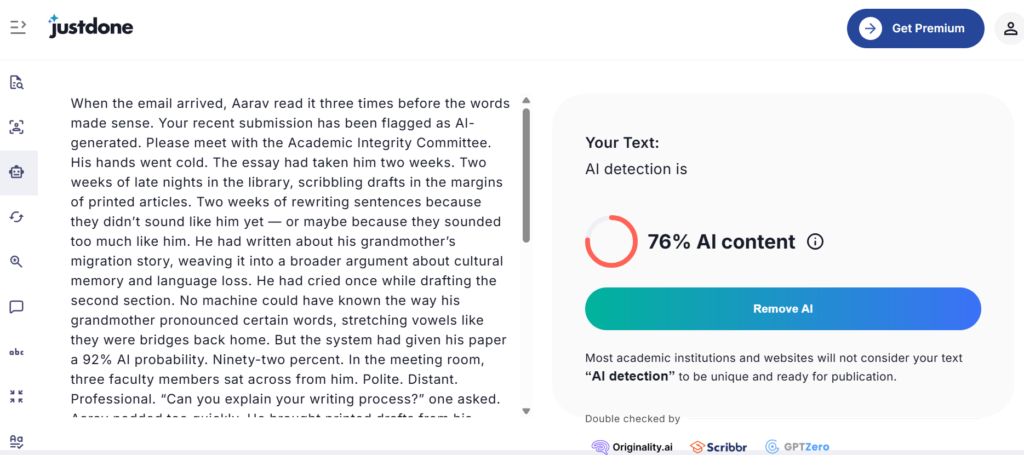
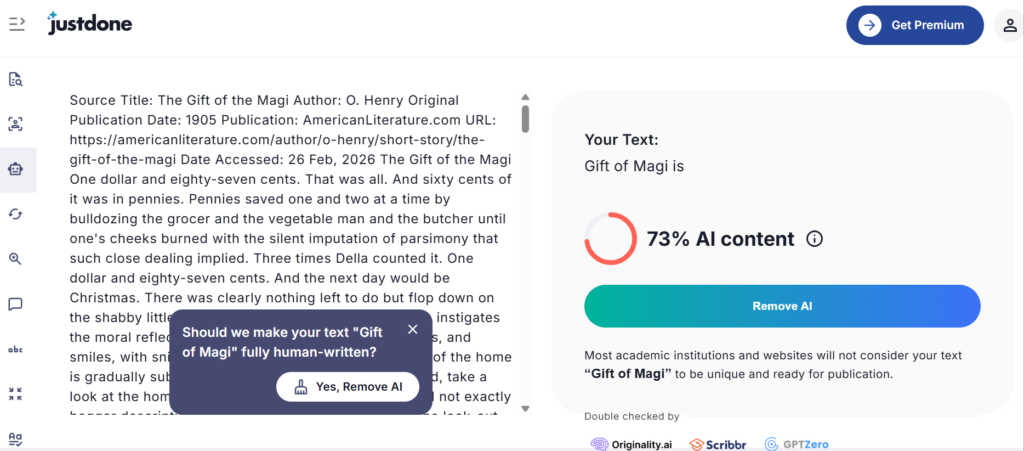
| Creative Writing | 76% AI ✅ | 73% AI ❌ |
| LinkedIn Post | 94% AI ✅ | 94% AI ❌ |
| Average | 86.6% AI | 87.6% AI |
How We Tested JustDone AI Detector
To put JustDone AI’s marketing claim to the test, we put the detector to a stress test. The aim is to test the tool’s capabilities and whether it can truly achieve 94% accuracy. This is based on real writing scenarios using a controlled testing process.
- We adopted three different use cases: an essay, a LinkedIn-style social media post, and a creative writing article.
- We used two content samples: one human-written and one entirely AI-generated.
- The AI-generated samples were created using a popular LLM model without editing.
- The human samples were a repository of samples we’ve developed over time.
- We used the JustDone AI Detector to scan each sample.
- We took screenshots of the results after each scan.
The goal is to ensure a proper structure and consistent, unbiased results across the board.
Test Samples Used for the JustDone AI Detector Review
Here is the set of samples we used (a total of six) for the test:
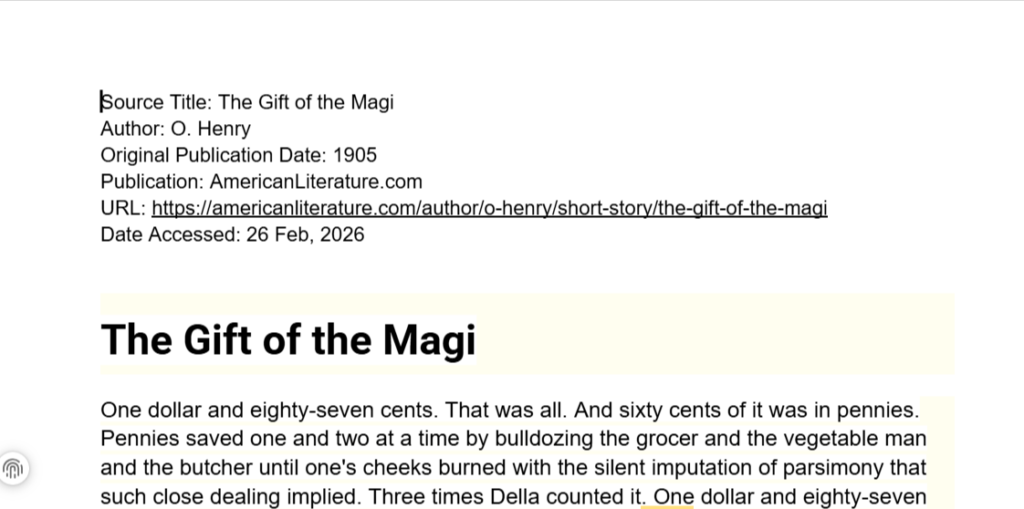
Test Sample: AI-Generated Creative Writing vs Human-Written Creative Writing
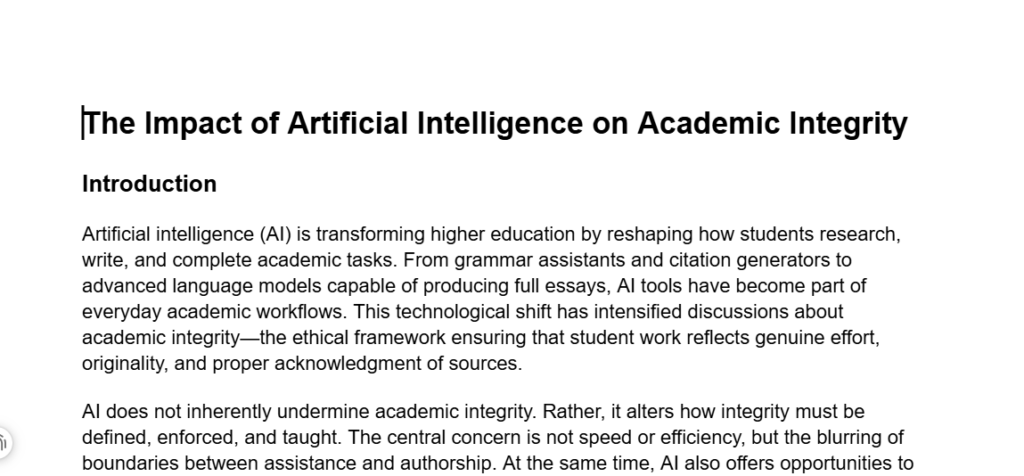
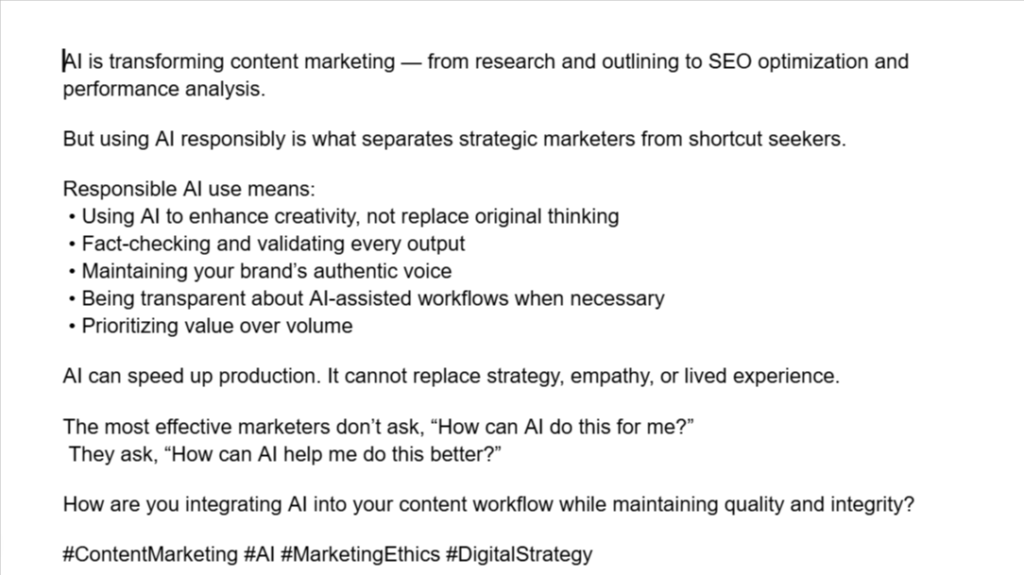
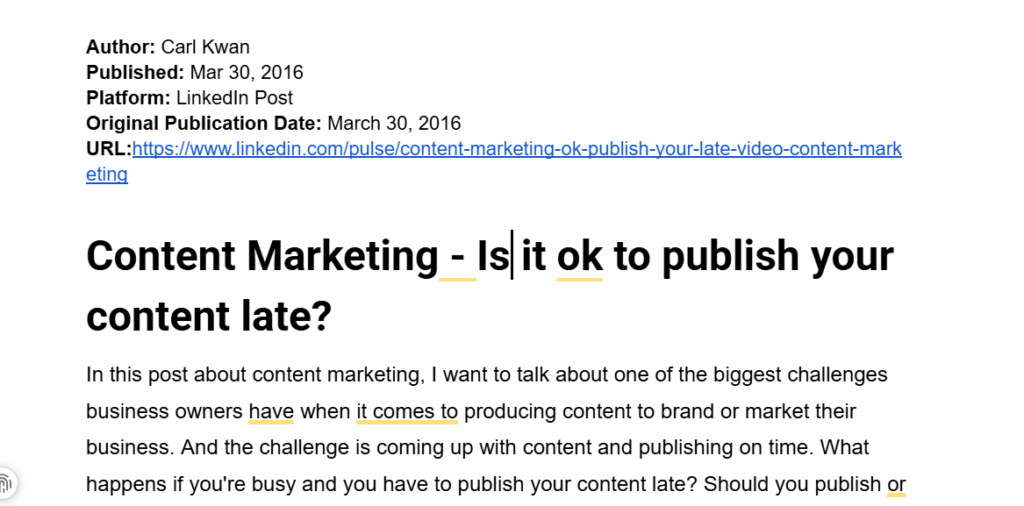
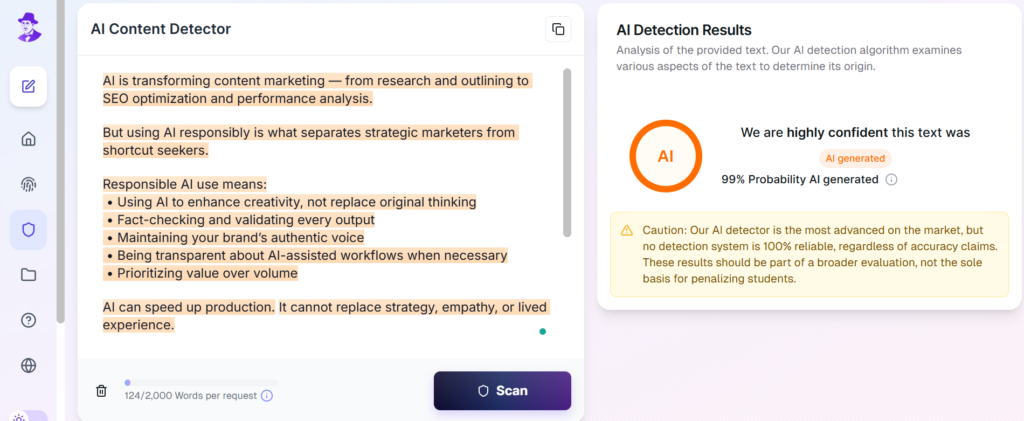
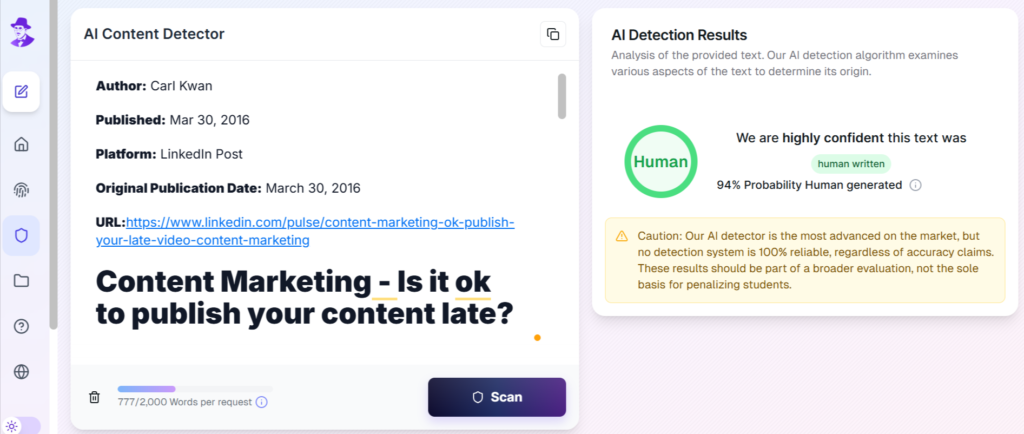
Test Sample: AI-Generated LinkedIn Post vs Human-Written LinkedIn Post
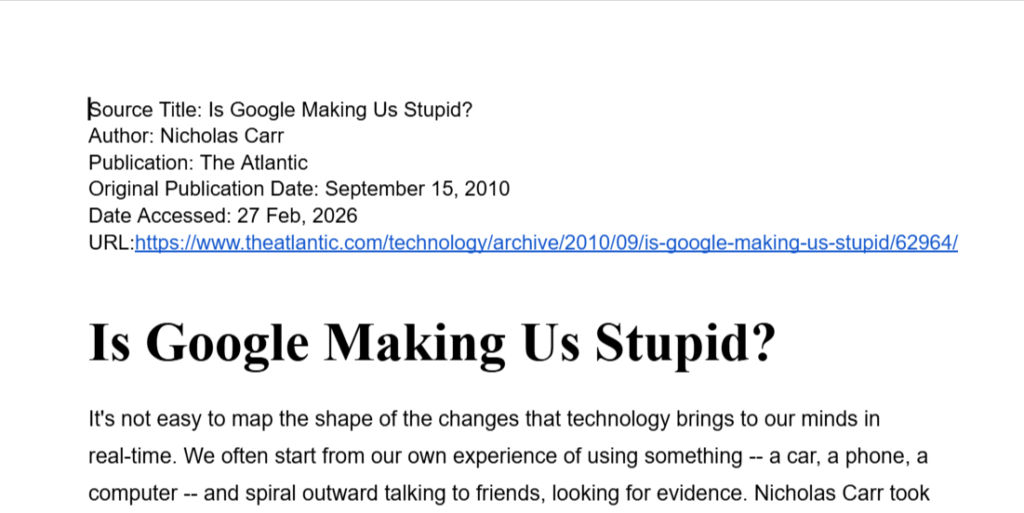
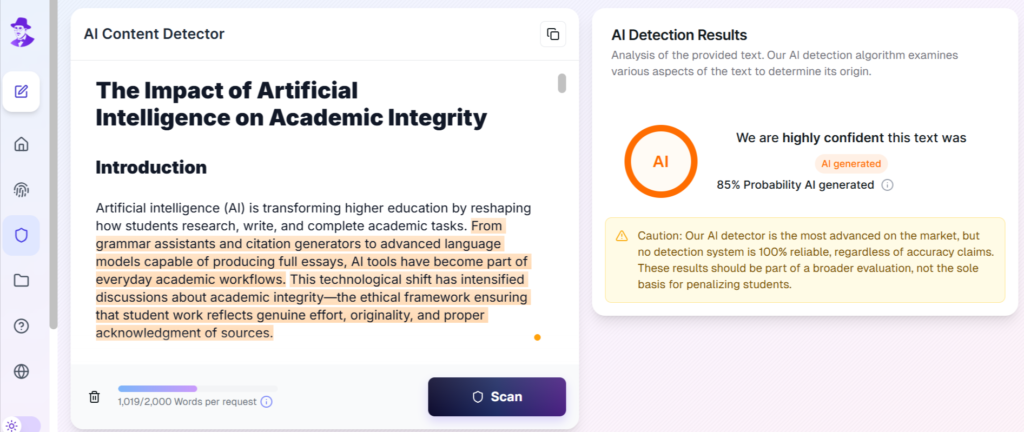
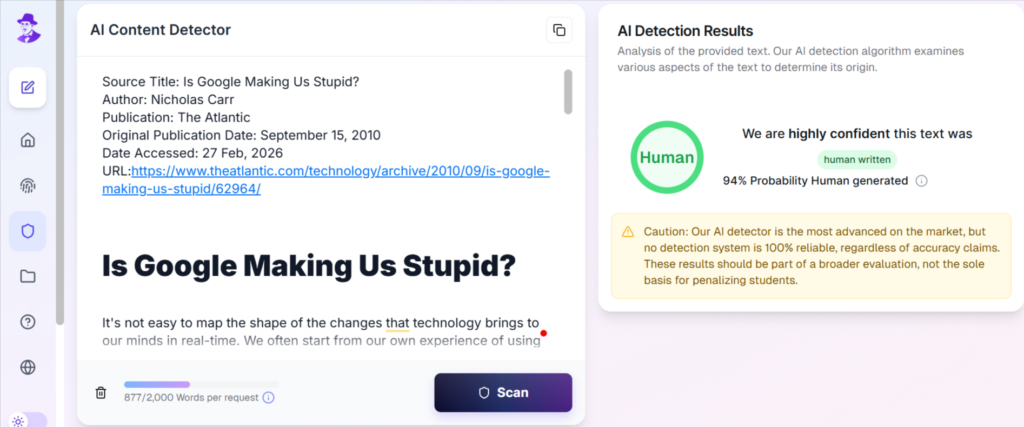
Test Sample: AI-Generated Essay vs Human-Written Essay
Links to the samples:
- Creative Writing: AI (A Student’s Nightmare) and Human (The Gift of Magi)
- Essay: AI (Impact of Artificial Intelligence) and Human (Is Google Making Us Stupid?)
- LinkedIn Post: AI (Using AI for Content Marketing) and Human (Is It Okay to Publish Content Late?)
JustDone AI Detector Results: AI and Human Creative Writing
Results from scanning the creative writing AI and human writing. Click image to enlarge:
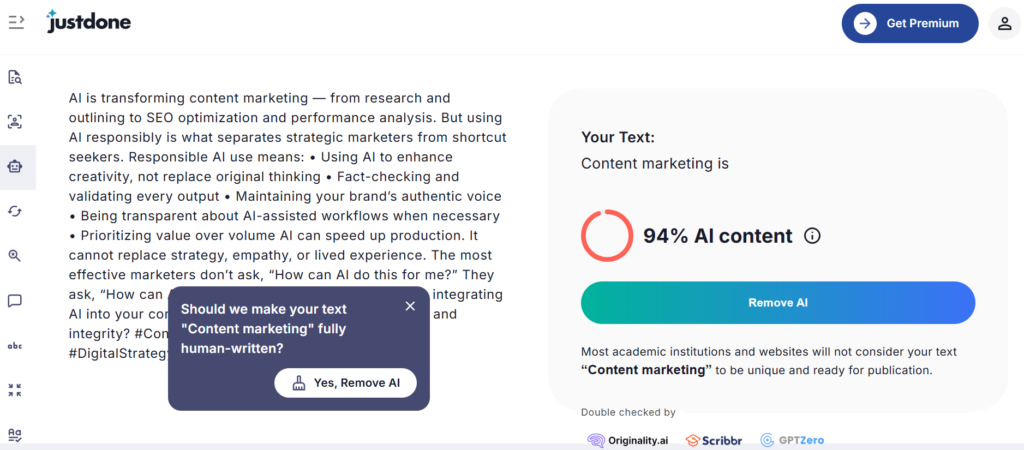
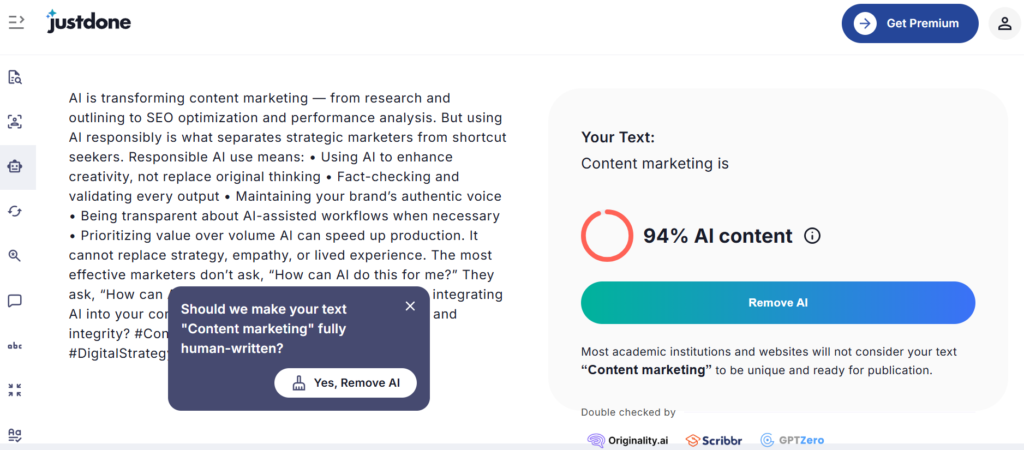
JustDone AI Detector Results: AI and Human LinkedIn Post
Other results from scanning both AI and Human LinkedIn posts. Click image to enlarge:
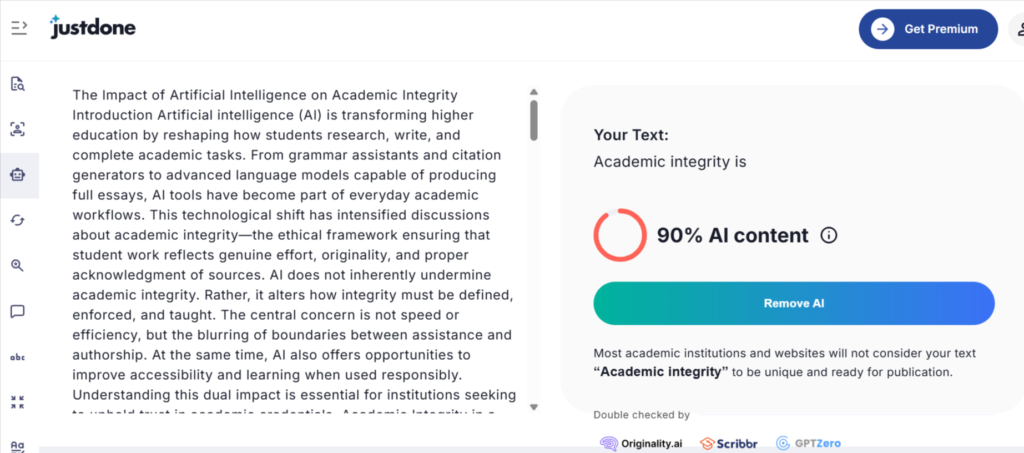
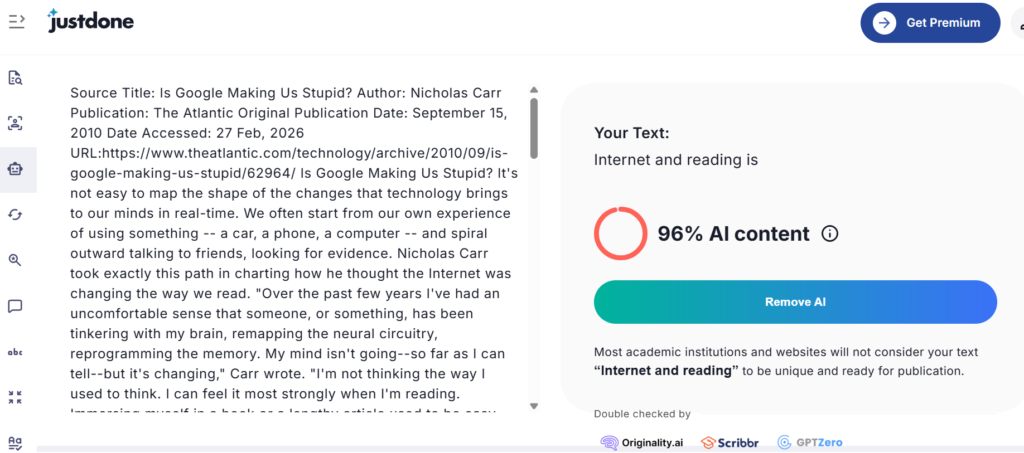
JustDone AI Detector Results: AI and Human Essay
Finally, these are the scan results from JustDone for the AI and Human Essays. Click image to enlarge:
What These Results Mean (Our Observations)
Based on the test conducted, here is what we observed about the JustDone AI Detector.
Accuracy on AI Content
The JustDone AI Detector correctly identified all AI-generated content from the samples. However, the tool flagged all of the human-written content samples as AI. This shows a very high false positive rate for the tool. We don’t think the length has any effect on the results, as they were varied for this reason.
- The AI-generated creative writing at 350+ words got 76% AI content, which isn’t great but good enough. The human-generated version, on the other hand, at 2000+ words, is also labeled as 73% AI. As for the AI-generated Essay, it is 991 words and has a 90% AI score. This is excellent. But then the human-written version, at 861 words, is scored 96% AI, which is totally wrong.
- Finally, we have the AI-generated LinkedIn-style post at just 120 words being scored at 94%, which is great. But when we checked the human-written post of 768 words, the tool scored it 94% AI content; way off the mark.
These results show that the detector is not accurate as regards human-written content. We recommend you use Walter Writes AI Detector when evaluating human-written content. This is based on superior test results from the scans below.
False Positive Rate
From the test results, it’s clear that the tool performed well with the AI-generated content, with an average of 86.6%. This isn’t excellent by industry standards, but it is still passable. Where the tool really fails is in the results of the human-written content. It is totally out of range with a 87.6% AI label. This shows a very high low positive rate. There is a high possibility that human-written content will be flagged when you test-run it through the tool.
Consistency
It doesn’t seem like the content length affects the result. The consistent are consistent on both edges. When it’s AI content, it’s moderately accurate. And when it’s human-written content, it’s wrong across the board. This poor performance means the tool isn’t reliable, especially in academic settings.
Notable Patterns
- The detector consistently identifies AI content but fails to do the same for human-generated content
- All human samples are flagged as AI, showing less accuracy and reliability
- The tool can’t distinguish authentic human writing from AI content.
- There is no time discrepancy between analyzing short and long samples, implying surface-level analysis.
Where JustDone AI Detector Is Reliable
- Act as a good AI detector for AI-generated drafts
- Used for surface-level screening before deeper review
- Works as an early warning model for non-human written content
Where Students Face Risks
- Human academic writing can be flagged as 90% AI
- The chances of getting false positives are high in formal writing, like academic work
- Unreliable for content writing by humans
For human-written content, it’s not safe to rely on a single detector to avoid risks.
It’s also a good idea to review your drafts, both human and AI-assisted, with Walter Writes’ AI detector. Even better, the results are reliable for both original human and AI-generated content.
JustDone AI Detector vs Walter Writes AI Detector
How We Tested
To test Walter Writes AI detector, we used the same samples we scanned on JustDone AI. The test is done following the same procedure and ensuring it’s unbiased.
Side-by-Side Results Table
| Sample Type | Use Case | JustDone Score | Walter Score | Winner |
| AI-Generated | Essay | 90% AI ✅ | 85% AI ✅ | Both |
| Human | Essays | 96% AI ❌ | 6% AI ✅ | Walter |
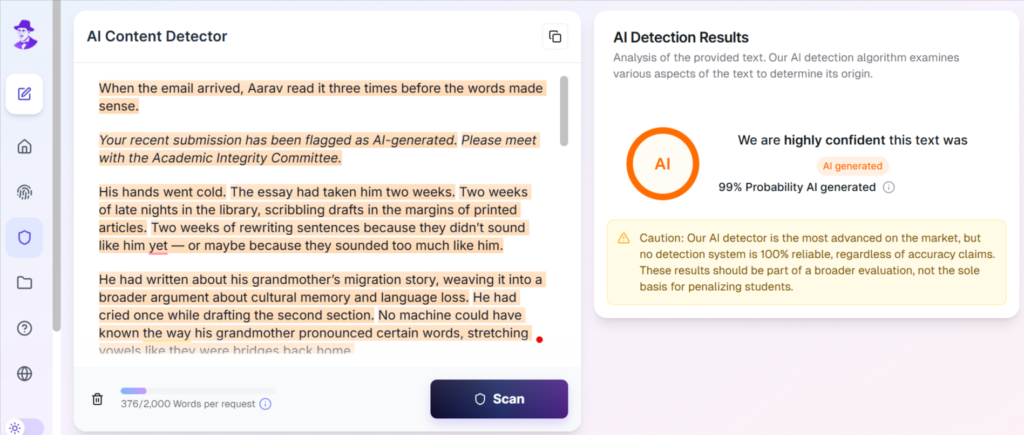
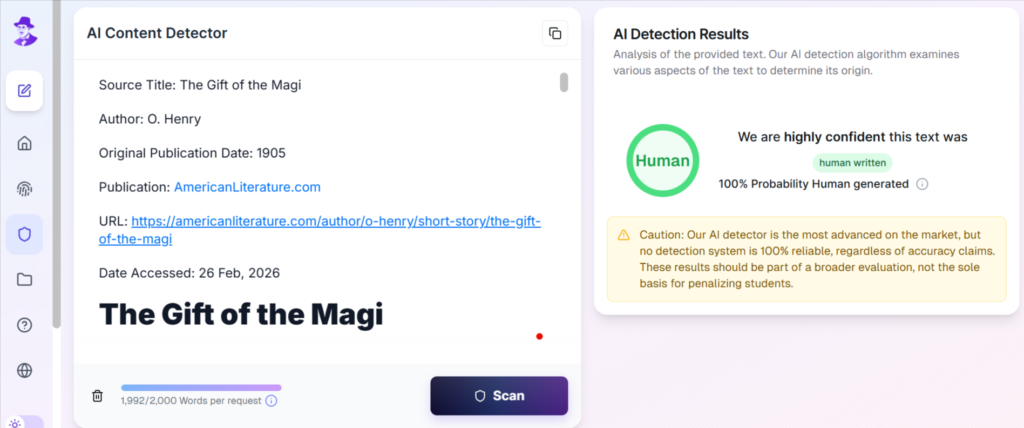
| AI-Generated | Creative Writing | 76% AI ✅ | 99% AI✅ | Both |
| Human | Creative Writing | 73% AI ❌ | 0% AI ✅ | Walter |
| AI-Generated | LinkedIn Post | 94% AI ✅ | 99% AI ✅ | Both |
| Human | LinkedIn Post | 94% AI ❌ | 6% AI ✅ | Walter |
Walter Writes AI Detector Results: AI and Human Creative Writing
Walter Writes AI Detector Results: AI and Human LinkedIn Post
Walter Writes AI Detector Results: AI and Human Essay
Comparative Analysis: Walter vs JustDOne
Here is what we discovered after testing both tools:
Detection Accuracy
- JustDone failed to detect all human-written samples
- Walter Writes consistently detects human-written content across diverse subjects and content lengths
- Walter’s human detection ranges from 0% to 6% AI, while JustDone returned an average of 87% AI
False Positive Rate
- JustDone flagged all human samples as 96%, 73%, and 94% AI, respectively.
- Walter Writes classified samples between 0% and 6% AI, showing a very low false flag risk
Consistency
- JustDone’s results varied significantly based on content format
- Walter Writes maintained stable detection across human-generated and AI-generated content
- Walter’s scoring remained within safe ranges of 0% and 6% AI detection for human content
Where Each Tool Performs Better
- JustDone displayed limited reliability in detecting human-written content
- Walter Writes demonstrated balanced detection between both human and AI samples
Overall Testing Verdict
- Walter Writes AI correctly identified all AI-generated samples with strong percentages
- Human samples are classified with little to no AI scores, indicating low false flag risk
- JustDone flagged all human samples as AI with strong percentages
- Results were extremely different in both AI and human sample detection.
Using the same test samples and conditions, Walter Writes correctly identified both AI and human samples. JustDone had difficulty with being consistent as it only detected AI content but failed to do the same for human samples.
It is important to consider the detector’s stability and reliability when reviewing your human-written drafts. Only rely on a detector that can accurately detect the originality of the content.
JustDone AI Humanizer Review
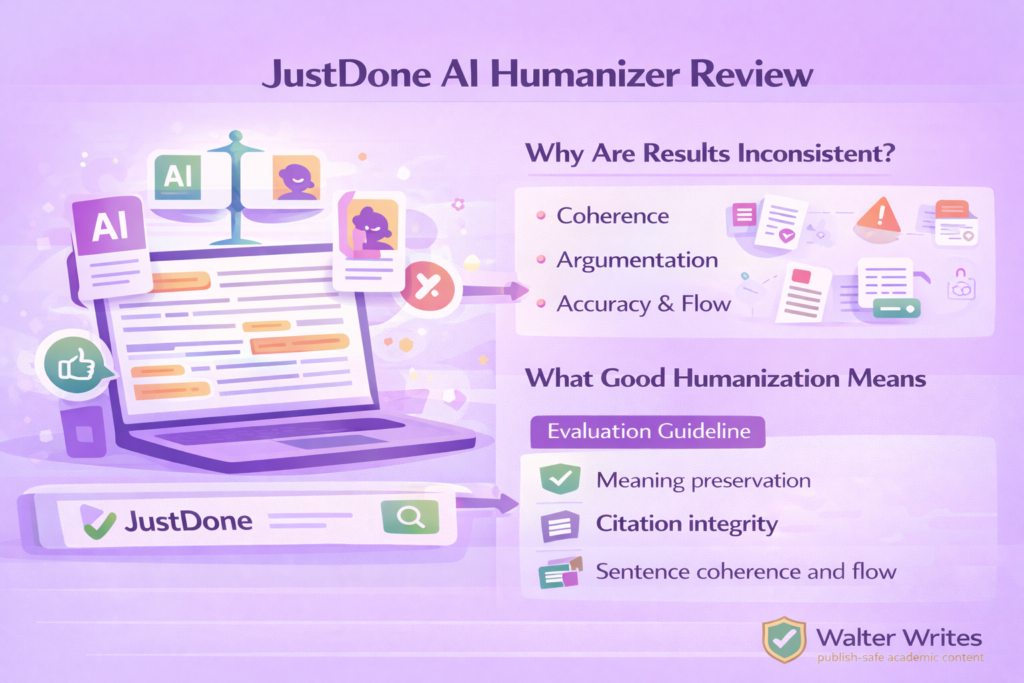
Most JustDone AI reviews are split along two extreme edges. Some students found the tool to be a convenient all-in-one system that saves them time. Others feel the outputs are too unnatural to be useful. The reason for the two extremes is that AI humanizers have to make a trade-off between readability and detection. When a humanized test text passes detection tests, it may have sacrificed readability and vice versa.
Why Are Results Inconsistent?
Typically, tools like JustDone AI humanizer struggle with long-form content such as academic writing. As content length increases and the structure becomes more rigid, performance drops. This is because humanizers cannot maintain long-term coherence. The tone shifts inconsistently, making the text feel “stitched together”. Also, in complex writing, these tools fail to grasp nuanced argumentation like humans would. This often leads to hallucination or accidental removal of technical vocabulary. The final content contains inaccurate, disjointed, and repetition that’s still detectable.
Now that we know the limitations of JustDone AI Humanizer, let’s look at the features to look for in a good humanizer.
What Good Humanization Means
Most tools want you to believe that you can get human-like output or bypass detectors. That shouldn’t be the focus. Good humanization isn’t just about the bypass rate but also preservation of content meaning, consistency, and readability. The truth is that a higher bypass rate can reduce the content accuracy due to the changes in meaning.
Evaluation Guideline
Meaning preservation
When testing an AI humanizer, don’t be swayed by the brand’s marketing. Instead, look at the tool output holistically. Does it maintain the original argument? Some tools prioritize reducing detection risk, thereby distorting arguments and the content’s meaning. In an academic setting, such content will be graded poorly. Any tool that can balance both should be given preference.
Citation integrity
Another thing you need to pay attention to is the integrity of the citation. In the humanized version, check if all references are preserved correctly. Altering citations may have a huge impact on the integrity of the entire content.
Sentence coherence and flow
Another common issue you may face is disjointed sentences that are grammatically correct. Humanized content should be as close to human-written content as possible. That means it should read naturally and logically.
Where JustDone AI Humanizer Is Useful
Use it for simple rewriting or to break repetitive phrasing in your content. For even better results, do a manual rewrite after using the tool to humanize your content. This way, you’ll catch any inaccuracies before preparing your content for submission. It should not be used as a one-click final solution, especially for academic work. You can also compare it with the best AI humanizer tools on the market, such as Walter Writes.
JustDone Plagiarism Checker Review
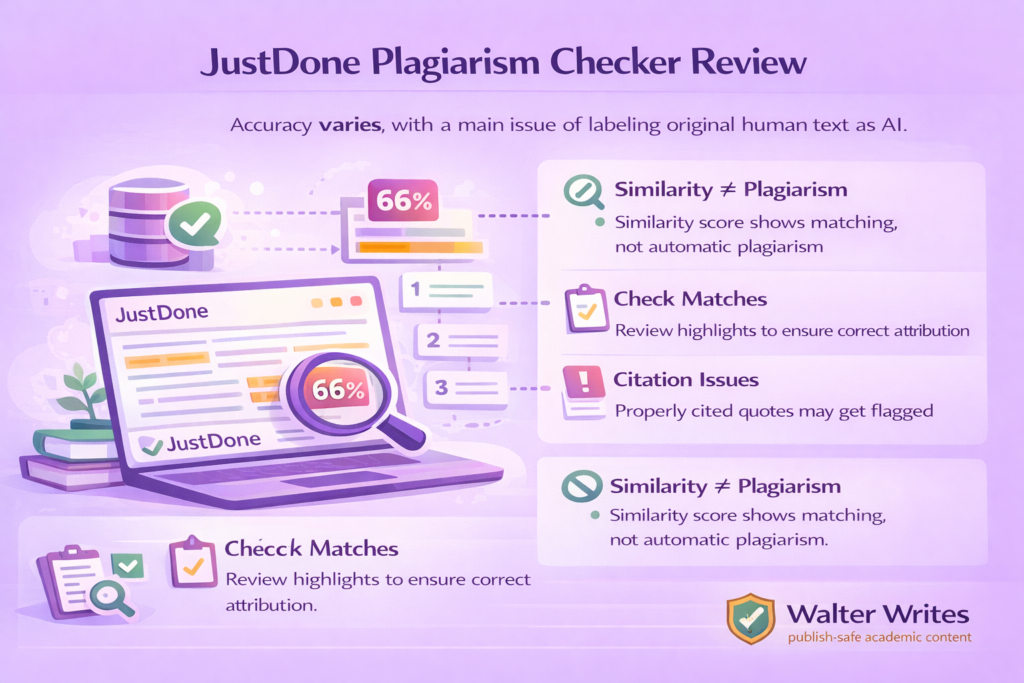
JustDone’s AI plagiarism tool is touted as a comprehensive checker for students to detect paraphrased content. It’s useful for quick checks but not as thorough as industry-leading tools like Turnitin or Walter Writes. Most students use plagiarism checkers as a detector. However, they should be used as a similarity checker tool. The goal of using the tool is to help you transition from unintentional copying to proper source attribution.
How the Plagiarism Checker Works
The plagiarism compares your text against published sources and the database of existing work. The output then shows you how similar your content is to others if there are any matches. The matches are often highlighted and linked, so that you can compare both. Sometimes, these tools flag common phrases and even properly cited sources. That shows they are not 100% accurate. When properly cited quotes come up, they increase similarity but not necessarily plagiarism.
Similarity Is Not Plagiarism
Plagiarism tools show you how much your text matches existing sources. But just because there is similarity doesn’t mean it is plagiarism. Some students may think that % scores determine pass/fail for their work. That’s not true. The scores are just to tell you the percentage of content that may be similar to your text. And you don’t have to worry if you properly attribute sources in your work.
Limitation
The accuracy of the plagiarism checker depends on the database size and the matching algorithm. That’s why you can check the same content across different platforms and get conflicting results.
How to Interpret
Review each highlighted match and check if it is cited. If not, add a source attribution. And if it’s intentional, then you can ignore. This way, you’ll be using the tool as a revision tool, not for final approval. For further information, check this resource from Walter Writes for an in-depth guide on how a plagiarism checker works.
Pricing Plans, Free vs Paid
JustDone AI offers a free option, which is extremely limited. You don’t need to register to access the option, but it is restricted to only 3 checks of 250 words each. To enjoy other features on the website, you have to subscribe to a trial.
The trial plan comes with a $2 charge, which runs for 7 days. If you don’t cancel, you’ll be charged $39.99, which is a recurring monthly subscription. There is another plan, which is unlimited, priced between $19.99 to $29.99 per month. This plan gives you full access to all SEO, writing, and AI tools.
When you’re charged, you’ll be offered credits, which you can use for both AI detection and humanization. The bad thing is that the credits will expire if you don’t use it at the intended period. Some users also complained about the subscription being tricky, as they are fraught with hidden fees.
JustDone Reviews from Real Users
| What Users Like | What Users Didn’t Like |
H2: JustDone vs alternatives (including Walter Writes) for students in 2026
| Critera | JustDone AI | GPTZero | Undetectable AI | Walter Writes |
| Primary Strength | All-in-one toolkit (detector, humanizer, plagiarism checker) | Widely used academic detector | Strong rewriting/humanization | Editor-first workflow (write, refine, check) |
| Detector Reliability | Mixed; inconsistent on edited or hybrid text | Moderate; struggles with edited text | Not a detector-focused tool | Focus on interpreting detection signals |
| False Positive Risks | Present, especially with formal writing | Can misclassify human text | Not applicable | Reduced through structured workflows |
| Humanizer Quality | Mixed; may help or reduce clarity | Not a core feature | Strong rewriting but can affect the meaning | Focus on clarity and natural tone |
| Meaning Preservation | Inconsistent depending on the output | Not applicable | Risk of meaning drift | Strong focus on preserving intent |
| Workflow Simplicity | Convenient but requires validation | Simple but limited | Requires switching tools | Integrated workflow, less tool-hopping |
| Plagiarism Checking | Included | Not included | Not included | Not a core feature |
| Best Use Case | Quick draft workflow in one place | Basic academic detection | Rewriting AI-generated drafts | Safer academic writing workflow |
| Not Idea For | High-stakes submissions without validation | Edited or hybrid text reliability | Final academic submissions | Users wanting only a quick one-step tool |
Final Recommendation for Students
Yes, if: You ned an all-in-one tool for content generation and simple rephrasing. It is affordable and helps you check your own work.
No, if: You need to use it in an academic setting where integrity and high accuracy are needed. It is best suited for marketers, rather than high-stakes academic work.
While it offers convenient options for detection and humanization, the accuracy is unstable, especially in academic contexts. It also faces accusations of false positives. If you need a reliable AI detection and humanization tool, you may want to check out Walter Writes AI.
It’s important to note that there is no single detector that is 100% accurate. The result or output should always be used as a guide, not the final verdict. Sometimes, your content may be flagged by AI when it truly is not. If you ever experience that, then this resource may help you know what to do if you’re flagged for AI.
Frequently Asked Questions About JustDone Review
Is JustDone AI Legit?
Yes, it’s a legit product with a substantial user base. However, there are mixed review, which shows it is usable but with limitations.
How Accurate Is JustDone’s AI Detector?
The accuracy of the tool varies by the type of content. It is reliable for quick checks but prone to false positives and inconsistency when checking complex writing.
Does JustDone Bypass Turnitin or GPTZero?
There is no verifiable evidence that it can bypass those tools. Moreover, passing one tool doesn’t mean it will pass institutional systems. Neither does that make it credible.
Can JustDone Give False Positives on Human-written Content?
Yes, and that is very common with structured, polished content. This is because the tool uses pattern-based detection.
How Does JustDone’s Pricing Work, and What Happens If You Forget to Cancel?
This is one of the downsides of the tool. If you forget to cancel before the cancellation window, you’ll be charged. Refund is also not guaranteed.
What Are the Main Differences Between Free and Paid Plans?
The free plan gives you limited access with a cap on word count and features, while the paid plan gives you full access.
How Does JustDone Compare to Other AI Humanizers Like Undetectable AI or Walter Writes?
JustDone is a broad toolset which include plagiarism checkers. Alternatives like Walter Writes are more specialized, focusing on avoiding detection in academic settings.
Does JustDone Store or Use Your Text in Its Models?
Always verify before you start using. Read the TOS and Privacy Policy to see how they handle user data for training their tool.
Is JustDone’s Plagiarism Checker Reliable for Academic Submissions?
JustDone’s plagiarism checker is generally considered unreliable for academic submissions. The detection accuracy may not be up to academic standards.
What Do Users Say About JustDone’s Customer Service and Refund Process?
There is mixed feedback, with some negative experiences trailing positive experiences.
Want a humanizer that actually works? Walter Writes’ free AI humanizer rewrites AI content with a 98% human-detection score and a free trial.