




Ever hit “check plagiarism” and wondered what’s really happening behind the scenes? In just a few seconds, tools like Turnitin, Copyleaks , or Grammarly can scan your essay or article and spit out a similarity report that feels almost magical. But it isn’t magic, it’s algorithms, databases, and a lot of clever computing.
Quick Answer:
A plagiarism checker works by breaking your text into smaller units, comparing those units against massive databases of academic papers, websites, and publications, and flagging similarities. Modern checkers go even further, using AI and semantic analysis to catch paraphrased or reworded ideas that older tools might miss.
So, whether you’re a student double‑checking your essay or a writer making sure your blog is original, understanding how plagiarism checkers work can help you use them more effectively (and avoid false alarms). For a deeper dive into plagiarism detection accuracy, check out our guide on how SafeAssign detects AI and our comparison of the best AI detector tools.
What Is a Plagiarism Checker?
At its core, a plagiarism checker is a text‑matching tool. You paste in or upload your content, and the software runs it against an enormous database of existing material. That database might include:
- Academic journals and research articles (often sourced from publishers and databases like Crossref)
- Student papers (submitted to other universities or institutions, especially when using tools like Turnitin)
- Published books and e‑books
- Websites, blogs, and online articles
- News archives and even subscription‑only databases
The checker doesn’t just say “copied” or “not copied”. Instead, it generates a similarity report, showing you which sentences or phrases overlap with known sources, often with a percentage that indicates how much of your text matches existing material.
Think of it as a giant librarian who has read millions of books and articles. You hand them your paper, and within seconds, they can tell you which parts remind them of passages they’ve seen before.
If you want to see how plagiarism reports differ across tools, we tested them in our guide: Best AI Detector Tools and Does Turnitin Detect AI?.
How Does a Plagiarism Checker Work? Step‑By‑Step
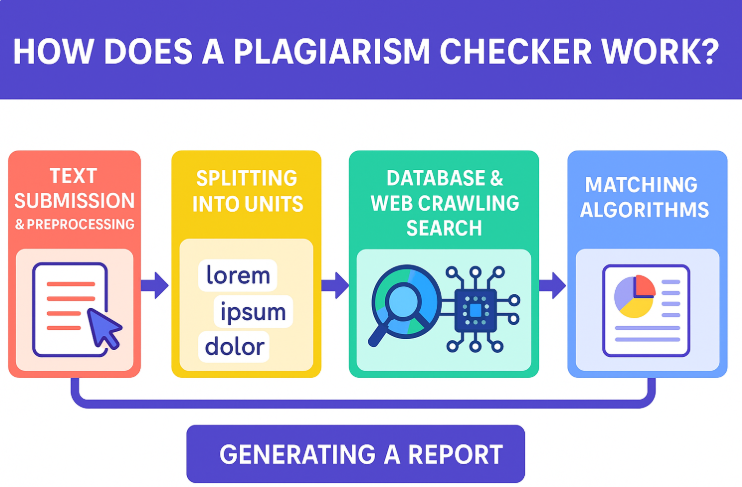
Now let’s break down the process in a way that’s easier to follow. Most plagiarism checkers work through a 5‑step pipeline:
- Text Submission & Preprocessing
- You paste your content into the checker.
- The software cleans it up (removes formatting, converts to plain text).
- Splitting Into Units (n‑grams / tokens)
- The checker doesn’t compare your essay word‑for‑word.
- Instead, it breaks the text into chunks (often sequences of 3-10 words, called n‑grams).
- Database & Web Crawling Search
- These chunks are compared against vast databases of academic papers, online sources, and proprietary archives.
- Some tools also crawl the web in real time for matches.
- Matching Algorithms
- Tools use different approaches like:
- String Matching: Direct word‑for‑word comparison.
- Fingerprinting: Hashing chunks of text to create unique “fingerprints.”
- Semantic Similarity: Using Natural Language Processing (NLP) to catch paraphrases.
- Tools use different approaches like:
- Generating a Report
- The final step is creating a similarity index report, highlighting which sections overlap with which sources.
- Advanced tools even show whether the text was paraphrased, quoted without citation, or potentially AI‑generated.
Example: If you write “The quick brown fox jumps over the lazy dog,” the tool might flag it as overlapping with the same phrase in a children’s story, but it could also recognize a paraphrase like “A swift auburn fox leapt across a sleepy canine.”
Plagiarism Detection Methods Explained
Different plagiarism checkers rely on different techniques. Let’s unpack the main ones so you can see how they actually “spot” copied or reworded content.
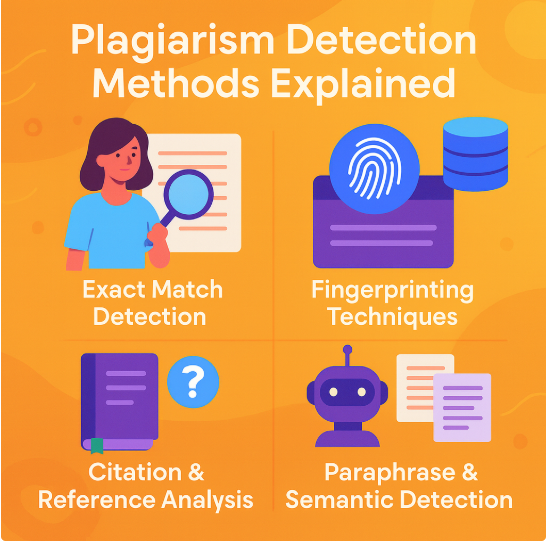
Exact Match Detection
This is the simplest method: a string‑matching algorithm. It looks for direct overlaps in wording, usually by scanning small text chunks (n‑grams).
Example: If your sentence says “Climate change is a pressing global issue,” and another source has the exact same phrase, the checker will highlight it instantly.
Pro Tip: Exact matching is great for copy‑paste detection, but it struggles with paraphrasing.
Fingerprinting Techniques
Fingerprinting turns your text into a unique digital signature. Each sentence or phrase is converted into a hashed “fingerprint,” which is then compared across databases.
Imagine a fingerprint scanner at the airport even if you change your hairstyle or clothes, your fingerprints are still the same. Similarly, even if someone reorders a few words, the underlying text structure can still match.
Citation & Reference Analysis
Some tools don’t just check what you wrote, they check how you cited it. Did you include quotation marks? Is the citation formatted properly? Does the source exist?
This matters especially in academic writing, where a missing citation can turn an honest mistake into an accusation of plagiarism.
Paraphrase & Semantic Detection
This is where things get more advanced. Modern tools use Natural Language Processing (NLP) and semantic similarity models to catch reworded ideas.
Example:
- Original: “Artificial intelligence is changing the way we work.”
- Paraphrased: “AI is transforming workplace practices.”
A simple string‑matcher might miss this. But an AI‑driven checker would still flag it as highly similar.
Engagement Box: Myth vs Fact
- Myth: Paraphrasing always avoids plagiarism checkers.
- Fact: Advanced tools can detect paraphrasing using AI and semantic models.
Machine Learning & AI in Plagiarism Detection
Plagiarism detection has evolved from word‑matching to AI‑driven intelligence. Here’s how:
- Traditional Approach: Looks for exact or near‑exact matches.
- AI Approach: Uses machine learning algorithms and neural networks to detect meaning, not just words.
Comparison Table
| Feature | Traditional Tools (String / Fingerprint) | AI‑Driven Tools (ML / NLP) |
|---|---|---|
| Exact copy detection | ✅ Strong | ✅ Strong |
| Paraphrase detection | ❌ Weak | ✅ Strong |
| Database size dependency | ✅ High | Medium (context aware) |
| Ability to detect AI writing | ❌ Limited | ✅ Emerging feature |
| Speed & efficiency | ✅ Very fast | ⚡ Improving with GPUs |
Why this matters: If you’re only using a basic checker, paraphrasing tools might slip past it. AI‑based systems, however, can flag “hidden” similarities.
Challenges & Limitations of Plagiarism Checkers
Even the smartest tools aren’t perfect. Here are the main challenges:
❓ Can they detect paraphrasing accurately?
Not always. While AI makes progress, subtle rewrites or deeply restructured sentences can go unnoticed.
❓ Do they include every possible source?
No. Most tools have proprietary databases. For instance, Turnitin has access to millions of student papers that others don’t. Free tools, on the other hand, may only search the open web.
❓ Can plagiarism checkers catch AI‑generated text?
Some are trying, but it’s far from perfect. AI‑writing detectors are still developing and often misclassify human writing as AI‑generated.
Engagement Element: “Myth vs Fact” Mini‑Box
- Myth: If a checker says 0% plagiarism, your work is completely original.
- Fact: It only means no overlap was found in that tool’s database. Another tool could show a different result.
Real‑World Examples of Plagiarism Detection
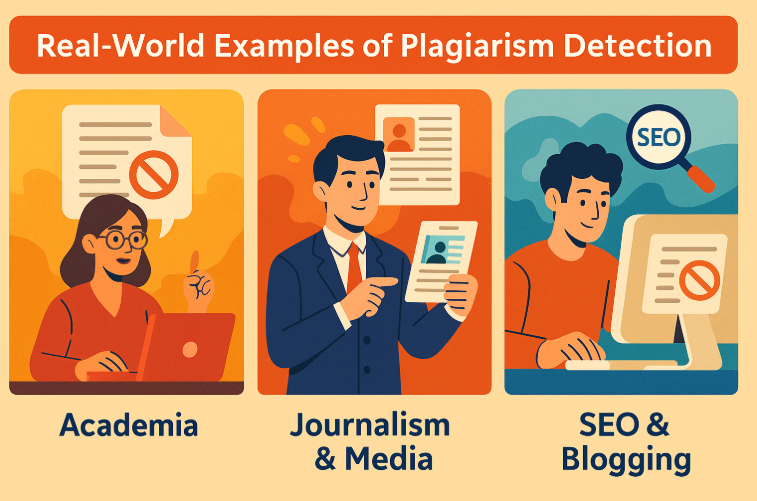
Plagiarism checkers aren’t just academic tools, they’re used across industries. Here’s how they show up in real life:
Academia
Students and universities rely on tools like Turnitin to ensure assignments are original. A professor can instantly see if parts of a paper were copy‑pasted from published research or even another student’s essay. Curious how accurate these systems are? We break it down in our guide: Can Teachers Detect ChatGPT?.
Journalism & Media
Editors use plagiarism checkers to verify that articles are authentic. It’s not only about catching outright copying sometimes a writer unknowingly repeats phrasing from a press release or another journalist’s work.
SEO & Blogging
Content duplication can hurt search rankings. Digital marketers and bloggers often run posts through plagiarism tools to make sure their content won’t get flagged by Google for duplication. If you’re writing for the web, our guide on The Best AI Humanizer for Turnitin and How to Make Your Essay Undetectable are must‑reads.
Quick Poll: “Do you think paraphrasing tools can fool plagiarism checkers? Yes / No”
And here’s where tools like Walter Writes come in. While the best plagiarism checkers catch duplication, Walter helps you humanize AI‑generated drafts so they don’t sound robotic and ensures they pass both plagiarism and AI detectors.
Best Practices for Writers & Students
Using plagiarism checkers the right way can actually make you a stronger writer. Here are a few tips:
✅ Check early, not at the last minute. Don’t wait until right before a deadline. Run drafts through a checker so you can fix overlaps gradually.
✅ Learn the difference between quoting and paraphrasing. Properly citing a source with quotation marks is fine. Copying without credit isn’t.
✅ Don’t rely on free tools alone. They’re helpful but often limited in scope. Paid or institution‑backed tools have much bigger databases.
✅ Use AI carefully. Many students and professionals use ChatGPT or other AI tools to speed up their writing. That’s fine but unedited AI text often gets flagged by detectors or feels stiff. This is where Walter Writes shines: it makes AI‑assisted writing sound natural, unique, and plagiarism‑safe.
Example: You could write a draft with ChatGPT, then run it through Walter to “humanize” it before submitting. That way, you’re safeguarding against plagiarism and AI detection false positives.
Relevant: What is Mosaic Plagiarism?
FAQs About Plagiarism Checkers
❓ Do plagiarism checkers detect AI content?
Some do, but not reliably. That’s why AI humanizers like Walter are becoming essential, they make sure AI‑assisted writing doesn’t get flagged unfairly.
❓ How accurate are plagiarism reports?
Accuracy varies. A 5% similarity score could just be common phrases, while 40% likely signals copied or improperly paraphrased text. Always review the report manually.
❓ How accurate are plagiarism reports?
Accuracy varies. A 5% similarity score could just be common phrases, while 40% likely signals copied or improperly paraphrased text. Always review the report manually.
❓ What’s the difference between free and paid tools?
Free tools: Good for quick checks, but databases are small. For a detailed look at one of the most widely used free options, this Quetext plagiarism checker review covers its DeepSearch technology, accuracy across different plagiarism scenarios, and how its free and paid plans compare.
If you want a detailed breakdown of how a specific web-based checker handles Quick Search and Deep Search accuracy, a Plagium review walks through both modes and shows where they hold up and where they fall short.
Paid tools (like Turnitin, Copyleaks): Access massive academic and private databases, making them much more reliable.
❓ Can plagiarism checkers tell if I used QuillBot or a paraphrasing tool?
Yes, advanced semantic detection can often spot paraphrased sentences. Relying only on paraphrasing tools is risky. Instead, aim for authentic rewording and polishing with a humanizer like Walter Writes.
Make Your Writing Truly Yours with Walter Writes
Plagiarism checkers may seem like mysterious black boxes, but now you know what’s really going on inside:
- They break your text into chunks and compare it against massive databases.
- Techniques like fingerprinting and string matching catch copy‑pastes.
- AI and machine learning models push detection further, spotting paraphrases and even attempts to disguise copied work.
But no checker is perfect: databases vary, paraphrasing can sometimes slip through, and AI‑generated text adds a whole new layer of complexity.
The takeaway: plagiarism checkers are powerful safety nets, but they work best when combined with strong writing habits and a little common sense.
That’s also why more writers, students, and professionals are turning to tools like Walter Writes. It doesn’t just “beat the detector” it makes your content sound human, natural, and original, so plagiarism checkers and AI detectors won’t raise false flags. If you’re worried about Turnitin or GPTZero, check out our reviews of Turnitin’s AI Detector and GPTZero to see how they really work.
Here’s what to remember: Use plagiarism checkers as a guide, not a crutch. And if you’re using AI to draft or brainstorm, run it through Walter Writes before submitting. You’ll not only protect yourself from accidental plagiarism, but you’ll also deliver writing that feels authentically yours.
Ready to give it a try?
Check out Walter Writes and see how it can make your AI‑assisted writing sound like you and not a machine.