



AI writing tools are now widely used by marketers, students, and businesses. AI detection systems have become more advanced. The real challenge today is not using AI but making AI-written content sound natural without raising detection risks.
Tools like Undetectable AI and StealthWriter come into focus. Most readers are not searching for perfect or “magic” results. Users are only looking for a comparison of which tool is best to use in everyday applications and what risks come with using AI humanizers.
This article compares Undetectable AI vs Stealthwriter, describes how AI detection works in 2026, and reviews where each tool excels or fails. We will also present some safer alternatives to these tools for our users’ applications.
Comparing Undetectable AI vs StealthWriter at a Glance
| Aspect | Undetectable AI | StealthWriter |
| Core goal | Avoid AI detection | Improve tone and flow |
| Detection evasion | Aggressive rewriting to pass AI detectors | Not focused on detector evasion |
| Readability | Often uneven | Generally smooth |
| Meaning accuracy | Can shift | Usually preserved |
| Long-form content | Less reliable | More stable |
| Risk level | High risk | Still risky, but lower |
| Ideal use | Detection testing | Content refinement |
What Does “Humanizing AI” Mean in 2026?
Humanizing AI-generated content will improve readability and tone to make it feel more like a human-created document. It does not mean that the AI content is undetectable.
Different tools take different approaches. Rewrite tools simply change the wording or structure of the content, evasion tools try to reduce the number of detector signals from your content (often at the cost of quality), and edit tools focus on making the content clear and conveying your intended message.
An AI detector will not evaluate the intent but the patterns of language in your content. Even well-written content can be flagged if those patterns remain, which is why humanizing should be about quality and not beating detectors.
How AI Detection Tools Actually Work
AI detection technologies do not consider intentions or morality. They examine patterns in terms of predictability, sentence structure, and statistical consistency of the language. The characteristics of low perplexity and equal sentence rhythm are typical signs of text written by a machine.
Variation in tone, pacing, and structure are natural elements in human writing, typically called burstiness. Although surface wording can be altered by paraphrasing, linguistic patterns on a deeper scale in longer texts are rarely rearranged.
There is a positive correlation between length and accuracy of detection. As articles get longer, there will be more data to use in your research, making it easier to identify the trends (recurring patterns), which can then be used to either confirm or deny whether you’ve detected the article as being created by an artificial intelligence system. Due to this, it is very easy for short form content to pass as well as fail, and long form content to fail.
These types of signal-based tests (pattern-based) tend to grow more accurate with article length, which is one of many reasons that makes it even more difficult for someone to create long form artificially generated content.
Undetectable AI - Strengths, Weaknesses, and Best Use Cases
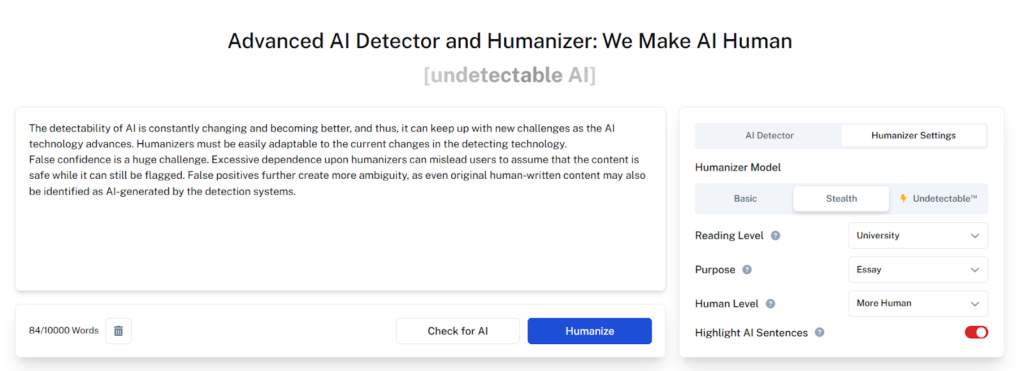
How Undetectable AI Works
Undetectable AI is built to rewrite AI-generated content with detection systems in mind. It paraphrases by changing sentence structure, words, and patterns of phraseology to minimize predictability cues that AI detectors frequently pick up.
The method may be useful in short-form content, where less text creates fewer data points to be detected by the systems. It is commonly employed as a testing layer to learn how various detectors react to rewritten AI content.
This approach comes with significant risks. It can result in diffusion of meaning; poor language use; and unreliable performance on longer text. These weaknesses become more pronounced as content length grows, both for human readers and detection tools.
Undetectable AI should not be used in academic work or other high-stakes professional work. It should not be used for final publication but rather for controlled testing.
Strengths of Undetectable AI
- Uses detection-oriented rewriting methods that change sentence structure, vocabulary, and word patterns to minimize predictability cues
- May work on relatively short content where there is less text to analyze
- Beneficial for determining how various AI detectors react to rewritten content
- Can temporarily reduce AI detection scores in low-risk experimentation
Weaknesses and Risks
- Prone to meaning drift
- Awkward phrasing, unnatural breaks, or tone may be introduced
- Weak long-form performance
- Increased academic and professional risk due to deliberate evasion
- May negatively affect reader trust if overused
Best Use Cases for Undetectable AI
- Testing how AI detection tools respond to rewritten content
- Minor edits for low-risk, short-form content
- Understanding linguistic attributes used by detection software
- Comparing detection score differences
- Not suitable for academic or high-stakes professional work
StealthWriter: Strengths, Weaknesses, and When to Use It
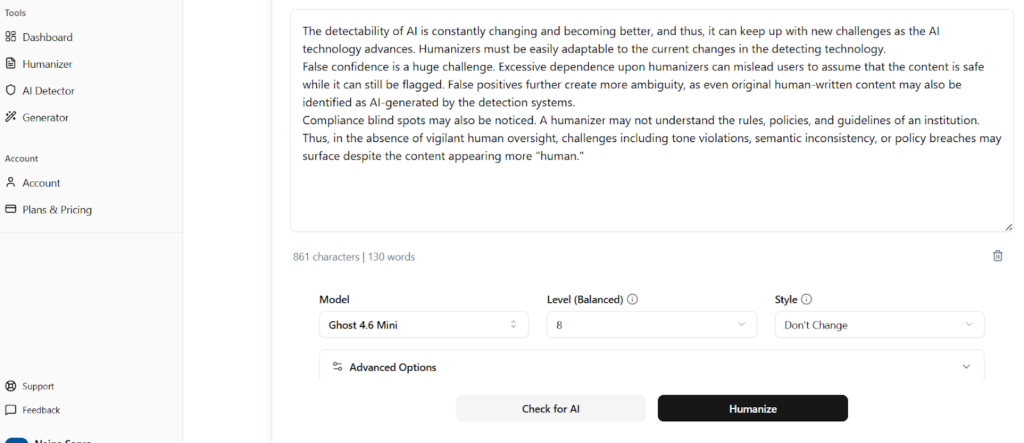
How StealthWriter Works
StealthWriter does not perceive AI humanization in the same way that other detection-based solutions do. Rather than rewriting the text very heavily, StealthWriter seeks to adjust the way the reader views the content through restructuring of the sentences, tone adjustment, and normalizing the natural flow so that the content is much easier to understand.
The method allows the user to maintain the original intent of the material while improving the rhythmic quality of the writing. The output from StealthWriter will resemble human edited writing versus highly rewritten scripts.
Because StealthWriter is not advanced enough to fool strict AI detectors, StealthWriter is not suitable for high risk areas like academic or compliance-based content.
StealthWriter could be viewed as a “finishing layer” tool and would work well with human editors who prioritize readability and content quality over detection scores.
Strengths of StealthWriter
- Emphasizes smooth, readable content through refined sentence structure
- Preserves original message and intent
- Enhances clarity, tone, and readability
- Produces output close to human-edited writing
Weaknesses and Limitations
- Content may still be flagged by AI detectors such as GPTZero or Turnitin
- Not recommended for academic submissions
- Cannot fix poorly written original content
- Manual revision may still be required
Best Use Cases
- Editing AI-generated blog posts
- Improving marketing and SEO content
- Enhancing emails, landing pages, and product descriptions
Head-to-Head Comparison: Undetectable AI vs StealthWriter
Detecting Evasion: Depending on the length of content produced by the tool and type of AI detection utilized; the detection evasive capabilities of Undetectable AI would be expected to temporarily lower your detection rate. StealthWriter is designed to avoid detection through producing readable, natural sounding content.
Readability: The design of StealthWriter produces readable and natural-sounding content; whereas the rewriting capabilities of Undetectable AI are often aggressive and significantly reduce readability.
Preserving Original Content Meaning: StealthWriter preserves the content meaning much better than Undetectable AI. There is a higher likelihood of making errors in the meaning of long-form content when using Undetectable AI.
Risk Level: The use of Undetectable AI is at a much greater risk due to possible academic and SEO risks than StealthWriter which has a lower risk profile since it still requires review.
Real-Life Test (What Really Happens)
We have also tested both of the two tools with respect to three types of content: A 500-word Blog Post; An Academic-Style Paragraph; Marketing Landing Page Copy.
500-word Blog Post:
The undetectable version of AI can reduce detection signals, but will affect the natural flow & tone of writing. StealthWriter did preserve the readability & meaning of the content; and in most cases, it did not impact the detection scores.
Academic-Style Paragraph:
In this case, both of the tools were difficult to work with. However, while the undetectable version of AI was able to avoid detection by misrepresenting the intended meaning, it did not prevent the detection from occurring. StealthWriter did improve the clarity of the content, but the content was still detected as having been written by an AI.
Marketing Landing Page Content:
StealthWriter helped create a natural flow & tone for the content. While the stealth version of AI also created a similar appearance in creating a natural flow & tone for the content, it was very aggressive in rewriting the content to look disconnected from the original content.
When you are using AI to generate content, creating quality content is much more important than trying to get the highest possible detection score. Walter Writes has a quality first approach as it improves content to make it readable while preserving the authenticity, clarity and intent of the content.
Which Tool Is Better Suited to Your Case?
Students & Academic Writers:
The risk is extremely high. All educational institutions have policies that prohibit students from using technology to attempt to circumvent or “beat” an AI detection tool. Both Undetectable AI and StealthWriter are not recommended.
Bloggers & Content Writers:
StealthWriter allows you to preserve your original writing while making it easier to read, with improved tone, flow, and readability; however, there is no way to completely eliminate the need for manual review.
Marketing & SEO Teams:
Being able to pass through AI detection tools does not guarantee you will not be penalized in search engine rankings. Search engines like Google give priority to content that is useful and well-written. For this reason, many companies work with the top SEO agencies in the US to ensure their AI-assisted content is part of a larger, human-vetted strategy that prioritizes long-term authority and relevance.
What Happens If You Get Caught Using AI?
When you’re caught using an AI system, it may result in academic consequences for instance, failing a course assignment or being suspended from your studies.
For those who are involved in SEO, and/or publishing, submitting a number of pieces of low quality, or “flagged” content may ultimately damage your long term search engine ranking and credibility.
You may get a flag when you submit a piece of content through an AI system, but the flag does not tell you the entire story; unnatural writing is usually the first thing that a reader will notice and it will negatively affect your credibility and trust with them.
Shortcomings of AI Humanizers
- Detection technology continues to evolve. Humanizers must adapt, but no tool guarantees safety.
- False confidence is a major risk. Content may appear safe while still being flagged. False positives add further uncertainty.
- Humanizers do not understand institutional rules or policies, making human oversight essential.
How to Manually Humanize AI Content
- Use AI to create an initial draft. Review it manually to improve readability, organization, tone, and coherence.
- AI humanizers can assist, but they are not replacements for human judgment. Detection checks indicate potential risk, not guarantees.
Undetectable AI vs StealthWriter: Alternatives
Walter Writes AI Humanizer - Quality-first humanizing
It is designed to improve tone, clarity, and natural flow without aggressive rewriting or detection evasion. This makes it suitable for writers who want to focus on readability and meaning instead of attempting to manipulate detection systems.
Walter Writes AI Checker - Detection awareness
Walter Writes AI Checker focuses on pre-publish AI risk awareness. It helps writers evaluate potential AI-generated signals and make revisions before publishing, rather than relying on assumptions about safety.
Recommended workflow
AI draft → humanizer → human edit → detection check
This workflow emphasizes human oversight, content quality, and intent, while reducing reliance on any single tool. It supports sustainable content creation without prioritizing detection evasion over writing quality.
Before publishing AI-generated content, it is always recommended to understand the potential risk of AI instead of making assumptions. Walter Writes AI Writing Checker brings pre-publish awareness so that you may review your content with confidence and focus on quality.
Final Verdict
Undetectable AI focuses on detection evasion, which may help in experimentation but increases risks to meaning, readability, and trust.
StealthWriter focuses on clarity, tone, and flow. It does not guarantee invisibility but is generally safer for marketing and blogging.
Good writing, human control, and ethical use of AI tools remain the most sustainable approach.
FAQs
1. Is Undetectable AI really undetectable in 2026?
Undetectability cannot be guaranteed by any tool. AI detection systems continue to evolve, which means that methods that seem to work today may fail as detection models improve.
2. Undetectable AI vs StealthWriter: Which is better in for humanizing content?
Stealthwriter will be more of an improvement to your ability to write clearly and in a good tone for most daily applications because it is focused on being readable as opposed to hiding detectability cues.
3. Which is safer to use: Undetectable AI vs StealthWriter?
Stealthwriter would be safer, mainly because it is focused on readability. Neither tool is acceptable for use in academic or policy-restricted writing environments.
4. Can Undetectable AI or StealthWriter bypass GPTZero or Turnitin?
Results are often unpredictable; thus, there is no foolproof way that they can completely avoid GPTZero or Turnitin.
5. Is it safe to use AI humanizers for school or university work?
You can use AI humanizers for school/university work as refinement tools (e.g., improving flow, grammar) if your institution permits, but never to generate entire assignments.
6. Can AI humanizers hurt SEO rankings?
It depends on content quality. Search engines prioritize content that is helpful, relevant, and well written rather than content designed to evade detection systems.
7. What happens if your content is flagged as AI-generated?
After getting flagged, the content will be rejected or it will have to go through a review process to check for plagiarism
8. Are there any safer alternatives to Undetectable AI and StealthWriter?
Manual human editing is considered the safest, most effective alternative to AI humanizers.
9. What is the best AI humanizer that doesn’t ruin content quality?
The best tools focus on readability and meaning instead of aggressive rewriting meant to bypass detection.
10. How does Walter Writes compare to Undetectable AI and StealthWriter?
Walter Writes is generally considered better than Undetectable AI and StealthWriter by many users and testers for reliable AI detection bypassing, offering superior output quality, structural changes, and customization.
11. What is the safest way to humanize AI-written content?
Use AI for drafting, edit manually, apply a humanizer for tone refinement, and review before publishing.
12. Should you rely on AI detection scores before publishing?
Detection scores are useful information, but they cannot be definitive. Content quality, clarity, and intent should always take priority over numerical scores.
For our independent 2026 testing of Undetectable.ai against Turnitin, GPTZero, and Originality.ai, see our Undetectable.ai Review 2026.