





Key Takeaway: During our Crossplag AI Detector Review, it showed inconsistent detection accuracy and a noticeable false positive risk.
- Failed to detect multiple AI-generated samples in short and long formats
- Flagged some human-written content as 100% AI
- Scores varied significantly based on text length and structure
- Results frequently showed extreme 0% or 100% swings
- Better suited as an initial signal, not final proof
By now, you have likely heard a lot about false positive reports and reliability issues with Crossplag online, and are maybe wondering if Crossplag is trustworthy.
It can be difficult to assess if concerns expressed by other users reflect a legitimate risk that could apply to anyone or if they simply represent an isolated experience.
Instead of repeating what others say, in this Crossplag Review, we tested this tool on a variety of different content types and in multiple academic settings.
After reading this article, you will know exactly how Crossplag performs, when it can be a potential risk, alternative options for use, and whether or not it is safe for you to include in your academic submissions.
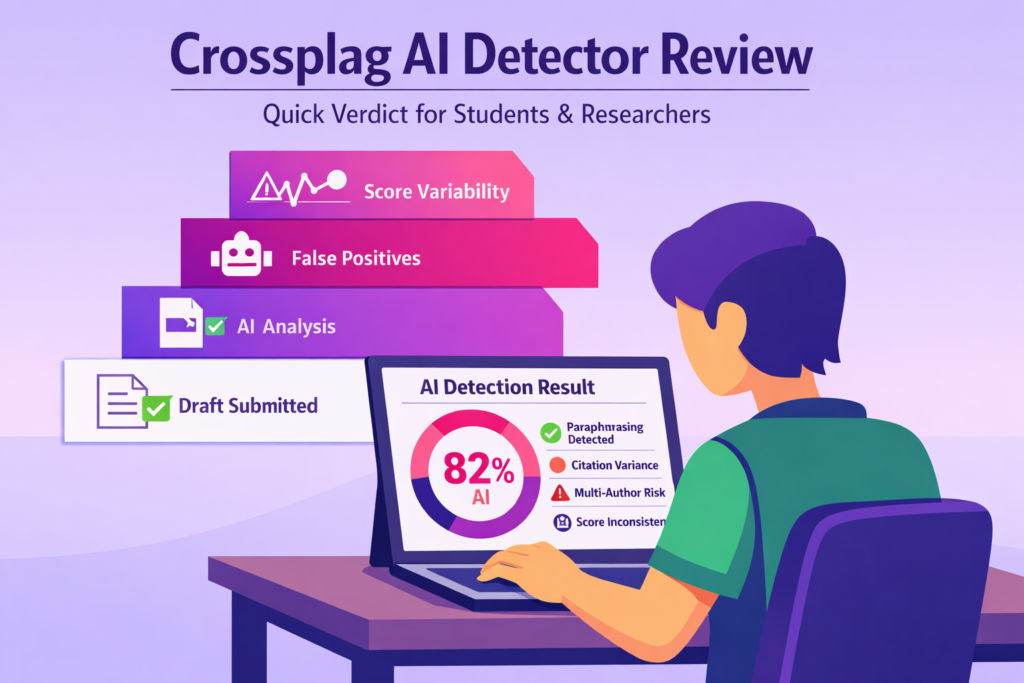
Crossplag AI Detector Review: Quick Verdict for Students & Researchers
- Use Crossplag for an initial assessment if you want to see how your draft might be classified.
- Do not use it as the ultimate proof of your work’s originality, especially for research papers or high-stakes submissions.
- Accuracy varies based on the amount of paraphrasing, citation, and multiple authors drafting together.
- False positive results can occur frequently, so no single score should be considered definitive.
- Results can sometimes be extreme, especially as the text length or structure changes
- The consistency of the scores given by this tool is doubtful
If you want real academic confidence before submitting, it is safer to verify your draft for a second opinion with a reliable AI detector and review any flagged sections inside a tool that allows you to check and refine your writing in one place.
What Crossplag AI Detector Actually Does
Crossplag offers two separate functions that are often confused. The first one is plagiarism checking against existing sources, and the second one is identifying if a piece of content is likely produced using an AI tool.
Crossplag also assigns an AI likelihood score to indicate how likely the writing is created using AI. The plagiarism detection feature of this tool supports multiple languages, while AI detection is limited to English only.
AI Detection vs Plagiarism Detection
- Plagiarism detection looks for copied or matching content
- AI detection analyzes writing patterns and probability signals
- A low plagiarism score does not confirm human authorship
- Positive plagiarism results do not guarantee AI accuracy
Because these two features evaluate different types of risk, they should be considered independently of one another.
The AI-Like Percentage Score
- The score represents the tool’s estimate of AI likelihood
- It is based on internal pattern analysis
- It does not prove authorship or writing intent
- It cannot confirm whether a draft was edited or partially rewritten
If you are using it, then you should consider the percentages provided as indicators of probabilities rather than absolute evidence.
How to Use Crossplag AI Detector
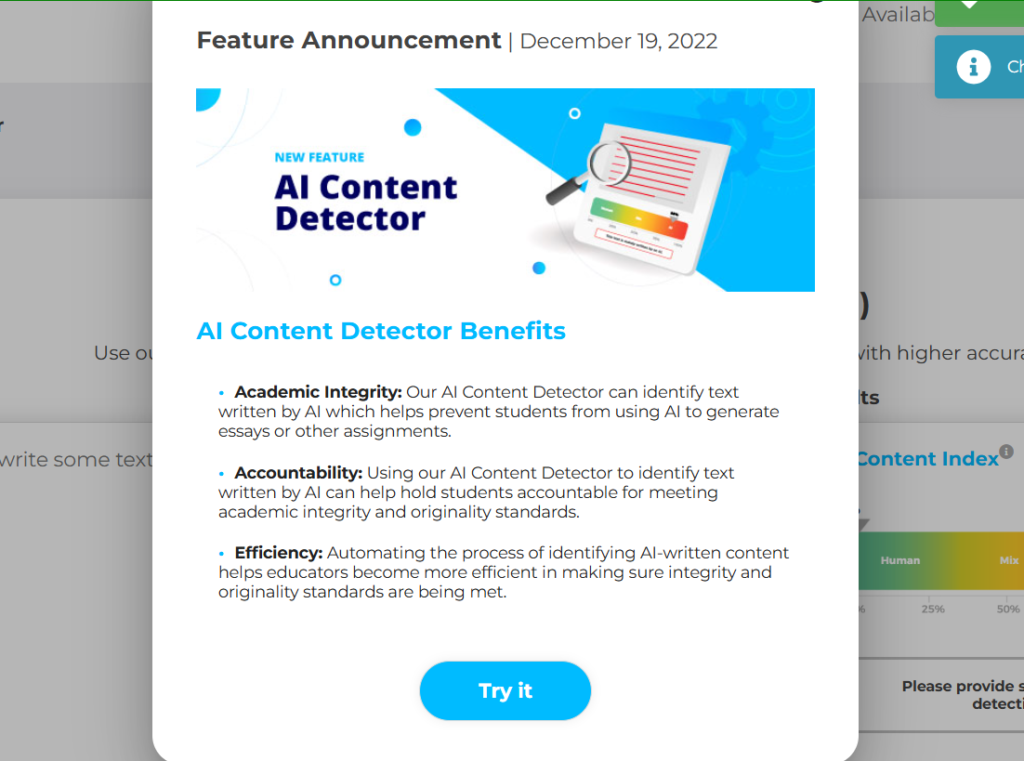
Step 1: Create an Account
First, create an account either by signing up or logging in so you can have access to the AI detector tool.
Step 2: Copy Your Content
Copy all of your content from your document or email and paste it into the AI Detector Input Box.
Step 3: Run The Scan
Paste all of your content into the input box and click on “scan” to let the tool analyze your content.
Step 4: Look at Results (AI Likelihood indicator)
The indicator will show you the probability of how much of your content was written using an AI program.
Step 5: Be Careful
Use the AI Detector’s scoring only as an indication that there may be some parts of your content generated with AI tools.
Never consider the detector to be definitive proof of your writing being AI-generated. Always verify the result using a second AI detector to be sure about your writing.
Crossplag Stress Test: How Accurate Is It Really?
Crossplag Results Table
| Use Case | AI-Generated | Real Human |
| Essays | 0% AI ❌ | 100% AI ❌ |
| Creative Writing | 0% AI ❌ | 0% AI ✅ |
| LinkedIn Post | 0% AI ❌ | 100% AI ❌ |
| Average | 0% AI | 66.7% AI |
How We Tested Crossplag
To evaluate Crossplag fairly, we followed a controlled testing process:
- Selected three use cases: academic essay, creative writing, and social media post
- Created two samples for each use case: one AI-generated and one human-written, which was sourced before LLMs were born.
- Set up a Crossplag account and documented usage limits
- Used the exact same samples across all tests without editing
- Captured screenshots of results and recorded percentage scores
This ensured consistency and allowed us to compare performance across different content types.
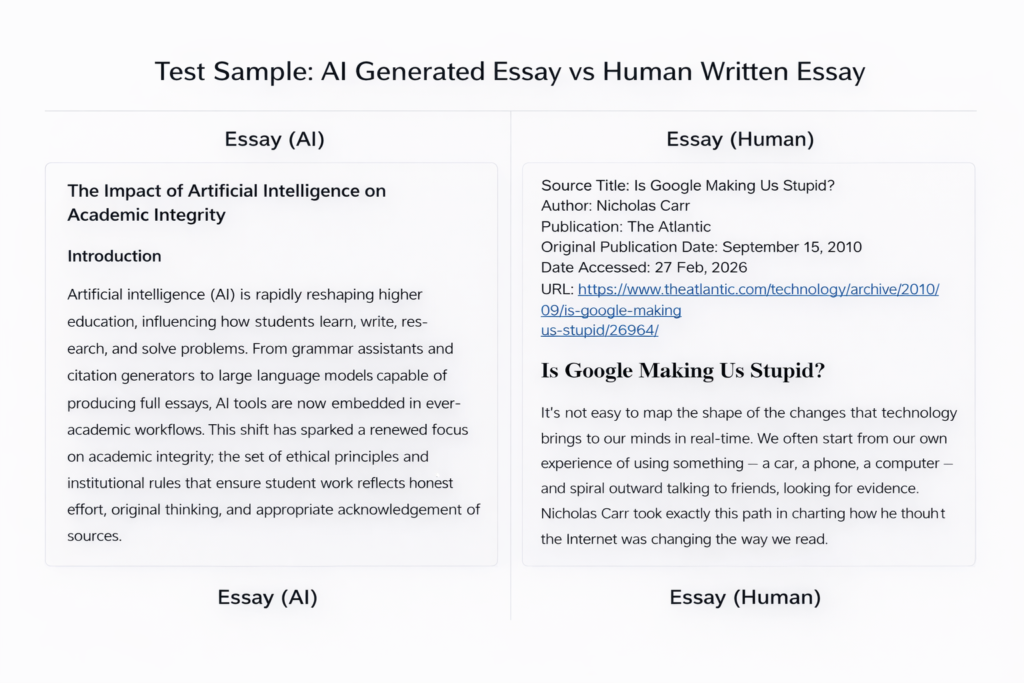
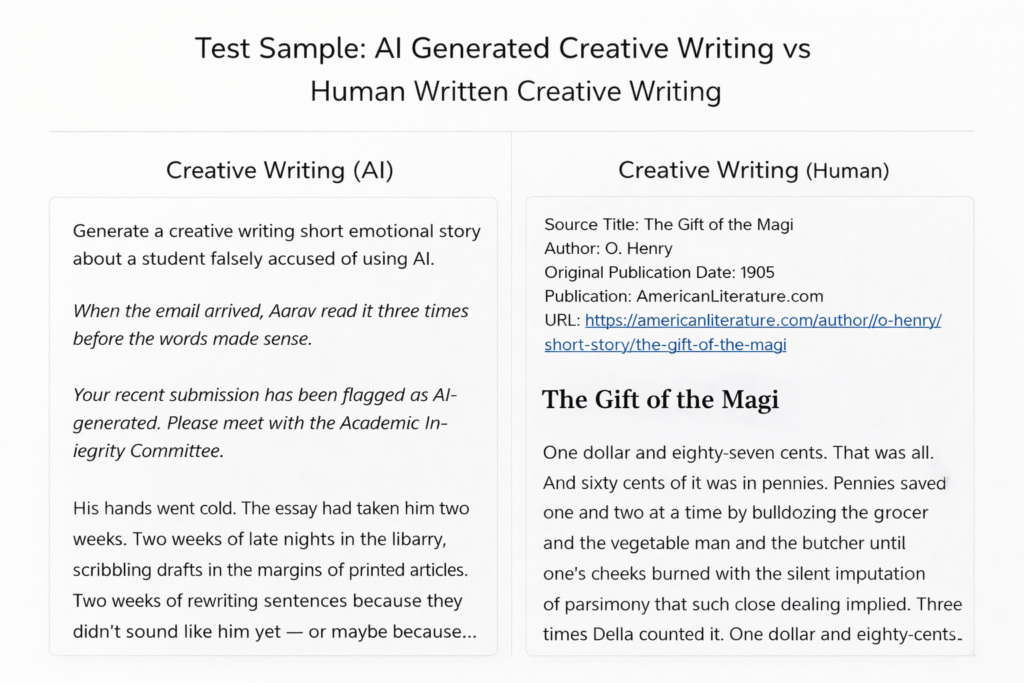
Test Samples Used for this Crossplag Review
Below are the 3 sets of test samples used for the entire testing process, a total of six:
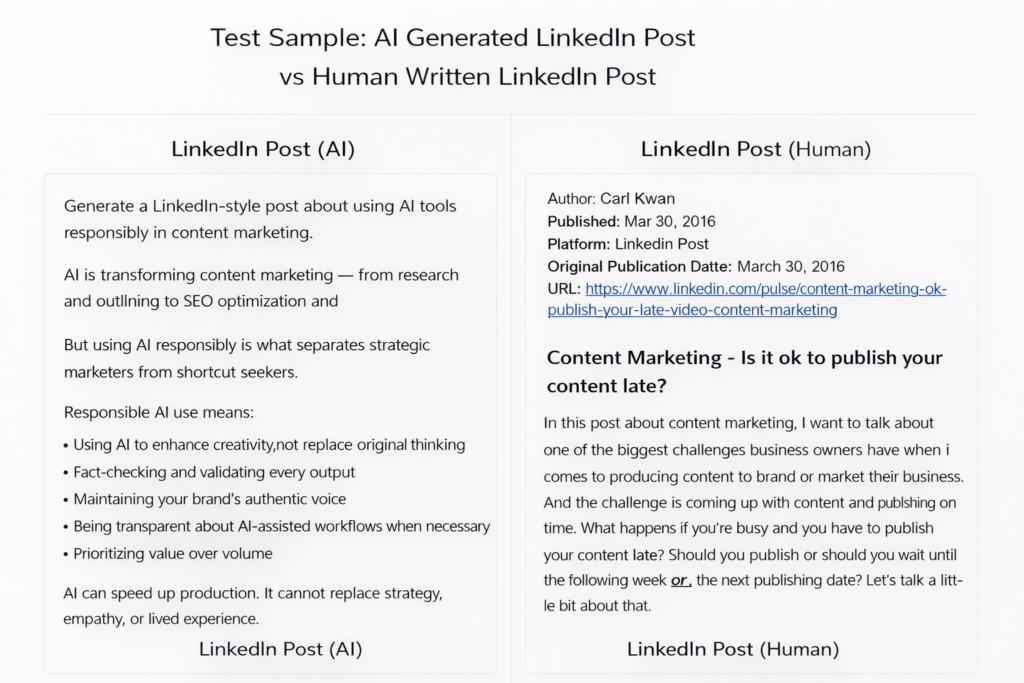
Links to these samples:
- Essay: AI (Artificial Intelligence) and Human (Is Google Making Us Stupid?)
- Creative Writing: AI (Student’s Nightmare) and Human (Gift of the Magi)
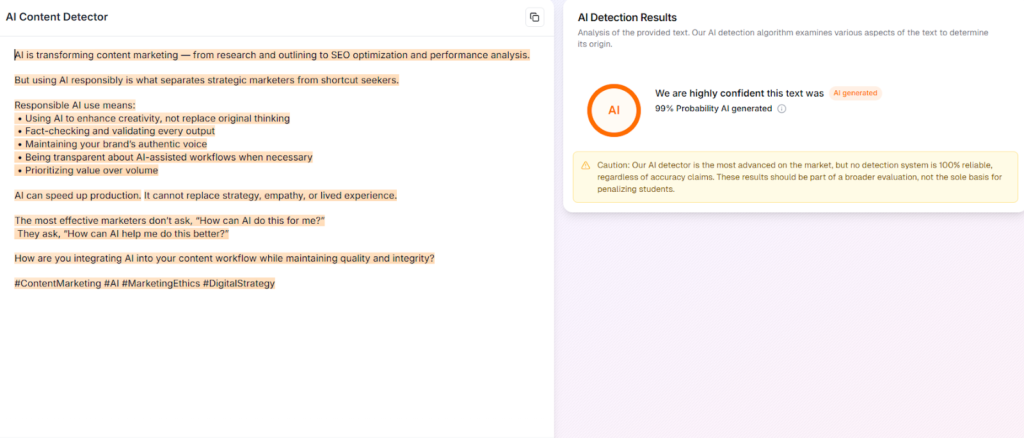
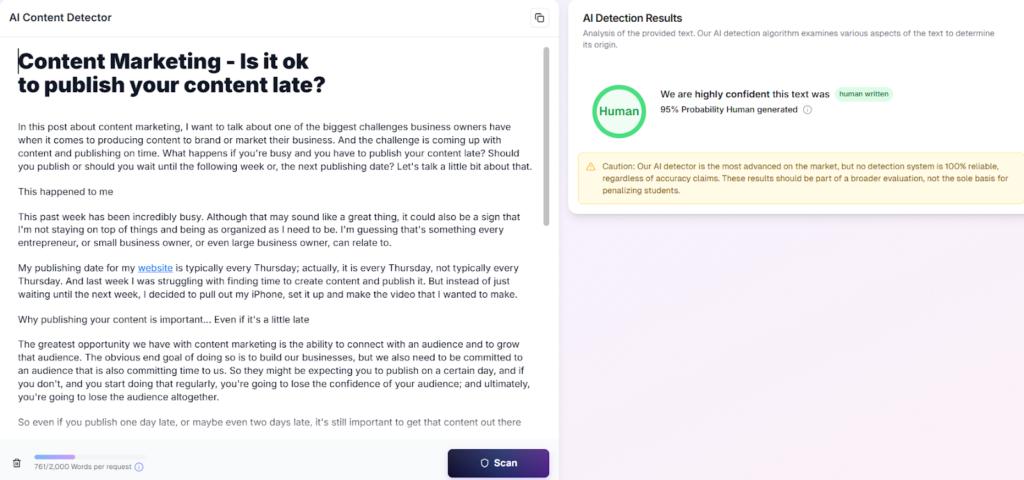
- LinkedIn Post: AI (Transforming content marketing) and Human (Is It OK to Publish Late)
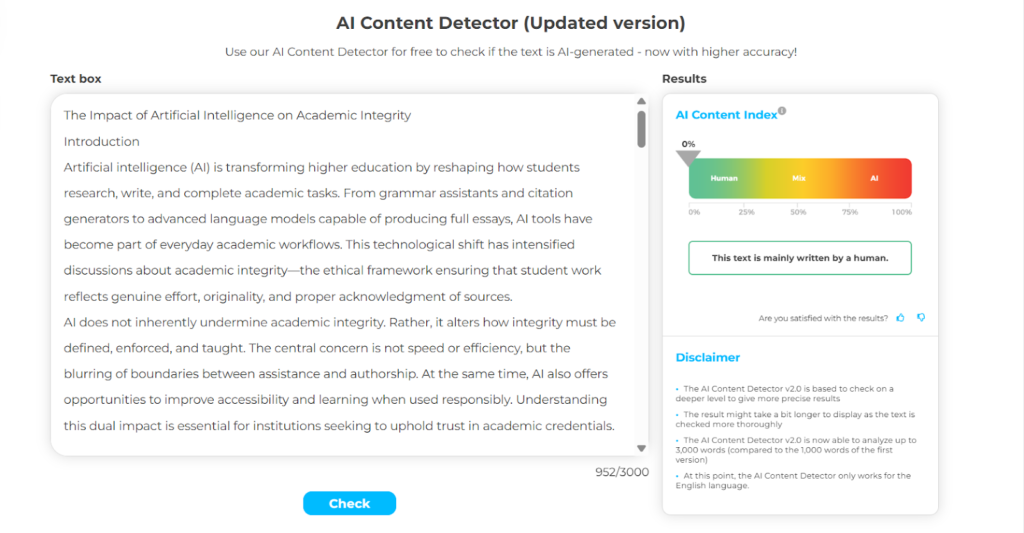
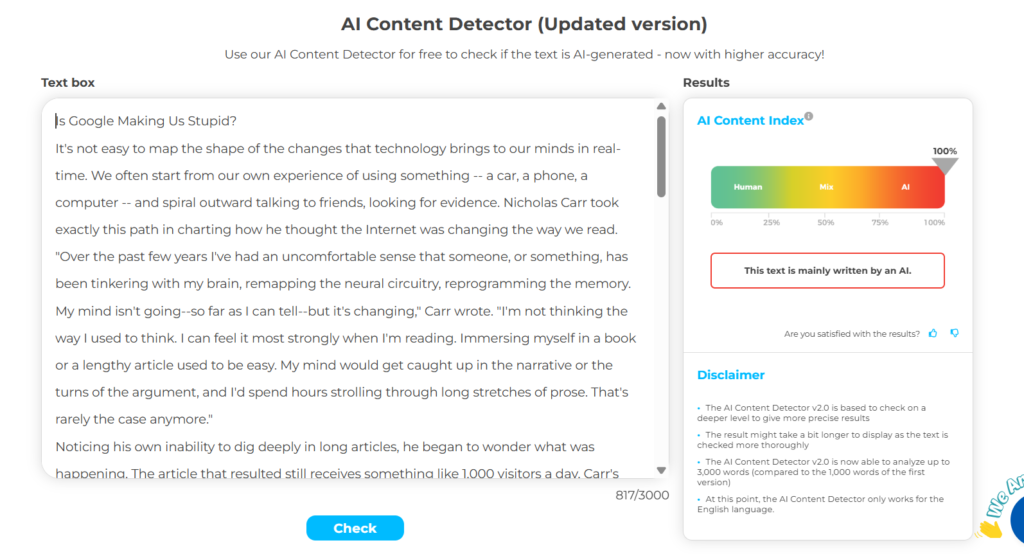
Crossplag Results: AI and Human Essay
First up are the essays. Click to enlarge.
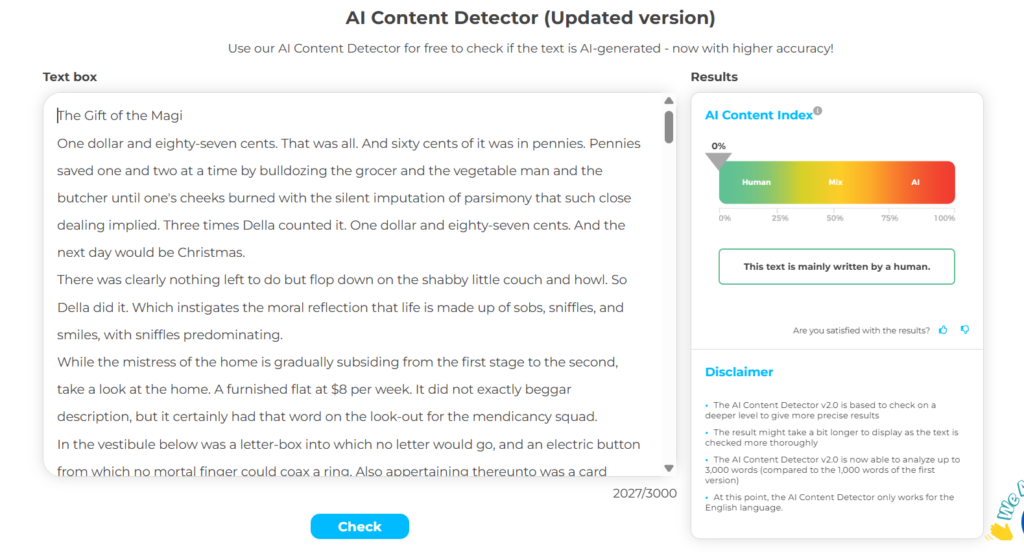
Crossplag Results: Creative Writing
Creative writing next. Click to enlarge.
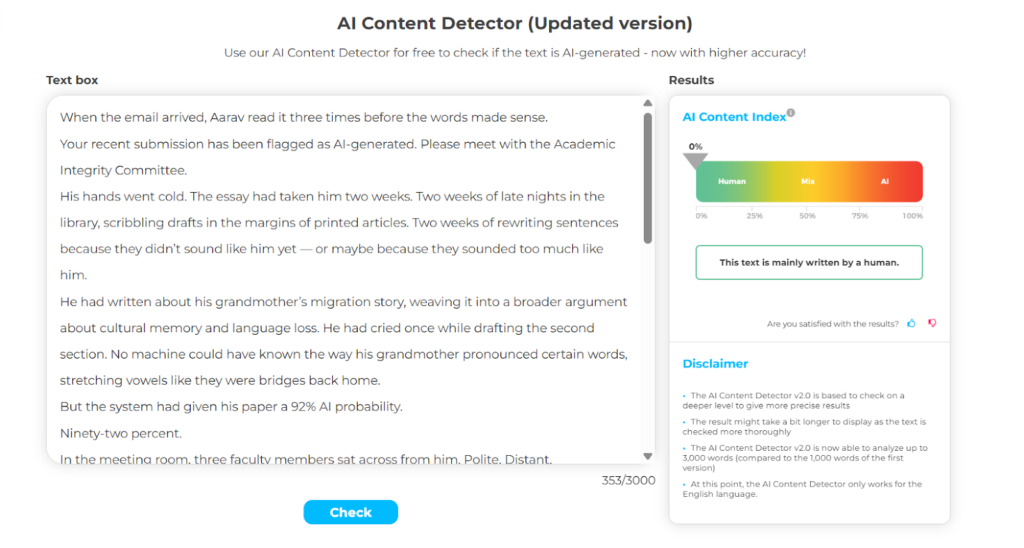
Crossplag Results: Linkedin Post
Last one. The Linkedin Posts. Click to enlarge.
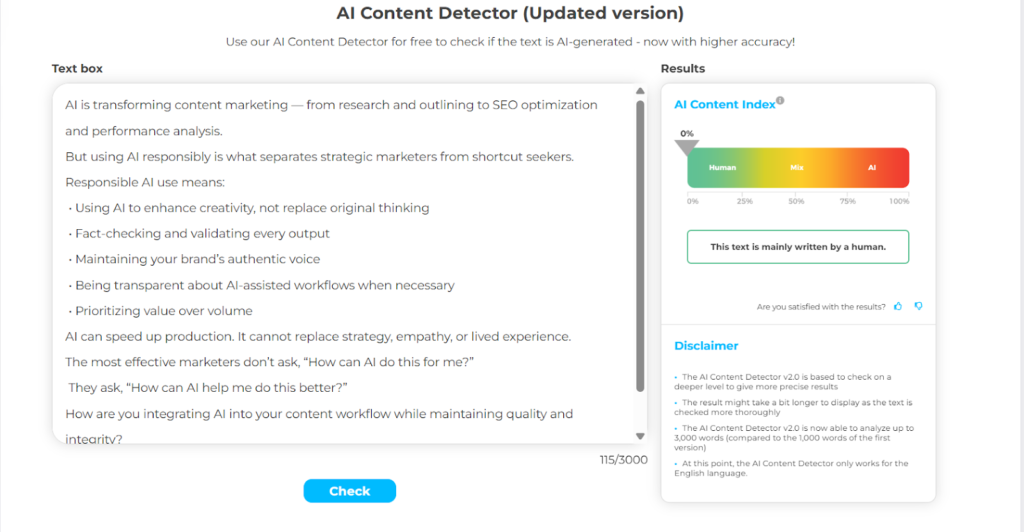
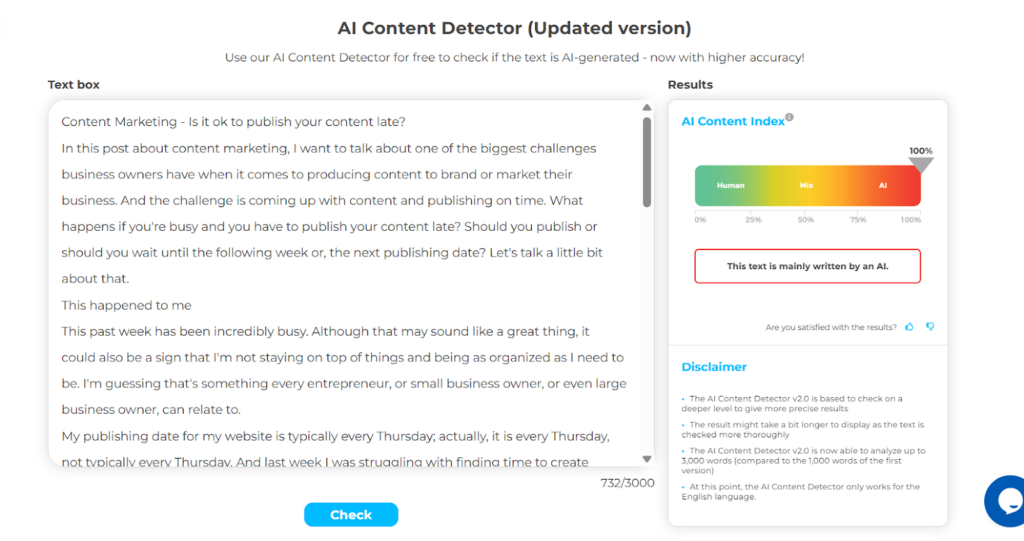
What These Results Mean (Observations)
Based solely on the results we sampled:
Accuracy on AI Content
Crossplag failed to detect most AI-generated samples.
- 1000-word AI essay marked 0% AI
- AI creative writing marked 0% AI
- AI LinkedIn post marked 0% AI
- 2000-word AI essay marked 80% AI
Detection appeared influenced by text length. Short-form AI was not detected reliably.
False Positive Risk
Two genuinely human-written samples were marked 100% AI, including older content written years before AI tools were common. This indicates a high false flag risk.
- Human essay and LinkedIn post both marked 100% AI
- Only one human sample correctly marked 0% AI
Such reversals, AI shown as human and human shown as AI, can create serious academic risk.
Consistency Across Use Cases
Mostly, short AI content was not detected, while longer AI content received higher scores.
- Results varied significantly by content type
- Scores changed based on text length
This suggests unstable performance across different scenarios.
Notable Patterns Observed
Several patterns emerged during testing:
- Short-form AI content was frequently marked as human
- Longer AI content increased detection likelihood, but not reliably
- Formal academic tone in human essays triggered high AI scores
- Results often appeared extreme, either 0% or 100%, with little middle ground
These patterns indicate that Crossplag may rely heavily on surface-level statistical signals rather than deeper authorship analysis. It also raises questions regarding the reliability of using this service for real academic purposes.
Where Crossplag Is Reliable
- Can act as a quick initial signal for longer AI-generated drafts
- May detect higher AI likelihood in extended academic essays
- Useful for basic surface-level screening before deeper review
- It works better as an early warning tool than as final proof.
Where Students Face Risk
- Short AI content may bypass detection
- Human academic writing can be flagged as 100% AI
- Results may shift significantly based on text length
- High chances of getting false positives in high-stakes assignments
- Extreme scores increase uncertainty before submission
For high-stakes academic work, relying on a single detector creates avoidable risk.
If you want to see how the same samples perform under a more stable detection workflow, you can run the same stress test on your draft in the Walter Writes AI detector.
Testing Crossplag vs Walter AI Detector
Same Samples, Same Conditions
The same essay, creative writing, and LinkedIn post samples were tested under identical conditions. No edits were made between tests, and the content was submitted in the same format and length.
This allows a direct side-by-side evaluation without changing variables.
Side-by-Side Results Table
| Sample Type | Use Case | Crossplag Score | Walter Score | Winner |
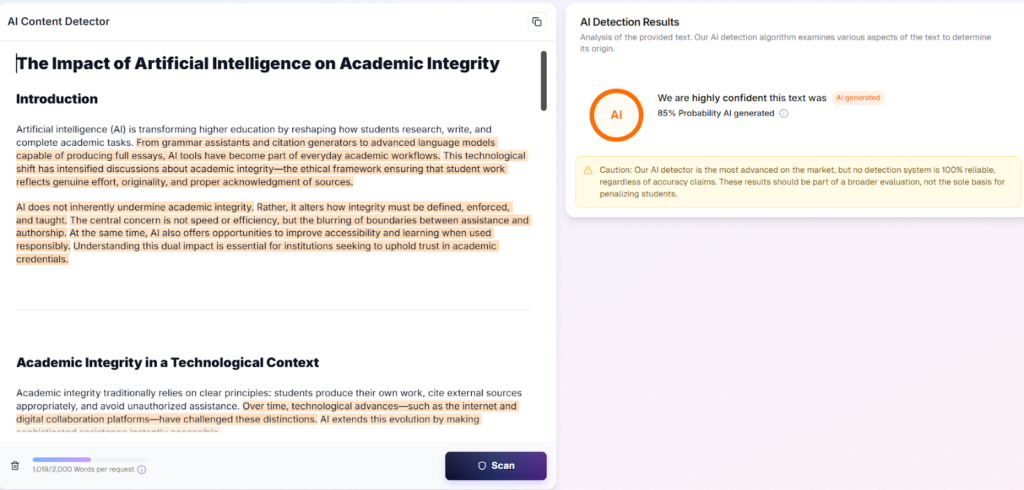
| AI-Generated | Essay | 0% AI ❌ | 85% AI✅ | Walter |
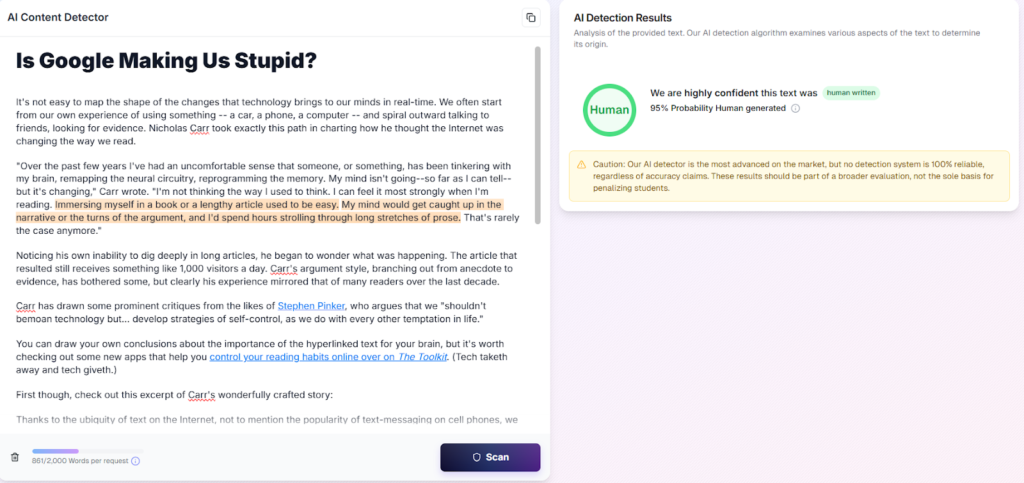
| Human | Essay | 100% AI ❌ | 5% AI✅ | Walter |
| AI-Generated | Creative writing | 0% AI ❌ | 99% AI✅ | Walter |
| Human | Creative writing | 0% AI ✅ | 1% AI✅ | Both |
| AI-Generated | LinkedIn Post | 0% AI ❌ | 99% AI✅ | Walter |
| Human | LinkedIn Post | 100% AI ❌ | 5% AI✅ | Walter |
Walter Writes Results: Essays
Walter Writes Results: Creative Writing
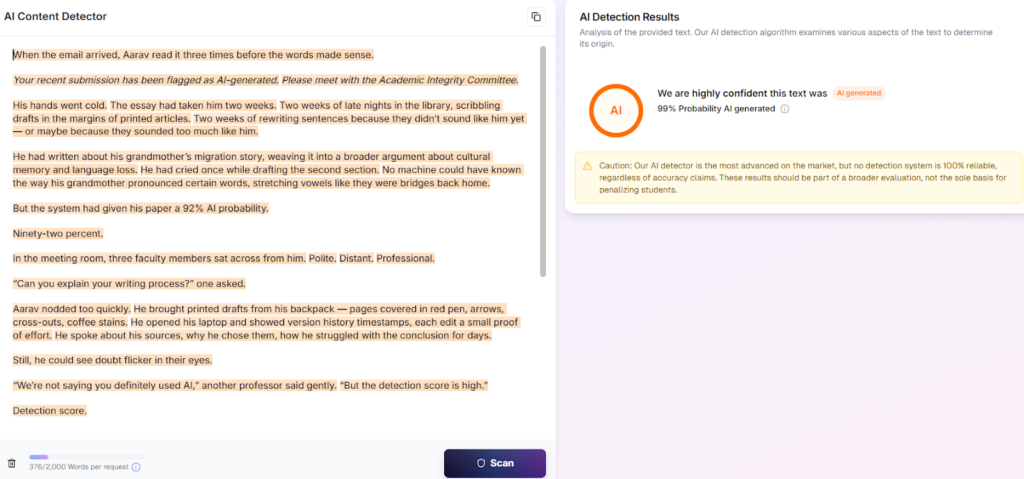
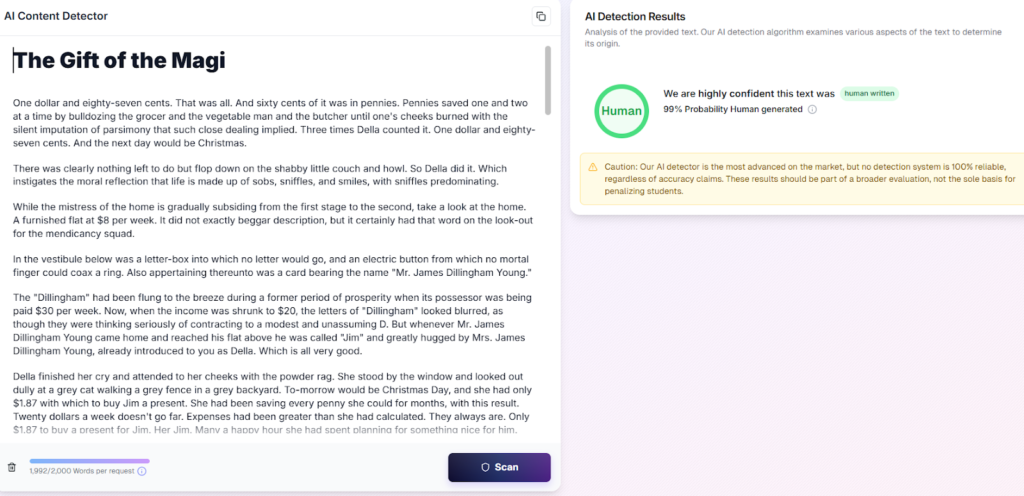
Walter Writes Results: LinkedIn Post
Comparative Analysis: Walter vs Crossplag
During our tests, here’s what we found:
Detection Accuracy
- Crossplag failed to detect most AI-generated samples.
- Walter consistently identified AI content across essays, creative writing, and LinkedIn formats.
- Walter’s AI detection ranged between 85% and 99%, while Crossplag returned 0% in most cases.
False Positive Rate
- Crossplag flagged two human samples as 100% AI.
- Walter classified human samples between 1% and 5% AI, indicating low false flag risk.
- No extreme reversals were observed in Walter’s results.
Consistency
- Crossplag’s results varied significantly based on content length and format.
- Walter maintained stable detection across short and long-form content.
- Walter’s scoring remained within logical ranges rather than extreme 0% or 100% shifts.
Where Each Tool Performs Better
- Crossplag showed limited reliability in short-form AI detection.
- Walter demonstrated balanced detection of both AI and human samples.
Overall Testing Verdict
- Walter correctly identified all AI-generated samples with strong detection percentages.
- Human-written samples were classified within low AI ranges, reducing false flag risk.
- No extreme reversals were observed in Walter’s results.
- Crossplag failed to detect multiple AI samples and flagged genuine human content as 100% AI.
- Results were extremely different based on the length and format of the writing samples used.
In the same samples with the same writing style and same test conditions, Walter was consistently able to identify AI-generated content, and Crossplag had major differences in its ability to produce reliable data.
For academic purposes, if you want to rely on an AI detector that can accurately determine whether or not your content is AI-generated and want to control false positives, the most important consideration will be the detector’s stability.
Reliability and Accuracy: What the Web Evidence Suggests
Several reviews have raised questions as to whether Crossplag has sufficient accuracy to support academic decision-making processes. Others mention that it appears to be either free or has no restrictions placed upon it, providing users with an unrealistic sense of confidence in their score results.
The Accuracy Problem Students Face
- Paraphrased academic writing can still trigger high AI scores.
- Misclassification of proper citations and formal research tone
- Drafts that mix human writing with AI edits are difficult to evaluate accurately.
This is part of a larger issue around how detection systems interpret real academic drafts. If you want a deeper breakdown of this problem, see our guide on: Are AI detectors accurate in real academic writing?
False Positives: The Real Academic Risk and How to Protect Yourself
Students’ concerns are evident in many online discussion forums regarding whether a single detector score can be used as absolute evidence. The use of a single percentage may lead to unnecessary academic risk, given the potential of false positives.
False Positive Response Plan
If you receive a flag on your paper, follow this procedure:
- Save all draft versions of your document
- Export edit history from Google Docs or Word
- Preserve research notes and source links
- Re-check your text using two or three different AI detectors
- Document any AI prompts used during drafting
- Maintain a clear citation trail
One way to summarize this concept is to say that one score is a signal, not a judgment.
Students comparing such AI tools often look at cases like Scribbr AI detector review, Sapling AI detector review, and QuillBot AI detector false positive risks to understand how different detectors handle academic writing.
Pricing and Limits in 2026: What’s Consistent and What’s Contradictory
Crossplag does not clearly publish fixed pricing on its official website. It seems that they have a quotation-based pricing model. In order to get more information on pricing, you would need to create an account and log in to contact the sales team.
There is some third-party information available which suggests that possible plans could fall somewhere between $9-$15 but Crossplag has not officially made this information publicly available.
Some reviewers report that it offers plans with structured credit-based content limitations with a word limit, while others say that there are no clear paywall restrictions.
The inconsistencies listed above make it difficult for students to compare prices and services side by side.
From direct testing, the dashboard shows:
- 10 available credits upon login
- Up to 3,000 words per scan
- No detailed public pricing tiers are visible on the main site
Verification Checklist for Students
Before relying on pricing information:
- Check the official dashboard after login
- Screenshot available credits and word limits
- Confirm whether pricing is subscription or credit-based
- Save evidence if you are working under academic deadlines
Because pricing details are not fully transparent publicly, students should verify the cost structure before depending on the tool for ongoing use.
Crossplag vs Alternatives That Students Actually Compare
Below are some alternatives that students and researchers commonly compare with Crossplag when accuracy and false positive control matter.
| Tool | Best For | Detection Accuracy | False Positives | Cost |
| Walter Writes | All kinds of drafts (AI & human) | High | Low | Free trial + Paid starts from $8/month |
| Proofademic | Academic submissions and assignments | High | Low | Free trial + Paid starts from $8/month |
| Scribbr AI | Student-oriented academic checks | Moderate | Moderate | Starts at $10–$15 per use (estimate) |
| Originality.ai | Content publishers and SEO/marketing | Strong (claimed) | Low to moderate | Starts at $14.95 per 5k words |
| ChatGPTZero | Quick AI screening for students and educators | Varies with content length | Moderate | Free tier + Paid plans (est $9/month) |
| Copyleaks AI | Institutional and university-level detection | Generally stable (claimed) | Low | Plans start at $10–$20/month (estimate) |
To get a deeper view of what academic detection tools are mainly reviewed for student and university use, look at our article about the best AI detector tools for students and universities that compares price transparency, accuracy, and false positives in greater detail.
Real Reviews from Real Users
The following are some real and genuine user reviews to show what they have experienced while using CrossPlag.
| What users liked | What users did not like |
| “Being in the research and market analysis, I often use ChatChatGPT…” – Sara K, G2.com | “It tagged all my own original work as 80% or more generated by AI…” – Thomas M, G2.com |
FAQs: Crossplag AI Detector Review
Is Crossplag AI Detector Accurate?
Crossplag will identify AI-generated text in certain instances, but detection accuracy will likely be impacted by the degree of paraphrasing. Users should view this tool as an indication of potential probability as opposed to definitive proof.
Does Crossplag Give False Positives?
CrossPlag can incorrectly identify human-written content as AI. Particularly when the writing style is academic, or has been heavily revised prior to submission for evaluation.
Is Crossplag Safe for Academic Submissions?
It can be used as a preliminary check, but relying on it alone before submission is risky. A second opinion is recommended.
How Does Crossplag Detect AI-Generated Content?
It analyzes writing patterns and statistical signals to estimate AI likelihood. It does not directly identify the exact source of authorship.
Is Crossplag Better Than Originality.ai?
Originality.ai claims stronger accuracy in its own testing, but performance depends on content type. Students should compare tools based on false positive risk and reliability. For a deeper understanding, you can read this Originality AI review.
Can Universities Detect AI Better Than Crossplag?
Many universities use institutional tools and manual review processes. Detection decisions are rarely based on a single tool alone.
What Percentage Is Considered AI on Crossplag?
No universal threshold exists. While higher percentages are indicative of stronger AI signals, the user must interpret these results within their specific context.
Does Crossplag Store Uploaded Documents?
Before you upload anything that could contain sensitive data, take a moment to read through the platform’s privacy statement to determine what is going to happen with the information you are sending them.
How Much Does Crossplag Cost?
Pricing is not available on the company’s official website. Some reports suggest credit-based plans, but users may need to request details directly.
Is Crossplag Reliable for Research Papers?
It can provide a signal, but research writing with citations and a formal tone may increase misclassification risk. Use cautiously for high-stakes submissions.
Final Recommendation
Crossplag should be used as an initial detection tool to determine whether there may be a risk of using AI, but do not rely solely on it as your last word. Due to the potential for false positives and inconsistent scoring, students should never rely on a single tool to detect plagiarism or AI before submitting their work.
To ensure stronger protection against academic dishonesty, utilize a process that will allow you to review flagged portions of your paper in detail. Walter Writes AI humanizer and AI detector is a one-stop solution for that. It rewrites, humanizes, and detects your score with proper caution to maintain integrity.
If you need to rewrite AI content fast, try our Walter’s AI humanizer — 300 words free, no signup required.