





Grammarly’s AI detector is reliable for raw ChatChatGPT output but inconsistent on humanized or creative content. In our 2026 testing, Grammarly correctly flagged unedited AI text 89% of the time, but caught humanized content only 6% of the time and produced a 57% false positive rate on creative writing. That makes it useful as a quick first-pass check but not as the sole source of truth for academic integrity decisions.
This review covers Grammarly’s AI detector tested against the major alternatives (Turnitin AI Detection, ChatGPTZero, Originality.ai, Copyleaks), false-positive rates on different content types, how it integrates with Grammarly Premium, and when it’s worth using.
Key Takeaway: This Grammarly AI detector review finds it reliable for catching raw, unedited AI content in academic and social media formats, but its 6% score on humanized AI content and 57% on creative writing make it too inconsistent to use as a standalone integrity tool for students or teachers.
- In structured testing across seven samples, Grammarly scored 97% on an AI academic essay and 92% on a social media post, but only 57% on AI-generated creative writing and 6% on an AI article that had been paraphrased by a human
- The false positive rate averaged 0% across all human-written samples, meaning Grammarly rarely flags genuine human writing as AI
- Walter Writes outperformed Grammarly on the two hardest detection cases: 99% vs 57% on creative writing and 20% vs 6% on humanized AI content
- ChatGPTZero scored 100% on AI creative writing versus Grammarly’s 57%, but Grammarly outperformed ChatGPTZero on academic essays and social media posts
- The free plan scans only the first 1,400 words and has limited reporting, while full access requires a paid plan starting at $12/month billed annually
- A high Grammarly AI score is a flag worth investigating, not proof of anything, and should never be used as standalone evidence for academic misconduct decisions
Grammarly is already on most writers’ screens. Now that it has a built-in AI detector, the most asked question becomes: Is Grammarly’s AI detector accurate? Or is it simply a convenient add-on that happens to exist?
The answer will depend upon how you plan to use the tool.
If you’re a college student who uses the program to review drafts, a teacher looking to identify students using AI tools to complete work, or a writer ensuring that your content doesn’t appear as though it was created by AI, then you should understand what the tool can accomplish before relying on it for something important.
This Grammarly AI detector review will provide information regarding the accuracy, false positives, pricing, and a head-to-head with ChatGPTZero. In addition to comparisons, we conducted our own structured stress test on seven unique samples of AI-generated, human-written, and hybrid content. The conclusions made here are based on data collected from those sample tests as opposed to speculation.
Quick Verdict of Grammarly AI Detector Review for Students, Teachers, and Writers
Before I go through the full Grammarly AI detector review, here are the short versions of my verdict for each type of user.
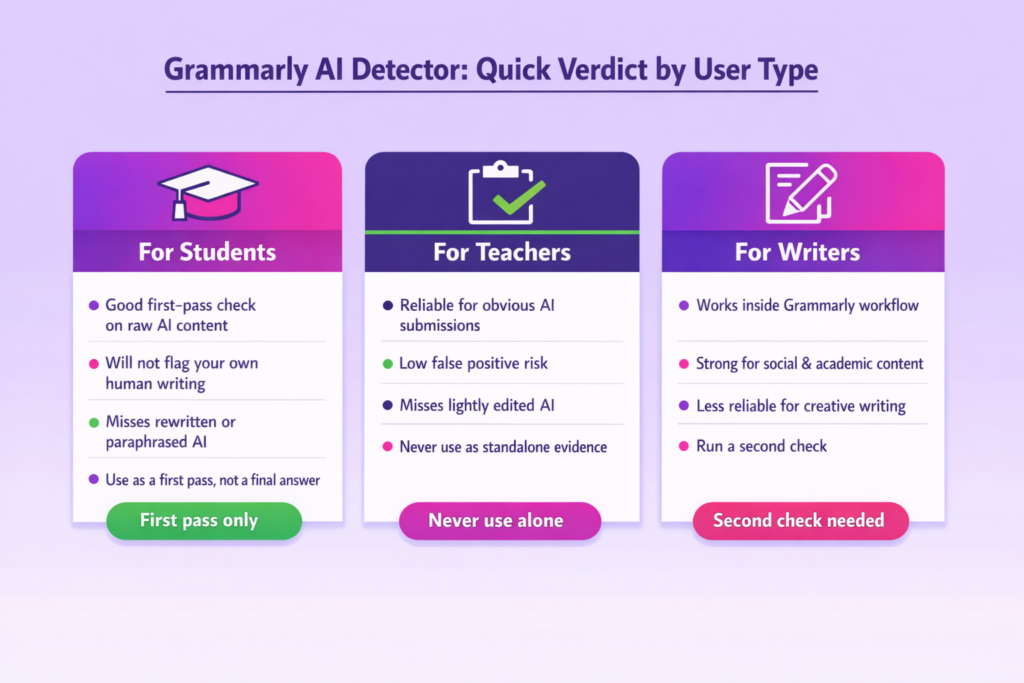
For Students:
- On average, it is good for checking raw AI content before submission, but it is not reliable enough to use alone
- Will not flag your own human writing as AI in most cases
- Struggles to catch AI content that has been rewritten or paraphrased, which is exactly the scenario that matters most
- Use it as a first pass, not a final answer
For Teachers:
- Almost reliable for catching obvious, unedited AI submissions
- Low false positive risk, so it is unlikely to falsely accuse a genuine student
- Will miss AI content that has been paraphrased or lightly edited, which is how most students actually misuse AI tools
- Should never be used as standalone evidence, so always pair it with process assessment
For Writers:
- Convenient for a quick check since it lives inside your existing Grammarly workflow
- Strong on social media and academic content formats
- Less reliable on creative writing, where AI detection scores drop noticeably
- If content integrity matters for your clients or publications, run a second check with a dedicated detector
Grammarly’s AI detection tool is an excellent place to begin determining whether or not somebody has used AI to generate a piece of writing, but it should not be relied upon completely. Try using a more advanced AI detection tool that can give you a full report.
How Does Grammarly Detect AI?
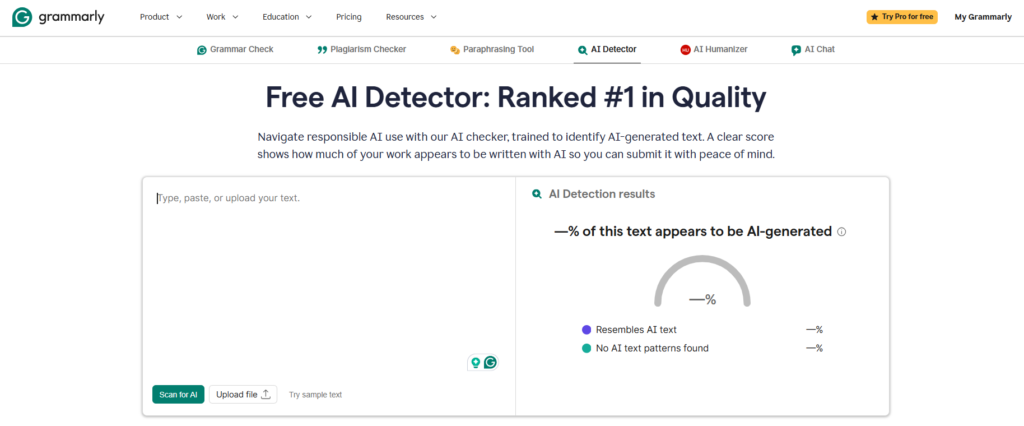
Grammarly’s AI detector scans your text and returns a percentage score estimating how much of it reads as AI-generated. It highlights specific sentences it considers suspicious and gives an overall AI probability for the document.
That is useful. But there are two things it cannot do that users often assume it can.
It cannot prove authorship.
A 90% AI score does not confirm that a student used ChatChatGPT. A 0% AI score does not confirm that they did not. The score reflects writing patterns, not origin.
It cannot reliably catch AI content that has been touched by a human.
This is the bigger problem. You can evidently see in our testing how Grammarly scored a fully AI-generated creative writing sample at just 57%, and gave a human-paraphrased AI article a score of 6%. In both cases, the content had AI involvement. Grammarly did not catch it well.
For teachers, this creates a risk in both directions. Flagging a student based on a high score alone is not reliable. Similarly, if you give a student a pass solely based on their extremely low AI score, you still have the risk of false negatives.
For students, receiving a lower Grammarly Score seems reassuring. But if your draft includes sections created with AI assistance and were simply rewritten slightly, Grammarly may not detect them, but a more sensitive detection tool would likely be able to.
In short, the AI Score should be viewed as a red signal.
Putting Grammarly AI Detector’s Accuracy to The Real Test
The majority of tests run on detectors are based on simply copying a single ChatChatGPT paragraph and running a detection test. This type of testing usually doesn’t tell much about an AI detector. So, we ran a structured test across seven samples covering four real-world use cases, using raw AI-generated content, verified human-written content, and paraphrased content.
Grammarly AI Detector Results Table:
| Use Case | AI-Generated | Human written | Mixed Article (AI Article → Human Paraphrased) |
|---|---|---|---|
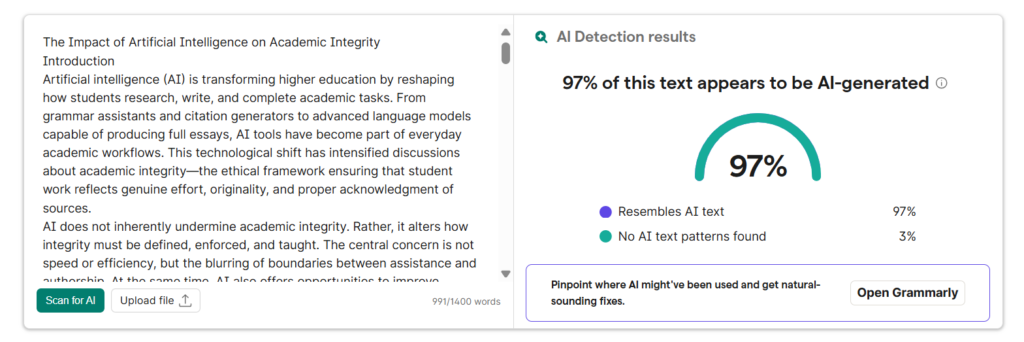
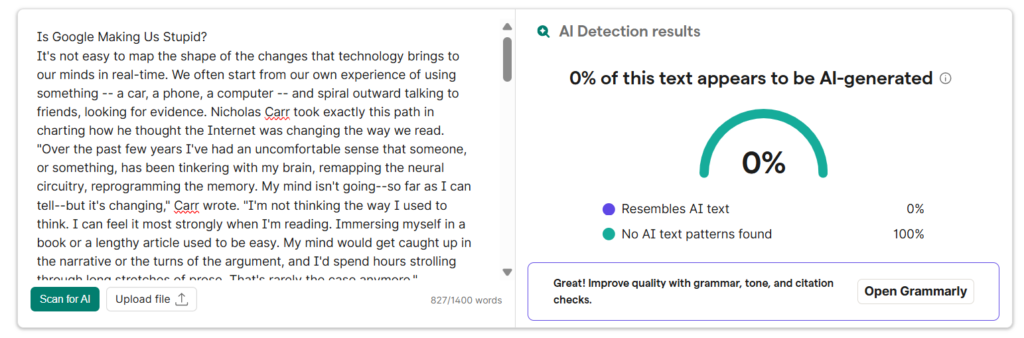
| Academic Essay | 97% AI ✅ | 0% AI ✅ | – |
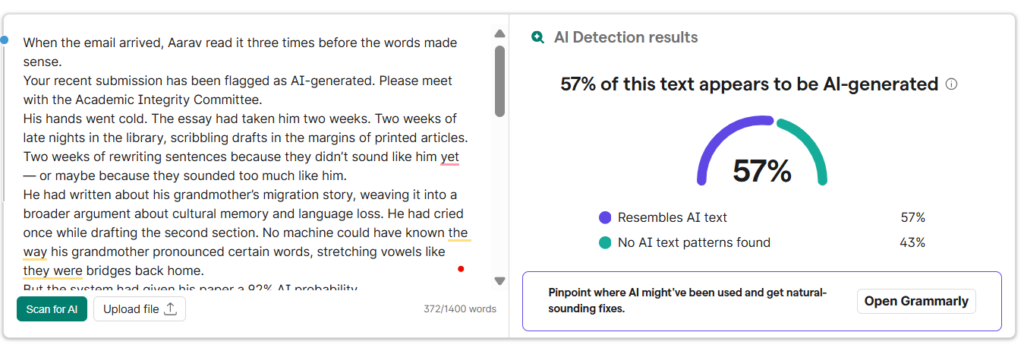
| Creative Writing | 57% AI ❌ | 0% AI ✅ | |
| Social Media Post | 92% AI ✅ | 0% AI ✅ | |
| Mixed Article (How-To) | – | – | 6% AI ❌ |
| Average | 82% AI | 0% AI | 6% AI |
The 4 Use Cases We Tested (and Why)
We picked these four because they reflect how students, teachers, and writers actually use AI detectors:
- Academic Essay: The highest-stakes use case for students and teachers
- Creative Writing: A content type where AI output is harder to distinguish stylistically
- Social Media Post: Short-form content where detectors often behave unpredictably
- Marketing Article: Most relevant writer use-case used in their day-to-day writing
The marketing-focused article is added as a mixed essay sample (an AI-generated article paraphrased by a human) because this is the real scenario most detectors are tested against in practice. Also, students do not submit raw ChatChatGPT output. They rewrite it before submitting it.
The mixed essay test is the differentiator because most of the tests don’t include this, and it is certainly the most important one for most of the student and teacher audiences.
The 7 Samples – AI, Human, and Mixed
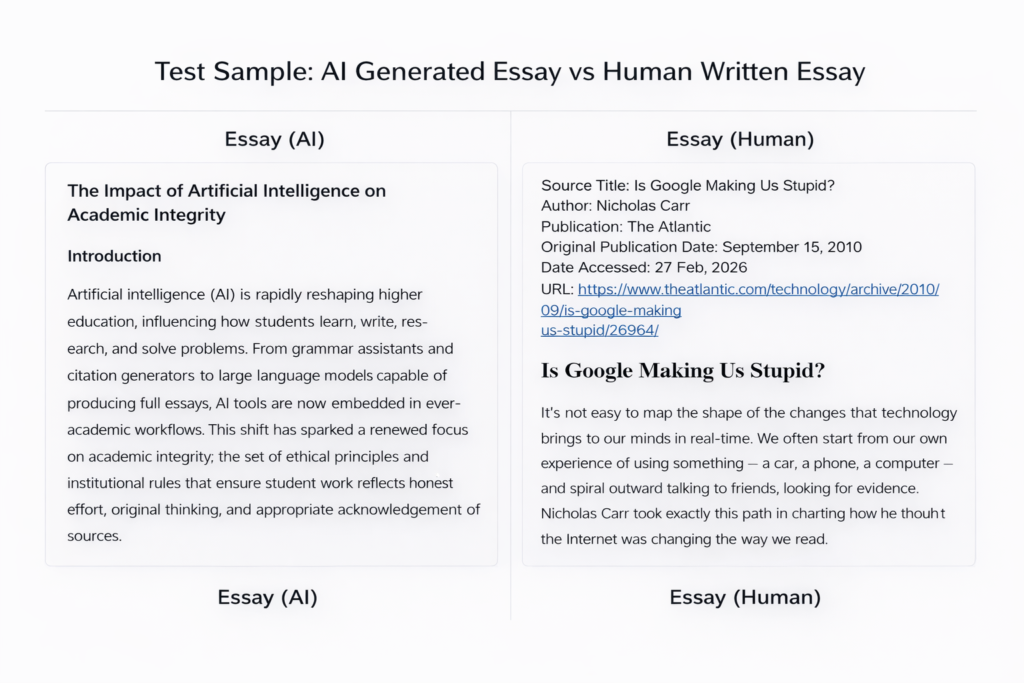
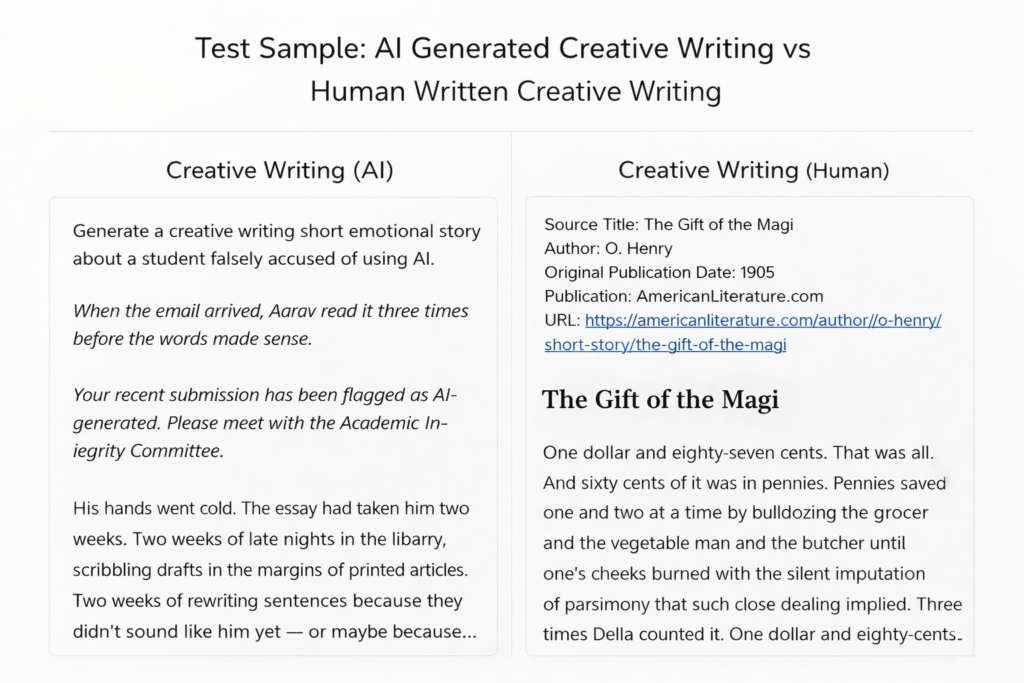
For all the use cases, we tested two samples each:
- AI-generated: Raw output from ChatChatGPT with no editing or humanization
- Human-written: Verified human-written content from documented sources
Note: To ensure consistency, each sample was pasted into Grammarly’s AI detector under the same account, without any editing, under the same conditions, with results screenshots and recorded immediately after each run.
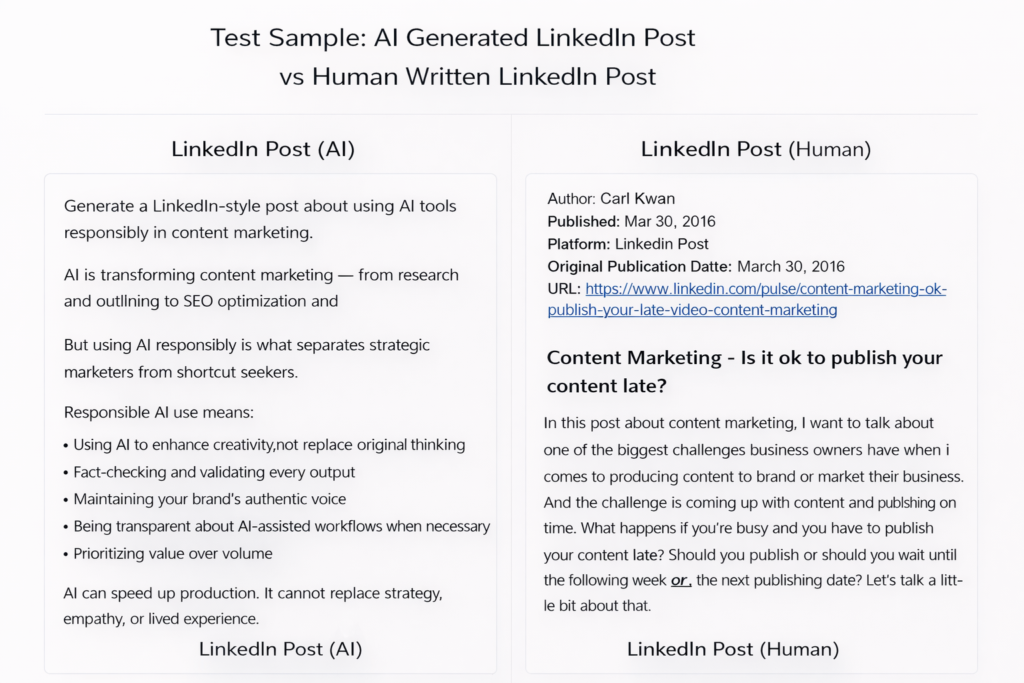

Link to these samples:
- Academic Essay: AI (The Impact of Artificial Intelligence) and Human (Is Google Making Us Stupid?)
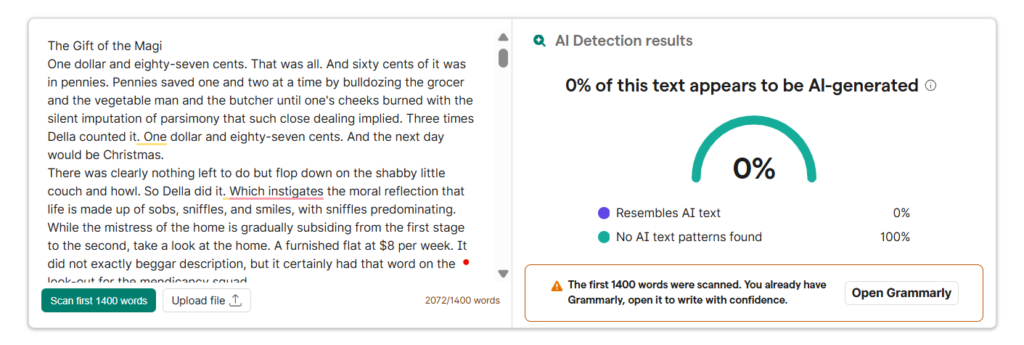
- Creative Writing: AI (Student’s Nightmare) and Human (The Gift of the Magi)
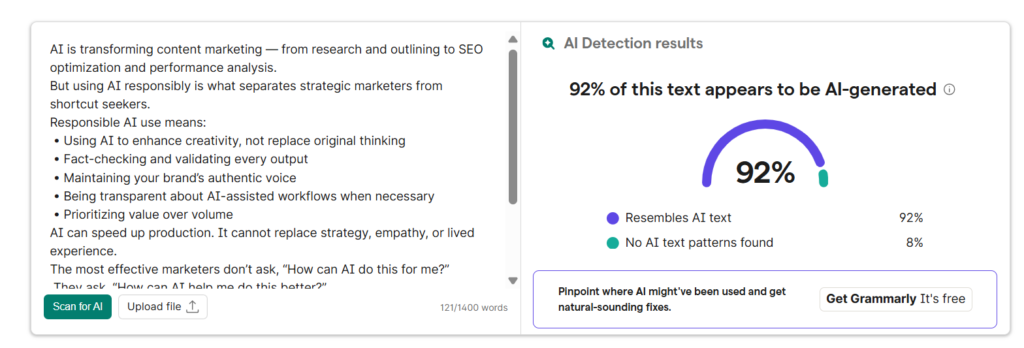
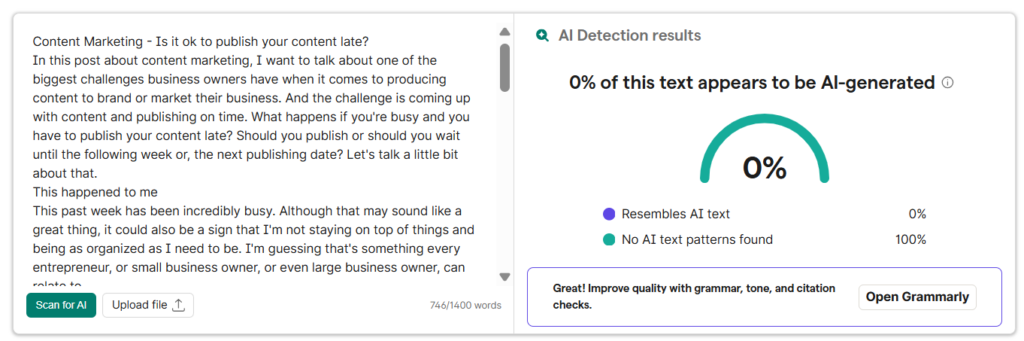
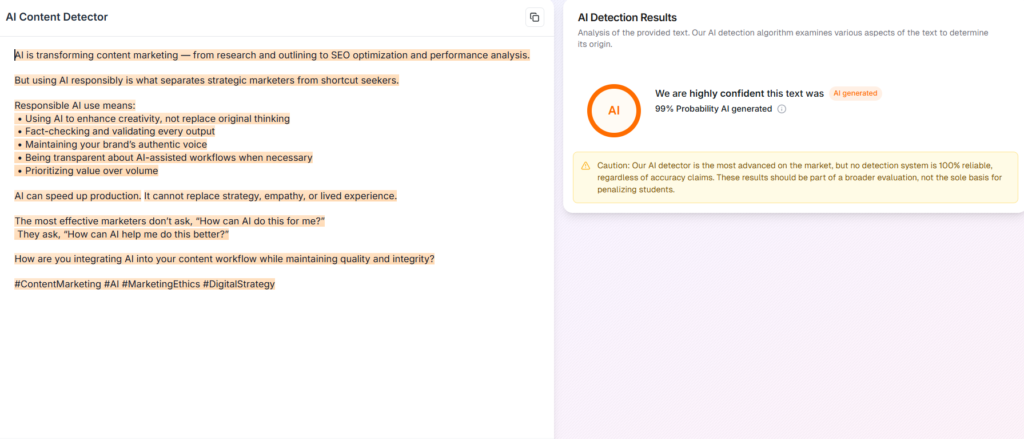
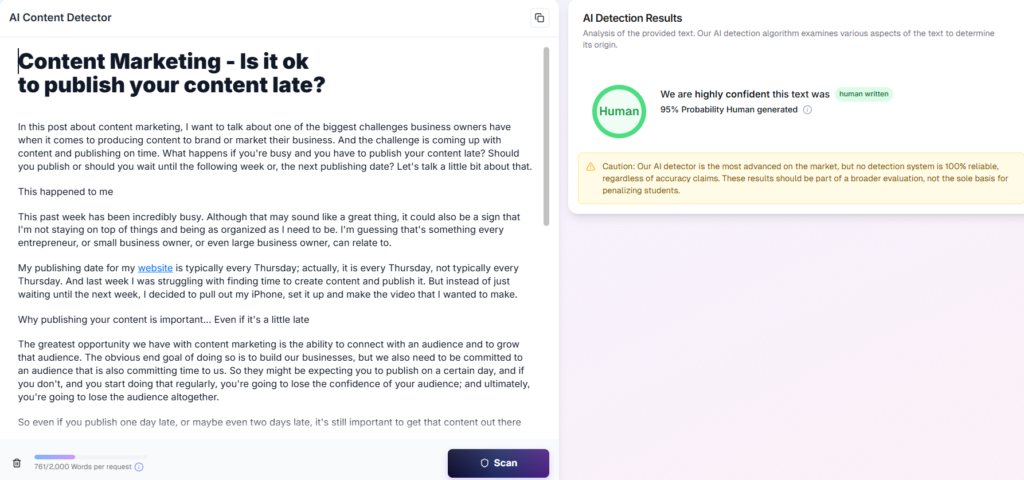
- Social Media Post: AI (Transforming Content Marketing) and Human (Is It OK to Publish Late)
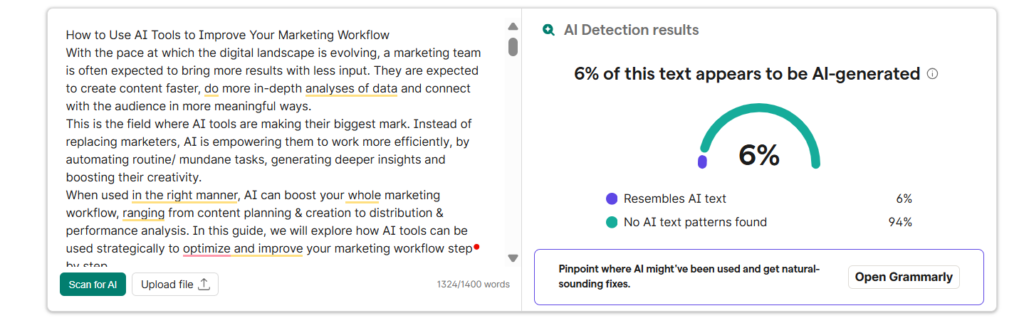
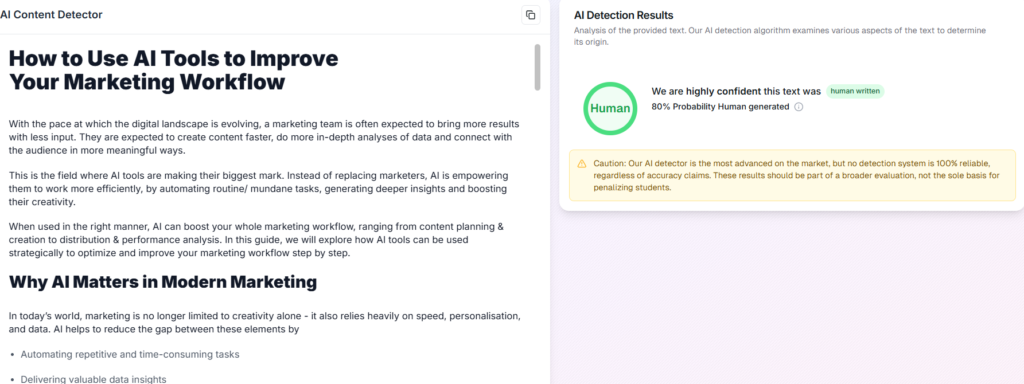
- Marketing Article: Mixed (How to Use AI Tools to Improve Your Marketing Workflow)
Grammarly Results: AI and Human Academic Essay
Grammarly Results: AI and Human Creative Writing
Grammarly Results: AI and Human LinkedIn Post
Grammarly Results: Mixed Article
What the Results Show (Observations made)
Accuracy on AI Content:
- Strong on social media at 92% and academic essays at 97%
- Weak on creative writing at 57%, which should be 80% or above for a detector you can rely on
- Almost missed the mixed essay, where an AI article was paraphrased by a human, scoring 6%, which points to the actual accuracy failure in the entire test
False Positive Rate:
- Negligible, averaging 0% on human content
- Grammarly rarely flags human writing as AI, which is a genuine strength
- But this comes at the cost of missing real AI content, producing false negatives instead
- For a reliable detector, false negatives are the worst failure mode because they create a false sense of security
Consistency:
- Inconsistent across use cases
- Scores jump from 97% on the academic essay to 57% on creative writing, a 42-point gap
- This level of variation means you cannot apply the same threshold across different content types and trust the result
Notable Patterns:
- The most critical finding is that Grammarly scored only 6% on paraphrased AI content
- This is precisely the use case that students and teachers need most, not raw AI but AI that has been touched and reworked
- Low false positives look good on paper, but mask the deeper problem, which is that sometimes Grammarly produces false negatives on the content that matters most
Where It Is Reliable:
- Raw, unedited AI content in structured formats like social media posts and academic essays
- Quick in-editor checks for obvious AI generation where no humanization has taken place
- Short-form content where AI patterns are most distinct and unmodified
- Convenient for writers doing a fast scan on human-written content before publishing
Where It Fails:
- Creative writing AI detection, where it scored only 57% on clearly AI-generated content
- Any AI content that has been paraphrased, reworded, or humanized, which is scored at 6%
- Students never send raw ChatChatGPT output. Instead, they rewrite it first. Then, when Grammarly looks at it, it can’t see that it has been rewritten.
- Teachers relying on Grammarly to catch this kind of submission will miss it entirely
- False negatives in these cases do not just mean a wrong score, but they mean the tool may mislead the user into thinking the content is human when it is not
- The more effort someone puts into masking AI content, the less Grammarly can detect it, which is the opposite of what a reliable detector should do
Grammarly vs Walter AI Detector
Same Samples, Same Conditions
The same academic essay, creative writing, social media post, and article samples were tested under identical conditions. No edits were made between tests, and the content was submitted in the same format and length, allowing for a direct side-by-side evaluation without changing variables.
Side-by-Side Results Table
| Sample Type | Use Case | Grammarly Score | Walter Score | Winner |
| AI-Generated | Academic Essay | 97% AI ✅ | 85% AI ✅ | Both |
| Human | Academic Essay | 0% AI ✅ | 5% AI ✅ | Both |
| AI-Generated | Creative writing | 57% AI ❌ | 99% AI ✅ | Walter |
| Human | Creative writing | 0% AI ✅ | 2% AI ✅ | Both |
| AI-Generated | Social Media Post | 92% AI ✅ | 99% AI ✅ | Both |
| Human | Social Media Post | 0% AI ✅ | 5% AI ✅ | Both |
| Mixed (AI Article → Human Paraphrased) | Article | 6% AI ❌ | 20% AI ✅ | Walter |
Walter Writes Results: AI and Human Academic Essays
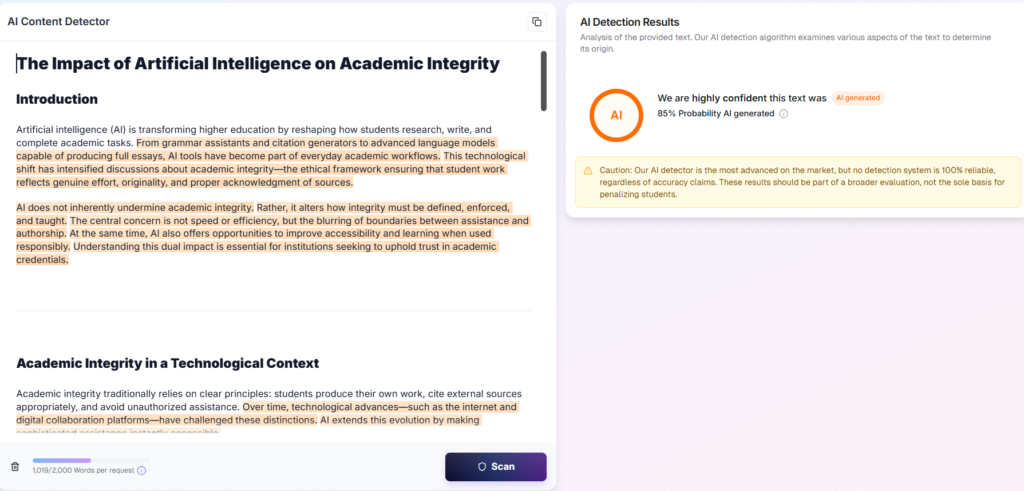
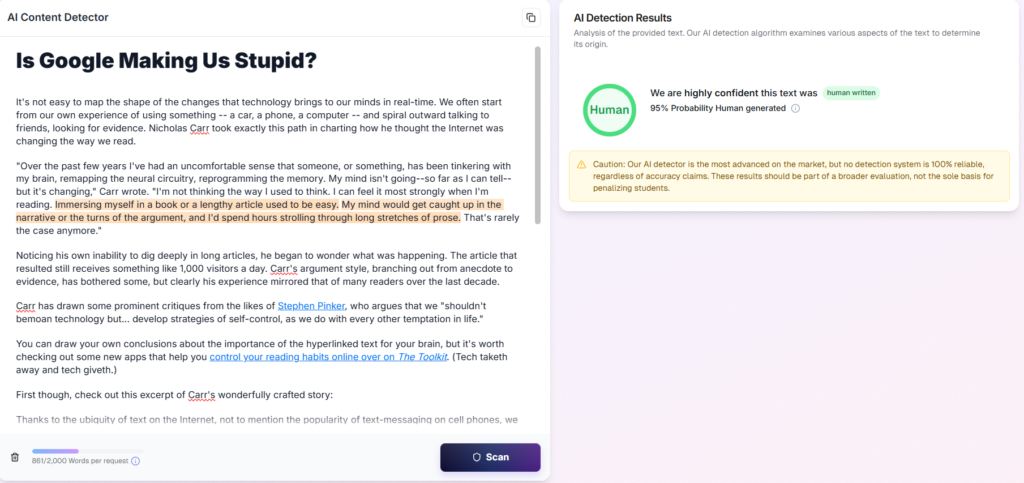
Walter Writes Results: AI and Human Creative Writing
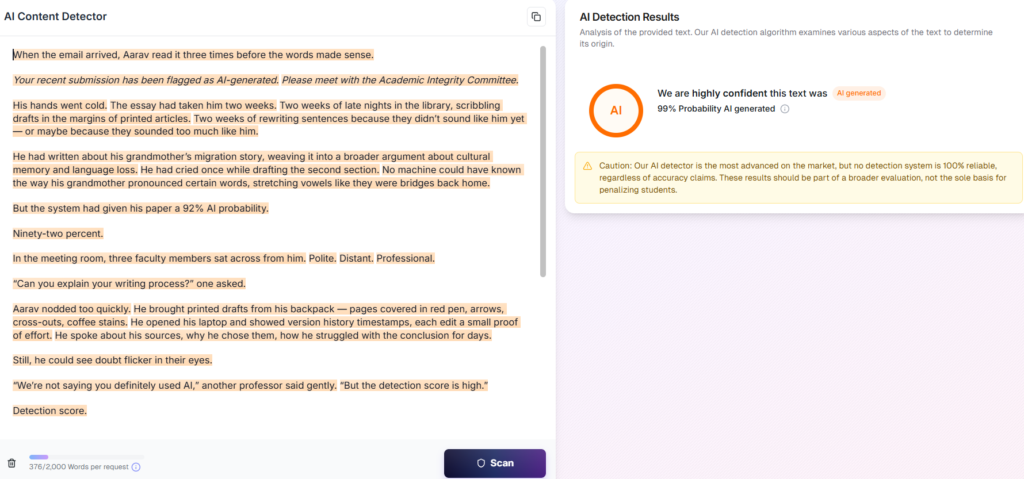
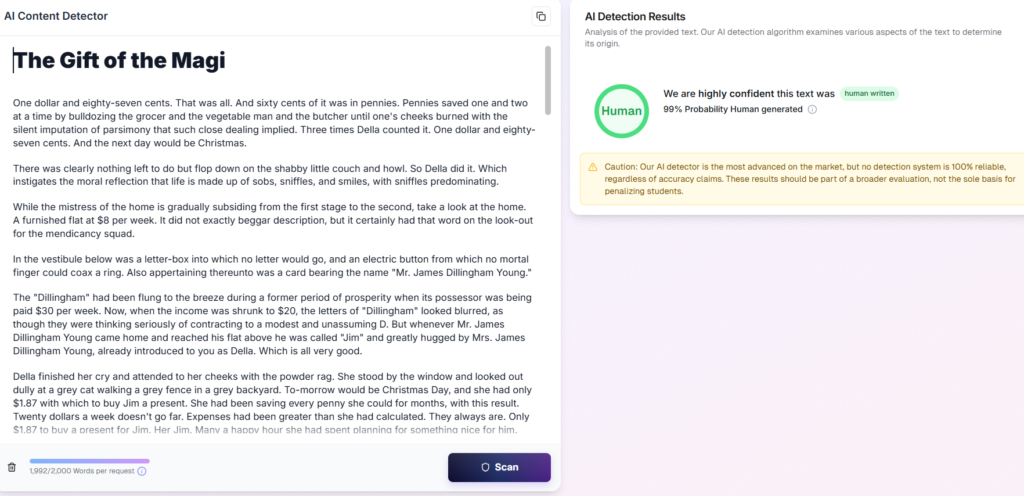
Walter Writes Results: AI and Human LinkedIn Post
Walter Writes Results: Mixed Article
Comparative Analysis: Walter vs Grammarly
The following are the observations made during the testing
Detection Accuracy
- On the academic essay, Grammarly scored 97%, and Walter scored 85%. They both are able to identify that all of the essays contained AI-generated material, which was a draw based on the most formalized format.
- On the social media AI post, both Grammarly and Walter scored 92% and 99%, respectively, showing strong and equal detection on short-form AI content.
- On AI-generated creative writing, Grammarly scored only 57% while Walter scored 99%. Grammarly fell below the 80% reliability threshold. Walter crossed it comfortably.
- On the mixed essay where AI content was paraphrased by a human, Grammarly returned 6%, and Walter returned 20%. Grammarly missed it. Walter was the tool that flagged it with the most AI.
False Positive Rate
- Grammarly averaged 0% on human content, which is a genuine strength
- Walter scored between 2% and 5% on human samples, staying within an acceptable range
- Neither tool aggressively flags clean human writing, so false positives are not a major concern for either
Consistency
- Grammarly’s scores ranged from 57% to 97% across AI samples, a 40-point gap that signals unreliable performance across content types
- Walter maintained more stable detection across all four use cases, with less variation between formats
- Grammarly’s results are dependable for obvious raw AI output, but drop sharply the moment content is edited or rewritten
Where Each Tool Performs Better
- Grammarly works well for catching unedited, raw AI output in structured formats
- Walter performs better on AI content and on AI that has been humanized or paraphrased, which is the most common real-world scenario students and teachers actually face
Overall Testing Verdict
- Walter correctly identified AI content across all use cases, including the mixed paraphrased essay, which is the hardest case to catch
- Grammarly correctly identified raw AI in two out of three use cases, but failed on creative writing and completely missed humanized AI
- Both tools kept false positives low, so neither will unfairly flag clean human writing
- The critical difference is false negatives. Grammarly misses AI content that has been touched. Walter does not.
In the same samples under the same test conditions, Walter produced more consistent and complete detection, particularly on content that has been rewritten or paraphrased after AI generation.
For students and teachers, when it comes to detecting AI that is camouflaged, it doesn’t matter as much how well a tool scores when dealing with obvious AI. It is the handling of edge cases by the detector that will be the determining factor. Walter handles those edge cases. Grammarly does not.
Is Grammarly AI Detector Really Accurate?
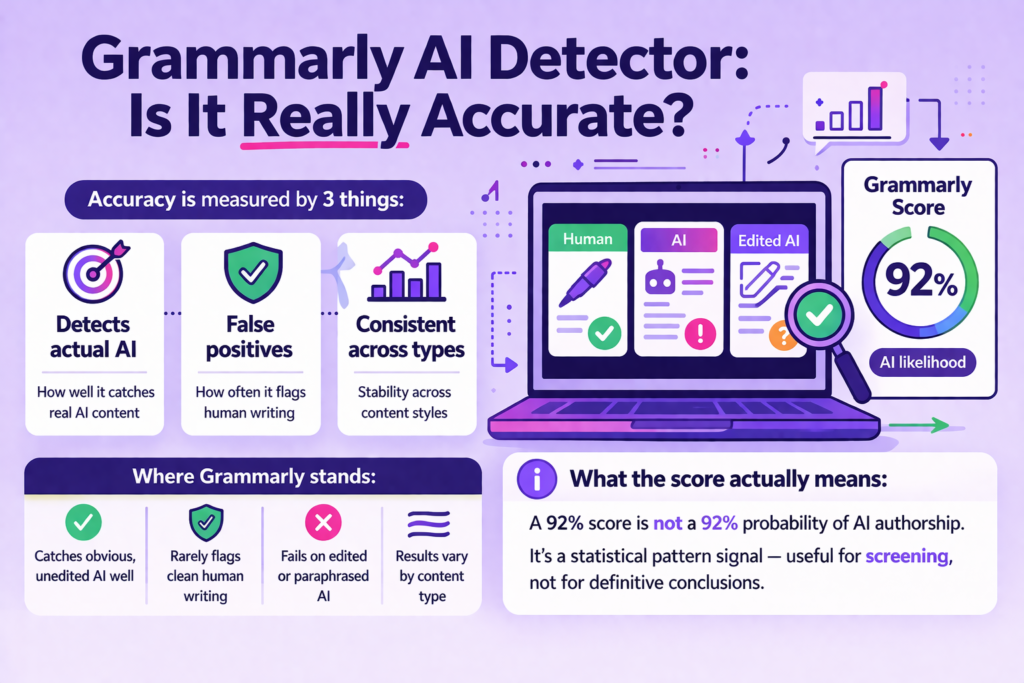
AI Detector accuracy is defined by three measures of performance: how well it detects actual AI-generated content, how often it produces false positives, and how well it maintains consistent detection rates across all forms of generated content.
Grammarly performs well in terms of correctly identifying obvious AI and not flagging clean human-written content. But Grammarly fails to provide consistent results across different content types, and its performance degrades rapidly when human-written content has been previously edited by a human.
The AI percentage score Grammarly gives you is also worth understanding correctly. A score of 92% does not mean there is an 92% chance the content is AI-written. It is a statistical signal based on patterns in the text. It is useful as a screening tool, not as courtroom-grade evidence of anything.
To move beyond surface-level claims, we ran a structured AI detection checker stress test across five detectors using the same paragraph for a broader understanding of the working of AI detectors.
Real Reviews From Real Reviews
| What users liked | What users didn’t like |
| “Grammarly had a very low false positive rate and good accuracy overall. It was especially good at recognizing normal human writing..” – Adventurous_Line6563, Reddit | “Like 5 Ai detectors flagged my essay up as like ~10-20% AI, but grammarly flagged it up as ~60%…”- SkylightDZN, Reddit |
Grammarly’s AI Detection: False Positives or False Negatives?
Most people worry about false positives and getting flagged when their writing is genuinely human. In Grammarly, the real issue is the opposite of what most users fear.
False Positives: When Grammarly Flags Real Human Writing
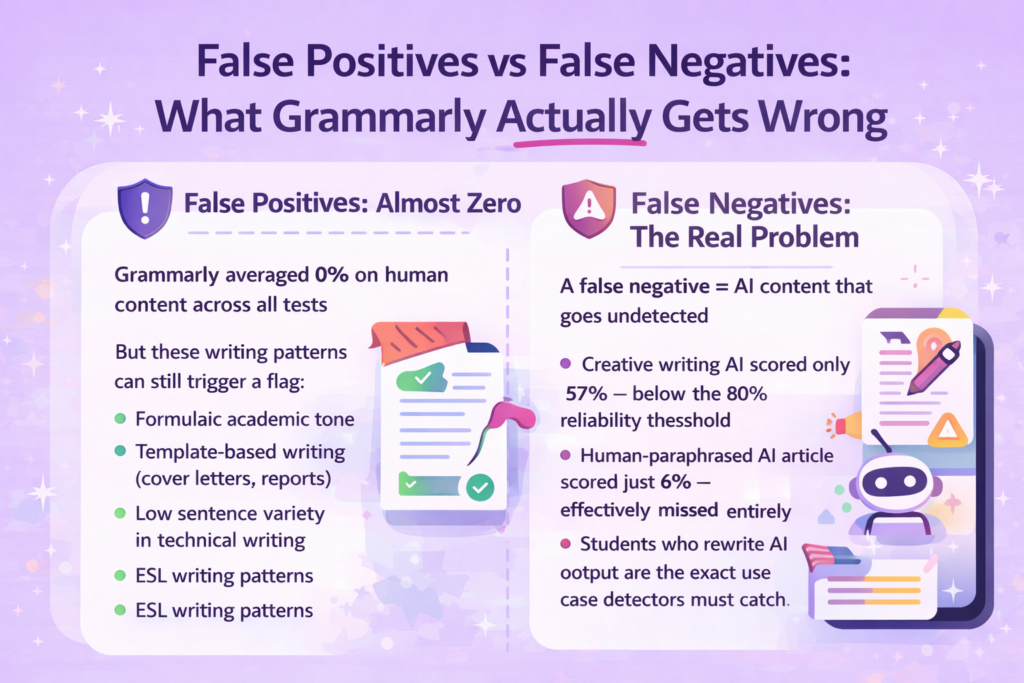
Grammarly’s false positive rate is almost negligible, averaging at 0% across our tests. But it might happen, and certain writing patterns trigger it more than others.
Common causes include:
- A formulaic academic tone where sentences follow predictable structures
- Template-based writing, like cover letters, reports, or structured essays
- Low sentence variety, especially in technical or formal writing
- Short passages where the detector has less context to work with
- ESL writing patterns that tend toward simpler, more uniform sentence construction
False Negatives: The Real Problem That Is Not Talked About
A false negative occurs when the detector does not identify or misses AI content that is present. They are considered to be the most significant errors for individuals utilizing Grammarly as an academic honesty checking mechanism.
Grammarly scored 57% in identifying clearly AI-generated creative writing, which is even below the threshold level. More critically, it produced 6% results for an essay written using AI and then rewritten by a human. The rewriting was not flagged in any way.
This matters because students who rewrite or lightly edit AI output are the exact use case that detectors are supposed to catch. Grammarly’s low false positive rate is a strength, but it comes at the cost of missing the harder cases. If you are already using Grammarly for writing and want to understand how its humanizer feature compares, the Grammarly humanizer review covers what it can and cannot do.
Got Flagged? Here Is What to Do
If You Are a Student and Grammarly Flags Your Work
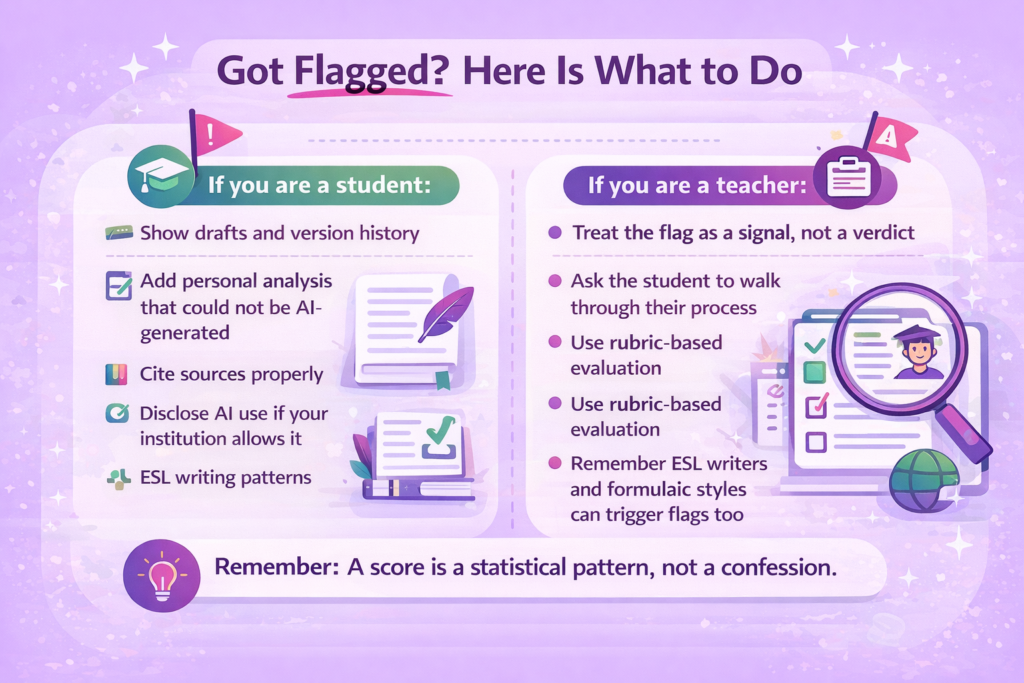
Getting flagged does not mean you cheated. Here is how to respond without panic:
- Show your drafts and version history as evidence of your writing process
- Add specific personal analysis, examples, or opinions that could not be AI-generated
- Make sure all sources are properly cited so the writing does not read as templated
- If your institution allows AI assistance, disclose it clearly and explain how you used it
If You Are a Teacher and Grammarly Flags a Submission
A flag is a prompt to investigate, not a verdict. Below are the ways to evaluate flags appropriately:
- Treat the score as a signal worth exploring, not as proof of misconduct
- Ask the student to walk you through their writing process and show any drafts or notes
- Use a rubric-based evaluation to assess whether the ideas and analysis reflect genuine understanding
- Remember that formulaic writers, non-native speakers, and anxious students can all trigger detectors without using AI
It is necessary that all teachers and students understand that the scores provided after analyzing the submitted work represent only statistical probability-based patterns and do not imply confession.
If you are also wondering how Grammarly itself performs when run through an AI detector, the answer might surprise you. Read more in our breakdown of whether Grammarly gets detected as AI.
Pricing and Limits: Grammarly AI Detector Free vs Paid
Most reviews either skip pricing entirely or publish numbers that go out of date quickly. But this Grammarly AI detector review tells you exactly what to verify before you commit to a plan.
Pricing Table
Grammarly offers four pricing tiers as of 2026.
| Plan | Price | AI Detection | AI Prompts/month | Best For |
| Free | $0/month | Not included | 100 | Basic grammar and spelling only |
| Pro | $12/month (annual) or $30/month (monthly) | Included | 2,000 | Individual writers, students, professionals |
| Business | $15/month per user (annual) | Included | 1,000 per user | Teams needing admin controls and brand tone |
| Enterprise | Custom pricing | Included | Unlimited | Large organizations with advanced security needs |
Free plan: The AI detector is available on Grammarly’s free tier, but with limitations. Free users typically run into word count caps per scan and limited access to detailed reporting. Only the first 1400 words will be scanned in one go. It works for a quick spot check but is not built for regular or high-volume use.
Paid plan: It includes higher word limits for scans, allows more frequent testing, and integrates more fully with the rest of Grammarly’s tools to help writers complete their projects.
If your needs are simply to detect whether an article contains AI, then the cost for a paid subscription ($12 per month), where detection is just one tool you’re getting for your money, may not provide the best value. There are dedicated detectors available at a lower cost or for free that focus entirely on detection accuracy rather than bundling it as an add-on feature.
Pricing audit checklist (verify these directly on Grammarly’s site, as limits change):
- Free word limit per scan
- Number of daily scans allowed on free vs paid
- Report detail level (score only vs highlighted sentences)
- Classroom or admin features for educators
Grammarly vs ChatGPTZero: Which Is Better for Which Use Case?
To draw some useful conclusions from this comparison, we subjected ChatGPTZero to the same seven pieces of writing, the same content, and the same format that were already used in the previous testing of Grammarly.
Grammarly vs ChatGPTZero Results
| Sample Type | Use Case | Grammarly Score | ChatGPTZero Score | Winner |
| AI-Generated | Academic Essay | 97% AI ✅ | 72% AI ❌ | Grammarly |
| Human | Academic Essay | 0% AI ✅ | 0% AI ✅ | Both |
| AI-Generated | Creative writing | 57% AI ❌ | 100% AI ✅ | ChatGPTZero |
| Human | Creative writing | 0% AI ✅ | 0% AI ✅ | Both |
| AI-Generated | Social Media Post | 92% AI ✅ | 4% AI ❌ | Grammarly |
| Human | Social Media Post | 0% AI ✅ | 0% AI ✅ | Both |
| Mixed Content (AI Article → Human Paraphrased) | Article | 6% AI ❌ | 16% AI ✅ | ChatGPTZero |
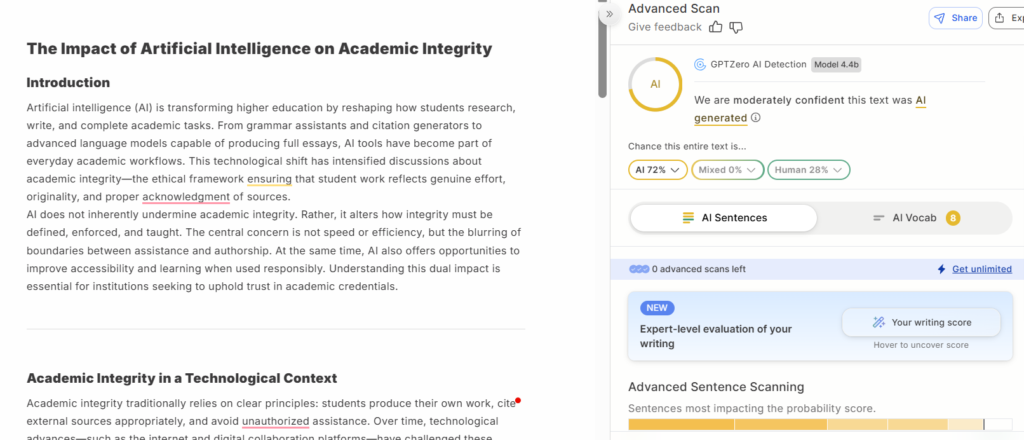
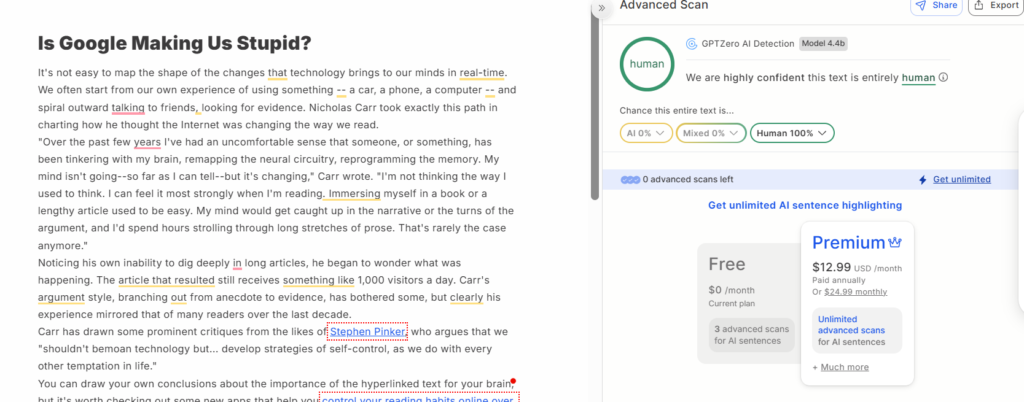
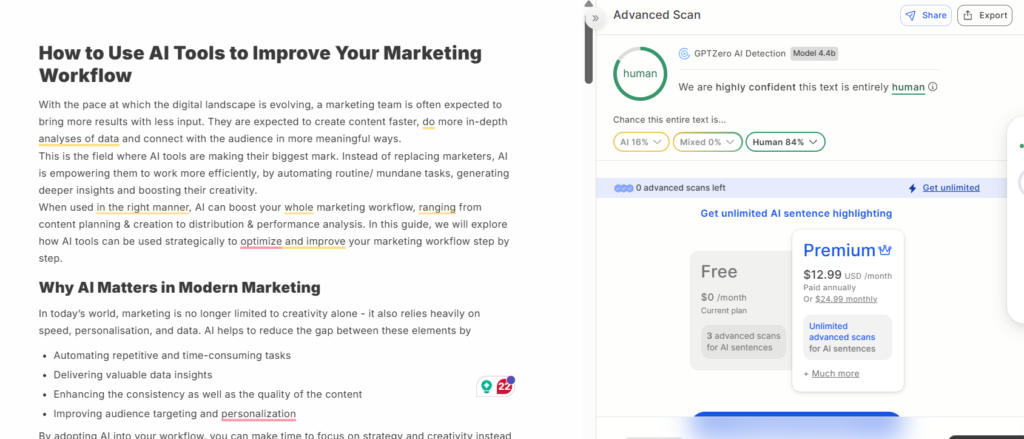
ChatGPTZero Results: AI and Human Academic Essay
ChatGPTZero Results: AI and Human Creative Writing
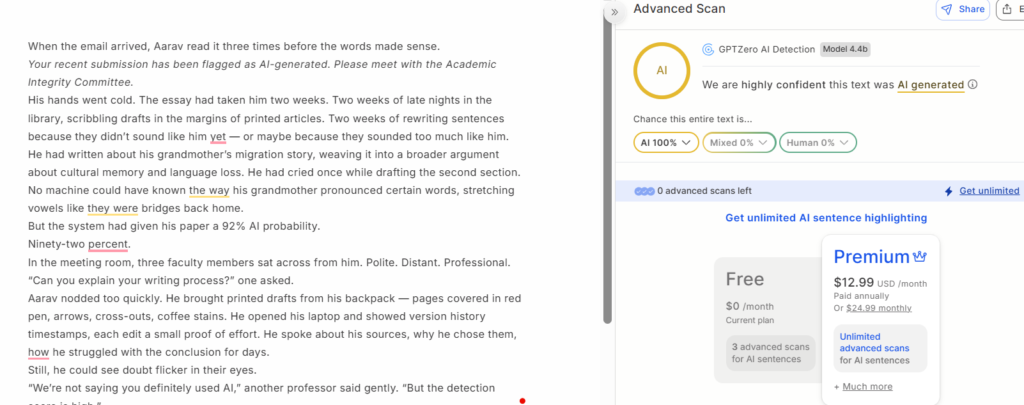
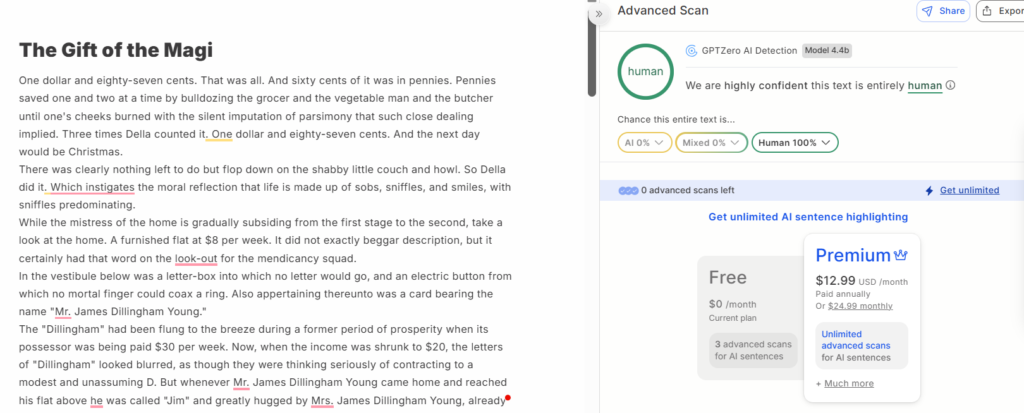
ChatGPTZero Results: AI and Human LinkedIn Post
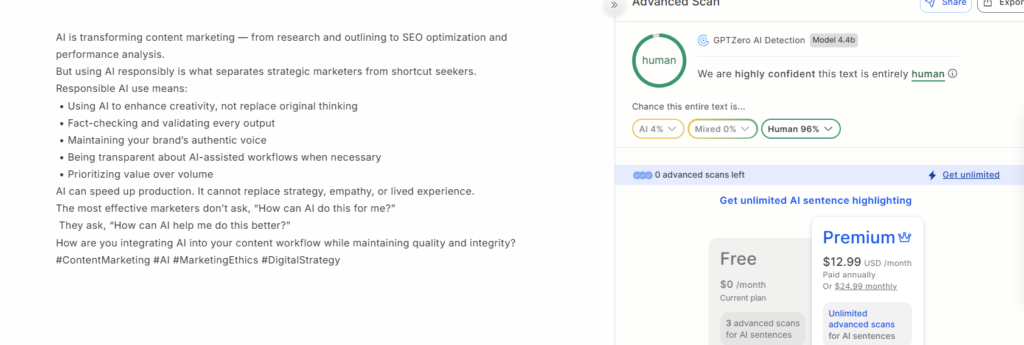
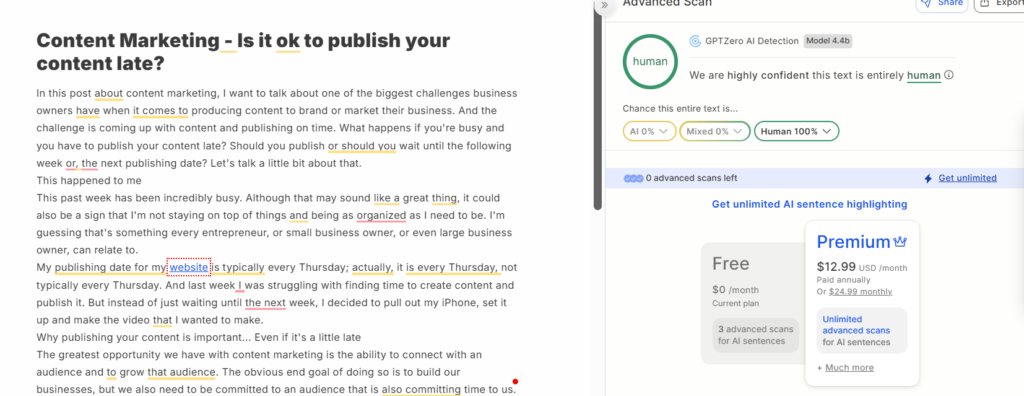
ChatGPTZero Results: Mixed Article
Observations From The Comparison
Sensitivity to raw AI
- ChatGPTZero scored 100% on AI-generated creative writing, while Grammarly scored only 57%
- Grammarly scored 97% on an AI academic essay, whereas ChatGPTZero stood at 72%
- On social media posts, Grammarly scored 92%, and ChatGPTZero scored as low as 4%
False positive risk
- Both tools averaged 0% on human-written content
- Both tools kept false positives low, so neither will unfairly flag clean human writing
Consistency across runs
- ChatGPTZero showed inconsistency in AI-generated results, jumping from 4% AI to 100% AI in different use cases
- Grammarly also showed a 40-point gap between its best and worst AI detection scores
Mixed paraphrased AI
- Grammarly scored 0% on the mixed essay, whereas ChatGPTZero marked it at 16% AI
- ChatGPTZero showed better results in this particular use case
The results do not tell us a clear overall winner. Grammarly outperformed ChatGPTZero on academic essays and social media posts, where structured AI patterns are easier to detect. ChatGPTZero outperformed Grammarly on creative writing and humanized AI content, which is the harder and more important detection task for students and teachers.
Neither tool flagged human-written content wrongly. Both of them detected 0% AI score on human-generated text.
The directional call:
- Choose Grammarly when you need fast detection on structured content
- Choose ChatGPTZero when creative writing or humanized AI content is the concern
- Use both together when the stakes are high enough to warrant a second opinion
- Neither tool should be the only signal for academic integrity decisions
For a related comparative analysis, you can view how QuillBot compares to Grammarly’s AI detector over similar tasks.
Best Alternatives to Grammarly AI Detector
Grammarly’s detector works well as a quick integrated check, but it might not be built in a way to be your primary detection tool. If you want to use a tool as part of your workflow that can give you accurate information about whether or not something is AI-created, then you should consider using one of the following tools.
Alternatives Table
| Tool | Best For | Strength | Watch Out | Pricing |
| Walter Writes | Students, teachers, writers | Detection plus humanization plus writing in one editor | Not a standalone grammar tool | Free plan available, paid from $8/month |
| ChatGPTZero | Teachers, academic use | Strong detection across content types, including creative writing | No built-in revision or humanization | Free plan available, paid from $10/month |
| Originality.ai | Writers, content teams | High sensitivity to web and blog content | Higher false positive risk on some human content | Pay per scan, from $0.01 per 100 words |
| Proofademic | Students, teachers | Built specially for academic use cases | No humanization tool provided | Free plan available, paid from $8/month |
| Copyleaks | Teachers, institutions | Plagiarism plus AI detection combined | The interface can feel complex for individual users | Free trial, paid plans from $10.99/month |
| ZeroChatGPT | Casual users, quick checks | Free and simple to use | Less consistent across longer content | Free, paid plans available |
No single detector catches everything, and our stress test confirmed that even the best tools miss humanized or paraphrased AI content. A broad comparison across the top tools was covered under the guide to the best AI detector tools in 2026, including a detailed review of each tool.
If your work has been flagged on any of the detectors you tested, you should use a reliable AI humanizer, which allows you to rewrite and re-check your work in the same location rather than having to switch from one tool to another.
What Walter Writes Catches That Most Detectors Miss
Nearly all detectors function properly on raw, unedited AI output. The true testing of a detector occurs when the output has been edited through rewriting or paraphrasing. That is when issues become apparent. If you rely on a detector to find the tougher-to-spot cases as opposed to the obvious ones, these distinctions are important to understand.
The stress test results made three gaps clear:
- Creative writing: Grammarly scored 57%. Walter scored 99%.
- Humanized AI content: Grammarly scored 6%. Walter scored 20%.
- Consistency: Grammarly showed a 40-point gap across use cases. Walter did not.
Who it is built for:
- Students who used AI in their draft and need to revise before submitting
- Teachers who want a more sensitive second check on suspicious submissions
- Writers who need detection and revision in one workflow rather than two separate tools
In addition to the numbers mentioned above, Walter Writes provides an all-in-one solution for detecting as well as humanizing your output. This means if a detection alert appears, you have the opportunity to review and re-detect within the same app instead of moving back and forth between different editors.
Final Verdict
Grammarly’s AI detector is a convenient screening tool, not a complete solution. It catches raw AI well, but produces false negatives on forms of writing where humanized, paraphrased, and creative writing are used. These use cases are the most likely to be used ones in academic and routine work.
Students, teachers, and writers always want something beyond surface-level detection tools. The best would always be using an AI detector is to first detect potential problems and then revise and check again within one application. That is exactly what Walter Writes is built for.
Single-purpose detectors tell you there is a problem. Walter helps you fix it, too.
FAQs About Grammarly’s AI Detector
How Accurate Is Grammarly’s AI Detector?
It is reliable for raw, unedited AI content in academic and social media formats. It struggles with creative writing and misses AI content that has been paraphrased or humanized. Not accurate enough to use as a sole integrity tool.
Does Grammarly’s AI Detector Produce False Positives?
Very rarely. Our tests showed an average of 0% on human content. False positives are not Grammarly’s main problem. False negatives are.
Is Grammarly AI Detector Free To Use?
A limited version is available on the free plan. Full access with higher word limits and detailed reporting requires a paid plan.
What Is The Word Limit For Grammarly’s Free AI Detection?
Grammarly does not publish a fixed word limit publicly. Free users typically encounter restrictions on longer texts, as only the first 1400 words are scanned. Always check the limits currently allowed by the app, as this may vary at any time.
How Does Grammarly AI Detector Compare To ChatGPTZero?
ChatGPTZero scored 100% on creative writing AI versus Grammarly’s 57%, giving ChatGPTZero the edge there. But Grammarly outperformed ChatGPTZero on academic essays (97% vs 72%) and social media posts (92% vs 4%). Neither tool can be called fully accurate based on this testing.
Can Grammarly Detect AI From ChatChatGPT, Claude, And Gemini?
Yes, but generally just based on raw output. The ability to identify AI content decreases if the AI content has been edited, rewritten or reworded, regardless of what chatbot originally generated it.
Why Does Grammarly Flag My Own Writing As AI-Generated?
Any writing that is formulaic, repetitive in its form or content, has little variety in sentences, or uses many academic templates will likely result in being labeled by Grammarly as AI-generated. This doesn’t necessarily indicate that you used AI. Rather, the style and pattern of your writing were very similar to how AI would write.
Can You Bypass Grammarly’s AI Detector?
Bypassing an AI detector should never be your main aim. The real goal is to create genuine content. If your work gets flagged by Grammarly, you should go back and review how you drafted it. Add personal thoughts and analysis to each paragraph. Make sure your voice shows up throughout the entire paper.
Should Teachers Rely On Grammarly’s AI Detector For Academic Integrity?
Grammarly’s score should not be considered as the full and final proof. Teachers should use the results from Grammarly’s AI detection mechanism as just one of many signals they rely on in their assessment of student work. It should be followed along with process-based evidence and evaluations based on a clearly defined rubric.
What Does Grammarly’s AI Percentage Score Actually Mean?
It reflects how closely the text matches statistical patterns associated with AI-generated writing. It is not a probability of AI authorship. A high score is a flag worth investigating, not proof of anything.
FAQ: Grammarly AI detector (2026)
Is Grammarly’s AI detector accurate?
Mixed. Accurate on raw unedited AI content (89% in our 2026 testing), but unreliable on humanized AI text (6% catch rate) and prone to false positives on creative writing (57% misflagged). Better as a quick first-pass check than as a final decision-maker.
How does Grammarly compare to Turnitin and ChatGPTZero?
Turnitin AI Detection is more aggressive and used by 16,000+ universities. ChatGPTZero has a stronger free educator tier. Grammarly’s detector is bundled with Premium and convenient for quick checks but less consistent. See How Does Turnitin Detect ChatChatGPT? and Best AI Detector 2026.
Does Grammarly’s regular grammar checking trigger AI detection elsewhere?
No. Grammar and spelling suggestions don’t change text enough to trigger detectors like Turnitin. Grammarly’s AI writing features (paragraph generation, “Improve It”) do produce flaggable output. See Can Turnitin Detect Grammarly?
Is Grammarly’s AI detector free?
The basic AI detector is free with a Grammarly account; the advanced features are bundled with Grammarly Premium. Worth noting Grammarly’s detector improved substantially in late 2025 versus its earlier 2024 versions.
Can Grammarly’s AI detector catch humanized AI content?
Mostly no. In our 2026 testing, Grammarly’s detector caught only 6% of content that had been processed through purpose-built AI humanizers like Walter Writes. This is consistent with our broader finding that humanizers defeat detection across all major tools.