




Grammarly is not just fixing typos anymore. With its AI Humanizer, it tries to turn stiff, obviously AI written drafts into something that sounds closer to a real person. You paste in text from tools like ChatChatGPT, hit the Humanizer, and Grammarly rewrites it for clarity, flow, and tone so it feels less robotic and more like something you would actually say in an email, essay, or doc.
If you are wondering whether Grammarly actually has a humanizer, the answer is yes. The feature lives inside the Grammarly experience as an AI Humanizer you can trigger on your text, with basic access available on the free tier and heavier usage tied to paid plans. It is meant to keep your meaning intact while smoothing awkward AI phrasing, not to magically make AI content undetectable or “fool” every AI checker out there. Grammarly’s own messaging leans heavily on clarity, readability, and integrity, not on beating detectors.
That nuance really matters in 2025. Students, content writers, and knowledge workers are all dealing with the same tension: they want AI to help, they do not want their writing to scream “I was written by a bot,” and they are facing stricter AI detectors at schools and workplaces. If you are specifically worried about whether Grammarly itself gets flagged, you can dive deeper into this in our guide on whether Grammarly gets detected as AI
In the rest of this article, we will break down what Grammarly Humanizer actually does well, where it starts to fall apart in real world AI detection tests, and when it makes sense to bring in a dedicated AI Text humanizer like Walter to finish the job. If you already live in Grammarly and just want your AI assisted drafts to sound genuinely human while staying safer around AI checks, you are exactly who this guide is for.
And if you want to know how Grammarly performs as the detector, not the detected, the Grammarly AI detector review walks through its accuracy scores across academic, creative, and humanized content.
What Is Grammarly Humanizer? (Quick Answer)
Grammarly Humanizer is Grammarly’s AI powered rewrite button that tries to make stiff, AI sounding text feel more like something a real person would write. You paste or type your draft, highlight the part that feels off, then ask the humanizer to rewrite it. The tool keeps your core idea but adjusts wording, sentence length, and tone so the paragraph reads smoother and less obviously machine generated.
If you have been wondering, does Grammarly have a humanizer, the answer is yes. The Grammarly AI Humanizer lives inside the same interface you already use for grammar and style, so you do not need a separate app. It shows up as one of the AI actions or agents in the editor and in supported integrations like the browser extension.
On the money side, there is a limited way to try it for free. Grammarly’s free plan includes a small allowance of AI actions, which covers a bit of humanizer usage. Once you start using it regularly on longer essays, blog posts, or client work, those limits run out and you are pushed toward a paid tier. So if you are asking is Grammarly Humanizer free, the honest answer is: it is free to test, but real day to day use sits behind Grammarly’s paid plans.
If you want to zoom out and see how this fits into the wider world of humanization tools, you can skim our explainer on what an AI humanizer actually is and how a more advanced AI humanizer differs from a rewrite feature that happens to live inside a grammar checker.
How Grammarly Humanizer Works Inside Grammarly
Grammarly Humanizer is not a separate app. It lives inside the same Grammarly space you already use for grammar, spelling, and style checks. If you are in the editor or using a Grammarly extension, the humanizer shows up as one of the AI actions you can apply to a piece of text.
At a high level, the flow looks like this:
- You write or paste a draft, often something that started in ChatChatGPT or Gemini or another LLM.
- You highlight a sentence, paragraph, or the whole thing.
- You trigger the Humanizer action and let Grammarly rewrite it.
What you get back is still your idea, but with different wording, smoother transitions, and a more natural rhythm. Think of it as a Grammarly text humanizer that sits on top of all the usual grammar and clarity suggestions you already expect.
If you want to get a bit more systematic about it and really understand how to use Grammarly Humanizer well, here is how it behaves in practice.
Where you actually find the Humanizer
Grammarly has been evolving into more of an AI workspace, with different “agents” you can call on inside the same interface. The Humanizer is one of those agents.
You will typically see it:
- Inside the main Grammarly web editor when you open a document
- In supported integrations, like the browser extension when you are writing in tools such as Google Docs or web based email
In all of those places, the basic pattern is the same. Select the paragraph that feels too AI written, open the AI suggestions panel, then choose the Humanizer option. Grammarly runs its rewrite and shows you a new version that you can accept, reject, or edit further.
If you are already used to letting Grammarly fix grammar in your email or Docs, this feels like an extra layer that works on style and “voice” more than just correctness. For a deeper walkthrough on turning AI drafts into something that sounds like you, you might also like this broader guide on humanizing AI text.
What the Humanizer actually changes
Under the hood, the Humanizer is an AI powered rewrite. It is not just swapping synonyms. It will often:
- Break up long, clunky sentences
- Change stiff phrasing into something more casual or more formal, depending on the context
- Smooth out repetition and obvious “AI tell” patterns, so the text does not sound like a generic ChatChatGPT answer
If you feed it a raw AI draft, you will usually see fewer robotic transitions, more varied sentence length, and a tone that feels closer to how people actually write and speak. That is the core of the Grammarly AI Humanizer features set: take AI to human text in one click, inside the same tool you are already using to proofread.
You still have to read what comes out. It is not a magic “fix everything” button. Sometimes it over simplifies a technical point or leans a little too hard into a friendly tone when you need something sharper or more professional. That is where a second pass and your own judgment come in, or where a more specialized AI humanizer can give you finer control over tone and structure.
Is Grammarly Humanizer free?
Here is the honest version, without marketing speak.
There is a way to try Grammarly Humanizer for free. On the free plan, Grammarly lets you run a limited number of AI actions, which includes the humanizer. That is enough to experiment on a few paragraphs or a short document and get a feel for what it does.
If you want to rely on it every day, across longer essays, blog posts, or client work, you run into usage caps. That is where the paid plans come in, and where people start searching for things like “Grammarly AI Humanizer pricing” or “Grammarly AI Humanizer free” and realize the free tier is more of a taste than a full setup.
So if your use case is occasional cleanup of short emails, the free Humanizer inside Grammarly might be enough. If you are regularly turning large amounts of AI generated content into something that has to read as human and also play nicely with ChatChatGPT detection, you will probably outgrow the free limits and start comparing Grammarly’s approach with dedicated humanization tools that were built for that job from day one.
What Grammarly Humanizer Is Designed To Do (And Not Do)
Grammarly’s official stance on AI humanization and detection
Grammarly is very clear about what its AI Humanizer is for. It is built to make AI written text sound more natural, clearer, and easier to read. That is it. It exists to tidy up awkward AI phrasing, smooth the tone, and help your writing feel more like you, not to secretly erase every AI fingerprint in your document.
On their own pages, Grammarly leans hard on three ideas: clarity, flow, and integrity. They talk about using the Humanizer to refine AI generated drafts so they match your voice and intent, and pairing that with their usual grammar and tone tools so the final result is polished and consistent. They do not market it as “undetectable AI” and they do not promise that anything you run through it will pass every AI checker.
That fits with the broader direction of the product. Grammarly now has its own AI detection and Authorship style features, and its messaging around them is all about transparency and responsible use in school and work. If you are curious how those detectors work in general, our guide on how AI detectors work is a good companion read.
So when people ask how good is Grammarly Humanizer, the honest framing is this:
it is good at making AI text easier to read and less stiff, especially in short form content and day to day writing. It is not positioned as a stealth tool for bypassing detection, and Grammarly is pretty intentional about that.
Is Grammarly Humanizer meant to bypass AI detection?
Short answer: no. The goal is to refine AI written text, not to beat AI detectors.
In practice, if you take a raw ChatChatGPT paragraph, run it through the Grammarly AI Humanizer, then drop it into an AI Content detector, you might see a lower “AI score” than before. That happens simply because the rewrite changed sentence patterns, word choice, and structure. Some detectors will treat that as less obviously AI. Others will still flag it. Results vary a lot by model and by how heavy your original AI use was.
That is why “does Grammarly AI Humanizer work” is the wrong question on its own. You really want to ask “work for what.”
For:
- Making AI text feel more human to a real reader
- Cleaning up tone and grammar in one step
- Polishing short emails, social posts, or internal docs
it works quite well.
For:
- Consistently passing strict AI checks on long essays, scholarship applications, or SEO content that is going into serious review
- Environments where your school or company is actively scanning with multiple detectors
- Workflows that need an audit trail and tight control over what gets rewritten and what stays untouched
it is not designed for that, and Grammarly does not claim it is.
If your main concern is “I do not want my writing to scream AI” then Grammarly Humanizer can help. If your main concern is “this absolutely cannot be flagged in any AI detection system,” you are in a different use case. That is where a dedicated AI Generated Content humanizer tool with built in detection, keyword freezing, and clearer guardrails is a better fit than trying to push Grammarly past what it is meant to do.
Does Grammarly Humanizer Actually Work On AI Text?
So here is the real question everyone cares about: if you feed Grammarly Humanizer a chunk of AI generated text, does it actually work in practice, or is it just a slightly fancier paraphraser?
The honest answer is somewhere in the middle. If this were a Grammarly AI Humanizer review on a spectrum, it would sit between “basic paraphrasing tool” and “full blown dedicated AI humanizer.”
Strengths: Where Grammarly Humanizer Performs Well
Grammarly Humanizer is genuinely useful on short and medium length content. Things like:
- Cold emails and outreach messages
- LinkedIn posts and social captions
- Internal docs, memos, and quick updates
- Simple blog intros or conclusions
If you drop a raw ChatChatGPT paragraph into Grammarly, run the humanizer, and read it out loud, you will usually notice a few nice things:
- Sentences are less stiff and more varied
- Repetitive phrasing gets smoothed out
- The tone feels more like a person who has a point of view and less like a generic AI assistant
For most day to day writing, that is all people want. They are not trying to pass a forensic AI writing detection check, they just do not want their message to sound like it was copied and pasted straight from a chatbot.
In that sense, when someone asks “how good is Grammarly AI Humanizer,” the answer is: good enough to noticeably improve AI text for human readers, especially in short form.
Limitations: Where Grammarly Humanizer Starts To Struggle
Things get messier once you move into high stakes or long form content.
Take these examples:
- A 2,500 word SEO article that started entirely in ChatChatGPT
- A scholarship essay or personal statement written with heavy AI assistance
- A research summary or policy document where tone, nuance, and facts really matter
Grammarly Humanizer can still help, but a few issues tend to show up:
- It will often clean up the surface level language while keeping deeper AI patterns intact, so detectors may still flag the piece
- On longer documents, voice consistency can wobble, with some sections feeling nicely human and others clearly AI touched
- Nuance can get sanded down, particularly in technical sections, where the humanizer leans toward simpler phrasing that reads nicer but loses precision
You can partially fix this with manual editing and multiple passes, but at that point you are doing more work than you probably wanted from a “click to humanize” feature.
If your bar is “make this sound nicer,” Grammarly Humanizer is great. If your bar is “this needs to feel human across thousands of words and survive scrutiny, including from multiple AI detector tools and skeptical readers,” you will start to feel the ceiling.
When Grammarly Humanizer Is “Good Enough”
There is a sweet spot where Grammarly Humanizer is exactly the right level of help.
It is usually “good enough” when:
- You are polishing your own draft that only used AI as a light helper
- You already wrote the core ideas and just used ChatChatGPT for phrasing, then let Grammarly Humanizer clean up the AI edges
- The content is low risk: internal docs, basic marketing emails, non critical blog posts, quick site copy you are comfortable editing by hand
In those cases, you are not relying on Grammarly to fully humanize AI to human text. You are asking it to make what is already mostly your writing more natural and less clunky. That is where it shines.
It is not “good enough” on its own when:
- You are heavily dependent on AI for full drafts
- You are in an environment where teachers, professors, or compliance teams are actively scanning for AI, sometimes with multiple tools
- You need a clear strategy for staying under a certain acceptable AI percentage and understanding what that percentage even means in context (if that is you, this guide on AI detection score meaning is worth a read)
That is the point where a tool that was built from day one as an AI humanizer plus detector starts to make more sense than a grammar assistant that happens to have a humanizer feature. Grammarly Humanizer can absolutely improve AI content. It just was not designed to carry the full weight of long form, high stakes AI heavy writing on its own.
Related: Ahrefs Humanizer review
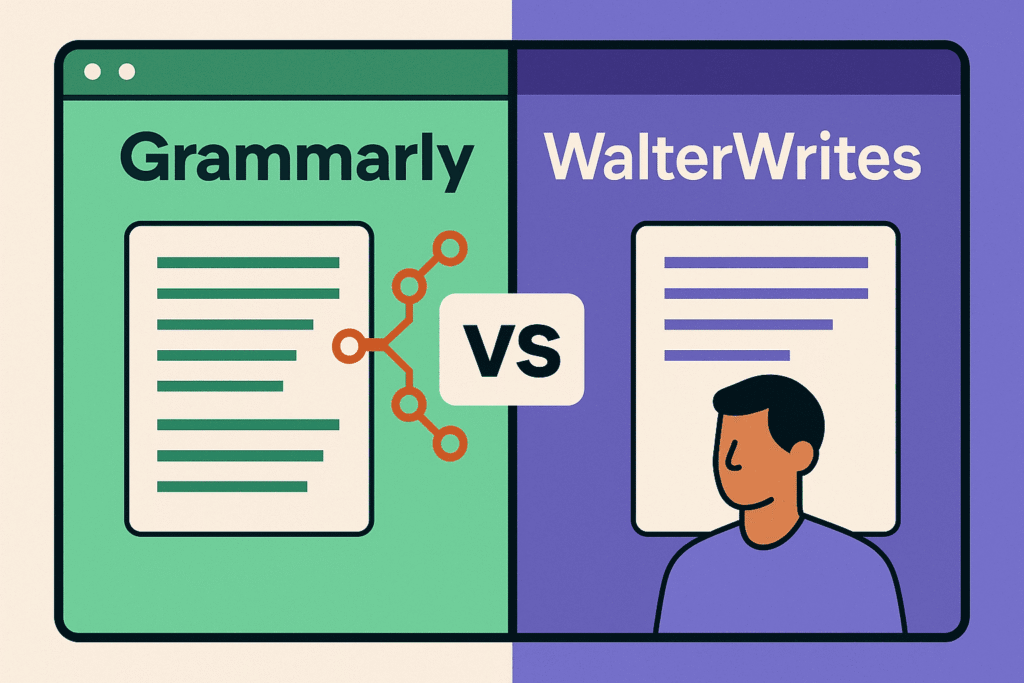
Grammarly Humanizer vs Dedicated AI Humanizers (Including WalterWrites)
| Feature | Grammarly | Humanizing Tools (e.g., Walter Writes) |
|---|---|---|
| Primary Purpose | Polishes text for grammar and clarity | Makes AI text sound human and natural |
| Technology | Grammar rules + NLP | AI detection bypass + rewriting engine |
| Tone & Style | Crisp, polished, and professional | Conversational, realistic, and varied |
| AI Detection | Includes an AI detector | Helps bypass AI detectors |
| Best Use Case | Editing human-written content | Rewriting AI-generated text |
At some point the question stops being “does Grammarly Humanizer work” and becomes “is this the right tool for the job.” Grammarly is built as a writing assistant first. Dedicated AI humanizers like WalterWrites are built as infrastructure for AI to human text. That shift in purpose changes how deep the rewrite goes, how it handles AI detection, and how much control you get over things like SEO and brand language.
Depth of humanization
Grammarly Humanizer is intentionally conservative. It is tuned to keep your meaning, tidy up the language, and stay close to your original style. That is great if you want a safety net inside your day to day writing tool. It is less great if your draft is 90 percent AI and you need it to feel like a real, slightly messy human wrote it.
You can think of it like this:
- Grammarly Humanizer is a smart rewrite layer attached to a grammar checker. It improves clarity, trims repetition, and softens the “I was written by ChatChatGPT at 3 a.m.” vibe.
- A dedicated AI humanizer is built to actively break AI patterns, vary structure, and reshape the text so it reads like genuine human work over thousands of words.
In practice that means Walter goes deeper. Instead of just smoothing the surface, it can restructure paragraphs, change pacing, and introduce more natural variation in a way that is closer to how a human expert editor would work. If you want to see how that philosophy compares with simple paraphrasing, there is a whole breakdown of AI humanizer vs AI paraphraser that gets into the differences.
For people who mostly rely on AI to get a full first draft, this extra depth is what turns “slightly less robotic” into “this actually sounds like me.” It is why a lot of writers start with Grammarly Humanizer, then go looking for a more serious Grammarly Humanizer alternative once the stakes and word counts go up.
AI detection and transparency
On the detection side, Grammarly and WalterWrites care about similar things, but they operate at different layers.
Grammarly has its own AI detection features and Authorship style signals built into the ecosystem. The story there is transparency. It wants students, teams, and companies to be able to see when and where AI was involved, and to keep them inside a responsible use zone. The Humanizer fits that philosophy. It cleans things up but does not pretend that AI was never part of the process.
WalterWrites treats detection as part of the core workflow, not a side feature. The whole product is designed around the loop of:
- Generate or paste AI text
- Humanize it to a chosen level
- Run a proper AI detection check on the result
- Iterate until you are comfortable with both the style and the detection score
For people working under AI policies, that loop is the product. They are thinking about acceptable AI percentages, false positives, and the difference between “this was lightly assisted” and “this looks fully machine generated.” If that is you, it is worth spending a few minutes with the guides on how AI detectors work and what AI detection scores actually mean, because detection is not as simple as a green or red light.
So while Grammarly Humanizer can sometimes lower AI scores as a side effect of rewriting, WalterWrites is intentionally built as both a humanizer and an AI checker in one stack. That makes it easier to build repeatable, policy aligned workflows instead of guessing and hoping.
Control for SEO and brand content
If you are doing serious content work, control starts to matter more than convenience.
Grammarly Humanizer is excellent for readability. It will tidy up awkward phrasing in a product description, landing page, or blog paragraph. What it does not really give you is fine grained control over things like:
- Which keywords should never be changed
- How aggressively certain sections can be rewritten
- Different tones or risk levels for different content types
If you are working on campaigns or growth content, you can also layer this with things like an AI text enhancer or AI rewriter flow when you need to refine, expand, or repurpose humanized drafts without reintroducing that “fresh from the model” feel.
This is where the real line gets drawn. Grammarly Humanizer is perfect when you mostly want to polish language while staying inside one familiar app. WalterWrites and other top tier AI humanizer tools make more sense when your job is to ship a lot of AI assisted content that has to sound human, stay on brand, rank in search, and hold up under AI detection all at the same time.
When You Should Use Grammarly Humanizer vs WalterWrites
There is nothing wrong with using both tools. The real question is when Grammarly Humanizer is all you need and when it starts to hold you back.
When Grammarly Humanizer is enough
Grammarly Humanizer is at its best when you already live in the Grammarly ecosystem and your main goal is to clean up the rough edges of your writing.
It is usually the right choice when:
- You are drafting mostly on your own and only using AI as a light assistant
- You want to fix stiffness, repetition, and tone in short pieces like emails, internal docs, or social posts
- You are fine with a quick AI rewrite that still feels roughly like your original draft
If you spend your day inside Gmail, Google Docs, or a CMS with the Grammarly extension on, the Humanizer is a nice extra layer. You highlight the awkward paragraph, run the AI Humanizer, accept or tweak the rewrite, and move on. In that context, you are not obsessing over AI detection percentages or building complex workflows. You just want your writing to sound more human and less like a raw ChatChatGPT reply.
For a lot of people in that bucket, Grammarly’s humanizer is more than enough.
When Walter is the better choice
Things change once you lean heavily on AI for full drafts, or you are working in an environment where AI use is actually monitored.
Walter makes more sense when:
- Most of your first drafts are AI generated and you need them to read like real human work from start to finish
- You care about AI detection risk at schools, universities, or inside a company policy
- You need control instead of just surface level polish
Here are a few concrete examples where a dedicated Grammarly Humanizer alternative like Walter is a better fit:
- You are a student using AI to help brainstorm and draft, but your university uses AI detectors and you need to stay inside an acceptable range. The humanizer for students is built with that context in mind.
- You write long form content for SEO, where frozen keywords, entities, and brand phrasing matter. Walter lets you humanize text while protecting those terms, then double check everything with an AI detection checker.
- You work on essays, research summaries, or academic style content that cannot afford to be flattened by generic paraphrasing. The academic oriented humanizer and the broader AI humanizer flows are built to preserve nuance while still breaking AI patterns.
In that world, you are not just asking “can this sound less robotic.” You are asking:
- How much AI is too much for this assignment or review process
- Which parts of the text are safe to rewrite and which lines must stay exactly as written
- Whether your final draft will raise flags in one or more detectors
That is where Walter’s full pipeline approach starts to matter. You can humanize Grammarly AI text or any other AI draft, freeze critical phrases, pick how aggressive the rewrite should be, then measure the result instead of guessing. If you want a bigger picture on how that all ties together, there is a full guide on humanizing AI text properly.
Simple rule of thumb
If your main concern is sounding more natural to a human reader and you are already inside Grammarly all day, stick with Grammarly Humanizer for quick cleanup.
If your main concern is shipping a lot of AI assisted content that needs to feel human, respect SEO and brand rules, and hold up under AI checks, treat Grammarly as a helpful editor and WalterWrites as the actual humanization and detection layer that sits on top of everything else.
How To Humanize Grammarly And ChatChatGPT Content With WalterWrites (Step By Step)
If you are already drafting with ChatChatGPT and polishing in Grammarly, you are halfway there. WalterWrites simply becomes the final layer that turns “this sounds okay” into “this sounds like a real person wrote it” while giving you proper AI detection checks and more control.
Here is a clean, practical workflow you can steal.
Step 1: Paste your AI text from Grammarly, ChatChatGPT, or any LLM
Start wherever you like:
- Generate your draft in ChatChatGPT or another model
- Run a quick cleanup with Grammarly Humanizer if you want that first pass
- Accept the version you are happy with
Then copy that text and paste.
At this point it does not matter whether the content started in ChatChatGPT, Gemini, Claude, or straight from Grammarly AI. Walter treats it all as AI influenced text and is built to turn that into something that reads as genuinely human.
If you are doing this a lot and want to tighten up the upstream process too, it is worth skimming the guides on how to make ChatChatGPT sound more human and how to rewrite AI generated text properly. The better your starting draft, the more room Walter has to focus on nuance instead of basic cleanup.
Step 2: Configure humanization depth, tone, and frozen keywords
Once your Grammarly or ChatChatGPT text is in WalterWrites, you choose how aggressive you want the humanization to be.
In practice that means you can:
- Set the rewrite strength, from light “polish this” edits to deeper restructuring
- Pick or hint at the tone you want, for example student, legal, academic, ecommerce, or email style, using flows like the student humanizer or essay focused humanizer
- Freeze important words and phrases so they are never touched, such as brand names, legal wording, SEO keywords, or course codes
That last part is where Walter pulls away from simple paraphrasing tools. You can keep the critical pieces of your message intact while letting the system completely reshape the sentences around them. For heavier use cases, you can also treat it like an AI text enhancer when you want to refine or expand what is already there without reintroducing that bland AI feel.
The goal of this step is simple. You tell Walter how much freedom it has and what must not change. It then does the “AI to human” work inside those boundaries.
Step 3: Run detection, tweak, and export
After humanization, you do what Grammarly Humanizer does not natively give you in one place. You check the result.
From here you can:
- Run an AI detection check or a deeper AI detection checker test on your new draft
- Look at how the text scores across different detectors and what that means in plain language
- Decide whether you want another round of humanization or just a few manual edits
If you are writing in a context where acceptable AI percentages matter, pairing this with the explanation in AI detection score meaning will help you understand what “safe enough” actually looks like.
Once you are happy with both the voice and the detection profile, you simply copy the final text back into your LMS, CMS, Google Doc, or email platform. Over time this becomes a habit: draft with AI, polish if you like in Grammarly, then send everything through WalterWrites as your last mile humanizer and checker.
If you want to see what that looks like in more detail, the full humanize AI text guide walks through more examples and use cases across students, professionals, and content teams.
Responsible Use: Grammarly Humanizer, WalterWrites, And Academic Integrity
It is impossible to talk honestly about Grammarly Humanizer or any AI humanizer without touching the ethics piece. The tools are not the problem. How they get used is.
Grammarly’s whole positioning leans into “write better with AI” rather than “hide the fact you used AI.” The Humanizer exists to clean up clunky AI phrasing and make your writing clearer and more natural. WalterWrites is similar in that sense. It is built to help you turn AI to human text and understand your AI detection risk , not to promise some magical, consequence free “undetectable AI” button.
Where things get tricky is in schools and high stakes academic or professional settings.
Teachers, professors, and institutions are under pressure to respond to AI. Many now use dedicated AI detector tools , classroom platforms, or even LMS integrations to flag suspicious work. There is also a growing conversation about what counts as acceptable AI assistance, how AI detection scores actually work, and when “help” crosses the line into misrepresentation.
If you are a student, the safest rule is simple:
- If your school or professor explicitly says “no AI,” using a humanizer to hide AI involvement is risky and can count as academic misconduct.
- If AI is allowed in a limited way, focus on using tools to draft, organize, and clarify your own ideas, then use something like WalterWrites to refine and check, not to generate the whole assignment for you.
Guides like can teachers detect ChatChatGPT, how professors detect AI and the overview of AI detection in education are worth a read if you are in that world. They explain how detection fits into teaching rather than just punishment.
On the Walter side, the goal is to support responsible use, not encourage you to outsmart every check in sight. That is why there is so much emphasis on:
- Understanding how detectors behave
- Knowing what an “AI percentage” actually means in context
- Giving you visibility into your text with tools like the AI detection checker test
The healthiest way to use Grammarly Humanizer and WalterWrites together looks something like this:
- You use AI to help brainstorm, outline, and draft, but you stay involved and keep your own thinking in the loop.
- You let Grammarly Humanizer smooth the rough edges so the writing feels more natural for a human reader.
- You run the result through WalterWrites to humanize more deeply where needed and to understand how it might look under AI detection.
- You decide, as the human in charge, whether this aligns with the rules and expectations in your class, company, or industry.
If the only goal is to “beat AI detectors,” you are already on thin ice. If the goal is to write faster, sound more like your best self, and stay honest about the role AI played, these tools can actually make that easier. They give you better inputs and better visibility so you are not guessing in the dark.
If you want a broader perspective on where all of this is heading, the piece on the future of AI detectors is a good way to zoom out. It shows why trying to stay one step ahead of detection forever is a losing game, and why building a responsible, transparent workflow around AI use is a much more sustainable strategy.
FAQs About Grammarly Humanizer And AI Humanization
Does Grammarly have a humanizer tool?
Yes. Grammarly has a built in AI Humanizer that you can use from inside the regular Grammarly interface. It shows up as one of the AI actions or agents you can call on a selected piece of text. You do not need a separate app or browser tab.
If you want a bigger picture of how humanizers work in general, not just inside Grammarly, you can skim this overview of what an AI humanizer is and how it differs from simple paraphrasing
Is Grammarly Humanizer free to use?
There is a free way to try it, but it is not fully unlimited.
On the free Grammarly plan you get a small pool of AI actions, and the humanizer pulls from that pool. That is usually enough to experiment on a few paragraphs or short pieces. If you start using Grammarly Humanizer heavily on long essays, SEO articles, or client work, you will hit the cap and need a paid plan to keep going.
So the honest version is: you can test Grammarly Humanizer for free, but day to day reliance on it lives on the paid tiers.
Can Grammarly Humanizer bypass AI detection?
Sometimes it will lower AI scores. Sometimes it will not. It is not built or marketed as a guaranteed way to bypass AI detection systems.
When you run AI generated text through the humanizer, it changes sentence structure, word choice, and rhythm. That can make the text look less obviously AI to some detectors. Other tools can still flag it, especially if the original draft was heavily AI written.
If AI risk really matters in your world, you are better off treating Grammarly as a polishing step and then running your draft through a dedicated AI detection check or a full AI detection checker test. That way you are looking at actual scores instead of guessing. The explainer on how AI detectors work is also useful context here.
Is Grammarly Humanizer good for long form content like blog posts or essays?
It helps, but it has limits.
On long form content, Grammarly Humanizer tends to improve readability and tone, especially on sections that feel stiff or repetitive. It is very good at cleaning up surface level language. Where it starts to struggle is with deep structure, voice consistency across two thousand plus words, and high stakes detection scenarios.
If you are working on long essays, research style writing, or in depth SEO content and relying heavily on AI for first drafts, you will usually get better results from a tool that is built specifically as an AI humanizer for essays and academic work, an SEO Content Humanizer or for students and academics Grammarly can still be part of the process, but it should not be your only line of defense
What are the best Grammarly Humanizer alternatives?
It helps to think in categories rather than chasing a single “best” tool.
You have:
1. General AI writing suites that include some rewrite or “human sounding” modes
2. Dedicated AI humanizers that focus almost entirely on AI to human text, often with detection and controls built in
3. Classic paraphrasing tools that mostly spin wording and should be used very carefully
WalterWrites lands in the second group. It is built as an AI humanizer plus detection layer, with controls like keyword freezing, tone presets, and flows for different roles such as students, educators, and ecommerce or marketing teams.
If you are comparing options, the roundup of top AI humanizer tools gives a broader look at the landscape and how Walter fits into it.
Can I humanize ChatChatGPT content in Grammarly and then run it through WalterWrites?
Yes, and that is actually a very practical workflow.
A simple pattern looks like this:
1. Draft with ChatChatGPT or another LLM.
2. Clean up the roughest edges with Grammarly Humanizer if you like working in that environment.
3. Paste the result into WalterWrites to do the deeper AI to human conversion and run an AI detection check before you submit or publish.
This gives you the convenience of Grammarly inside your usual tools, plus a final layer that is built for humanization and detection from the ground up. If you are doing this regularly, the how to humanize AI text guide and the piece on rewriting AI generated text the right way will help you tighten up that pipeline so you get better outputs with less manual stress
Final Thoughts
At this point you have a pretty clear picture of what Grammarly Humanizer is good at and where it starts to tap out. It is a polished, convenient way to tidy up AI written text inside a tool you already use, especially for emails, shorter pieces, and everyday writing. When the stakes are higher and you are working with full AI drafts, detection risk, or strict SEO and brand rules, you need something that treats AI to human text as the main job, not a side feature.
If that is where you live, let Grammarly keep doing what it does best and let Walter handle the rest. Paste your AI or Grammarly Humanizer output into WalterWrites, run it through the AI humanizer, and then check it with the built in AI detector. You will spend the same five minutes, but you get a final draft that sounds like you, respects your constraints, and comes with a lot fewer question marks
For developers building their own AI workflows, Walter offers an AI Humanizer API with native Grammarly-output handling and production-scale throughput.