



Nowadays, AI tools are extensively used for content writing. This widespread usage has also created a need for reliable AI detection tools such as ZeroGPT and GPTZero. The main question that arises is whether these tools are 100% reliable.
One instance that helps answer this question is when a professor ran her own notes through an AI detector. To her surprise, the tool labeled the notes as AI-generated when in real they were made even before AI tools were used.
With easy access to AI detectors, their usage has increased rapidly. Students are now questioned about essays they have written on their own, while educators are expected to maintain academic integrity using tools whose accuracy is not always consistent.
Both these tools claim to detect content written by human or AI but their accuracy varies to a great extent. Hybrid content is the most difficult to identify, and false positives remain one of the major loopholes in these tools.
In this article, we compare ZeroGPT vs GPTZero based on real-world behavior, not marketing claims.
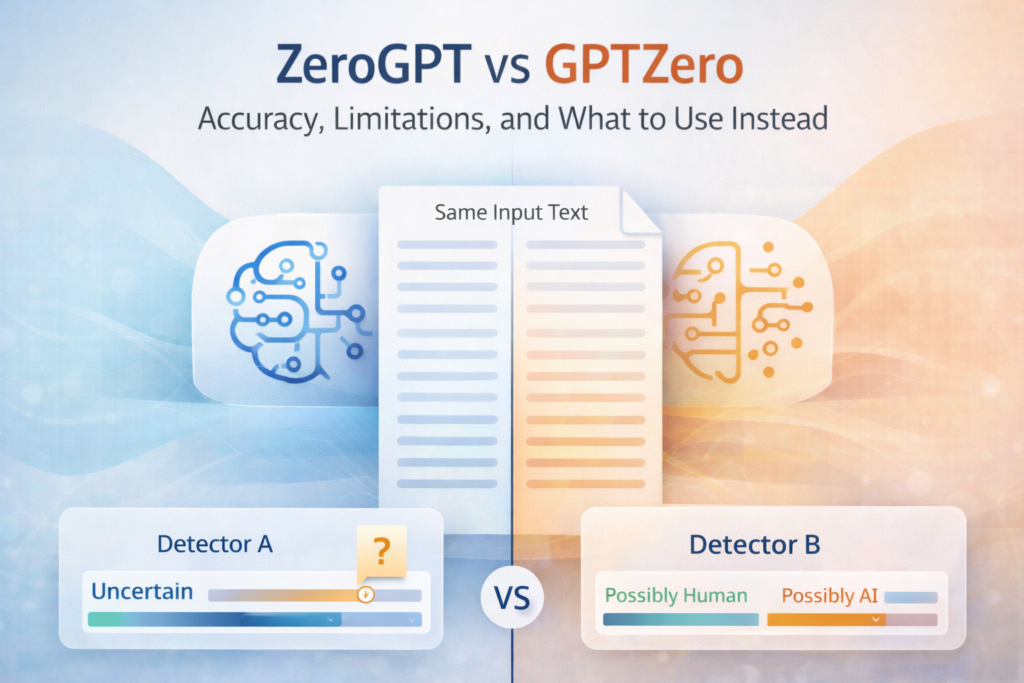
Why AI Content Detection Is Unreliable by Design
AI detection tools have structural limitations, which is why they are not fully reliable. They predict the results on the basis of sentence structure and token estimation to check whether the content is AI generated or not. Hence these structural limitations can only suggest likelihood of AI detection but they can’t be fully relied upon.
Because of this approach, AI detectors can only suggest the likelihood of AI usage. Their results cannot be treated as definitive.
The judgement of the difference between AI generated content and human written content becomes difficult when it is the hybrid form of content that is partly human and partly AI. Collaborative drafts, rewritten passages and formal academic writing are some examples of the content that is very difficult to differentiate into one single category. A small edit may take the content from human written to AI generated.
Discussions during community testing also highlight this issue as users report inconsistent results from the same content over multiple scans, as these tools use probability estimates for their results.
Another limitation is the lack of transparency. The scores generated by these tools cannot be independently verified, making them difficult to interpret confidently.
What Is ZeroGPT?
ZeroGPT is an AI content detection tool commonly used by students, writers, and casual users for general purposes. It is mainly used for quick checks to determine whether content is AI-generated or human-written. Usually used by ChatGPT users.
The tool analyzes the text and provides a confidence score indicating how likely the content is AI-generated. While the process is fast and simple, the results often lack consistency. Repeated scans of the same content can produce different outcomes, and even minor human edits may result in false positives.
Because ZeroGPT avoids detailed explanations, it should only be used for rough screening. It is not suitable for important academic, legal, or publishing decisions.
What Is GPTZero?
GPTZero was originally designed for educational purposes and gained popularity as a classroom-focused AI writing detection tool.
Unlike ZeroGPT, it explains results using terms such as perplexity and burstiness. However, the underlying mechanism remains probabilistic, similar to other AI detectors.
GPTZero also struggles with hybrid content and exhibits limitations similar to ZeroGPT. It can support classroom discussions and content review, but it should not be fully relied upon for enforcement or final judgment.
ZeroGPT vs GPTZero: Limitations, Accuracy Issues, and False Positive Risks
| Feature / Factor | ZeroGPT | GPTZero |
| Primary Target Audience | General users | Students & educators |
| Detection Approach | Probabilistic pattern analysis | Probabilistic, education-focused |
| Transparency of Scoring | Low | Moderate (still opaque) |
| Accuracy Consistency | Inconsistent | Inconsistent |
| False Positive Risk | High | High |
| Performance on Hybrid Content | Poor | Poor |
| Free Version Limits | Strict | Strict |
| Paid Plan Benefits | Higher limits, UI features | Higher limits, classroom tools |
| Suitable for High-Stakes Decisions | ❌ No | ❌ No |
| Best Use Case | Rough checks / curiosity | Classroom discussion support |
Detection Method and Transparency
- Both tools are based on statistical modeling and do not provide direct verification methods. They also fail to offer clear guidance on how detection scores should be interpreted or applied in real-world decisions.
Accuracy and Consistency
- Community reports and independent testing show inconsistent results. The same content may produce different outcomes when scanned multiple times. Even small human edits can change classification results.
False Positives
- A false positive occurs when human-written content is incorrectly detected as AI-generated. This often happens with formal academic or business writing.
- False positives AI detection represents one of the biggest risks of AI detection tools. AI detection should not be considered the only factor in decision-making.
Free vs Paid Limitations
- Paid plans mainly increase usage limits and interface features. They do not significantly improve detection accuracy.
- Many experts believe the real issue lies in how content is presented to these tools. When AI-assisted drafts are carefully edited to sound natural, the effectiveness of AI detectors decreases.
- As a result, humanization tools are often used to refine language, tone, and flow. These tools are intended for editing and review, not as shortcuts or replacements for human judgment or ethical writing practices.
False Positive Risk: Who Gets Affected the Most

- False positives can have serious consequences. Students may be questioned unfairly, educators may misjudge integrity, marketers may discard original content, and business writers may lose confidence in their work.
- The more critical the content, the greater the potential damage caused by false positives.
Human and AI Hybrid Content: Where Detectors Fail
AI tools are widely used for content creation, often followed by human editing. As a result, hybrid content has become common. AI detection tools struggle to categorize such content accurately as either human-written or AI-generated.
Detection Does Not Equal Intent
Using AI tools does not automatically indicate dishonesty. Many writers use AI for structuring or efficiency. Detection results alone should not be used to judge integrity.
Real-World Testing vs Marketing Claims
Marketing pages often claim high accuracy, but real-world testing shows significant variability, especially for long-form and hybrid content. This gap between claims and real behavior creates confusion for users.
Do These Tools Still Work in 2026?
Yes, but only in limited contexts. These tools can provide signals, not conclusions. Their results should be interpreted cautiously.
When ZeroGPT or GPTZero Are Useful
These tools can be useful for classroom discussions, awareness, or rough checks driven by curiosity. They should not be trusted for important academic or business decisions.
A Better Approach Than Detection Alone
A better approach includes clear disclosure policies, human review, evaluation of writing quality, and consistent internal standards. AI detection should be treated as one factor, not the final verdict.
ZeroGPT vs GPTZero: Final Verdict
Neither ZeroGPT nor GPTZero can be considered superior. Both share the same structural limitations, struggle with hybrid content, and produce inconsistent results. None of the AI detector tools provide enough reliability for high-stakes decisions.
What to Do If You Need Confidence in Your Content
Professionals should not rely on AI detectors alone. These tools should be used as support, not authority. Human evaluation remains essential.
Tools such as the AI checker on Walter AI should be used as guidance, not as final judgment.
FAQ
1. Which AI detector is more reliable for academic writing?
Academic AI detection is an essential use case for educators. Both ZeroGPT and GPTZero are not consistently reliable for academic enforcement and may produce false positives.
2. Is it safe to submit work checked by ZeroGPT vs GPTZero?
A passing score does not guarantee acceptance. Results can fluctuate.
3. Should marketers use AI detectors before publishing?
AI detectors can highlight patterns, but human review is more valuable for quality and trust.
4. Can AI detectors detect human-edited or hybrid AI content?
No. Hybrid content often confuses detection models.
5. Will AI detectors ever be 100% accurate?
No. As long as humans and AI write in the same space, detection will remain probabilistic.