



Key Takeaway: ZeroChatGPT is a fast, free tool for quick AI detection on structured academic writing, but its high false positive rate on human content and inconsistent performance across creative and mixed writing makes it unreliable for high-stakes use.
- ZeroChatGPT scored the AI essay 97.1% but gave human creative writing 57.8% AI
- Walter Writes scored all human samples between 0-6% AI on the same test content
- No account is required. Free plan allows up to 15,000 characters per scan
- ZeroChatGPT and ChatGPTZero are different tools. ChatGPTZero is more established and slightly more expensive
- Edited or paraphrased AI content can bypass ZeroChatGPT detection
- Scores should never be used as standalone evidence of AI use or authorship
As AI writing becomes harder to distinguish from human writing, many professionals, schools, universities, etc., are increasingly adopting AI detectors. But concerns about accuracy are growing alongside adoption. People aren’t doubting whether they can catch AI output. But whether human writing can be wrongly classified as AI-generated. Like most AI detectors, ZeroChatGPT claims it can distinguish and accurately detect both human and AI content. In this review, we put the tool to a rigorous test. Can it prove it is truly accurate and reliable? Read on to find out.
ZeroChatGPT AI Detector Review: Quick Verdict
In our test, we discovered that ZeroChatGPT is effective at detecting academic-style AI-generated writing. ZeroChatGPT reliability drops when writing becomes heavily edited, more personal, or mixed with human input.
It is therefore best for students who want a quick first-pass scan. It is fast and useful for identifying AI patterns in your content. It is not suitable for schools, teachers, publishers, or editors who require human input devoid of AI. ZeroChatGPT has a high false positive rate on human writing. As a result, it often labels genuine human write-ups as AI-generated. If you want a safer detection capability, you can try Walter Writes AI detector for students, which is more accurate and reliable.
What ZeroChatGPT Claims To Do
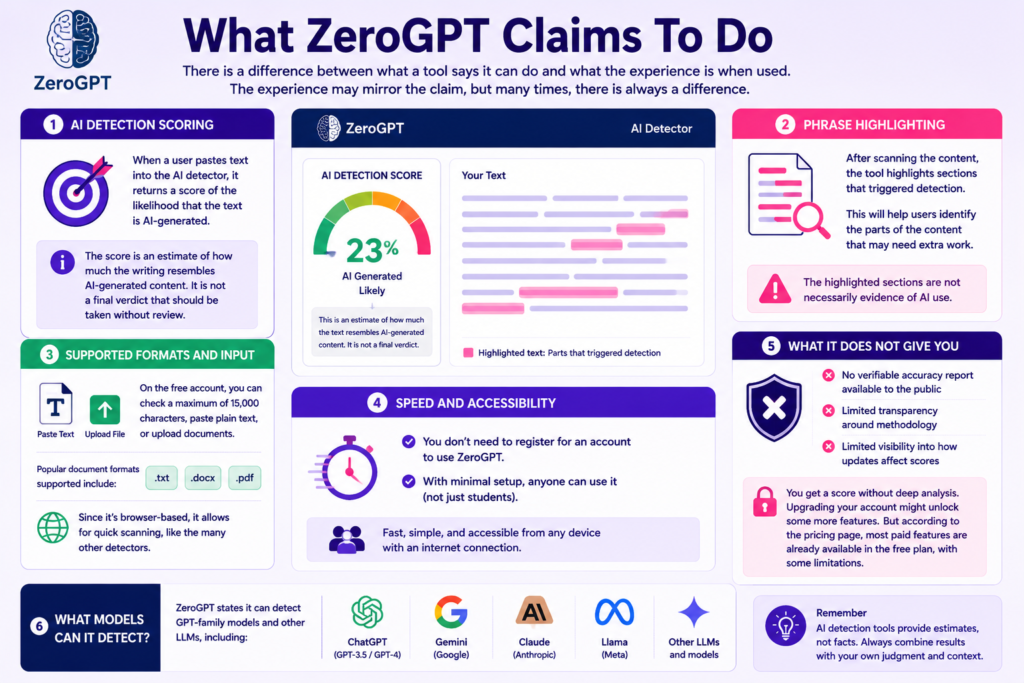
There is a difference between what a tool says it can do and what the experience is when used. The experience may mirror the claim, but many times, there is always a difference.
AI Detection Scoring
When a user pastes text into the AI detector, it returns a score of the likelihood that the text is AI-generated. The score is an estimate of how much the writing resembles AI-generated content. It is not a final verdict that should be taken without review.
Phrase Highlighting
After scanning the content, the tool highlights sections that triggered detection. This will help users identify the parts of the content that may need extra work. The highlighted sections are not necessarily evidence of AI use.
Supported Formats and Input
On the free account, you can check a maximum of 15,000 characters, paste plain text, or upload documents. Popular document formats supported include .txt, .docx, and text-based .pdf. Since it’s browser-based, it allows for quick scanning, like the many other detectors.
Speed and Accessibility
You don’t need to register for an account to use ZeroChatGPT. With minimal setup, anyone can use it (not just students).
What It Does Not Give You
There is no tool without limitations. Just as there are advantages to using ZeroChatGPT, there are also downsides to consider. There is:
- No verifiable ZeroChatGPT accuracy report available to the public
- Limited transparency around methodology
- Limited visibility into how updates affect scores
You get a score without deep analysis. Upgrading your account might unlock some more features. But according to the pricing page, most paid features are already available in the free plan, with some limitations.
What Models Can It Detect?
ZeroChatGPT states it can detect ChatGPT-family models and other LLMs, including Gemini and Claude.
ZeroChatGPT Review: Accuracy vs Reliability
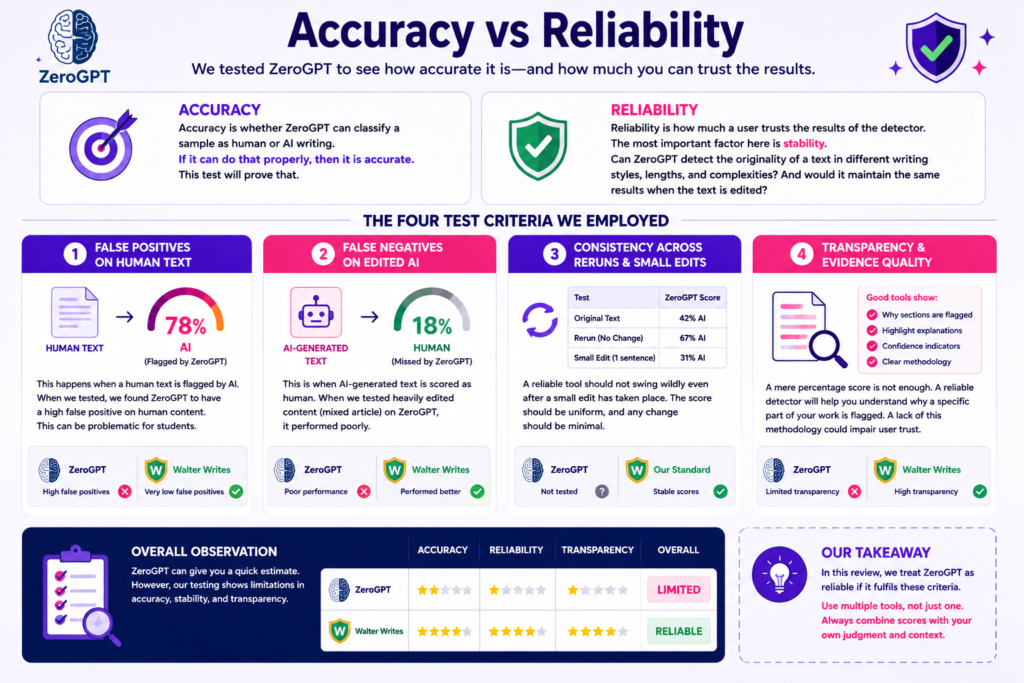
Accuracy is whether ZeroChatGPT can classify a sample as human or AI writing. If it can do that properly, then it is accurate. This test will prove that.
Reliability is how much a user trusts the results of the detector. The most important factor here is stability. Can ZeroChatGPT detect the originality of a text in different writing styles, lengths, and complexities? And would it maintain the same results when the text is edited? We evaluate these and more while testing the capabilities of the AI detector.
The Four Test Criteria We Employed
ZeroChatGPT False Positives on Human Text
This happens when a human text is flagged by AI. When we tested, we found ZeroChatGPT to have a high false positive on human content. Not only does this cause an accuracy issue. It can also be problematic for students who get their human text flagged for AI. A better alternative is Walter Writes AI detector, which has very low false positives when tested against the same samples.
False Negatives on Edited AI
This is when AI-generated text is scored as human, the direct opposite of false positives. When we tested heavily edited content (mixed article) on ZeroChatGPT, it performed poorly. Only Walter Writes performed better in the test.
Consistency Across Reruns and Small Edits
A reliable tool should not swing wildly even after a small edit has taken place. The score should be uniform, and any change should be minimal. If the score differs too much, then the tool may not be reliable. Granted, we didn’t test ZeroChatGPT on this, so we don’t know how it would perform.
Transparency and Evidence Quality
A mere percentage score is not enough. A reliable AI content detector will help you understand why a specific part of your work is flagged. A lack of this methodology could impair user trust in tools. In this review, we treat ZeroChatGPT as reliable if it fulfills these criteria.
How to Use ZeroChatGPT Responsibly
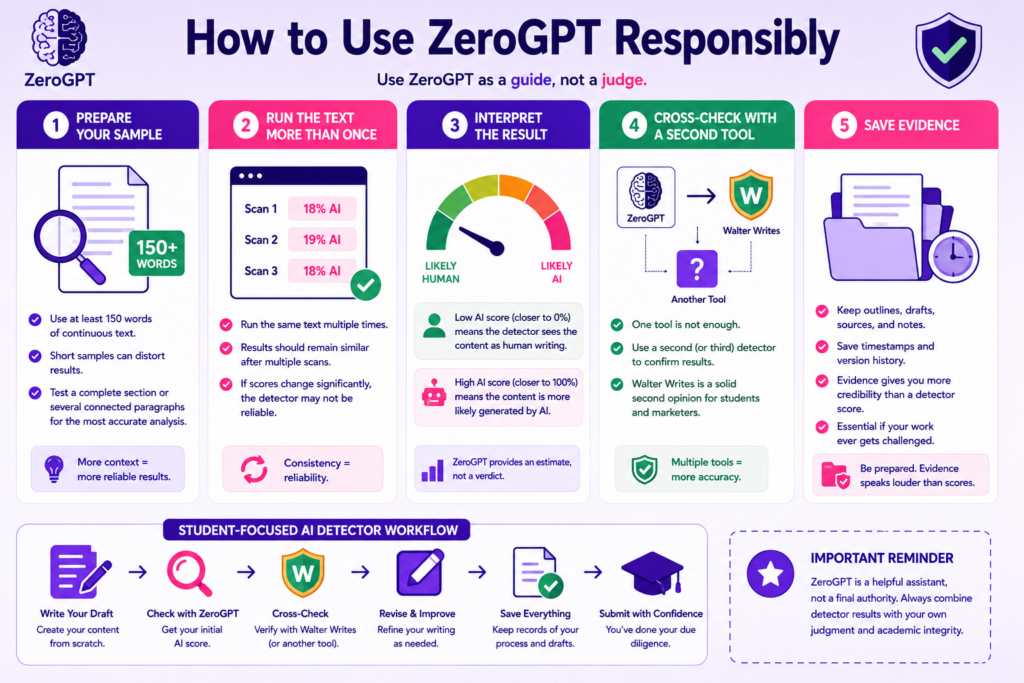
Prepare Your Sample
When testing a sample, make sure the content is at least 150 words. The reason is that short sections can distort results. ZeroChatGPT needs enough context to assess writing patterns. If you need to test a part, make sure it has several connected paragraphs or a complete section.
Run the Text More Than Once
This shows how stable the detector is. If results are inconsistent, then the detector may not be reliable. The results should remain the same after multiple scans. If the score changes significantly, use another detector for confirmation.
Interpret the Result
Naturally, you’ll get a percentage score when you test a sample with ZeroChatGPT. It’ll be between two extremes: Likely human and Likely AI. If the AI score is low, then it means the detector sees the content as human writing. A higher AI score means that AI generated the content.
Cross-check with a Second Tool
If you’re a student or marketer, you need more than reliability in a detector. You also need accuracy. Testing with a second tool will reveal whether the result you get is stable across systems. You can use Walter Writes, AI detector for students, to get a second opinion.
Save Evidence
If you’re a student, your instructor may also be using a detector to check your work. While your work may pass in one detector, it may come up weak when tested in another. You should be prepared for such a scenario. Keep outlines, drafts, sources, notes, timestamps, etc. Evidence will give you more credibility than a detector score. And especially useful when your work is challenged. Check your work with a student-focused AI detector workflow.
ZeroChatGPT AI Detector Stress Test: How Accurate Is It?
| Use Case | AI-Generated | Real Human | Mixed Article (How to) |
| Essays | 97.1% AI ✅ | 33.5% AI ❌ | – |
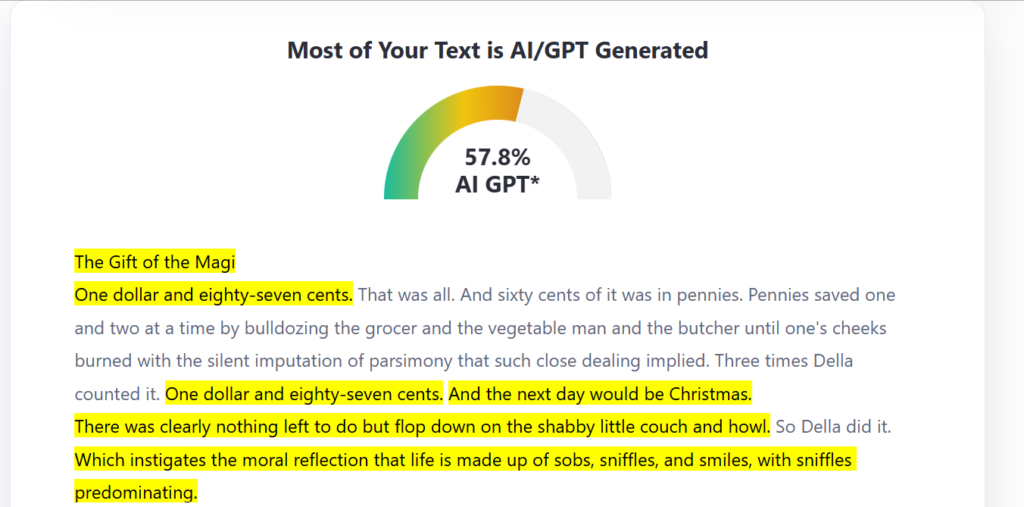
| Creative Writing | 30.1% AI ❌ | 57.8% AI ❌ | |
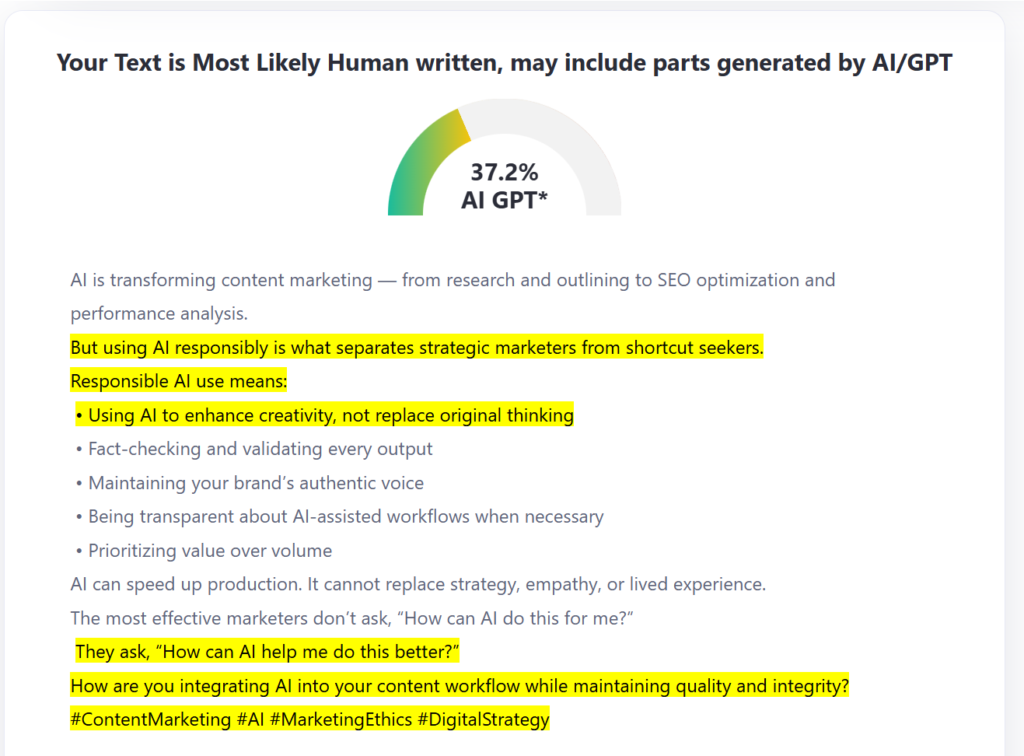
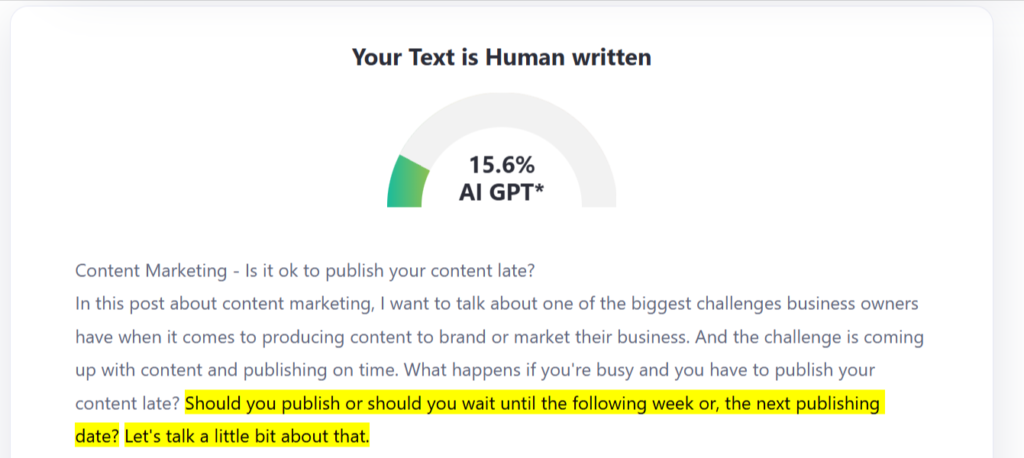
| LinkedIn Post | 37.2% AI ❌ | 15.6% AI ✅ | |
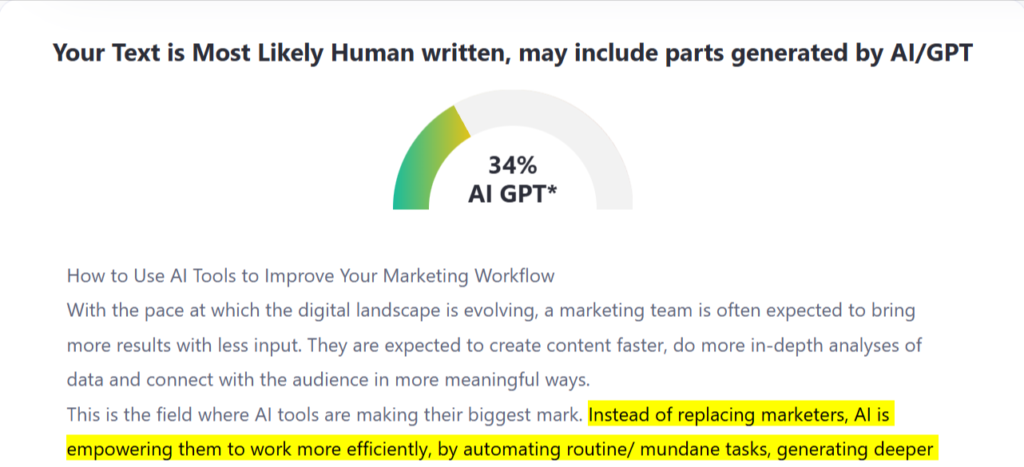
| Mixed (AI Article → Human Paraphrased) | – | – | 34% AI ✅ |
| Average | 54.8% AI | 35.6% AI | 34% AI |
The Experiment
In this experiment, we evaluate how ZeroChatGPT classifies content of different types. The goal is to determine whether it can accurately identify AI content while observing:
- How confidently can it label various writing styles?
- Whether the length and complexity affect detection accuracy
- How human editing influences AI scores
A total of 7 samples were used in the test. We aim to test three questions and how the detector performs in each:
- Can ZeroChatGPT distinguish between human and AI writing?
- Can paraphrasing reduce AI detection scores?
| Category | Human Version | AI Version |
| Essay Writing | Yes | Yes |
| Creative Writing | Yes | Yes |
| LinkedIn-Style Post | Yes | Yes |
| Mixed Content | N/A | Yes |
Test Samples Used for the Experiment
- AI and a human-written essay
- AI and human-written creative writing
- AI and a human-written LinkedIn-style post, and
- Mixed (AI Article → Human Paraphrased) post
Here are links to the samples:
- Essay: AI (Impact of Artificial Intelligence) and Human (Is Google Making Us Stupid?)
- Creative Writing: AI (A Student’s Nightmare) and Human (The Gift of Magi)
- LinkedIn Post: AI (Using AI for Content Marketing) and Human (Is It Okay to Publish Content Late?)
- Marketing Article: Mixed (How to Use AI Tools)
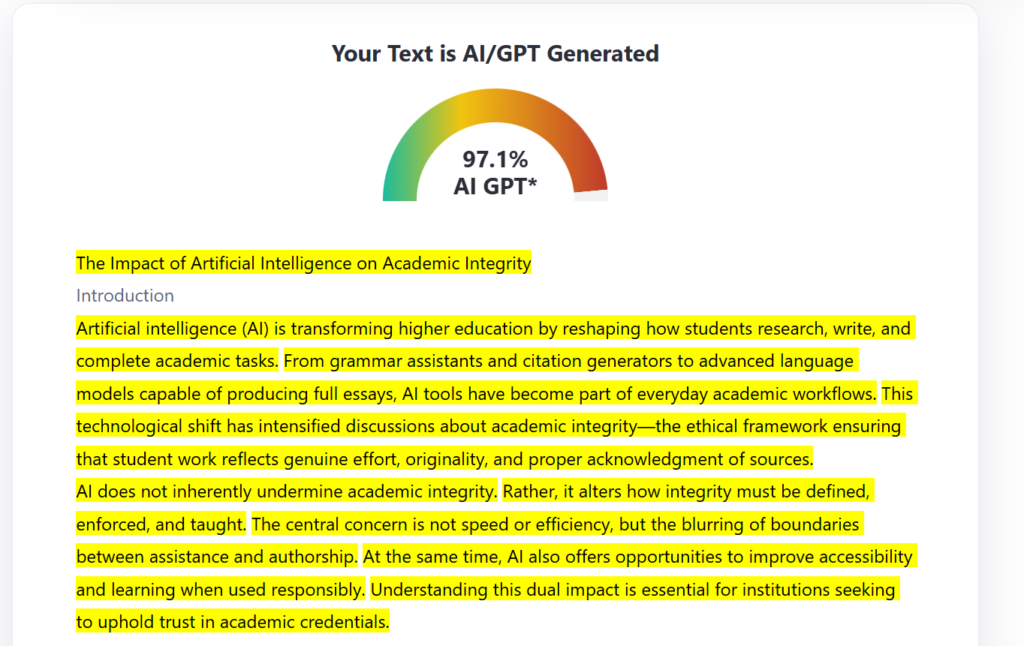
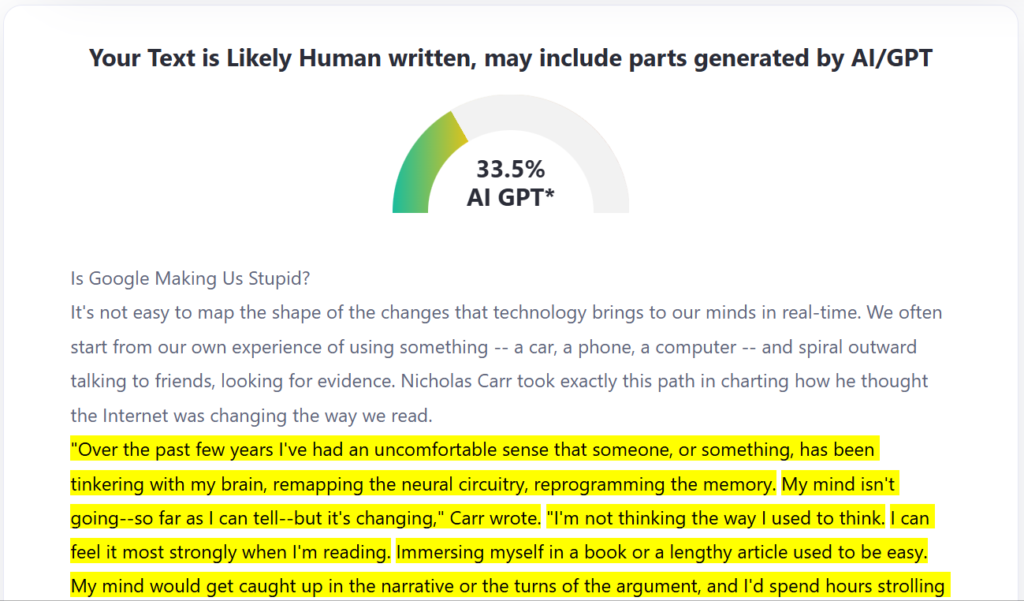
ZeroChatGPT AI Detector Results: AI and Human Essay
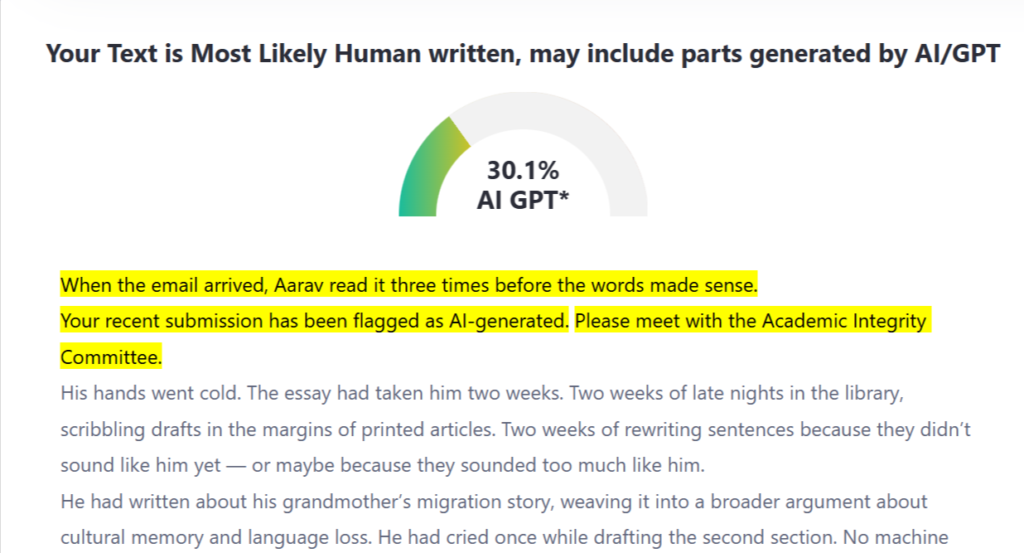
ZeroChatGPT AI Detector Results: AI and Human Creative Writing
ZeroChatGPT AI Detector Results: AI and Human LinkedIn Post
ZeroChatGPT AI Detector Results: Mixed Marketing Article
Our Observations Based on Test Results
- ZeroChatGPT scored the AI-generated essay 97.1% AI. This suggests that it is strongest when analyzing content with predictable argument flow and uniform sentence construction.
- In the creative writing section, the sample scored 57.8% AI. The detection confidence reduced significantly, compared to the essay sample. This suggests that narrative variability may mask AI patterns.
- Human-written content received similar scores of 30.1% and 33.5%. This demonstrates that the detector uses a probabilistic system. It can’t really verify the originality of content. When human writing is structured, has a predictable rhythm, and is grammatically sound, it may trigger high AI scores.
- The mixed sample scored 37.2% AI, which means human editing may disrupt AI-detection patterns. Most importantly, hybrid writing is more difficult to classify reliably.
Final Assessment
The detector demonstrated:
- Strong performance on overtly AI-generated academic writing
- Moderate performance on mixed and creative writing
- Very weak performance on an AI-generated social media post
The experiment further emphasizes the fact that ZeroChatGPT AI detector cannot prove the authorship of content. The tool only estimates statistical probability based on known AI writing patterns. This can be disrupted with enough human editing. This means that the AI scores from detectors like ZeroChatGPT should be treated with caution. It may lead to false positives with serious negative consequences.
ZeroChatGPT AI Detector vs Walter Writes AI Detector
Side-by-Side Results Table
| Sample Type | Use Case | ZeroChatGPT | Walter Writes | Winner |
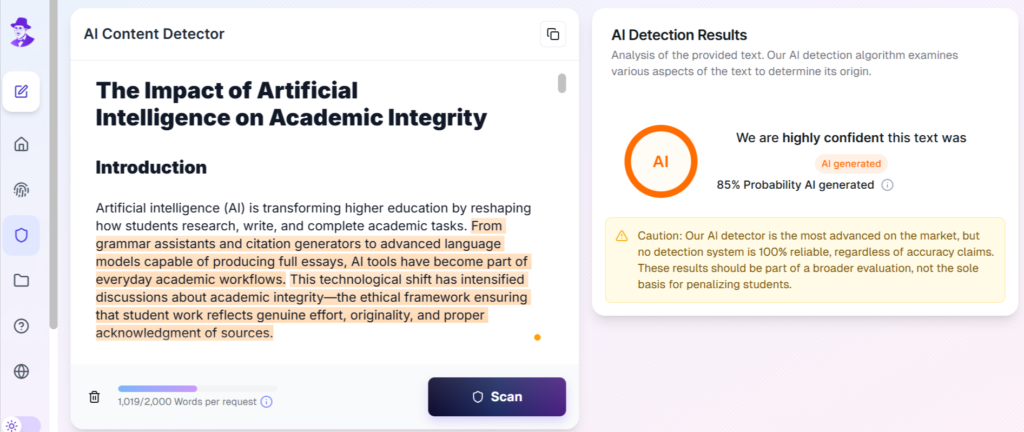
| AI-Generated | Essay | 97.1% AI ✅ | 85% AI ✅ | Both |
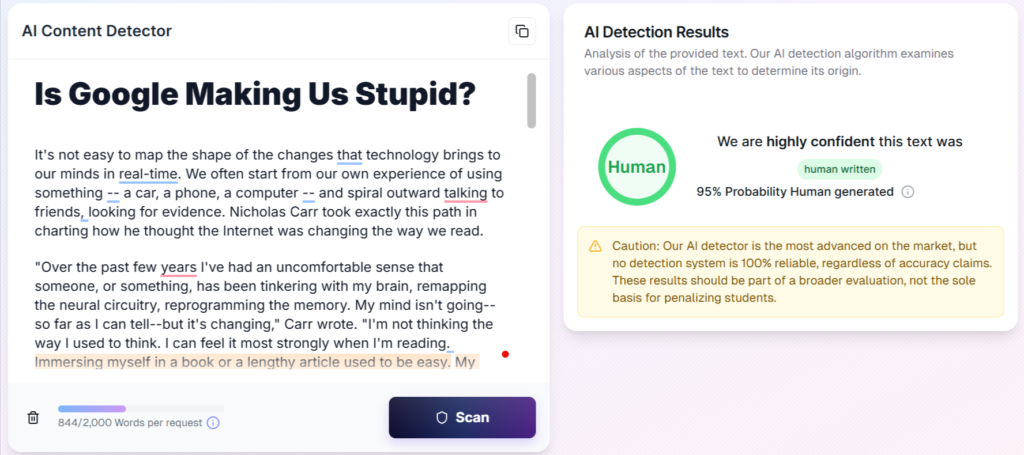
| Human | Essays | 33.5% AI ❌ | 6% AI ✅ | Walter Writes |
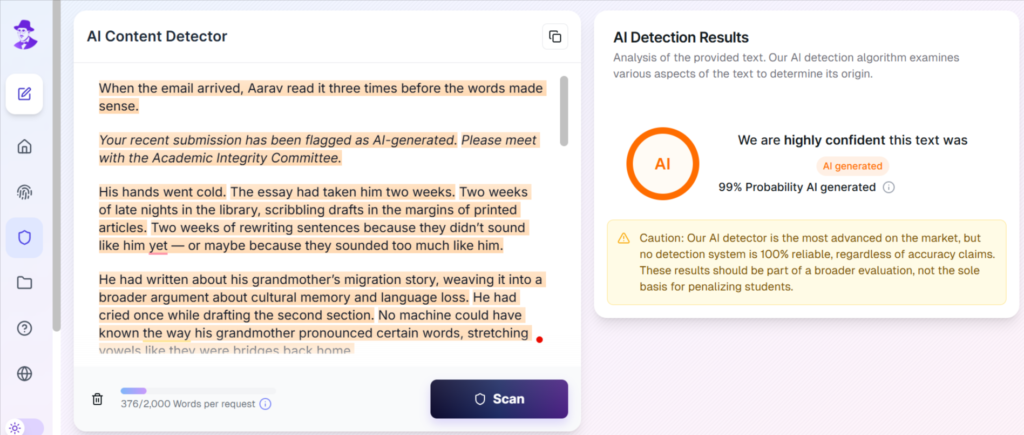
| AI-Generated | Creative Writing | 30.1% AI ❌ | 99% AI✅ | Walter Writes |
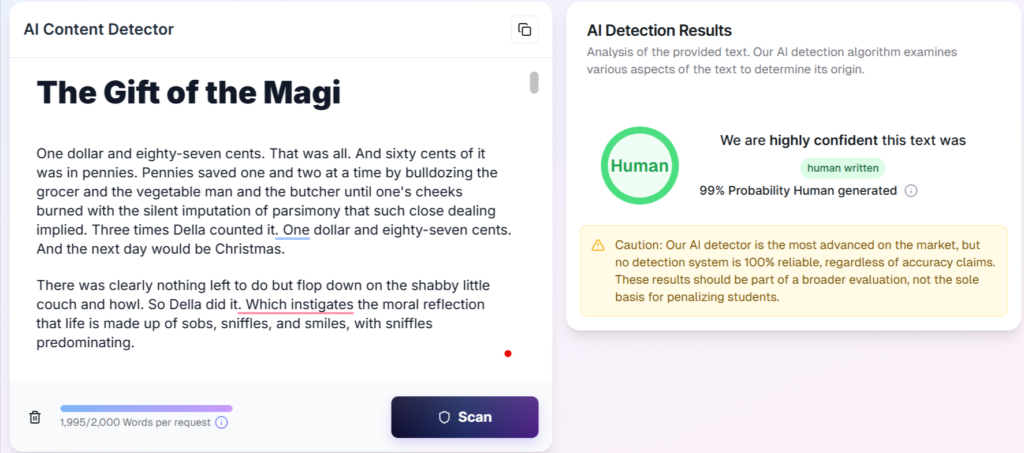
| Human | Creative Writing | 57.8% AI ❌ | 0% AI ✅ | Walter Writes |
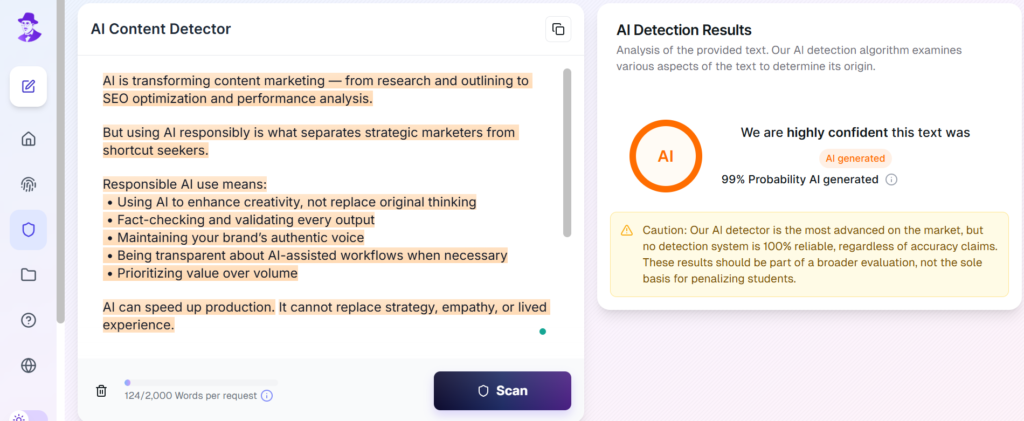
| AI-Generated | LinkedIn Post | 37.2% AI ✅ | 99% AI ✅ | Both |
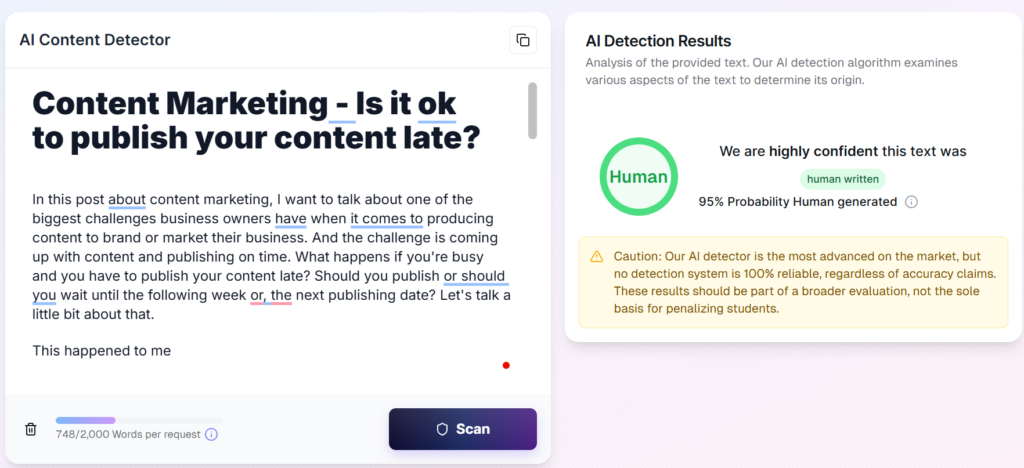
| Human | LinkedIn Post | 15.6% AI ❌ | 6% AI ✅ | Walter Writes |
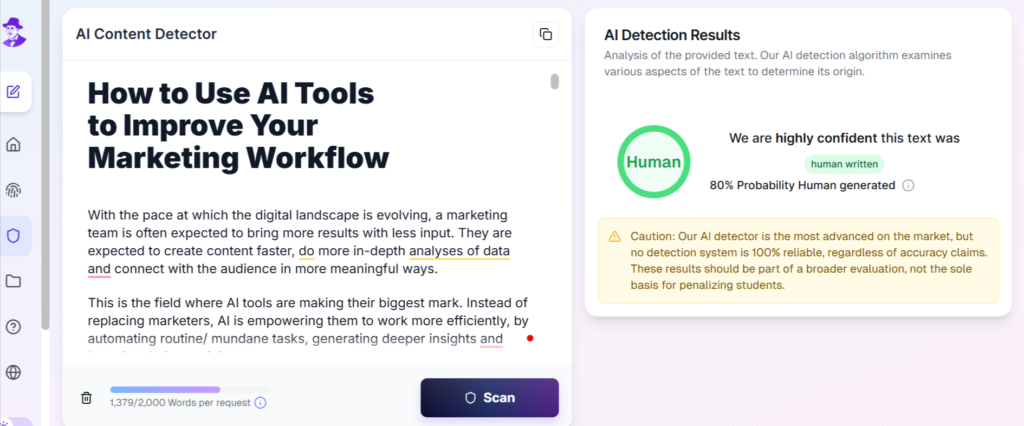
| Mixed (AI Article → Human Paraphrased) | Article | 34% AI ✅ | 20% AI ✅ | Both |
Walter Writes AI Detector Results: AI and Human Essay
Walter Writes AI Detector Results: AI and Human Creative Writing
Walter Writes AI Detector Results: AI and Human LinkedIn Post
Walter Writes AI Detector Results: Mixed Marketing Article
Comparative Analysis: Walter vs ZeroChatGPT
Consistency
Walter Writes AI was more consistent across all seven samples. It correctly identified both AI-generated and human-written content in all the samples. Human samples consistently received low AI scores (0-6%), while AI-generated samples received high scores (85-99%).
ZeroChatGPT was less stable. While it strongly detected the AI-generated essay (97.1%), it struggled with creative writing and prose. It ended up scoring the creative writing sample 57.8% AI and the AI-generated one 30.1% AI.
False Positives/Negative Rates
- ZeroChatGPT produced more false positives by flagging human-written content as AI-generated. This is especially noticeable in the human essay (33.5% AI) and creative writing (57.8% AI).
- It also showed more false negatives by under-detecting AI-generated creative writing (30.1% AI) and LinkedIn content (37.2% AI).
- Walter Writes has fewer false positives and negatives. It can maintain a strong classification accuracy across genres.
Detection Accuracy
Walter Writes achieved the highest overall accuracy. It correctly classified nearly all samples under the testing conditions. On the other hand, ZeroChatGPT performed reliably on only structured academic AI essays. Overall, Walter Writes has proven more dependable, balanced, and adaptable across different writing styles.
Overall Verdict
Walter Writes is the most accurate and consistent of the two. It identified both AI-generated and human-written samples in all genres. ZeroChatGPT assigned suspicious AI scores to human writing. It even failed to detect AI-generated creative writing. ZeroChatGPT’s weakness lies in its lack of clarity in the middle range. It consistently gave human samples very low AI scores, making it unreliable as its counterpart.
Walter Writes is the superior detector in this test based on several factors:
- AI samples received high AI scores
- Human samples received very low AI scores
- Mixed content was treated as low-to-moderate AI rather than full AI.
Pricing Tiers (Pros & Cons)
| Plan | Price | Best for | What You Get | Limitation(s) |
| Free | $0 | Casual checks | Basic AI detection, 15,000 character limit/scan | Limited use, ads |
| Pro | $7.99/m | Students/writers checking more text | 100,000 character limit, 50 batch files, PDF reports, detection history | Still not proof of AI authorship |
| Plus | $14.99/m | Teams, publishers, heavier users | 100,000 character limit, 60 batch files, PDF reports, detection history | Better access ≠ better reliability |
| Max | $18.99/m | Companies needing workflow integration | 150,000 character limit, 75 batch files, PDF reports, detection history | May require policy and human review process |
ZeroChatGPT vs Turnitin
ZeroChatGPT positions itself as a public web-based detector. It is available to students/marketers who want a quick self-check. Turnitin is more of an institutional tool and isn’t as accessible as ZeroChatGPT. Institutions mostly use Turnitin to evaluate students’ academic submissions. While ZeroChatGPT is a standalone checker, Turnitin is used in a formal academic process. ZeroChatGPT doesn’t have a built-in appeal system. So, it may not be easy for students to provide drafts or sources to back their submission. This is one of the strongest points of Turnitin and the best AI checkers for teachers.
Turnitin is often connected to classroom submission systems, while ZeroChatGPT is copy-paste or upload-based. ZeroChatGPT doesn’t have an official review process. However, institutions using Turnitin have policies surrounding how AI scores are used. Walter Writes covers college AI detector policies here.
Best Alternative If You Need a Reliable Workflow
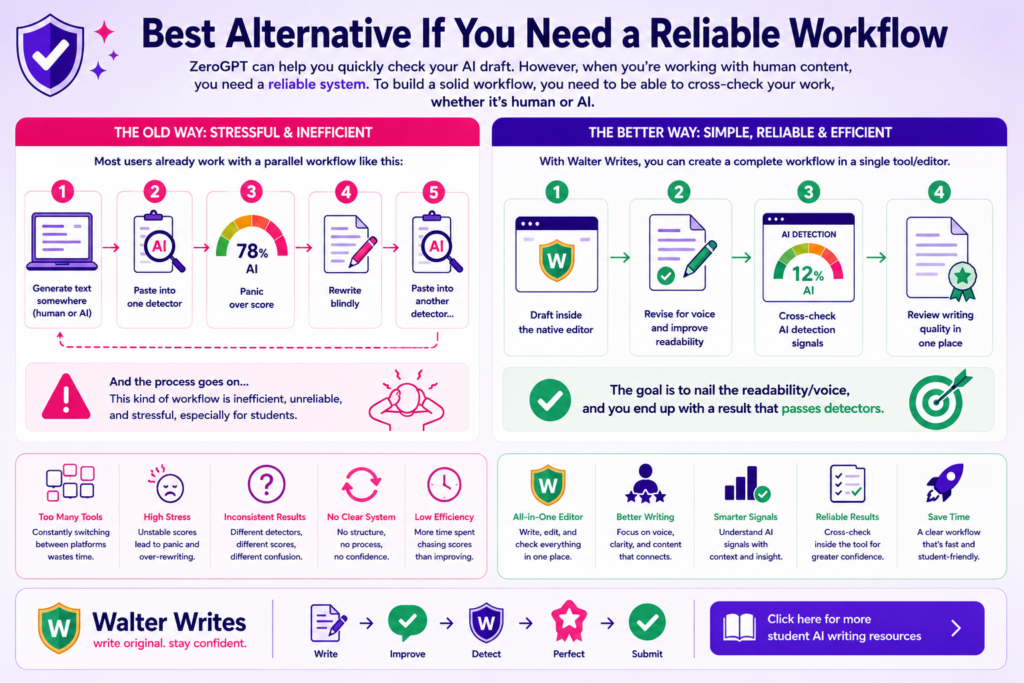
ZeroChatGPT can help you quickly check your AI draft. However, when you’re working with human content, you need a reliable system. To build a solid workflow, you need to be able to cross-check your work, whether it’s human or AI. Most users already work with a parallel workflow similar to this:
1. Generate text somewhere (human or AI)
2. Paste into one detector
3. Panic over score
4. Rewrite blindly
5. Paste into another detector…
And the process goes on. This kind of workflow is inefficient, unreliable, and stressful, especially for students.
A better workflow is simple, reduces stress, and increases efficiency. You don’t have to hop between tools to get it done. With Walter Writes, you can create a workflow in a single tool/editor. The workflow should look similar to this:
1. Draft inside the native editor
2. Revise for voice and improve readability
3. Cross-check AI detection signals
4. Review writing quality in one place.
The goal is to nail the readability/voice, and you end up with a result that passes detectors. Click here for more student AI writing resources.
Frequently Asked Questions
How Good Is ZeroChatGPT at Detecting AI?
ZeroChatGPT is strong on structured AI text but less reliable with mixed, human-like writing. Its score shouldn’t be taken as a final verdict but rather scrutinized further.
Is ZeroChatGPT As Good As Turnitin?
They are not direct competition. ZeroChatGPT is a public checker, while Turnitin is often integrated into an institutional workflow.
Which Is the Most Trustworthy AI Detector?
No detector can be conferred with the title of the most trustworthy. However, a trustworthy detector is reliable, consistent, and can detect and classify human and AI writing.
Does ZeroChatGPT Give False Positives?
Yes, ZeroChatGPT has a fairly high false positive.
How Accurate Is ZeroChatGPT on Human-Written Text?
Our experiment shows that ZeroChatGPT isn’t accurate on human-written text. It couldn’t detect the human-written text sample we tested it on. The scores fall below industry standards.
Can ZeroChatGPT Be Fooled or Bypassed?
Any AI detector can struggle with edited, mixed, or paraphrased text. Our test shows that edited or mixed AI content passes ZeroChatGPT detection. This is why scores should not be used as sole proof.
Is ZeroChatGPT Free to Use?
Yes, ZeroChatGPT offers a free option.
What AI Models Can ZeroChatGPT Detect?
Official documents state that it can detect content produced by major LLMs (large language models) like ChatChatGPT, Gemini, etc.
How Does ZeroChatGPT Compare to ChatGPTZero?
When you’re comparing ZeroChatGPT vs ChatGPTZero, you have to look beyond the name. They aren’t the same. Though they are both public AI detectors, ChatGPTZero is more popular and slightly more expensive. ZeroChatGPT has more pricing tiers, making it more accessible. ZeroChatGPT is suitable for students and marketers who want to check their draft for AI patterns. ChatGPTZero, on the other hand, is suitable for both students and institutional usage.
Is ZeroChatGPT Safe for Students?
If used responsibly, it can be safe for self-checking. However, it’s risky if taken as proof of misconduct. Here is evidence professors use beyond detector scores.
For a cleaner alternative, try our AI-to-human converter. It transforms AI-generated text into human-sounding writing while keeping your voice intact.