





Key Takeaway: GPTZero (ChatGPTZero) is one of the most effective free tools to detect raw AI-generated content in 2026. But it has reported a false positive rate on ESL writing, lower accuracy on revised writing, false negatives, and difficulty in identifying very short pieces of writing, which means that GPTZero should be used as one component of your analysis, rather than solely determining whether or not the content has been generated by an AI.
- GPTZero was built by Princeton student Edward Tian in 2022 and now reports over 2.5 million educators using the platform
- It analyzes two core metrics: perplexity (how predictable the text is) and burstiness (how much sentence structure varies)
- GPTZero’s own benchmarks cite 99% accuracy, but a Stanford study found a 61.3% false positive rate on non-native English essays, and real-world accuracy drops to 60-70% once editing is factored in
- Paraphrasing tools reduce GPTZero’s detection effectiveness by 15-20% in adversarial testing
- At least 12 major universities, including Yale and Johns Hopkins, have disabled AI detection tools entirely, citing false positive and ESL bias concerns
- Proofademic is the stronger alternative for academic use, offering sentence-level heatmaps and a paraphrase detection feature calibrated for formal writing
- We ran a 2026 stress test across seven real content types. In this GPTZero review, you will be provided with the information that is needed to understand where GPTZero is effective and where it is ineffective
GPTZero, also referred to as ChatGPTZero, has emerged as an extremely popular tool for identifying AI-generated content, particularly text produced by models such as ChatGPT and GPT-4.
This article is intended to provide students, teachers, content creators, and anyone who is simply interested in the field of AI detection and wants to know about what GPTZero is, how it operates, how it performs in real-life scenarios, and how GPTZero compares to other detection tools.
- GPTZero is often used as a free AI text detector.
- It scans for signs of AI-generated content using perplexity and burstiness scores.
- Detection accuracy is generally high for GPT-3.5 and GPT-4 content.
- Great for educators and professionals who need fast checks.
- Alternatives include Turnitin, Copyleaks, ZeroGPT, Proofademic, and Walter Writes’ AI Detector.
What Is GPTZero (ChatGPTZero) and What It’s Not
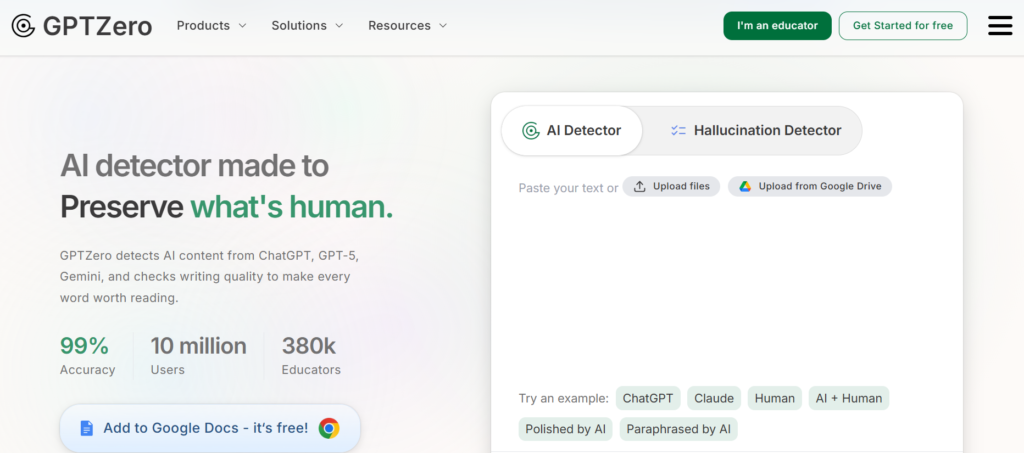
ChatGPTZero, more formally known as GPTZero, is an AI detection tool developed to flag text that may have been generated by AI systems like ChatGPT. It became popular after its release by Princeton student Edward Tian in 2022. Designed initially for academic integrity, it has since been adopted widely by educators, journalists, and content creators.
The goal? The primary function of GPTZero is to enable users to identify if a written piece of material appears to be written by a human or an AI program. GPTZero does not utilize plagiarism detection software. Instead, it uses algorithms that analyze the structure of written works to identify the presence of patterns that suggest the content was written using an AI.
ChatGPTZero vs GPTZero vs “Other GPTZero Sites”
“ChatGPTZero” is simply a search term. The official tool is called GPTZero, found at gptzero.me. There is a third-party who has created a website called gptzero.cc, but this website does not have any affiliation with Edward Tian’s team and is not the GPTZero tool you are searching for.
ZeroGPT (zerogpt.com), on the other hand, is a completely different tool created by another group. The identical names create great confusion, but we’ll discuss the variations separately in a section later.
AI Detection vs Plagiarism Detection (Don’t Confuse Them)
As mentioned previously, plagiarism checkers scan to find exact matches with the text entered into them. GPTZero scans to determine what type of pattern in the input text would be most indicative of AI-generated content. This difference in functionality is critical. A plagiarism checker will ask: “Is there some version of this article somewhere online?” GPTZero will ask: “Did this article appear to have been created using a language model?”
GPTZero does not indicate who might have written and does not prove any intent. It only provides a probability as to how likely it is that the input text was produced by an AI. That makes a big difference when using a score as part of a serious decision-making process related to a student’s work.
Use GPTZero for:
- Quick screening of longer passages before submission or publication
- Flagging content that warrants a closer look
- Editorial quality checks on AI-assisted drafts
Don’t use GPTZero as:
- Standalone proof of AI authorship
- A pass or fail gate for short-form content
- A reliable check on heavily edited or ESL writing
How GPTZero Works (Perplexity, Burstiness, and What It Actually Measures)
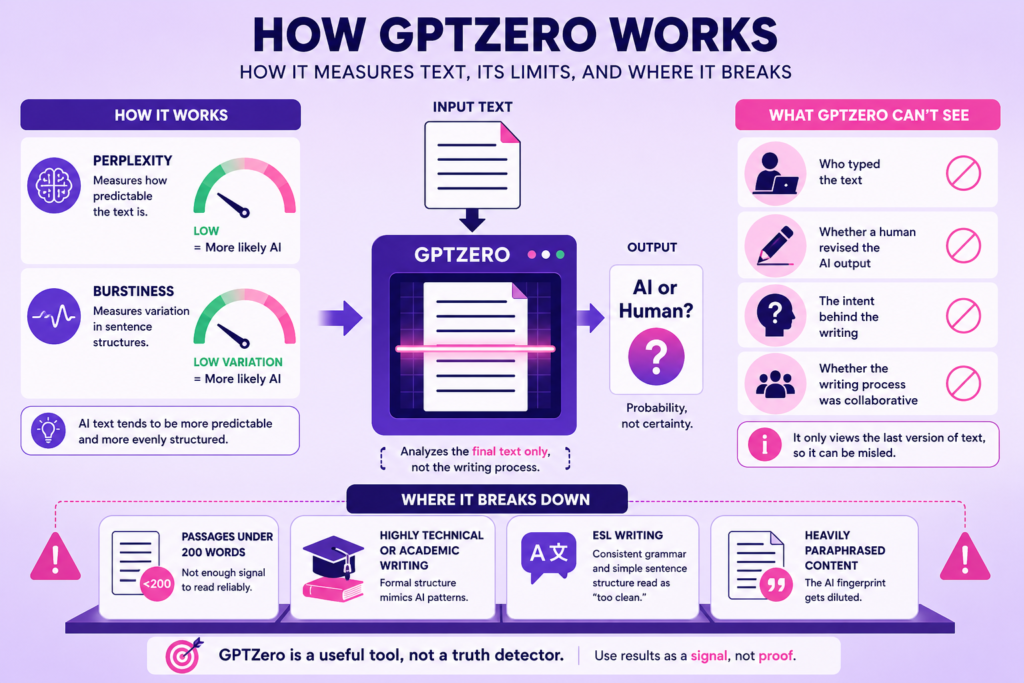
GPTZero relies on two primary metrics:
- Perplexity: A measure of how predictable the text is. AI-generated text tends to have lower perplexity.
- Burstiness: How sentence structures vary. Humans often write with more variation, while AI tends to be more even.
What GPTZero Can’t See
This is where the model has real limits. GPTZero cannot identify:
- Who typed the text
- Whether a human revised the AI output
- The intent behind the writing
- Whether the writing process was collaborative
It only views the last version of text, and because of this reason alone, it is possible to mislead GPTZero with edited AI content, hybrid versions of draft material, and human-written materials that have been formatted in an extremely formalized manner.
The detector also breaks down in predictable situations:
- Passages under 200 words: Not enough signal to read reliably
- Highly technical or academic writing: Formal structure mimics AI patterns
- ESL writing: Consistent grammar and simple sentence structure read as “too clean.”
- Heavily paraphrased content: The AI fingerprint gets diluted
Features GPTZero Mentions (Treat as Capabilities, Not Guarantees)
GPTZero also applies linguistic fingerprinting, mapping sentence structure, transition patterns, and syntactic choices against known profiles of AI-generated text. Since 2024, GPTZero includes the ability to detect multiple languages as well as a “Source Finder” which is able to identify specific verifiable claims within a passage when you enter said passage into the tool.
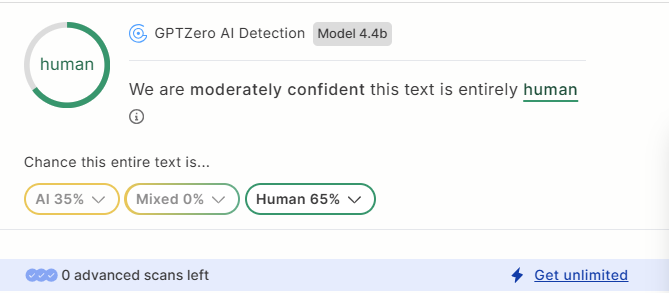
The tool will analyze the patterns in the text you entered and provide an estimated percentage likelihood, such as “likely AI” or “likely human”, based on the results of its analysis of the content.
If you would like to learn more about the mechanics behind these types of scoring systems, we have provided detailed information in our article on how AI detectors actually work.
How Accurate Is GPTZero in 2026? The Right Way to Interpret Results
The tool claims a high success rate, with reported accuracy exceeding 90% on standard GPT-3.5 and GPT-4 outputs. Just like the other tools in this category, it has limitations, and the tool is not perfect. It can struggle with:
- Text that’s been heavily edited by a human.
- Hybrid writing, which is a mix of AI and human writing.
- Short passages under 200 words.
Independent studies reveal a different view. According to a study conducted at Stanford University, GPTZero identified 61.3% of the human-created TOEFL essays by non native speakers as AI-generated. An independent study by MPGone found real-world accuracy closer to 60-70% after adding the effect of the editing process.
tGPTZero’s own benchmarks indicate 99% accuracy for its detecting ability, but chances are this is achieved under controlled test environments utilizing clean and unaltered AI text.
The results of adversarial testing suggest that paraphrase tools can significantly reduce the effective detection ability of GPTZero by 15-20%. In terms of education, it is clear that a high GPTZero score should be investigated further, rather than being considered as conclusive evidence of AI usage.
For more context on what detector scores actually mean, see our breakdown of whether AI detectors are really accurate.
How to Use GPTZero
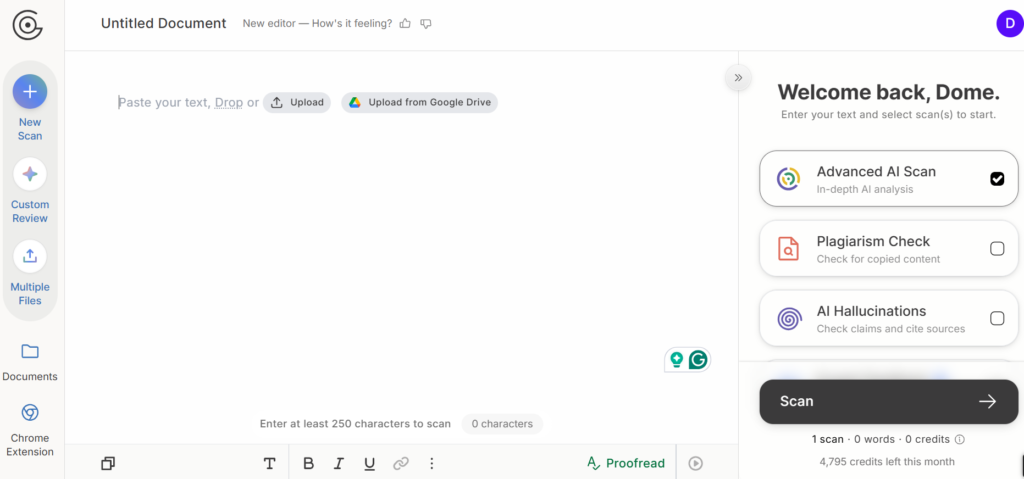
Gptzero is easy to use and is quite straightforward:
- Open gptzero.me.
- Copy, paste your content, or directly upload the file.
- Click “Check.”
- Review your results and flagged sentences.
For those who write using Google Docs, you can get an advantage by installing a GPTZero Chrome extension for easier integration into your workflow. The add-on will help you when writing to check drafts in real-time.
Who Uses GPTZero?
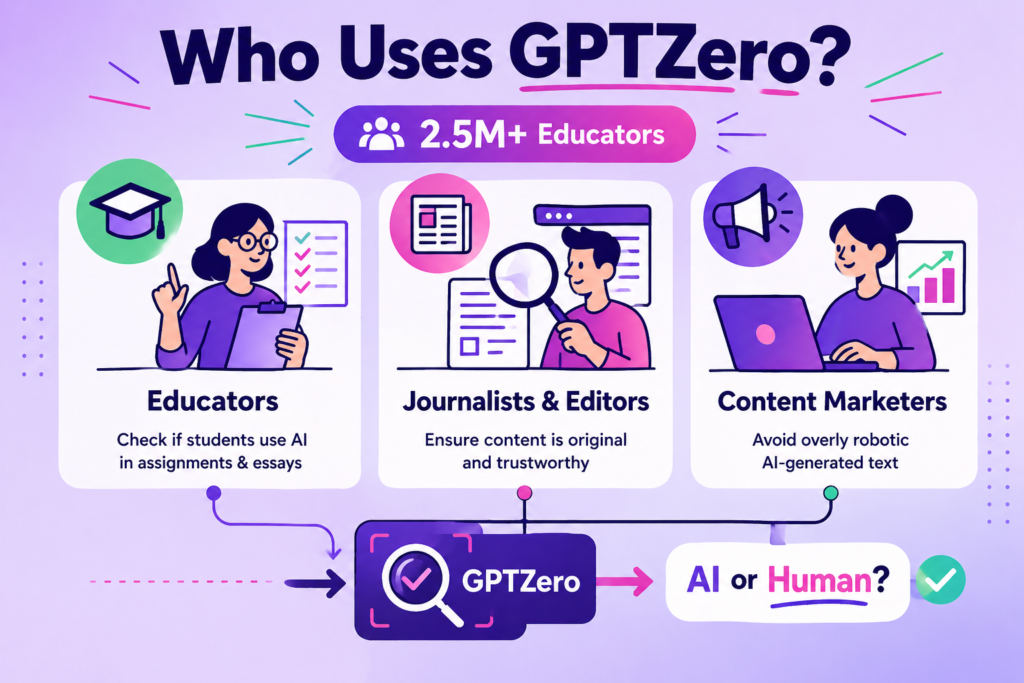
The tool is most popular in education, and it reports that over 2.5 million educators now use the platform.
- Teachers and professors: To find out if students have been submitting assignments written with AI.
- Journalists and editors: To ensure that their content is original.
- Content marketers: To avoid using overly robotic AI-generated text.
It is also commonly referenced in Reddit discussions about whether teachers can detect ChattGPT in reality. A lot of reports indicate that at least 12 major universities, including Yale, Johns Hopkins, and the University of Waterloo, have disabled AI detection tools entirely, citing false positives and ESL bias concerns. The consensus among educators is that AI-detectors should be considered just as one of many signals in detecting academic dishonesty, not an automatic indicator of cheating.
GPTZero Stress Test (2026): Real-World Scenarios GPTZero Must Survive
Most detector tests work like this: paste a raw ChatGPT paragraph, run it, and report the number. That tells you very little about how well a tool really works. So in order to find out how it is in real-life, we ran a structured test of real-world use cases using raw AI-generated content, verified human-written content, and mixed content, which was paraphrased by a human.
GPTZero AI Detector Results Table
| Use Case | AI-Generated | Human written | Mixed Article (AI Article → Human Paraphrased) |
|---|---|---|---|
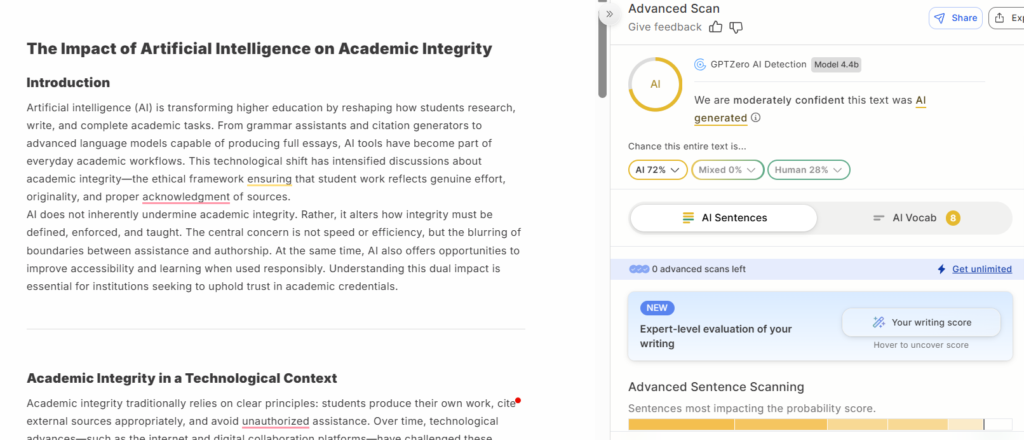
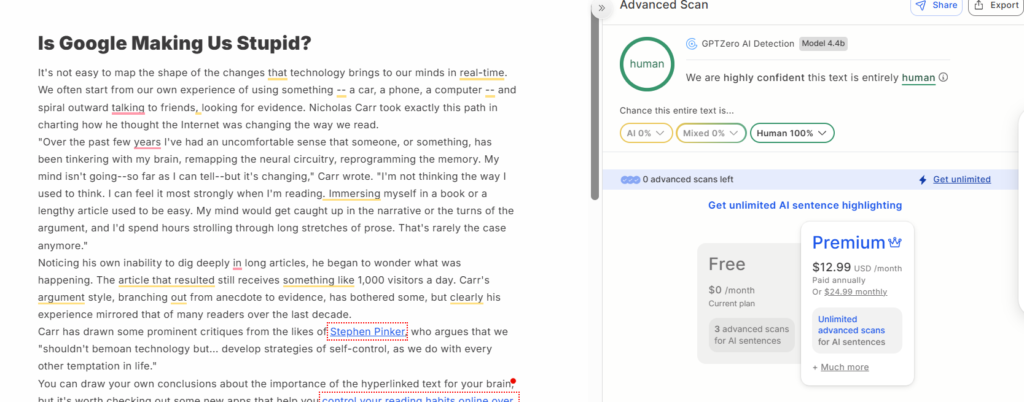
| Academic Essay | 72% AI ❌ | 0% AI ✅ | |
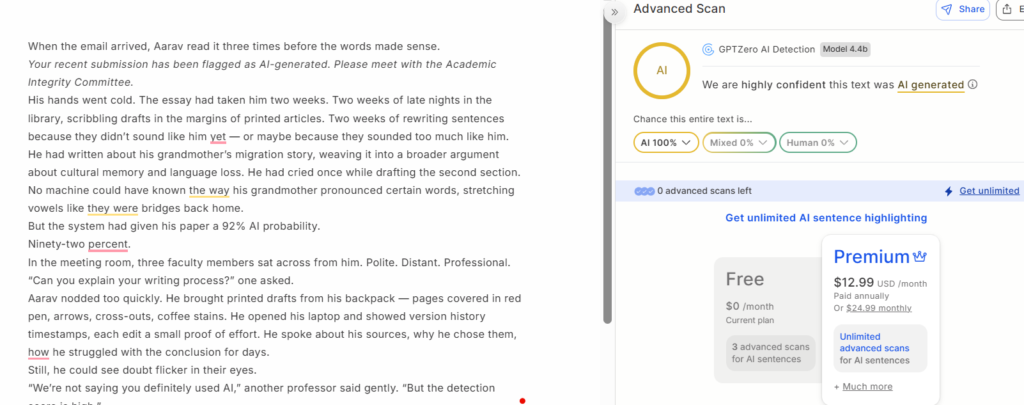
| Creative Writing | 100% AI ✅ | 0% AI ✅ | |
| Social Media Post | 4% AI ❌ | 0% AI ✅ | |
| Mixed Article (How-To) | 16% AI ✅ | ||
| Average | 58.6% AI | 0% AI | 16% AI |
Test Setup: The 4 Use Cases We Tested
We tested GPTZero across the same four use cases. We used AI-generated and human-written content for each use case and one additional mixed-content article as the real differentiator. Between the testing phases, no modifications to content were made. While testing GPTZero, the content was submitted to it in the exact same form and length each time, providing a method for direct comparison.
The four use cases:
- Academic Essay: The highest-stakes scenario for students and educators
- Creative Writing: A content type where AI output is harder to distinguish stylistically
- Social Media Post: Short-form content where detectors often behave unpredictably
- Marketing Article (AI content paraphrased by a human): The most important real-world test, because people rarely use raw ChatGPT output
Test Samples Used for this GPTZero AI Detector Review
Below are all the 7 samples used during the testing.
- Academic Essay: AI (The Impact of Artificial Intelligence) and Human (Is Google Making Us Stupid?)
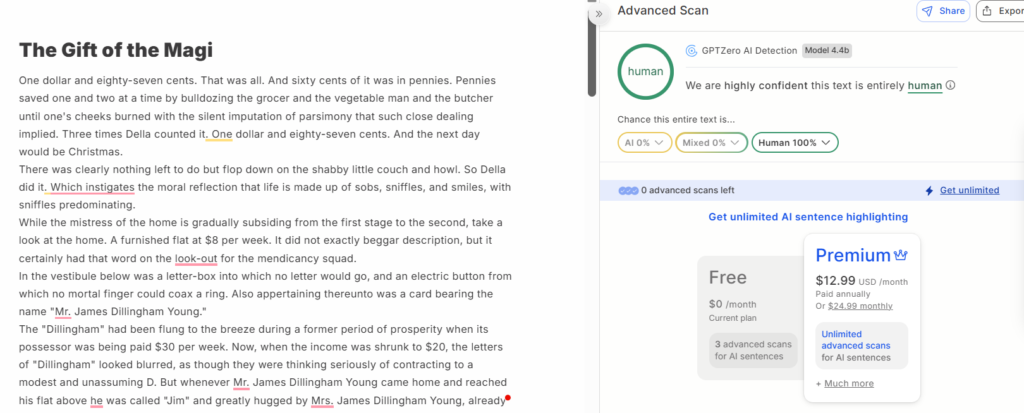
- Creative Writing: AI (Student’s Nightmare) and Human (The Gift of the Magi)
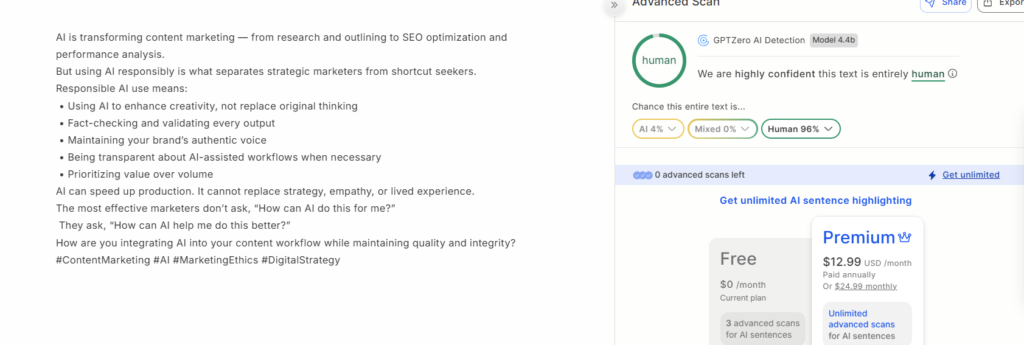
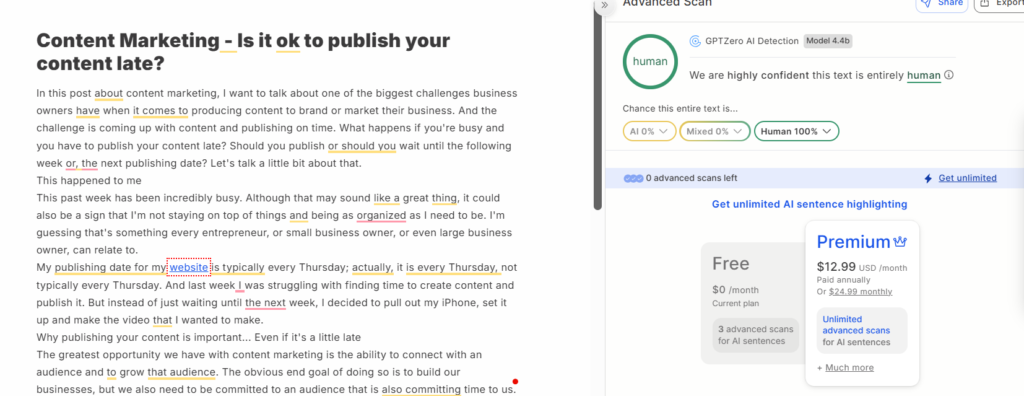
- Social Media Post: AI (Transforming Content Marketing) and Human (Is It OK to Publish Late)
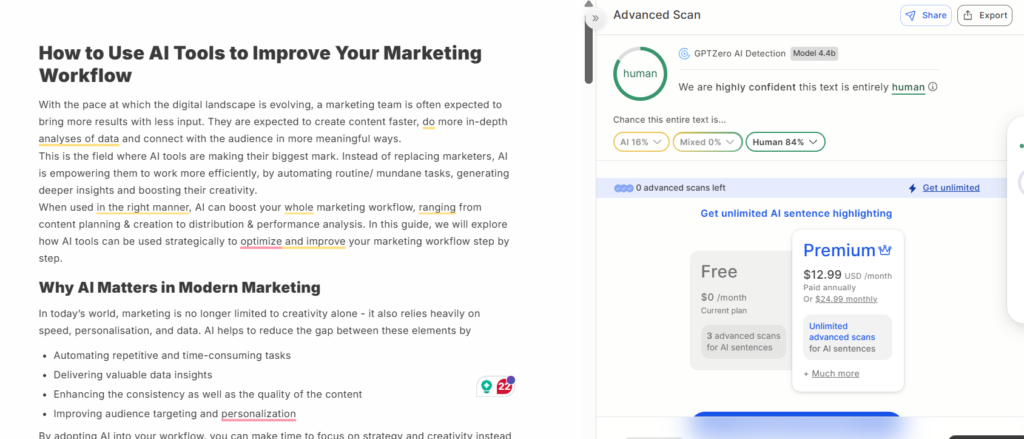
- Marketing Article: Mixed (How to Use AI Tools to Improve Your Marketing Workflow)
GPTZero Results: AI and Human Academic Essay
GPTZero Results: AI and Human Creative Writing
GPTZero Results: AI and Human Social Media Post
GPTZero Results: Mixed Article
What the Results Show
Where GPTZero Is Reliable (Raw AI content)
False positives are not a concern here. GPTZero scored 0% on all human-written samples. It will not flag your clean human writing as AI. Creative writing detection was also strong, returning 100% on fully AI-generated content.
Where GPTZero Falls Short (False negatives)
On the social media post, when using fully AI-generated content, GPTZero was able to detect AI with a mere 4%. The model is very ineffective at identifying short-form content. Content under 200 words does not provide enough data for the models to identify AI content.
As far as the academic essay, when GPTZero detected raw AI output, it produced a 72% result. For a tool designed to be used by educators, in order to accurately determine if an assignment has been written entirely through the use of AI, a rating of 72% falls well below the reliability standard set at 80% or higher on completely clean and unedited AI-generated content.
Notable Patterns
Length is the biggest variable in GPTZero’s performance. The shorter the content, the less signal it has to work with. The social media result is the clearest example of this pattern.
What the Results Mean
The mixed article score of 16% is actually an excellent finding, as most other detector tools can find almost no signal in paraphrased AI content. So, GPTZero is showing us that it found a signal at 16%, while many other detectors show nearly zero, indicating GPTZero detected some signal that most of the other detectors could not detect.
GPTZero vs Walter Writes: Same Samples, Same Conditions
We ran the same samples through Walter Writes AI Detector under identical conditions to see how the two compare directly.
Side-by-Side Results Table
| Sample Type | Use Case | ChatGPTEro Score | Walter Score | Winner |
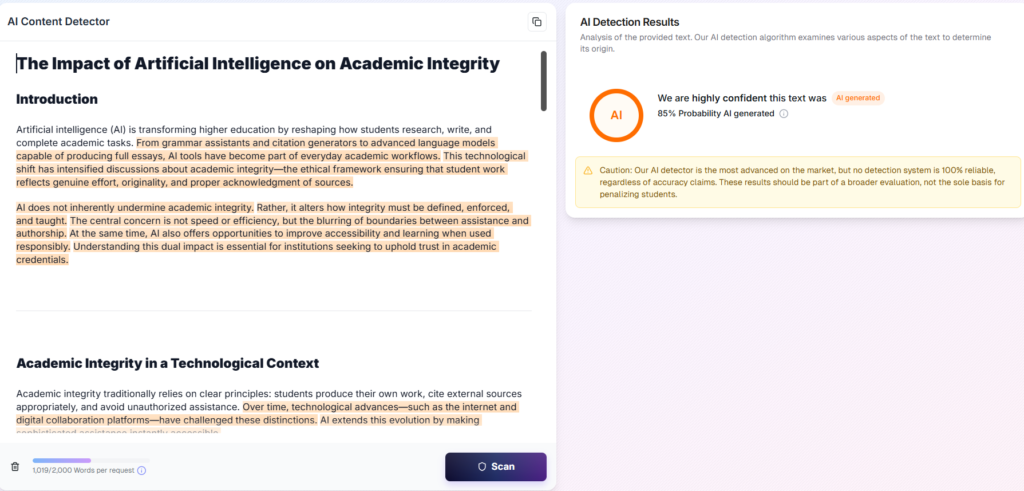
| AI-Generated | Academic Essay | 72% AI ❌ | 85% AI ✅ | Walter |
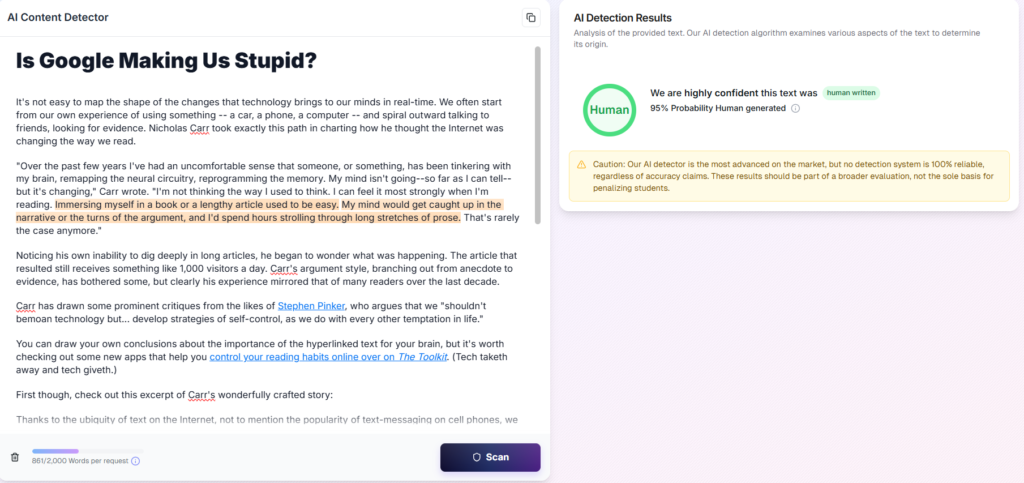
| Human | Academic Essay | 0% AI ✅ | 5% AI ✅ | Both |
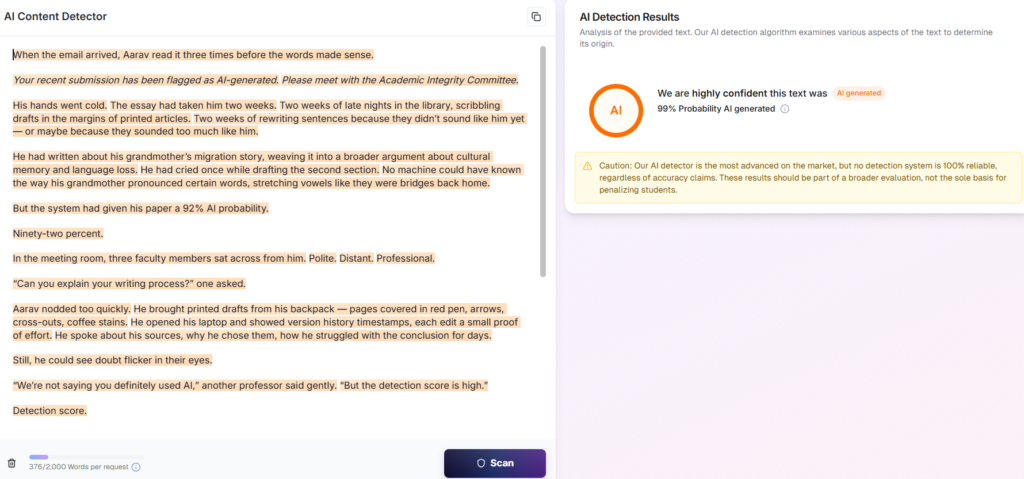
| AI-Generated | Creative writing | 100% AI ✅ | 99% AI ✅ | Both |
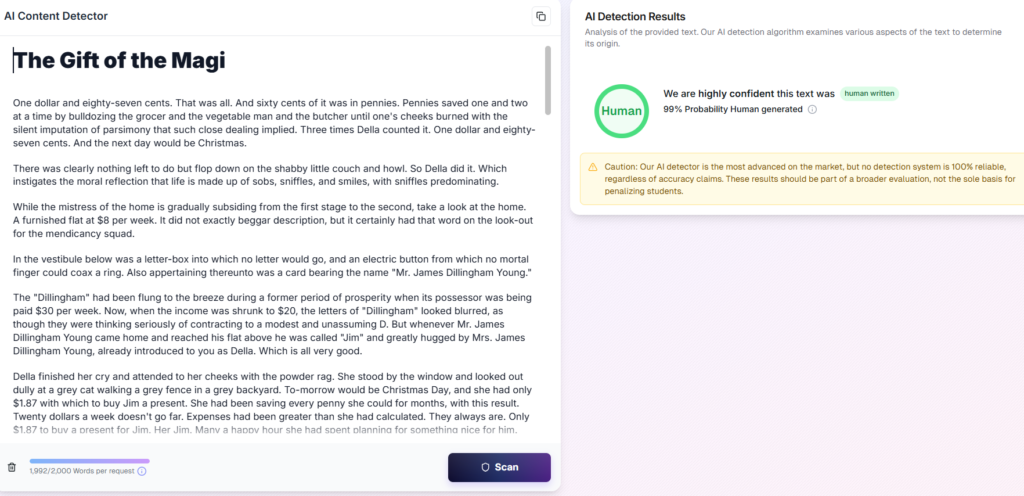
| Human | Creative writing | 0% AI ✅ | 1% AI ✅ | Both |
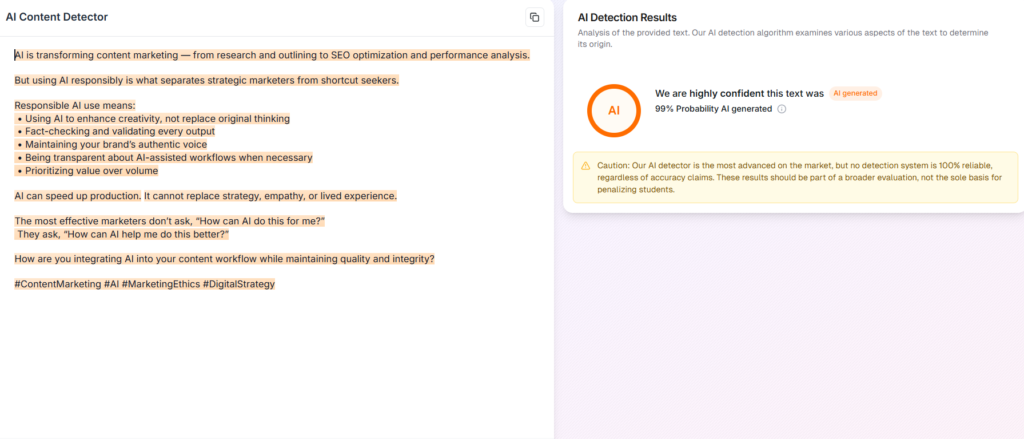
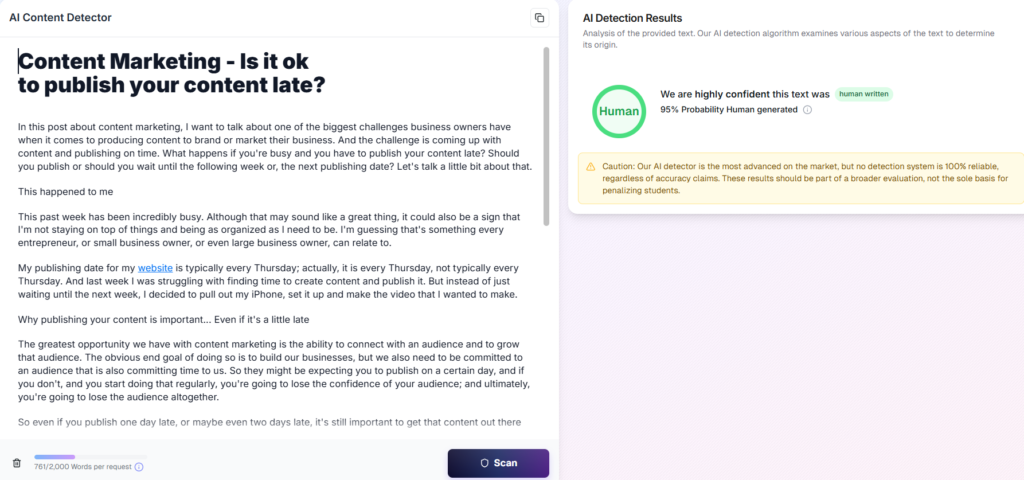
| AI-Generated | Social Media Post | 4% AI ❌ | 99% AI ✅ | Walter |
| Human | Social Media Post | 0% AI ✅ | 5% AI ✅ | Both |
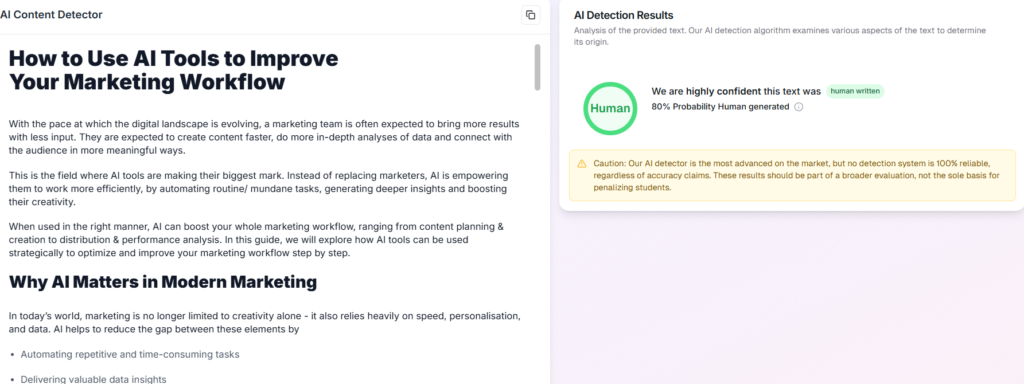
| Mixed (AI Article → Human Paraphrased) | Article | 16% AI ✅ | 20% AI ✅ | Both |
Walter Writes Results: AI and Human Academic Essays
Walter Writes Results: AI and Human Creative Writing
Walter Writes Results: AI and Human Social Media Post
Walter Writes Results: Mixed Article
Observations from the Comparative Stress Test
Detection Accuracy
On creative writing, GPTZero scored 100%, and Walter scored 99%. Neither tool had an issue handling creative writing.
On the academic essay, GPTZero returned 72% while Walter returned 85%. Walter crossed the 80% reliability threshold, but GPTZero did not meet it.
On the social media post, GPTZero returned just 4% on fully AI-generated content. Walter returned 99%. That was certainly the largest difference out of all the tests.
False Positives and Negatives
Neither tool flagged clean human writing aggressively. GPTZero’s average detection rate on clean human-written content was 0%, while Walter had an average detection rate of 1-5%. So, neither tool produced false positives.
The issue is false negatives. GPTZero missed the social media post almost entirely. A false negative does not just mean a wrong score. It means the tool signals the content is human when it is not.
Consistency
GPTZero’s scores ranged from 4% to 100% across AI-generated samples. That is a 96-point gap. Walter maintained strong detection across all four use cases with far less variation.
Where Walter Performs Better
Walter scored above 80% on every AI-generated sample. GPTZero was unable to do so. Both tools identified some amount of AI influence in the article that was paraphrased by a human. That was a fair answer given the way this content type is constructed. Walter provides more trustworthy signals on short-form evaluations and academic writing than GPTZero does.
Overall Verdict
GPTZero works as a screening tool for longer content. It has limitations when evaluating shorter pieces of content. It also falls short in meeting expectations in identifying AI influences present in social media posts. If one uses a more comprehensive approach for identifying the presence of AI-generated content, one can surely obtain a more consistent outcome. Test out the Walter Writes AI detector to find out how it will perform on your content.
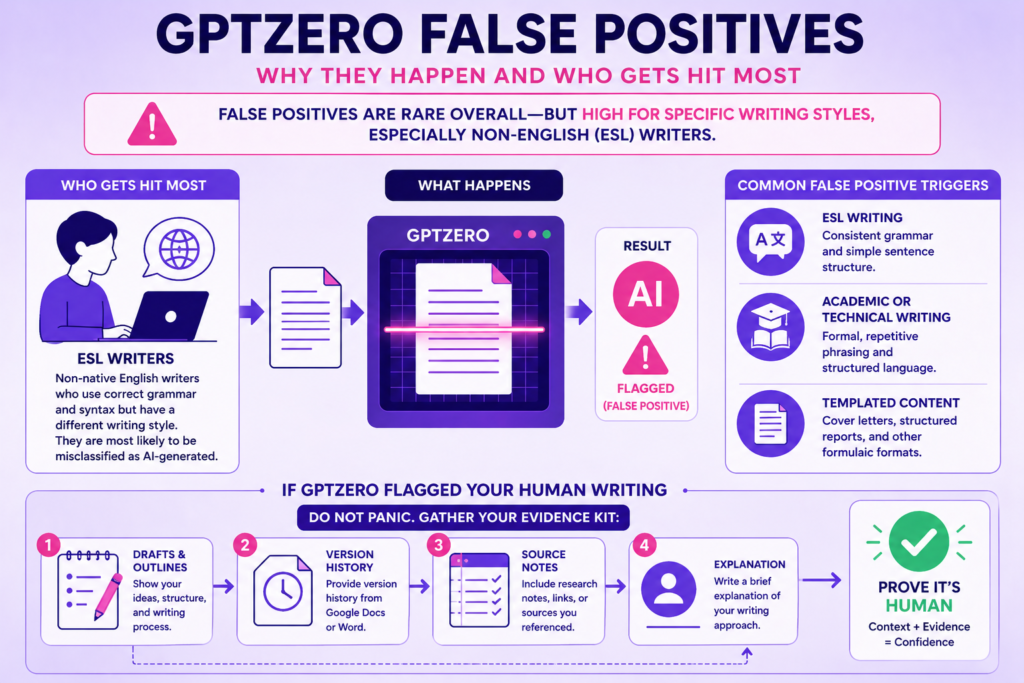
GPTZero False Positives: Why They Happen and Who Gets Hit Most
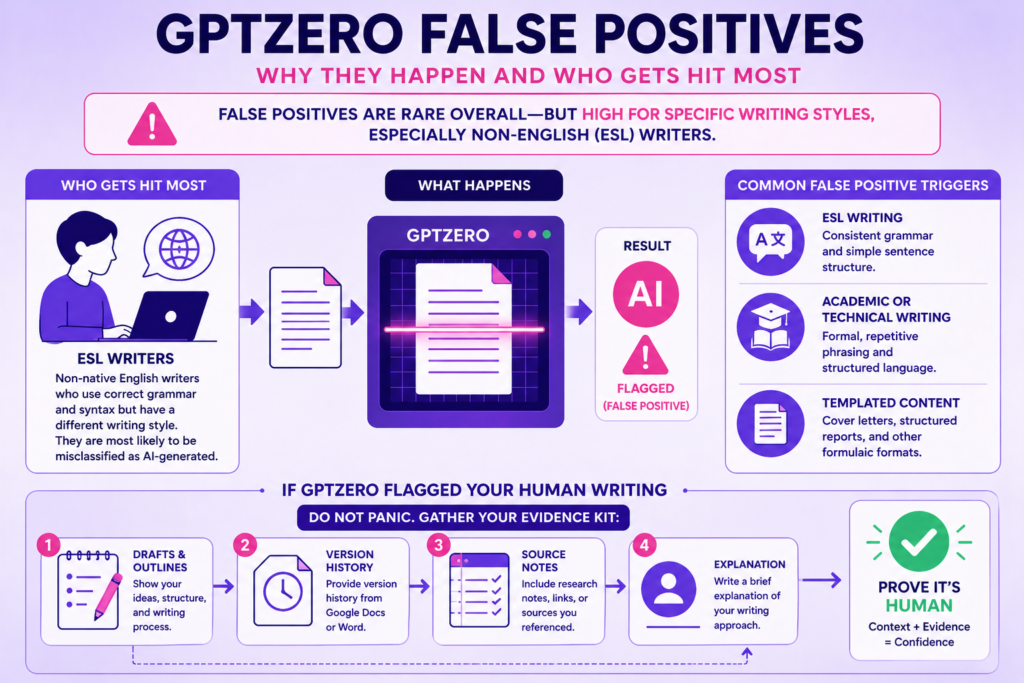
GPTZero’s false positive rate on general human writing is low. The bigger issue lies within a very specific area: Non-English speaking writers who try to write using correct grammar and syntax, but whose writing style differs significantly from native English writers, tend to have very high rates of being classified as AI-generated when tested against GPTZero.
Common False Positive Triggers
- ESL writing with consistent grammar and simple sentence structure
- Academic or technical writing with formal, repetitive phrasing
- Templated content like cover letters or structured reports
If GPTZero Flagged Your Human Writing
Do not panic. Gather your evidence kit:
- Drafts and outlines showing your writing process
- Version history from Google Docs or Word
- Source notes or research you referenced
- A brief explanation of your writing approach
Does GPTZero Detect GPT-4, Claude, Gemini, and Newer Models?
GPTZero is designed to detect text from GPT-3, GPT-3.5, GPT-4, GPT-4o, and other advanced models, including Claude and Gemini. The company updates its model continuously to keep pace with new AI systems.
GPTZero detects patterns, not model identities. It cannot tell you which model wrote a piece of text.
The Model Drift Problem
The AI model continuously updates, and each new version will have changed how it looks for the patterns that it was trained on. There can be a change in detection reliability over time, even though there has been no update made to the detector.
Practical Guidance
- Treat GPTZero as a signal for AI-like patterns, not a model identifier
- A high score means the text reads like AI writing, not that a specific model wrote it
- For newer models like GPT-4o or Claude 3.5, expect some variation in detection confidence
- Always pair the score with your own judgment
GPTZero vs ZeroGPT (And Why People Confuse Them)
ZeroGPT and GPTZero are frequently confused due to their similar names, but they are entirely separate tools built by different teams.
GPTZero was built in 2022 by Edward Tian as a tool for educational purposes. ZeroGPT is another tool with its own team developing it. They are two separate applications created by different teams, but are often confused due to their names being almost identical.
Quick Comparison Table
| Feature | GPTZero | ZeroGPT |
| Built for | Education, classrooms | General use |
| Sentence-level analysis | Yes | No |
| LMS integrations | Yes (Canvas, Moodle, Google Classroom) | No |
| Signup required | Yes | No |
| Result format | Probability + highlights | Percentage score |
| Best for | Detailed classroom review | Quick no-signup checks |
ZerotGPT is a free tool suited for quick, casual checks. It returns a percentage likelihood but provides less detail than GPTZero. GPTZero was built with the intention of being used in a formal educational setting and has features such as sentence-by-sentence detection, writing replay, which is available for integration into Google Docs, and LMS integration.
GPTZero would be the better overall tool for serious use within the classroom. But if you want to quickly and easily check your work without having to sign up for anything, then ZeroGPT may be the best solution.
Which One to Choose in 60 Seconds
- Choose GPTZero when you need sentence-level feedback, classroom integrations, or a more detailed breakdown of results.
- When you simply require a quick scan with no account sign-up and a single per cent is sufficient, choose ZeroGPT.
To get all information regarding both tools and a side-by-side breakdown, see our ZerotGPT vs GPTZero comparison.
GPTZero Pricing
GPTZero does have a free version, but it comes with limits.
- You can use it without paying for basic AI detection
- The free tier typically allows only limited scans or a word count of 10,000
- Some advanced features (like detailed reports, bulk scans, or deep analysis) require a paid plan
For example, the free plan restricts how much text you can check each month or how detailed the results are, while paid plans unlock higher limits and extra tools.
Bottom line:
GPTZero is free to try and use casually, but for serious or frequent use, you’ll likely need a paid plan.
Pros and Cons of GPTZero
| Pros | Cons |
| Free to use | Can return false positives |
| User-friendly interface | Struggles with mixed/hybrid content |
| Fast results | Not ideal for short paragraphs |
| Visual sentence-level feedback | Limited in detecting paraphrased AI |
| Actively debiased for non-native English (ESL) writers | ESL bias documented: 61.3% false positive rate on non-native English essays (Stanford study) |
| LMS integrations with Canvas, Moodle, and Google Classroom | Real-world accuracy drops 15-20% when AI text has been edited or paraphrased |
Alternatives to GPTZero
If GPTZero doesn’t provide you with accurate results, then there are many better alternatives available, listed below.
| AI Detector Tool | Best For |
| Proofademic | ChatGPT AI detector built for academic use with sentence-level heatmaps and paraphrase detection |
| Walter Writes AI Detector | More nuanced detection with humanizing tips |
| Turnitin | Great for schools and universities |
| Originality.ai | Good for SEO and content marketing |
| ZeroGPT | Free quick checks with no account required |
If you’re dealing with AI content regularly and want to polish it to sound more human, you can check out our deep dive guide on how to rewrite AI-generated text.
Proofademic: AI Detection Built for Academic Writing
Proofademic is an AI detection platform built specifically for academic writing. Unlike GPTZero, which is designed for general use, Proofademic focuses on the linguistic patterns of scholarly work, making it better at distinguishing formal human writing from AI-generated academic prose.
Key features:
- Sentence-by-sentence heatmaps showing exactly which passages are flagged
- Probability scores rather than a binary AI/human label
- Paraphrase Shield is designed to detect humanized AI content
- Support for 23+ languages
- Free tier: 1,000 words per scan, no credit card required
- Paid plans start at $8/month (billed annually) for 200,000 words per month.
- Enterprise and institutional plans are available with volume pricing.
According to independent reviews, Proofademic reports a range of 80-90% accuracy based on the type of content being analyzed. Its academic calibration provides fewer false positives on formal human writing compared to general-purpose tools.
Still not sure which tool fits your workflow? See our full roundup of the best AI detector tools in 2026.
Can You Bypass GPTZero?
People often ask: Can AI content be made undetectable? The answer is yes, you can accomplish that, but this is still the wrong objective.
A much better question would be: How do you create authentic, worthwhile writing using AI-assisted tools? This is achieved through editing and rewriting to make the work clear, specific, and have a voice. Not by running your tool through a spinner repeatedly until you get a green checkmark on the detection software.
The Right Workflow
- Detect: Run your draft through GPTZero or Walter Writes AI Detector to identify sections that read as robotic
- Revise: Using a tool like Walter Writes AI Humanizer can make AI text sound more natural. Even with this assistance, though, you should revise it manually for once.
- Re-check: Run it again to confirm the changes landed
Studies show that paraphrasing tools decrease the detection of GPTZero by 15-20%, but a lower detection score doesn’t indicate a better piece of writing. An effective editor improves the overall quality of the writing, not simply the AI output, as part of their single action of rewriting it.
If you would like to have additional information about rewriting AI-generated content, you should read our article about how to make ChattGPT sound more human.
Final verdict: When Should You Trust GPTZero?
GPTZero is still a fantastic free tool for detecting raw AI-generated content in 2026. But there are numerous limitations attached to it that have been demonstrated, which were also evident during our testing.
You can be confident in GPTZero’s ability to identify unaltered long-form AI-generated content, which should be at least 500 words long.
The output should be viewed as a weak indicator when you are dealing with extremely short-form content, content that has been significantly altered, content that is a rewritten version of the original content, or content written in a language other than the writer’s native language.
For most users, the best next step: Run combination of detection and then do your own editing. The detection score will only give you an idea of where to start doing the editing, but it will not tell you how to do the editing. For a workflow that can handle both aspects of this task, consider using Walter Writes AI detector.
FAQs About GPTZero
What Is GPTZero Used For?
It is used to check whether text was written by AI or a human. Most popular among educators and students, but also used by content teams for editorial quality checks.
Is ChatGPTZero The Same As GPTZero?
Yes. The most common term for GPTZero is also “GPTZero”, and this is simply what people call it. It has the same function, the same purpose.
How Accurate Is GPTZero At Detecting AI Content?
In a controlled environment, GPTZero claims to be able to detect AI-generated content with 85-99% of accuracy. But when you add editing into the mix, the reliability of GPTZero falls to approximately 60-70%. See our GPTZero review for a full breakdown.
Does GPTZero Work on GPT-4 and Claude?
The tool was developed with pattern detection in mind, specifically for GPT-4, GPT-4o, Claude, and Gemini. As these models are updated, reliability will vary. Results should be viewed as indicative rather than conclusive.
What Is The False Positive Rate Of GPTZero?
Low on general human writing, around 5 to 15%. Significantly higher on ESL writing, with a Stanford study finding a 61.3% false positive rate on non-native English essays.
Can GPTZero Detect Paraphrased AI Content?
Partially. Our stress test demonstrated 16% detection for a paraphrased AI article. But studies show that AI paraphrasing tools can lower detection efficiency for GPTZero by 15 to 20%.
Is GPTZero Free To Use?
Yes. Gptzero offers a completely free tier at gptzero.me. It also offers paid tiers, which include increased word counts, direct API access, and LMS integration capabilities.
How Does GPTZero Differ From ZeroGPT?
The two products were created separately by two different companies. GPTZero gives you a way to check individual sentences. ZeroGPT allows you to quickly see if something was AI-generated without signing up. To get a complete picture of how the two compare, please refer to our article comparing GPTZero vs ZeroGPT.
Can You Bypass GPTZero With An AI Humanizer?
While you may be able to reduce your score somewhat by using an AI humanizer, ultimately, the best approach is to improve your writing. Follow the detect, revise, and recheck process described above.
Do Universities And Schools Actually Trust GPTZero Results?
Increasingly, no. At least 12 top universities, including Yale and Johns Hopkins, have disabled all AI-detection software due to its bias against ESL writers and because the results are often inaccurate. Many educators view the results of AI detectors like GPTZero as just one piece of evidence rather than definitive proof.