

Key Takeaway: Finding an AI detector like Turnitin matters most if you’re a student who can’t access Turnitin directly or an educator who needs a supplementary tool with open access. The best alternatives replicate how Turnitin analyzes burstiness, perplexity, and sentence predictability.
- Walter Writes AI is the closest match for students: detection plus a built-in humanizer to fix flagged text
- Originality.ai is best for bulk scanning in publishing or academic content workflows
- GPTZero works for quick classroom checks but may overflag creative or formulaic writing
- Winston AI offers open individual access without institutional pricing
- No alternative replicates Turnitin’s hybrid plagiarism and AI detection inside an LMS
As AI-generated content continues to rise in academic circles, students, educators, and institutions alike are turning to advanced AI detection tools to ensure originality and uphold academic integrity.
Turnitin is institution-only software. Individual students and independent researchers can’t access it directly, which is exactly why so many people search for an alternative that works the same way. Turnitin, long known for its plagiarism checker, has now integrated AI detection capabilities. But it begs the question: which AI detector is most like Turnitin?
In this 2026 guide, we’ll break down the most accurate and Turnitin-like tools available today - including Walter Writes AI, GPTZero, and Originality AI - and help you decide which is best for your academic needs.
Who is this guide for?
This guide covers two main audiences. Students who want to pre-check their work before submitting to Turnitin, and educators or institutions looking for a supplementary AI detection tool with open access and transparent reporting.
Are you a student who wants a tool that both detects and rewrites AI content? Check this out.
Turnitin and AI Detection - What Makes It Unique?
Turnitin has been a staple in academia for over two decades. While originally focused on plagiarism detection, Turnitin now uses proprietary AI detection models that focus on more than just copy-paste matching.
So, what exactly does Turnitin check for when detecting AI writing?
- Syntax predictability: AI-generated text tends to have more uniform sentence structures.
- Burstiness and perplexity: Measures of how spontaneous and varied language is.
- Repetition and phrasing patterns: ChatGPT-based tools often rely on similar transitions and sentence templates.
- Unnatural flow or logic gaps: Sometimes, AI writing misses the nuance or reasoning human writers include.
Professors trust Turnitin’s reports because they highlight these issues with a mix of textual analysis and probability-based AI indicators. But it’s not the only game in town anymore.
What Does Turnitin Detect?
Before comparing alternatives, it helps to understand how Turnitin works under the hood. Turnitin does not simply compare your text to AI databases. It evaluates probabilistic writing behavior across the entire document.
When a submission is made, Turnitin breaks it into segments of roughly five to ten sentences. Each segment is scored for patterns consistent with large language models. Results appear in a color-coded report: blue highlights indicate likely AI-generated text, purple indicates text that appears to have been AI-generated and then paraphrased using a word spinner or AI rewriting tool.
Turnitin also requires a minimum of 300 words to run its AI detector, and only instructors and administrators can see the AI writing indicator. Students only see their plagiarism similarity score.
The core signals Turnitin uses include:
- Predictability at the sentence level: AI models produce statistically likely word sequences. Human writers introduce irregularity.
- Sentence burstiness: Human writing varies in length and rhythm. AI writing tends to stay uniform.
- Syntactic structure: Turnitin evaluates grammatical variation across paragraphs.
- Context continuity: The system checks whether ideas evolve naturally or follow templated transitions typical of AI output.
Top AI Detectors That Work Like Turnitin
Below is a side-by-side comparison of the most Turnitin-like AI detectors as of 2026:
| Tool | Accuracy | Similarity to Turnitin | Mixed Content Detection | Humanizer Built-in | Best For |
| Walter Writes AI ⭐ | 99.8% | Very Similar ⭐ | Yes (20% in our test) | Yes | Academic Writing, Research |
| Originality AI | 98% | Similar | No (0% in our test) | No | Content + Academic Publishing |
| GPTZero | 95% | Similar | No (0% in our test) | No | Teachers, Student Reports |
| Copyleaks | ~99% | Similar | No | No | Educators, LMS Integration |
| Winston AI | 99% | Similar | No | No | Individual Users, Open Access |
These tools vary not just in accuracy, but also in how they detect AI content. Let’s break them down.
Walter Writes AI - Best Turnitin-Like Detector (With Bonus Humanizer)
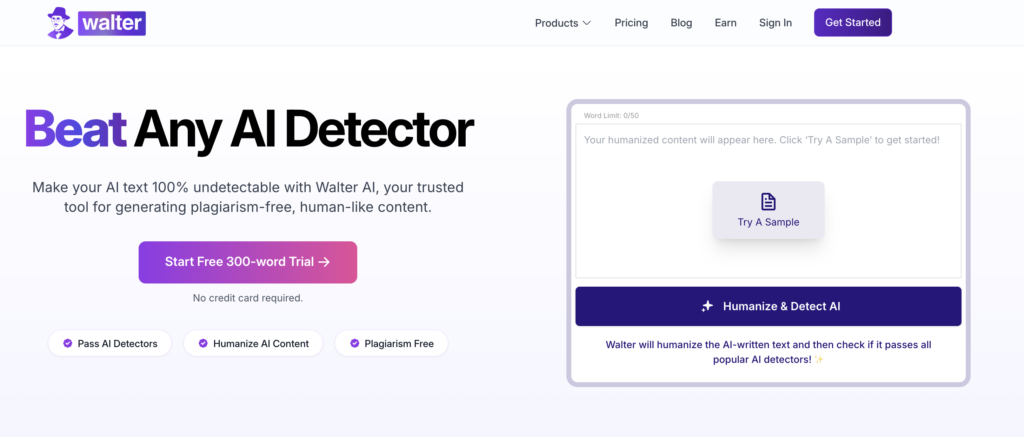
If you’re looking for a one-stop solution that mimics Turnitin’s AI detection accuracy and also helps you fix flagged text, Walter Writes AI stands out.
- It has a dual functionality. It detects AI-generated text with 99.8% accuracy and can rewrite it to sound more human using its proprietary AI Humanizer tool.
- Designed specifically for students, researchers, and academic writers.
- Its AI detector mimics Turnitin’s style by analyzing burstiness, perplexity, and language coherence.
- Integrates a rewriting feature that preserves citation tone and academic flow, making it ideal for university assignments.
- You can scan any text for AI-written content before submitting it.
Originality AI
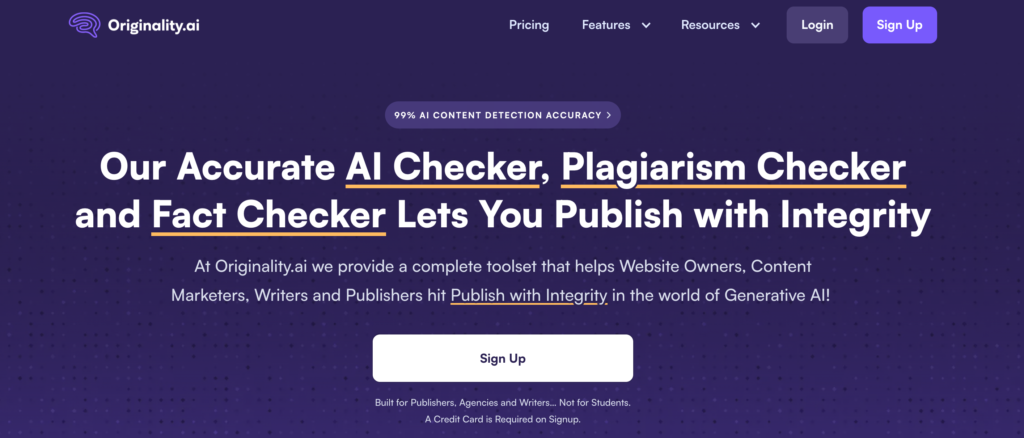
Originality AI is another strong contender, known for its enterprise-level integrations. It’s used widely by:
- Academic publishers
- University integrity departments
- SEO professionals
It detects AI content using token entropy analysis, similar to ChatGPT-based assessments, and supports team dashboards. However:
- It lacks rewriting or humanizing features, making it more of a red-flag tool.
- More ideal for reviewers than writers.
For more on how this compares to rewriting-focused tools, check out our article on the Best AI Humanizer Tools.
GPTZero
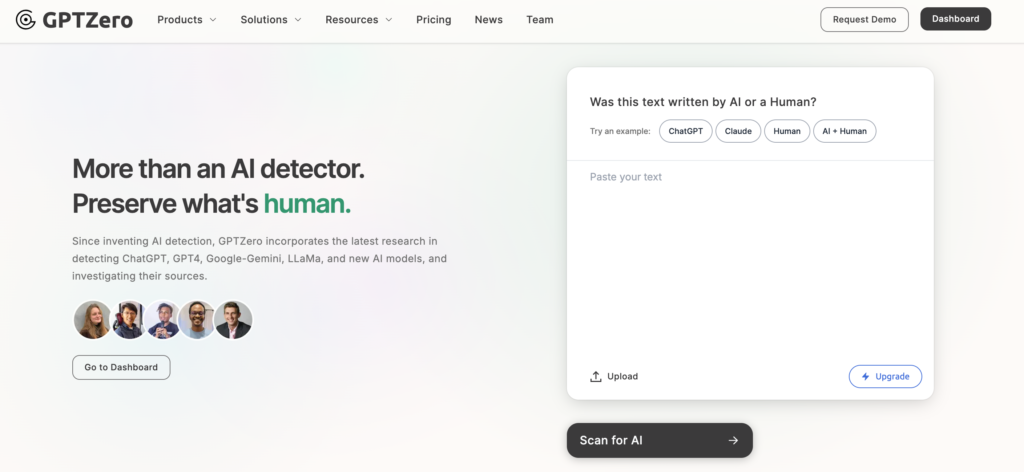
GPTZero became popular due to viral posts on Reddit and usage in classrooms. It’s often compared directly to Turnitin for AI detection.
- Provides clear scoring on each passage (Human-written vs. AI-generated).
- Used by high school and college teachers.
- Slightly lower accuracy than Walter Writes AI or Originality AI, but good for quick checks.
Downside? It may overflag creative or formulaic human writing, and it doesn’t integrate into workflows as smoothly as Turnitin or Walter Writes AI.
Copyleaks
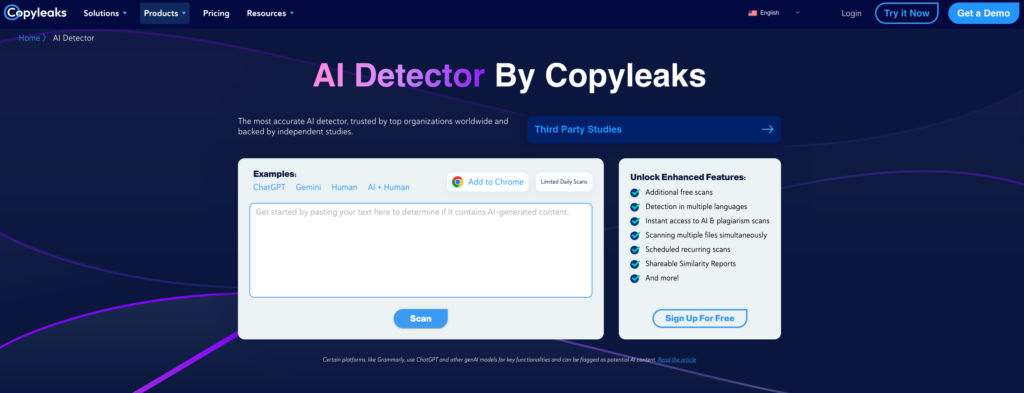
Copyleaks is one of the most widely adopted AI detectors in education, and it comes closer than most to Turnitin’s institutional experience. It supports over 30 languages, integrates with LMS platforms like Canvas and Moodle, and produces detailed reports covering AI-generated text, paraphrasing, and plagiarism in a single scan.
The key limitation: Copyleaks struggles with mixed or edited AI content. In our controlled stress test, it scored 0% on a human-rewritten AI essay, making it blind to the most common real-world scenario. It’s a strong institutional tool, but not a substitute for a humanizer.
Winston AI
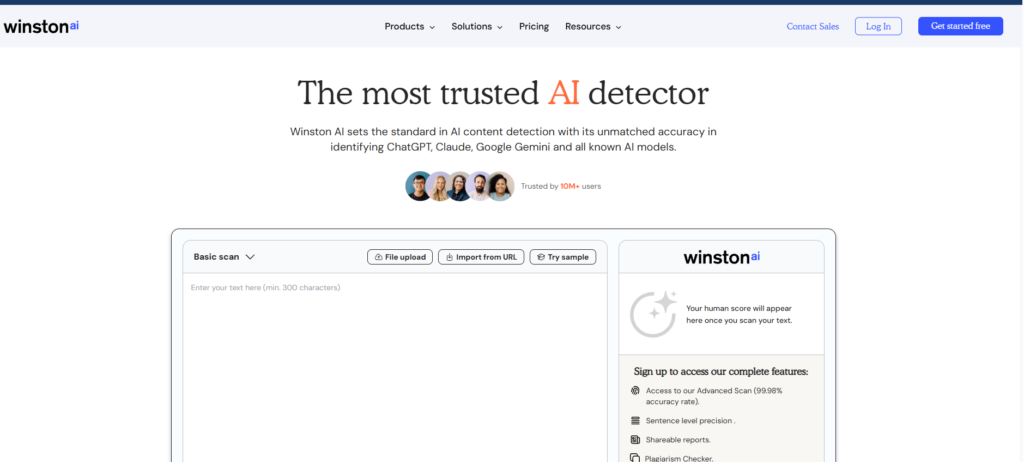
Winston AI is one of the most accessible Turnitin-like detectors for individual users. Unlike Turnitin, it doesn’t require institutional access, which makes it a practical option for students who want to pre-check work before submission. It offers sentence-level scoring and real-time file scanning.
Key limitations: results can be inconsistent on shorter texts under 200 words, and multiple features are locked behind enterprise pricing tiers.
How Do These Tools Compare to Turnitin’s AI Checker?
When looking at Turnitin vs other AI checkers, several commonalities emerge:

Similarities:
- Language model-based detection: All tools use machine learning models that analyze sentence predictability.
- Entropy-based scoring: How random or expected the text is.
- Document-level analysis: These tools look at the whole essay or article, not just segments.
What Turnitin Does That Others Don’t:
- Plagiarism + AI analysis together: Turnitin’s hybrid reports flag both kinds of violations in one place.
- Integration with LMS (Canvas, Blackboard, Moodle, etc.)
- Contextual sentence analysis: Turnitin uses paragraph-level logic checking.
- Color-coded reports: Blue for likely AI-generated text, purple for text that was AI-generated and then AI-paraphrased using a word spinner.
- Minimum word requirement: Turnitin needs at least 300 words to run AI detection, and scores below 20% are not displayed to avoid false positives.
What Other Tools Do Better:
- Real-time rewriting suggestions (Walter Writes AI)
- Transparency and open scoring (GPTZero)
- SEO + content workflows (Originality AI)
- Open individual access without an institutional license (Winston AI, Walter Writes AI, GPTZero)
So while many tools mimic Turnitin’s detection style, they may not replicate its academic ecosystem unless paired with extra functionality, like rewriting or LMS integration.
Read more: Packback AI detector review and Can Turnitin Detect Grammarly?
How to Choose the Right Turnitin-Like Detector
With several solid options available, the right choice depends on your specific situation. Use the framework below to match your needs to the best tool.
If you’re a student who wants to pre-check before submitting to Turnitin, Walter Writes AI is the best fit. It combines detection with a humanizer, so if something gets flagged, you can fix it in the same workflow.
If you need bulk scanning for content or publishing, Originality AI is built for that use case with team dashboards and volume-based pricing.
If you’re an individual who wants open access without institutional pricing, Winston AI and GPTZero are both solid free-to-use options for basic checks.
Best Turnitin Alternative in 2026 - Final Verdict
So, which AI detector is most like Turnitin?
Walter Writes AI wins our comparison by a landslide for students and researchers. It combines:
- High detection accuracy
- Academic language focus
- Rewriting features that pass AI detectors (including Turnitin)
And it’s built specifically to help users avoid academic penalties while improving the quality of their writing.
Want to see how Walter Writes AI compares to other tools? Read our review here.
FAQs About AI Detection and Turnitin-Like Tools
What AI detection model does Turnitin use?
Turnitin uses a proprietary detection model that blends natural language processing (NLP), syntactic complexity analysis, and comparison to both AI and human benchmarks. It does not rely on open-source tools like GPTZero.
Is GPTZero similar to Turnitin?
Yes, to an extent. GPTZero analyzes writing using burstiness and perplexity, key components of Turnitin’s AI detection. However, it’s less integrated and may offer lower accuracy in some academic contexts.
Can AI detectors detect paraphrased or rewritten content?
Not always. Many AI detectors, including Turnitin, struggle with heavily rewritten or creatively paraphrased AI content. That’s why humanizer tools like Walter Writes AI are so valuable.
Is Walter Writes AI accurate for students?
Yes. Walter Writes AI was built with student use cases in mind. It not only flags AI content but also rewrites it into human-like academic writing. The tool is a popular option for those seeking to stay compliant while enhancing their essays or assignments.
Does Turnitin detect Cramly AI?
Yes, in most cases. Cramly AI is a student essay generator that is not specifically built to bypass AI detectors. Testing by multiple independent reviewers shows Turnitin flags raw Cramly output almost every time, primarily because Cramly-generated text retains the uniform sentence structures and predictable phrasing patterns that Turnitin’s detection model is trained to identify. Cramly’s built-in paraphraser does not do enough to remove these signals. If you’ve used Cramly and want to reduce your AI detection risk before submitting, running the output through Walter Writes AI’s humanizer is a more reliable approach.
Can Turnitin detect clever spinners?
Yes. Turnitin added dedicated AI paraphrasing detection in 2024, and its model specifically flags text that has been processed through word spinners and AI rewriting tools, including popular ones like QuillBot and Grammarly’s free paraphraser. In Turnitin’s color-coded reports, this type of content is highlighted in purple to distinguish it from content flagged as directly AI-generated (highlighted in blue). CleverSpinner, despite being one of the older paraphrasing tools, consistently fails to bypass modern AI detectors because it relies on predictable synonym substitution patterns rather than genuine restructuring. If you’re using a spinner to try to mask AI-generated text, Turnitin is likely to catch it.
Wrap-Up: AI Detection Is Only Getting Smarter
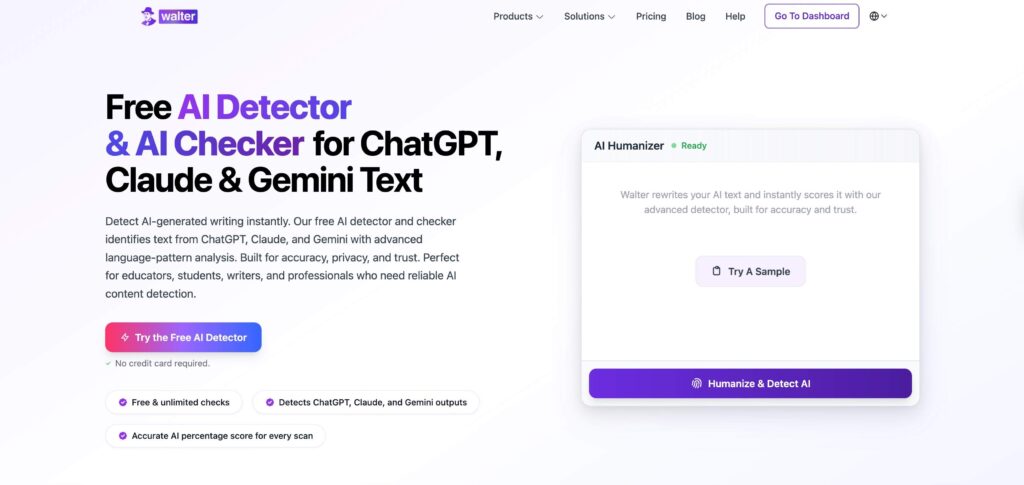
With the rise of AI-generated essays, blogs, and research papers, the need for reliable AI detectors continues to grow. While Turnitin remains the gold standard for academic institutions, tools like Walter Writes AI now offer Turnitin-level detection with the bonus of rewriting and formatting assistance.
For students, researchers, and even publishers, choosing the right tool can mean the difference between a flagged submission and a flawless, humanized document.
Bypass AI detection and try Walter Writes AI today!
Before comparing alternatives, the full breakdown of how Turnitin’s AI detection actually works covers what the percentage means, accuracy data, and 2026 false-positive rates.
For a closer look at one of the alternatives, see Grammarly AI Detector Review 2026 including its limitations on humanized content.
For platform-grade integration, Walter offers an AI Detector API with native LMS-integration patterns and Turnitin-equivalent accuracy benchmarks.