



Key Takeaway: The best AI SEO tools are the ones that solve a specific problem in your workflow, not the one with the most features. Pick by use case, budget, and team size, then build from there.
In 2026, AI will play a central role in SEO. Teams that ignore it will move more slowly than their competitors. Whether you are a small team or an enterprise agency, you need to integrate AI into your workflow. Not only will it speed up your process, but it’ll also let you achieve more with less effort. In this article, we’ve gathered the best AI SEO tools in 2026, both free and paid.
We use these tools for our SEO. Expect only the essential AI tools that’ll elevate your SEO.
Quick Table
| Tool | Category | Best For | Standout AI Feature | Who Should Avoid | Pricing |
| Ahrefs | Keyword Research | SEO operators who need backlink + SERP depth | Intent grouping and keyword expansion | Budget beginners who won’t use advanced features | Mid - High |
| Semrush | Keyword Research | Teams wanting broader marketing coverage | AI keyword suggestion and intent classification | Users wanting a narrow research tool | Mid (trial available) |
| LowFruits | Keyword Research | Small businesses targeting low-competition queries | SERP weakness detection focused on realistic wins | Enterprise teams needing deep backlink analysis | Affordable, credit-based |
| Surfer SEO | Content Optimization | Fast on-page gap analysis | Real-time content scoring against SERP patterns | Sites prone to keyword stuffing | Mid-tier |
| Clearscope | Content Optimization | Editorial teams prioritizing guidance over scoring | Semantic keyword recommendations | Solo creators on tight budgets | Premium |
| MarketMuse | Content Optimization | Teams building long-term topical authority | Deep topic modelling and content planning | Quick blog production workflows | Higher-tier |
| SE Ranking | Rank Tracking / GEO | Simple, affordable rank tracking | Ranking trend analysis and visibility scoring | Enterprise users needing heavy API integrations | Low - Mid |
| AccuRanker | Rank Tracking / GEO | Fast SERP tracking with customizable keyword sets | Automated detection of significant rank shifts | Users needing integrated keyword research | Mid (free trial) |
| Screaming Frog | Technical SEO | Crawl diagnostics and issue discovery at scale | Pattern detection and structured exports | Very small sites | Low (free tier available) |
| Sitebulb | Technical SEO | Visual audit explanations | Issue interpretation with visual context | DIY beginners unfamiliar with technical SEO | Subscription |
| Respona | Link Building | Semi-automated outreach campaigns | Personalization draft assistance | Teams focused on pure relationship-building | Mid (trial available) |
| Pitchbox | Link Building | Agencies scaling outreach | Workflow automation and campaign tracking | Solo bloggers | Premium |
| Zapier | Automation | Connecting SEO tools, LLMs, and CMS platforms | Massive app ecosystem for workflow automation | Users without defined workflows | Low (free tier available) |
The 60-Second Tool Picker: The AI SEO Tool You Need
As a business owner, you shouldn’t be picking AI SEO tools just for the brand name. Any tool you pick should solve a specific problem. Otherwise, you may not get a good return on your budget. The fastest way to choose the appropriate SEO tool is to start with what you need, then apply a few constraints. You can do that in about 60 seconds.
Step 1: Where Do You Need Help?
Keyword Research
From experience, we’ve found the best tool is the one that provides topic ideation and topical clustering quickly. If you’re a business owner, your bottleneck is likely that you don’t know what to write next. Look for a tool that combines a large keyword database with AI clustering.
- <$50: long-tail keyword tool (Keysearch) + Google Search Console
- $50 - $150: a mid-tier keyword discovery (LowFruit Pro)
- $150+: full competitive gap analysis (Semrush)
Content Optimization
If you already have pages that rank but not in the top #3-5, you can make them stronger with optimization. But you need to know what to optimize to get the best result. Surfer SEO does a good job here. The best tool will integrate SERP pattern analysis with coverage gap detection. We recommend Clearscope for this. Either of the two can help you optimize for intent and fill the gaps your competitors have neglected.
If your goal is turning AI drafts into publishable SEO content, your bottleneck is execution, not analysis. In that case, a publishing layer like Walter Writes (SEO Mode) makes more sense than adding another dashboard.
Technical SEO
If your pages aren’t indexing or you are experiencing cannibalization, you need a crawler or technical audit tool. They can expose hidden errors quickly.
- Small sites: A lightweight crawler (e.g., Xenu’s Link Sleuth)
- Larger sites: Full audit platforms with automation (e.g., Screaming Frog)
Link building
If competitors outrank you despite similar content, they have more authority. Look for backlink audit and outreach tools. AI helps with prospecting and email drafting, but strategy still matters.
- Low budget: manual outreach + backlink data from GSC.
- Higher budget: outreach automation with tracking (Hunter or Pitchbox)
Rank tracking
If you publish consistently or report to clients, you need visibility into performance.
- Solo SEOs: simple rank trackers (SE Ranking)
- Agencies: multi-location tracking with reporting (Accuranker)
AI Overview/GEO tracking
If your SERPs show AI Overviews or you care about LLM citations, traditional rank tracking isn’t enough. GEO tools help you monitor where and how your content appears beyond blue links.
- Early stage: manual SERP checks
- Scaling: automated AIO/GEO monitoring
Automation and Workflows
If you repeat the same tasks weekly, then embrace automation (with Zapier). Automation is like a junior SEO that executes your instructions based on preordained rules. You don’t handhold. You don’t micromanage. Just focus on what matters.
Step 2: Filter
Once you know your primary job, narrow options using these filters:
Budget
- <$50: one lightweight tool + manual processes
- $50 - $150: one core tool + one assistant
- $150+: a small, focused stack
Team size
- Solo: Go for speed and simplicity
- SMB: Scale with a tight budget
- Content teams: Choose collaboration and workflow over features
Skill level
- Beginners benefit from guided interfaces
- Operators need manual controls and deeper SERP data
How We Tested + The Scorecard (So This Isn’t Another Random List)
The AI SEO space in 2026 is loud and heavily marketed. Most best tools lists stack 20+ platforms with shallow summaries. This review avoids that. The tools we select aren’t judged by feature checklists alone. We tested them inside real SEO workflows: keyword research, briefing, drafting, publishing readiness, rank tracking, and AI Overview visibility analysis. We weren’t looking for the tool that does a bit of everything. We wanted to assess how well each tool performs the job it claims to do. This is what AI SEO means in 2026 if you want to get ahead.
The Scorecard (Weighted for 2026)
1. Data Reliability (25%)
This is the foundation of SEO decisions. It involves keyword volume accuracy, backlink database depth, and ranking freshness. Weak data leads to a weak strategy. That’s why we want to ensure the foundation is strong.
2. Workflow Fit (20%)
How naturally the tool integrates into an SEO process. Does it reduce the friction from research to publishing? Or just creates extra exports? Feature density alone doesn’t equal workflow efficiency. We score any tool that adds features with no equivalent benefit lower.
3. AI Overview (15%)
Search visibility is no longer limited to blue links. We evaluated each tool to see whether it helps surface AI Overview patterns or offers insight into emerging visibility layers. No single platform provides the perfect LLM citation tracking. We are more concerned about what it does than marketing claims.
4. Automation (10%)
Automation is only useful when it supports a clear strategy, not just scaling output. We therefore considered API access, native automation, and integrations (with platforms like Zapier).
5. Ease of Use (10%)
We examined the overall learning curve, including setup time and dashboard clarity. A powerful tool that takes weeks to master may not be suitable for small SEO teams. So, we scored ease of use higher only when the learning curve is moderate.
6. Pricing Transparency (10%)
Transparent pricing tiers are very important with tools that require monthly recurring costs. There should be no hidden fees, and all pricing policies should be well spelled out.
7. Speed and Support (10%)
Report generation speed can save SEO teams valuable time. The quality of documentation can bring business owners up to speed quickly. Support responsiveness is equally important during downtimes. All of these influenced the final scores.
A Necessary Reality Check
AI can accelerate SEO tasks, but can’t guarantee rankings. It doesn’t replace search demand data, nor can it build EEAT on its own. In fact, it cannot eliminate the need for human review and brand alignment during content audit. Tools that promise push-button rankings were scored accordingly. This scoring system ensures the tools recommended are aligned with how SEO works in 2026. We simply refuse to select based on popularity.
Best AI SEO Tools by Category (Shortlists That Don’t Waste Your Time)
AI Keyword Research Tools
These tools help you discover topics and platforms that can drive AI recognition for your brand. They analyze search intent and predict keyword difficulties.
Ahrefs
Ahrefs sets the data ceiling for many SEO strategies with its research-heavy features.
Best for: SEO-first operators who care about backlinks and in-depth SERP analysis
Standout AI feature: Intent grouping and keyword expansion on top of the strongest backlink databases available
Who should avoid: Budget-conscious beginners who won’t use advanced features
Pricing snapshot: Limited trial access with mid-to-high pricing tier
Setup time: Requires a moderate learning curve
Semrush
Semrush is more suite-oriented than specialist. It’s the swiss knife of SEO tools.
Best for: Teams that want broader marketing coverage beyond SEO
Standout AI feature: AI-assisted keyword suggestion and intent classification
Who should avoid: Users who want a narrow research tool
Pricing snapshot: Tiered pricing with trials available
Setup time: Moderate
LowFruits
LowFruits is narrow, but can be practical for the intended audience.
Best for: Small businesses that want a cheaper alternative tool for targeting low-competition queries.
Standout AI feature: SERP weakness detection focused on realistic wins.
Who should avoid: Enterprise SEO teams who need deep backlink and SERP analysis
Pricing snapshot: Affordable and credit-based.
Setup time: Quick and easy
AI Content Optimization Tools
These tools are designed to enhance existing content. They can also identify gaps and opportunities that you can easily overlook.
Surfer SEO
Use Surfer SEO when your content is already strong. It doesn’t create quality if it’s missing from your page.
Best for: Fast on-page gap analysis
Standout AI feature: Real-time content scoring against SERP patterns
Who should avoid: Sites prone to keyword stuffing
Pricing snapshot: Mid-tier subscription
Setup time: Easy to implement
Clearscope
We like Clearscope because it doesn’t push aggressive optimization metrics. Instead, it provides clear guidance to improve content.
Best for: Editorial teams who prioritize guidance over arbitrary scoring.
Standout AI feature: Excellent semantic keyword recommendation
Who should avoid: Solo creators on tight budgets
Pricing snapshot: Premium
Setup time: Quick to implement
MarketMuse
MarketMuse is one of the oldest in the market, with a robust dashboard for content optimization.
Best for: Teams that want to build long-term topical authority
Standout AI feature: Deep topic modelling and content planning
Who should avoid: Quick blog production workflows
Pricing snapshot: Higher-tier pricing plans
Setup time: Moderate
AI Rank Tracking Tools + AI Overview/GEO Tracking
AI rank-tracking tools monitor your brand’s visibility in Google’s AI Overviews (AIO) and in generative AI engines like ChatGPT. They focus on Generative Engine Optimization (GEO) to identify where AI is recommending your content.
SE Ranking
A straightforward rank-tracking tool with only the essential features.
Best for: Simple, affordable rank tracking
Standout AI feature: Ranking trend analysis and visibility scoring
Who should avoid: Enterprise users who need heavy API integrations
Pricing snapshot: Lower-to-mid tier
Setup time: Fast
AccuRanker
AccuRanker’s strength lies in high-frequency updates, fast dataset refreshes, and easy keyword segmentation.
Best for: Fast SERP tracking with customizable keyword sets
Standout AI feature: Automated detection of significant rank shifts
Who should avoid: Users who need integrated keyword research within the same suite
Pricing snapshot: Tiered pricing with free trial
Setup time: Very quick
AI Tools for Technical SEO
These tools use AI to analyze structure and identify technical problems efficiently.
Screaming Frog
Screaming Frog offers one of the fastest ways to understand site structure at scale.
Best for: Crawl diagnostics and issue discovery
Standout AI feature: Pattern detection and structured exports
Who should avoid: Very small sites
Pricing snapshot: Paid license with free tier
Setup time: Moderate
Sitebulb
Sitebulb is heavier on insight than raw crawling, which gives it a step ahead of Screaming Frog.
Best for: Visual audit explanations
Standard AI feature: Solid issue interpretation
Who should avoid: DIY beginners unfamiliar with technical SEO
Pricing snapshot: Subscription model
Setup time: Moderate
AI Tools for Link Building/Outreach
These tools assist in drafting and prospecting for serious link-building and PR campaigns.
Respona
Respona can speed up your PR strategies. You still need to build relationships with your prospects.
Best for: Semi-automated outreach campaigns
Standout AI feature: Personalization draft assistance
Who should avoid: SEO teams that focus on relationship-building when building links
Pricing snapshot: Subscription with trial available
Setup time: Moderate
Pitchbox
Pitchbox makes it easy to find influencers in your niche. Valuable tool for link builders and outreach teams of all sizes.
Best for: Agencies scaling outreach
Standout AI feature: Workflow automation and campaign tracking
Who should avoid: Solo bloggers
Pricing snapshot: Premium tier
Setup time: Very high
SEO Automation Tools/Workflow Builders
These tools streamline SEO tasks by using AI agents to automate reporting, keyword research, and on-page optimization.
Zapier
If you already have a working system in place, automation can amplify it. Do less and get more done.
Best for: Connecting SEO tools, LLMs, and CMS platforms.
Standout AI feature: Massive app ecosystem
Who should avoid: Users without defined workflows
Pricing snapshot: Paid plans with free tier
Setup time: Moderate
To learn more about Zapier and other automation tools, check our guide on how to use AI for SEO workflows.
AI Overview/GEO/LLM SEO Tools: What Matters Now (And What’s Hype)
There is an undeniable shift in SEO. In the past, brands fought to rank high in the top search results pages. In 2026, a position in the same place doesn’t guarantee traffic. You have to appear across multiple platforms to maintain brand visibility. Aside from traditional organic listings, you can appear in featured snippets, Google AI Overviews, and entity panels. Structuring your site for AI can help you get cited in LLM responses (think ChatGPT, Gemini, Perplexity, etc.) The best SEO strategy now involves positioning your site for maximum visibility on these interfaces.
What Tools Can Measure Right Now
There is a growing category of GEO (Generative Engine Optimization) and LLM SEO tools. Most promise AI tracking and ranking. As a business owner, you need to know the true capacity of these tools.
Measurable metrics with reasonable reliability include SERP feature presence and citation in Google AI Overviews. Partially reliable metrics include CTR drops after an AI Overview rollout, and impression changes that correlate with AI Overview inclusion. Brand mentions in AI-generated answers can also be monitored to some extent.
No AI tool can guarantee you a ranking in Google’s AI Overview. They are only useful for evaluating appearance on AI platforms, not getting you on there. It’s your SEO strategy that will help you rank in Google AI Overviews.
A Practical GEO Optimization Loop
Instead of chasing tools, build a repeatable testing loop instead.
Step 1: Create a Prompt Set
Develop standardized queries:
- What are the best [category] tools?
- How do I [solve problem name]?
- Explain [topic] in a simple test
Test them across ChatGPT, Google AI Overviews, Gemini, and Perplexity. Document any inclusion of your brand or competitors.
Step 2: Track Citations
Record whether or not you’re cited and where. Also note any competitor domains referenced. You can create a spreadsheet to keep track of data.
Step 3: Refresh Content
Adjust your content based on the gaps you identified in step 2. If you’re not cited, consider upgrading your content. Add data and cite sources, tighten structure, insert summaries, or strengthen entity inclusion.
Step 4: Reinforce Internally
Connect related pages using consistent anchor text. Build clear topical clusters. Generative systems favor coherent ecosystems over isolated pages.
Step 5: Re-Test and Compare
Re-run prompts. Monitor changes in impression, SERP feature movements, and AI Overview inclusion. Repeat every month if you’re in a competitive niche. You can also read how to rank in Google AI Overviews for more strategies specific to Google’s generative platform.
SEO Tools for Small Businesses (Minimum Viable Stack + Budget Plans)
If you’re a small business, you don’t need an enterprise SEO stack. You need a minimum viable system that helps you publish and improve content. We found suitable tools that can support your budget, traffic, and content as you grow:
Starter Pack (Free/Cheap)
Best for: Small sites under ~50 pages, fewer than 5,000 monthly traffic, and publishing 2-3 articles per month.
Use ChatGPT for drafts and Google Search Console for performance data. Google Keyword Planner can give you basic keyword validation. If you want, you can stack on a lightweight tracker (free tier or entry plan).
With this setup, you can validate keywords have demand before targeting. Track your top 10-20 search terms and identify pages getting impressions but have low clicks. ChatGPT or any other AI model can give you a basic AI Overview analysis.
The learning curve is low because everything can be set up in less than 2 hours. There is still a lot of manual work. You have to review and edit AI drafts to build your first publishable SEO article.
When to Upgrade
When your traffic crosses ~10,000 visits per month, or you want to start publishing more than ~3 articles a month. To keep growing your traffic, you will need solid keyword data. For that, you may need to move up a tier.
Growth Phase ($50-$150/month)
Best for: SMBs with 10k-50k monthly visits and 50-300 pages indexed.
You need one core SEO suite (SE Ranking or Ahrefs Lite plan) for keyword rank tracking. Combine with one content optimization tool (e.g., Surfer SEO) and one automation tool (e.g., Zapier starter plan) to start scaling. With these tools, you’ll be able to refine existing content and do basic automation.
The learning curve is steeper here. Plan to spend up to 2 days configuring everything. At this stage, avoid paying for advanced features until you’re ready to use them.
When to Upgrade
When you have 300+ indexed pages with a consistent publishing schedule (8-12 articles per month). You have a dedicated writer in your team. Start looking at the next tier.
Serious Stack ($150-$400/month)
Best for: Established SMBs with 50k+ monthly visits and active content/SEO teams.
Consider upgrading to a higher-tier SEO suite, dedicated AI Overview monitoring, and a content ops system. This tier supports citation tracking, entity cluster reinforcement, and content refresh cycles. It takes more than a week to get everything fully set up. Avoid stacking tools without corresponding SEO workflows.
Which AI Tools Create the Best SEO Articles? (Publishability > “Generated”)
If you’re creating AI SEO articles, you need to avoid publishing without editing. Readers can identify an article that was generated in one click.
Article Generators vs Editor-First Publishing Layers
Article generators are built for speed. Supply a topic and length, and get a full article in a few minutes. Many of these tools only scrape the top SERP results and regurgitate existing info. We don’t use them beyond quick content ideation and first drafts at scale.
The editor-first publishing layer helps refine content and prepare it for publication. This is where we add clarity, structural flow, voice consistency, and natural phrasing. By generating an article fast and passing it through the layer, our chances of ranking at the top are higher.
Our Publishing Checklist
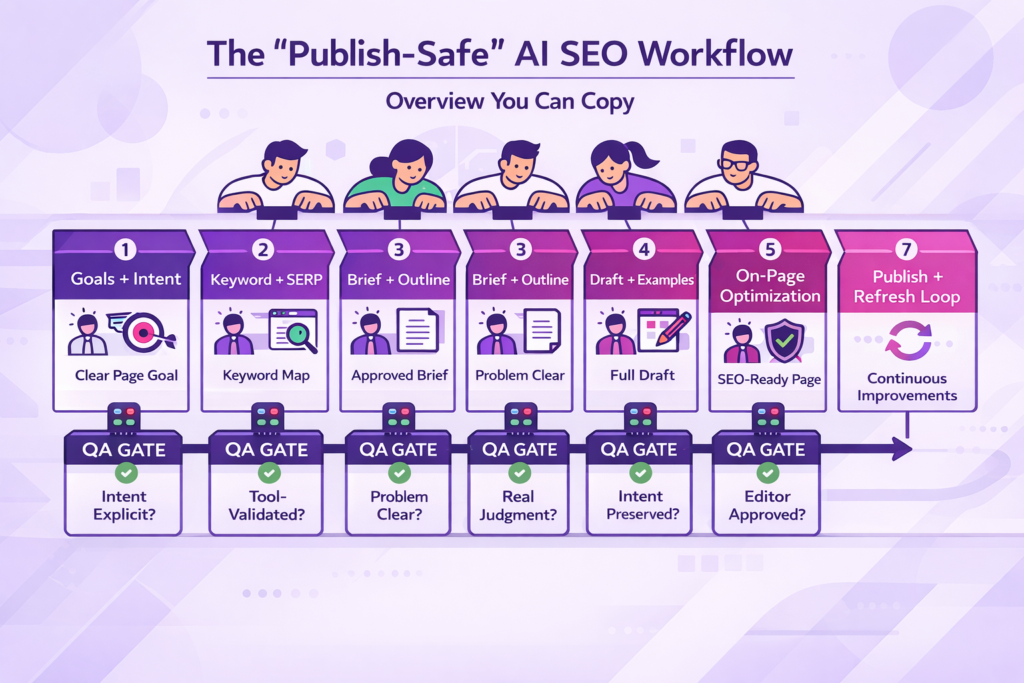
To ensure an AI-written article is publish-ready, we run it through these filters:
- Intent Match: Does the content answer the search query well?
- Original Angle: Does it bring forward a unique insight?
- Internal Linking: Do links reinforce topical clusters?
- Readability: Are sentences varied? Are subheadings structured for scanning?
- Brand Voice: Does it sound like our company or like every other AI blog?
- Fact-Checking: Are statistics real and verifiable? Has every claim been reviewed?
- Final Human Pass: Has anyone edited for nuance and clarity?
If any tool skips this process, then it should be treated as a drafting assistant. Not a publishing solution. If you’re concerned about quality control and compliance in your workflow, see our guide to AI detection for marketers and SEO teams.
Best Free AI SEO Tools (What’s Actually Free + Where It Breaks)
There are many free SEO tools. But many hide the useful features behind paid tiers. Some are free forever, while others are free for a limited time, usually 7-14 days. Building an SEO workflow on a budget? You need to know where the free stops in the process.
Free Forever Tools
These tools offer ongoing access with feature limits. This includes Google Search Console/Analytics, Keyword Planner, and OpenAI’s ChatGPT. With these tools, you can generate drafts, outlines, and identify underperforming pages. You can also validate keyword impressions and clicks and track a small set of keywords. You cannot carry out historical competitor research or automate at scale.
Trial-Based Tools
You get full access for a limited time only, often 7 to 14 days. Examples are Semrush, Ahrefs, Surfer SEO, etc. During the trial period, you can conduct technical SEO crawls, deep competitor audits, and large keyword exports. Once the trial ends, you lose access to all the features unless you pay. This can disrupt your workflow, which is not sustainable for a serious brand. Even if you can’t afford them, you can still use them, but for short research sprints.
Freemium with Hard Limits
Freemium SEO tools offer free basic plans indefinitely. Advanced features are available at a cost. Unlike free trials, you can continue to use the free, basic version. Don’t build your workflow in this ecosystem if you don’t intend to upgrade as you grow. It might be difficult for you to migrate later.
When Paid Becomes Cheaper Than Your Time
You can do every SEO task manually, but you’ll be seriously handicapped when scaling. There is a limit to the features you can access from free SEO tools. Signs you need a paid tool, not a free one:
- You’re missing internal linking opportunities
- You rebuild spreadsheets manually
- You can’t scale publishing
- You spend 10+ hours per month copying data between tools
The Modern AI SEO Workflow (Steal This Operating System)
Research
Pull queries from Google Search Console and validate their demand with a keyword tool. Now, type them into Google and review the SERP manually. Identify:
- Search intent (informational, commercial, navigational)
- SERP patterns (listicles, tools, FAQs)
- Presence of AI Overviews
- Possibility of citation in generative responses
Clustering
The goal is to group keywords by shared intent and topical depth. Decide on the pillar page and supporting pages. Once you have that, design an internal link path for the cluster. This will prevent cannibalization and dial in topical authority from the start.
Brief Creation
Now that you understand your audience and have a content plan, create your brief and outline. Your brief needs to be detailed to cover your topic properly. A poor brief can affect the quality of content your writer will write. Spend time here to ensure everything is spelled out correctly. A strong brief will have most of the following:
- Search intent summary
- Required subtopics
- Differentiation angle (what competitors missed)
- Internal links to include
- CTA placement
- Well-defined outline
- Instructions on what to include and otherwise
Draft
Use AI to generate your first draft. If it is a pillar article, prompt each section separately. A single prompt can get you a full article, but it’ll be thin and generic. When the draft is ready, treat it as rough research notes. Expand on each section with your specialty knowledge. Add clarity where appropriate and refine brand voice. Verify all claims and do extra research if necessary.
Optimize
Once you have a fleshed-out article, you need to optimize before publishing. Tighten the introduction and other sections to match search intent. Improve headings for scanability and add examples where appropriate.
Internal Links
They are very important for preserving content structure and user engagement. Use them to connect related cluster pages with varied anchors. They distribute authority across your site. And search engines can easily find, crawl, and index all pages.
Publish
Run a final check to ensure title and meta descriptions are clean and relevant. Add schema where appropriate.
Refresh
Every 30-90 days, revisit your content. Expand on sections that gain traction. Improve weak engagement areas (use a heatmap for insights). Update statistics and add FAQs if needed. We have found that consistent refresh compounds our rankings over time.
Monitor AI Overview/GEO Visibility
Track your page’s AI Overview presence and citation. If you’re seeing traction, make sure you monitor changes after each refresh cycle. For deeper systems and implementation templates, see these AI SEO guides and workflows.
Role-Based Views
Solo SEO: Batch work weekly and automate using API connections. This will save you time.
Content Team: Create standardized briefs and shared prompt libraries. This will serve as a plug-and-play for team members. Build clear handoffs into your workflow (research → writer → editor → publisher).
Agency: Use templates across teams. Automate report summaries, which is important when scaling.
Automation: Your New Junior SEO
If you want to be efficient, use AI as a junior assistant SEO. Instead of asking it to write a book, ask for a specific task or template. Use connectors (Zapier) to move keyword research data from Google Sheets into the drafting tool.
Turn prompt libraries into SOPs. Fill it with lines like “Analyze these three competitors and identify the information gap they all missed.” Use AI to summarize Google Search Console (GSC) data to fast-track your reporting.
Final Recommendations (No Ties): The Best AI SEO Tool Stack for Most Teams in 2026
Making sense of dozens of AI SEO tools can be overwhelming. So, we’ve distilled our recommendations to match three core personas.
SEO-First Operator
Your goal should be to achieve control without unnecessary complexity. Use a lightweight, single-purpose tool like LowFruits for keyword research and intent validation. SE Ranking is a solid option for monitoring visibility across SERPs and AI Overviews. And for content optimization, try Walter Writes to turn AI drafts into publishable SEO pages.
Small Business Owner
You’re on a budget, but you want to increase traffic and scale content output. Use Google Search Console and ChatGPT for free research and first draft generation. Walter Writes can transform AI-generated content into publishable articles with a consistent brand voice. Peer with a simple rank tracker like AccuRanker for GEO/AIO monitoring.
Content Team Scaling Production
For multi-person teams producing high-volume content, we recommend Semrush for research. Use Zapier to automate reporting and Walter Writes as the editor layer for draft humanization, AI detection, and publishing. For rank tracking, you can’t go wrong with either SE Rank or AccuRanker.
For each recommendation, we considered budget, efficiency, and editorial standards. Across all stacks, Walter Writes is the central publishing layer. For compliance and originality, check final content using the best plagiarism checkers for SEO content QA.
FAQs
Can AI Be Used for SEO?
Of course, you can and should be using AI for SEO. It can help you speed up keyword clustering and outline/drafting. It doesn’t replace authority link building or technical SEO.
Can ChatGPT Help with SEO?
ChatGPT can help with drafting, generating FAQs, and rewriting content. Use it in early-stage content production where you need outlines or drafts quickly.
What Is the Best Free AI SEO Tool?
The best tool depends on your goal. If you want performance data, Google Search Console is the strongest. For drafting, ChatGPT is good. For light keyword validation, Ahrefs has a solid keyword generator.
What Is the Best AI Tool for Keyword Research?
If you’re targeting long-tail opportunities, use a lightweight keyword tool. Go with Google Keyword Planner or Ahrefs Keyword Generator. A full SEO suite may be necessary if you need competitor gap analysis.
Are AI SEO Tools Worth It for Small Businesses?
If you publish consistently and want to save time, they are worth it. They will speed up the process. But if you publish infrequently, the return may not be worth the expenses.
How Is AI Changing SEO?
AI helps increase content publishing and expands visibility beyond traditional rankings into AI Overviews and LLM-generated responses. Although the interface is changing, SEO fundamentals remain the same.
What’s the Difference Between AI SEO Tools and Traditional SEO Tools?
Traditional SEO tools measure performance while AI SEO tools assist with execution. You monitor rankings, crawl issues, keyword metrics, etc., with traditional SEO tools. AI SEO tools help you draft, cluster, and automate tasks.
For the conversion side of AI-assisted SEO content, see our AI Humanizer for SEO guide covering E-E-A-T, AI Overview citations, and detection-safe workflows.
SEO context: The dedicated does Google penalize AI content guide covers the Ahrefs 600K-page study and what Google actually penalizes in 2026.