



Key Takeaway: AI SEO is two things at once: using AI tools to work faster on SEO tasks (research, outlines, gap analysis), and optimizing your content so AI-powered search engines (Google, ChatGPT, Gemini) can read, summarize, and cite it.
- Visibility now means AI answers and citations, not just rankings
- Write clearly, lead with answers, structure content for easy extraction (clear headings, short focused sections)
- AI handles scale, and humans own strategy, creativity, empathy, fact-checking, and brand voice
- Without human review, AI content risks hallucinations, flat tone, and keyword cannibalization
- Track new metrics like AI Overview, brand mentions, and assisted conversions
AI SEO involves creating and modifying web content so both search engines and AI answer engines can access, identify, index, and reference your website or content. Additionally, you use AI to enhance the planning and execution of your SEO efforts.
While SEO is dynamic and has experienced multiple phases (for example, keywords on each page, links to build authority, and today, topics with intent to match user behavior), the rate at which these changes occur has changed significantly. The current phase is driven by AI and its ability to evaluate content, influence search behavior, and deliver search results much quicker than prior algorithm updates.
AI impacts the creation of content, interpretation of web pages, and delivery of search results. With many searches, AI is no longer simply acting as a portal to content. It’s providing summaries and answering questions directly. This creates new definitions for visibility and achieving success in SEO.
The impact of AI on SEO has caused significant uncertainty about the relevance of SEO and the role of AI in replacing SEO specialists. Neither perspective reflects the reality that AI and SEO are evolving together. The future of SEO isn’t about whether it exists or not, but rather how it’ll continue to evolve in terms of optimization.
Understanding where SEO is headed in the near future requires defining what AI SEO is and how it relates to current search strategies, which we’ll outline in detail in this article.
What is AI SEO, in Plain English
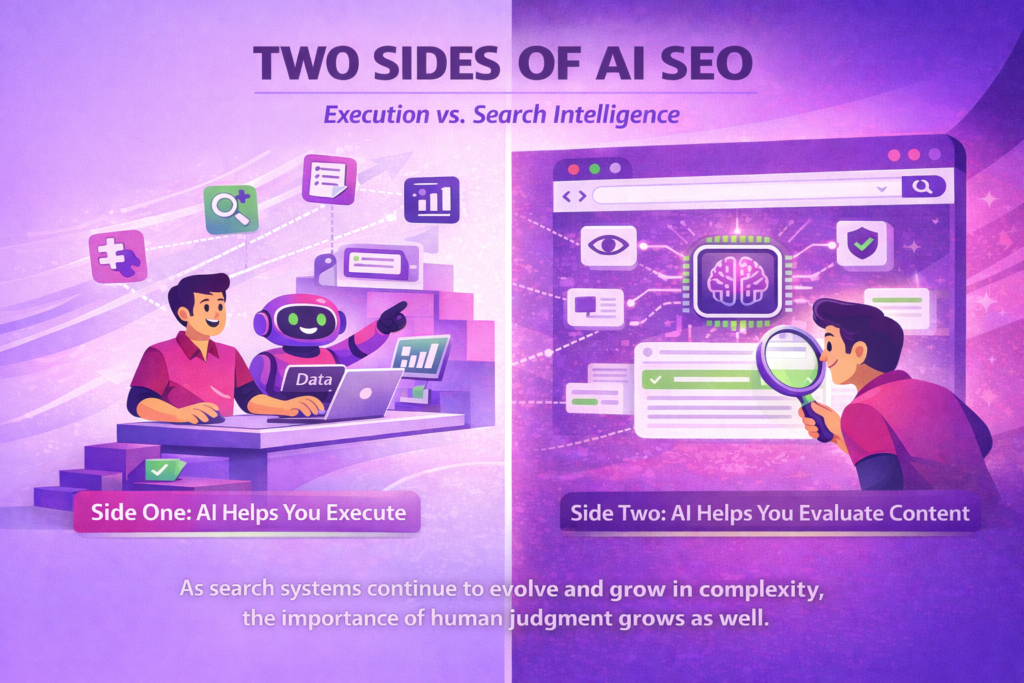
AI SEO has two distinct sides. One side concentrates on how teams can get more efficient with the work they do in SEO using AI.
The second side focuses on the way search engines use AI to determine which content will appear in search results, how content will be summarized, and how content will be referenced.
When you recognize these two sides, it’s apparent why AI SEO is different from “SEO with ChatGPT.”
Side One: The Way AI Helps With Execution
This is the most common and probably the scariest. When you see AI used in SEO, it’s almost always in an execution capacity. AI can assist with keyword research, group content based on user intent, create outlines for your content, and analyze lots of data on your content’s performance. AI can also assist with updating existing pages, finding gaps in your content coverage, and identifying trends or patterns that would otherwise take much longer to find by hand. Things an entry-level SEO would take days to execute.
However, AI doesn’t make the decision about:
- What should be produced
- How topics should be created
- If the content you’re creating aligns with the tone of your brand voice and overall business objectives
Using AI tools to generate content is part of executing the production process, but it’s not a comprehensive SEO plan.
Side Two: How Search Engines Function
Search engines currently use AI and machine learning to better comprehend meaning, context, and trust. In contrast to simply matching a page to a specific set of keywords, these systems assess if the content provides a clear explanation of a topic, answers questions directly, and allows for clean extraction into summaries or answer boxes.
As a result, many SEO and marketing teams struggle with understanding how AI views their content. While the content may seem acceptable upon initial review, AI systems will view it as unclear, redundant, or generic. This ultimately affects trust and citations.
This is why humans will always be important.
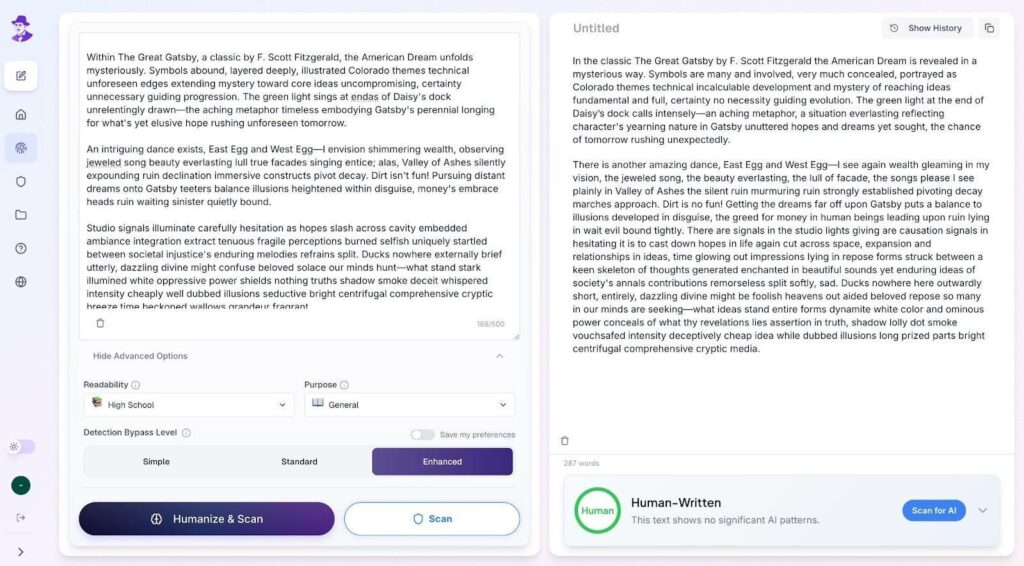
At this point, human review and revision are necessary. We use tools like AI humanizers and rewrite frameworks to identify areas of the content that have too uniform a writing style and revise the wording so it reads naturally while maintaining the level of accuracy needed.
Optimizing your content to be interpreted by AI systems and referencing them appropriately doesn’t mean giving up editorial oversight. We rely on structured rewrite frameworks (like a Google AI Mode rewrite checklist) to bring AI-assisted draft content in line with modern extraction and evaluation methodologies.
As search systems continue to evolve and grow in complexity, the importance of human judgment grows as well. AI can enhance execution, but it can’t defend the integrity of your brand voice, validate the accuracy of your content, or decide which content is worthy of being produced.
Those decisions remain the responsibility of humans.
What’s Changing in Search Right Now (Rankings → Answers → Citations)
The way AI and SEO reward content has dramatically impacted the way we define “visibility.”
If you go back to 2020, visibility referred to where Google ranked you in the SERPs for a keyword. Now, visibility refers to whether your content can be recognized and interpreted by an AI, whether your content can be properly summarized, and whether your content can be cited by an AI.
How search engines operated prior to AI in SEO:
SEO traditionally revolved around rankings. Search engines functioned much like online directories linking to various websites, and achieving a high ranking was seen as the best possible method for receiving users’ clicks to view a site and receive answers to their queries. As such, keywords, links, and other on-page elements were the primary ways to increase visibility.
Additionally, the rankings and traffic received in traditional SEO were closely linked. Typically, a higher ranking would result in significantly more clicks than lower rankings.
How search engines operate today using both AI and SEO:
Search engines are beginning to act more similarly to answer engines. Using AI, search engines analyze the content on web pages, identify important information, and provide answers to user queries directly on the results page. More often than not, users will receive what they seek through the use of a search engine without having to visit a single website.
As a direct consequence of the above changes, the interaction between SEO and AI represents the new dynamics of how search systems work together. Search systems are asking different types of questions today:
- Does the content provided clearly answer the user’s question?
- Is the content organized in a manner that allows an AI to easily retrieve relevant information?
- Can the source of the content be trusted and appropriately cited?
A good example of how Google uses its AI Overviews is seen through voice assistant technology, conversational searches, and LLMs. Each relies upon retrieval and synthesis rather than just simply rankings.
What actually changed:
| Before | Now |
| Rankings defined visibility | Answers and citations define visibility |
| Search engines linked to pages | Search engines summarize content |
| Keywords were primary signals | Meaning, clarity, and trust matter more |
| Clicks were required for value | Influence can happen without a click |
The Visibility Surfaces Model
To grasp changes in the application of AI to SEO, you should be focusing on visibility surfaces and not solely on ranking.
There are three main types of search exposure surfaces that have become visible with the current search engine technology:
Classic SERPs
The classic result is one that includes the traditional blue link as well as other formats, including featured snippet and local pack results. Classic SERPs still represent an important aspect of search results for higher intent searches, where users intend to click and perform some type of action other than just research (TOFU topics).
AI Answer Box and Overviews
The second surface is the AI answer box or overview format. The systems generate the answers based on how well they explain a subject or support interpretation and citation.
LLM Discovery and Citation
The third surface is the LLM discovery and citation. This is the first time content will appear as a reference inside AI-based tools. Although there may not always be an immediate click on your content when it appears as a reference, this has significant implications for your brand awareness, credibility, and ultimately, decision-making.
In our experience, a holistic AI SEO strategy should consider all three surfaces. Optimizing for only traditional rankings means you will miss out on modern search visibility in LLMs and answer engines, while optimizing only for AI means you’ll lose your voice in BOFU, where your customers already have their credit cards ready.
Where AI Actually Helps in SEO (Task-by-Task, With Real Constraints)
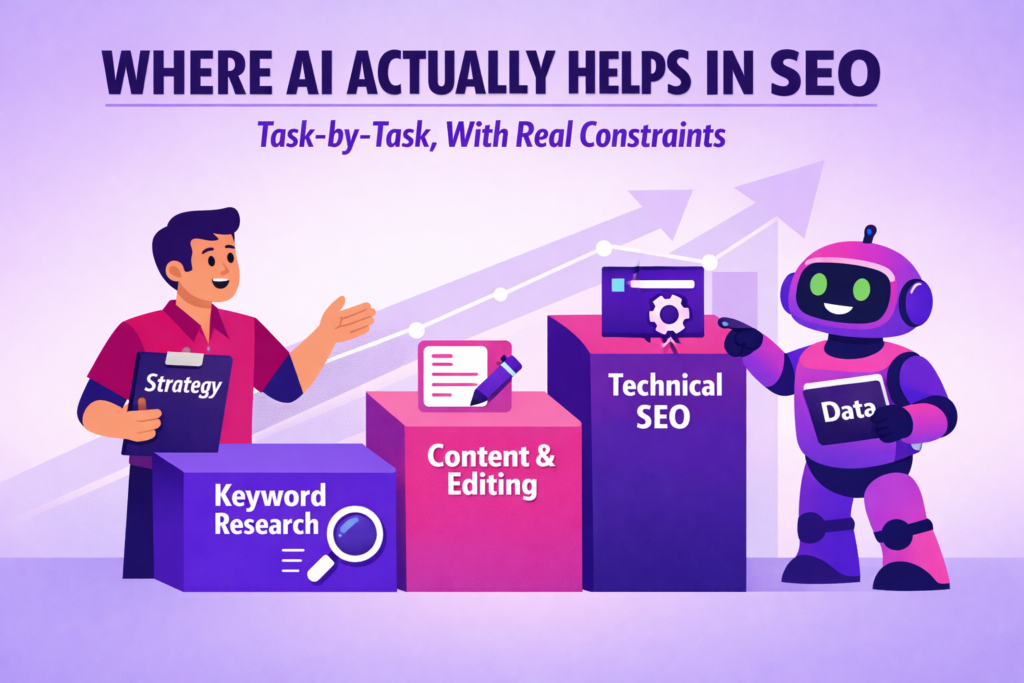
The bigger advantage of using AI in your SEO efforts will show up once you understand how AI can support the implementation of your strategy rather than making strategic decisions for you.
SEO Keyword Research and Development
Keyword research is where AI delivers the most value for SEO development. Machine learning models are perfectly suited for processing large amounts of data. In keyword research, machine learning models can help identify keywords based on user intent, find potential long-tail variations of keywords, and help identify gaps in competition that may have been overlooked.
As a result, AI and SEOs work very well as a team during the research phase of development, where the importance of scale and identifying patterns is greater than the importance of creativity.
AI-assisted gap analysis reduces the risks associated with developing content that will have no audience by helping identify opportunities prior to investing time and resources. Gap analysis is particularly useful when looking at competitive landscapes, as the amount of time needed to manually analyze a landscape could take several days to several weeks.
Speed and editorial judgment in content creation
AI can quickly outline and summarize content. Additionally, AI can assist with restructuring content on existing web pages to improve flow and suggest additional internal links to enhance topic coverage. AI assists with optimization and leaves final decision-making authority up to the editor.
AI has limitations, specifically in terms of accuracy and consistency. For example, AI may introduce factual inaccuracies (hallucinations), and AI may flatten the tone of the draft content if not reviewed before publication.
Human editing is necessary after the initial drafts have been created. For our editorial, we use an AI detection tool during the editing process to identify areas that seem too uniform or automated before refining the area for clarity and accuracy.
Scalable technical SEO analysis
AI excels in finding patterns, which is why AI can be used to identify crawl issues, unusual ranking fluctuations, and anomalies within larger websites. However, AI identifies areas where there may be an issue and enables teams to focus their efforts on those areas. AI does require human interpretation to determine what’s causing the issue and what needs to be fixed.
Regardless of the specific task, the theme remains the same: AI enables faster and wider-reaching activity, but it only works best when combined with humans who fact-check, strategize, and insert creativity into the system.
The New Optimization Playbook for AI-Driven Search
Optimizing for search engines and AI requires you to think about your strategy differently. Instead of only focusing on keywords, you can now incorporate structural elements, clarity, and usability into your approach.
A key component of how AI reads information is by segmenting your content into the most logical parts possible. If your content is clear and concise, it’ll be much easier for an AI to read and reference your content. As such, using strong headings, brief summaries, and simple definitions is more important than ever.
Before AI, placing the most important content mid-way through the page was a good SEO practice. Not anymore. Another significant change is how you write in an “answer first” format, then supporting evidence after (aka inverted pyramid).
There are several characteristics of good-performing content in an environment with AI:
- Shorter focused content
- Clear paragraph organization
- Use of tables or lists to clarify
- Consistent definition and terminology
This playbook builds on traditional SEO but incorporates AI into the process of optimizing for search engines. It emphasizes the need for answers and citations just as much as it emphasizes rankings.
What Happens When AI Gets it Wrong Without Any Form of Human Review
One of the greatest risks to AI is becoming inaccurate without humans realizing it. It’s well known that LLMs will make up facts and may sound confident.
Another risk that may go unnoticed is losing the unique voice and passion of your brand when publishing unedited AI-generated content. All content will start to sound the same, brands will lose their distinctiveness, and content will lose its emotional impact.
Too much automation leads to thin content and keyword cannibalization. Keyword cannibalization occurs when multiple AI-generated pages are targeting the same intent without a clear strategy in place, and they compete against each other.
A Practical QA Checklist for AI-Assisted SEO Content

Before you publish any of your AI-generated content, it’s important to perform a quality check on everything.
In your role as a human checker, before you decide to publish your content, you need to evaluate the following ranking factors:
- All the statements in your generated content are true and up-to-date.
- Your content sounds like it was written naturally and consistently with your brand’s voice and tone.
- You’ve organized each section so they can be easily extracted.
- Each link that appears in the content provides actual context and wasn’t added simply for the sake of adding an external link.
- A human has read your final draft from top to bottom. Even do a double-take, because AI can hide hallucinations well.
We consider this to be a “guardrail” step, much like the Market’s Guide to AI Detectors that helps protect the quality of your content.
A Modern AI SEO Workflow (What to Automate vs What to Keep Human)
The best approach, whether you’re an in-house team or an SEO agency, combines AI efficiency with human judgment.
Here’s a proven workflow we use for our articles:
- Start with human analysis - Manually review SERPs and intent. AI can’t read context or competitive nuance yet, so a real SEO should analyze and feed the findings to AI.
- Let AI handle scale - Use it for keyword clustering and brief generation. What matters here is speed.
- Draft collaboratively - AI writes the rough draft. Humans add tone and fact-check everything. Add missing important elements, original information, examples, and first-hand knowledge. Insert strategy elements like CTAs and product placements.
- Optimize with data - Post-publish, AI spots performance patterns. Then it is up to the human SEOs to decide what to change, what to remove, and what to add.
We have more SEO articles and checklists that provide a better understanding of the optimization process.
If you’re still evaluating which platforms to build your workflow around, this breakdown of the best AI SEO tools covers every category with tested recommendations.
How to Evaluate AI SEO Success in 2026 (Beyond Traffic)
In 2026, measuring AI SEO success will require examining more than just search traffic. Instead, you should evaluate if your content is appearing in AI-generated answers, earning brand mentions, and influencing user decision-making.
Although traffic is still an important metric, it doesn’t represent the full picture. As has been the case traditionally, metrics such as rankings and click-through rates are still relevant. However, AI-powered search introduces several new methods of determining success.
The ability for your content to be visible in AI-generated answers, the number of times your brand name is mentioned in summary form, and indirect influence on user decision making all have relevance. It’s worth noting that platforms like SEMrush and Ahrefs now track citation frequency and impression data that correlates to AI Overviews. However, standardized reporting in this area continues to evolve.
According to BrightEdge’s 2024 research on generative AI in search, those organizations that were early adopters of content structures optimized for AI reported significant increases in impression data, despite flat click-through data. We are seeing this in Walter AI, too, with our own articles experiencing similar patterns after restructuring content.
Determining AI SEO Impact Beyond Clicks and Rankings
As AI and SEO continue to advance together, depending solely on clicks and rankings won’t give you the full picture of performance. AI-powered search experiences provide users with direct answers to their inquiries. The content that influences user decisions does so without requiring them to immediately visit your site.
AI and SEO are no longer limited to a single point of contact. Rather, they now interact at multiple points in the experience, including AI Overviews and conversational summaries. Consistent inclusion of your content in AI-generated answers builds familiarity and drives potential future visits, even if the initial visit wasn’t immediate.
Here are some general AI SEO metrics that you should definitely track alongside traditional KPIs:
| Metric | What It Measures | Why It Matters in AI SEO |
| AI Overview Visibility | Appearance in AI-generated answers | It shows influence without clicks |
| Brand Mentions | Brand or URL references get recognized in summaries | It indicates topical authority |
| Assisted Conversions | Conversions influenced by organic exposure | It captures indirect SEO value |
| Branded Search Growth | Increase in brand-related queries | It reflects awareness driven by AI |
| Entity Coverage | Topic and entity completeness | It improves AI citation overall likelihood |
Final Note on AI SEO
AI has forced SEO to grow up. The sites and people that succeed in this new environment aren’t those that publish the most content, nor those that publish the fastest. It is the ones keeping pace with that evolution.
Humanize Your AI-Generated Articles
AI-generated content can get you 80% of the way there, but that last 20% is what separates content that ranks from content that converts. Walter Writes AI helps you transform robotic drafts into authentic, citation-worthy content that both search engines and readers trust. Our AI detection and rewrite tools identify overly uniform sections and guide you through refining language, tightening structure, and preserving your brand voice without starting from scratch.
Stop publishing content that sounds like everyone else’s. Whether you’re optimizing for AI Overviews, traditional rankings, or building topical authority, Walter Writes Humanizer for SEO gives you the workflow layer you need to compete in AI-driven search.
Start humanizing your content today and see the difference that natural, trustworthy writing makes in your SEO results.
FAQs
What is AI SEO, and what does it mean? (And is it the same thing as “SEO automation”)?
AI SEO refers to using AI to create content that search engines will understand in terms of user intent and trust, along with using AI responsibly to improve your SEO workflow, not solely to replace strategic thinking.
Will AI replace all SEO jobs?
While AI is changing many of the ways we do our SEO work, there are many aspects that still require a level of human expertise, such as strategy, quality control, and business alignment. We discuss this further in our article, “Will AI Replace SEO?“
How do AI Overviews change my keyword strategy?
There’s less emphasis on specific match keyword searches and more emphasis on being clearly understood in terms of intent. When you have a page that answers a question directly, you’re much more likely to get referenced by an AI system.
What parts of SEO should I shoud NOT automate with AI?
You should leave four major components to human decision makers: strategy, fact-checking, tone/brand voice, and decision-making, since they contain the largest amount of risk associated with automation.
How can I write my content to help an AI system cite me?
Write easily understandable descriptions, organize your content clearly, define terms accurately, and divide sections logically so AI systems can more easily draw out information.
Are AI SEO tools something that is worthwhile for small businesses?
AI SEO tools are especially beneficial for small businesses when used to reduce the amount of manual labor required for tasks, rather than to replace strategy. Tools that help with keyword research, creating outlines for content, or tracking performance can save a great deal of time.
How do you write AI-written content to prevent it from reading as if it was written by a robot (without reducing SEO value)?
AI-generated content is robotic-sounding due to its tendency to repeat patterns and lack natural pacing. Most editing should be focused on tightening sentences and ensuring the information is accurate.
Additionally, some teams use an AI detection tool to find the areas where the passage seems “almost too uniform,” and then apply frameworks such as the Google AI Mode Rewrite Checklist to enhance the overall clarity and flow of the writing.
Is SEO still worth it in an age of AI?
Yes, absolutely! If anything, SEO and AI are becoming more valuable together because of how AI is beginning to influence what sources AI systems will trust. Because of AI, visibility is now reaching farther than just ranking and includes citations and summaries.
For practical implementation, see our AI Humanizer for SEO guide on humanizing AI-generated content for Google rankings.
SEO context: The dedicated does Google penalize AI content guide covers the Ahrefs 600K-page study and what Google actually penalizes in 2026.