





Key Takeaway: To rank in Google AI Overviews, you need both strong traditional SEO and content that’s easy for Google to extract and reuse.
- Answer the main question early
- Address the common follow-ups on the same page
- Write self-contained sections that work independently
- Use specific examples and clear explanations
- Rank in the top 10 organically in Google SERPs
If you hop into a time machine and work as an SEO before the AI boom, ranking on page one was usually enough. But that’s not the case anymore. AI Overviews have become the new first page for many informational searches. And usually, getting featured in the overviews takes a lot more than simply ranking on page one.
AI Overviews sit on top of traditional results and act like a gatekeeper that adds another layer of selection that we have to hurdle. You still need solid SEO fundamentals: relevance, authority, and intent match… plus something extra. You have to make your content easy to extract and reuse by Google.
So when people talk about ranking in AI Overviews, it’s about whether your content gets pulled, cited, and used. This guide focuses on how to appear in AI overviews. Let’s unpack what drives that selection using detailed studies and real-world tests.
What Google AI Overviews Are (and What “Ranking” Means)
Google AI Overviews are generated answers that summarize information from multiple sources, rather than pointing users to a single page. Google still crawls, indexes, and ranks pages the usual way, but on top of that, it now decides which pieces of content are helpful enough to be reused inside an AI response.
A classic analogy is that the traditional searches act like a librarian, giving you choices on which books to read. But with AI overviews, the same librarian now locates all the best answers and summarizes them for you.
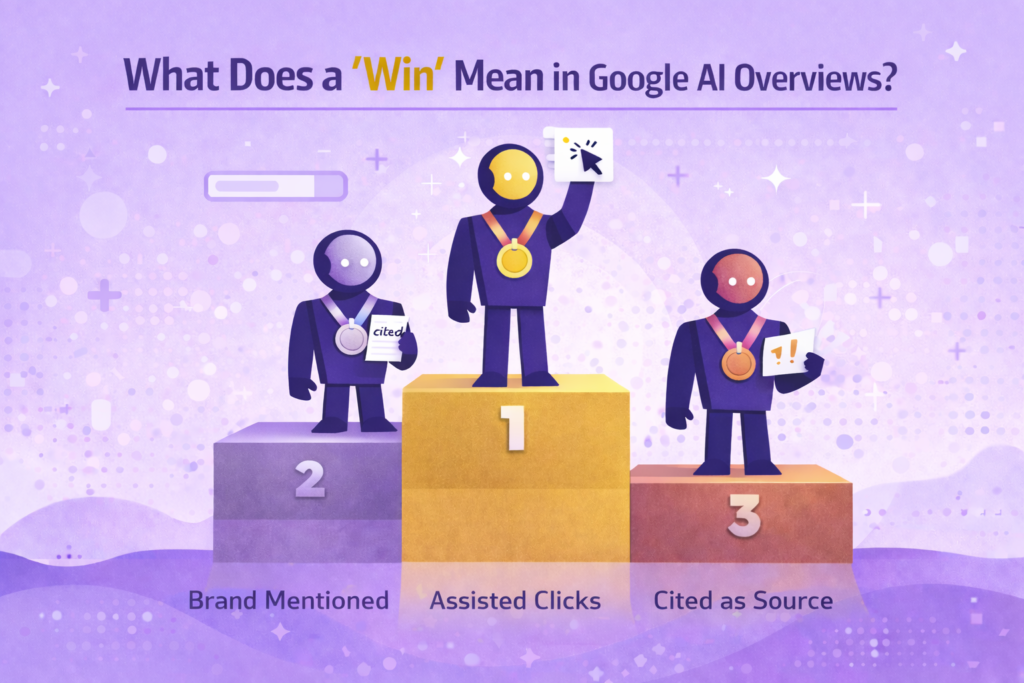
That’s where the definition of “ranking” changes. A win here usually looks like one or a combination of three things:
- Your page is cited as a source (which means Google trusts your article)
- Your brand is mentioned inside the explanation (good for visibility and retention, and your viewers see your brand even if they do not click through)
- You earn assisted clicks from users who want more detail than the overview provides (arguably the biggest win, because you get quality traffic and leads that are 23x more likely to convert)
Does this mean traditional SEO stopped mattering? Not really. Most AI Overview citations still come from pages that already rank on the first page. But here’s the clincher: when faced with two equally strong players, Google usually defaults to the article that’s easier to scan.
How Google Chooses Sources for AI Overviews (Mechanics You Can Optimize For)
Once your SEO fundamentals are solid, this is where differentiation actually happens. If two sites are equally strong on the basics (like authority, relevance, and technical SEO), AI Overviews don’t guess. They choose the content that’s easier to reuse when assembling an answer.
The winner is mainly decided by two mechanics: query fan-out and passage retrieval.
Query Fan-Out: What it Looks Like in the Real World
If you were researching compression shirts, your next questions will probably be: How tight should a compression shirt be? What makes a compression shirt good for running? Brands with the best compression shirts?
When someone searches, Google doesn’t treat that query as a single request. It expands it into a set of related questions the user is likely asking implicitly. That expansion is the fan-out.
Take this other example:
Query: “How to rank in Google AI Overviews.”
You don’t see it, but under the hood, Google will fan this out into other questions like:
- What are Google AI Overviews?
- How does Google choose sources for AI Overviews?
- Do rankings still matter for AI Overviews?
- Can new websites appear in AI Overviews?
- Does schema help with AI Overviews?
Since Google looks for related questions, you should do that too. If your page only answers the main question, you only give Google one usable answer. But address related follow-ups, and you give Google multiple passages to use for AI overviews.
That’s why pages with broader topical coverage tend to show up more often. You’re not just answering the question. You’re also answering the questions the searcher will ask next.
This is also where people misunderstand “topical authority.” It’s not about publishing dozens of loosely related articles and sounding impressive. It’s about anticipating the next question and answering it on the same page.
Passage Retrieval: Why Structure Matters More Than Flow
After fan-out comes retrieval. AI Overviews don’t read your page from top to bottom the way a person does. They retrieve individual passages and evaluate whether each can stand on its own.
Here’s another example.
Harder to reuse passage: “Because of this, it’s important to structure your content properly.”
This sentence doesn’t work on its own. What is “this”? What does “properly” mean? A human might understand it in context, but a retrieval system won’t.
Easier to reuse passage: “AI Overviews select individual passages, not full pages. Sections that open with a clear answer and define key terms are easier for Google to reuse inside generated answers.”
That paragraph works by itself. It defines the concept and explains why it matters, even if you just read that tiny passage by itself. No surrounding concept required.
We found that AI Overviews tend to be built out of sections like the second example. They don’t rely on narrative buildup, and they don’t assume the reader followed every step. Each section explains something independently.
When Two Sites Are Equally Strong, This is What Decides Who Wins.
Extractability is the practical tie-breaker.
If two websites have similar authority, rankings, and intent, Google isn’t asking which one is better overall. It’s asking which one provides more usable pieces.
In real terms, that looks like this:
| What gets cited in AI Overviews | What doesn’t get cited |
| Answers the main query and common follow-ups | Answers only the main query |
| Clean, self-contained sections | Long, interdependent paragraphs |
| Explains with specific reasoning or examples | Explains general ideas |
The first column gives Google more confidence. Not because it’s higher quality, but because it reduces the risk of misinterpretation when chunks are reused.
What Studies and Industry Data Actually Show (With Context)
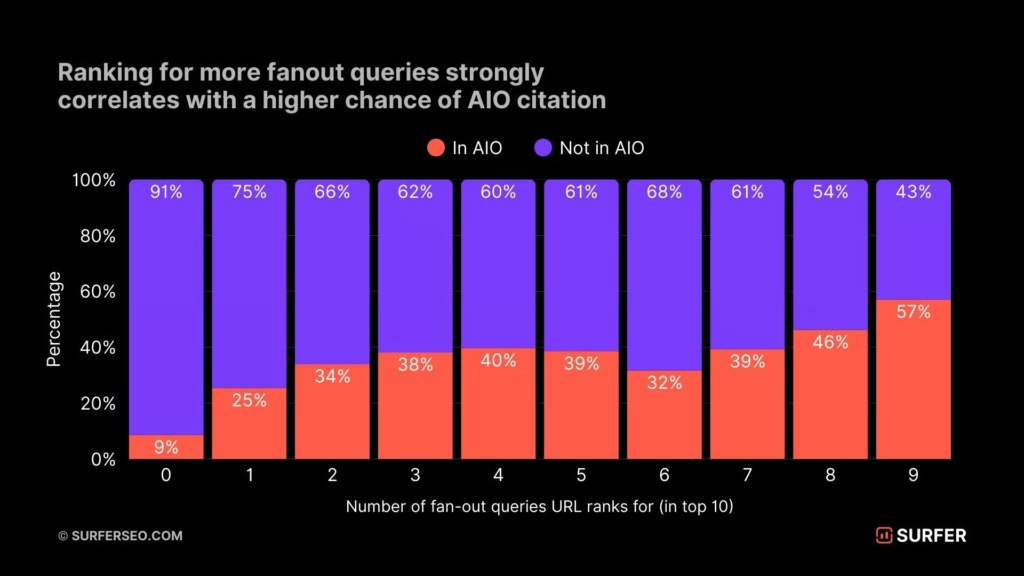
Across multiple analyses, the same patterns keep showing up.
- First, fan-out coverage correlates strongly with citations. Surfer SEO analyzed 173,902 URLs and found that pages that address related sub-queries are far more likely to appear as sources.
- Second, traditional SEO still matters. Ahrefs analyzed 1.9M citations and found 76% come from pages already ranking in the top 10. This means AI Overviews don’t bypass SEO. They sit on top of it. Strong rankings get you into the candidate pool.
- Third, experience and credibility show up indirectly. Our internal study found that pages that include firsthand explanation, clear authorship, or concrete examples tend to be reused more consistently than generic summaries.
If you want to see how these patterns show up across other experiments and updates, there’s ongoing coverage in our SEO research and experiments.
The “AIO Citation-Ready Page” Blueprint
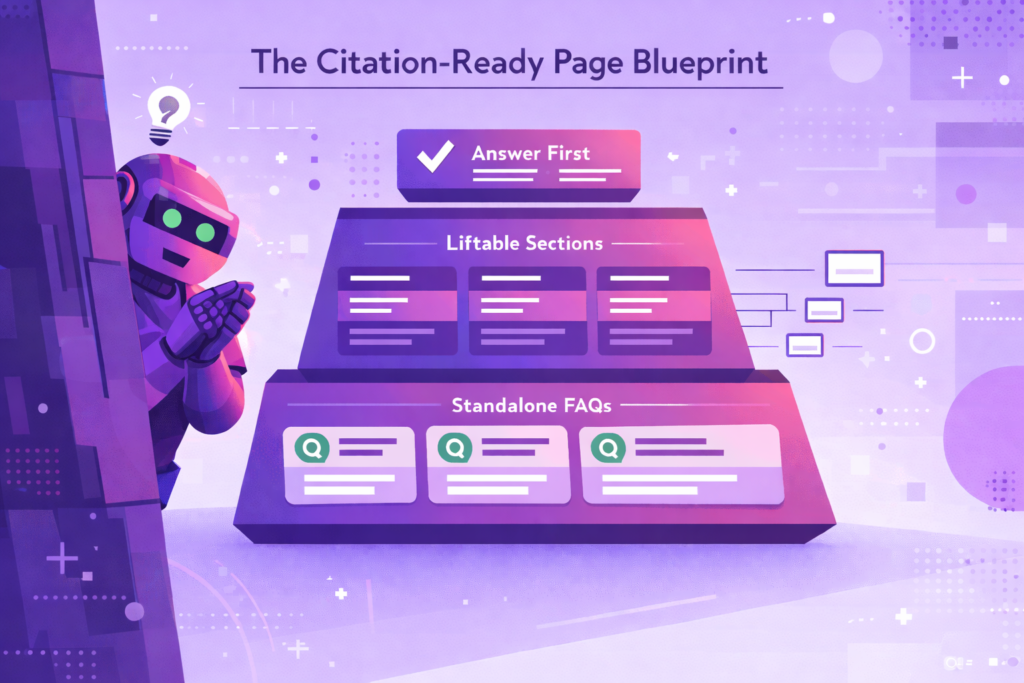
Once you understand how AI Overviews select content, the next question is: what does a page actually need to look like to get cited?
Pages that get pulled into AI Overviews tend to make their usefulness obvious early, and then reinforce it section by section. If you studied journalism, you’re right, it’s the inverted pyramid format.
1. Answer-First Opening (the first 5–8 lines)
Pages that are often cited answer the main question immediately. Not with a hook. Not with a story. Just a clear response.
This doesn’t mean you flatten nuance or oversimplify. It means you establish relevance fast, then expand. The model needs to know, right away, that your page is a legitimate candidate for reuse.
You can still layer in context and depth. Just don’t bury the answer under it.
2. Add Section Patterns AI Can Easily Lift
After the opening, the structure does most of the work. A reliable pattern looks like this:
- A clear question or statement as the heading
- A short, direct summary (two or three sentences)
- Evidence, context, or explanation
- Practical implications or steps
This works because each section is self-contained. A model can extract the summary without losing meaning, and a human can keep reading for details if they want to.
The mistake we see most often is interdependence. One section leans heavily on the previous one. Delayed definitions and a promise to “discuss this later.” That reads fine to a person, but it makes extraction harder.
We use this to train new writers: If you’re unsure whether a section stands on its own, copy the first paragraph of that section into a blank document. If it still makes sense, you’re good.
3. FAQs That Are Useful
FAQ sections tend to fail for one of two reasons: they repeat what the page already said, or they exist purely to stuff keywords.
When FAQs work in AI Overviews, it’s because they answer additional fan-out questions that the main content didn’t fully cover. Each question functions like a mini-article. It introduces the topic, answers it directly, and adds enough context to be useful.
If you want a quick, skimmable way to double-check whether your page structure is actually AI-ready, this SEO AI mode rewrite checklist is designed specifically for Google’s AI mode.
Google AI Overviews Ranking Factors You Can Actually Influence (Prioritized for Small Teams)
Now that you know how to rank in AI overviews and how to structure your articles, the next step is deciding where to spend effort. Chasing every possible signal is a good way to waste your time.
Spend a few hours a week on your most important articles first. Then move to pages that almost rank. Then the content that doesn’t rank yet.
The factors below show up consistently in pages that earn AI Overview citations.
- Intent match and specificity: Tighten your main answer so it clearly matches the query’s intent. Be explicit about what you’re answering and what you’re not.
- Fan-out topic coverage: Add one or two tightly related sub-questions to the page. Focus on what users usually ask next.
- Experience signals: Add concrete examples, edge cases, or decisions you’ve actually made. Specifics matter more than polish.
- Passage clarity: Rewrite sections so each one can stand alone. Remove vague references and delayed definitions.
- UX basics: Improve readability and mobile layout: shorter paragraphs, clearer headings, less visual friction.
The common thread across all of these is usability. Usability for a system that needs to extract and reuse parts of your content without rewriting them.
Once you optimize for that, the rest of the process becomes much more predictable, and AI SEO becomes a second nature for your team.
If you haven’t settled on the right stack yet, this guide to the best AI SEO tools includes a dedicated section on GEO and AI Overview tracking tools.
Fan-Out → Topical Authority Map (From One Keyword to a Citable Cluster)
Fan-out doesn’t stop at the page level. Over time, it becomes a site-level advantage.
Start with one primary query and list the follow-up questions users usually ask next. Some of those belong in sections on the same page. Others deserve their own supporting pages. The goal isn’t volume. It’s coverage of adjacent intent.
Once those pages exist, link them together clearly. Make the relationships obvious. When Google expands a query, it should continue to surface your content from multiple angles.
Refresh the cluster as new sub-queries appear. This isn’t a one-time build. It’s maintenance. When done well, you stop competing page by page and start showing up as a system.
This is where real topical authority begins.
Can AI-Generated Content Rank in AI Overviews? (Yes, With Constraints)
AI-assisted drafts can appear in AI Overviews. Generic AI summaries usually don’t.
Pages that get cited tend to go through a human editing layer that adds specificity, objective reasoning, and structural clarity. The model can generate a summary. What it struggles to create safely are judgment, edge cases, and experience-based explanations.
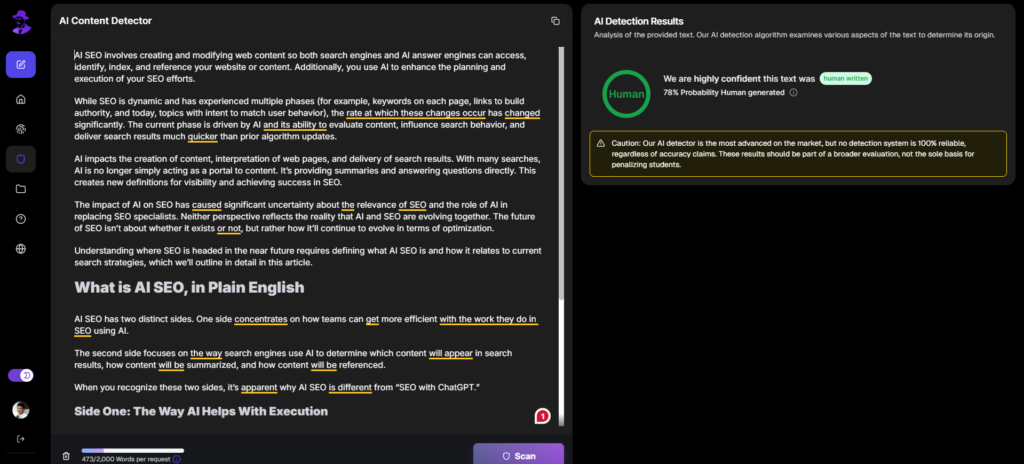
Before publishing, it’s worth checking whether your content reads like a human explanation or a model output. Walter Writes AI detector is designed to flag risk before content goes live.
If you’re using AI in your workflow, the goal isn’t to bypass systems. It’s to rewrite drafts into clearer, more original language that reflects actual understanding.
Quick FAQ
What are Google AI Overviews?
AI Overviews are summaries created by AI and shown at the top of search results. Google extracts information from multiple sources and compiles them into one answer with citations. The citations appear as clickable links within or below the summary.
How does Google choose sources for AI Overviews?
Google uses query fan-out and passage retrieval to find sources. Fan-out expands your search into related questions. Passage retrieval pulls specific sections that work independently.
Google starts with pages that already rank well organically, then evaluates which ones have content that’s easiest to extract and reuse. Ranking in the top 10 gets you into the candidate pool. Structure and clarity determine whether you get cited.
Can new websites rank in AI Overviews?
Yes. About 76% of citations come from pages ranking in the top 10, but 24% come from pages that don’t rank there at all. New sites can get cited if they provide clear, specific answers and cover related sub-queries. Authority helps, but it’s not the only factor.
Do AI Overviews replace featured snippets?
Not yet, but it’s heading that way. Featured snippets still appear for some queries, but AI Overviews have become the default for most informational searches.
D
o AI Overviews require schema markup?No. Schema helps Google understand what your content represents (entities, relationships, context), but it doesn’t guarantee citations. It’s an eligibility and clarity tool, not a ranking lever. Use it to reduce ambiguity, not chase visibility.
Does original research help rank in AI Overviews?
Yes, especially when you provide unique data or perspectives that aren’t easily found elsewhere. Case studies, firsthand experience, and original data give Google content it can’t pull from ten other sources. If your research is genuinely unique, it increases your chances of being cited.
How is AI Overview SEO different from traditional SEO?
Traditional SEO focuses on ranking for specific keywords. AI Overview SEO focuses on clear passages and answering follow-up questions in the same section. Traditional SEO cares about keyword density. AI Overview SEO cares about making content easy to extract and reuse.
Can AI-generated content rank in AI Overviews?
Yes, but only after human editing. Generic AI summaries don’t get cited because they lack specificity and experience signals. If you draft with AI, you need to revise it with concrete examples, edge cases, and clear reasoning. The final content needs to read like it was written by someone who understands the topic, not assembled from other summaries.
Will AI replace SEO?
Not really. It just redefined what a good SEO is. You can’t rely on keyword research and content clustering alone anymore. Good SEO now requires creativity, empathy, and strategic thinking, which AI struggles with, making humans more valuable. We discuss this in our article, Will AI replace SEO?
For the production workflow, see AI Humanizer for SEO — covering how to humanize AI-assisted content so it satisfies E-E-A-T and gets AI-Overview cited.
SEO context: The dedicated does Google penalize AI content guide covers the Ahrefs 600K-page study and what Google actually penalizes in 2026.