



Most students think that paraphrasing means changing enough words to get past a plagiarism checker. A major flaw with rewriting like this is that most of the time, the rewrite ends up worse than the original.
Paraphrasing means expressing an idea in your own natural voice in such a way as to retain its essential meaning and value.
With AI writing tools, doing quick rewording of content is now possible in 2026. But the vast majority of these AI-generated reworded versions contain excessive and awkwardly written sentence structures that will confuse or mislead a reader. The ability to successfully paraphrase continues to require human judgment.
Most paraphrasing mistakes come down to one thing: rewriting before you understand. The fix is a process, and it ends with a correct citation in APA or MLA.
What Is Paraphrasing?
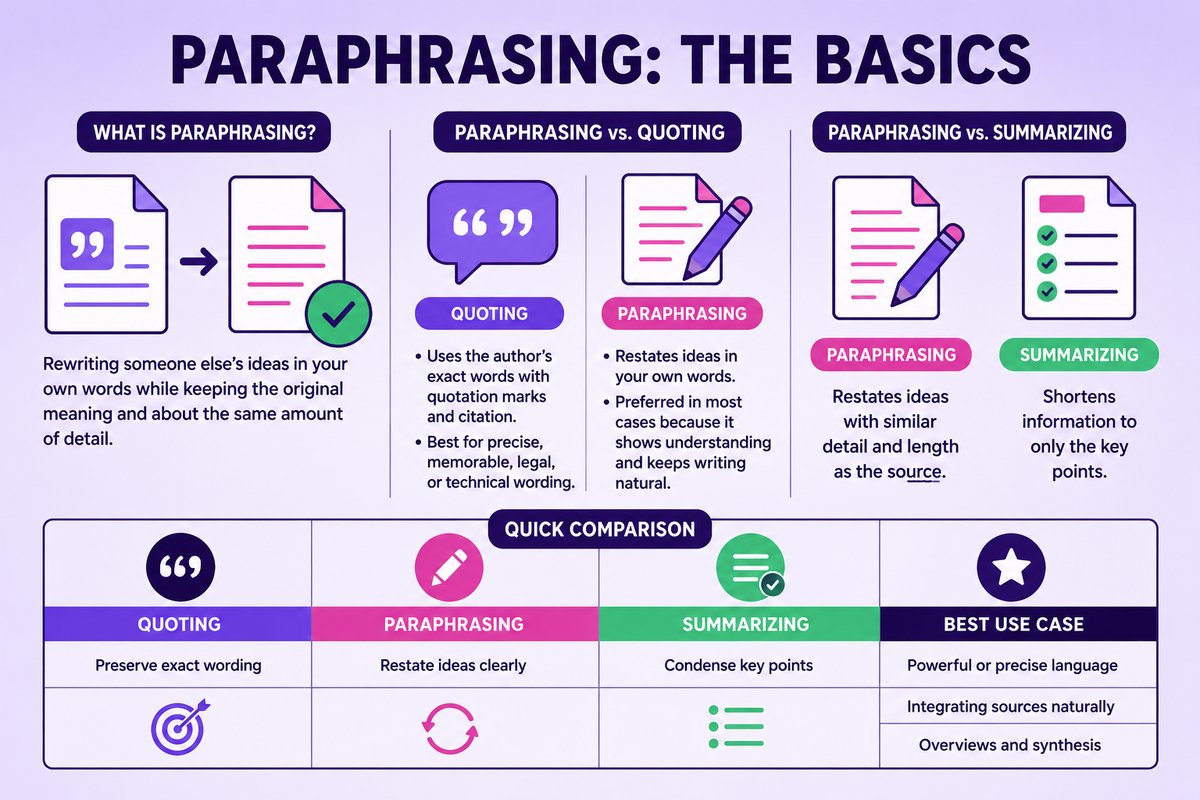
Paraphrasing is rewriting another writer’s ideas into your own words, as well as maintaining their original message. When paraphrasing, you do not cut down the level of detail from the source. You simply rewrite the data in a form that will fit naturally within your own writing.
This is one of the most useful skills that can be used in academic as well as professional writing because it allows you to use someone else’s ideas or research without including large sections of their work as full-length quotations.
Paraphrasing vs. Quoting
Direct quotes reproduce exactly what the author wrote using quotation marks with a citation. Using an author’s words can be effective when their original wording is memorable and accurate, such as in a document where changing one word could alter the source’s intent.
The best choice for almost all situations is paraphrasing. It shows that you understand the material and can express it on your own while keeping your voice consistent throughout the work.
Paraphrasing vs. Summarizing
Although these terms are frequently used interchangeably, paraphrasing and summarizing serve very different purposes.
| Technique | Purpose | Length | Best Use Case |
|---|---|---|---|
| Quoting | Preserve exact wording | Same as source | Powerful or precise language |
| Paraphrasing | Restate ideas clearly | Similar to the source | Integrating sources naturally |
| Summarizing | Condense key points | Shorter | Overviews and synthesis |
A paraphrase includes details. A summary does not include many details, but instead focuses on the most important information. If an author wrote three different arguments in their article and you write three new sentences using your own words to represent each of their points, you are paraphrasing. But when you take all three arguments and reduce them down to just one, that would be considered a summary.
How to Properly Paraphrase Without Losing Clarity
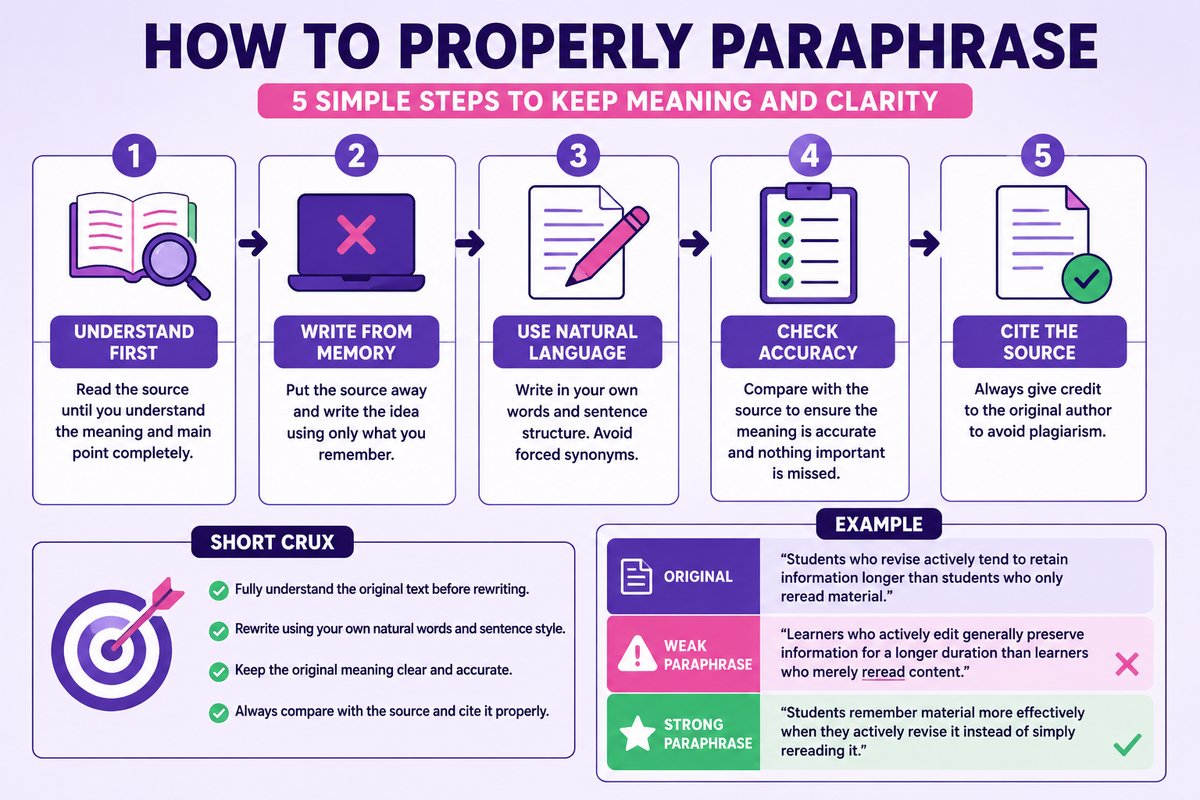
Weak paraphrases always occur due to this one error: You did not completely comprehend the material prior to writing your own words. The following 5 steps can resolve this issue:
Step 1: Read Until You Understand the Meaning
Read the original article until you can summarize what is written and explain the overall point of view. When you are done reading the original and can do this without looking at the original source, you will be ready to paraphrase. Many people do not take enough time to read a piece before they try to paraphrase, and they end up with an awkwardly worded paraphrase that may also contain inaccuracies.
Step 2: Put the Original Away
Close or remove access to the page containing the original work. Create your own version of the work in addition to the information that you remember. By doing this, you can express yourself in whatever form of sentence structure or vocabulary you choose, rather than copying the author’s.
Step 3: Use Your Natural Sentence Structure
Write as usual. Do not attempt to utilize a thesaurus to make your writing look better. This could result in your writing having an unnatural, stiff quality. Write about ideas just like you would when discussing them with others.
Step 4: Compare Against the Source
After you have completed your initial draft of your paper, go back through the source material you used as a starting point for your research and ask yourself:
- Is the meaning conveyed in the paraphrase consistent with the meaning found in the original source?
- Are there any important details or nuances that you missed?
- Are you using some sentences or phrases that are too similar to those found in the source document?
- Would someone else be able to follow the writing without having seen the source?
Step 5: Cite the Source
Even though you may rewrite the author’s ideas in your own way, if you do not provide appropriate credit, this will still be considered plagiarism. You must cite the authors in order to avoid being accused of plagiarizing.
Example
Original: “Students who revise actively tend to retain information longer than students who only reread material.”
Weak paraphrase: “Learners who actively edit generally preserve information for a longer duration than learners who merely reread content.”
Because this example uses many complex vocabulary terms and has essentially the same framework structure as the authors’, it would qualify as a poor paraphrase. This kind of paraphrasing does little to improve the reader’s understanding of the author’s intended message, nor does it make the message easier to read.
Strong paraphrase: “Students remember material more effectively when they actively revise it instead of simply rereading it.”
The above version uses less space and is easier to read. The meaning is retained, but everything is written clearly in its own original language and doesn’t seem forced.
7 Common Paraphrasing Mistakes That Hurt Clarity
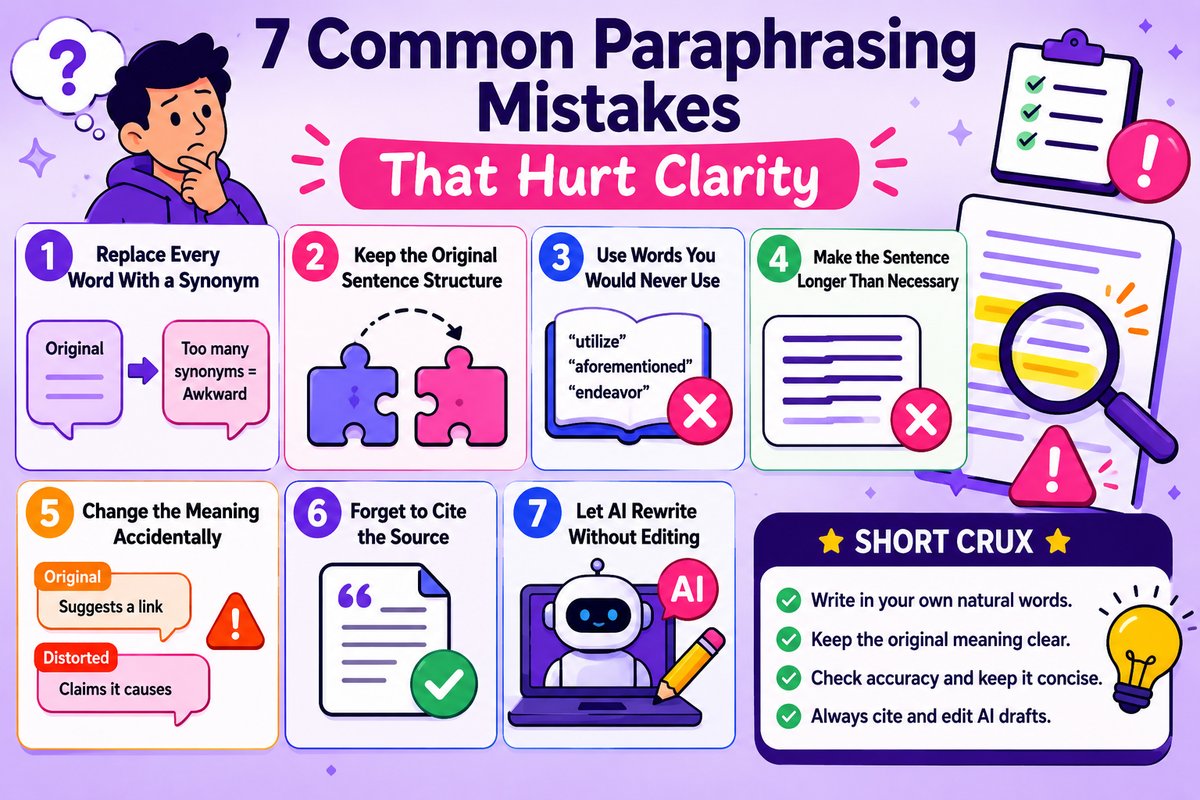
1. Replacing Every Word With a Synonym
Replacing every word with a synonym in this type of writing is referred to as “synonym spinning.” This can be extremely difficult for readers to follow, and they have to put in more effort to get the same amount of information as when reading the original. This type of spin is particularly common with automated rewriting tools.
Original: “Regular exercise improves mental health by reducing stress and anxiety.”
Spun version: “Frequent physical activity enhances psychological wellness by diminishing tension and apprehension.”
The second version communicates nothing better. It just sounds worse.
2. Keeping the Original Sentence Structure
Changing words but preserving the sentence frame is called patchwriting. The rhythm and logic of the original are still there, just with different vocabulary on top. A strong paraphrase changes both the wording and the structure.
3. Using Words You Would Never Normally Use
Inflated language does not make paraphrases more credible. Words like “utilize,” “aforementioned,” and “endeavor” rarely appear in natural writing. If you would not say it in conversation, do not write it in a paraphrase.
4. Making the Sentence Longer Than Necessary
If your rewrite is significantly longer than the original, you are over-explaining. Trim anything that does not add meaning.
5. Changing the Meaning Accidentally
Using a slightly different wording can somehow completely change the way the original ideas were presented.
Original: “Some studies suggest a link between screen time and sleep disruption in adolescents.” Distorted: “Research proves that screen time causes sleep problems in teenagers.”
Always be sure to compare the altered version with the original to ensure they both have the same level of confidence.
6. Forgetting to Cite the Source
Paraphrasing does not transfer ownership of an idea. Skipping the citation is plagiarism regardless of how well the rewrite was done. In 2026, AI detectors like Turnitin flag more than simply copied text. Now they can also identify paraphrases that are similar in content to the original source.
7. Letting AI Rewrite Without Editing
While AI tools can certainly serve as a helpful starting point, they are not meant to replace the editing process. The majority of AI-generated writing uses overly formal language and loses nuance. Any writing produced by an AI should be treated as a rough draft and should be edited enough to ensure the written work is accurate and contains a natural flow. Walter Writes is designed to assist in humanizing and making your work less robotic while retaining the meaning and authenticity of the original work.
If you are still unsure of which tool to use, see our roundup of the best AI humanizer tools for students and writers.
How to Paraphrase a Quote Effectively
Some quotes should be kept in their exact wording. Other quotes will have a much stronger impact when they are paraphrased, particularly when you want to emphasize the concept expressed by the author rather than the specific words used by them.
When you paraphrase an author’s work, you are attempting to convey the original idea or message in your own words while keeping the same intended meaning as the original. Also, ensure that your rewritten version is written with the same tone as your other works, for it to effectively represent itself.
Original quote: “The greatest obstacle to discovery is not ignorance - it is the illusion of knowledge.”
Strong paraphrase: “Believing we already understand something can prevent us from learning new information.”
Meaning has been maintained. The entire phrase was reworded. Reworded portion flows with an academic writing style without the use of quotation marks.
One important note: If the unique aspect of an original quote lies in its precision or power, then it is suggested not to reword or paraphrase it. Once a quote is rewritten, there may be a loss of some, if not all, of what made the original quote so powerful.
How to Cite a Paraphrase in APA and MLA
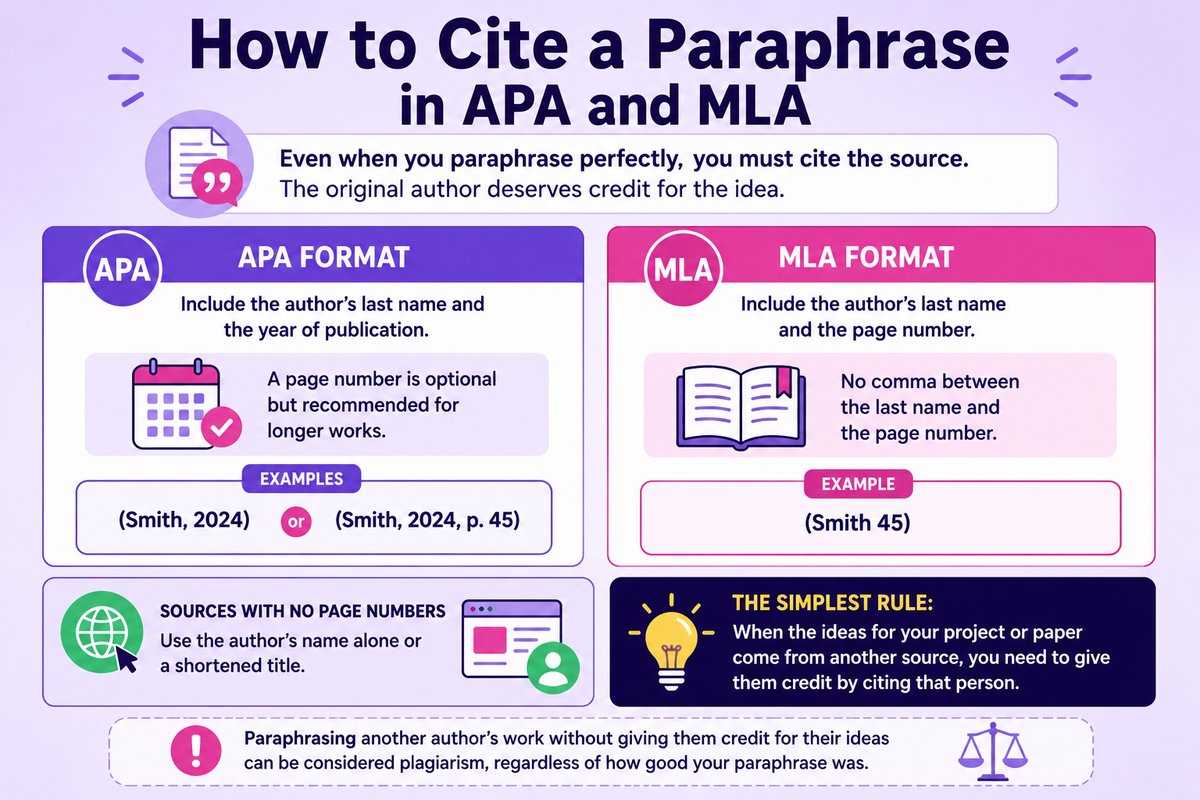
Even though you have written a paraphrase perfectly, it will need to be cited. Regardless of the difference that has been made to the content by changing the words used, the original author should still be credited for the idea.
APA Format
Include the author’s last name and the year of publication. A page number is optional but recommended for longer works.
(Smith, 2024) or (Smith, 2024, p. 45)
MLA Format
Include the author’s last name and the page number, with no comma between them.
(Smith 45)
If you are working with a source that has no page numbers, such as a website, use the author’s name alone or a shortened title.
The simplest rule: When the ideas for your project or paper come from another source, you need to give them credit by citing that person. Paraphrasing another author’s work without giving them credit for their ideas in the first place can be considered plagiarism, regardless of how good your paraphrase was.
If you are curious about how AI-assisted writing holds up against plagiarism checkers, tools like Turnitin and GPTZero will detect much more than simply copied text. To find out more about GPTZero and how this detector works, our guide on what ChatGPT Zero is explains it further.
When Paraphrasing Actually Makes Writing Harder to Read
Paraphrasing can backfire. Over-processing of sentences, too many unnatural synonyms, or excessive use of wording makes writing hard to follow.
When writers want their writing to appear academic, they may remove detail from the original, reduce powerful language, and replace simple words with jargon. This results in writing that appears distant and unclear.
A good paraphrase sounds as though it were said by an actual person. When you read your paraphrase aloud and it seems artificial, this is an indication that you need to simplify it. Clarity will always be superior to the complexity of an idea, particularly if one is borrowing from another writer, so that the reader can comprehend immediately.
Best Practices for Clear, Natural Paraphrasing in 2026
- Understand the source fully before rewriting it
- Change both the wording and the sentence structure
- Write in your natural voice
- Keep it at least as clear as the original
- Read it aloud before finalizing
- Always cite the source
- Edit any AI-generated rewrites before using them
If you frequently use AI writing tools to create your documents, Walter Writes AI Humanizer can assist you in cleaning up robotic versions of what was written by the AI, as well as improving the readability of those documents while keeping the meaning intact. It is particularly suited for students and writers looking to give their AI-assisted drafts a human voice.

Final Verdict
An effective paraphrase is truly more than just substituting words of the original author. It’s about showing that you’ve understood the content. If a reader can easily follow your writing as compared with the source, then you’ve successfully paraphrased the material.
If you are a student working on essays and papers, our student resource hub has more guides to help you write clearly and confidently from sources.
FAQs
What Is the Difference Between Paraphrasing and Summarizing?
Paraphrasing restates a source at the same level of detail in your own words. A summary provides a shortened version of the source’s key points.
How Do You Paraphrase Without Plagiarizing?
You can avoid plagiarism when paraphrasing by changing the word choice and the sentence format. Simply rewriting the source does not constitute paraphrasing.
What Makes a Paraphrase Too Close to the Original?
Using identical sentence structures along with new vocabulary keeps it almost close to the original version. This is considered patchwriting.
When Should You Paraphrase Instead of Quoting Directly?
Use paraphrasing when the idea that is being stated in a source is considered more important than the exact wording. Use a direct quote when the source has expressed an idea so well that you cannot do justice to their thought by restating it in your own words.
Is Paraphrasing the Same as Rewording?
Almost the same, but the main difference is that rewording involves changing vocabulary, whereas paraphrasing requires rewriting the entire concept so that it sounds like you wrote it.
Can You Paraphrase Too Much in a Paper?
Yes. When you paraphrase too much, it makes your writing seem like it relies on other authors’ words. Your own analysis and interpretation of the information should drive your assignment.
How Do You Cite a Paraphrase in APA?
Insert the writer’s last name and year of publication in parentheses at the end of the sentence: (Smith, 2024). If it is long enough, then try to add page or paragraph numbers and add the citation directly before the period.
How Do You Cite a Paraphrase in MLA?
Include the author’s last name and the page number in parentheses with no comma between them: (Smith 45). If you cannot locate a page number, you may want to substitute with a short title. Include the citation immediately before the final period of the sentence.
How Do You Paraphrase a Long Passage Without Losing Meaning?
Take the long passage, break it down into smaller ideas, take each of those small ideas individually and rewrite them, then go back and look at both versions to see that none of the original ideas were lost in the rewriting process.