



The best AI essay graders speed up feedback on grammar, structure, and organization, but they’re not a replacement for teacher judgment on reasoning, originality, and student context.
- Brisk Teaching for fast feedback inside Google Docs without changing your workflow
- Flint for rubric-based grading with export to Google Drive or Word
- CoGrader for LMS integration with Google Classroom and Canvas
- SchoolAI for privacy-conscious classrooms
- AI scores well on mechanics; it struggles with creative arguments and nuanced reasoning
- Always run a calibration test on 10 essays before using any AI grader at scale
Are AI essay graders really capable of reducing hours of grading work for teachers?
Grading an entire classroom’s essays can be very overwhelming, as teachers have to go through each student’s essay based on criteria such as structure, clarity of argument, and proper citations, along with providing feedback to students.
This is why many educators are looking into using some of the best AI essay graders to help them evaluate student writing, so they can get consistent feedback on their students’ writing.
In this review of the best AI essay graders, we help you understand how these tools actually work, how well they grade writing, and which options are most useful for teachers in real classrooms.
What “Best Essay Graders” Actually Means in a Classroom
In real classrooms, the best essay graders are not simply the fastest tools. A practical AI essay grader should help with:
- Rubric alignment so essays are evaluated using clear grading criteria
- Useful feedback that helps students improve their writing
- Consistent scoring across large sets of papers
- Privacy protection when handling student work
- Teacher control to review or override AI suggestions
AI can speed up the first pass of grading, but teachers still make the final judgment, especially for high-stakes assessments.
If you would like to explore additional classroom-friendly alternatives to grading, you may also consider these best AI tools for teachers. These options will help you develop a complete system to create a better workflow for your classroom.
How AI Essay Grading Works and Where It Breaks
AI essay graders review patterns in grammar, structure, vocabulary, and argument flow to estimate how strong an essay is.
Most AI grading tools rely on two common approaches.
- Feature-based analysis that checks grammar, sentence structure, and organization
- Deep learning models that compare writing patterns with large datasets of previously graded essays
Because tools rely on different models and training data, scores can vary slightly from one AI grader to another.
Where AI Essay Grading Can Break
AI grading works well for structure and mechanics, but some areas remain difficult to evaluate.
- Middle range score clustering, where many essays receive similar scores
- Nuance and personal voice that AI models may not fully understand
- Prompt specific reasoning when essays respond creatively to a unique question
- Culturally varied writing styles that do not match the patterns the system was trained on
AI can often come close to human scoring, but even human graders sometimes disagree. This is why AI works best as a support tool while teachers make the final judgment.
The 2026 Teacher Scorecard for AI Essay Graders
Use this quick scorecard to evaluate any tool.
- Rubric support: Upload your rubric and get criterion-level comments
- Feedback quality: Actionable insights like strengths and improvement areas
- Academic integrity checks: Citation checks and possible integrity flags
- Export and sharing: Easy export to Google Docs, Word, or LMS platforms
- Privacy and compliance: FERPA or COPPA awareness with minimal data storage
- Teacher control: Ability to edit, adjust, or override AI feedback
- Pricing transparency: Clear free tier limits and paid feature boundaries
A strong AI grading tool for teachers should support these features while keeping the final grading decision in the teacher’s hands.
Comparison of the Best AI Essay Graders at a Glance
| Tool | Best For | Key Strength | Free Plan | Rubric Support |
| Brisk Teaching | Fast feedback inside existing workflows | Works directly in Google Docs with multiple feedback styles | Yes | Yes |
| Flint AI Essay Grader | Rubric-first grading and export workflows | Custom rubric upload with detailed feedback and export options | Limited | Yes |
| SchoolAI | Privacy-aware and ethical AI use | Focus on structured grading with privacy-conscious design | Limited | Yes |
| CoGrader | Rubric-based grading with LMS integration | Bulk grading with LMS integrations and built-in rubrics | Yes (limited to 100 essays/month) | Yes |
| Microsoft 365 Copilot | Student-side self-checking and revision support | Helps students improve writing before submission | No | No |
Best AI Essay Graders for Teachers in 2026
Below are some practical AI essay grading tools for teachers, grouped by the situation where they work best.
While all of these options will provide a faster way to grade papers, it is still important for teachers to review critical components of the grading process.
Brisk Teaching (Best for Fast Feedback Inside Existing Workflows)
Where it’s strong
- Works as a Chrome extension directly inside Google Docs
- Generates several feedback styles such as targeted comments, strengths and growth notes, rubric-aligned feedback, and next step suggestions
- Fits into existing teacher workflows without requiring a new grading platform
Cost and access
- Free plan: Available for educators at no cost
- Free trial: Premium features available for about 14 days
- Paid plan: Custom pricing for schools and districts
Where teachers still must review
- Argument quality and thesis strength
- Whether feedback matches the assignment prompt
- Final grade decisions for important assessments
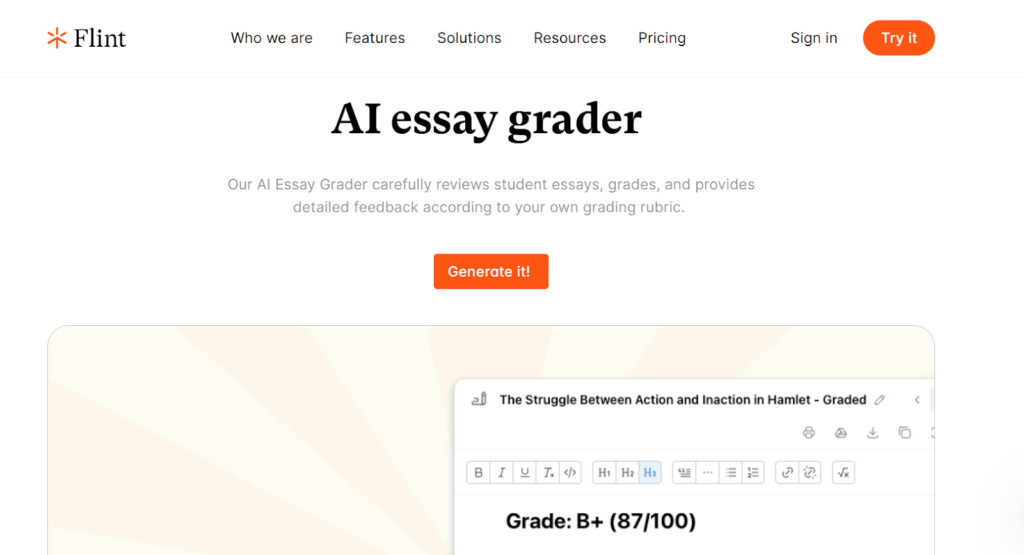
Flint AI Essay Grader (Best for Rubric First Grading and Export Workflows)
Where it’s strong
- Teachers can upload their own rubric so grading aligns with their criteria
- Generates detailed feedback on strengths, weaknesses, and recommendations
- Exports graded essays to Google Drive or Word for easy sharing
Cost and access
- Free access: Limited demo or tool access available
- Free trial: Available for testing the grader
- Paid plan: Typically offered through school or district pricing
Where teachers still must review
- Nuanced reasoning or creative arguments
- Context-specific interpretations of prompts
- Final feedback before returning work to students
SchoolAI (Best for Privacy Aware and Ethical AI Use)
Where it’s strong
- Allows teachers to upload rubrics and grading instructions
- Evaluates structure, coherence, and grammar automatically
- Designed to help standardize grading and reduce manual workload
Cost and access
- Free plan: Limited free classroom access
- Free trial: Often available for educators
- Paid plan: Offered through school subscription pricing
Where teachers still must review
- Potential bias in feedback
- Cultural or language differences in writing style
- High-stakes grading decisions
CoGrader (Best for Rubric-Based Essay Grading with LMS Integration)
Where it’s strong
- Uses rubric-based grading to assess a student’s essay for claim, evidence, organization, and language.
- Allow users to upload assignments directly from other platforms, such as Google Classroom or Canvas, which will make it much faster to grade multiple submissions at once.
- Provides feedback reports and suggestions of what the teacher may want to assign as a grade, and also allows the teachers to go in and edit their decisions prior to giving them back to students.
Cost and Access
- Free version: Free plan available
- Usage limit: Supports grading up to 100 essays per month
- Rubrics: Includes 30+ built-in rubrics or allows custom rubric creation
- Integrations: Works with Google Classroom, Canvas, and Schoology
Where teachers still must review
- Complex reasoning or creative argument development
- Context behind a student’s interpretation of the prompt
- Final grade decisions for high-stakes assignments
Microsoft 365 Copilot (Best Student Side Self-Checking Approach)
Where it’s strong
- Helps students review grammar, clarity, and organization before submission
- Encourages early revision and self-improvement
- Useful prompts can guide students to improve citations and structure
Cost and access
- Free plan: Not available
- Free trial: Sometimes included as part of Microsoft trials
- Paid plan: Typically costs around $20 - $30 per user per month, depending on the plan
Where teachers still must review
- Whether feedback actually improves the argument
- Plagiarism or AI-generated writing concerns
- Final evaluation of reasoning and originality
Pros and Cons of AI Essay Graders
Pros
- Consistent scoring, even when teachers are grading many papers
- Faster feedback cycles so students receive comments sooner
- Reduced grading fatigue during large assignments
- Pattern spotting across a class, such as common grammar or structure issues
Cons
- Bias risks if the training data does not reflect diverse writing styles
- Over standardization, where creative or unusual writing may be undervalued
- Optimize for AI behavior where students write to satisfy the system instead of improving ideas
- Privacy concerns related to student data storage and retention
Can AI Grade Essays Accurately? What the Evidence Suggests (And the Safe Way to Use It)
Research shows that AI essay graders can often score essays close to human raters, especially for structure, grammar, and organization, but are not always going to be perfectly reliable.
A Safe Way to Use AI Essay Graders in Class:
Run a 10 essay calibration test: Select 10 essays that represent weak, average, and strong writing.
Compare AI scores with teacher scores: Check where the AI agrees and where it over- or underscores.
Create anchor papers: Keep a few essays as examples for each grade level to guide future grading.
Run a Drift Check on each unit: Test a few of the essays you are using to test each new assignment to make sure AI is still giving consistent and accurate grades.
Rule of Thumb for Classrooms:
- Use AI for the first pass feedback on grammar, structure, and clarity
- Let teachers review thesis quality, reasoning, originality, and argument strength
- Treat AI grading as a time-saving assistant, not the final evaluator
Is AI Essay Grading Fair for All Students? Practical Bias Checks Teachers Can Run
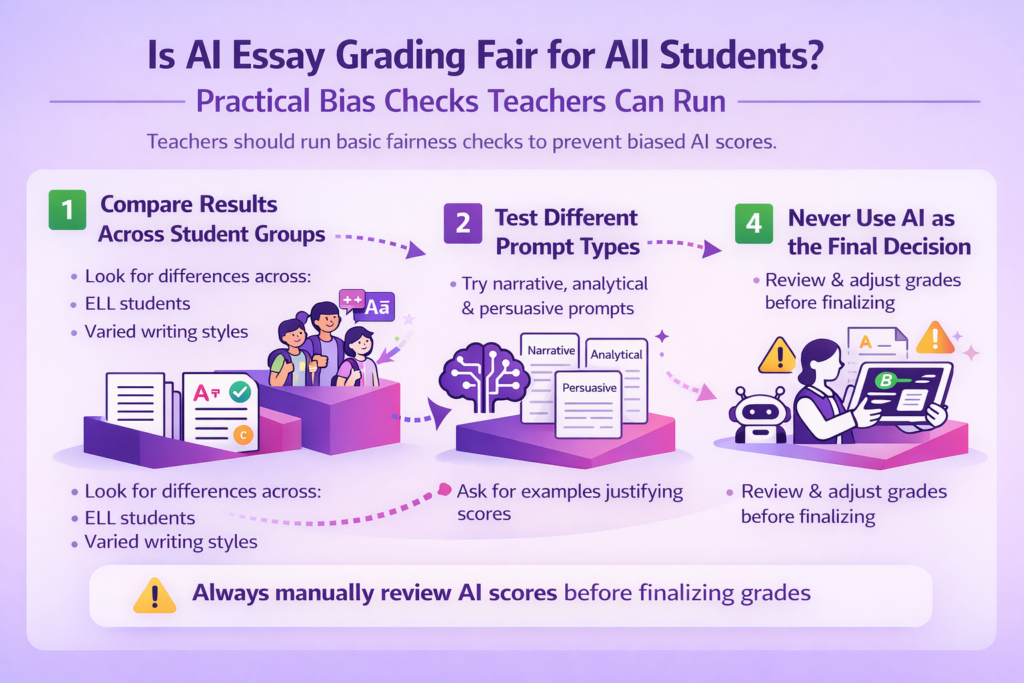
AI essay grading can sometimes reflect bias if the system was trained on limited writing patterns. Teachers are advised to do some basic fairness checks prior to using AI-scored grades in their classrooms.
Teachers need to compare how an AI system evaluates writing from various groups, such as students who are English language learners and those with varied writing styles. Also, compare how the system reacts to different prompt types.
Always include examples that explain why the AI assigned a particular score. Do not use an AI’s evaluation as the only basis for a final grade, but instead check its result before giving grades.
Can AI Replace Teachers in Grading Essays? The Right Division of Labor
AI essay graders work best as a first pass feedback tool that highlights grammar issues, structure problems, and common patterns across student submissions. Teachers should remain the final evaluators of reasoning, originality, and student context.
A practical classroom policy is to use AI for formative feedback, while summative grading and final scores remain the teacher’s responsibility.
The Missing Piece: When Students Use AI to Write, “Grading Faster” Isn’t Enough
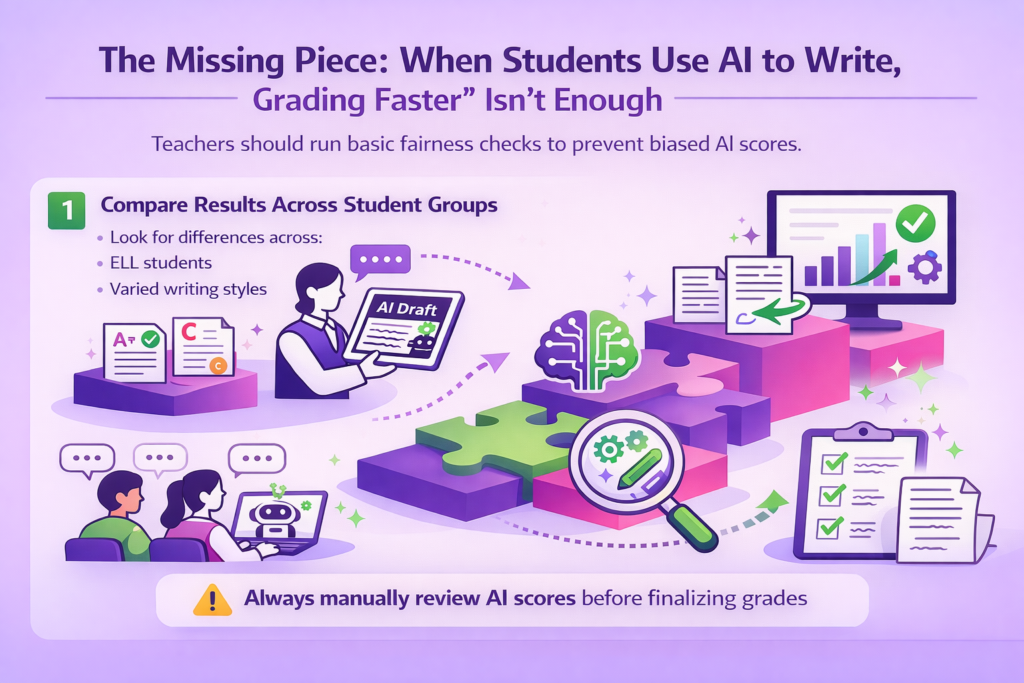
Faster grading will solve only part of the problem. In today’s classroom, teachers have to contend with the additional issue of AI assisting students while they write.
Thus, schools require a workflow for grading, improving student writing, and maintaining academic integrity to be integrated into one system.
Teachers can view AI-generated drafts of their students’ writing as a first step to allow students to maintain basic revision records, and instead of using the detection results as a method to automatically penalize the students, use them as a basis for further discussions.
For larger-scale checks, teachers may also use AI detection for all essay assignments to provide a fair and transparent assessment of each student’s assignment.
Recommendation for 2026: The Most Practical Setup for Schools
If your goal is faster grading comments, a rubric-focused AI essay grader combined with teacher sampling rules can work well for most assignments.
However, many classrooms now face a larger challenge with AI-assisted writing and revision cycles. In that case, a complete workflow that supports students in writing improvement through humanization and verification becomes more useful.
Tools like an AI detector for teachers can prove to be really useful, as it allows them to review the students’ draft versions and see if the AI has been used.
Real-Life Practical Essay Grading Stack
Good For: Teachers who want a simple workflow for faster grading, AI-use checks, and clear feedback.
Tools
- Flint AI Essay Grader (Free trial or Paid plans) - Rubric-based essay grading with automated feedback.
- Walter Writes AI ($8/month) - Improves AI-assisted text and checks AI-detection risk.
- Grammarly (Free or $12/month) - Fixes grammar and improves clarity in feedback or revisions.
Cost Per Month: About $8 - $20, depending on Grammarly plan.
Limitation: AI tools speed up grading, but teachers should still review reasoning and originality before assigning final grades.
FAQs
What is The Best AI Essay Grader for Teachers?
The best AI essay grader for teachers is one that supports rubric-based grading, provides useful feedback, and allows teachers to review or edit the results. Most effective will be those that fit into current workflow processes like Google Docs or LMS systems.
Can AI Grade Essays Accurately?
AI can grade essays fairly accurately for grammar, structure, and organization. But it may struggle with creativity, reasoning, and nuanced arguments, which is why teacher review is still important.
Is There a Free AI Essay Grader?
Yes, some AI grading tools offer limited free versions or trial features. These usually provide basic feedback, while advanced grading features or rubric-based scoring may require a paid plan.
How Does AI Essay Grading Work?
AI essay grading works through natural language processing and machine learning. The system analyzes patterns in grammar, vocabulary, structure, and argument flow to estimate a score and generate feedback.
Can AI Replace Teachers in Grading Essays?
No, AI will not completely replace teachers. AI is most useful in being able to provide fast initial feedback, allowing teachers to then assess and evaluate the deeper aspects of students’ work, including their reasoning, original ideas, and contextual understanding.
What are the Pros and Cons of AI Essay Graders?
Some of the positive aspects of AI essay grading software include rapid feedback, consistent assessment, and less grading time for educators. But the main negative factors of AI essay grading software include the possibility of bias, the inability to measure creativity, and students’ rights to protect their data.
Is AI Essay Grading Fair for all Students?
When teachers review AI grading results, AI grading can be equitable for all students. Teachers should ensure they are checking for bias, particularly in terms of writing style, and reviewing the scores prior to issuing students their final grade.
To prevent problems in evaluation due to AI assistance, students should revise their essays before submitting them. Students can use tools such as an AI humanizer for students, which allows AI-assisted writing to sound much more natural. Also, students can learn legitimate methods to pass AI detectors for students before submitting their final work.
How Accurate are AI Essay Graders Compared to Human Teachers?
AI essay graders can often produce scores close to those of human graders for many essays. However, human graders also sometimes disagree with each other, so AI results should be treated as guidance rather than the final grade.
Students can also enhance their writing quality through the use of tools that assist with the development and revision of their writing drafts, such as the best AI writing tools for students.
Can AI Grade Essays Based on a Rubric?
Yes, many AI essay graders allow teachers to upload a rubric. The system then evaluates essays based on the provided criteria and generates comments for each section.
What AI Tools Do Teachers Use to Save Time Grading?
Teachers use several AI tools such as automated essay graders, feedback generators, and writing analysis tools to speed up evaluation.
For revision support, educators may also rely on tools like an AI humanizer for educators to improve clarity and readability in AI-assisted writing.
Final Verdict
AI Essay Graders are useful to educators because of their ability to assist in reducing the amount of time spent grading. It helps ensure that all evaluations of student assignments remain objective and consistent.
The modern classroom also needs tools that will allow educators to utilize AI-assisted tools to enhance the writing process. Tasks like revision and editing of student work and monitoring the use of AI to aid in the completion of written assignments require a complete workflow.
Tools such as Walter Writes combine these elements into one platform to allow educators to review draft versions of an assignment, provide guidance on improving clarity, and verify whether or not AI was used to complete the assignment.