



If you’re reading this right now, chances are something went wrong with your content, which is exactly why the QuillBot vs Undetectable AI debate matters in the first place.
Maybe a professor flagged your assignment as rewritten mainly because you used QuillBot. Or you checked your content using Turnitin, GPTZero, or Originality.ai and realized that simply changing the wording was not enough.
Most writers give up at that point.
That frustration is exactly why comparisons like QuillBot vs Undetectable AI have become so common among students and professionals trying to understand whether rewriting tools actually reduce AI detection risk.
The actual problem for many individuals is finding the best tool for evading AI detection. QuillBot is usually the first tool people try. It rewrites sentences, improves clarity, and changes the wording. When it comes to Undetectable AI, while it will rewrite your content, it will also rearrange it to decrease AI detection signals. Because of this, both tools are frequently mentioned in student forums, SEO communities, and content teams, often around the same question: which tool actually works better when avoiding AI detection is the goal?
To answer this, we have tested both tools to make a purpose-driven comparison between them. This article is a focused analysis of real detection behaviors, real risks, and real results. By the end of this article, you’ll be easily deciding whether QuillBot or Undetectable AI offers a meaningful advantage towards AI detection or if each provides more risk than clarity.
Why AI Detection Is a Problem for Writers Today
AI detection affects writers because content is evaluated differently across academic, editorial, and professional settings.
- Academic and educational institutions assess flagged writing as a violation of the rules regarding originality of work, which may lead to policy violations, disciplinary action, or penalties.
- Blogs, publishers, and other online media organizations use plagiarism-detection software to remove potentially plagiarized content before it reaches readers.
- Similar concerns are voiced by SEO companies and freelancers due to their clients’ need for original content that is safe to publish.
All three areas have one thing in common if AI is detected: work rejection, multiple revisions, academic risk, or diminished credibility, regardless of whether your intent was to make your writing clearer or faster.
How AI Detectors Actually Work (And Why Paraphrasing Often Fails)
Understanding how detectors evaluate structure and predictability is essential before comparing tools like QuillBot vs Undetectable AI, since both approach rewriting in very different ways.
AI detects patterns, such as predictability, repetition, sentence rhythm, and how well the structure matches existing patterns of output from AI systems. Humans write at many different speeds and with different ways of phrasing, whereas AI produces writing that is generally “statistically smooth.”
These tools produce probability-based scores rather than definitive judgments, so some results may vary depending on the detection tool, content length, and structure.
Paraphrasing tools mainly fail for this reason; they focus primarily on changing the wording rather than altering the structure or flow. While the words of the new sentences appear to be different, the fundamental structure and flow typically remain the same. As a result, AI scoring will likely change somewhat, but the core signals on which most detectors depend will still exist and could therefore flag your content.
What Is QuillBot and What Is It Designed to Do?
To understand the QuillBot vs Undetectable AI comparison properly, it’s important to first look at what each tool is fundamentally designed to accomplish.
QuillBot’s Core Functionality
QuillBot is an AI-based paraphrasing and rewriting tool. The primary goal is to assist the user in rewriting their content into a more polished version with improved clarity, without changing the original meaning.
Examples of common use cases:
- Sentence rewording to prevent repetition
- Clarifying poorly written or awkward drafts
- Making grammar and tone more consistent
QuillBot is not designed to make your content undetectable by AI detectors. It focuses on rewriting by altering some of the wording and rearranging phrases, without disturbing the deeper structure that most detection software looks for. As a result, while the output may read better to humans, most detection software will still be able to identify the content as AI-generated.
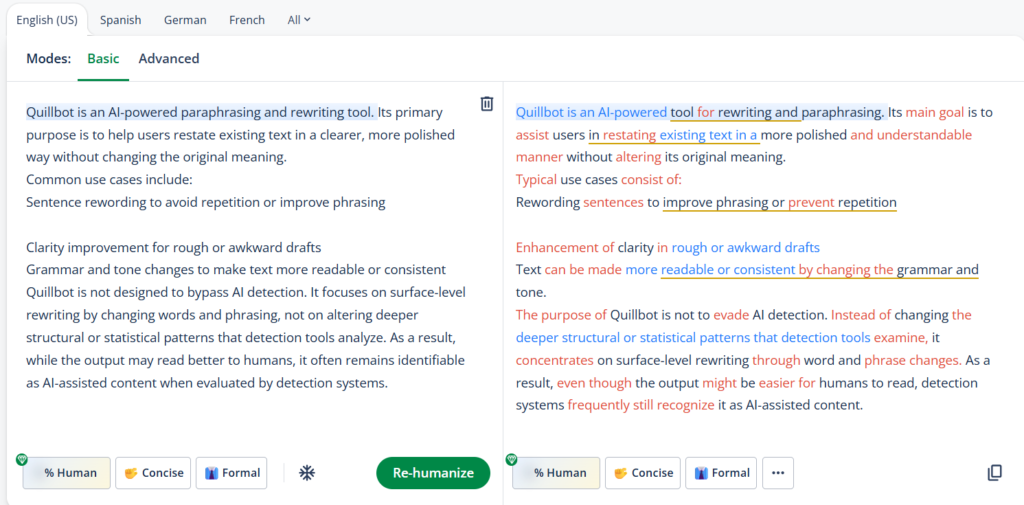
How QuillBot Performs Against AI Detectors
QuillBot will somewhat reword your text and slightly alter how you have structured your sentences. However, it retains the primary flow and predictability of the original AI-generated text. This still results in high detection rates for your rewritten content, particularly with stricter AI detectors like Turnitin or in longer academic or editorial content. QuillBot has not been developed to evade AI detection and should not be used for that purpose.
What Is Undetectable AI and How Is It Different?
Undetectable AI is viewed as a tool for humanizing AI-written content rather than a generic paraphraser. The purpose of this tool is to reduce the predictability of AI-written content by changing how ideas are expressed, not just which words are being used. Unlike QuillBot’s rewriting on a sentence-level basis, Undetectable AI aims to analyze patterns that can be detected by systems.
It is designed to:
- Restructure sentences rather than merely rephrase
- Increase variability in pace and phrasing.
- Reduce the predictability of AI writing over long passages of content.
The difference in purpose is key here: QuillBot is an improvement upon readability, while Undetectable AI is focused on improving detectability.
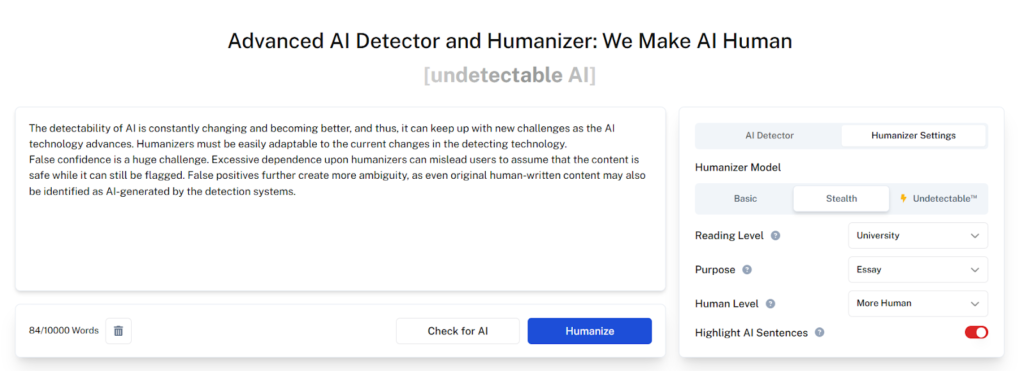
Undetectable AI’s Performance Against AI Detectors
Undetectable AI aims at deeper restructuring to limit AI-like patterns that can lead to even lower detection scores than basic paraphrasing in some cases. Detection performance is always variable among different detection systems and content types. Detection models get updated very frequently, so Undetectable AI should be considered unreliable as a stand-alone solution. Especially for high-risk academic or professional use, human review will still be required.
Quillbot vs Undetectable AI - Side-by-Side Comparison
| Aspect | QuillBot | Undetectable AI |
|---|---|---|
| Primary purpose | Paraphrasing and rewriting text | Reducing AI-detection signals |
| Core design intent | Improve clarity, wording, and tone | Alter structure and patterns to appear less AI-like |
| Approach | Sentence-level rewording | Structural restructuring |
| Focus | Readability and writing assistance | Detection avoidance |
| Detection bypass intent | Not designed for AI detection bypass | Explicitly designed for detection reduction |
| Output predictability | Often predictable due to preserved structure | Less predictable but inconsistent |
| Reliability for bypassing AI detection | Low | Variable, not guaranteed |
| Suitability for high-risk use | Not suitable | Not suitable |
Output Quality and Readability
When we look at the quality of the output, the trade-offs are very apparent between these two.
Quillbot usually produces better readable content since the rewording process occurs at a sentence level. However, this clarity often results in a predictable structure and, therefore, is easier for AI detection tools to identify.
Undetectable AI tends to produce less predictable output through the more aggressive alteration of both structure and phrasing. But at the same time, it may reduce the clarity of the text.
In both cases, human editing will be necessary to determine if the final product is readable, accurate, and aligns with the intended context.
Effectiveness at Bypassing AI Detection
Both QuillBot and Undetectable AI fail to provide a consistent method for evading AI detection.
QuillBot may occasionally provide lower detection percentages, but the majority of the content is still frequently flagged because the overall structure and predictability of the content are still primarily based on the original source material.
Undetectable AI usually performs better than basic paraphrasing, particularly against certain AI detectors and short-form content. However, the results of each comparison can vary significantly depending upon which detection tool was utilized, the total amount of content produced, the context of the writing project, and updates to detection tools.
In reality, both tools should not be viewed as viable alternatives for avoiding AI detection.
Control, Risk, and Reliability
AI detection systems are constantly being updated, and therefore, any short-term gains provided by these tools will eventually become unreliable as detection thresholds change.
This creates a false confidence in their writing. The writer may assume that the content is “safe” after using a single detection tool or receiving a single result. However, a manual evaluation could still identify the AI-generated patterns. Thus, relying solely on these tools can lead you into trouble, especially in academic, editorial, and essay-based work.
In practice, neither of the tools provides a guarantee of reliable results or long-term consistency without some form of human intervention.
Check Detectability Before You Submit or Publish
When using AI-assisted content, checking for detectability before submission is more important than assuming that your work will pass detection. Walter’s AI Writing Checker identifies possible AI-related issues in writing, which enables writers to make thoughtful revisions and publish with confidence.
Which Tool Is Better for Your Use Case?
Students and Academic Writing
Academic writing is a high-risk environment for both educators and students, where AI detectors and manual review are common. Paraphrasing tools like QuillBot do not remove AI patterns, and many students worry whether using QuillBot counts as cheating, since detection-avoidance tools offer no protection against policy violations.
Bloggers and SEO Writers
In blogging and SEO, detection scores are not as important as originality and readability. The use of paraphrasing or detection-focused tools may give you a low score, but they would still require proper editing in order to create credibility.
Marketers and Freelancers
Working with clients requires consistency in your writing style, along with maintaining brand voice. The use of AI detection tools introduces risk, as this can easily hamper the relationship with the client.
Limitations, Ethics, and Best Practices
No AI tool can guarantee permanent evasion of detection. AI detectors are constantly evolving, and as such, institutional, academic, and platform rules remain in effect regardless of the software you use to create your content. Therefore, relying solely on such software to simply paraphrase your content may create unnecessary risk for you if policy compliance or credibility are important in the context of your work.
A better way to ensure safety is to use a quality-first workflow: Draft with AI → Rewrite → Human Edit → Detection Check.
Using this workflow, you focus on developing clear content that conveys your intended message and focuses on the authenticity of the content as opposed to achieving very high detection scores.
A Quality-First Alternative to Aggressive Detection Bypass
Unlike many other tools that attempt to disguise the fact that AI was used in generating content, Walter’s AI Humanizer aims to improve clarity, tone, and natural language use through refinement instead of radical structural changes. This makes it suitable for controlled refinement and readable output.
Final Verdict - Quillbot vs Undetectable AI: Which Wins?
The QuillBot vs Undetectable AI debate ultimately comes down to risk tolerance, intended use case, and how much human oversight is applied to the final output.
QuillBot can be a good option to improve clarity and word selection of your paraphrase, but it won’t save you from completely avoiding AI detection. It is still a pattern-based rewrite, making it unreliable in academic environments.
While Undetectable AI may have greater success with some detectors, it is not foolproof. The results are highly dependent on the specific detector used, the type of content being rewritten, and the use-case scenario of the user.
Ultimately, the right choice would depend on the risk you’re willing to take. Neither tool guarantees safety. There are no safeguards using either of these tools, so having a clear intent, human editing, and being aware of your policies matter more than any single AI workaround.
Frequently Asked Questions
Many of the questions below come up repeatedly in discussions around QuillBot vs Undetectable AI, especially among students and writers trying to understand real detection risks rather than tool marketing claims.
Will I get caught if I use QuillBot?
It depends on the detector, content structure, and review context. QuillBot does not guarantee that paraphrased content will not be flagged.
Can my professor detect QuillBot?
Detectors don’t look for how a student used an online tool. They simply examine whether the student humanized their work or paraphrased.
Does QuillBot paraphrasing count as AI?
AI detectors are designed to measure statistical language patterns and not tool names. So, Paraphrased AI text can still be detected as AI-generated.
How accurate is Undetectable AI?
Undetectable AI could potentially reduce the number of detection signals compared to basic paraphrasing, but it does not provide a 100% guarantee of complete avoidance.
Is 40% AI detection bad?
There is no universal “pass” or “fail” or “acceptable” AI levels. Even moderate levels of AI usage can lead to risks of being flagged in academic and editorial settings.
Our independent 2026 review of Undetectable.ai’s detection bypass performance covers real test data across Turnitin, GPTZero, and Originality.ai.