



Key Takeaway: There is no universally accepted AI percentage in writing, but most detectors treat scores under 20% as low risk, and the safest approach is to use AI for brainstorming and minor edits while ensuring the final text reflects your own voice.
- Most SEO agencies cap AI-detected content internally at 15-20% to satisfy editorial standards
- Turnitin’s AI score and similarity score are two separate metrics that measure completely different things
- Scores between 1-19% on Turnitin appear with an asterisk and are considered too unreliable to act on
- Since August 2025, Turnitin detects text that has been AI-generated and then run through a humanizer
- The same paragraph can score 12% on one detector and 42% on another
- Non-native English speakers face higher false positive rates because their writing patterns resemble LLM output
Writers, students, researchers, and content creators often ask the same question: how much AI is acceptable in writing. With tools like ChatGPT becoming part of everyday work, the concern is real. Detectors such as Turnitin, GPTZero, and Originality AI scan for machine-generated text and often assign a percentage score. But what does that number mean, and is there a safe level of AI use?
As of 2026, Turnitin data shows that 14.8% of submitted essays contain 80% or more AI-generated writing, up from 3% in 2023, which has prompted universities to sharpen their review policies.
AI Writing Score vs. Similarity Score: What Is the Difference?
Before looking at acceptable percentages, it helps to understand that Turnitin produces two completely separate scores on the same report. Students and educators frequently confuse them, and that confusion leads to misread results.
The AI writing score measures how closely your text resembles the linguistic patterns of large language models. The similarity score measures how much of your text matches content already in Turnitin’s database of web pages, academic journals, and previously submitted student work. A paper can have a high AI score and a low similarity score, or vice versa. They are independent indicators.
Here is how the two compare:
| AI Writing Score | Similarity Score | |
| What it measures | Writing patterns that resemble LLM output | Text that matches existing sources in Turnitin’s database |
| What it is not | Proof of misconduct | The same as an AI score |
| Can they diverge? | Yes: high AI score, low similarity is common | Yes: a paper can be original but still AI-generated |
| Shown in same report? | Separate section with cyan highlights | Separate section with colour-coded similarity highlights |
What Percentage of AI Writing Is Acceptable
When it comes to an acceptable AI percentage, there is no single number that works for everyone. Some academics on ResearchGate have suggested that even 1-2% AI-generated text could be acceptable if it is only supporting content, such as grammar or small edits. On the other hand, informal guidelines shared by detector experts and blogs like Word Spinner suggest that keeping AI content under 20% is generally considered safe.
The key here is intent. If AI is used only for minor improvements, summaries, or brainstorming, it is often tolerated. When the majority of an essay or article is machine-generated, the risk of being flagged rises quickly. This is why writers are encouraged to combine their own original voice with small, careful uses of AI rather than relying on detectors to tell them what is safe.
Turnitin and Acceptable AI Levels
Turnitin is one of the most widely used AI detection tools in education, and it plays a major role in shaping what is considered acceptable. According to Turnitin’s own guidance, any AI percentage between 1-19% appears with an asterisk, meaning it is not reliable enough to be taken as evidence. Scores above 20% are more likely to be investigated further, but even then, universities decide how to interpret the results.
The University of Melbourne has explained that a score of 40% AI-detected means the system is confident the text has been machine-generated, but this does not automatically mean a student is guilty of misconduct. It simply triggers a review. This highlights why there is no fixed safe level of AI writing. It depends on policy, context, and supporting evidence such as drafts and references.
To put the full score range in context, here is how each band is typically interpreted:
| Score | What it means | Risk level | Typical outcome |
| 0% | No AI-like patterns detected | None | No action |
| 1-10% | Minimal patterns: generic phrases, template language, or false positive | Very low | No action; instructor may glance at flagged phrases |
| 11-19% | Noticeable but below Turnitin’s display threshold. Score shown with asterisk (*) | Low to moderate | Score suppressed in Turnitin reports since July 2024; other detectors may still flag |
| 20-40% | Significant AI-like content. Turnitin’s practical concern floor | Moderate to high | Likely triggers instructor review; ask for drafts and notes |
| 41-60% | Majority of text follows AI patterns | High | Formal review likely; student asked to explain writing process |
| 61-80% | Predominantly AI-like throughout | Very high | Strong signal for integrity investigation |
| 81-100% | Strongly resembles unedited LLM output | Critical | Institutional integrity process; student should provide full documentation |
One important development for 2025 and 2026: Turnitin now includes a separate detection layer for AI bypasser tools. Since August 2025, the AI writing report splits its score into two sub-categories: text that appears AI-generated, and text that appears AI-generated and then modified by an AI paraphrasing or humanizing tool. This means running AI output through a basic rewriter is no longer enough to avoid detection. Tools that produce genuinely natural, human-like writing rather than simple paraphrases are the only ones that consistently avoid the bypasser flag. The Walter AI Humanizer is built to this standard.
For context on how widespread AI writing has become: Turnitin published data in February 2026 showing that 14.8% of English-language submissions now contain 80% or more AI-generated text. That is up from just 3% when Turnitin launched its AI detection feature in April 2023. The increase reflects how normalized AI writing tools have become, and it is a key reason universities are tightening their policies.
For students worried about Turnitin, the safest approach is to keep AI use minimal and to always rewrite text in their own style. Tools like Walter’s AI Humanizer can help smooth out robotic phrasing and ensure essays sound natural before submission.
GPTZero, Copyleaks, and Originality AI Thresholds
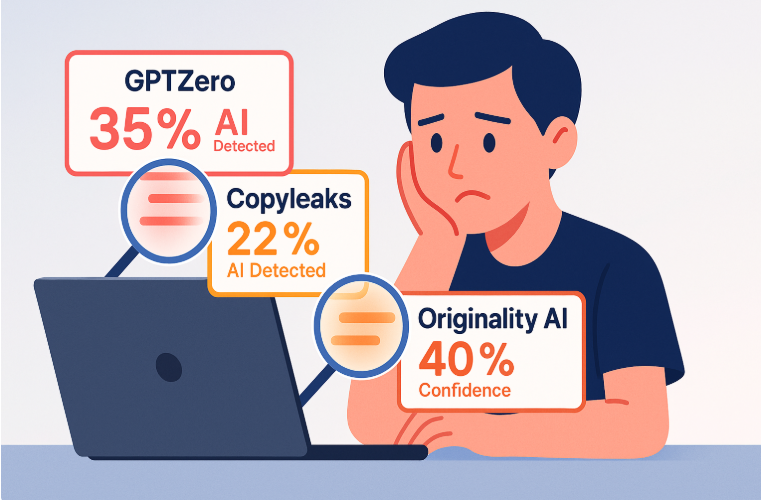
Different detectors treat AI percentages in different ways. GPTZero is known for flagging essays when the writing style feels predictable, even if the actual content is human-written. This is why you will often see students complain about GPTZero false positives. Copyleaks states in its accuracy reviews that anything over 20% AI is suspicious. Originality AI takes a slightly different approach, explaining that their percentage scores reflect confidence rather than exact proportions.
This means that a score of 40% on Originality AI does not necessarily mean that 40% of the essay is AI-generated. Instead, it means the system is fairly confident that the writing includes machine-generated elements. Students and writers need to understand that these scores are guides, not absolute truths. This is why using a humaniser such as Walter AI’s Humanizer is important to reduce the likelihood of being flagged across different tools.
Accuracy benchmarks vary significantly across tools. In 2026 testing, GPTZero claims 98.78% recall and a near-zero false positive rate on clean AI text, though accuracy drops to around 60-80% on heavily edited or humanized content. Turnitin targets a false positive rate under 1% for documents where more than 20% of text is flagged, but this conservative design means it misses an estimated 15% of AI-generated content. Importantly, the same paragraph can score 12% on one detector and 42% on another, which means running your work through a single tool is not a reliable strategy.
One consistent blind spot across all detectors is non-native English writers. Students writing in a second language often use simpler vocabulary and more regular sentence structures, patterns that closely resemble what LLMs produce. Turnitin, GPTZero, and Copyleaks all acknowledge this limitation. If you are a non-native English speaker and receive a high AI score, keeping your revision history and drafts is your best defense.
Why No Detector Can Guarantee a Safe Percentage
The most important point is that there is no universally safe AI detection threshold. A piece of writing could pass Turnitin AI detection but be flagged by Copyleaks or GPTZero. This happens because each detector relies on different methods of measuring perplexity, burstiness, and predictable patterns.
Even Turnitin admits that percentages between one and nineteen percent are often unreliable. The University of Melbourne also highlights that false positives are common, and investigations are triggered not by small scores but by higher confidence readings.
This is why writers should not depend on any single “acceptable AI percentage.” Instead, the focus should be on humanising your work so it reflects your authentic style. Our Undetectable AI Content Guide explains how small changes in phrasing, rhythm, and personal detail can make the difference between being flagged or passing as natural writing.
Best Practices for Keeping AI Use Acceptable
If you are asking how to keep AI writing acceptable or how to avoid AI detection, the answer is simple: use AI responsibly and always add your own voice. Here are the best practices to follow:
- Use AI only for brainstorming or minor edits, not for full essays
- Rewrite and personalise text so it reflects your unique style
- Keep drafts, notes, and references to prove originality
- Vary sentence lengths and avoid uniform robotic phrasing
- Run your essay through a humaniser like Walter Writes AI Humanizer before submission. Walter’s humanizer is built to produce naturally human-sounding writing, not just rephrase sentences, which means it is less likely to trigger Turnitin’s bypasser detection layer.
Following these steps helps you stay well below the acceptable AI percentage and ensures your writing does not trigger detectors unnecessarily.
Acceptable AI Percentage for Professional and SEO Content
The acceptable AI percentage question is not limited to academic writing. Content creators, SEO agencies, and marketing teams face the same challenge with their own tools and editorial standards.
For SEO content, the question is less about a detector score and more about Google’s E-E-A-T framework (Experience, Expertise, Authoritativeness, Trustworthiness). Google does not penalize AI-generated content outright, but it rewards content that demonstrates genuine expertise and first-hand experience. Most SEO agencies now set an internal cap of around 15-20% AI-detected content on client deliverables as a hedge against future algorithm changes and to satisfy editorial review.
For professional writing and publishing, policies vary more widely. Many publishers now require disclosure if AI tools were used in drafting. Some editorial outlets have a hard zero-tolerance policy; others permit AI for research and structural assistance as long as the final text is human-written and fact-checked. The safest approach in professional contexts is to treat AI as a research and outlining tool, with all prose written or substantially rewritten by the human author.
Is 10% AI Writing Acceptable?
Many students ask if 10% AI writing is acceptable on Turnitin or other detectors. The truth is that there is no official safe number, but most universities consider scores under 20% unlikely to trigger action. A 10% AI score could still include false positives, which is why context and supporting drafts matter.
What Happens if My Essay Has 30 Percent AI Detected?
If an essay is flagged with 30% AI detected, most detectors will treat that score as a warning. According to the University of Melbourne, a result in this range often leads to further review, not automatic penalties. It is up to instructors to decide whether the AI involvement was significant. Writers should use their notes, drafts, and sources to prove originality.
Frequently Asked Questions About Acceptable AI Percentages in 2026
What percentage of AI is acceptable in essays
Most detectors treat under 20% AI as acceptable, but this varies. Always focus on rewriting and adding your own voice.
Is 10% AI writing acceptable?
A 10% AI score is usually safe, but it can still include false positives.
Can Turnitin detect small amounts of AI?
Yes. Turnitin can flag even 1-19% AI use, though these scores appear with an asterisk and are less reliable.
How much AI use is allowed in academic writing
There is no universal limit. Most universities advise using AI only for small edits or brainstorming, not for core arguments.
What happens if my essay has 30% AI detected
A 30% score often triggers manual review rather than automatic punishment. They are separate metrics. The AI score estimates how much of your text was generated by an AI tool, based on linguistic patterns. The similarity score measures how much of your text matches content already in Turnitin’s database, such as published papers or previously submitted essays. A high AI score does not mean you plagiarized, and a low similarity score does not mean you did not use AI.
Can Turnitin detect AI humanizers?
Since August 2025, yes. Turnitin’s AI writing report now includes a specific category for text that appears AI-generated and then modified by an AI paraphrasing or humanizing tool. Basic rewriters and word spinners are flagged by this layer. Tools that produce naturally human-like output rather than mechanically rephrasing text are less likely to be caught. Walter’s AI Humanizer is designed with this distinction in mind.
How to Keep AI Use Acceptable and Safe in 2026
Being flagged for AI does not always mean misconduct. Acceptable AI percentages are more about context and intent than exact numbers. Detectors such as Turnitin, GPTZero, Copyleaks, and Originality AI use different methods and thresholds, which means no single score is a guarantee.
The safest way to keep AI use acceptable is to write in drafts, add personal insights, and only use AI for small support tasks. Before submission, refine your essay with a humaniser to ensure your work feels natural. For deeper insights into AI detection tools, head over to our Best AI Detector Tools list. These resources will help you make a more informed decision when choosing the detection and humanizing tool that is right for you.
To understand what those AI percentage thresholds actually represent and how Turnitin produces them, see Can Turnitin Detect AI? 2026 Guide with the technical breakdown of detection methodology.
For the broader picture on how professors detect AI writing in 2026, including the manual review patterns faculty learn to spot.