




Online tutoring is no longer a backup option. It has now formed a backbone of many students’ academic activities (K-12 through college). Consistency of sessions, academic progress, and an easy-to-manage schedule have made it attractive to many parents. Some choose tutoring platforms based on brand recognition and pricing. This can lead to inconsistent tutor quality, poor student engagement, and wastage on packages. Choosing the best online tutoring platforms in 2026 goes beyond price and popularity. The student’s age, learning goals, and flexibility also have to be considered. In this guide, you’ll learn how to choose the most suitable platform for your situation and avoid common mistakes. We’ll cover what makes tutoring effective and how to compare options practically.
Best Online Tutoring Platforms: Quick Pick
Don’t want to go through the lengthy reviews? We’ve condensed the top online tutoring services. Here is a list of experience-based recommendations to help you make a choice quickly:
Varsity Tutors
- Best for: Parents (K-12) who want structured, all-in-one support
- Why people like it: Managed experience, vetted tutors, extra learning tools included
- Biggest complaint: Subscription pricing can feel expensive over time
- Who should avoid: Families who only need occasional, pay-as-you-go help
Wyzant
- Best for: Students (HS/College) who want control over tutor choice
- Why people like it: Huge tutor marketplace and flexible hourly booking
- Biggest complaint: Quality varies a lot between tutors
- Who should avoid: Parents who don’t want to vet tutors themselves
Preply
- Best for: Students learning languages
- Why people like it: Affordable options, global tutor pool
- Biggest complaint: Inconsistent teaching quality across tutors
- Who should avoid: Anyone needing strict curriculum alignment
Outschool
- Best for: Parents (K-12) looking for engaging, small-group classes
- Why people like it: Interactive format, strong engagement for younger kids
- Biggest complaint: Not truly 1-on-1 tutoring
- Who should avoid: Students needing personalized academic assistance
Superprof
- Best for: Tutors and budget-conscious students
- Why people like it: Lower-cost potions, wide tutor availability
- Biggest complaint: The platform does less vetting and support
- Who should avoid: Families needing strong safety and oversight
Skooli
- Best for: Students who want quick, on-demand academic assistance
- Why people like it: Instant access with a pay-as-you-go model
- Biggest complaint: Limited continuity with the same tutor
- Who should avoid: Students who want long-term academic improvement
We have included marketplace options (Wyzant/Preply) that offer complete price control without compromising on flexibility. If budget isn’t a problem, but you want consistency and oversight, choose a structured program (Varsity). Otherwise, go with on-demand options (Skooli), as that will give you instant help. However, don’t expect long-term progress like the two previous options. For more resources to accelerate your learning, check out the Walter Writes student area.
How to Choose the Best Platforms for Online Tutoring
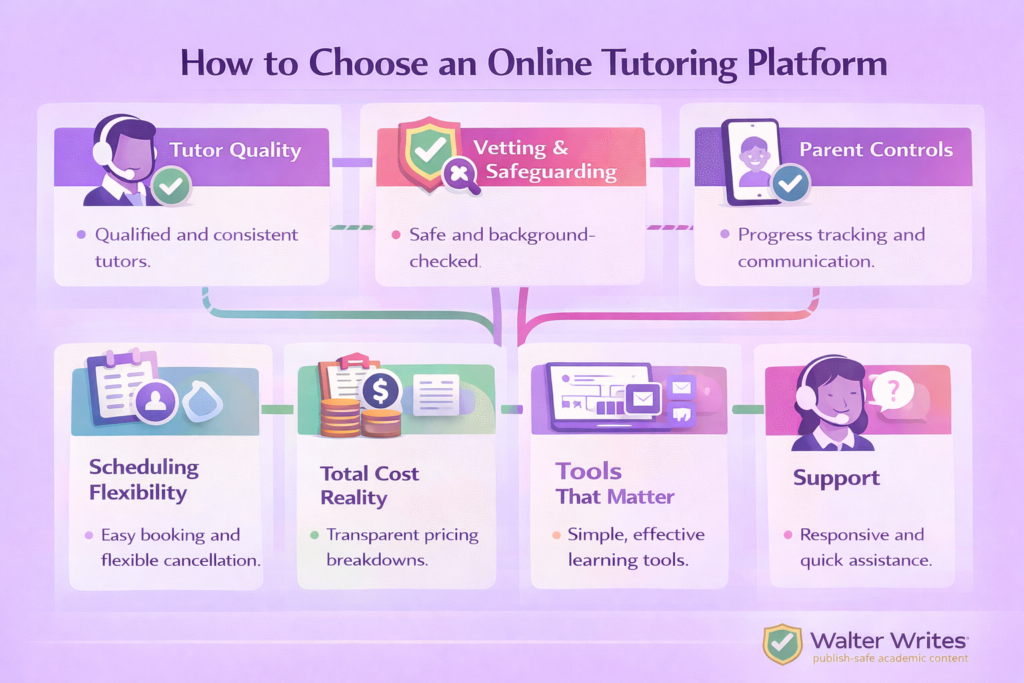
To choose the right online tutoring platform, you need to know what to check for or what matters to you. The best platform offers consistent sessions that bring continuous progress for students. Obviously, not all platforms can work for you. When looking at each option, consider the following:
Tutor Quality Consistency
The most important indicator of a great platform is a combination of highly qualified tutors and consistent session quality throughout. An unreliable tutor will impair a student’s progress. In the same vein, a platform that cannot guarantee the same quality tutor over time is inefficient. To ensure consistent progress, choose a platform that allows for a permanent, reliable tutor. Structured platforms are more consistent and highly suitable here.
Vetting & Safeguarding
If you’re a K-12 parent, verify the background and credentials of tutors and the platform’s communication policies. This ensures the child’s safety and value for your money. Unlike structured platforms, marketplaces offer minimal oversight, making them riskier. We consider this when ranking the platforms.
Parent Controls & Progress Tracking
Many platforms leave parents in the dark after sessions. And without a solid way to track progress, you may not be able to tell whether the program is working. There should be a system in place to track student progress. You should also be able to communicate with tutors to get informed about how your child is doing.
Scheduling Flexibility & Cancellation
Some platforms have rigid policies that make the program hard on parents and students. Generally, a good platform will offer ease of scheduling, time zone flexibility, and early communication of cancellation penalties. This removes friction and makes the platform transparent.
Total Cost Reality
Many programs are not always upfront about the total costs, fearing low patronage. As a result, the $20/hour rate listed on their website might be misleading and may not show the full picture. Transparent platforms will communicate all pricing information early, rather than resorting to hidden-fee tactics. To avoid ending up with an option that looks cheap initially but expensive over time, ask for a full cost breakdown before committing.
Tools That Matter
When it comes to learning, utility is more important than tech stack. The simpler the tools are (Zoom/docs), the easier it is for students to grasp their lessons. Students should be spending more time revising their lessons than learning complex tools. Other things to pay attention to are:
- Recording sessions (so students can review later)
- Whiteboard quality (so that it is easy to watch on student tablets/iPads)
Support
This is the backbone of any system that interfaces between a group of people. It should be easy to resolve issues whenever they come up. Tutor replacement should be swift but rare. Customer support responsiveness should be proactive, empathetic, and exceptionally fast to prevent minor issues from escalating. Finally, there should be policies in place to guide refunds and explain how to go about them.
No platform is perfect. The goal is to increase the chance you end up with a platform that works for you. We recommend prioritizing 2-3 criteria that matter to you and making your choice accordingly.
Comparison Table: Online Tutoring Platforms (2026)
| Platform | Tutor Consistency | Vetting & Safety | Cost | Tools | Support |
| Varsity Tutor | High | High | Low (subscription-based) | Strong (built-in classroom, whiteboard, recordings) | Strong |
| Wyzant | Medium | Medium | Medium (extra fees apply) | Solid (built-in tools, scheduling features) | Medium |
| Preply | Medium | Low-Medium | High (hourly rates) | Strong (integrated classroom, scheduling tools) | Medium |
| Outschool | Medium | Medium-High | High (per class pricing) | Strong (interactive class tools, engagement-focused) | Medium |
| Superprof | Low-Medium | Low | Medium (subscription + tutor rates) | Basic (often external tools like Zoom) | Low |
| Skooli | Low (by design) | Medium | High (pay-as-you-go) | Basic–Medium (simple online classroom) | Low–Medium |
If whiteboard quality is a priority in your decision, the best online whiteboard tools guide compares Miro, Mural, and Microsoft Whiteboard specifically for classroom and remote tutoring settings.
The Best Online Tutoring Platforms in 2026
There is no single best platform because trade-offs are inevitable. The most important thing is to understand what you need and evaluate each option based on that. Platforms often differ by model, which is why it’s not easy to have a straight rank from #1 to #6. To make it easier to choose, we arranged them in tiers based on the real-world problems they solve. This way, you can easily see which one is the most suitable for you.
Best for Most Families
Varsity Tutors
If you’re looking for the best managed tutoring experience, then look no further than Varsity Tutors. They have a tutor vetting process in place to ensure quality and safety for your kid. Their tutor consistency is also higher than that of marketplace options. This makes them suitable for parents (K-12) and students who need consistency and guidance. You’re not just paying for tutoring hours. But also for oversight and consistency.
Strengths
- Varsity accepts only a small % of applicants, all of whom are vetted.
- The platform offers personalized programs and matching for students.
- Covers a wide range of subjects from K-12 to college.
Weaknesses
- Subscription pricing ($300-$1000/m) puts it at the higher echelon; it may not be affordable for many.
- Less control over tutor selection.
Best Markeplaces
Superprof
This is a pure marketplace model with a broad range of subjects for students to choose from. There is minimal teacher vetting, which may affect lesson quality. You can pick tutors based on price. If you want highly qualified teachers, you may have to pay a higher price point. But the flexibility to downgrade can come in handy when you experience a cash crunch. High flexibility means parents have more independence. But low support means more time resolving issues.
Strengths
- Students can pick tutors based on reviews, rates, and experience.
- High flexibility means parents and students have more options.
Weaknesses
- There are no built-in classrooms like Preply, so students have to rely on external tools.
- It may take time to find the right tutor.
Wyzant
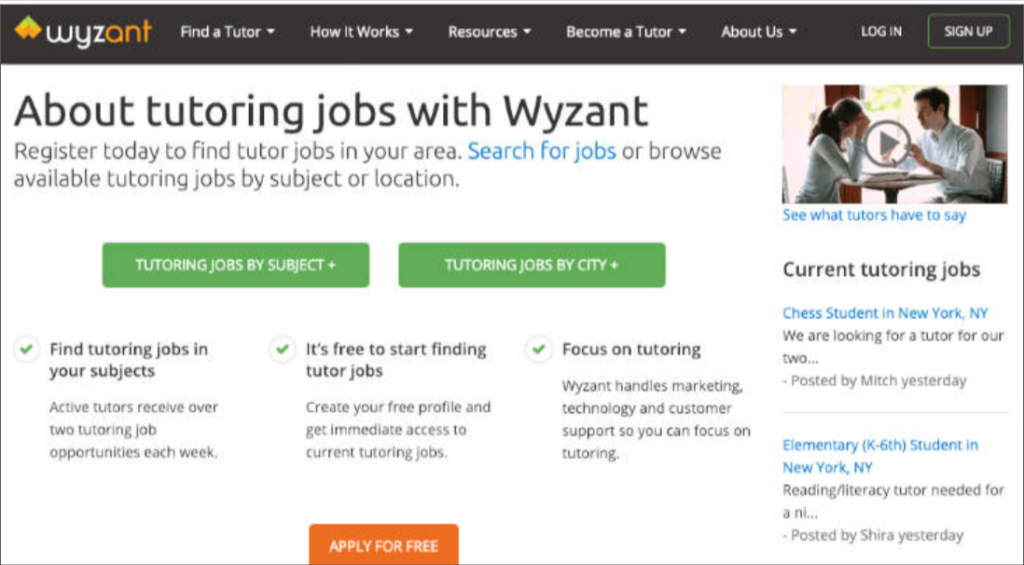
Marketplaces are very powerful when you know how to evaluate tutors. They are designed for students who value freedom over supervision. Unlike structured programs like Varsity, Wyzant allows you to choose your own tutor. It is one of the most suitable platforms for students and tutors (due to the flexibility). The price is at the lower end and is dependent on the tutor. This makes it suitable for budget-conscious users. With Wyzant, users will also enjoy the best balance between flexibility and structure.
Strengths
- There is a wide selection across subjects for students to pick from.
- The price range from as low as $10/hr up to $600/hr, determined by the tutor.
- Features a built-in classroom (whiteboard, code editor, recordings, etc.)
- The vetting process is stronger than most marketplaces.
Weaknesses
- Finding the right tutor may take time.
- There is a moderate tutor turnover, so there is a high chance of disruption along the way.
Best for On-Demand/Homework Help
Skooli
This platform allows students to get immediate help with their assignments in short sessions. Students who need homework support and don’t want to follow a structured plan will find this option great. While this is great for emergency needs, it may not be the best for long-term learning. Learning is only surface-level with poor progress tracking.
Strengths
- There is instant access to tutors who are always ready.
- There is no need to engage in long-term commitments.
- Very simple process to get help.
- Teachers are certified before admission.
- No booking required; just pay to access the classroom and recorded sessions.
Weaknesses
- Different tutors handle each session, breaking down continuity.
- There is no long-term plan for students.
- Too much focus on solving immediate problems.
Best for Tutors
Preply
Preply is one of the best online tutoring platforms for tutors. It has a global tutor pool (100k+ tutors) and is available in over 90+ languages worldwide. That makes it a strong language-learning platform, in addition to where students can study. While vetting is not as strict as others, tutors are replaced immediately in the event of a turnover. The good side is that tutors can build their own client base through the platform. Moreso, the experience gathered here can help with consulting and freelancing. There is also high traffic, so there will always be demand for teaching services. The downside is the lower pay, which pushes some teachers away from the platform.
Strengths
- Global student access makes it attractive to students across different backgrounds.
- Built-in tools for progress tracking.
- Teachers can set their own rate.
- Flexible schedule for students and tutors.
Weaknesses
- Inconsistent income.
- Teachers must self-market.
- Platform fees can cut into teacher income.
What “Most Effective” Means
While most platforms sell access, what you actually need is outcomes. When a platform is effective, you’ll continually see improvements in your child’s studies. Otherwise, you may just be wasting money. Let’s look at a few considerations when considering personalized tutoring for your kid.
Baseline
The tutors on the platform should be highly trained. Before any tutoring, they evaluate the child to know their current level and weaknesses. Jumping straight into teaching without assessment means the tutor will miss vital information for success.
Weekly Goals
A tutor will set specific goals to ensure each session builds toward something. It could be mastering a concept or improving test performance in a subject. All of these make progress measurable and minimize guesswork.
Feedback Loop
Each session should end with extra tasks, such as homework and feedback on mistakes made. For the tutor, that might mean an adjustment in teaching style if the student is not responding positively. Without a strong feedback loop, students will continue to make the same mistakes, which can affect their learning.
Measurable Improvement
Student’s progress must be visible and trackable. What does improvement mean? Higher test scores, faster problem-solving skills, and thinking more independently. If progress can be tracked, then it’s happening. Otherwise, it didn’t occur.
Week 3 Reality Check
Three weeks is enough time to identify patterns, establish a routine, and evaluate performance. If there is no progress by that time, then there is a problem somewhere. It could be an issue with the tutor, platform, or structure. If it’s a tutor issue, then the tutor should adapt or be replaced. If it’s a platform issue, consider contacting support. Switching to a different platform may be worth it if issues persist. If it is a structural issue, a weekly challenge may be introduced to improve consistency and track progress.
K-12 and Younger Kids (What Parents Should Prioritize)
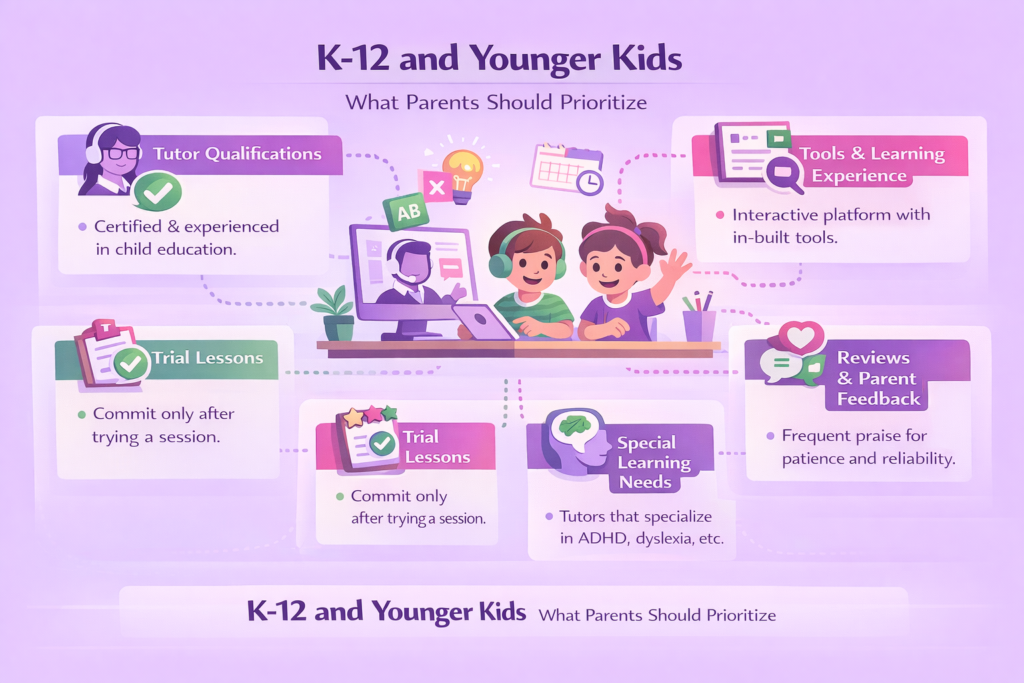
Choosing the best online tutoring platforms for kids requires more effort. For young learners, structure, safety, and fit should be prioritized over platform quality. The reason is simple. Younger students need more supervision, engagement, and consistency. It is less about the tutor delivering the lecture and more about how it is delivered. The wrong approach can make a child dislike a subject more.
Tutor Qualifications
When you’re vetting, focus on teaching credentials, subject specialization, and experience with children. Some teachers are good in some subjects and poor in others. Choose a teacher who is good at the subject you want your kid to excel in. Versity Tutors has a very strong vetting process in place, so you may want to start from there. Avoid marketplaces if you know you can’t do appropriate vetting.
Tools & Learning Experience
The tools can affect session quality, so consider options that come with built-in classrooms. This should include features such as live and recorded sessions, document sharing, whiteboards, etc. They often have a high level of engagement and interactive whiteboard usability. These features can keep students engaged for longer. Again, avoid platforms that rely too often on external tools.
Trial Lessons
Before committing to a platform, you can do some trial lessons. This is to see the teaching style, the child’s comfort level, and the effectiveness of the communication. Fortunately, children will show fit problems immediately. Pay attention to the first lesson to see how the tutor delivered and how your child responds. Preply and Wyzant (Good Fit Guarantee) make it easy to try multiple tutors. Although subscription platforms like Varsity offer the best plans, you may not be able to test without commitment.
Reviews & Parent Feedback
Look for consistent reviews from parents. Don’t be swayed by generic or overly positive reviews that don’t reveal many details. Read into what people comment, such as how reliability and patience are imperative for teaching young children. For example, “Helped my 7th grader improve in algebra” is very useful when you’re trying to determine fit.
Contract Terms
Consider reviewing each platform’s cancellation and refund policies. Also, note that there are no subscription lock-ins before you commit. Pay attention to things like missed lesson fees, session expiry, rescheduling rules, etc. Markplaces are often more flexible in their terms but have less overall support.
Special Learning Needs
Children in this category need to be handled with care. You also have to be more involved as a parent. Look for teaching specialists who have experience with ADHD, dyslexia, autism, etc. If you can’t get one with both, emphasize experience, as that is more important. This is less about the best platform and more about choosing the best fit for younger learners.
Tutoring works best when it supports stronger study habits beyond the session. You can review Walter Writes for student learning and study guides.
On-Demand vs Scheduled Tutoring
When faced with the two options, don’t choose based on price or convenience. Rather, consider the type of academic problem you’re facing and then decide on the option that’ll help solve it.
On-Demand
If you need homework help, the most suitable option is on-demand. You can get last-minute help when you’re stuck on a problem since you don’t need to book to onboard. This should not be used for long-term learning, but you can combine it with another plan focusing on continuity and deeper understanding.
Pros
- Best for quick help
- Less structured
- No guarantee on tutor continuity
Scheduled
If you’re falling behind on a subject and you need mastery, a structured learning plan with consistent sessions may be what you need. In this case, go for a plan that offers scheduled tutoring so you can learn a subject in-depth. Varsity Tutors and Wyzant are great options to consider.
Pros
- Allows for progress tracking
- Builds a relationship with the tutor
- Best for long-term progress
A hybrid version is also possible, combining both. Use a scheduled plan for deep learning and an on-demand plan for urgent support. This way, you avoid two issues students often face when they depend on only one.
Real Cost Per Hour
Some platforms may have cheaper upfront costs and more upsells later on. When evaluating a teaching platform, you need to look beyond just pricing. You need to consider the frequency, consistency, and effectiveness of sessions offered. This is what will drive the cost you’re quoted. Nonetheless, there are average pricing models that you can consider, depending on the package.
Pricing Models
Markeplace Hourly (Wyzant, Preply, Superprof)
The price range is $10 to $100+/hour, but can go higher for specialists. Make sure you vet the tutors, not just concentrate on cheap hourly rates, which often come with little experience and less domain expertise. The advantage is that you have a flexible, pay-as-you-go plan. However, the time spent replacing/find tutors isn’t accounted for. Moreover, if you end up with inconsistent quality, you will end up paying for more sessions.
Subscriptions (Varsity Tutors)
The price range is higher, from ~$200 to $1000/month, depending on the package you choose. The advantage is structured support, and the consistency is higher than marketplace plans. It should be noted that you sometimes pay for unused sessions and may even be locked into commitments.
On-Demand (Skooli)
This is the cheapest among the three, with prices as little as ~$0.80-$1/min (approximately ~48-$60/hour). You pay only when needed, but repeated usage can add up quickly.
Institutional
Some libraries and platforms like Khan Academy offer free access or at a lower cost. These are effective for practising and reviewing concepts. The downside is little to no accountability and personalized guidance. You can start with this to figure out what you really need and then go with a different model when you’re ready.
A Practical Workflow: Tutoring Session → Assignment → Final Submission
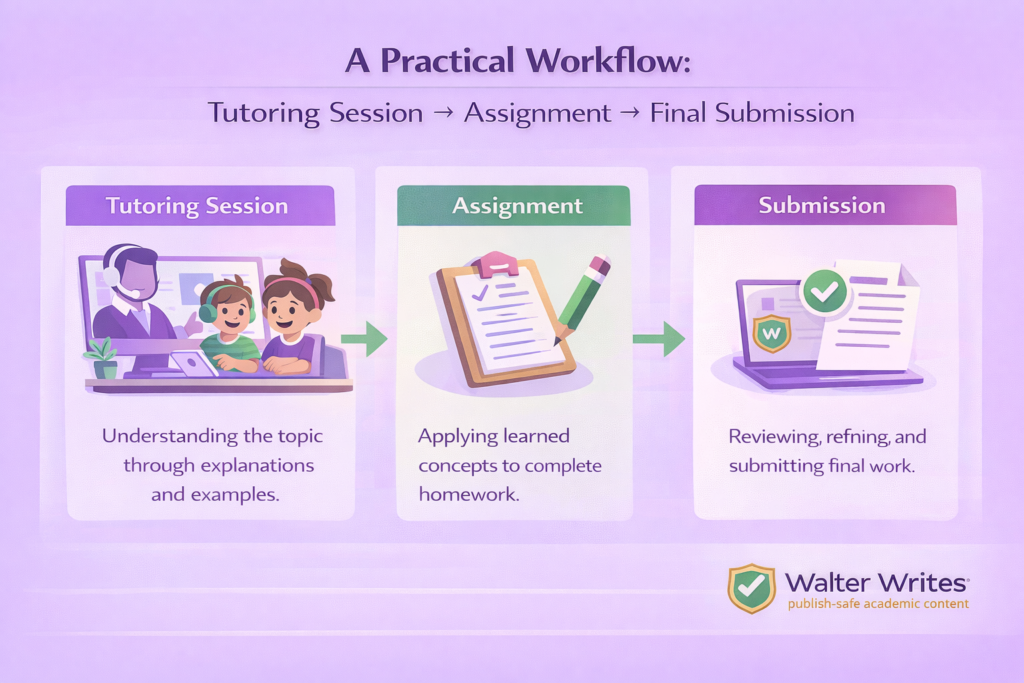
When students depend only on classroom sessions without further reviews, they soon forget what they have learnt. Tutoring alone doesn’t always produce expected results. It is only when backed with extra activities after each session that changes begin to occur. Good tutoring includes assignments and solid feedback after submissions.
Tutoring Session
This is where understanding of the topic occurs. The session is where the tutor breaks down difficult concepts, and students can ask questions on areas that are unclear to them. The goal is for the student to leave each session with a moderate understanding. This can be achieved with adequate explanation and appropriate examples where required. This is then backed with in-class practice or an assignment.
Assignment
This is the part where the student can apply what they have learned. It also determines how much learning has actually happened. As a parent, always leave your child to try the assignment without any assistance. It’s easier to monitor their progress this way. This will solidify their understanding or expose areas where they are weak. This can then be tackled in subsequent sessions or extra research outside the classroom.
Submission
Before submitting, students should review their assignment for structure and ensure that their ideas are expressed naturally. If it is a written assignment, an AI humanizer for students can help you refine wording or clarify awkward phrasing. For academic essays and writing tasks where integrity is important, you can use Walter Writes AI detector to stay compliant.
Frequently Asked Questions
What Are the Best Online Tutoring Platforms for K-12 Students?
There is no single best option. Parents have to evaluate platforms based on structured support (Varsity Tutor) or flexibility, which requires parental effort (Wyzant).
How Much Does Online Tutoring Typically Cost Per Hour?
Typical range is $20-$100/hour on average for standard subjects. The cost for test prep and more advanced subjects is a bit higher at $100-$150+.
Are Free Online Tutoring Platforms Actually Effective?
Yes, but milestones vary. They are useful for practice and concept review. Not suitable if you want accountability and personalized guidance.
What Subjects Can You Get Help With On Online Tutoring Platforms?
You can get help with core subjects like Math, English, and Science. There are options for test prep tutoring, such as the SAT, as well as language learning. Students who prefer self-paced practice alongside tutoring will find a structured comparison of language learning apps covering Duolingo, Babbel, Pimsleur, and Memrise for ESL learners.
How Do I Choose the Right Online Tutoring Platform for My Child?
Consider structure, progress tracking, and tutor quality when choosing. Start with a trial session to gauge quality and fit before committing.
What’s the Difference Between On-Demand and Scheduled Online Tutoring?
On-demand gives you quick help but no continuity, while scheduled offers structured learning, with long-term results.
Do Online Tutoring Platforms Hire Certified Teachers?
The likes of Skooli do hire certified teachers. Others go with mixed backgrounds, especially in marketplaces.
Can Online Tutoring Replace In-Person Tutoring?
Yes, if the tools and structure are strong. But if the student needs close supervision, it may not be effective.
What Online Tutoring Platforms Work Best for Special Learning Needs?
Structured platforms with experienced tutors (e.g., Varsity Tutors) are strong contenders here.
How Do I Know If an Online Tutor Is Qualified?
Check their credentials, reviews, and performance during trial sessions.