

Key Takeaway: Bypassing Turnitin AI detection in 2026 is significantly harder than most guides suggest, because Turnitin’s August 2025 update now specifically detects text that has been run through low-quality humanizer tools, making the real goal submitting work that is genuinely yours rather than chasing a lower score.
- Since August 2025, Turnitin detects both AI-generated text and text modified by humanizer tools
- Low-quality humanizers introduce unnatural rewording that creates a second layer of detectable patterns
- There is no universal safe AI score. Thresholds vary by institution and instructor
- False positives are common for formal, structured, or repetitive academic writing styles
- A higher score with strong process evidence is more defensible than a low score with no drafts
- If flagged, gather outlines, drafts, and research notes before requesting a review
Most of the online tutorials or cheat sites you’ve seen regarding how to bypass Turnitin AI detection are outdated. As of August 2025, Turnitin has begun detecting students who use a “humanizer” tool on their writing, in addition to AI-generated writing.
This guide will explain exactly how Turnitin’s AI detection works in 2026, why almost all bypass methods are no longer working, and what you can do instead to submit work you’re confident in.
What “Turnitin AI Detection” Actually Does (and What It Does Not Prove)
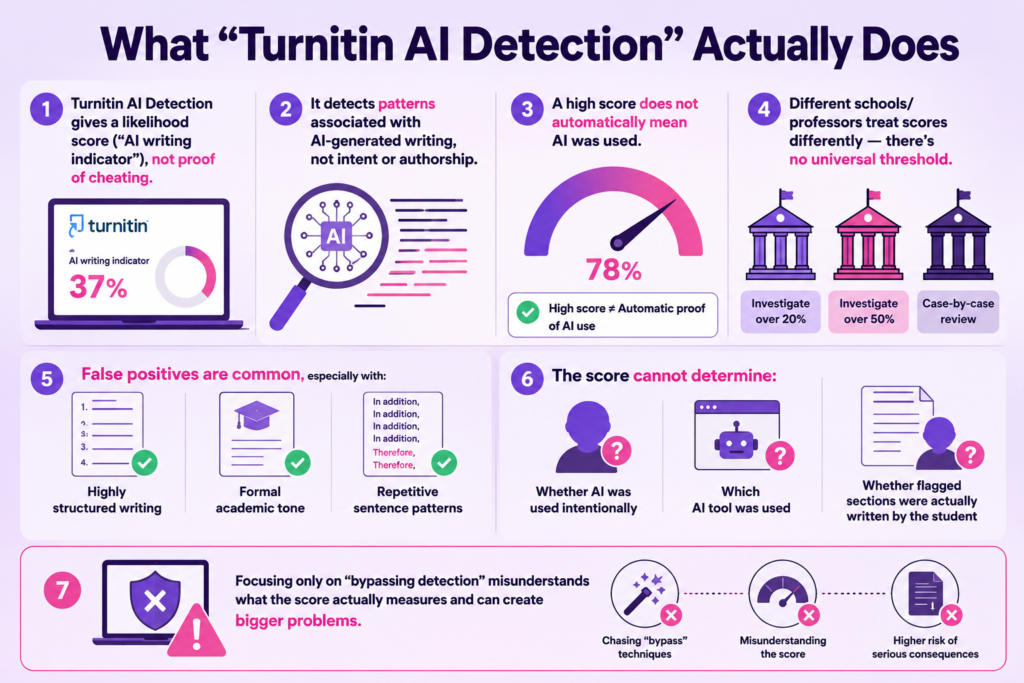
Turnitin’s AI detection does not read your paper and decide you cheated. Instead, Turnitin uses its AI detection to generate a likelihood score called an “AI writing indicator” based on whether or not the detected text matches the types of patterns associated with AI generated-text.
That’s all it does. A high likelihood score does not automatically mean you used AI. It simply indicates that the system has identified some type of pattern that may be indicative of AI-written content. Ultimately, it will be up to your professor and institution to determine if this information warrants action. Some institutions view any score over 20% as serious enough for further investigation, while others don’t take notice until the score exceeds 50%. There seems to be no standard.
Another major issue is false positives. Writing that follows highly structured formats, uses very formal language as part of its tone, and has many repeated sentence structures may also trigger the detection system regardless of whether or not 100% of the work is written entirely by the student.
What the Score Cannot Tell Anyone:
- Whether you used AI intentionally
- Which specific tool did you use
- Whether the flagged sections were written by you or generated
This matters because a lot of “bypass Turnitin AI detection” advice treats the score as the enemy. But if students are simply trying to obtain a lower score without understanding the actual measurement that the score represents, they will often end up in more trouble than before.
To better comprehend the mechanics of this, you can read how AI detectors work.
The 2026 Update Students Keep Missing: Turnitin Now Targets “AI Bypassers”
Most bypass guides you’ll find online are working with outdated information. In August 2025, Turnitin updated its system, and many students didn’t know anything about this update.
Turnitin now recognizes and can identify when text has been modified using low-quality humanization tools in addition to identifying directly generated content from AI. This means simply running your work through a humanizer tool and submitting it as written will not be as effective as before.
Here’s why. Because cheaply produced or poorly constructed humanizers tend to generate unnatural synonyms, disrupt the rhythm of sentences, and produce unnatural-sounding phrases. These unnatural modifications result in the production of two sets of detectable patterns. One is the underlying AI-produced content, and the second is the above layers of unnatural modification. Turnitin’s detection software can identify both combinations.
The risk is not humanizing itself. The risk is humanizing badly. A simple word scrambler that doesn’t allow you to maintain your voice and preserve your original writing style will not help your paper pass through Turnitin. Instead, it will increase the likelihood of raising red flags.
In this Turnitin report, it refers to this detection method as “AI bypass detection.” This is an automated process used along with its existing AI detection service when a student submits their work.
The takeaway for 2026: keep in mind that not all of the available humanizers are created equally. The ones that strip away students’ voices and replace them with robotically written rewrites are the ones putting students at risk.
For more information about how the system has evolved, read our Turnitin AI detector review.
Why “Bypass Methods” Backfire: The 5 Most Common Student Failure Patterns
Most students don’t get flagged because they used AI heavily. They get flagged because of how they tried to hide it. Below are the five patterns that are most commonly responsible for causing issues.
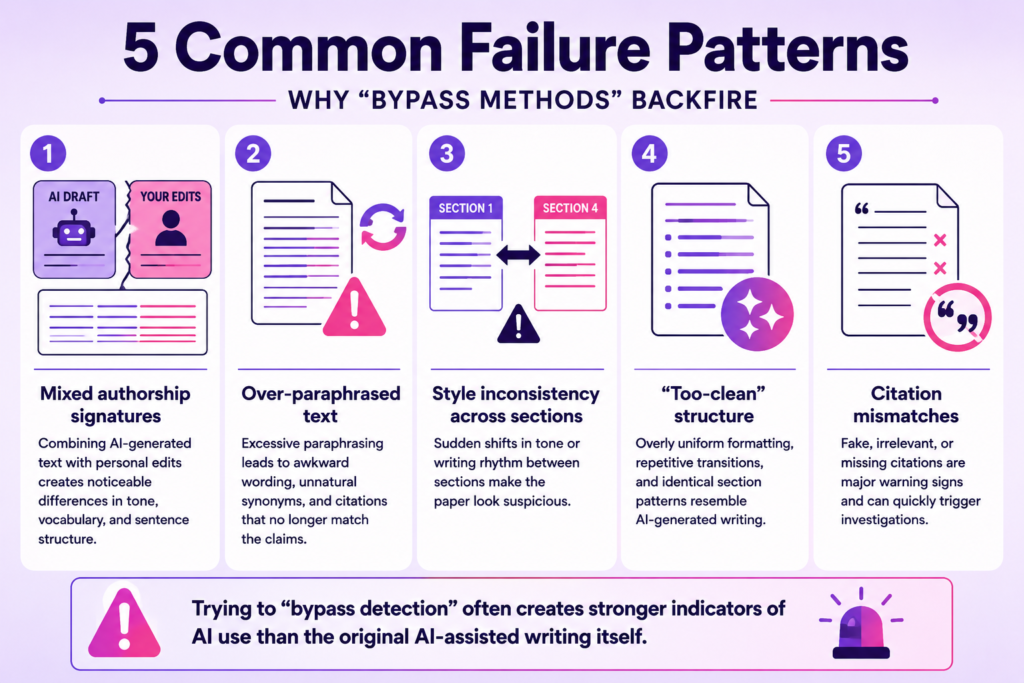
1. Mixed Authorship Signatures:
When a student uses a draft from an AI directly and then adds their own final edits, it causes inconsistencies with regard to vocabulary, tone, and sentence structure throughout different parts of the paper. These inconsistencies are picked up by Turnitin easily.
2. Over-Paraphrased Text:
When you use a paraphrase tool multiple times, you will find unnatural substitution of synonyms and citations that no longer support the claims being made.
3. Style Inconsistency Across Sections:
If you have an assertive opening, but a businesslike closing, it can be a problem. The sudden shift in tone and rhythm from section to section in a paper is a very obvious warning sign.
4. “Too-Clean” Structure:
Evenly spaced paragraphs, generic transitional phrases, and the same structural pattern for each section of your paper are features that show that the content was generated with AI.
5. Citation Mismatches:
Citations created by AI do not relate to the claim they are supposed to support. Many times, there are no citations at all. Using fabricated citations to create a warning flag is usually the quickest way to get a formal investigation started.
The Student-Safe Alternative to “Bypassing”: How to Use AI Without Getting Accused
The goal should never be to trick Turnitin. The goal should be to submit work that is genuinely yours, with AI playing a supporting role where your institution allows it.
Here’s how students can use AI responsibly without putting themselves at risk.
Use AI for the Thinking, Not the Writing
Brainstorming, outlining, generating counterarguments, and getting feedback on your ideas are all low-risk ways to use AI. The writing itself should come from you so that your voice remains the same throughout the entirety of your paper.
Use AI to Polish, Not Produce
Using AI to assist with your writing to fix grammar or improve clarity is very different from generating your final written product. There is a significant difference between utilizing AI to support your writing versus replacing your writing.
Document Your Process
Save copies of your original outline, rough drafts, research notes, and internet searches. If your work ever gets questioned, maintaining documentation of how your idea was generated will provide you with a paper trail that clearly shows how you arrived at the conclusion.
Know Your Institution’s Policy Before You Start
Policies on AI can differ greatly among schools, as well as from course to course. While some instructors are open to students disclosing their use of AI in a project or assignment, others will completely prohibit it. The safest approach is always to ask your instructor directly if they allow AI or have a specific policy regarding its use.
If Your Class Allows AI, Say So
Writing a short statement that discloses your use of AI in an assignment, such as “I used AI to assist me in outlining this paper and also to check my grammar,” demonstrates honesty and responsibility.
For additional guidance on responsibly using AI, browse our student guides.
“Can I Just Paraphrase It?” What Turnitin Can Still Flag in 2026
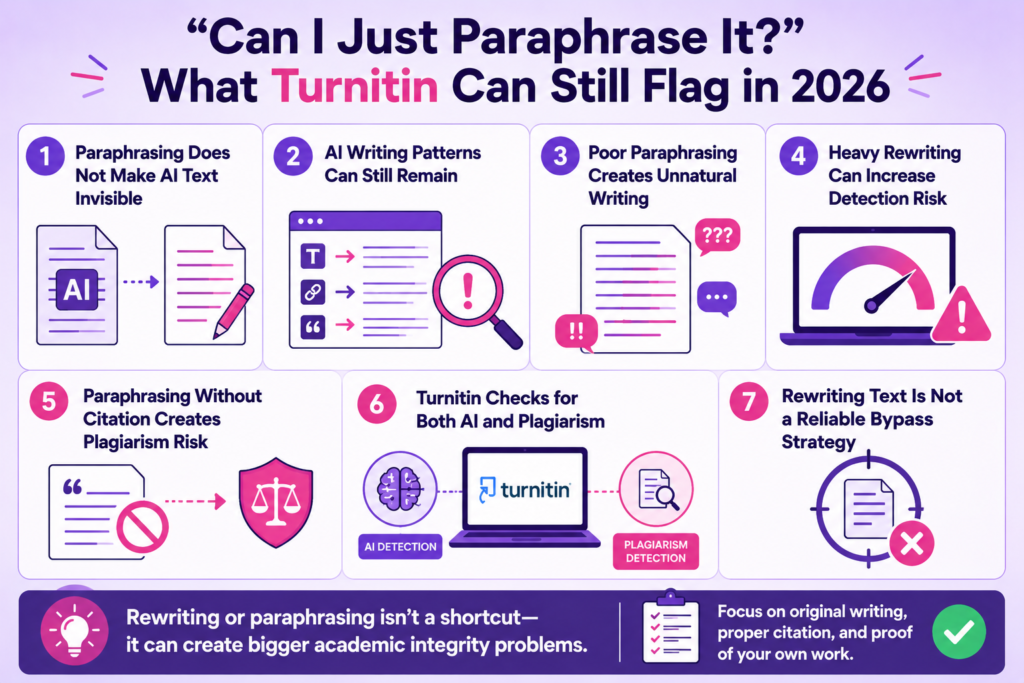
Paraphrasing is one of the most common strategies students turn to when trying to lower their AI score. While paraphrasing may eliminate many obvious signs of AI-generated writing, it has its own pitfalls. Many guides do not alert students to these potential falls.
Paraphrasing Does Not Make AI-Generated Text Invisible
While Turnitin detects writing characteristics rather than just verbatim wording, rewritten AI content also has a tendency to exhibit predictable writing formats, transition words or phrases, and consistently similar tones. These characteristics are not eliminated due to word changes made during the paraphrasing process.
Poor Paraphrasing Can Introduce Bypasser-Like Artifacts
As covered earlier, heavy paraphrasing often results in unnatural rewording and poor synonyms, which Turnitin’s bypassers specifically target. This type of rewriting can result in a higher detection rate if the tool used to perform the rewriting was chosen improperly.
Paraphrasing Borrowed Content Creates Plagiarism Risk
If you’re paraphrasing from a source without proper attribution, you’re no longer dealing with an AI detection problem because then you have a plagiarism issue. When Turnitin is used on a piece of writing, there will be two checks run. One is for plagiarism, and the second is the AI detection one.
Many students have asked about specific tools, such as Quillbot, to paraphrase. In general, there is no paraphrasing tool available on the market that can guarantee a clean report. If you want a detailed explanation regarding the same, read Does QuillBot pass Turnitin?
Your safest option for paraphrasing is simply to paraphrase yourself, in your own words, having clearly understood what was said by the original source.
What’s a “Safe AI Score” on Turnitin? (And Why the Number Alone Is the Wrong Target)
Students frequently ask what percentage is considered “safe” on Turnitin. The honest answer is that there is no universal safe number. The score means different things depending on where you study and who is reading it.
Institutions Set Their Own Thresholds
Every institutional policy has varying levels of thresholds. For example, some departments will flag anything with an AI percentage greater than 20%, while other departments may only require escalation when an AI percentage reaches 50% or higher. Some instructors review the entire AI report before making determinations regarding a potential violation, but some will regard any indication from the AI report as sufficient to initiate a formal investigation.
A Low Score Does Not Automatically Mean You Are Safe
Just because you received a low AI detection score doesn’t necessarily mean you did nothing wrong. A score of 10%, which indicates very little AI usage, can be coupled with fabricated references that are highly polished and can potentially raise more red flags than a 35% score on a paper that clearly documents the author’s research.
A Higher Score With Strong Process Evidence Is Defensible
If you have drafts, notes, outlines, and sources that document the development of your paper, it will be considerably easier to justify a higher score as well as dispute them. One score is merely a single data point. Your process is the total picture.
Here is a simple framework to guide your thinking:
- Low score + weak citations + no drafts = still risky
- Higher score + strong drafts + clear sources = defensible
Your goal should not be for a particular score. Instead, your goal should be to produce writing that has your voice and a supportable process.
For more on how scoring works in practice, read Can Turnitin detect AI-generated content?
What to Do If Turnitin Flags Your Work as AI-Generated
Getting flagged is stressful. The most important thing when being flagged is how you react to the situation, rather than the fact of having been flagged. Below is a complete, step-by-step guide on how to proceed if a student believes their work has been unfairly flagged.
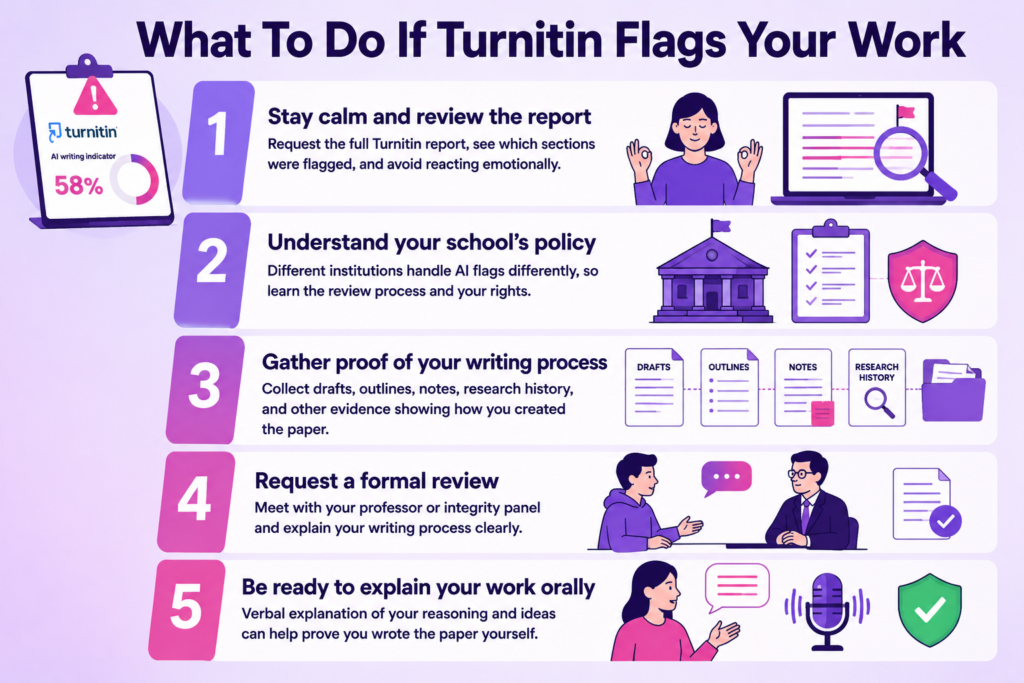
Step 1: Stay Calm and Read the Report
Before doing anything else, request your professor to obtain a copy of the full Turnitin report. Determine what parts of your paper were flagged and at what percentage of similarity. Take time before acting and avoid reacting impulsively.
Step 2: Check Your Institution’s Policy
Schools differ on how they will address AI-flagged papers. Some have an official review process. Others leave decision-making up to individual instructors. Understanding what your school policy is gives you a better understanding of what to expect in terms of your rights.
Step 3: Gather Your Process Evidence
Collect as much documentation as possible that illustrates your writing process. All outlines, drafts, research materials, and browser histories that can help document the process. The more documentation you collect, the more solid your argument.
Step 4: Request a Review and Make Your Case
Request an official review session with your professor or the academic integrity panel. Walk them through how you did things. If they want to hear you explain your reasoning orally, then offer that opportunity. Oral explanation can be very helpful in demonstrating that you actually wrote the paper yourself.
What not to do:
- Do not rewrite and resubmit without explanation
- Do not delete your drafts or notes
- Do not ignore the flag and hope it goes away
Where Walter Writes Fits for Students: One Workflow to Reduce Risk (Without Gaming the System)
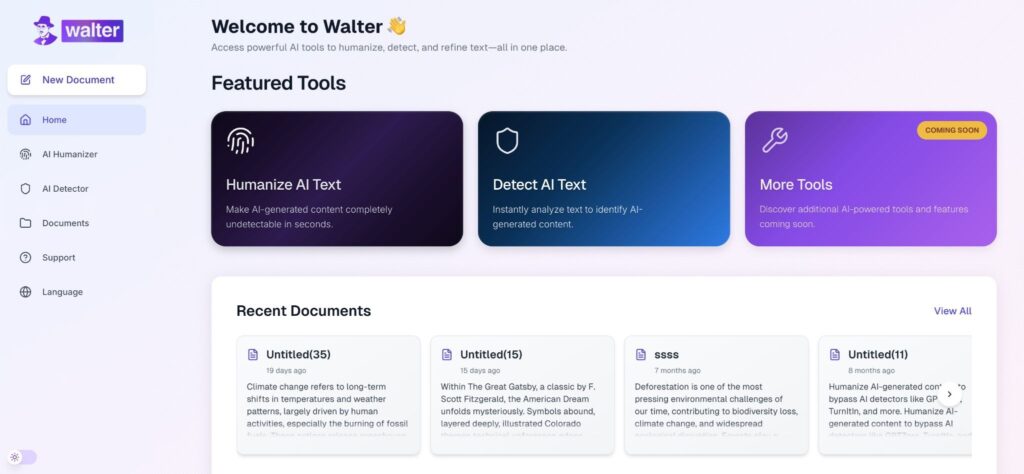
Many of the tools that students have access to are designed for one function. A humanizer tool, which will randomly scramble the words in their writing, or a detector tool, which will give them a score, but it does not tell the student what they can improve upon or where to go from there. This type of fragmented workflow causes much more anxiety than it reduces.
Walter Writes is built differently.
Walter Writes was created with the idea of giving students the ability to help them write using their own voice while guiding them as they check how their final product reads once finished, prior to submitting. As such, students can develop an authentic writing piece in their own voice rather than chasing down a score at the end of the semester.
Here’s how students really use Walter Writes in practice:
- Humanizing: The AI humanizer for students makes writing smoother, with no robotic phrases, and easier to read without losing your original voice or tone.
- Self-checking: Before your teacher checks for AI, you can check your final draft by running it in the AI detector for students to identify areas that do not sound like you.
This isn’t about cheating. This is about submitting something you feel confident about.
Check out the list of the best AI humanizers for Turnitin in 2026, ranked by bypass reliability and output quality
Frequently Asked Questions
Does Turnitin Actually Detect AI-Generated Content?
Yes, but not perfectly. Turnitin generates a probability score based on patterns in your writing. It does not definitively prove AI use. The score is a flag for review, not a verdict.
What Percentage of AI Content Will Turnitin Flag?
Turnitin assigns an arbitrary percentage value, and it’s up to each institution as to whether they want to take that as a serious enough reason to do a second look. For example, 20% in one school may be considered a serious offense, while in another school it might not be an issue.
Can Turnitin Detect ChatGPT If I Paraphrase the Text?
Paraphrasing reduces some signals but does not eliminate them. Turnitin is looking at your overall writing style as well as how much you rewrote something. So yes, if you use a tool like ChatGPT to write and then rewrite it using different words but similar sentence structure, Turnitin could potentially find out.
Does Turnitin Detect QuillBot or Other Paraphrasing Tools?
It can. Since August 2025, Turnitin has actively targeted text modified by paraphrasing and humanizer tools. Turnitin uses a bypasser detection feature that identifies awkward rewording and unnatural-sounding phrases as possible indicators of having used such a rewriting tool.
Can Turnitin Detect AI If I Edit the Text Manually?
Manual editing can be helpful, especially when you’re changing the structure and tone of the original. Light edits on heavily AI-generated content are unlikely to fully remove detectable patterns.
What Is a Safe AI Score on Turnitin?
There is no specific number to define a safe Turnitin AI score. The importance of context far outweighs the number itself. A well-documented process and consistent authorship support a defensible score regardless of the numbers
What Happens If Turnitin Flags Your Work as AI-Generated?
Your instructor or institution reviews the flag based on their policy. It does not automatically mean punishment. You will typically have an opportunity to respond and present evidence of your writing process.
How Does Turnitin’s AI Bypasser Detection Work?
It looks for modification patterns introduced by humanizer tools layered on top of AI-generated text. The combination of both pattern types is what triggers the bypasser flag.
Will Turnitin Flag My Original Work as AI by Mistake?
Yes, false positives happen. Formal academic tone, highly structured writing, and repetitive sentence patterns can all trigger the detector even in fully original work.
Can Grammarly Edits Cause Turnitin To Flag Content As AI?
Grammarly alone is unlikely to trigger an AI flag. But if the underlying text was AI-generated and Grammarly edits were applied on top, the combination could contribute to a higher score.
Final Thoughts
The search for ways to bypass Turnitin AI detection is understandable. But in 2026, the arms race between bypass tools and Turnitin’s detection has shifted in Turnitin’s favor.
The students who come out of this in the best position are not the ones with the lowest AI score, but they are the ones who have demonstrated the strongest writing processes, most consistently written voice, and clear documentation in their work. Write like yourself, track your work as you go, and if you need help getting there, Walter Writes is here to help.
Considering Undetectable.ai specifically? See our 2026 test results in our Undetectable.ai Review.