



Key Takeaway: Yes, Google can detect AI content patterns, but it doesn’t penalize you for using AI. It penalizes low-value, scaled, automation-shaped content that exists to game rankings rather than help users.
- AI content can rank; the risk is publishing unreviewed, generic drafts at scale
- Google evaluates intent, quality, and usefulness, not whether AI wrote it
- Algorithm demotions are not manual penalties; you won’t get a notification
- Humanizing a draft isn’t enough if the content still lacks substance and specificity
- Use AI for drafting only; humans own intent, fact-checking, and editorial judgment
- Run a QA pass before publishing: intent match, info gain, differentiation, verified facts
ChatGPT and its sisters have made life easy for SEOs. Content that took hours to write before now takes a few minutes to complete. But is it safe to use AI content? Does Google penalize AI content? A lot of people are worried they might be penalized if Google detects they are using AI. However, for marketers, we must base our actions on evidence, not hearsay. We’ve used AI-assisted content across a small portfolio of sites, all published after the Helpful Content updates. None of these sites received manual actions related to AI usage itself. We wrote this guide share our experience and clear the misconceptions surrounding the use of AI, what the real SEO risks are, and how to use it safely.
Can AI Content Rank? What Google Says
When producing content with AI, many still think along the lines of: “Can my AI content rank?” While that’s a genuine concern, it may be purely anecdotal.
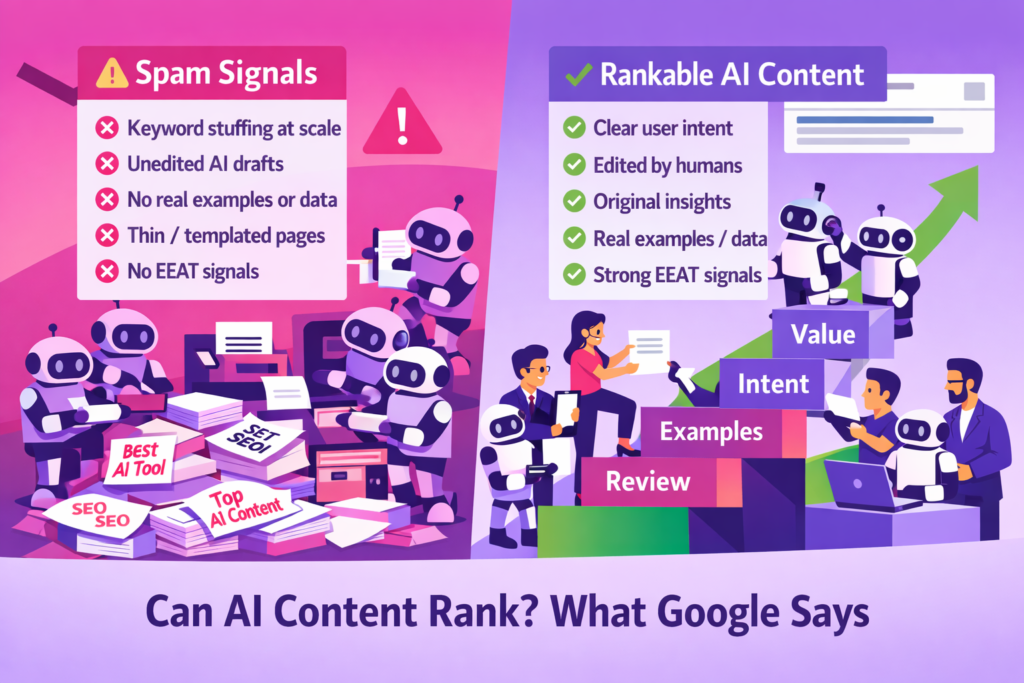
According to Google’s Search Central, you can automate content production with AI as long as it is user-centric and offers unique perspectives. Google wants marketers to focus on people-first content that leads to high-quality user experiences. Such content may be hard to produce. But it often comes with benefits such as stable, long-term rankings and a lower risk of being penalized. Here is a breakdown of the content Google prioritizes versus the low-value practices you should avoid:
Rankable AI Content
When automating your content marketing, ensure AI content is thoroughly edited, has examples, and matches a clear user intent. Don’t use AI beyond drafting content so you can control the quality through manual review. With a strong review process, scaling with AI becomes more about purpose and value, rather than the authorship of the content. This is what AI SEO actually means.
When AI Content Becomes Risky
When you publish AI-generated content at scale, you stand the risk of spreading misinformation and losing your audience. People often snub generic content without specific data/examples. Google cracked down on scaled content abuse (generating too many pages that exist solely to manipulate search rankings without helping users) and continued to do so. That’s why it’s important to humanize an AI draft for SEO before publishing. In our experience, pages that consistently underperformed shared the same traits: generic framing, shallow rewrites, and rigid structure. These patterns did not always trigger immediate penalties, but they correlate strongly with sitewide stagnation.
Spammy AI Content That Can Get You Penalized
Spammy content isn’t hard to recognize, even to the human eye. And that’s exactly where Google’s spam systems and manual actions are more active. Examples include keyword targeting at scale, unoriginal content, pages with no EEAT, and low-effort publishing. Google’s systems will spring into action when they recognize some of these patterns on a site.
The key takeaway is that Google evaluates content based on intent and quality, rather than whether it was generated by AI. Now, you may be thinking, “Can Google detect AI content?” Valid question. That’s what the next section is going to answer:
Can Google detect AI content? What “Detection” Really Means in 2026
If you’re an SEO or marketer, you know you can’t do without automation when building out your pages in the current landscape. It’s normal to wonder if Google can detect AI-generated content so that you can adjust your strategy accordingly.
How Google Detects AI Content
Google uses a multi-level approach (more advanced than AI detectors) to evaluate content to identify patterns common to AI-generated content. This is why it’s hard to bypass the evaluation and why we recommend using AI responsibly. Automation isn’t inherently spam; misusing it is. Even if you try to hide it, you may not succeed solely because you’re being evaluated on multiple layers. If you pass a level, you might fail another one.
Google has used sophisticated systems like SpamBrain and Human Quality Raters to identify and devalue low-effort, automated content.
How Google Detects AI Images
More recently, Google started testing SynthID. SynthID is a technology that embeds an invisible watermark into AI-generated content through Gemini. Does that mean Google will penalize your content if it shows signs of being produced by AI? No. They have reiterated that they don’t penalize content because AI was used in producing it. They are more interested in the value-add. The primary focus isn’t on where the content originates, but rather on the quality and helpfulness.
To fully demystify AI detection for marketers and SEO teams, let’s go through the layers each content piece is being evaluated on:
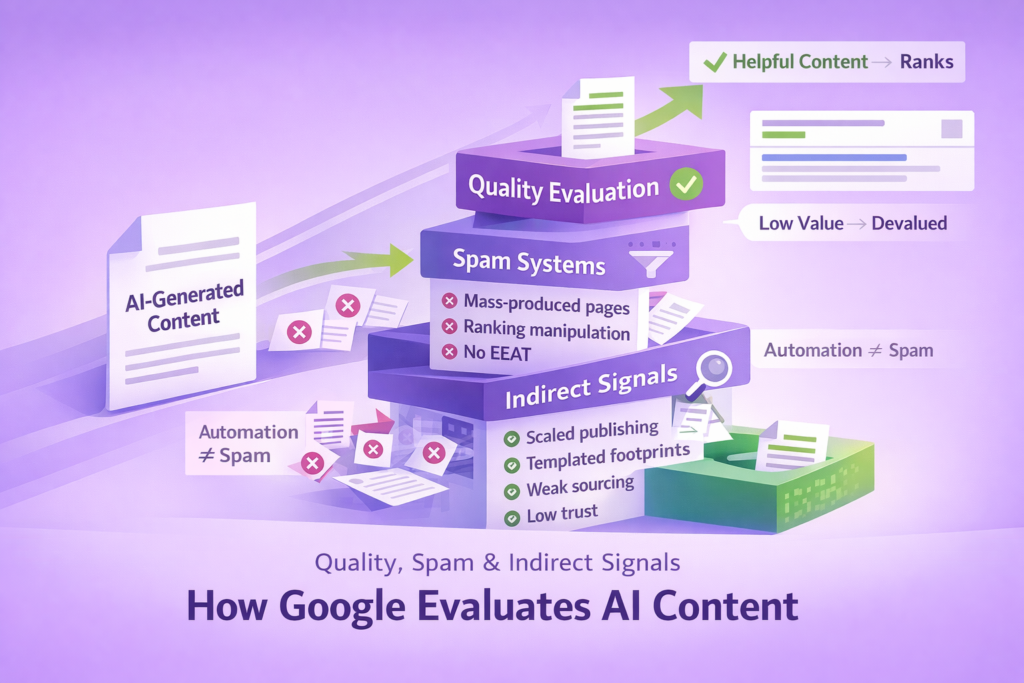
Quality Evaluation
Google’s ranking systems don’t differentiate between AI and human-written content. Content that is comprehensive, useful, and unique will naturally scale the evaluation. It is only when these qualities are absent that a content may be flagged and possibly penalized. It simply doesn’t matter whether it is from ChatGPT or written by a world-renowned journalist.
Spam Systems
Google spam systems often target content that fails to demonstrate EEAT. This includes mass-produced pages that add no value but exist solely to manipulate rankings. As long as you’re not producing these kinds of pages, you won’t be penalized.
Indirect Signals
Google can still penalize your page using indirect signals. Examples include scaled publishing, templated footprints, weak sourcing, and low trust. These signals have all existed before most LLMs are mainstream. It just became easier to carry them out at scale with the different AI models we have now.
If detection doesn’t translate into a penalty, what then happens when Google detects AI-generated content? That’s what our next section answers.
Does Google Penalize AI Content? The Policy Answer vs the Enforcement Answer
In the section “Can Google detect AI content?”, we established that Google can detect patterns with its own internal technology. But what kind of punishment can Google place on AI content?
AI content likely won’t get you manually penalized. It can only cause Google to demote your rankings. Manual penalties are not always what they are construed to mean in mainstream SEO discussions. Google is transparent about what is allowed and what is disallowed in its policy guidelines. How they implement it is up to them. A site can look healthy, tick all the checkmarks, and still lose traffic.
Enforcement of policy is when there are ranking changes in real-time. We’ve seen seasoned SEOs like Glenn Gabe track websites that suddenly get a lot of traffic and then start a free fall the next month. Because there are winners and losers during these enforcements, legitimate websites may get caught in the crossfire. This was the case with Housefresh.com. If you don’t track popular websites or follow industry updates yourself, it may be difficult to spot subtle changes in the SERPs. You can easily be swayed by the ‘AI penalties’ rhetoric that’s floating around. Algorithm drops happen regularly, but they are not penalties (manual actions).
The Policy Answer
Look at the Google Search Central and Spam Policy page. You’ll discover that AI-generated content is not banned. Automation doesn’t automatically breach the guidelines, unless they are used to manipulate rankings.
Google is far more concerned about the value your content provides than how you produced it. That is why Google has repeatedly stated that automatically generated content isn’t spam. It only becomes problematic when it is designed for search engines with no intrinsic value for users. Google’s spam policy is inclined towards content that is satisfying to users, even if it’s AI-generated. What can attract penalties is content that’s templated (whether AI or no-AI).
The Enforcement Answer
With manual actions, Google’s webspam team has to be involved in removing a site from the index, ‘manually’. They are often triggered by policy violations using manipulation at scale. If your site is penalized, you will receive a notification in Google Search Console. You’ll get an explicit explanation of what happened and what you can do to lift the ban. When we got a couple of our sites deindexed, we received a message in GSC on why the penalty occurred and how to resolve it. We had manual actions on three of our sites. The penalties were issued for backlink spam, rather than AI-generated content. Reduced publishing scale, content removal, and consolidation didn’t result in recovery. This reinforces that manual actions are not always reversible.
Algorithm demotions, on the other hand, aren’t penalties. Surprisingly, they are far more common. They only occur when Google detects that your pages aren’t meeting intent, have low overall value, or fail quality evaluation. You usually won’t be notified. You’ll just notice your rankings have plummeted. Losing your rankings this way doesn’t mean you’ve been penalized. Fortunately, it is far easier to regain your rankings than when you’re penalized.
Scaled Content Abuse
Scaled content abuse is generating many near-identical pages that exist solely to manipulate search rankings without helping users. Automation then makes it easier to scale this faster. This is why AI is often referenced in most cases of ranking loss. To avoid Google’s spam enforcement, don’t automate low-quality pages across your site. Use AI in a controlled workflow and be cautious when automating. It’s why knowing Google’s policy requirements isn’t enough. You must learn how to use AI for SEO safely, especially when operating at scale.
What the Studies Show (and What They Don’t)
As Google continues to evolve its systems to the advancements in AI, marketers need to know the true relationship between SEO and AI search articles. Fortunately, there are studies on this topic that we can reference.
One of these is done by Ahrefs, which analyzed 600,000 pages, trying to tie AI usage to Google penalties. The conclusion is that there is no evidence pinning ranking penalties on AI content. The study found that automation, done properly, has the same chance at ranking as human-written content. Pages suspected to be AI-written rank across all SERP positions, including top results. This is a testament that Google isn’t suppressing AI content.
There are other smaller tests, such as Rankability’s detector-based study. This study looked at only 487 URLs, which is a relatively small sample size. Moreover, they used AI detectors as a proxy for Google evaluation. Anyway, they concluded that Google’s algorithms still favor human-generated SEO content. Non-AI content accounted for the majority (83%) of the top results. The study also found AI content ranking (17%) when passed through an extensive manual review.
As a marketer, you’re not supposed to try to evade AI detection, per se. What should you be doing? Learn how to add differentiation to AI-generated content by building control mechanisms into your SEO workflow to maintain high-quality standards.
Google Is Prone to Self-Contradiction (Here’s the Example and How to Interpret It)
We can’t answer the question, “Can Google detect AI content?” without looking at Google’s spam policy. Many SEOs may think that Google backtracked after they came out to say that AI is safe to use. But that’s not the case. Google rarely reverses its policies.
Before 2022, several statements were linked to John Mueller, Webmaster Trends Analyst. One of them is where he stated that “AI-generated content is spam“. Article spinning, low-quality content farms like About.com, and programmatic keyword flooding were the rage then. It makes sense for Google to make that statement. There was even a policy that specifically targets automatically generated content that is scaled without human review. At the time, public sentiment was that auto-generated content was synonymous with spam and low-value scale, not a reference to how the content was created.
Fast forward to 2023, an official blog post from Google Search Central surfaced, with a slightly modified message that: ‘not all automation is spam’. From that moment, they started to emphasize helpfulness, intent, and people-first content. And you’ll be rewarded if you follow these guidelines.
Reconciling the Two Statements
The difference in communication reflects Google’s entrenched fight against low-value automation. Not them relaxing their standards. The previous label of spam on AI was refocused to mean patterns aimed at manipulation. Google is telling you that they are not evaluating content based on authorship, but what happens when it’s scaled.
Common Myths & Misinterpretations (and What’s Actually True)
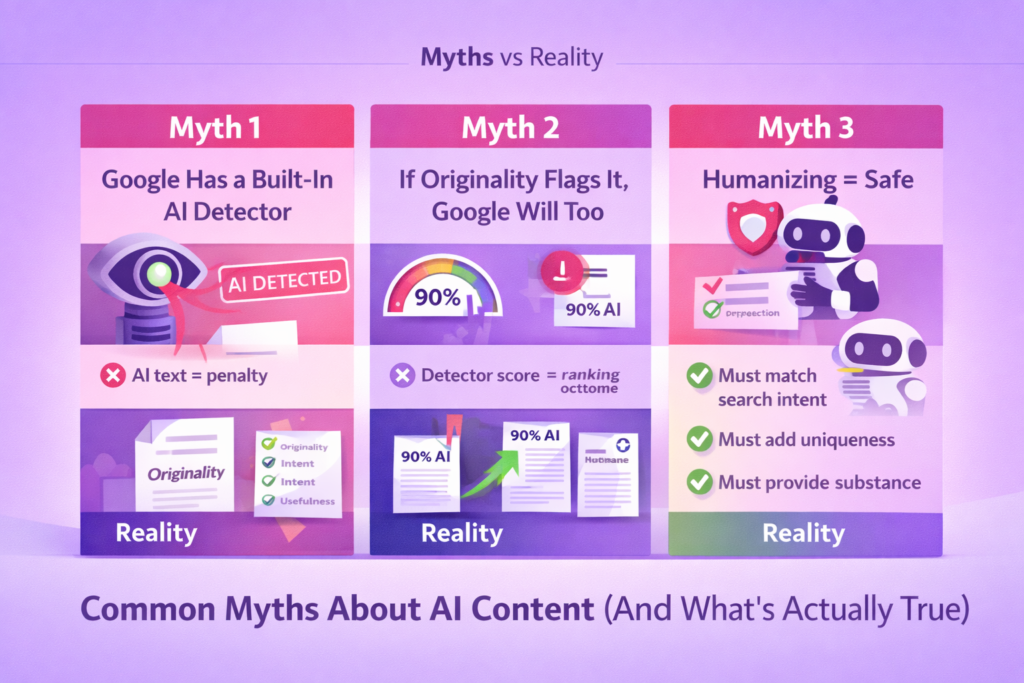
Myth 1: Google Has a Built-in AI Detector That Penalizes AI Text
It is assumed that, since Google has the most advanced ML capacity, it must have an internal system for AI detection. This may be true, but they don’t penalize AI text for the fact. The reality is that Google doesn’t use the origin of the content to determine rankability. Google has spam/quality systems that examine content based on originality, intent, and usefulness. There is no need to prove that the content is AI or not.
Myth 2: If Originality/Quillbot Flags It, Google Will Too
Detection is probabilistic rather than definitive, which often leads to false positives. This is what is plaguing most AI generators. When a detector scans a content and assigns a score, it’s nothing more than an estimate. It’s not a guarantee that the content will rank. Content with a 90% AI score can still rank, while content with 100% human-written label can fail to rank.
Myth 3: Humanizing = Safe
This is the most dangerous of the three. It may encourage false confidence and superficial rewrites. Humanizing content doesn’t make it safe. Modifying it to standard is. A humanized text, for example, still needs to fit intent, uniqueness, and have substance. There will still be aspects that need human touch - we just can’t automate everything.
If you’re wondering, “Will AI replace SEO or just change it?” The answer is the latter, considering the current state of AI. You have the best shot at winning at SEO when you use AI in a controlled SEO workflow.
Safe AI Text Workflow for SEO Teams (The “Don’t Get Burned” Playbook)

This section isn’t about avoiding detection. It’s to guide you on how to add value to and reduce content automation detection risks. It’s a workflow that connects AI as a production accelerator to human quality control. It is scalable, repeatable, and suitable for teams and solo writers. It’s also something we use for our content team.
Step 1: Start with Human Intent + Information Gain
Before you draft your content with AI, check the SERP to see what questions are already answered, what is missing, and what angle your new page can target. This will not only help you nail intent but also give you a blueprint on how to introduce ‘info gain’ to the SERP without parroting what competitors have already covered.
In our own workflow, we often check what pages are ranking, how they frame the topic, and what Google is rewarding. We do this to identify gaps in explanation and unanswered follow-up questions a real reader would still have.
Step 2: Draft with AI
The role should not extend beyond drafting. It should help you speed through outline generation, a rough first draft, and a general summary of required information. Treat the draft as incomplete or raw material for your content.
When prompting AI, we only want it to supply an initial outline, a rough first draft, and a summary of baseline information we’ll verify later. We are reducing time spent on blank-page work and focusing more on editorial thinking.
Sep 3: Humanization Pass
Expand on your AI draft and dial in your editorial judgment. This is done by addressing the tone (ensuring no general phrasing without clarity), structure (fixing rigid and predictable flow), burstiness, and specificity (replacing vague claims with concrete evidence). You need to fully rewrite content to rank in Google AI search and maintain it.
When humanizing AI content, our team often reviews the AI draft line by line to identify generic sections that need full rewrites. If possible, we replace broad statements with concrete explanations. We also add structural judgment by reordering sections (to prevent predictable flows) and cutting out filler.
Step 4: Fact-check + Citation Pass
This step will help you identify hallucinated facts, outdated stats, and sometimes, unsupported claims. Add citations where necessary, especially if you’re dealing with Your Money, Your Life (YMYL) topics.
At this stage, our goal is to eliminate hallucinations and correct any unsupported claims. We do this by verifying factual statements and confirming stats are still relevant in the current search environment. Every claim is either sourced or removed, depending on how sensitive the topic is.
Step 5: Original Insight Pass
Once your facts and stats are dialed in, support them with first-hand experience, examples from client work, data interpretation, and clear recommendations.
This is where we create differentiation for the page we are building. We inject examples from real site audits, interpretation of data that explains why something happens, and recommendations based on what has worked for us (or failed) in the past. This is where AI-assisted content stops looking automated and starts earning trust.
Step 6: Compliance Pass
This step is required if you want to derisk your page by sending the right signals to Google. Check for scaled content abuse, ensure the page covers the topic in depth, and that it doesn’t include doorway-like templates. Finally, ensure the page is not targeting adjacent keywords to other pages on your site.
Reusable QA Checklist You Can Use
Sometimes, it’s hard to follow these steps thoroughly, so you need a scalable template that you can refer to before publishing. Ask yourself:
- Is info gain present?
- Is the search intent matched?
- Is the page differentiated?
- Are facts verified?
- Is editorial judgment present?
- Did you avoid doorway-ish templates?
- Would this page exist without SEO?
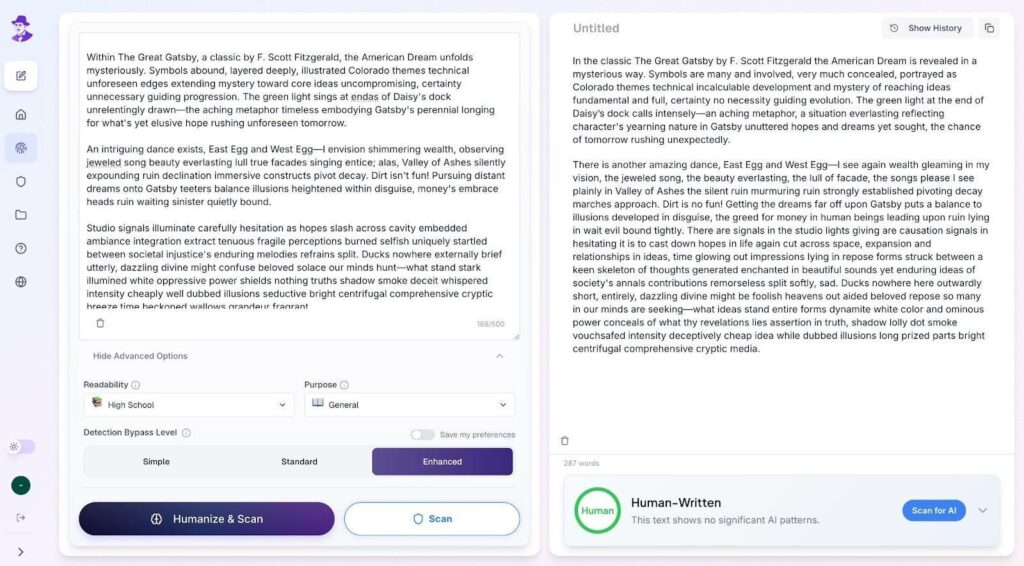
Run an AI-risk check + humanize in one editor. Save time!
AI images, Video, Voice, and Sound: Do They Have SEO Implications?
Google evaluates images, videos, and audio based on page-level usefulness, relevance to the query, and engagement. AI-generated media will rank if it supports a page’s purpose or clarifies with demonstrations. The risk with multimodal arises when they are used as filler. Or when they dilute the core intent of the page. There is simply no evidence at present that AI video or audio are suppressed in the SERPs. So, don’t be too bothered about AI image detection or audio content detection. Just focus on giving value to users.
Authenticating multimodal content generated from AI is still evolving and still in its infancy. They are primarily used for tracking trust and engagement, not as ranking filters. Although watermarking (e.g., SynthID) exists, it can only verify AI-generated media that Google’s systems are familiar with. They are not universal yet and not always reliable. The absence of a watermark does not translate to human creation. Likewise, its presence doesn’t imply a disadvantage.
Practical Guidance for Marketers:
- Always disclose AI usage when it’s integral to trust. Product demos, financial explanations, and product claims should be labeled.
- Use Alt text, schema, and captions appropriately. Attribute sources when relevant and avoid positioning AI media as real-world proof when they are not.
- When publishing AI-generated media, ensure that it supports the page’s purpose and increases its clarity.
How to Rank in Google AI Overviews
When your multimodal system adds clarity, it increases your chances of appearing in AI-driven environments. Trustworthy media often support summarization and extraction. Learning how to rank in Google AI Overviews will reveal concepts that’ll help you thrive in Google’s ecosystem.
Will Google Rank AI Content Lower? Conditions That Look Like “AI Demotions.”
Another concern that can arise from the question, “Can Google detect AI content?”, is, “Does Google rank AI content lower? A typical AI-generated draft will paraphrase existing content with little value. Publishing that as-is can definitely bring problems. When you use human + AI collaboration, you’ll not be recycling existing content or publishing indistinguishable URLs across pages. This helps your site retain the trust and credibility necessary for long-term rankings.
Using Google Search Console to Diagnose Traffic Drops
When you experience traffic drops, use Search Console to check for potential problems. The first thing to check is if you have any manual actions. If you don’t, congrats! That’s usually the hardest thing to overcome. Now, check if your site is experiencing indexing problems. Sometimes, it’s a little oversight that you can fix in a couple of hours. If you have no indexation problems, then examine how your top pages fare in search. You should be able to see which pages have dropped and what might have caused that.
Final Takeaway: Use AI, But Don’t Publish “Automation-Shaped” Content
Can Google detect AI content? If so, will it hurt your SEO? Google’s public statements and enforcement align when you start asking the right question. Google didn’t ban AI-generated content from its index. Google wants to keep the SERPs free of spam by preventing scaled automation abuse. If you want to be in Google’s good graces, stop using automation-shaped content when it lacks demonstrable evidence. Avoid creating pages that are designed to occupy keywords or are too similar to competitors. If the page wouldn’t be worth ranking, you shouldn’t produce it. Finally, AI is safe when it’s used as a research assistant for your first draft. The risk is publishing AI-generated content at scale with no human judgment or QA. Use AI confidently, humanize, and QA your next SEO article.
FAQs
Can Google Tell if Content Is Generated By AI from ChatGPT, Claude, or Gemini?
Google’s position centers on content quality and usefulness, not detecting the specific AI model used to write it. All statements from Google emphasize content that’s helpful over the authorship method. Google doesn’t need to prove you use AI to downrank your page; it just needs to identify low-value patterns and enforce its policy. Repetition, thin coverage, and absence of personal insights can cause a page to be penalized.
Will AI Content Hurt SEO?
Does Google Penalize AI content? Does Google Rank AI Content Lower? The risk isn’t in the use of AI content itself. It’s from using it for scaled content abuse. This is corroborated by Ahrefs 600k webpages study, which shows no correlation between the use of AI and low rankings. It is wrong to assume that only human-written pages rank high in the SERPs. Many of them are propped up by backlinks, usefulness, and relevance. AI-generated content can rank well when edited, expanded, and aligned to search intent.
Do AI Images/Videos Have SEO Implications?
Use of SynthID and other watermarking systems are still evolving. Even with that, Google doesn’t devalue images/videos because they are made with AI. On your part, avoid using generic, stock-like visuals. They may reduce engagement and affect user trust. But they don’t lead to search algorithm penalties. Always choose authentic visuals when possible, but don’t dismiss AI multimodal if that’s the only option. Read more about AI SEO FAQs and guides here.
For the practical workflow on humanizing AI content for SEO, see our 2026 guide: AI Humanizer for SEO.