




Key Takeaway: The best essay rephrasers for students in 2026 solve different problems at different stages of writing, and using one tool for the entire process from rough draft to submission is where most students go wrong.
- Synonym-spinning tools fail academic writing because they replace words without understanding context, which loses nuance and precision in graded work
- QuillBot is the strongest free option with ten rewrite modes and a synonym slider, but the free tier caps at 125 words per pass
- Wordtune is the best pick for sentence-level rewrites that need to stay in a formal academic tone, with a limit of 10 free rewrites per day
- Grammarly is a grammar and style editor, not a true rewriter, and should be used as a final pass rather than a paraphrasing tool
- Paraphrasers change wording and sentence structure, but do not address the deeper statistical patterns that AI detectors like ChatGPTZero and Turnitin measure
- Walter Writes is recommended as the single tool that covers rewriting, humanization, and detection risk in one editor, replacing the need to move between separate tools
Not all essay rephrasers are built for academic work. Most will simply replace words with their synonyms, deconstruct your argument, and provide an output that is inferior to the original.
This guide helps cut through the noise by providing a standard evaluation criterion for essay rephrasing tools, how they compare to each other in 2026, and a practical workflow to help you use these tools every day.
What Makes an Essay Rephraser “Best” for Students (The Rubric We Will Use)
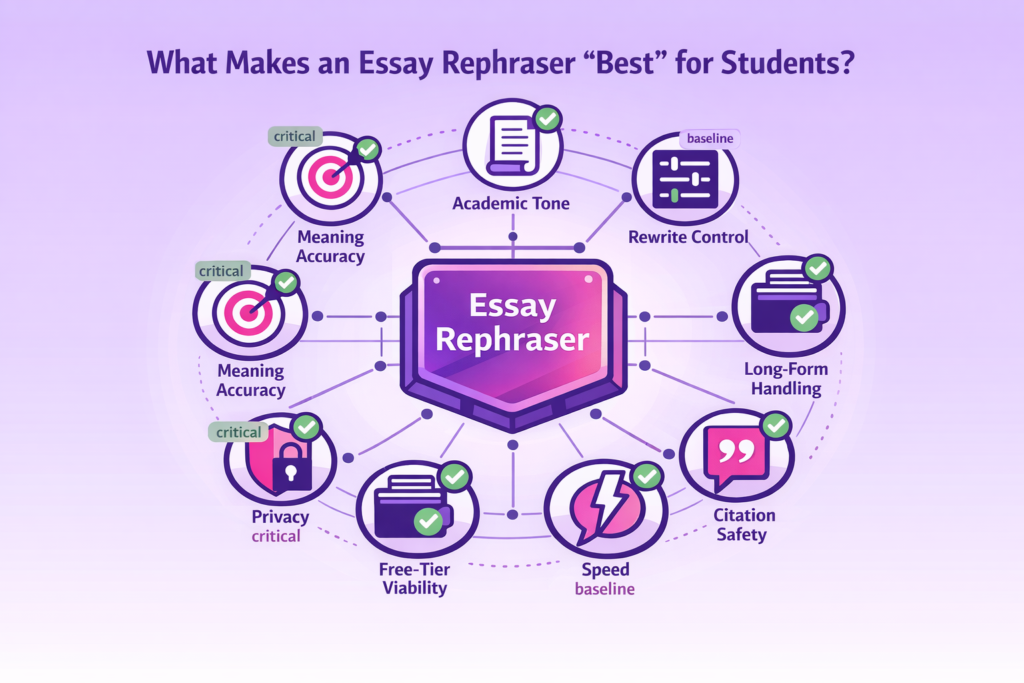
Before ranking any tool, it helps to define what “best” actually means for students. Here are the criteria every tool in this guide is measured against.
- Meaning accuracy: Does the rephrased output preserve the original argument, data, and claims without distorting them? This is your number one criterion when looking at the quality of an academic paper.
- Academic tone: Does the rewritten content appear to have been written by a university student, or could it be mistaken as being produced by an AI program or machine?
- Rewrite control: Is there a choice available for the level of rewriting that takes place? The availability of modes and/or sliders can provide a higher degree of flexibility when selecting an output.
- Long-form handling: Is the program able to provide coherent results when given full paragraphs or even longer pieces of writing?
- Free-tier viability: Is the free version capable of completing at least one full assignment? Or will you be forced to stop after the first few sentences due to limitations?
- Citation safety: Will the citation information remain intact once the tool has been used to edit your document? Or will this information become altered or lost during the process?
- Speed: How quickly can you get usable output from the tool?
- Privacy basics: Does the tool save or use my written content anywhere outside of where we agree on?
Why synonym-spinners fail students: Spinning tools are limited to simply replacing each word with a new one, while having no ability to understand the context surrounding those words. The result is technically “different” text, which means the end product lacks nuance and can also lose its precision within academia. For graded work, that is worse than the original problem.
Essay Rephraser vs Paraphrasing Tool vs AI Humanizer (Don’t Buy the Wrong Thing)
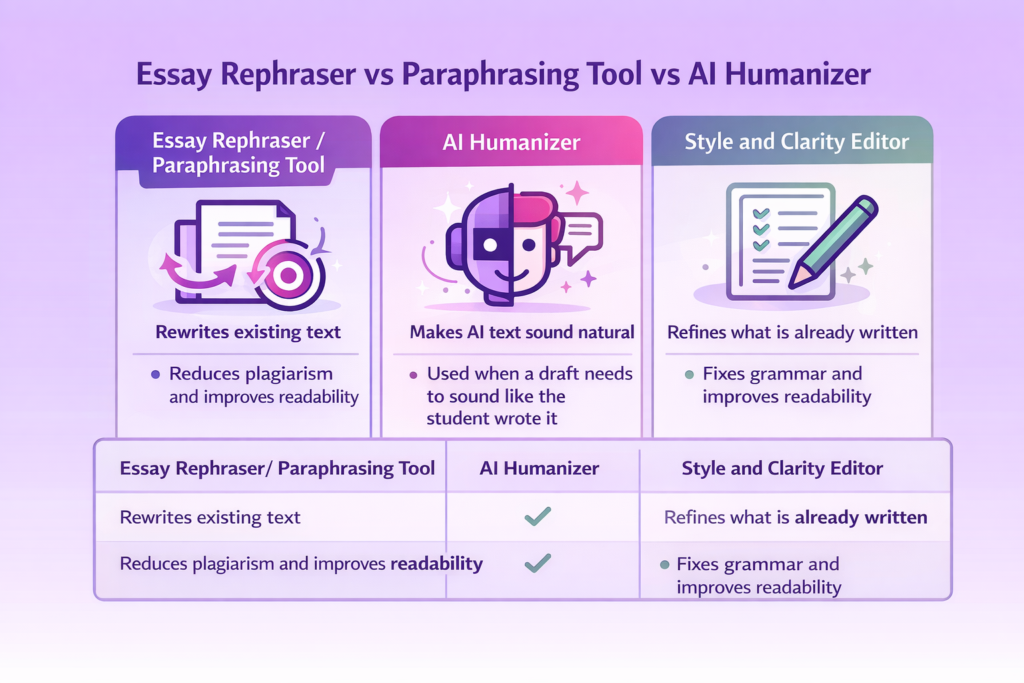
These three categories are often referred to as the same thing, but they do completely different things for you.
- Essay rephraser / paraphrasing tool: An AI paraphrase tool will take an essay, rewrite it with exact same wording, and present it as if the user wrote the essay themselves. A useful feature to assist with reducing plagiarism and also for making essays easier to read.
- AI humanizer: Will take an AI-generated piece of work and convert it into a form of writing that seems to be written by a human. Used by many college students who use an AI generator to produce the majority of their research papers, and then use this feature to make the final product seem as if the author had a hand in producing it.
- Style and clarity editor: Tools such as Grammarly help develop a better quality of writing by refining what has already been written. This type of editing helps to eliminate grammatical errors and also assists in creating clear, readable writing.
Most students need to utilize each option at some point during the completion of an assignment. Utilizing a single, multi-faceted workflow, as Walter Writes assists with rewriting, humanizing, and enhancing clarity, can greatly decrease the amount of time students spend moving from one tool to another while maintaining a consistent representation of the tone of their writing.
The 2026 Student Ranking: Quick Picks by Scenario
Can’t decide what is best for you? Let’s start from here
- Best overall for students: Walter Writes is the first editor to offer three separate features as part of a singular product, which includes rewriting your work, humanizing it so your work doesn’t read robotic, and AI detection. It eliminates the need to purchase a new product every time you want to accomplish each of these tasks.
- Best free option: QuillBot offers a free version that includes multiple different modes and has been a popular choice and reliable resource for students who have short pieces they need rewritten.
- Best for academic tone: Wordtune creates content that will always sound as though it was written by a person in a formal setting.
- Best for rewrite control: QuillBot allows users to select the mode and also allows users to adjust the synonym slider to allow for more user control when selecting how much of the original material should be altered.
- Best for long papers: Walter Writes works seamlessly with longer documents without losing continuity of thought or deviating from the original author’s voice.
If you want an AI rewriter that covers the whole workflow from rough draft to submission-ready writing, try Walter Writes before committing to anything else.
Comparison Table: Best Essay Rephrasers for Students (2026)
| Tool | Free Plan | Paid Plan | Rewrite Quality | Academic Tone | Rewrite Control | Long-Form | Best For |
| Walter Writes | Yes, limited | From $8/month | High | Strong | High | Yes | All-in-one workflow |
| QuillBot | Yes, 125 words | From $8.33/month (annual) | High | Good | High (modes + slider) | Limited on free | Paraphrasing + grammar |
| Wordtune | Yes, 10 rewrites/day | From $6.99/month (annual) | Good | Strong | Medium | No | Sentence-level rewrites |
| Grammarly | Yes, limited | From $12/month | Medium | Strong | Low | No | Grammar + style polish |
| Paraphraser.io | Yes, 600 words | Paid plans available | Medium | Medium | Medium | Limited | Quick free rephrasing |
| ChatChatGPT | Yes (ChatGPT-3.5) | $20/month (Plus) | High | Varies | High (via prompts) | Yes | Long-form rewriting |
| Jasper | No | From $39/month | High | Good | Medium | Yes | Long-form content creation |
| MyEssayWriter.ai | Yes, limited | Paid plans available | Good | Good | Low | Limited | Quick essay rewrites |
| PerfectEssayWriter.ai | Yes, limited | Paid plans available | Good | Good | Low | Limited | Academic essay rephrasing |
For a broader look at the paraphrasing tool landscape, the guide to best paraphrasing tools covers additional options worth knowing.
Mini-Reviews: What Each Tool Is Good At (and Where It Burns Students)
Walter Writes (AI Rewriter)
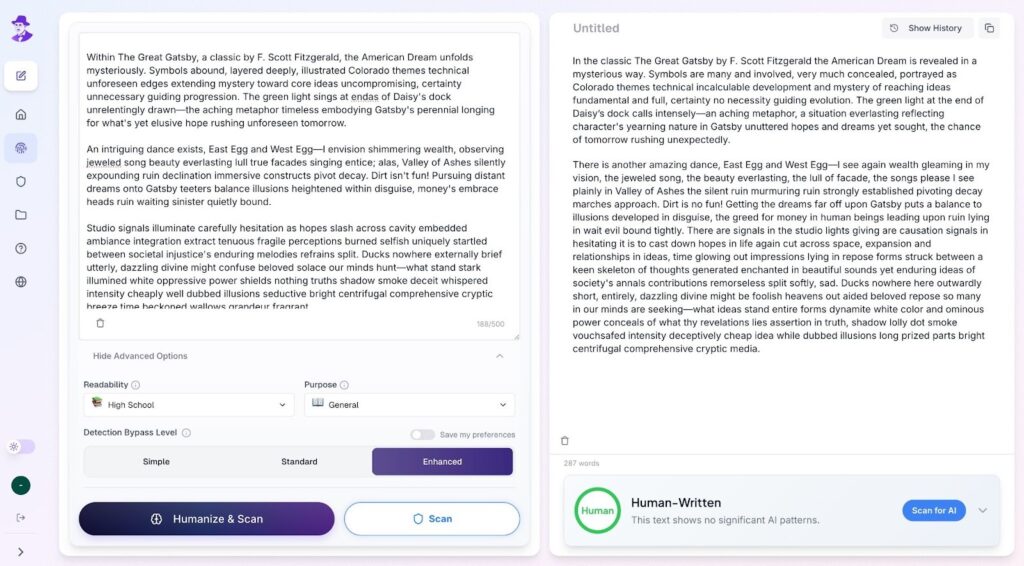
Best for: If you’re looking to have an AI-assisted draft rewritten into a human-sounding version of that work using a tool that checks for AI risk associated with writing and publishing content.
What it does well:
- Rewrites AI-assisted drafts into natural, academic-sounding prose without switching tools
- Handles multi-paragraph input without voice drift across sections
Where students get burned: Best utilized as a rewriting tool after the first draft has been completed, so that students can submit their final work rather than using it as a synonym swapper.
Use it safely: Open the original version of your draft at the time when you began working on your assignment and compare your rewritten versions to ensure that all changes were made appropriately during the rewriting process.
QuillBot
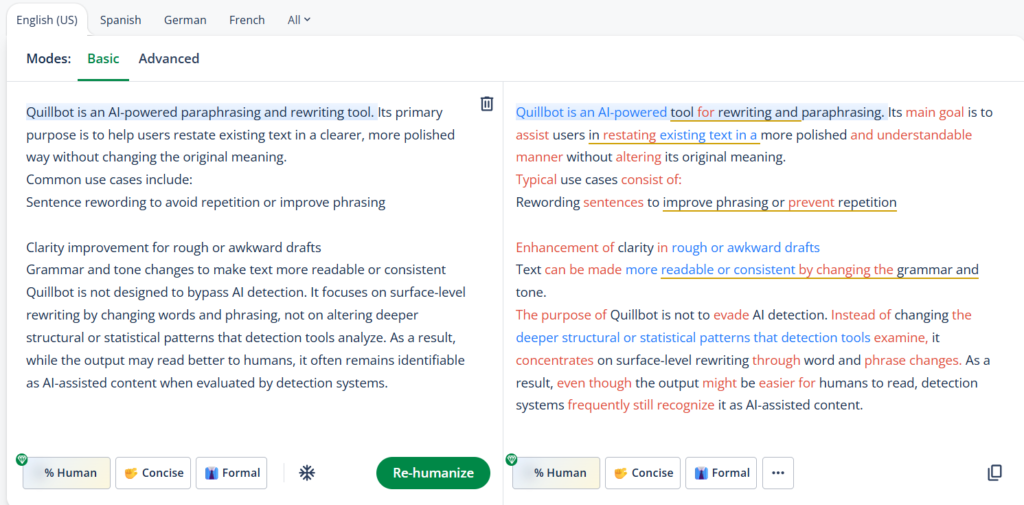
Best for: Students seeking a good paraphrasing service that offers options for rewriting their work and also has a free version option.
What it does well:
- Ten writing modes give genuine control over how aggressively the tool rewrites
- Synonym slider lets you dial in the level of change from minimal to extensive
Where students get burned: Quillbot’s free version limits rewritten content to no more than 125 words. While Quillbot is very good at rewording written content, it may still be detectable by some plagiarism detection software. If reducing detection risk is your goal, the guide on how to make your essay undetectable covers what actually works beyond basic paraphrasing.
Use it safely: Use this service to assist with the task of paraphrasing existing content or to create new sentence structures rather than creating and then submitting an entire draft of AI-generated content.
Wordtune
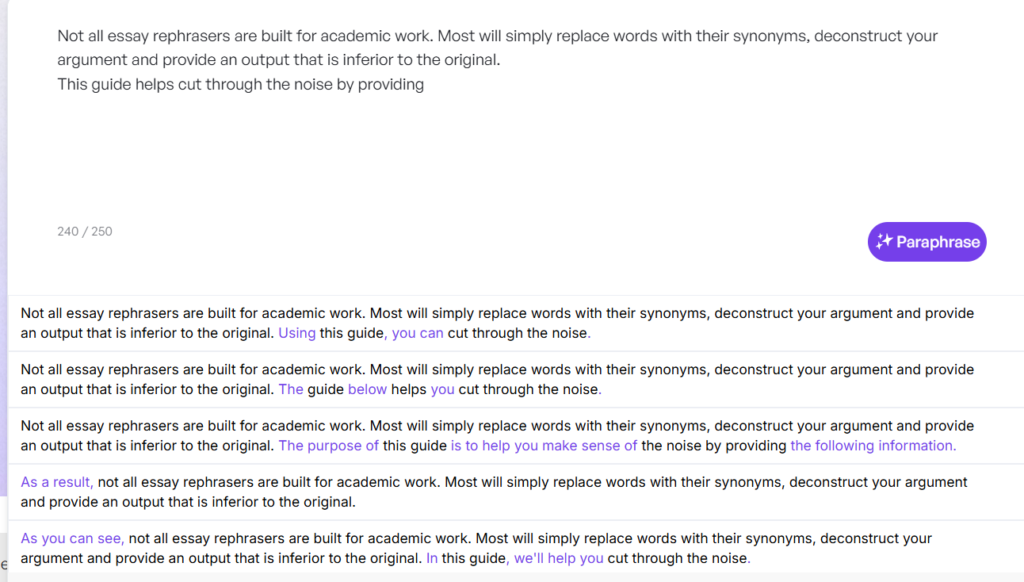
Best for: Students looking to rewrite sentences while maintaining the tone of the original text.
What it does well:
- Multiple rewrite suggestions per sentence with formal and casual tone options
- Inline suggestions appear as you write, reducing context switching
Where students get burned: The free version of Wordtune has a limit of 10 rewrites per day. The tool isn’t designed for complete essay paraphrasing. Instead, use Wordtune when working with single sentences or brief paragraphs.
Use it safely: Only use Wordtune to tweak single sentences once you have completed your original draft rewrite. Do not rely solely on it to generate all rewritten content.
Grammarly
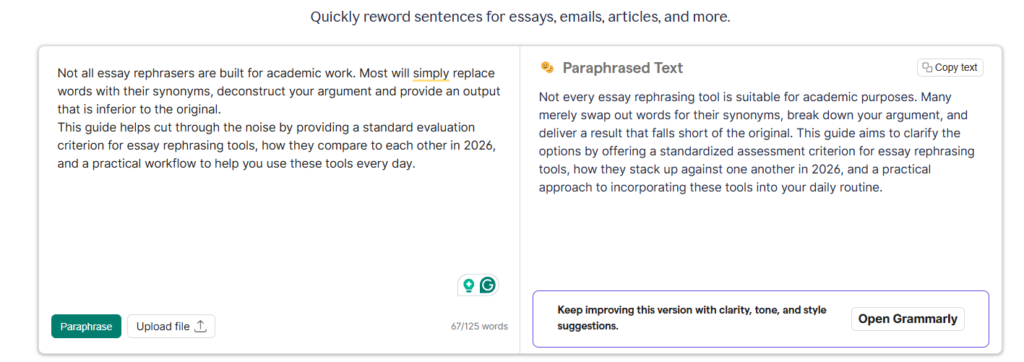
Best for: Grammarly provides polishing of your grammar, clarity, and writing style. It’s a paraphraser that can help you polish your writing, but mostly it works like a synonym swapper only.
What it does well:
- Sentence-level suggestions for grammar, concision, and tone
- Works inside Google Docs, Gmail, and most web editors
Where students get burned: Grammarly isn’t a true rewriter. It provides suggestions on how to improve sentences, rather than actually rewriting entire paragraphs. If students are looking at using this tool as their source paraphrasing tool, they may find themselves very disappointed.
Use it safely: The best way to use Grammarly is as the last step before submitting a paper. It should never replace your own rewriting process.
Paraphraser.io
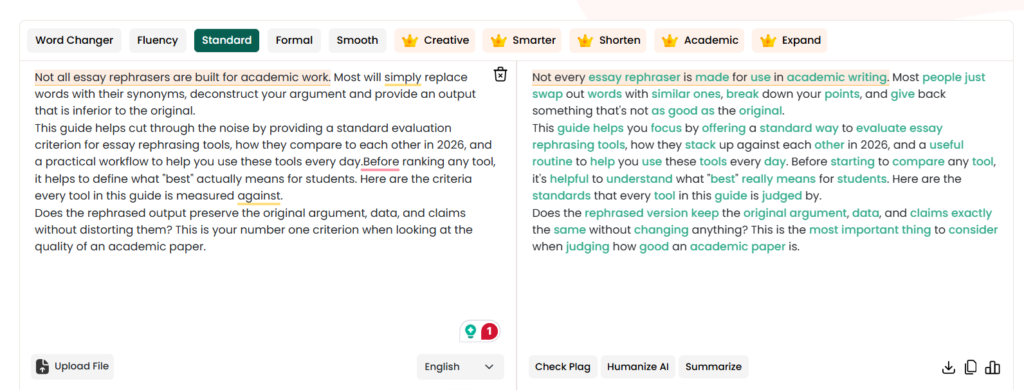
Best for: Quick free paraphrasing when you only have a short passage to rework.
What it does well:
- Free tier allows up to 600 words per pass
- Multiple modes, including fluency, standard, and creative
Where students get burned: The free plan runs ads and has restrictions on output quality. Meaning drift is more common at higher rewrite modes.
Use it safely: For academic purposes, only use fluency or standard rewrite modes. Compare all generated outputs from this tool to the original content prior to use.
ChatChatGPT
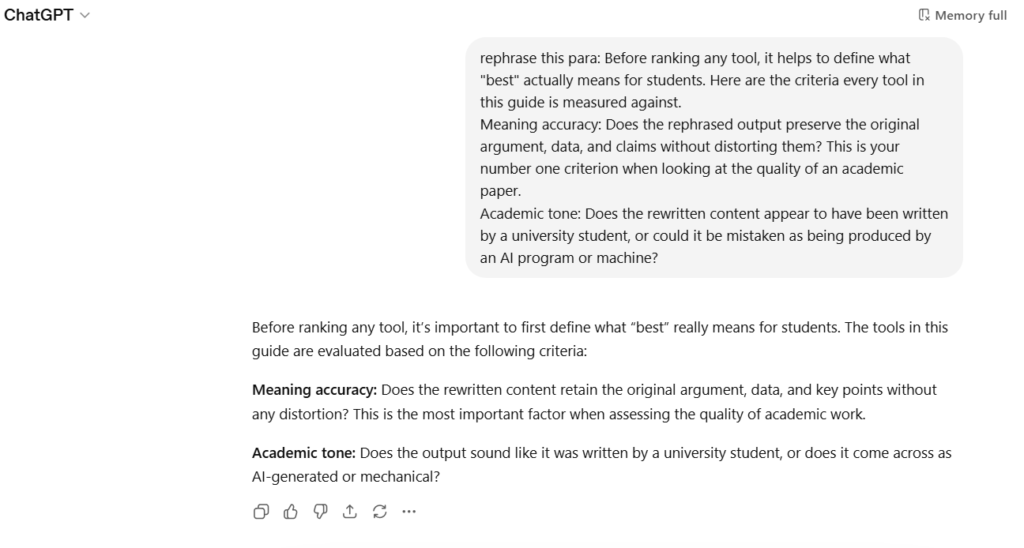
Best for: Students who need flexible rewriting of longer content with total control over the tone & style of their rewritten work via prompts.
What it does well:
- Handles long essays without breaking coherence
- Can be instructed to preserve specific phrases, maintain academic tone, or keep citations intact
Where students get burned: Output quality totally depends upon your ability to write effective prompts. A poorly written prompt will yield a poor result. Even if ChatChatGPT produces high-quality rewritten content, it can still be easily detected as being produced by an AI tool without first running it through a humanizing filter.
Use it safely: Write a detailed set of prompts telling it whom it should write for, and what tone should be maintained. Then submit the product of the prompts through a humanizer before turning them in. If you also publish content online, the guide on humanizing your SEO content covers how the same workflow applies to web writing.
Jasper
Best for: Content writing as opposed to rewriting an academic paper.
What it does well:
- Strong output quality for longer pieces
- Handles full-document rewrites without the word count anxiety of other tools
Where students get burned: Jasper is priced for professional content teams, not students on a budget. Starting at $39/month, it is hard to justify for occasional essay work. It is also built for marketing content, not academic tone.
Use it safely: If cost is a concern, Jasper is probably not the right tool for a student assignment. Consider it only if you are already using it for other purposes.
MyEssayWriter.ai
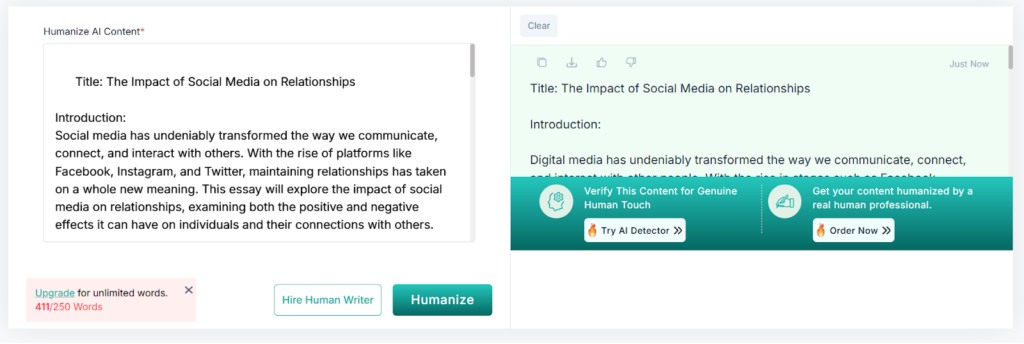
Best for: Students who require a fast rewrite of their academic essay with little or no configuration.
What it does well:
- Produces output in an academic register faster than general-purpose tools
- Simple interface with low friction to get started
Where students get burned: There are limited controls available on the output style, and very few free options are available. The rewritten version will still have to be manually edited for citation accuracy, tone consistency, and meaning.
Use it safely: Rewrite the paper in part to produce a first draft that you can review or edit before running it through clarity and detection checks.
PerfectEssayWriter.ai
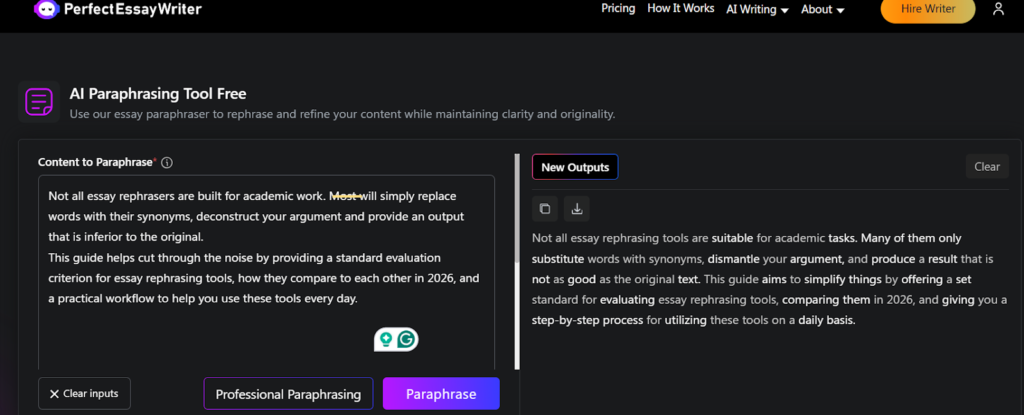
Best for: Students looking to create a rewritten essay using academic language style.
What it does well:
- Output tends to stay in the academic register better than general paraphrasers
- Built specifically for essay formats rather than general content
Where students get burned: Similar to MyEssayWriter, you’ll have to manually review all output. Both tools can’t replace the process of carefully reviewing and verifying citations for accuracy prior to submitting your paper.
Use it safely: Treat the output of this tool as a draft rewrite and never submit work produced by this tool without first verifying all claims, data, and citations to your original source material.
From Rough Draft to Submission-Ready: Student Writing Support Tools
Students usually use only one tool at a time and find it difficult to understand why their results don’t feel right. Each of the tools listed below will be used in succession as a chain, with each filling the gap that was left unfinished by the previous step.
Walter Writes is positioned at the beginning of this stack and is intended to be used as a single location where students can focus on both rewriting and humanizing their content while also becoming aware of some of the risks involved.
| Tool | Role in the Workflow | When to Use | Common Mistakes to Avoid |
| Walter Writes | Rewrite + humanize + check detection risk in one editor | After your first draft or after using a rephraser | Skipping this step and submitting the rephraser output directly |
| QuillBot or Paraphraser.io | Rephrase specific sentences or paragraphs from sources | When restating a source in your own words | Running entire AI-generated drafts through it and assuming detection risk is gone |
| Grammarly | Grammar and clarity polish | Final pass before submission | Using it as a rewriting tool instead of a cleanup tool |
| Zotero | Citation management and bibliography building | During research and throughout drafting | Forgetting to verify that AI-generated citations actually exist |
| Google Scholar | Finding and validating primary sources | Before writing, when building your argument | Citing the search result instead of the actual paper |
| Hemingway | Readability check | After rewriting, before the final grammar pass | Cutting sentences so aggressively that academic nuance is lost |
For a better understanding of how all of these tools are designed to fit together to create a student’s entire writing process, you should take a look at the guide to the best AI writing tools for students.
One Practical Real-Life Tech Stack (Copy This for Tonight’s Assignment)
The Student Essay Stack is good for: Students who use AI tools at any time during their process of writing an essay and want to have a dependable flow from rough draft to a final submission-ready essay.
Tools:
- QuillBot (Free / Plan starts from $8.33/month): Rephrase source-based paragraphs in your own words
- ChatChatGPT (Free): Brainstorm ideas, outline structure, or rewrite specific sections with custom instructions
- Walter Writes (From $8/month): Unify voice, humanize phrasing, and check detection risk before submitting
- Grammarly (Free): Final grammar and clarity pass
- Zotero (Free): Manage citations and build your reference list accurately
Cost Per Month: Starting as low as $8 with Walter Writes and the free tier option on every other tool in the stack.
Limitation: The free versions of Quillbot and ChatChatGPT have both word count limitations and restrictions on how many times you can access them, which can be very limiting on larger essays.
If the source material you are working with runs long, using text summarizer tools for students before bringing text into QuillBot or ChatChatGPT gives you a more manageable input and reduces the risk of hitting word count caps mid-assignment.
Final Recommendation: Which Essay Rephraser Should You Use?
Most rephrasers solve one problem. They change wording. Changing word choice can be helpful in many ways, but alone changing the way something is written is insufficient as an approach to get from a first draft to a completed and submitted paper by itself.
If you are going to select only one of these tools to support all aspects of your writing process, like rewriting, improving clarity, creating a consistent voice, and being aware of AI risk, then select the one that covers the entire process without forcing you to switch back and forth among 5 different programs.
For most students, that single tool is Walter Writes.
You should use a rephrase tool such as QuillBot or paraphraser.io for simply restating sources. Then proceed with using Walter Writes for unifying your voice, smoothing out phrasing that sounds too robotic, and doing a pre-submission review of your work. After that, use Grammarly for a final grammar review, and Zotero for keeping your references and citations accurate.
That’s the full stack. Any other combinations are discretionary.
One thing no tool in this stack can substitute for is understanding self-plagiarism: if you reuse your own prior submissions without disclosing it, no rephraser will prevent Turnitin’s internal database from flagging the duplicate.
FAQs
What Is the Best Free Essay Rephraser for Students?
QuillBot is the most reliable free option with multiple rewrite modes and a 125-word limit per pass. A good alternative is paraphraser.io, which also has a max of 600 words as well. If you want to rewrite an entire paper, then get a paid version from one of these tools or use Walter Writes to have better quality rewriting.
How Do Essay Rephrasers Help Avoid Plagiarism?
Rephrase your original sources into a new language so there isn’t much of the same writing. However, just rewriting your own paper doesn’t mean all risks of plagiarism go away. You still need to cite sources correctly and ensure meaning is accurately preserved.
Is Using an Essay Rephraser Considered Cheating?
It depends on your institution’s policy. Using a rephraser to help express your own ideas more clearly is generally acceptable. Using it to restate uncited sources as your own work is not. Always check your school’s academic integrity policy before using any AI tool for graded work. Always check your school’s academic integrity policy before using any AI tool for graded work, and for a fuller breakdown of where the line sits, the guide on are paraphrasing tools cheating walks through the four-part test students can apply before submitting.
Can Essay Rephrasers Bypass Turnitin or ChatGPTZero?
Not reliably. Rephrasers change wording and sentence structure but do not address the deeper patterns that AI detectors measure. Both Turnitin and ChatGPTZero will often detect and flag content generated using AI rephrasing tools. A dedicated AI humanizer for students handles this more effectively than a paraphraser.
What’s the Difference Between a Paraphrasing Tool and an AI Humanizer?
A paraphrasing tool rewrites text to reduce similarity. An AI humanizer restructures language patterns to reduce AI detection signals. They solve different problems. For academic submissions, you often need both at different points in your workflow.
How Accurate Are AI Essay Rephrasers at Keeping the Original Meaning?
Most modern tools are reasonably accurate on short passages in fluency mode. Accuracy drops on longer text and in aggressive rewrite modes. Always compare the output against the original to catch meaning drift before submitting.
Do Essay Rephrasers Work on Long Academic Papers?
Most free tiers do not handle full papers in one pass due to word limits. Paid plans on QuillBot or Walter Writes handle longer input more consistently. To achieve high-quality rewritten sections using longer, multi-page essays, it is generally best to use an essay rewriter to rewrite each section separately rather than attempting to rewrite the entire paper at once.
What Paraphrasing Modes Should Students Look for in an Essay Rephraser?
You should search for a fluency or standard mode that preserves your original meaning as closely as possible, an academic or formal mode for your university writing assignments, and a mode chooser, mode selector, or slider that allows you to adjust how aggressively the essay rewriter rewrites your material. Do not use an essay rewriter that only has one fixed way of rewriting your content.
Can an Essay Rephraser Improve the Quality and Clarity of My Writing?
Yes, in limited ways. A good rephraser can improve sentence flow and reduce repetition. But it will not improve your argument, strengthen your analysis, or fix weak citations. Combine it with a grammar tool and careful manual editing for the best results.
Are Essay Rephrasers Safe to Use for College Assignments?
Most are safe from a data perspective if you use reputable tools. But they do pose an academic integrity risk. Always view the rephrased content as a first draft and edit it yourself before verifying citations and reviewing it for compliance with your school’s AI usage policies.