




AI detectors work by measuring statistical patterns in text that distinguish AI-generated writing from human writing. The two primary signals are perplexity (how predictable each word is given context) and burstiness (variation in sentence length and complexity). Modern detectors like Turnitin AI Detection, ChatGPTZero, Originality.ai, Copyleaks, and Proofademic combine these signals with model-specific token patterns to assign each piece of text an AI-probability percentage. The result: text with low perplexity, low burstiness, and known AI fingerprints gets flagged.
This guide covers exactly how AI detection works under the hood: the math behind perplexity and burstiness, how detectors are trained, what model fingerprints they look for, false positive rates from independent research, and how the major 2026 detectors (Turnitin, ChatGPTZero, Originality.ai, Copyleaks, Proofademic) compare technically.
AI detection is often treated online as a simple pass or fail test. In reality, it is far more nuanced.
AI-generated content has flooded classrooms, offices, and creative studios and naturally, so have the tools that detect it. Whether you’re a student worried about Turnitin, a researcher safeguarding your work, or a content creator striving for originality, understanding how a ChatChatGPT detector works is more important than ever.
So, what is a ChatGPT detector exactly?
A ChatGPT detector, also known as an AI content detector, is a tool that analyzes text to determine the likelihood it was generated by AI models like ChatGPT-3 or ChatGPT-4. Tools like Proofademic, ChatGPTZero, and ZeroChatGPT use statistical analysis and pattern recognition to identify AI-generated content.
The Fundamental Reality: Probability, Not Proof
Modern AI detectors do not identify authorship with certainty. Instead, they estimate the likelihood that a piece of text was produced or influenced by an AI model based on statistical patterns, structure, and linguistic features. These signals are probabilistic, not definitive, and they vary significantly depending on the content.
A comprehensive 2023 study published in the International Journal for Educational Integrity by Weber-Wulff et al. concluded that available detection tools for AI-generated text are “neither accurate nor reliable.” This landmark research, which has been cited over 200 times, fundamentally challenges the claims of near-perfect accuracy made by many commercial detection platforms.
What Detection Tools Actually Measure
Detectors analyze factors such as sentence predictability, repetition, vocabulary distribution, and structural consistency. The tools typically score based on a metric known as “perplexity,” which correlates with the sophistication of the writing,something that varies naturally among human writers based on their linguistic background and writing style.
Text that is short, highly structured, or evenly polished is more likely to be flagged, even when it has been edited or partially written by a human. Longer or more varied writing often produces different results, sometimes across the same detector. This variability isn’t a bug,it reflects the fundamental challenge of distinguishing between statistically similar patterns.
Academic Consensus on Limitations
By 2026, most major platforms, including academic institutions, recognize these limitations. The MLA-CCCC Joint Task Force on Writing and AI urged educators to “focus on approaches to academic integrity that support students rather than punish them” and cautioned against detection tools, noting that “false accusations” may “disproportionately affect marginalized groups.”
AI detection tools are commonly used as screening or guidance systems, not as final arbiters of authorship. This is why different detectors can produce very different scores on the same piece of writing. UCLA’s HumTech center notes that these tools play a role in academic integrity but emphasizes their significant limitations and the need for careful interpretation of results.
The Bias Problem: Non-Native English Speakers
One of the most troubling findings in AI detection research concerns systematic bias against non-native English speakers. Stanford researchers found that ChatGPT detectors flagged writing by non-native speakers as AI-generated 61.22% of the time, while they were “near-perfect” in evaluating essays written by U.S.-born eighth-graders.
The Stanford Human-Centered Artificial Intelligence study explains this occurs because non-native English writers typically score lower on common perplexity measures such as lexical richness, lexical diversity, syntactic complexity, and grammatical complexity,the same metrics AI-generated text exhibits.
People typically have bigger vocabularies and a better grasp of complex grammar in their first languages. This means non-native English speakers tend to write more simply in English. So does ChatChatGPT. The result is a devastating false positive rate that threatens to unfairly penalize already marginalized student populations.
The Arms Race: Detection vs. Evasion
Another important factor is that detector models change frequently. Updates to scoring logic or training data can shift results overnight, even when the text itself remains unchanged. This makes absolute claims about detection outcomes unreliable and often misleading.
Research demonstrates that simple prompt engineering,asking ChatChatGPT or Gemini to “Elevate the provided text by employing literary language”,reduced detection rates from 100% to 13%. This isn’t sophisticated hacking; it’s basic manipulation that any user can apply.
The research published in arXiv shows that AI generators and AI detectors are locked in a perpetual competition, with both improving over time but detection always lagging behind generation capabilities.
How Accurate Are ChatGPT Detectors? Real-World Accuracy Data
While detection tool providers often claim accuracy rates of 99% or higher, independent research paints a different picture:
- Studies focusing on correct identification of AI-generated text show significant variability across tools, with some performing remarkably well and others failing completely.
- In general, false positive rates for mainstream, paid AI detectors such as Turnitin are relatively low, with the best tools reporting rates around 1-2%,but these figures represent ideal laboratory conditions, not real-world mixed-authorship scenarios.
- A 2023 analysis by Weber-Wulff et al. found that most AI detectors scored below 80% accuracy when tested on diverse text samples.
The National Centre for AI analysis emphasizes that accuracy depends heavily on “the exact version of the LLM used to create the text, the exact version of the detection tool, and the nature of the text being used for the test”,all factors that change constantly.
The Paraphrasing Problem
Paraphrasing or manual manipulation of AI-generated text such as introducing spelling errors, adjusting sentence structure, or altering vocabulary can significantly reduce the effectiveness of detection tools.
Research from the International Journal of Educational Technology in Higher Education found that after altering content using automated paraphrasing tools, detection rates dropped from over 70% to less than 5% in some cases. This reveals a fundamental weakness: detectors are trained on raw AI output, not on the edited, refined versions that users actually submit.
Why This Matters for Academic Integrity
With the developing technology, ChatChatGPT 4 was launched in March 2023 and ChatChatGPT 4o was released in May 2024. Studies have shown that the newer versions answer questions more accurately than previous versions and can generate better answers.
The peer-reviewed study in PMC emphasizes that as AI models advance, the detection challenge intensifies. Detectors trained on earlier models become less effective with each new generation of language models, creating a moving target that detection technology struggles to track.
Unlike traditional forms of plagiarism detection,which document the original source of the plagiarized text as evidence of academic dishonesty,no such evidence currently exists for AI detection platforms. This fundamental difference, highlighted by California State University Fullerton’s Faculty Development Center, means that AI detection cannot provide the same level of proof as traditional plagiarism checkers.
The Case Against Punitive Use
Even a 1% potential false-positive or false-negative rate presents a considerable challenge to enforcing academic integrity because the instructor cannot “prove” their case to an independent observer.
Brandeis University’s AI Steering Council compiles extensive research demonstrating that AI detection tools are unreliable and can be biased against non-native speakers and students who are underrepresented in higher education.
Recent findings are particularly concerning for equity: About 10 percent of teens of any background said they had their work inaccurately identified as generated by an AI tool, with Black students more likely to be falsely accused.
Current Research Consensus
The PeerJ Computer Science literature review analyzing 2024-2025 research concludes that for certain categories of prompts and subjects, the most efficient detection technologies can only achieve a 90% success rate at best, and detectors have a possibility of wrong allegations as well as unreported instances.
AI detectors are not necessarily better today than they were when they first came out. As time passes, we’d imagine that AI detectors improve and become even more accurate and reliable. However, AI detectors are trained on AI-generated text and, therefore, always lag behind AI models. This observation from The Effortless Academic captures the fundamental challenge: detection is inherently reactive.
Understanding These Realities
Understanding these realities is essential. Tools that promise guaranteed outcomes ignore how detection systems actually work. The most responsible approach recognizes that:
- Detection provides probability estimates, not certainty,scores should be interpreted as one data point among many, never as definitive proof.
- Context matters more than scores,a 70% AI probability score means something different for a short answer versus a research paper, for a native speaker versus an international student.
- Multiple factors influence results,text length, subject matter, writing style, linguistic background, and even the time of testing can all affect outcomes.
- The technology is inherently limited,no amount of refinement can overcome the fundamental challenge of distinguishing between statistically similar patterns, especially as AI models continue improving.
- Fairness concerns are paramount,any system that systematically disadvantages specific student populations undermines rather than supports academic integrity.
The Path Forward
Professional organizations and researchers increasingly agree that detection-based approaches alone are insufficient. Institutions must accept that AI detection is an unworkable solution to a problem that cannot be solved through surveillance and punishment. The focus must move from detection and enforcement to assessment design that recognizes AI’s role in learning.
Research published in medical education journals emphasizes an urgent need for advanced detection tools to ensure authenticity and integrity of content, especially in scientific and academic research, along with more refined detection methodologies to prevent the misdetection of human-written content as AI-generated and vice versa.
Walter is built around this understanding, which is why it focuses on realism, quality, and responsible use rather than oversimplified scores or promises. The future of academic integrity lies not in perfecting detection, but in reimagining assessment practices that acknowledge AI’s permanent presence while preserving authentic learning and intellectual growth.
Key Takeaways for Educators and Students
For Educators:
- Use detection tools only as preliminary screening, never as sole evidence
- Consider context and individual circumstances before drawing conclusions
- Be especially cautious with international students and non-native speakers
- Focus on assessment design that emphasizes process over product
- Engage students in conversations about ethical AI use rather than defaulting to surveillance
For Students:
- Understand that detection scores are probabilistic, not absolute
- Be prepared to explain your writing process and show your work
- Know that your linguistic background may affect detection results unfairly
- Document your research and drafting process as protection against false accusations
- Engage honestly with instructors about how and when you use AI assistance
The era of simple “human or AI” binaries has ended. We now navigate a complex landscape where tools, humans, and AI collaborate in various configurations. Success in this environment requires nuanced understanding, not technological determinism.
Related: Best Academic Search Engines
What Is AI Detection, and Why Does It Matter?
AI writing tools like ChatChatGPT, Claude, and Gemini are now mainstream. But this surge in AI-generated content has raised concerns about academic integrity, content originality, and transparency.
Enter: ChatChatGPT detectors and broader ChatGPT AI detectors.
These tools exist to:
- Prevent plagiarism in schools and universities
- Help publishers and marketers ensure content authenticity
- Preserve institutional trust in job applications, grant writing, and academic submissions
Whether you’re using AI responsibly or want to detect it in others’ work, understanding the underlying tech is key.
Curious how AI fits into academia? We’ve explored that in Can Colleges Detect AI Essays?
Key Differences: Human vs. AI-Generated Writing
Human writing is emotional, inconsistent, and full of quirks. AI writing? Often formulaic, structured, and overly polished. That difference is what ChatGPT detectors latch onto.
Common AI traits detectors flag:
- Repetitive transitions (“furthermore,” “in conclusion”)
- Predictable sentence structure
- Rigid paragraph formats
- Lack of personal insight or nuance
Want to write with AI and still sound human? You’ll need to account for these markers.
How ChatGPT Detectors Work: 4 Core Techniques
1. Perplexity & Burstiness Analysis
These are the backbone of most detectors:
- Perplexity measures how predictable a sentence is. Lower perplexity often means AI involvement.
- Burstiness gauges sentence variation. AI tends to write in even patterns. Humans mix short and long sentences.
Popular AI Detection tools like Walter Writes AI, Proofademic, Turnitin, ChatGPTZero and ZeroChatGPT rely heavily on these metrics.
2. Pattern Recognition & Statistical Analysis
Detectors also analyze:
- Overused phrases and robotic transitions
- Syntax structure and rhythm
- Sentence openers (“One reason is…”, “The next step…”)
These markers help flag writing that “feels” machine-made.
3. AI Fingerprinting
Some tools try to match writing back to known LLM outputs. Since models like ChatChatGPT, Claude, and Bard each have unique styles, this can sometimes identify not just AI involvement, but the exact model used.
4. AI Probability Scores
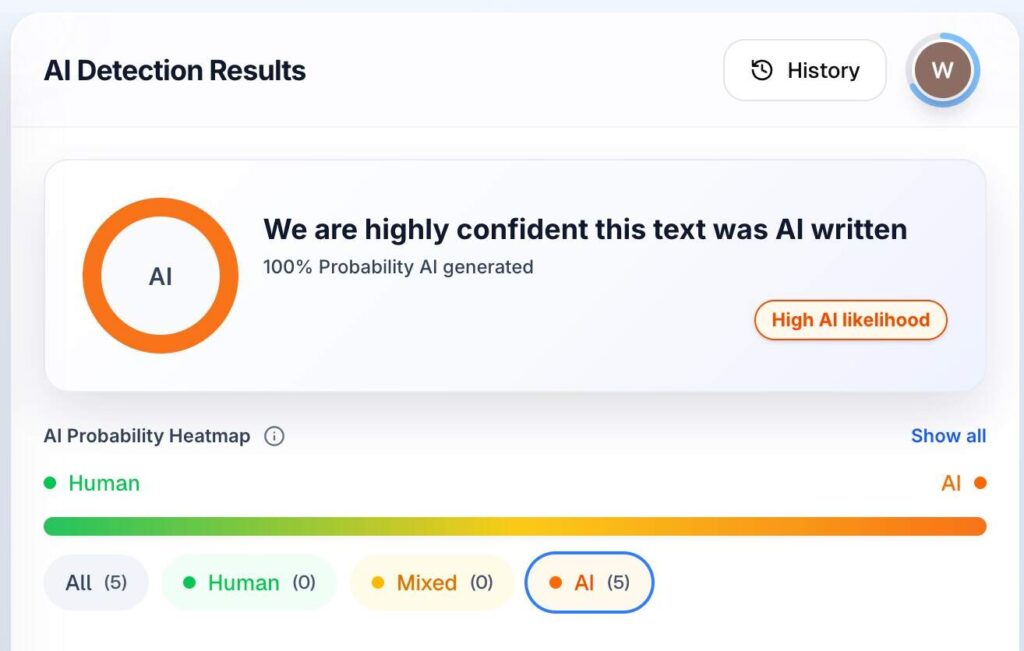
Ever seen a score like “87% likely AI”? This is a composite score based on all of the above. It’s not infallible:
- Polished human writing may score high
- Edited AI text may score low
Treat these numbers as clues, not absolute proof.
Ever seen a report with “85% likely AI” on it? That’s the AI Probability Score, a numerical assessment of how much the text you wrote probably was machine-generated.
These are composite scores based on all those signals above: perplexity, sentence structure, syntax, and so on. But this score isn’t always dependable. An edited AI segment might get 30% or lower, and a human answer 80% based on formal tone or subject.
That’s why understanding the limits of detection tools is important, which we’ll outline in a moment.
Most Popular ChatChatGPT Detectors (2026)
1. Walter Writes AI Detector
- Best for: General-purpose detection across academia, marketing, and business
- Strength: Combines detection and humanization in one tool
- Unique: Uses behavioral and tonal signals to refine AI outputs and reduce detection scores
2. Proofademic
- Best for: Academic institutions and educators
- Strength: Focuses on formal writing styles and essay structures
- Accuracy: High performance with long-form academic content
3. ChatGPTZero
- Best for: Educational settings
- Strength: Detects burstiness/perplexity issues
- Weakness: May mislabel academic writing
Learn more in our ChatGPTZero Review.
4. Originality.ai
- Best for: Marketers and content teams
- Strength: Combines AI detection with plagiarism scanning
- Weakness: Can misclassify rewritten AI content
We break this down in our Originality.ai Review.
5. Turnitin
- Best for: University-level plagiarism and AI detection
- Strength: Deep institutional integration
- Weakness: Known to produce false positives with grammarly or formal edits
Want a deeper dive on Turnitin? checkout our in-depth Turnitin AI Detector review
For a full side-by-side breakdown, see our AI Detector Comparison Guide.
False Positives, Limits & Reliability Explained
ChatGPT detectors like ChatGPTZero, Turnitin, and Proofademic aim to distinguish between human-written and AI-generated content. But how accurate are they really?
Short answer: They’re helpful but far from foolproof.
❌ Common Detection Failures
- False positives: Human writing, especially structured or formal text (like academic essays), may be incorrectly flagged as AI.
- False negatives: Edited or paraphrased AI content can often slip past detectors undetected.
- Model bias: Some detectors score content higher if it mimics ChatGPT-style outputs or uses certain patterns.
Even OpenAI shut down its own AI detection tool in 2023 due to low accuracy. (Source: MIT blog)
???? Ethical & Legal Considerations
- Privacy risks: Submitting student essays to public tools may violate data protection laws like FERPA (Family Educational Rights and Privacy Act).
- Data usage: Many free detectors retain user text for training future models, often without explicit consent.
Tip: Always check a tool’s data policy before pasting in sensitive or original writing.
Also, see our full guide: How to Make Your Essay Detection-Safe
How to Ethically Reduce Your AI Detection Score (Without Cheating)
To lower an AI‑detection score ethically, edit AI drafts by varying sentence length, adding personal examples and domain detail, and performing manual rewrites to inject voice and unpredictability.
- Manually rewrite key paragraphs. Don’t rely only on paraphrasers rework openings, transitions, and conclusions in your own voice.
- Vary sentence rhythm and length. Mix fragments, questions, and longer compound sentences to increase burstiness.
- Add concrete specifics and examples. Dates, names, numbers, anecdotes, and sensory detail are hard for off‑the‑shelf AI to invent convincingly.
- Show opinion and subjective judgment. Personal stance, qualified claims, and caveats reduce machine‑like neutrality.
- Use natural phrasing and idioms sparingly. Contractions, rhetorical questions, and short colloquialisms make text feel human.
- Post‑edit for local quirks. Replace stock transitions (“furthermore”) with context‑specific connectors.
- Run iterative checks. Use a detector to flag risky passages, then rework those sections manually.
Why this works: detectors score on predictability and pattern; human edits introduce unpredictability and unique signals that lower automated “AI probability” estimates.
If you want to stay ahead of AI detection tools, this content humanizer is worth a look.
How Tools Walter Writes Helps Your Text Sound Human
Walter Writes is a text‑refinement tool that restructures AI drafts, injects voice and specificity, and suggests stylistic edits to make AI‑assisted content read more naturally and reduce its AI‑likeness.
What it does:
- Restructures sentences to increase burstiness and varied rhythm.
- Adds contextual details and real‑world examples where appropriate.
- Suggests voice & tone variants matched to audience (conversational, formal, persuasive).
- Highlights predictable AI markers and gives inline rewrite suggestions.
How to use it ethically:
How to ethically humanize ChatChatGPT writing: generate with AI, then run a humanization pass, add personal insights, and verify facts before publishing.
Final Thoughts: The Future of ChatGPT Detection
AI detection tools are a useful part of an integrity workflow, but they have clear limitations. Treat detector outputs as probabilistic signals: follow up with human review, context checks, and direct queries when stakes are high. Use AI responsibly, and rely on manual edits and domain knowledge to produce content that reads naturally and honestly.
Frequently Asked Questions (FAQ)
What is a ChatGPT detector?
A ChatGPT detector (AI content detector) is software that analyzes text features like token predictability, sentence variation, and phrase patterns to estimate the likelihood the text was produced or heavily assisted by large language models such as ChatChatGPT, ChatGPT‑4, or other LLMs.
Are AI detectors reliable?
Partial. Detectors can flag obvious machine‑like output but struggle with short snippets, heavily edited AI text, and domain‑specific styles. Expect false positives and false negatives; scores are probabilistic clues, not legal proof.
How can I ethically reduce my AI detection score?
Edit AI drafts manually: add personal examples, vary sentence length, introduce idiosyncratic phrasing, and cite domain knowledge. These human edits increase unpredictability and decrease machine‑likeness while preserving transparency about AI use when required.
Is AI detection the same as plagiarism detection?
No. Plagiarism tools compare text against known sources to find copying. AI detectors analyze linguistic patterns to estimate whether text likely originates from an LLM two different technical objectives with different outputs.
Which detectors are most used today?
Common tools include Proofademic (Academic AI detector), and advanced solutions such as Walter AI (academic, publishing, SEO). Other notable AI detectors include: ChatGPTZero, Originality.ai, Turnitin. Each varies in method, calibration, and domain strengths choose based on your use case.
Want to integrate detection into your own product? See Walter’s AI Detector API for developer-grade access to the same detection engine.
FAQ: How AI Detectors Work (2026)
What do AI detectors actually measure?
AI detectors measure two primary statistical signals: perplexity (how surprising or predictable each word is given the previous context) and burstiness (variation in sentence length and complexity throughout a document). Human writing scores high on both metrics. AI writing tends to score low because language models pick the most probable next word and produce sentences of similar length and structure.
What is perplexity in AI detection?
Perplexity is a measure of how surprised a language model is by a given sequence of text. Low perplexity means the model expected each word easily, suggesting the text was produced by a similar AI. High perplexity means the text contains unexpected word choices that throw the model off, suggesting human authorship. Detectors compute the perplexity of a submitted document relative to their reference language model.
What is burstiness in AI writing?
Burstiness measures how much sentence length varies across a document. Humans mix short punchy sentences with long complex ones. AI defaults to a steady cadence. A document with low burstiness (uniform sentence length) signals AI generation. Detectors track burstiness alongside perplexity and combine both into the final AI-probability score.
How accurate are AI detectors in 2026?
Vendor claims: 87 to 99% accuracy. Independent research (Stanford HAI, Penn State) measures 60 to 85% on real submissions, with 4 to 9% false positive rates. ESL writers get flagged at 2 to 3x the rate of native English speakers. Short text (under 250 words) is unreliable across all detectors. See Can Turnitin Detect AI? for detailed Turnitin benchmarks.
Can AI detectors be defeated?
Yes. Purpose-built AI humanizers introduce varied perplexity and burstiness while removing model-specific token patterns, dropping detection scores from ~86% (raw ChatChatGPT) to ~12% (Walter Writes humanizer) on Turnitin. Paraphrasers like QuillBot only partially defeat detectors. See Does QuillBot Pass Turnitin?
What’s the difference between AI detection and plagiarism detection?
Plagiarism detection compares submitted text against a database of existing sources to find verbatim or near-verbatim matches. AI detection uses statistical analysis (perplexity, burstiness) to identify text that was likely generated by a language model, regardless of whether it matches any existing source. Turnitin offers both in a single report.
Are AI detectors reliable for short text?
No. All major detectors are unreliable on text under 250 words. Discussion posts, short answers, lab notes, and email replies can’t be classified with confidence. Turnitin’s own documentation acknowledges this limitation. Detection accuracy improves significantly past 500 words.
How do detectors recognize specific AI models like ChatChatGPT or Claude?
Beyond perplexity and burstiness, modern detectors are trained on outputs from specific models (ChatChatGPT, Claude, Gemini, Llama) and learn each model’s token-pattern fingerprint: favored transitions, hedge phrases, structural tics. This is why detection scores can vary depending on which AI generated the text.
Why do AI detectors flag non-native English speakers?
ESL writers tend to use simpler sentence structures and more predictable vocabulary, which mimics the statistical patterns AI produces. Stanford research has documented ESL writing flagged at 2 to 3x the rate of native English writing. This is a documented bias of current detection technology, not a feature.
LMS-specific guide: If you teach with Moodle, see the dedicated does Moodle detect AI breakdown for plugin options, accuracy, and false positive evidence.
Using Google Classroom? See the dedicated does Google Classroom detect AI guide covering Originality Reports vs third-party detectors.
Need to spot AI text yourself? The how to detect ChatChatGPT writing guide covers the five telltale signs, the top detection tools, and the verification steps to take before acting on a flag.
Side-by-side comparison: See the dedicated Turnitin vs ChatGPTZero 2026 benchmark for accuracy, false positives, pricing, and use-case fit.