




Key Takeaway: Are AI Detectors Accurate in 2026? They are useful but not reliable enough to be the final word on anything. Accuracy ranges from 65% to 90% depending on the tool, and false positives are a real and documented problem.
- Originality.ai and Copyleaks are the most accurate for long-form academic text
- ChatGPTZero is free and widely used, but has the highest false positive rate
- Non-native English writers and shorter texts are disproportionately flagged
- Paraphrased or humanized AI content drops detection accuracy by 20% or more
- Never use a single detector score as proof of AI use or misconduct
- Run the same text through multiple tools before drawing any conclusions
AI-generated writing is pervasive, and the world has seen everything from student essays, blogs, and business reports. With AI writing on the rise, AI detectors have become the safety net for teachers, editors, and recruiters. The real question is, “How accurate are AI detectors, or are we merely subscribing to a flawed system?”
AI detectors are somewhat accurate. They have been found to perform at generally between 65% to 90% accuracy, depending on the tool used, the length, and writing style of the text. Most people say Originality.ai and Copyleaks had the highest accuracy scores. Free versions like ChatGPTZero are recommended since they are free, but they are legendary for holding the most true “false positives”, as many AI detectors do. AI detectors are not even 100% accurate, especially in the case of paraphrased or humanized AI writing.
The reliability problem is serious enough that OpenAI, the company behind ChatChatGPT, shut down its own AI detection tool shortly after launch, citing poor accuracy as the reason.
What Are AI Detectors and How Do They Work?
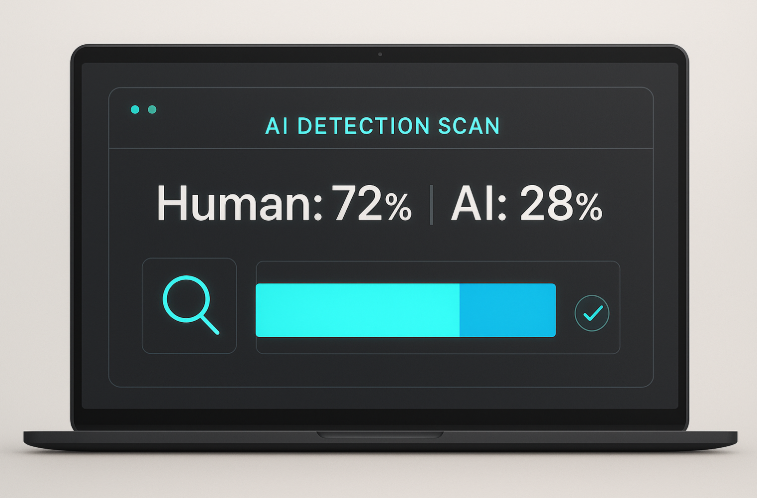
AI detectors are tools designed to figure out whether a piece of text was written by a human or generated by models like ChatChatGPT, Claude, or Gemini. They don’t “read” the text like a teacher would. Instead, they look for statistical fingerprints in writing.
Most detectors rely on:
- Perplexity: how predictable each word is in a sequence. AI text is usually more predictable.
- Burstiness: the variation in sentence structure and word choice. Humans mix it up more naturally, while AI tends to stay smoother and more uniform.
- Training comparisons: some detectors match your text against massive databases of known AI outputs.
Sounds smart, right? But here’s the catch: these methods are not foolproof. Short answers, paraphrased text, or essays written by non-native speakers often confuse the algorithms. That’s why results can feel hit-or-miss.
Related reading: How AI Humanizers Bypass AI Detectors
Are AI Detectors Accurate in 2026?
The short answer: not completely.
According to multiple studies:
- A 2023 analysis by Weber-Wulff et al. found that most AI detectors scored below 80% accuracy when tested on diverse text samples.
- Another 2023 benchmark study showed CopyLeaks to be among the most accurate, while ChatGPTZero flagged far more false positives than competitors.
- Accuracy rates across tools have been documented between 55% and 97%, depending on text type, length, and language.
It is worth noting that even top tools carry a significant margin of error. Turnitin, for example, acknowledges a variance of plus or minus 15% points in its scores. That means a result of 50% AI could legitimately fall anywhere between 35% and 65%, making confident conclusions about any individual piece of writing difficult to justify.
Example: When researchers tested paraphrased text, nearly all detectors dropped in accuracy by over 20%, misclassifying both human and AI content.
And accuracy isn’t the only issue. Detectors also face bias problems:
- Non-native English essays are more likely to be flagged as AI.
- Shorter responses (like discussion posts or summaries) often trigger false positives.
Bias and Limitations: Who Gets Flagged Unfairly?
AI detectors also face bias problems that go beyond simple error rates.
Why AI detectors flag non-native English speakers more often
Writers who learned English as a second language are disproportionately flagged by AI detectors. A 2023 study published on arXiv by Liang et al. titled ‘ChatGPT Detectors Are Biased Against Non-Native English Writers,’ tested seven widely used AI detectors and found they consistently misclassified writing from non-native English speakers as AI-generated. The authors specifically cautioned against using ChatGPT detectors in evaluative or educational settings when assessing the work of non-native English speakers. The reason comes down to how these writers construct sentences. Non-native speakers often rely on more predictable phrasing, common grammatical structures, and conventional vocabulary, all of which detectors associate with AI output because large language models do the same thing.
A student writing in their second language, producing careful, clear prose, can score higher on an AI detection check than a native speaker writing carelessly. If you have had your writing flagged and you know it is your own, this bias is a likely explanation.
Walter Writes’ detector is built to reduce this type of false positive by layering multiple signals rather than relying on perplexity alone. If you have been incorrectly flagged, running your text through Walter’s detector gives you a second reading that accounts for writing style variation, not just word probability.
Shorter responses, such as discussion posts or summaries, also often trigger false positives regardless of the writer’s background. The less text a detector has to analyze, the less reliable its output.
This means if you’re a student or content creator relying solely on detection results, you could be wrongly accused of using AI.
Related reading: My Essay Was Detected as AI When It’s Not
Can AI Detectors Be Wrong? False Positives and False Negatives Explained
Yes, AI detectors can definitely be wrong. Even the most popular tools regularly misclassify content. This usually shows up in two ways:
- False positives: Human writing flagged as AI. For example, student essays or professional articles have been wrongly marked by detectors like ChatGPTZero or Turnitin.
- False negatives: AI-generated writing that slips through as human. Paraphrased ChatChatGPT text or content passed through humanizers often evades detection.
These errors are why there is growing scepticism about relying on a single detector. The reality is that most detectors hover between 65% and 90% accuracy, which leaves a lot of room for mistakes.
The problem is not limited to basic or student writing. Polished, sophisticated human writing can also trigger false flags. In one documented test, A leading detector classified a passage generated entirely by ChatChatGPT as ‘likely human written,’ while correctly flagging a separate piece of genuinely human text as AI. The failure runs in both directions, and the more refined the writing, the harder it is for detectors to make the call.
This is where Walter Writes AI Detector sets itself apart. Instead of relying on just one metric like perplexity, it layers multiple signals together, including writing rhythm, structure shifts, and probability analysis to minimise false flags. When we tested Walter against other tools, it consistently produced fewer false positives on human text while still catching AI passages that others missed.
If you are worried about being unfairly flagged, our resource on how to make your essay undetectable explains how combining Walter’s detector with rewriting can protect you against misclassification.
Related: Does Walter AI work? and Crossplag AI Detector Review
Which AI Detector Is the Most Reliable in 2026?
Not every AI detector works the same way. Some are designed for institutions, others are free classroom tools, and a few are built for professional writers and publishers. Here is how the most common options stack up this year:
| AI Detector | Accuracy Range | Strengths | Weaknesses | Best For |
| Walter Writes AI Detector | 90% to 95% | Multi-signal analysis, reduced false positives, built for students and professionals | Newer on the market but rapidly growing | Writers, students, researchers, SEO creators |
| Originality AI | Around 90% | Good for long form academic text, includes plagiarism checker | Paid only, overflags short content | Universities, publishers |
| Copyleaks | 85% to 90% | Strong integration with education platforms, supports multiple languages | Bulk scans slower, weaker on hybrid content | Schools, enterprises |
| ChatGPTZero | 70% to 85% | Free, simple for classroom use | High false positives, weak on paraphrased AI | Educators, casual checks |
| Turnitin AI Detector | 80% to 90% | Widely adopted in universities | Locked to institutions, not for individual users | Academic institutions |
| Quillbot AI Checker | 70% to 80% | Free and convenient add on | Lower reliability, no plagiarism checker | Casual writers, bloggers |
When comparing across the board, Walter Writes AI Detector comes out on top for balance. It avoids the overflagging problem of ChatGPTZero and Turnitin, while matching or surpassing the accuracy of Originality AI and Copyleaks without their paywall restrictions.
For a deeper breakdown of the competition, take a look at our full guide on the best AI detector tools.
If your focus is classroom use specifically, our hands-on comparison of AI checkers for teachers tests detection across three types of student writing, including the mixed AI-human samples that most tools fail on.
How Accurate Are Popular AI Detectors in 2026
Accuracy is the question everyone asks when it comes to AI detection. Some tools claim to be close to perfect, while others are free and widely used in classrooms but show major gaps in reliability. Here is a closer look at the most well-known AI detectors in 2026 and how they perform in real tests.
ChatGPTZero Accuracy
ChatGPTZero has become one of the most recognised names in this space, especially among teachers. It is free, simple to use, and often the first tool students hear about. That said, accuracy is inconsistent. While it can flag AI text reasonably well, it is known for producing many false positives, sometimes even calling original essays or professional articles AI-generated.
If you want the full story, we tested it in depth in our ChatGPTZero review. You will see how it compares to other detectors and why it is best used for quick checks rather than as a final authority.
Originality AI Accuracy
Originality AI is often praised as one of the most accurate premium tools, especially in academic and publishing circles. It regularly scores above 90% on long-form essays and also includes plagiarism checking. The main drawback is accessibility, since it is locked behind a paid subscription and often overflags short or creative writing.
For a detailed breakdown of its strengths and weaknesses, see our Originality AI review.
Copyleaks Accuracy
Copyleaks is another big player in education and business settings. It works across multiple languages and integrates with learning management systems. Accuracy generally sits in the mid to high eighties. However, when tested on mixed or paraphrased content, it sometimes struggles to keep up.
We explored this further in our Copyleaks review, where we compared it head-to-head with other leading tools.
Turnitin AI Detector Accuracy
Turnitin remains the standard for many universities worldwide. Its AI detection features are built directly into the same system that checks for plagiarism, making it a common choice for academic integrity. Accuracy is good for longer assignments, but short writing samples often return uncertain or misleading results. Students also cannot access it independently since it is available only through institutions.
For context on how it works in practice, read our guide on Turnitin AI detection.
Quillbot AI Checker Accuracy
Quillbot offers a lightweight AI detection feature alongside its popular paraphrasing tool. While convenient and free to access, accuracy is relatively low compared to more advanced detectors. It is best suited for casual checks rather than serious academic or professional use.
We covered this in our Quillbot AI detector review.
Why Walter Writes Stands Out
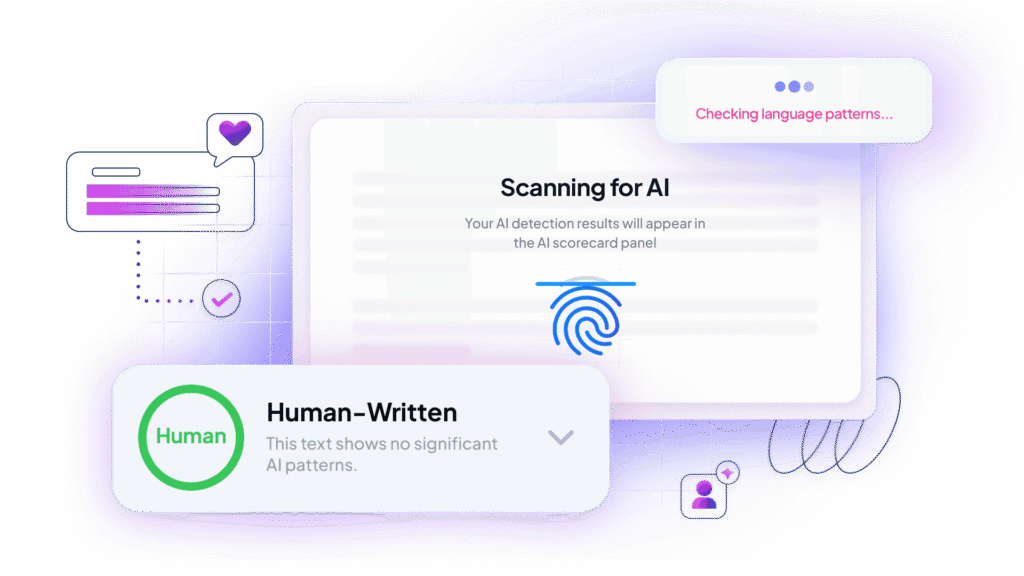
When you look at these tools together, a pattern emerges. Each has strengths, but each also has clear limitations: ChatGPTZero overflags, Originality AI is paywalled, Copyleaks slows down on bulk scans, Turnitin is restricted to institutions, and Quillbot is too shallow for serious cases.
This is exactly why the Walter Writes AI Detector was built. It combines multiple signal analysis with a focus on reducing false positives, giving students, professionals, and researchers a more balanced and accessible option. In side-by-side tests, it has consistently matched or outperformed the accuracy of established tools while avoiding the major pitfalls that frustrate users elsewhere.
Why Do AI Detectors Get It Wrong? Key Biases in 2026
Even the most popular AI detectors struggle with accuracy. Research shows that many tools drop below 80% once the text is edited or doesn’t fit their trained patterns. Here are the three main reasons they still misfire in 2026.
Paraphrased AI Text
Quick Answer: AI detectors perform poorly on paraphrased text. Accuracy often drops by 20% or more.
Most tools, such as ChatGPTZero, Copyleaks, and Turnitin, are trained to recognise raw AI outputs. Once text is paraphrased or rewritten, their models lose confidence and misclassify it as human. This explains why humanizers are so effective at bypassing detection.
Research backs up just how easy evasion is. A 2023 study by Sadasivan et al., titled “Can AI-Generated Text be Reliably Detected?” demonstrated a technique called recursive paraphrasing, where AI-generated text is run through a second language model to be rephrased. This alone reduced detection accuracy from over 70% to under 5% in some tests. Basic manual edits and word substitutions had similar effects across multiple detection tools, including those using watermarking methods.
Learn more in our guide: How AI Humanizers Bypass AI Detectors
Non Native or Simplified Writing
Quick Answer: Detectors often confuse non native English writing with AI-generated text.
Because detectors analyse predictability, essays with simpler vocabulary or short repetitive structures look “AI-like” to the algorithm. This creates false positives that unfairly flag human work.
For protection strategies, read our Undetectable AI Content Guide
Hybrid Content
Quick Answer: Mixed human and AI writing is the hardest case for detectors.
When a student or marketer drafts with AI and then edits by hand, detectors often break down. The result is an uncertain score or a wrong classification. This is a growing problem in 2026 because hybrid workflows are now the norm.
Try the Walter Writes AI Detector, which analyses multiple signals beyond simple perplexity and burstiness, making it more accurate on hybrid text.
Why It Matters
Biases like these show why no single detector can be treated as a final authority. In Google’s own SGE results, readers are looking for clear answers with evidence, comparisons, and solutions. That is why Walter Writes stands out: it explains not only what detectors miss but also how to work around these flaws safely.
How to Test AI Detector Accuracy Yourself
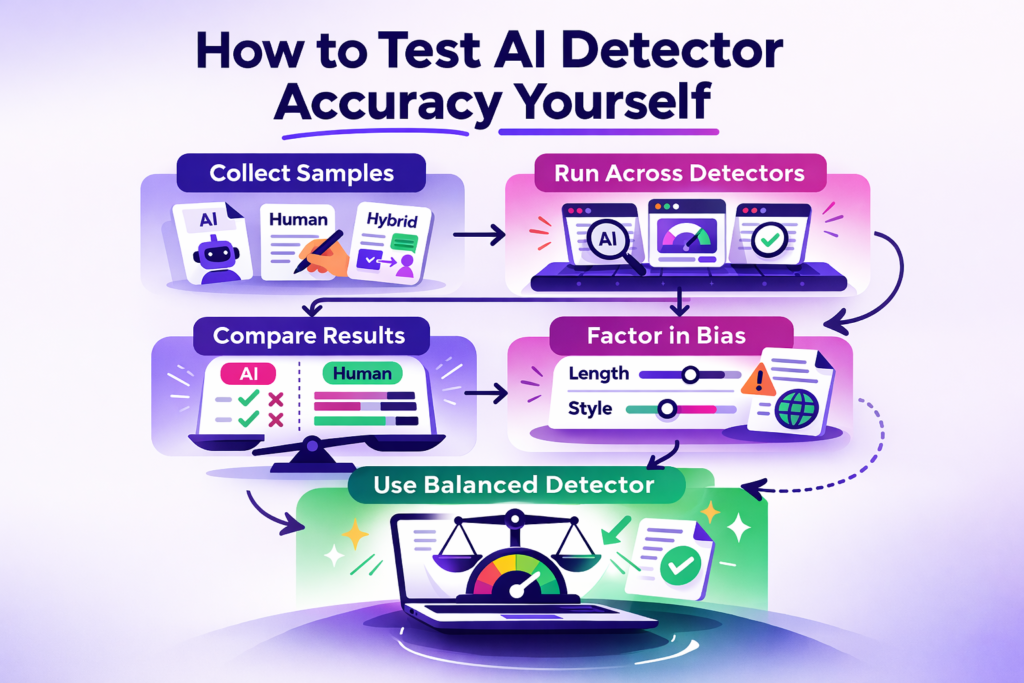
Quick Answer: The best way to test AI detector accuracy is to run the same passage through multiple tools, compare results, and note false positives or misses. A mix of raw AI text, paraphrased content, and genuine human writing gives you the clearest picture.
Here is a simple method you can follow:
- Collect samples
- Use one passage fully written by AI (for example, a ChatChatGPT paragraph).
- Write one passage fully by hand.
- Create a paraphrased or hybrid passage that blends both.
- Run each sample across several detectors
- Start with popular tools like ChatGPTZero, Originality AI, Copyleaks, and Turnitin.
- Record their outputs: did they flag it as AI, human, or uncertain?
- Compare the results
- Look for inconsistencies: is one detector more strict while another passes the same text?
- Note false positives (human flagged as AI) and false negatives (AI flagged as human).
- Factor in bias
- Test with shorter and longer passages.
- Try different writing styles, especially if you are a non native English writer.
- Check with a balanced detector
- Use the Walter Writes AI Detector as part of your test set. It is designed with multi-signal analysis, which means it avoids the overflagging problem common in ChatGPTZero and Turnitin while still catching AI content that slips past other tools.
- Use the Walter Writes AI Detector as part of your test set. It is designed with multi-signal analysis, which means it avoids the overflagging problem common in ChatGPTZero and Turnitin while still catching AI content that slips past other tools.
Why This Testing Matters
Detectors can claim “90% accuracy,” but your real-world results will depend on the type of writing you feed them. By testing yourself, you will see just how much variance exists between tools. This is especially important for students and professionals submitting work in high-stakes situations.
If you are worried about being wrongly flagged, pair this testing method with our guide on how to make your essay undetectable or explore how AI humanizers bypass detectors to stay one step ahead.
The Future of AI Detection: Can Detectors Keep Up With Humanizers?
Quick Answer: AI detectors are improving, but so are AI humanizers. By 2026, detection tools will be locked in a constant race against rewriting systems that make AI text look human. The result is that no detector will ever be perfect, which is why human-style editing and balanced tools like Walter Writes matter more than raw detection scores.
Why Detectors Alone Are Not Enough
Detectors rely on statistical patterns like predictability and burstiness. As large language models evolve, those patterns become harder to spot. At the same time, AI humanizers are specifically built to rewrite sentences in ways that confuse detectors. This arms race means accuracy claims of “95%” often collapse when real-world testing begins.
We explained this cat-and-mouse dynamic in detail in our guide on how AI humanizers bypass AI detectors.
The same challenge applies beyond text. AI image detectors face a parallel problem: compression, re-encoding, and post-processing degrade the very signals these tools rely on, which means no single score can be treated as definitive proof.
Humanizers Are Growing More Sophisticated
Early paraphrasers simply swapped words around, but modern humanizers go much further. They vary sentence rhythm, inject natural phrasing, and even mimic stylistic quirks of human writing. In tests, tools like Walter Writes consistently made AI text pass as human, even when checked against strict detectors like Originality AI and Copyleaks.
For students and writers worried about unfair false positives, our undetectable AI content guide shows how to use humanization safely without sacrificing originality.
The Bottom Line
AI detectors are a useful part of the toolkit for educators, content teams, and publishers. They can flag obvious, low-effort AI content with reasonable reliability. But their error rates, directional failures, and documented biases against non-native speakers mean they should never be the only basis for an important decision.
If you are a student, a writer, or a professional whose work has been questioned, the most practical step is to run your content through a multi-signal detector like Walter Writes before submission. A single score from a single tool is not enough to draw conclusions either way.
AI detectors are a useful starting point, but they should be treated as a rough signal, not definitive proof for academic misconduct cases, hiring decisions, or content moderation. No score from any tool currently available is reliable enough to stand on its own.
Why Walter Writes Leads the Future
Unlike other detectors that focus only on “catching” AI, Walter Writes takes a balanced approach. Walter Writes AI Detector reduces false positives while still identifying machine-generated patterns. At the same time, Walter Writes Humanizer helps users rewrite text so it feels natural and trustworthy.
This dual system reflects the reality of 2026: detection and humanization are no longer separate worlds but part of the same workflow. By giving readers both options, Walter Writes positions itself ahead of tools that only offer one side of the equation.
Frequently Asked Questions
Which AI detector is the most accurate in 2026?
Most independent studies show that Originality AI and Copyleaks reach the highest accuracy on long-form academic text, often above 90%. However, both tools have issues with paraphrasing and short answers. In side-by-side tests, the Walter Writes AI Detector performed just as well while reducing false positives, making it one of the most balanced options in 2026.
Can Turnitin detect ChatChatGPT?
Yes, Turnitin’s AI detection system can flag text produced by ChatChatGPT or Gemini and similar models. Its accuracy improves on longer essays but becomes less reliable on short discussion posts or mixed writing. For students, this means you may still face false positives even when writing by hand. Learn more in our Turnitin AI Detector Review.
Are free detectors like ChatGPTZero reliable?
Free tools such as ChatGPTZero are useful for quick checks but should not be considered final authority. Accuracy hovers between 70% and 80%, with a higher-than-average false positive rate. Instructors may use it as a first pass, but relying only on ChatGPTZero can be risky. See our full ChatGPTZero review for details.
Why do AI detectors give false results?
False positives usually happen when detectors confuse predictable human writing such as simple essays or non native English, with AI-generated text. False negatives occur when AI text is paraphrased or run through a humanizer. To avoid unfair flags, use Walter Writes Humanizer to naturalise your writing, then confirm with the Walter Writes Detector for balance.
How can I make sure my work does not get wrongly flagged?
The safest approach is to write in your own voice, but if you use AI for brainstorming, always rewrite and personalise. Testing your text across multiple detectors also helps you spot inconsistencies. Our guide on making essays undetectable outlines practical steps students can follow in 2026.
Should AI detectors be used as evidence of academic misconduct?
No. Multiple studies and institutional guidance, including from the University of Kansas and MIT Sloan, conclude that AI detector scores should not be used as standalone evidence in academic misconduct cases. The error rates are too high, false positives are well-documented, and the tools carry known biases against certain groups of writers. A detection score is a signal that warrants further investigation, not a verdict on its own.
Why are neurodivergent students more likely to be flagged by AI detectors?
Yes. A 2024 chapter by Gegg-Harrison and Quarterman, published in peer-reviewed research, found that neurodivergent writers are among the groups most likely to be impacted by AI detector false positives. The University of Nebraska’s Center for Transformative Teaching also documents this, noting that students with autism, ADHD, and dyslexia are prone to false positive ratings due to their reliance on repeated phrases, consistent terminology, and pattern-based composition, all of which detectors associate with AI output. A high detection score is not evidence of AI use. It is evidence of a writing style the detector wasn’t trained to account for.
Final Verdict: Should You Trust AI Detectors?
AI detectors are helpful, but they are not perfect. Accuracy varies between 60% and 90%, with common issues like false positives, bias against non native writing, and weakness against paraphrased or hybrid content. This makes them useful as a guideline but risky as a final judgment.
If you want a tool that is fair, balanced, and practical for real-world use, the Walter Writes AI Detector for Teachers is the best choice in 2026. It is built to reduce false positives, catch hidden AI signals, and give students, writers, and professionals a trustworthy option. And if you need to make your AI text more natural, the Walter Writes Humanizer ensures your content reads as if it came from you, not a bot.
Here’s what to remember:
- No detector is one 100% accurate
- Accuracy depends on text type, length, and editing
- Walter Writes offers both a powerful detector and a humanizer, making it the most complete solution today
For the technical breakdown of how AI detectors actually work, see How Do AI Detectors Work? covering perplexity, burstiness, and model fingerprints.
Need to spot AI text yourself? The how to detect ChatChatGPT writing guide covers the five telltale signs, the top detection tools, and the verification steps to take before acting on a flag.
Side-by-side comparison: See the dedicated Turnitin vs ChatGPTZero 2026 benchmark for accuracy, false positives, pricing, and use-case fit.