



À retenir : Un texte produit par ChatGPT peut devenir plus naturel après une vraie révision. L’objectif est d’améliorer le rythme, la précision et la voix du texte, sans présenter la réécriture comme une garantie contre les détecteurs.
- Un vocabulaire prévisible et un rythme monotone peuvent nuire au style, mais ne prouvent pas qu’un texte vient d’une IA
- Utilisez la réponse de ChatGPT comme un brouillon, puis vérifiez les faits et reformulez avec vos propres mots
- Supprimez les formules creuses comme « dans le monde actuel » ou « il est important de noter »
- Variez la longueur des phrases selon le sens : une idée brève, une explication, puis une conclusion claire
- La révision humaine garde l’auteur aux commandes ; les outils de reformulation peuvent accélérer certaines étapes
Oui, il est possible de rendre un texte de ChatGPT plus naturel. Cela demande généralement davantage qu’un clic sur « Régénérer ». Le récit initial de cet article décrit l’expérience d’un étudiant ayant utilisé l’IA pour respecter plusieurs échéances, puis retravaillé ses textes et comparé les résultats de GPTZero, Turnitin et Originality.ai. Ces observations historiques ne constituent pas un nouveau test indépendant ni une garantie de résultat.
Objectif de ce guide : expliquer comment retravailler un texte d’IA pour le rendre plus naturel, clair et personnel, tout en préservant son sens.
Une expérience avec ChatGPT et les détecteurs
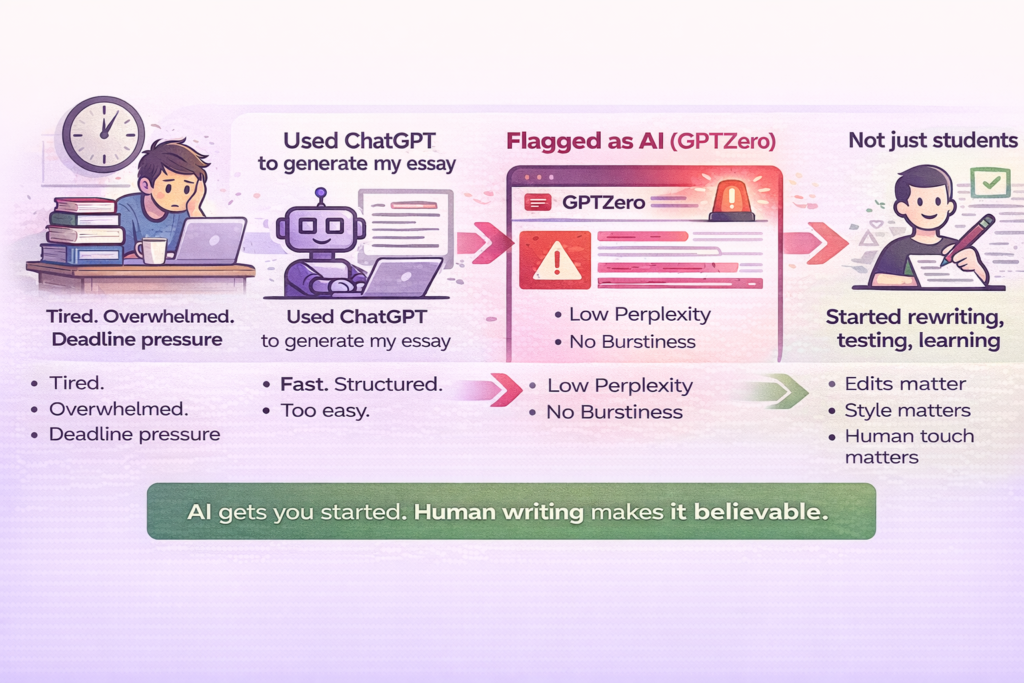
Le récit initial décrit un étudiant fatigué, partagé entre un emploi à temps partiel et les devoirs. Pendant les examens, il se tourne vers ChatGPT pour avancer sur une dissertation de 1 500 mots en sciences politiques.
Le premier brouillon semble convaincant : des paragraphes structurés, des références et une conclusion. Mais une présentation soignée ne suffit pas à garantir la qualité ou l’exactitude du texte.
D’après ce récit, GPTZero a ensuite signalé le brouillon comme susceptible d’avoir été produit par une IA.
L’auteur découvre alors les notions de « perplexité » et de variation du rythme. Un signalement de détecteur peut être préoccupant, mais il ne constitue pas, à lui seul, une preuve de faute universitaire.
Cette inquiétude l’amène à revoir sa façon de travailler.
Le récit décrit ensuite des essais de révision manuelle et d’outils, dont un outil de reformulation de texte d’IA, avec une comparaison des résultats obtenus. Ces observations n’ont pas été reproduites indépendamment dans cette mise à jour.
Le problème du brouillon trop générique concerne aussi les rédacteurs, les professionnels du marketing et les indépendants. Un texte peut sembler correct à première vue, tout en manquant de précision ou de personnalité à la lecture.
Que signifie rendre un texte d’IA plus naturel ?
Il s’agit de réviser un texte généré automatiquement pour lui donner un enchaînement fluide, une voix identifiable et les nuances adaptées à son public.
Les grands modèles de langage, comme ChatGPT ou Claude, peuvent produire une prose soignée mais répétitive. Les structures se ressemblent et le ton reste parfois générique, même lorsque les faits sont exacts.
Une bonne révision peut apporter :
- Des phrases variées, en alternant les formulations brèves et les explications plus développées.
- Des transitions naturelles, qui rendent le raisonnement facile à suivre.
- Un ton adapté, en fonction du contexte et des lecteurs.
- Une voix personnelle, sans ajouter volontairement de fautes ni inventer des expériences.
La révision ne consiste pas simplement à remplacer des mots par des synonymes. Elle peut modifier le rythme, l’organisation et le ton du texte tout en conservant les idées.
L’IA fournit un brouillon ; la révision lui apporte la précision et la cohérence nécessaires.
Un texte bien révisé doit :
- Préserver les faits vérifiés et les termes utiles.
- Adopter une voix cohérente et naturelle.
- Intégrer des nuances ou une expérience réelle lorsqu’elles sont pertinentes.
- Se lire facilement, sans promesse de classement ou de résultat à un détecteur.
Des outils comme Walter Writes peuvent aider à reformuler un brouillon dans un ton plus naturel. Il reste nécessaire de vérifier qu’ils en préservent le sens.
Pourquoi certains textes d’IA paraissent-ils artificiels ?
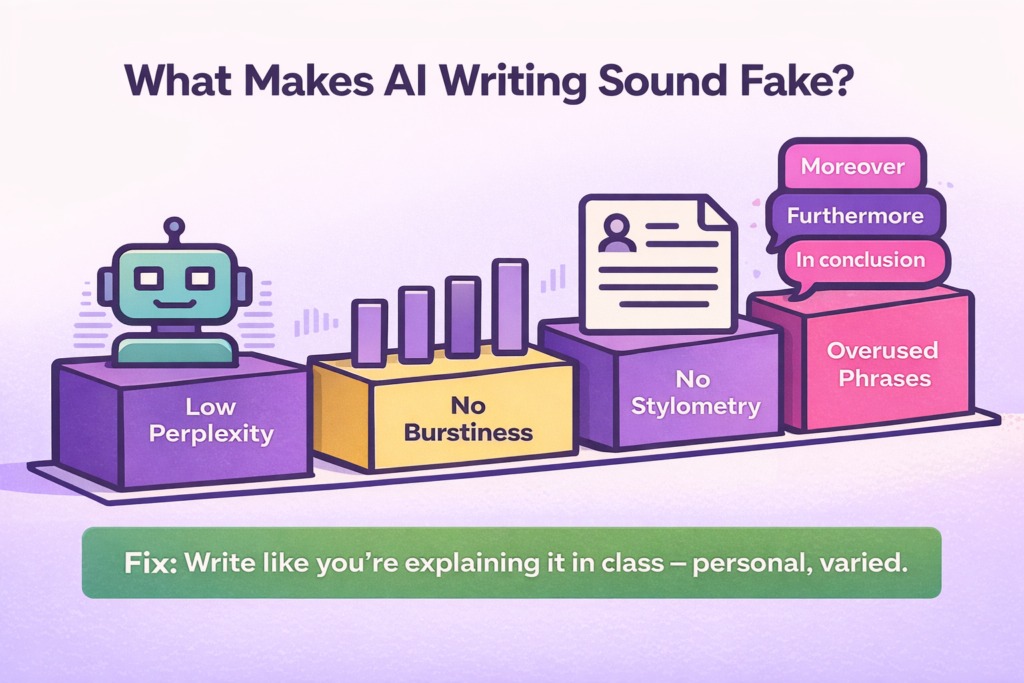
Les modèles de langage produisent du texte à partir de régularités apprises. Le résultat peut contenir des répétitions, des formulations convenues ou des informations inexactes. Aucun de ces signes ne permet, à lui seul, d’établir l’origine d’un texte.
Voici plusieurs caractéristiques à examiner pendant la révision :
Une formulation très prévisible
Des outils comme GPT-4 génèrent leurs réponses à partir du contexte et de régularités apprises. La perplexité décrit notamment la prévisibilité d’un texte pour un modèle. Une valeur faible n’est pas nécessairement un défaut : elle ne permet pas de conclure qu’un texte est artificiel ou mal écrit.
Exemple :
« Les conséquences économiques de la mondialisation sont importantes. »
❌ La formulation reste abstraite et générale.
✅ Version plus concrète : « La mondialisation a changé les échanges entre pays, mais aussi ma façon de faire les courses. »
Un rythme de phrases trop uniforme
Un texte peut gagner en naturel lorsque la longueur et la construction des phrases suivent les idées. Les humains comme les modèles peuvent produire des styles variés ; le rythme ne constitue donc pas une preuve d’origine.
Essayez cette progression :
- Une phrase courte.
- Une explication plus longue, qui développe l’idée avec précision.
- Puis une conclusion brève.
L’intérêt est d’améliorer la lecture, sans promettre de modifier un score de détection.
La stylométrie : les caractéristiques du style
L’analyse stylométrique s’intéresse au style : vocabulaire, structures de phrases et ponctuation, entre autres. Les méthodes des détecteurs varient, et ces caractéristiques ne suffisent pas à prouver qu’un auteur a utilisé une IA.
Comparer un brouillon à ses propres textes peut néanmoins aider à retrouver ses habitudes d’écriture.
À lire aussi : ZeroGPT vs GPTZero
Les formules toutes faites à réexaminer
Voici quelques expressions à supprimer ou préciser lorsqu’elles n’apportent rien :
- « Dans la société actuelle… »
- « Il est important de noter… »
- « L’essai suivant portera sur… »
- « En conclusion… » (l’IA adore celle-ci)
- « Par ailleurs… »
- « De plus… »
- « Il convient de noter… »
- « Dans le monde actuel… »
Essayez plutôt d’écrire comme vous expliqueriez le sujet à votre lecteur, en respectant le niveau de formalité attendu.
Les habitudes de rédaction à éviter
Au-delà des mots isolés, certaines structures rendent un texte mécanique. Il peut être grammaticalement correct tout en donnant l’impression d’avoir été assemblé sans véritable réflexion éditoriale.
Voici les principales habitudes à repérer :
Des phrases de longueur uniforme : toutes avancent au même rythme, sans contraste ni variation adaptée au raisonnement.
Des transitions répétitives : « Premièrement », « deuxièmement », « de plus » et « en conclusion » ne sont pas des erreurs, mais leur répétition systématique alourdit le texte.
Des idées qui tournent en boucle : plusieurs phrases reformulent la même idée sans ajouter d’information. Supprimez les doublons ou développez un point concret.
Une structure trop régulière : des paragraphes identiques et des sections toujours organisées de la même façon peuvent rendre la lecture monotone.
Un vocabulaire vague : remplacez « cela a un impact important » par une explication de cet impact, et « beaucoup pensent » par des sources ou des exemples précis.
Comment retrouver sa propre voix dans un brouillon
Demander simplement à ChatGPT de « paraître plus humain » ne garantit pas un texte convaincant. Une consigne précise et une vraie révision sont plus utiles.
Voici une méthode pour reprendre le contrôle du brouillon.
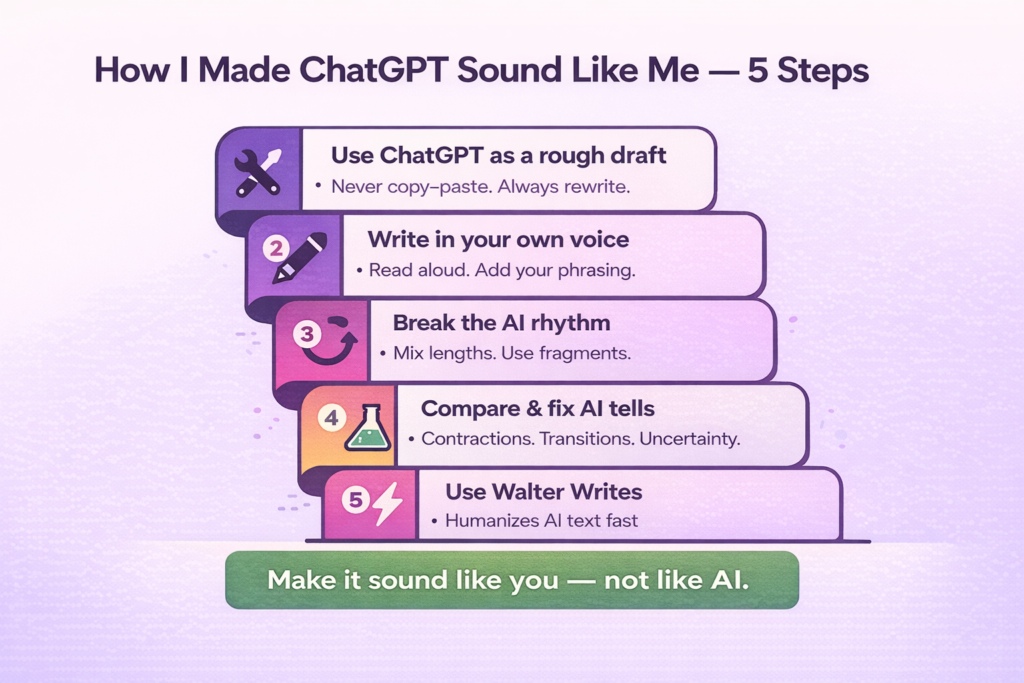
Étape 1 : utiliser ChatGPT pour préparer un brouillon
Commencez par distinguer le brouillon de la version finale. ChatGPT peut notamment aider à :
- Organiser les idées
- Esquisser des arguments
- Suggérer des pistes de recherche à vérifier
- Rédiger des sections préliminaires que je pourrais retravailler plus tard
Utilisez le résultat comme point de départ. Vérifiez les affirmations et les références, puis reformulez ce que vous retenez avec vos propres mots.
Exemple :
Brouillon : « La Grande Dépression a eu de vastes répercussions économiques dans de nombreux secteurs. »
Révision : « La Grande Dépression n’a pas seulement fait chuter la Bourse : elle a bouleversé l’emploi, le logement et des communautés entières. »
Étape 2 : lire le texte à voix haute
Posez-vous cette question : est-ce vraiment une phrase que j’emploierais pour expliquer cette idée ?
Si la réponse est non, retravaillez-la. Selon le contexte, vous pouvez utiliser :
- Parenthèses (comme ceci)
- Transitions décontractées (« Voici ce qu’il faut faire… »)
- Une émotion réelle (« Honnêtement, cette partie m’a choqué »).
Observez aussi les mots que vous choisissez naturellement et votre manière de commencer les phrases. Ces habitudes peuvent guider la révision.
Le résultat doit rester adapté au public et au type de document.
❌ « Les données suggèrent une corrélation. »
✅ « Il s’avère que les statistiques concordent bien plus que je ne le pensais. »
Étape 3 : varier le rythme
Vous pouvez rendre un passage moins monotone en :
- Variant la longueur des phrases
- Utilisant des enchaînements naturels
- Réservant les phrases fragmentaires aux contextes qui les autorisent
Une phrase brève peut annoncer l’idée ; une phrase plus longue apporte le contexte ; une dernière phrase en précise la portée. Utilisez cette alternance avec souplesse.
La variation doit servir le sens, sans devenir une nouvelle formule appliquée mécaniquement.
Étape 4 : comparer avec ses propres textes
Relisez un texte antérieur dont vous reconnaissez la voix, puis comparez-le au brouillon. Un résultat passé à un détecteur ne garantit rien pour le nouveau document.
Examinez notamment :
- Vos choix de vocabulaire et votre niveau de formalité.
- Votre manière de relier les idées.
- La place que vous accordez au doute et aux nuances.
Cette comparaison peut devenir une liste de révision. Elle aide à repérer les passages génériques et à réintroduire vos habitudes d’écriture.
Exprimez l’incertitude lorsqu’elle correspond réellement aux faits, par exemple :
- « Cela a probablement influencé cette politique… »
- « Il est possible que cette tendance reflète… »
- « Une autre interprétation mérite toutefois d’être examinée. »
Étape 5 : s’aider d’un outil de reformulation
La révision manuelle prend du temps. Un outil peut proposer des formulations alternatives lorsque plusieurs textes doivent être retravaillés.
C’est notamment le rôle de Walter Writes, qui propose des fonctions de reformulation.
L’outil peut modifier le rythme, le ton et la structure des phrases. Comparez toujours sa proposition à l’original pour repérer les changements de sens.
Parmi les points à examiner :
- La fluidité et le naturel du texte reformulé
- La possibilité d’adapter le ton au contexte étudiant, sans rendre le texte artificiellement familier ou trop formel
- L’absence de garantie concernant les résultats de GPTZero, Turnitin ou Originality.ai
- La fidélité au sens et aux informations du brouillon
Voici une méthode de travail :
- Préparer un brouillon avec ChatGPT
- Le coller dans Walter Writes
- Choisir un mode de reformulation adapté
- Lancer la réécriture
- Relire et corriger le résultat, sans imposer de durée fixe
La version finale doit refléter votre intention et vos choix d’auteur.
Découvrir l’outil : Walter Writes, outil de reformulation de texte d’IA
Réviser un texte d’IA sans en changer le sens
Voici une méthode en huit étapes pour retravailler un brouillon, qu’il s’agisse d’un essai, d’un article ou d’un message professionnel.
- Lire à voix haute : repérez les phrases difficiles à suivre ou trop générales.
- Varier les longueurs : alternez les explications développées et les formulations brèves lorsque cela aide la lecture.
- Revoir les transitions mécaniques : choisissez un lien logique précis plutôt qu’une formule répétée par habitude.
- Ajouter des détails : utilisez des exemples réels et des chiffres vérifiés, sans inventer de preuves.
- Garder une voix personnelle : une tournure naturelle peut apporter du caractère ; les fautes volontaires ne sont pas nécessaires.
- Réorganiser les idées : commencez, si cela convient, par un exemple avant de l’expliquer.
- Essayer un outil de reformulation : utilisez ses propositions pour explorer un autre rythme, puis vérifiez leur fidélité au texte initial.
- Interpréter les détecteurs avec prudence : un résultat peut compléter votre révision, mais ne remplace ni la vérification des faits ni le jugement humain. Un détecteur de contenu généré par IA fournit un signal à examiner, pas un verdict définitif.
Cette méthode vise à améliorer le rythme, le vocabulaire et l’organisation tout en conservant votre message.
Améliorer le texte et interpréter les signalements
Dans un contexte universitaire ou professionnel, commencez par respecter les règles applicables à l’usage de l’IA. Une réécriture ne dispense pas de déclarer cet usage lorsque cela est demandé.
Travaillez le raisonnement, la précision et la structure, au-delà du remplacement de quelques mots.
Voici plusieurs pistes pour améliorer votre texte de façon responsable :
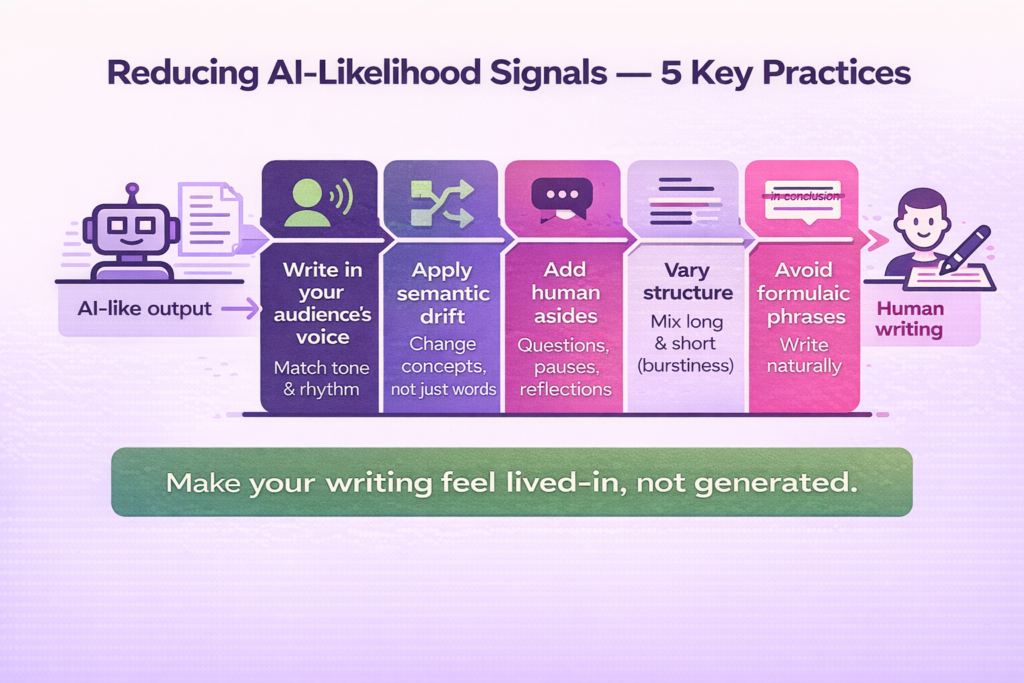
Adapter la voix au public
Un texte universitaire peut être formel tout en restant clair et nuancé. Un document professionnel privilégie souvent des résultats précis et une formulation concise. Adaptez le ton aux lecteurs et à la tâche.
Reformuler les idées avec précision
Exprimez l’idée autrement plutôt que de remplacer chaque mot par un synonyme. Un exemple pertinent peut rendre une explication abstraite plus accessible. Vérifiez que cette reformulation ne déforme pas le propos.
Ajouter une perspective personnelle pertinente
Une question, une remarque ou une expérience réelle peut enrichir le texte. N’inventez pas de vécu pour donner une impression d’authenticité, et évitez les apartés inutiles.
Varier la structure des paragraphes
Un paragraphe court peut souligner une idée ; un passage plus long peut développer un raisonnement. Cette variation sert la lecture. Elle ne démontre pas qu’un texte est humain et ne garantit aucun résultat de détection.
Remplacer les formules creuses
Choisissez vos transitions en fonction du lien entre les idées. « C’est pourquoi » ou « en revanche » peut être plus précis qu’une formule générale, mais aucun mot n’est une preuve d’origine humaine ou artificielle.
Après ces modifications, relisez le texte pour vérifier sa clarté, son exactitude et sa fidélité à votre intention. Une meilleure rédaction ne se mesure pas uniquement au score d’un détecteur.
Exemples avant et après révision
Les exemples suivants illustrent des choix de style dans trois contextes. Ils ne constituent pas des résultats de tests de détection.
Exemple universitaire
Brouillon : « L’intelligence artificielle est une technologie en évolution rapide qui possède de nombreuses applications. »
Version révisée : « L’IA intervient déjà dans certains outils d’aide au diagnostic, applications de tutorat et logiciels de comptabilité. Ses usages évoluent ; les comprendre aide à en évaluer les possibilités et les limites. »
La formulation générale est remplacée par des exemples concrets, sans présenter l’automatisation comme un remplacement systématique du jugement professionnel.
Exemple professionnel
Brouillon : « Le taux de clics dépasse la moyenne du secteur de 15 %. »
Version révisée : « Pour cette campagne, le taux de clics a dépassé d’environ 15 % la moyenne du secteur. »
Le chiffre est replacé dans son contexte. Il s’agit d’un exemple fictif de rédaction, pas d’un résultat mesuré dans cet article.
Exemple créatif
Brouillon : « Elle marchait dans la forêt, tandis que la lune éclairait étrangement son chemin. »
Version révisée : « Elle se glissa entre les arbres. Les feuilles craquaient sous ses pas ; une lumière froide et argentée baignait le sentier. »
Les détails sensoriels et la variation du rythme rendent la scène plus concrète.
Qualité rédactionnelle et référencement
Une révision utile vise d’abord les lecteurs : elle améliore la précision, la clarté et la pertinence du contenu.
Les notions de contenu utile et d’expérience, d’expertise, d’autorité et de fiabilité ne se résument pas à un score de naturel. Cet article ne démontre pas que le temps passé sur une page ou une reformulation entraîne directement une hausse du classement.
Vérifiez les sources, répondez à la question du lecteur et utilisez les termes pertinents sans répétition artificielle. Une meilleure lisibilité peut aider le public, mais ne garantit pas une position dans les résultats de recherche.
Pour comparer les approches disponibles, consultez notre liste des 12 outils de reformulation de texte d’IA. Évaluez leurs fonctions et leurs limites selon votre usage, puis relisez leurs résultats.
Les exemples de tests conservés dans l’article
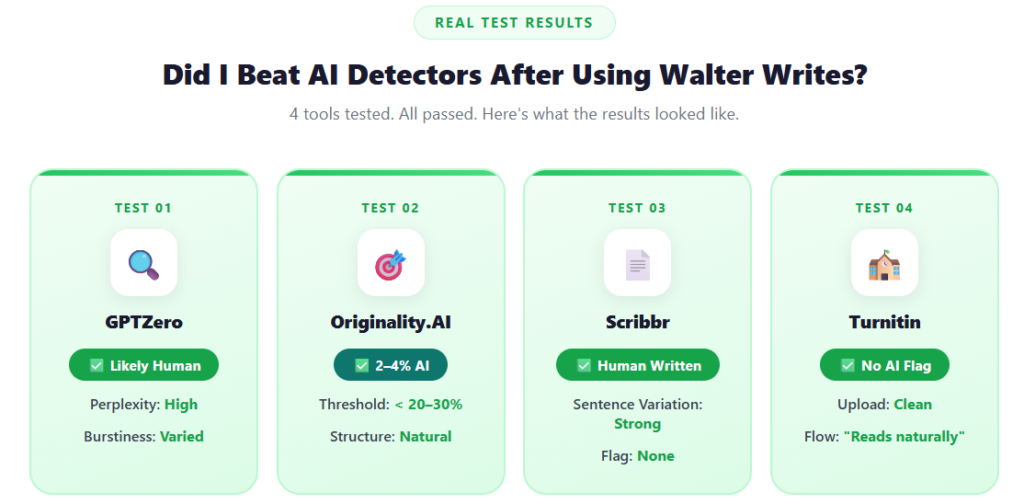
La version initiale rapportait des essais d’un texte réécrit avec Walter Writes dans plusieurs outils de détection d’IA. Les exemples ci-dessous sont conservés comme observations historiques. Ils n’ont pas été reproduits indépendamment lors de cette mise à jour et ne permettent pas de prédire les résultats actuels.
Exemple 1 : GPTZero
Le récit initial comparait le brouillon et sa version révisée dans GPTZero. Voici les observations qui y étaient rapportées :
Résultat rapporté : « Probablement écrit par un humain »
- Perplexité rapportée : plus élevée
- Variation de rythme rapportée : plus importante
- Aucun signalement de phrase rapporté
Exemple 2 : Originality.AI
Originality.AI figurait également dans les essais décrits. Les valeurs ci-dessous proviennent du récit initial ; elles ne sont pas des mesures nouvelles ou une garantie de performance.
Résultat rapporté : environ 2 à 4 % de probabilité d’IA
- Le récit comparait ce résultat à une plage de 20 à 30 %, qui ne doit pas être interprétée comme un seuil officiel vérifié ici
- Le texte révisé était décrit comme plus naturel
Exemple 3 : le détecteur de Scribbr
Le récit initial présente aussi un essai avec Scribbr , comparant le texte de ChatGPT et sa version révisée.
Résultat rapporté : « Texte humain »
L’amélioration de la variation des phrases est une appréciation du récit initial, et non un commentaire indépendant confirmé du détecteur.
Exemple 4 : le détecteur de Turnitin
L’accès décrit dans le récit initial passait par un compte universitaire. Cet article ne vérifie pas cet essai ni ses conditions d’autorisation. Utilisez uniquement un accès auquel votre établissement vous autorise.
Résultat rapporté : aucun signalement d’IA
- Le récit indique que la version révisée a été soumise sans signalement
- Commentaire rapporté : « C’est bien écrit, le texte est fluide »
À lire aussi : Turnitin peut-il détecter QuillBot?
Les méthodes utiles et leurs limites
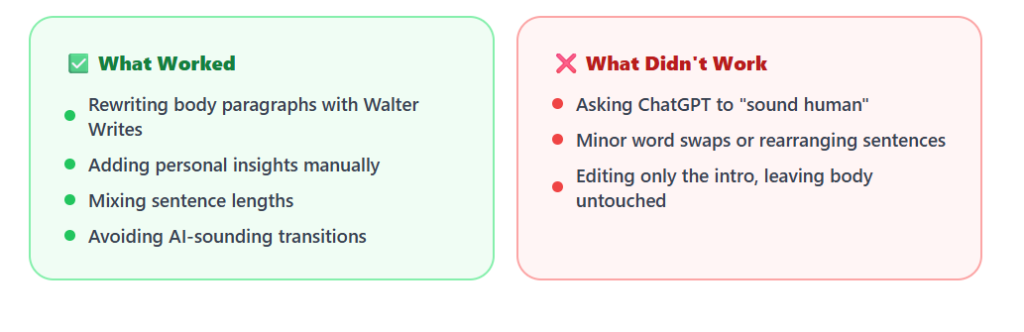
Les observations initiales suggèrent surtout l’intérêt d’une révision approfondie. Elles ne démontrent pas une méthode fiable pour contourner un détecteur.
Méthodes décrites comme utiles :
- Utiliser Walter pour réécrire tous les paragraphes du corps de texte
- Ajouter ensuite des observations personnelles réelles
- Mélange de longueurs de phrases
- Éviter les transitions à consonance « IA » (« donc », « de plus », etc.)
Méthodes jugées insuffisantes dans le récit :
- Demander au ChatGPT de « réécrire pour avoir l’air humain ».
- Modifications mineures (changement de quelques mots ou réarrangement de phrases)
- Il suffit de changer l’introduction et de laisser le corps intact.
Conseils pour utiliser l’IA de façon responsable
Ces conseils portent sur la qualité du travail et le respect des règles, plutôt que sur la dissimulation d’un usage de l’IA.
✅ À faire :
- Utilisez le ChatGPT pour la structure, puis vérifier et développer vous-même les idées
- Réécrivez tout avec votre propre voix
- Varier la longueur des phrases lorsque cela améliore la lecture
- Ajoutez des pensées réelles, des analogies ou des blagues
- Utiliser Walter Writes comme aide à la révision, sans garantie de détection
- Relire le résultat et vérifier ses sources avant de le soumettre ou de le publier
❌ À éviter :
- Soumettre un texte généré automatiquement lorsque les règles l’interdisent
- Utilisez des introductions telles que « Dans le monde d’aujourd’hui… »
- Ajouter volontairement des fautes pour paraître plus humain
- Oublier de vérifier les faits, les citations ou les reformulations
- Supposer qu’une réécriture rend conforme un usage non autorisé de l’IA
Rappel : un texte soigné n’est pas suspect par nature. Visez la clarté et une voix qui vous correspond.
Découvrir Walter Writes
Walter Writes peut faire partie d’une méthode de révision.
Pour un essai, une présentation ou un message, ses propositions doivent être relues afin de conserver votre voix et votre intention.
Vérifiez ses fonctions actuelles et les règles de votre établissement ; aucun résultat de détection n’est garanti.
Essayer l’outil de reformulation Walter Writes
Consultez les conditions actuelles d’accès, puis choisissez le ton adapté et relisez le résultat.
Questions fréquentes sur la révision des textes de ChatGPT
Peut-on rendre un texte d’IA indétectable ?
Aucune méthode ne garantit qu’un texte sera jugé humain par tous les détecteurs. Pour améliorer sa qualité, vérifiez les faits, précisez les idées et retravaillez le rythme avec vos propres mots. Un outil de reformulation peut aider, mais il ne remplace pas la relecture ni le respect des règles applicables.
Comment retravailler un texte de ChatGPT ?
Revoyez le raisonnement et la structure, supprimez les répétitions et ajoutez des exemples réels. Gardez les formulations qui servent le sens plutôt que de modifier chaque phrase mécaniquement. Le but est un texte clair et personnel, sans promesse d’indétectabilité.
Comment réviser gratuitement un texte d’IA ?
Lisez le brouillon à voix haute, précisez les passages vagues et vérifiez les sources. Des détecteurs tels que GPTZero & Scribbr peuvent fournir des indications complémentaires, à interpréter avec prudence. Les offres gratuites ou d’essai de Walter Writes et des autres outils peuvent évoluer ; vérifiez leurs conditions actuelles.
Une réécriture garantit-elle un meilleur score de détection ?
Non. Les résultats varient selon les outils, les textes et les versions des modèles. Travaillez la clarté, la précision et la cohérence ; ne traitez pas une variation de score comme une preuve de l’origine ou de la qualité du texte.
Que faire lorsqu’un texte est signalé comme artificiel ?
Examinez le passage, vérifiez les règles applicables et conservez les éléments montrant votre travail : notes, sources et versions successives. Corrigez les défauts réels du texte. Un signalement peut être erroné et ne doit pas être traité isolément comme un verdict.
Un détecteur reconnaît-il une réécriture manuelle de ChatGPT ?
Il n’existe pas de réponse universelle. Une réécriture peut modifier certains signaux, mais les détecteurs peuvent produire des erreurs dans les deux sens. La révision doit améliorer le texte et respecter les règles, sans garantir un résultat particulier.
Quelles formulations demander à ChatGPT d’éviter ?
Vous pouvez lui demander de limiter les formules vagues comme « dans le monde actuel », « il est important de noter » ou « de plus » lorsqu’elles n’apportent rien. Ces expressions peuvent être des introductions & des transitions. Une consigne possible : « Adopte un ton naturel ; évite les transitions mécaniques & les introductions génériques. » Vous obtiendrez un brouillon à retravailler, pas un texte automatiquement prêt à publier.
La consigne « écris comme un humain » suffit-elle ?
Elle peut influer sur le ton, mais reste imprécise. Décrivez plutôt le public, l’objectif, le niveau de formalité et les exemples attendus. Vérifiez ensuite le contenu : aucune consigne ne garantit un résultat de détection.
Comment préciser un style dans les instructions personnalisées ?
Dans les réglages de personnalisation disponibles, décrivez votre public, le ton souhaité, la longueur des phrases et les tournures à éviter. Par exemple : « Explique clairement les idées, varie les phrases et limite les formules générales. » Les intitulés de l’interface peuvent évoluer ; ces préférences ne remplacent pas la révision.
Quelle différence entre perplexité et variation du rythme ?
La perplexité mesure la prévisibilité d’un texte pour un modèle donné. La variation du rythme désigne ici la diversité des longueurs et structures de phrases. Les valeurs dépendent des méthodes utilisées ; ni une perplexité élevée ni un rythme varié ne prouvent une origine humaine.
Peut-on entraîner ChatGPT avec ses propres textes ?
Fournir un exemple dans une conversation peut orienter le style de la réponse ; cela ne revient pas à entraîner le modèle. Utilisez uniquement des textes que vous pouvez partager et vérifiez les règles de confidentialité. Les instructions personnalisées et la révision manuelle peuvent compléter cette approche.
Un outil de reformulation change-t-il le sens ?
Cela peut arriver. Même lorsqu’un outil vise à préserver le sens, il peut modifier une nuance, un chiffre ou une relation logique. Comparez toujours les versions et vérifiez les informations importantes. Notre guide sur les outils de reformulation de texte d’IA présente leur fonctionnement.
Comment obtenir un ton accessible dans un essai universitaire ?
Demandez une explication claire adaptée au niveau du cours, puis ajustez le registre aux consignes de l’enseignant. Définissez les termes techniques nécessaires, soutenez vos arguments et vérifiez les sources. Un ton accessible n’implique pas un style familier.
Que sont les micro-consignes ?
Ce sont des demandes ciblées portant sur une petite partie du brouillon : « raccourcis ce paragraphe » ou « précise le lien entre ces deux idées ». Elles permettent de réviser progressivement sans demander une réécriture complète à chaque étape.
Faut-il réviser manuellement ou utiliser un outil ?
La révision manuelle donne davantage de contrôle sur les idées et les nuances. Un outil peut proposer rapidement des variantes. Une méthode utile consiste à examiner ces propositions, puis à faire soi-même les choix définitifs.
ChatGPT peut-il produire un texte naturel ?
Oui, certains résultats peuvent sembler naturels, mais leur fluidité ne garantit ni leur exactitude ni leur conformité aux règles. Vérifiez les faits et adaptez la voix. Vous pouvez aussi travailler les consignes pour obtenir un style plus naturel.
Comment éviter les problèmes liés aux détecteurs ?
Respectez les règles d’usage de l’IA, conservez vos brouillons et documentez vos sources. Pour améliorer la rédaction, vous pouvez utiliser un outil de reformulation pour les essais, sans considérer cela comme une protection contre les signalements. Si vous utilisez un détecteur d’IA, interprétez son résultat avec prudence et dans son contexte.
Utiliser ChatGPT pour un essai constitue-t-il une tricherie ?
Cela dépend des consignes de l’établissement et de la tâche. Une reformulation ne rend pas autorisé un usage interdit. Demandez les règles, déclarez l’aide reçue lorsqu’il le faut et ajoutez les références à vos sources. Les outils de révision ne vous dispensent pas de ces obligations.
Walter Writes garantit-il un résultat favorable dans Turnitin et GPTZero ?
Non. Le récit initial rapporte des résultats dans GPTZero,Originality.AI et Turnitin, avec des exemples conservés plus haut. Ces observations historiques n’ont pas été reproduites indépendamment ici et ne garantissent pas les résultats d’un autre texte.
Quelle différence entre Walter et d’autres outils de reformulation ?
Les outils varient selon les réglages de ton, la profondeur de réécriture et le contrôle offert. Comparez leurs résultats sur votre texte et vérifiez la fidélité au sens, plutôt que de supposer qu’une catégorie d’outil est toujours supérieure.
Quels outils peuvent aider à réviser un texte d’IA ?
Les correcteurs, outils de paraphrase et outils de reformulation peuvent aider sur des aspects différents : grammaire, clarté, structure ou ton. Les détecteurs fournissent des estimations d’origine, pas une correction du texte. Une méthode prudente consiste à préparer un brouillon, le réviser, vérifier les sources et faire une dernière relecture.
Comment améliorer un brouillon de ChatGPT ou de Claude ?
Précisez le public, le contexte et le résultat attendu. Demandez des exemples vérifiables et des explications concrètes. Ajoutez uniquement des expériences réelles ; n’invitez pas l’outil à inventer un vécu. Réorganisez les idées si cela rend le raisonnement plus clair.
La révision des textes d’IA a-t-elle une utilité durable ?
La capacité à vérifier, préciser et organiser un texte reste utile, quel que soit l’outil qui a produit le brouillon. Le jugement de l’auteur est nécessaire pour choisir les sources, adapter le ton et répondre réellement au lecteur.
Conclusion : garder la maîtrise de son texte
ChatGPT peut faire gagner du temps. Mais un texte qui semble naturel peut encore contenir des erreurs ou ne pas respecter les consignes.
Traitez la réponse comme un point de départ et apportez votre propre travail de vérification et de révision.
Un outil comme Walter Writes peut aider à explorer des formulations. La version finale doit toutefois rester la vôtre.
L’IA peut accélérer le brouillon ; la révision humaine en contrôle la qualité.
Pour obtenir un texte plus naturel, commencez par comprendre ce que vous voulez dire, puis retravaillez les mots qui l’expriment.