



If you’re anything like me, you’ve probably found yourself staring down a paper deadline with a blank Google Doc and a serious case of writer’s block. It’s in those moments when the idea of using ChatGPT feels like a lifesaver.
In fact, a 2025 survey from EDUtech Insights found that nearly 3 in 5 students admitted to using AI tools for writing assignments at least once.
The pressure to perform, combined with easy access to powerful AI, makes it incredibly tempting. and wondering, “Could ChatGPT help me get this done faster?” It’s tempting, right?
But the big question is this: can professors detect ChatGPT?
I’ve done a deep dive into how detection works, what tools schools use, and what you need to know to stay out of trouble.
Let’s break it all down with zero fluff and real facts.
What Is ChatGPT & Why Students Use It
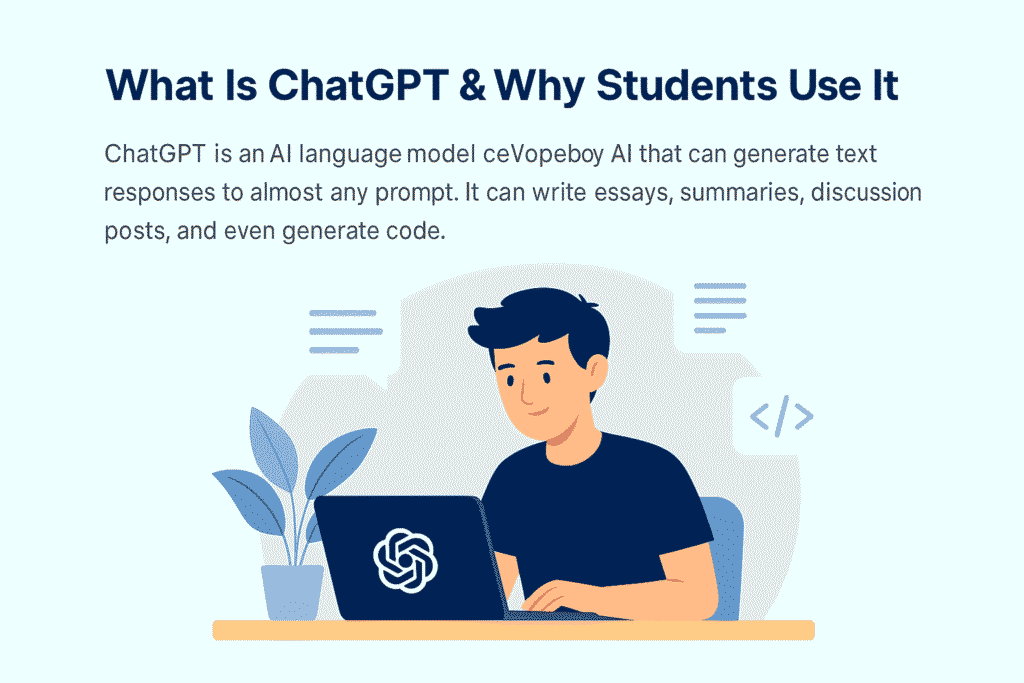
ChatGPT is an AI language model developed by OpenAI that can generate text responses to almost any prompt. It can write essays, summaries, discussion posts, and even generate code. As of 2025, it’s used by millions of students globally to brainstorm, polish, or even fully write assignments.
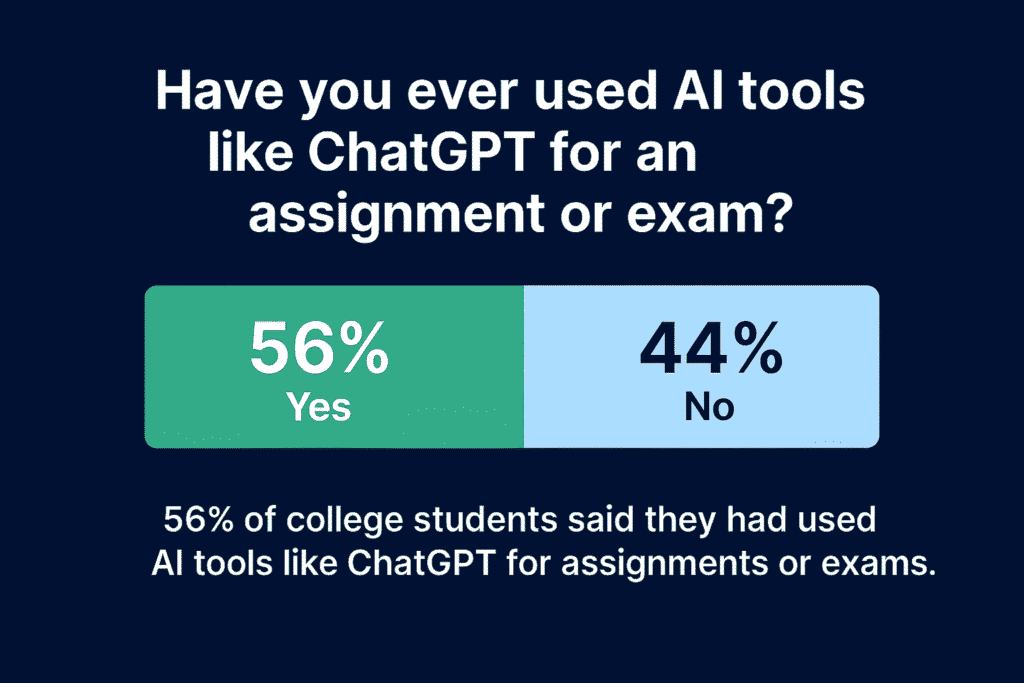
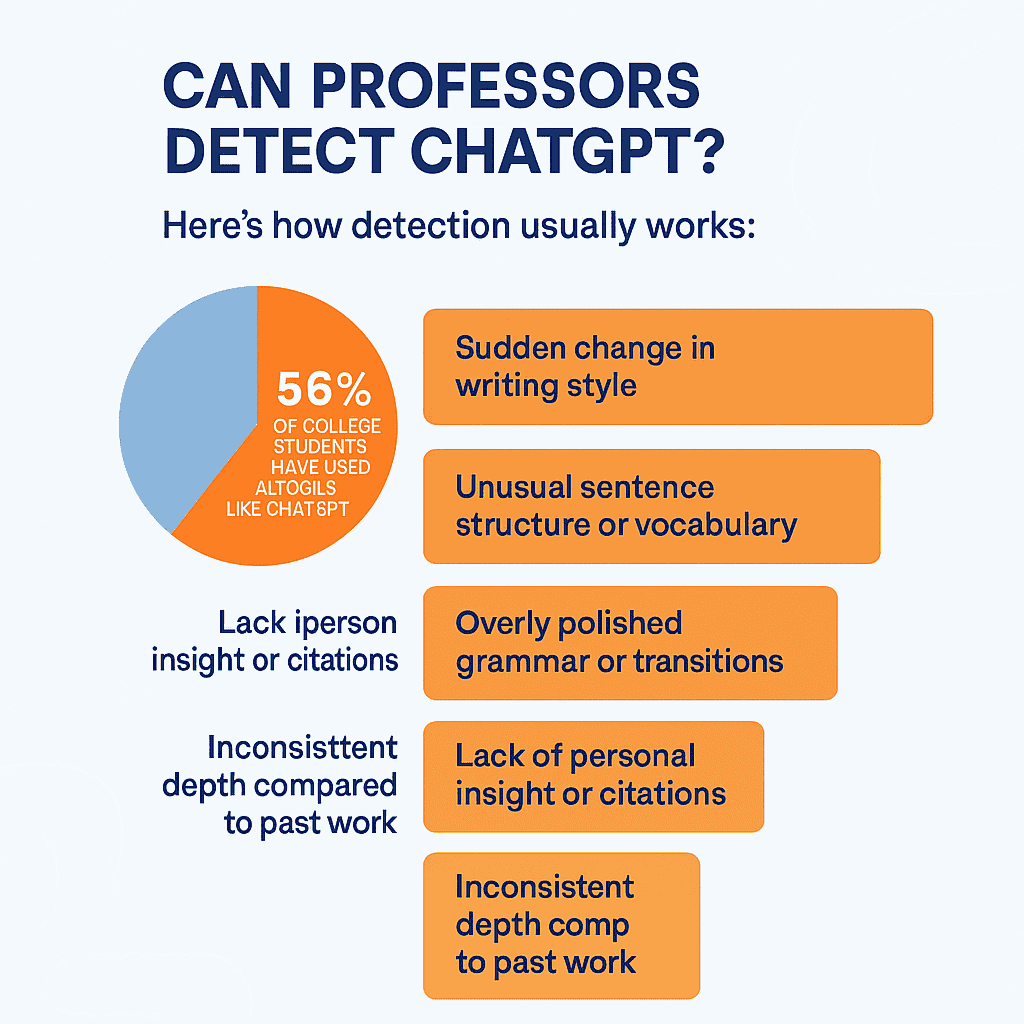
A recent poll from BestColleges found that 56% of college students have used AI tools like ChatGPT for assignments or exams. And here’s the kicker: 54% said they considered it a form of cheating.
Back when I was a freshman, the only tools I had were Grammarly and maybe a thesaurus extension. Now? Students have AI that can mimic human tone, generate citations, and organize entire arguments. It’s a massive shift - and professors are playing catch-up.
So clearly, there’s a disconnect between use and ethics - and that puts students in a tricky spot.
Can Professors Detect ChatGPT?
The short answer? Sometimes. But it’s not as straightforward as you might think.
According to a 2025 study published by BMC Education Integrity, tools like Turnitin and PlagiarismCheck detect AI-generated content with a 74% accuracy rate. That’s a pretty decent probability - but it’s also not foolproof.
Here’s what detection usually comes down to:
- Sudden change in writing style
- Unusual sentence structure or vocabulary
- Overly polished grammar or transitions
- Lack of personal insight or citations
- Inconsistent depth compared to past work
Some professors also use their own judgment - especially if they’ve seen your writing before. If something feels “off,” they might dig deeper.
How Do Teachers and Schools Check for ChatGPT?
Most colleges rely on a mix of software tools and manual review. Here’s what I’ve learned about what they’re using, along with a few real-world case studies:
1. Turnitin AI Detection
Turnitin, the popular plagiarism checker, now includes AI detection. It flags what percentage of your text may have been generated by AI.
But there’s a catch: false positives are a real problem. Some students have reported being flagged even when they wrote the content themselves. In 2024, the University of Texas published internal data showing that nearly 11% of flagged papers turned out to be false positives after professor reviews.
2. GPTZero, Proofademic, and Copyleaks
These are stand-alone AI detectors that scan your content and score how “robotic” or predictable it is. GPTZero is widely used among educators. For a full breakdown of these tools, check out our guide on AI detection tools tested and reviewed.
For an in-depth look at how these tools actually perform on student work, our tested guide to the best AI checkers for teachers compares six detectors on AI-only, human-only, and mixed essays with real accuracy scores.
3. Stylometric Analysis
Some professors manually compare your current work with past submissions. If your style suddenly shifts from average to literary genius, they might get suspicious. At NYU, a writing professor recently piloted a system where students submit three previous essays for baseline comparison. The result? About 60% of suspicious papers showed statistically significant shifts in syntax patterns.
4. Google Docs History & Drafts
A clever way some professors check is by asking for your document version history. If your essay magically appears in one sitting with no edits or changes, that’s a red flag. Professors at the University of Michigan now require all final papers to be submitted with full Google Docs history enabled.
5. Process-Based Assignments
Some schools require step-by-step submissions (outline, draft, final). If you skip those or turn them in all at once, it could raise concerns.
6. In-Class Writing Comparisons
Instructors may compare take-home essays with in-class writing samples or timed exams. Sudden changes in grammar, tone, or structure often trigger closer reviews.
7. Peer Review or Presentation Follow-ups
If you’re asked to explain your argument in class or during a follow-up presentation, and you can’t articulate your points, professors might investigate further. At Ohio State, some professors include a 5-minute oral defense to major written assignments, citing improved accountability.
8. AI Usage Disclosure Statements
Some universities, like Stanford, now require students to include a brief statement on whether AI tools were used during the assignment and how. This allows educators to set context and interpret any flagged results with more fairness.
This context matters even more as medical schools check AI usage with heightened scrutiny. Because these programs operate under stricter academic and professional standards, disclosures and review processes often play a larger role in how potential AI involvement is evaluated.
Most colleges rely on a mix of software tools and manual review. Here’s what I’ve learned about what they’re using:
Relevant: Can teachers detect Snapchat?
What AI Detection Can’t Do (Yet)
- Detect small bits of AI mixed with human text
- Catch paraphrased or heavily edited AI output
- Confirm AI use without a doubt - only flag likelihood
According to edintegrity, if you manually rewrite AI-generated text (also called “patchwriting”), detection likelihood drops to 42%. And with an AI humanizer, it drops even further. You can explore Walter’s AI humanizer tool to test it out youself.
That said, don’t assume you’re safe. Detection tools are evolving, and some professors go the extra mile.
Can Professors Tell If You Use ChatGPT?
This question comes up constantly, and the answer is more nuanced than a simple yes or no. Professors aren’t just relying on software - they’re relying on you.
If your instructor has read your previous work, they’ve got a mental snapshot of your writing style, vocabulary, and analytical depth. A sudden shift to perfectly structured sentences, complex transitions, or nuanced logic might raise suspicion.
A 2025 faculty survey conducted by EDUReport found that 68% of professors said they had “strong suspicions” about a student’s use of AI based purely on inconsistencies in writing voice or improvement speed.
Instructors also look at:
- Your ability to explain your argument during discussions
- Whether your citations are real and relevant
- If your tone aligns with past submissions
So yes, professors can often tell - especially if they’re actively paying attention.
Relevant: Can teachers detect AI in Powerpoint?
How Do Colleges Check for ChatGPT Use?
Colleges vary widely in how they approach AI detection, but most now treat it as a serious academic integrity issue.
Public vs. Private Institutions
- Public universities like UC Irvine and the University of Texas have adopted AI disclosure requirements and integrated Turnitin’s AI detection suite into their LMS platforms.
- Private colleges are more mixed: some lean into ethical education, while others ban AI tools entirely.
Tech-forward vs. Traditional Schools
- Tech-forward schools like Georgia Tech encourage students to use AI responsibly and teach how to cite it properly.
- Traditional liberal arts colleges may still rely on human grading, but many have adopted software quietly and use it selectively.
A published policy by Stanford University says:
“Students are required to disclose AI use in assignments and demonstrate critical engagement with all content submitted. Undisclosed use will be treated as academic dishonesty.”
Is There a Way for Teachers to Detect ChatGPT Without Tools?
Absolutely. Many professors rely more on their instincts and experience than any detection tool. Here are a few low-tech but highly effective methods:
- Comparison with earlier assignments: Professors can instantly notice shifts in sentence complexity or vocabulary level.
- Pop quizzes or impromptu explanations: Asking a student to explain their paper’s thesis or sources can quickly reveal whether they wrote it.
- Consistency checks: If your in-class writing differs drastically from your take-home assignments, expect questions.
A literature professor I spoke with shared:
“I don’t need a tool to spot ChatGPT. I just ask students one or two specific questions about their paper. If theycan’t answer, it tells me everything.”
Real-Life Example: When AI Gets Caught
Let’s look at a few real-life situations where students got flagged or caught for using ChatGPT.
Case Study 1: The Citation Trap
A student at a California university submitted a research paper with several citations - but none of them existed. When the professor followed up to verify sources, he discovered they were AI-generated fabrications. This prompted a deeper investigation using AI detectors, and the paper was flagged with over 85% AI probability. The student admitted to using ChatGPT for the entire draft.
Case Study 2: Style Shock
At a liberal arts college in the Midwest, an instructor noticed a drastic improvement in a student’s writing quality overnight. The student had previously struggled with grammar and clarity but submitted a final essay with advanced syntax, perfect grammar, and nuanced arguments. After using a stylometry tool and requesting an oral explanation, the professor found the student couldn’t articulate key ideas from the paper. This led to a formal review and academic penalty.
Case Study 3: Group Assignment Red Flag
In a business school group project, one member submitted a beautifully written executive summary using ChatGPT. The problem? It didn’t match the tone or terminology used by the rest of the group. The instructor flagged the inconsistency, and the student eventually disclosed AI usage without team consent. This led to disciplinary action - not just for AI use, but for misrepresenting group collaboration.
These cases show that it’s not just about whether AI was used - it’s about how it’s used, how it’s disclosed, and whether the final work reflects authentic effort.
Common Misconceptions
Let’s clear up some myths I hear all the time:
“If I use ChatGPT for multiple-choice questions, they’ll catch me.”
False. Detection tools don’t scan answers in LMS quizzes.
“If I paraphrase the ChatGPT response, I’m safe.”
Maybe. But stylometry tools can still spot shifts in tone and syntax. If you’re doing this, learn how to rewrite AI-generated text to sound more human.
“They need proof to accuse me of cheating.”
Not always. Some schools use suspicion + conversation (like an oral defense) to challenge students.
“All AI tools are the same.”
Nope. Some models are more detectable than others. GPT-4 outputs are more natural and harder to flag than older models like GPT-2.
Academic Integrity: Where Do You Draw the Line?
Using AI to help you think? Great. Using it to avoid thinking entirely? Risky.
Each university has its own policies. For example, Harvard’s honor code emphasizes “authenticity” and explicitly mentions unauthorized aids. Even if AI isn’t named, it’s often included by interpretation.
Ask yourself: Am I learning? Am I building my own voice? Am I taking shortcuts that rob me of understanding? That’s the real academic integrity test.
That question points directly to why AI is bad for students when it’s used without guardrails. Dependency, not technology, is the real risk.
Final Thoughts: Can Professors Detect ChatGPT?
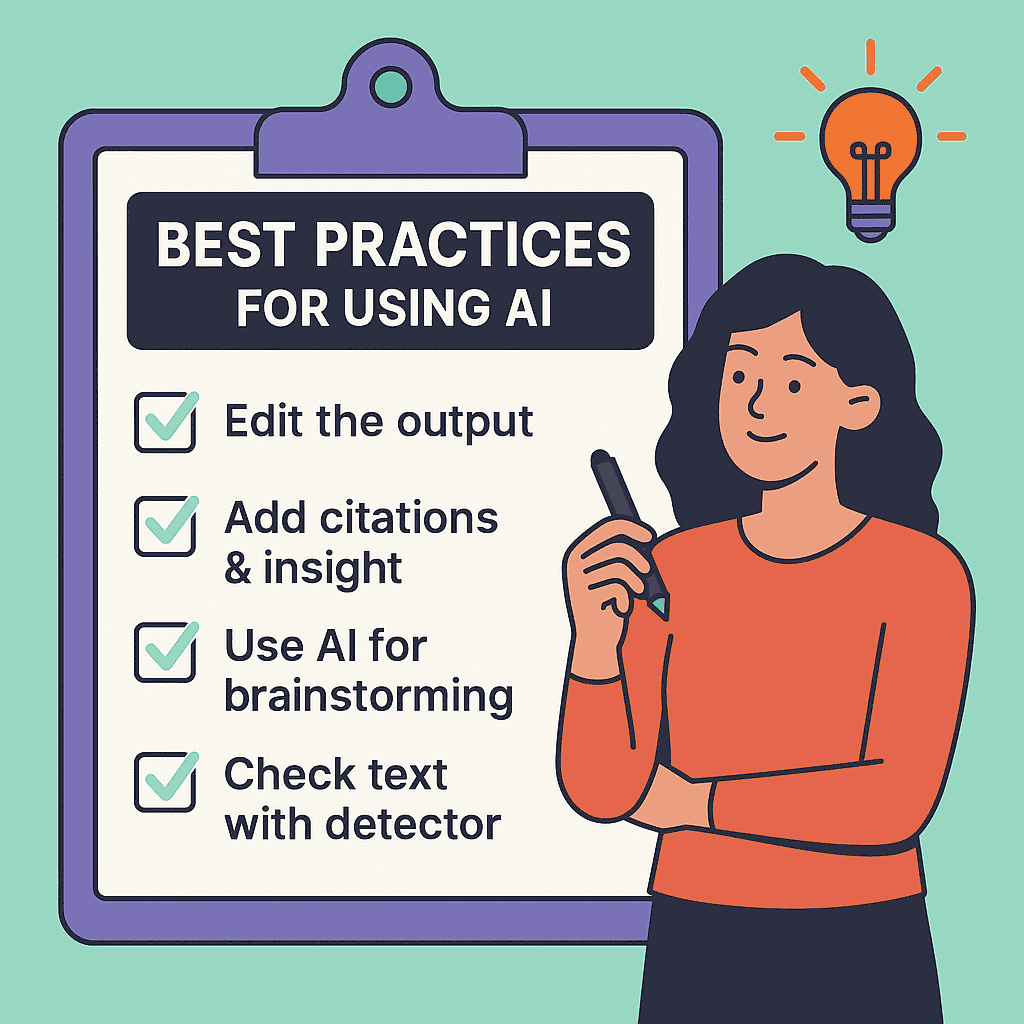
Before we wrap up, here’s a quick recap of what we’ve covered and what you should keep in mind moving forward. AI detection isn’t flawless, but it’s advancing fast. Whether or not your professor can spot ChatGPT depends on how you used it, how well you edited the output, and how familiar they are with your writing style.
You don’t have to fear AI - but you do need to respect academic integrity. Use tools smartly, not sneakily. Blend your insights with AI assistance instead of letting the tool do all the work.
If you’re ever unsure, just ask your professor what’s acceptable. Many educators are open to AI use if it supports learning rather than replaces effort.
And if you’re set on using AI in a responsible way, make sure you’re doing it right. Tools like our AI humanizer can help bridge the gap between AI efficiency and human authenticity.
From the student side, here’s how to avoid AI detection when you’re using ChatGPT for legitimate help (brainstorming, editing, accessibility).
Need to spot AI text yourself? The how to detect ChatGPT writing guide covers the five telltale signs, the top detection tools, and the verification steps to take before acting on a flag.