
AI Detector for Teachers.
Spot AI-assisted work.
Grade with confidence.

Make fair grading decisions, even when AI is involved. No guesswork. No unfair accusations. 100% support for your judgment.

Works with Turnitin
Check a paper in seconds
Grade fairly every time

AI Detector for Teachers

Ready
Walter rewrites your AI text and instantly scores it with our advanced detector, built for accuracy and trust.
Try A Sample

AI Detector for Teachers

Humanizing text & checking AI...

Just a moment—seasoning your words with human nuances...

Fingerprint icon

Rewriting this so well, you'll start questioning if it's AI or AI-amazing!

Analyzing your text…
Refining language patterns…
Adding human nuances…
Ensuring it's detection-proof…
Your humanized text is ready!
(It will appear in the text editor shortly.)

Just a moment—seasoning your words with human nuances...

Rewriting this so well, you'll start questioning if it's AI or AI-amazing!

AI Detector for Teachers

Human

Walter's industry leading humanizer & detector tool is trusted by millions to humanize & check AI content across education, business, and content marketing.

Walter Writes mentioned on Inc
Walter Writes featured on Zapier
Walter Writes featured on Shopify
Walter Writes featured on HubSpot
Walter Writes featured on Hootsuite
Walter Writes featured on SEMrush
Works with Turnitin
Check a paper in seconds
Grade fairly every time
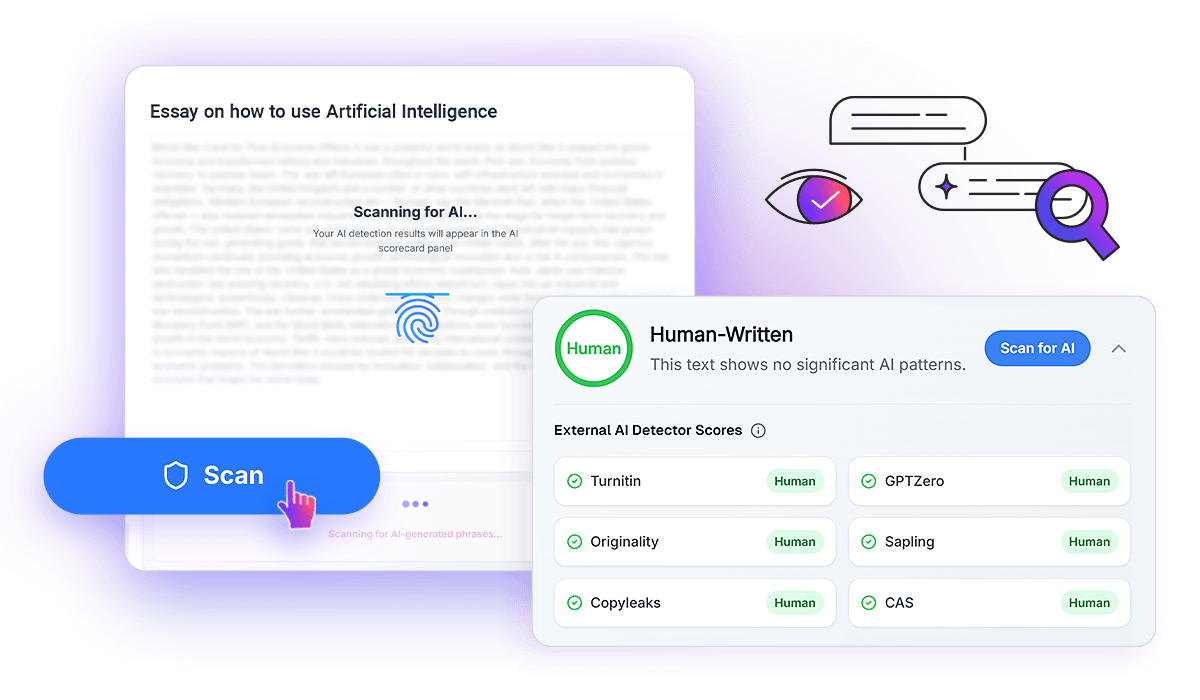
Walter Writes interface showing AI text scan and humanized SEO content result

Why Teachers Need an AI Detector

AI-assisted assignments are becoming harder to identify. Guessing puts fairness at risk. An AI detector built for teachers provides clear, defensible insight into when AI may be involved.

  • Highlights patterns consistent with AI
  • Grade confidently without jumping to conclusions
  • Reduces uncertainty and uncomfortable accusations

Walter Writes is more than a detector. It’s an AI clarity tool designed for educators. It also checks with Turnitin.

Where Teachers Can Use Our AI Detector

With the help of Walter AI, teachers can review AI-assisted work across typical academic submission formats.

Essays & Written Assignments

Detect everyday student assignments

The AI can assist educators in reviewing and assessing both written assignments, such as essays, and AI-assisted input when grading on fairness for essays that are a mix of AI-generated drafts and student writing.

Homeworks

Evaluate homework with confidence

Provides an easy way to quickly evaluate homework assignments and determine if they are AI-based.

Research Papers

Check AI involvement in research

Walter AI can be used to assess how much AI has been involved in the development of the students’ research papers and other forms of academic writing. This assessment does not disrupt the academic standards but rather provides context for how much AI was used in the writing process.

Theses & Dissertation Drafts

Evaluate and help polish thesis and desertation drafts

Helps you understand how AI can be used in high-risk academic projects. This can help you better evaluate your thesis or dissertation drafts, and nudge students in the right direction.

AI-Assisted Drafts with Student Edits

Help students understand editing

Will allow you not only to view drafts created using artificial intelligence, but also provide a view into what revisions were made by the student. This may assist you in understanding whether the student has used AI as a research tool to create a first draft.

Group Projects

Check if students collaborate to contribute

Assists in identifying AI-assisted writing patterns in group assignments. Helps determine if there was some level of collaboration on the writing pattern or not.

Use Our AI Detector for Teachers in 3 Steps

Educators can detect AI-generated content from ChatGPT, GPT-4, Claude, and more in seconds with a single AI detection scan.

1

Paste Your Student's Work

Copy and paste any text you want to check essays, blog posts, reports, or emails right inside the AI checker.

2

Scan for AI Content

Click “Scan for AI” and our detection engine will instantly analyze and check for signs of AI-generated text.

3

Get Your AI Detection Score Instantly

Instantly view a confidence score showing how likely content was AI-generated, based on advanced linguistic analysis.

How This AI Detector Helps Teachers

AI-assisted writing isn’t always obvious. Walter AI is designed to analyze student writing and surface clear signals of AI involvement, helping teachers make fair, confident decisions without guesswork.

  • Analyzes writing patterns
  • Highlights linguistic signals
  • Works alongside tools like Turnitin, GPTZero, and Originality.ai
  • Supports fair grading without replacing teacher judgment

Walter AI gives educators a reliable way to review student work with clarity, reducing uncertainty while keeping grading decisions professional and student-first.

Key Benefits Built for Teachers

Everything you need to make confident, fair grading decisions when AI enters your students’ work.

Turnitin-Compatible Workflow

Built to work alongside Turnitin and similar academic integrity tools. Adds AI-specific insight to your existing review process.

Advanced AI Pattern Analysis

Walter AI analyzes linguistic patterns like predictability, sentence variation, and semantic flow to identify writing that may be AI-assisted. Designed to provide context, not absolute judgments.

Broad AI Model Coverage

Detects writing patterns commonly associated with modern AI systems, including LLMs used for essays and reports. Helps surface AI-assisted content across a wide range of uses.

FAQs FAQs

What teachers want to know about AI detectors:

  • How can teachers use an AI detector without penalizing genuine student effort?

    AI detectors are best used as a review aid rather than a final judgment. They help surface patterns that may suggest AI assistance, but the final interpretation should consider the student’s history, writing style, and assignment context. This methodology allows for fairness and avoids automatic penalties.
  • Can an AI detector distinguish between AI-assisted drafting and full AI generation?

    In many instances, the detector will also indicate mixed signals when both AI-generated text and human edits are present in a single piece of work. This is particularly useful for identifying those pieces of work that contain AI-generated drafts that include some revision by students, and then treating only the AI-generated portions as AI.
  • Can non-native English writing be misidentified as AI-generated?

    Yes. While non-native writers' writing may have a more formal structure or be written in an identical way, it's best to look at the AI detection results on a case-by-case basis. The student's language background and prior submissions must also be taken into consideration for the context of the flagged area.
  • Do AI detectors work differently for group projects?

    Because group projects involve many different writing styles (which can produce a more consistent structure or repetitive writing), AI detectors are helpful in identifying unusual uniformity or repetitive writing that could indicate AI-generated content.
  • How can AI detection fit into existing grading workflows?

    Because AI-detection tools can be used with your current review process, they add another layer of contextualization for you while still allowing you to use rubrics, provide feedback, and make your own judgments about student work.
  • What writing patterns do AI detectors analyze beyond keywords?

    Current AI detectors analyze signals such as predictability of word choice, variation in sentence structure, and how ideas flow across paragraphs. These types of features and patterns are much more difficult to manipulate than just looking at surface-level keywords, which provides a deeper insight into how the text was created.
  • Why might a research paper be flagged differently than a short essay?

    When the document being analyzed is longer (example, a research paper), it typically has a greater consistency in structure, tone, and phrasing; this makes the detection of an AI-generated text easier to identify. However, shorter documents (e.g., essays) have much more natural variations, and it may be difficult to determine if AI was involved using the same signals.
  • How should teachers review AI-flagged sections before grading?

    The entire assignment should be reviewed along with prior work by the student and the original assignment directions. AI detection results will be most useful as a means of encouraging you to take a closer look at assignments that could include AI-generated content, rather than to make any type of automatic decision based on the results.
  • What is the difference between Turnitin scores and AI detection signals?

    The main difference between traditional plagiarism tools and AI-detection tools is that plagiarism tools look at what you have written, whereas AI-detection tools look at how you wrote it, offering additional information instead of simply duplicating data.
  • Can an AI detector estimate how much of a document may be AI-generated?

    Some tools allow you to receive section-level signals that will give you a better idea of where you might find the greatest likelihood of AI-generated content, allowing you to focus on certain areas of a document versus scoring the entire document.
  • How can teachers use an AI detector without penalizing genuine student effort?

    AI detectors are best used as a review aid rather than a final judgment. They help surface patterns that may suggest AI assistance, but the final interpretation should consider the student’s history, writing style, and assignment context. This methodology allows for fairness and avoids automatic penalties.
  • What writing patterns do AI detectors analyze beyond keywords?

    Current AI detectors analyze signals such as predictability of word choice, variation in sentence structure, and how ideas flow across paragraphs. These types of features and patterns are much more difficult to manipulate than just looking at surface-level keywords, which provides a deeper insight into how the text was created.
  • Can an AI detector distinguish between AI-assisted drafting and full AI generation?

    In many instances, the detector will also indicate mixed signals when both AI-generated text and human edits are present in a single piece of work. This is particularly useful for identifying those pieces of work that contain AI-generated drafts that include some revision by students, and then treating only the AI-generated portions as AI.
  • Why might a research paper be flagged differently than a short essay?

    When the document being analyzed is longer (example, a research paper), it typically has a greater consistency in structure, tone, and phrasing; this makes the detection of an AI-generated text easier to identify. However, shorter documents (e.g., essays) have much more natural variations, and it may be difficult to determine if AI was involved using the same signals.
  • Can non-native English writing be misidentified as AI-generated?

    Yes. While non-native writers' writing may have a more formal structure or be written in an identical way, it's best to look at the AI detection results on a case-by-case basis. The student's language background and prior submissions must also be taken into consideration for the context of the flagged area.
  • How should teachers review AI-flagged sections before grading?

    The entire assignment should be reviewed along with prior work by the student and the original assignment directions. AI detection results will be most useful as a means of encouraging you to take a closer look at assignments that could include AI-generated content, rather than to make any type of automatic decision based on the results.
  • Do AI detectors work differently for group projects?

    Because group projects involve many different writing styles (which can produce a more consistent structure or repetitive writing), AI detectors are helpful in identifying unusual uniformity or repetitive writing that could indicate AI-generated content.
  • What is the difference between Turnitin scores and AI detection signals?

    The main difference between traditional plagiarism tools and AI-detection tools is that plagiarism tools look at what you have written, whereas AI-detection tools look at how you wrote it, offering additional information instead of simply duplicating data.
  • How can AI detection fit into existing grading workflows?

    Because AI-detection tools can be used with your current review process, they add another layer of contextualization for you while still allowing you to use rubrics, provide feedback, and make your own judgments about student work.
  • Can an AI detector estimate how much of a document may be AI-generated?

    Some tools allow you to receive section-level signals that will give you a better idea of where you might find the greatest likelihood of AI-generated content, allowing you to focus on certain areas of a document versus scoring the entire document.

Ensure You're Judging Your Student's Work Correctly

Walter AI supports educators and researchers in reviewing AI-assisted writing with clarity and confidence. From research papers to dissertations, the tool helps identify AI involvement while preserving academic standards and original student contribution.

AI Detection Scorecard

Human-Written Score:
98%
GPTZero
Passed
Turnitin
Passed
Originality.ai
Passed

Insights on AI Detection

Explore articles, guides, and research from Walter Writes on AI in education, academic integrity, and humanized writing. Stay informed and ahead in your field.